Laxmi Kiranmai CH et al., J. Sci. Res. Phar. 2014, 3(4), 163-168
Journal of
Scientific
Research in
Pharmacy
Research Article
Available online through
ISSN: 2277-9469
www.jsrponl
ine.com
Assessment of Strength of Various Hydrotropic Agents in the Improvement of Solubility of a Poorly
Soluble Drug -Celecoxib
Laxmi Kiranmai CH*, Srinivas N
Department of Pharmaceutics, Malla Reddy Institute of Pharmaceutical Sciences, Maisammaguda, Secunderabad-500014.
Received on: 02-11-2014; Revised and Accepted on: 15-11-2014
ABSTRACT
I
n the present work, an attempt has been made to develop fast disintegrating tablets of Celecoxib, using a new generation technique called “hydrotropic technique”. Camphor, Benzoic acid and Urea were employed as hydrotropic agents. All the formulations were prepared by direct compression method using 8mm punch on 8 station rotary tablet punching machine. The blend of all the formulations showed good flow properties such as angle of repose, bulk density, tapped density. The prepared tablets were shown good post compression parameters and they passed all the quality control evaluation parameters as per I.P limits. Among all the formulations F4 formulation showed maximum % drug release i.e., 110.4 % in 2 min hence it is considered as optimized formulation. The F4 formulation contains Camphor as hydrotropic agent in the concentration of 40 mg.Key Words: Sublimating agent, Celecoxib, Camphor, Benzoic acid and Urea.
INTRODUCTION
T
he Center for Drug Evaluation and Research (CDER)division of US FDA defines oral disintegrating tablets as "a solid dosage form containing medicinal substances which disintegrates rapidly, usually within a matter of seconds, when placed under the
tongue[1]or “ a solid dosage form containing medicinal substances,
which disintegrates rapidly, usually within a matter of seconds,
when placed upon the tongue”[2]. Mouth dissolving tablets are also
called as Oro dispersible tablets, melt-in-mouth, fast dissolving
tablets, porous tablets, and quick dissolving tablets[3].
Oral route of drug administration have wide acceptance up to 50-60% of total dosage forms. Solid dosage forms are popular because of ease of administration, accurate dosage, self medication, pain avoidance and most importantly the patient compliance. The most popular solid dosage forms are being tablets and capsules; one important drawback of this dosage forms for some patients, is the
difficulty to swallow[3, 4]. Fast dissolving tablets are those when put
on tongue disintegrate instantaneously releasing the drug which
dissolve or disperses in the saliva[5, 6].
Hydrotropy is a solubilization phenomenon whereby addition of large amount of a second solute results in an increase in the aqueous solubility of a drug. Concentrated aqueous hydrotropic solutions of sodium benzoate, urea, nicotinamide, sodium citrate and sodium acetate have been observed to enhance the aqueous solubilities of many poorly water-soluble drugs. Hydrotropy is suggested to be superior to other solubiliztion method, such as miscibility, micellar solubilization, cosolvency and salting in, because the solvent character is independent of pH, has high selectivity and does not require emulsification. It only requires mixing the drug with hydrotrope in water. It does not require chemical modification of hydrophobic drugs, use of organic solvents,
or preparation of emulsion system[7].
The proposed method aimed at developing fast disintegrating tablets of poorly soluble drug Celecoxib, employing different hydrotropic agents to enhance the % drug release and thus improving the bioavailability of drug.
*Corresponding author:
Laxmi Kiranmai CH
Department of Pharmaceutics,
Malla Reddy Institute of Pharmaceutical Sciences, Maisammaguda, Secunderabad-500014. *E-Mail: [email protected]
MATERIALS AND METHODS
Materials:
Celecoxib was received as a gift sample from Aurobindo pharmaceuticals Pvt Ltd. Camphor, methylcellulose and other excipients were obtained from Nihar traders private limited.
Methods:
Determination of absorption maximum (λmax):
Absorption maximum is the wavelength at which maximum absorption takes place. For accurate analytical work, it is important to determine the absorption maxima of the substance under study. Celecoxib was weighed accurately 10 mg and transferred to 100 ml volumetric flask, dissolved in phosphate buffer pH 6.8 and the final volume was made up to 100 ml with phosphate buffer PH 6.8 to get a stock solution (100µg/ml). From the stock solution, 1 ml was pipette out in 10 ml volumetric flask and the final volume was made up to 10 ml with phosphate buffer PH 6.8 to get 10µg/ml. Then this solution was scanned at 200-400nm in UV-Visible double beam spectrophotometer (UV-3200,
Labindia, India) to get the absorption maximum (λmax).
Construction of Celecoxib calibration curve with phosphate buffer pH 6.8:
100mg of Celecoxib was dissolved in 100ml of phosphate pH 6.8 to give a concentration of 1mg/ml (1000µgm/ml). From the above standard solution (1000µgm/ml) 10 ml was taken and diluted to 100ml with phosphate buffer pH 6.8 to give a concentration of 100µgm/ml. From this stock solution aliquots of 0.5, 1,1.5, 2 and 2.5 ml were pipette out in 10ml volumetric flask and the volume was made up to the mark with phosphate buffer PH 6.8 to produce concentration of 5,10,15,20 and 25 µgm/ml respectively. The
absorbance (abs) of each concentration was measured at λmaxi.e., 254
nm.
Drug-excipient compatibility studies by FT-IR:
The compatibility between the pure drug and excipients was detected by FTIR spectra obtained on Bruker FTIR Germany (Alpha T). The potassium bromide pellets were prepared on KBr press by grounding the solid powder sample with 100 times the quantity of KBr in a mortar. The finely grounded powder was then introduced into a stainless steel die and was compressed between
polished steel anvils at a pressure of about 8t/in2. The spectra were
Laxmi Kiranmai CH et al., J. Sci. Res. Phar. 2014, 3(4), 163-168
Flow properties:
Flow properties such as Angle of repose, Bulk density, Tapped density, Hausner’s ratio were carried out as per standard procedures and observed for their compliance with standard values.
Formulation of Oro Dispersable Tablets of Celecoxib: Preparation of tablets:
Composition of Celecoxib orodispersible tablet by direct
compression is shown inTable 1. All the ingredients were weighed.
Required quantity of drug and excipient mixed thoroughly in a polybag. The blend is compressed using rotary tablet machine-8 station with 8mm flat punch, B tooling. Each tablet contains 100 mg Celecoxib and other pharmaceutical ingredients as shown in below table. Total weight of tablet was found to be 200 mg.
Table No.1: Composition of various tablet formulation
Post Compression Parameters: Evaluation of uncoated tablets: Shape and color:
The tablets were examined under a lens for the shape of the tablet and color by keeping the tablets in light.
Uniformity of thickness:
Randomly 10 tablets were taken from formulation batch and their thickness (mm) was measured using a Vernier callipers.
Hardness test:
The hardness of the tablets was determined using Monsanto hardness tester. Six tablets were randomly picked from
each formulation for the said test. It is expressed in Kg/cm2..
Friability test:
It is the phenomenon whereby tablet surfaces are damaged and/or show evidence of lamination or breakage when subjected to mechanical shock or attrition. The friability of tablets was determined by using Roche friabilator (Lab India, FT 1020). It is expressed in percentage (%). Ten tablets were initially weighed [W(initial)] and transferred into friabilator. The friabilator was
operated at 25 rpm for 4 min or run up to 100 revolutions. The
tablets were weighed again [W(final)].The percentage friability was
then calculated by,
Weight variation test:
The tablets were selected randomly from each formulation and weighed individually to check for weight variation. The U.S Pharmacopoeia allows a little variation in the weight of a tablet. The % deviation in weight variation is shown in table.
Table No. 2: Limits of Weight variation
Average Weight of Tablet(mg) %deviation
130mg or less 10
> 130or <324 7.5
> 324 5
Drug Content estimation:
The content uniformity test is used to ensure that every tablet contains the amount of drug substance intended with little variation among tablets within a batch.
Four tablets were weighed and crushed in the mortar. The powder equivalent to 1.25 mg of the drug were weighed and dissolved in 100ml phosphate buffer PH 6.8 to give a concentration of 12.5 µg/ml. 2ml of this solution was taken and diluted to 10ml to give a concentration of 2.5µg/ml. The absorbance of the prepared solution was measured at 262nm using UV Visible spectrophotometer (Lab India, UV-3200).
RESULTS & DISCUSSION
Standard Calibration curve of Celecoxib:
Table No. 3: Concentration and absorbance obtained for calibration curve of Celecoxib In pH 6.8 Phosphate buffer
S. No. Concentration (µg/ml) Absorbance* (at 254 nm)
1 5 0.277
2 10 0.414
3 15 0.594
4 20 0.739
5 25 0.890
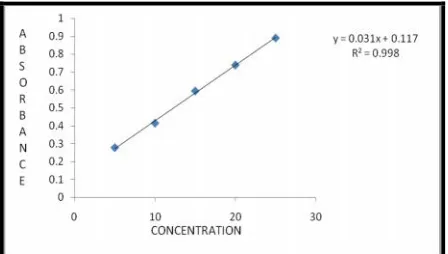
It was found that the estimation of Celecoxib by UV
spectrophotometric method at λmax254 nm in pH 6.8 Phosphate
buffer had good reproducibility and this method was used in the study. The correlation coefficient for the standard curve was found to be closer to 1, at the concentration range, 5- 25μg/ml. The regression equation generated was y = 0.031x +0.117.
Fig.1: Standard graph of Celecoxib in pH 6.8 Phosphate buffe
Ingredient Formulation Code
F1 F2 F3 F4 F5 F6 F7 F8 F9 F10 F11 F12
Celecoxib (mg) 100 100 100 100 100 100 100 100 100 100 100 100
Camphor (mg) 10 20 30 40 - - -
-Benzoic acid (mg) - - - - 10 20 30 40 - - -
-Urea (mg) - - - 10 20 30 40
Mg Stearate (mg) 2 2 2 2 2 2 2 2 2 2 2 2
Talc (mg) 2 2 2 2 2 2 2 2 2 2 2 2
MCC (mg) Qs Qs Qs Qs Qs Qs Qs Qs Qs Qs Qs Qs
Laxmi Kiranmai CH et al., J. Sci. Res. Phar. 2014, 3(4), 163-168
Fourier Transform-Infrared Spectroscopy:
1349.022 20.209 1297.876 11.655
1147.032 6.5511036.828 12.661
938.397 7.250 828.880 28.553
688.972 24.777
582.018 17.021
525.282 24.282
454.843 14.607
443.773 -0.000
419.623 53.304 403.606 26.650
PURE RUG
3800 3600 3400 3200 3000 2800 2600 2400 2200 2000 1800 1600 1400 1200 1000 800 600 400 200 106 104 102 100 98 96 94 92 90 88 86 Wavenumber % T ra n s m it ta n c e
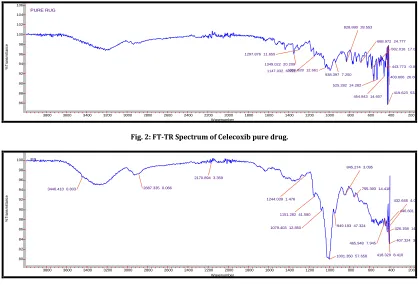
Fig. 2: FT-TR Spectrum of Celecoxib pure drug.
3446.410 0.803 2887.335 0.066
2170.894 3.359
1244.039 1.476
1151.282 41.580
1079.403 12.850
1001.350 57.658 949.193 47.324 845.274 3.095
755.393 14.418
465.948 7.945
446.601 4.069 432.648 4.076
426.158 14.389
418.329 8.410 407.324 33.629
F9
3800 3600 3400 3200 3000 2800 2600 2400 2200 2000 1800 1600 1400 1200 1000 800 600 400 200 100 98 96 94 92 90 88 86 84 82 80 Wavenumber % T ra n s m it ta n c e
Fig. 3: FT-IR Spectrum of Optimized Formulation
From the FTIR data it is evident that the drug and super
disintegrants, other excipients do not have any interactions.Hence
they were compatible.
Evaluation Parameters for Fast Dissolving Tablets of Celecoxib: 1. Pre-compression parameters:
The data is shown inTable 4. The values for angle of
repose were found in the range of 25°-30°. Bulk densities and tapped densities of various formulations were found to be in the range of 0.41 to 0.50 (gm/cc) and 0.50 to 0.58 (gm/cc) respectively. Carr’s index of the prepared blends fall in the range of 13.06% to 18.18%. The Hausner’s ratio fall in range of 1.14 to 1.22. From these results it is concluded that the powder blends had good flow properties and suitable for tablets manufacture.
Table No. 4: Pre-compression parameters
Formulation
Code Bulk Density(gm/cm2) Tap Density(gm/cm2) Carr’s Index(%) Hausner’sratio Repose(Ɵ)Angle Of
F1 0.45 0.55 18.18 1.22 27.91
F2 0.47 0.55 14.54 1.17 28.23
F3 0.50 0.58 13.79 1.16 29.34
F4 0.46 0.55 16.36 1.19 26.71
F5 0.50 0.58 13.79 1.16 29.34
F6 0.47 0.55 14.54 1.17 28.23
F7 0.50 0.58 13.79 1.16 29.34
F8 0.41 0.50 18.00 1.21 26.78
F9 0.41 0.50 18.00 1.21 26.78
F10 0.47 0.55 14.54 1.17 28.23
F11 0.47 0.55 14.54 1.17 28.23
F12 0.46 0.55 16.36 1.19 26.71
2. Post compression Parameters: Weight variation test:
Tablets of each batch were subjected to weight variation test, difference in weight and percent deviation was calculated for
each tablet and was shown in theTable 5.
The average weight of the tablet was found to be in the range of 107 to 98.5, which are within the permissible limit of ±10% (equivalent to tablet weight range of 110-90mg). The results of the test showed that, the tablet weight variation was within the pharmacopoeia limit.
Hardness test:
Hardness of the three tablets of each batch was checked by
using Monsanto hardness tester and the data was shown inTable 5.
The results showed that the hardness of the tablets is in range of 2.5
to 3.00 kg/cm2,which is within IP limits.
Thickness:
Thickness of three tablets of each batch was checked by
using Vernier Calipers and data shown inTable 5.The result showed
that thickness of the tablet is ranging from 3.56 to 3.64.
Friability:
Tablets of each batch were evaluated for percentage
friability and the data’s were shown in theTable 5. The average
friability of all the formulations lies in the range of 0.30 to 0.51% which was less than 1% as per official requirement of IP indicating a good mechanical resistance of tablets.
In vitrodisintegration time:
Tablets of each batch were evaluated for In vitro
disintegration time and the data’s were shown in theTable 5. The
Laxmi Kiranmai CH et al., J. Sci. Res. Phar. 2014, 3(4), 163-168
Assay:Studies on tablet assays were performed for the prepared
formulations. From the assay studies it was concluded that all the formulations were showing the % drug content values within 97.23 -99.2%.
In vitrodissolution studies:
Table no.5:in vitrodissolution data of formulation F1 to F4
Time
(Minutes) Volume: 500 mL, Apparatus: USP -II (Paddle), Rpm: 50Dissolution Medium: Phosphate Buffer pH 6.8, Formulation Codes
F1 F2 F3 F4
0 0 0 0 0
2 25 31 46 102
4 40 37 66 102
6 49 56 100 102
8 64 87 100 102
10 76 99 100 102
15 98 100 101 102
20 97 102 101 102
25 100 102 101 102
Fig. 4: Dissolution profile of formulations prepared with Camphor as super disintegrant
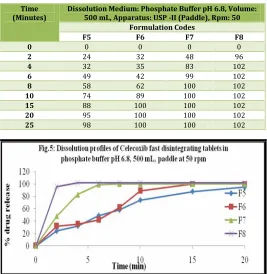
In vitro dissolution studies were carried out by using 500ml of pH 6.8 Phosphate buffer in USP dissolution apparatus by using paddle method. Above dissolution data of F1 to F4 formulations revealed that camphor has a significant impact on dissolution profile.
The rate of drug release from F1 was slower (98% in 15 minutes) when compared to F2 in which drug release was 99 % in 10 minutes while F3 has drug release was 100% in 6 min. Among all formulations, the drug release from the formulation with 40 mg of camphor (F4) was very rapid and was 102 % in 2 minutes.
Table No. 6:in vitrodissolution data of formulation F5 to F8
Time
(Minutes) Dissolution Medium: Phosphate Buffer pH 6.8, Volume:500 mL, Apparatus: USP -II (Paddle), Rpm: 50 Formulation Codes
F5 F6 F7 F8
0 0 0 0 0
2 24 32 48 96
4 32 35 83 102
6 49 42 99 102
8 58 62 100 102
10 74 89 100 102
15 88 100 100 102
20 95 100 100 102
25 98 100 100 102
Laxmi Kiranmai CH et al., J. Sci. Res. Phar. 2014, 3(4), 163-168
Above dissolution data of F5 to F8 formulations revealed that benzoic acid also has a significant impact on dissolution profiles of celecoxib orodispersible tablets. The rate of drug release from F5 was slower (98% in 25 minutes) as compared to F6 in which drug
release was 99 % in 15 minutes while F7 has drug release was 99 % in 6 minutes. Among above all the formulations the drug release from the formulation with 40 mg of benzoic acid (F8) was very rapid and was 102 % in 4 minutes.
Table No. 7:In vitrodissolution data of formulations F9 to F12
Time
(Minutes) Dissolution Medium: Phosphate Buffer pH 6.8, Volume: 500mL, Apparatus: USP -II (Paddle), Rpm: 50 Formulation Codes
F9 F10 F11 F12
0 0 0 0 0
2 15 28 40 79
4 28 35 76 89
6 33 49 96 99
8 60 67 100 100
10 79 78 100 100
15 89 86 100 100
20 94 100 100 100
25 98 100 100 100
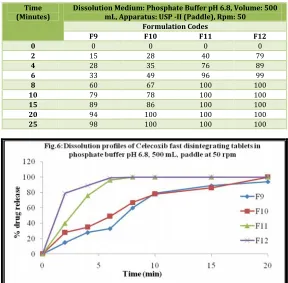
Fig. 6: Dissolution profile of formulations prepared with urea as super disintegrant
Above dissolution data of F9 to F12 formulations revealed that as like other two hydrophilic agents quantity of urea used in formulations has a significant impact on dissolution profile. Higher the quantity of urea, faster the drug releases. The rate of drug release from F5 was slower (98% in 25 minutes) when compared to F10 in which drug release was 100 % in 20 minutes while F11 has drug release 100 % in 8 minutes. Among above formulations the drug release from the formulation with 40 mg of urea (F12) was very rapid and was 100 % in 8 minutes.
From the dissolution profiles of all formulations using different hydrophilic agents, it was evident that the formulations prepared with super disintegrant camphor showed maximum %drug release. Hence, the formulation F4 containing 40 mg camphor as super disintegrant showing %drug release of 102 % in 2 min, is considered as the optimized formulation.
CONCLUSION
I
t is concluded that the new generation technique called“hydrotropic technique” is highly successful in developing fast disintegrating tablets of Celecoxib, prepared using different hydrotropic agents namely camphor, benzoic acid and urea. All the formulations were prepared by direct compression method using 8mm punch on 8 station rotary tablet punching machine, have exhibited good pre-compression and post-compression parameters.
Further, it is concluded that among all the formulations F4 formulation showed maximum % drug release i.e., 102 % in 2 min hence it is considered as optimized formulation. The F4 formulation contained camphor as hydrotropic agent incorporated in the concentration of 40 mg.
REFERENCES:
1. Renon J.P., Corveleyn S., rapidly disintegrating tablets, US
Patent No. 6,010,719,2000.
2. US Food and Drug Administration, CDER Data Standards
Manual. 2003. http://www.fda.gov/cder/dsm/DRG/drg
00201.htm
3. European Directorate for Quality of Medicines
(www.pheur.org.), Pharmeuropa,1998; 10(4): 547.
4. Sohi H, Sultana Y, Khar RK. Taste masking technologies in
oral pharmaceuticals: Recent developments and approaches,
Drug Dev. Ind. Pharm.,2004; 30: 429-448.
5. Seager H., Drug delivery products and zydis fast dissolving
dosage form, J. Pharm. Phamacol.,1998; 50: 375-382.
6. Aulton M.E. Dissolution & Solubility In: Aulton M.E,editor
Pharmaceutics:The Science of dosage forms and design; 2nd
ed, Philaalphia; Churchill Livingstone,2007; 7: 23-24.
7. MaheswariR.K. “A novel application of hydroscopic
solubilisation in spectrometric estimation of Frusemide in
tablets”, Pharma. Rev.,2006; 4: 148.
8. Gregory G. K. E. and Hod. pharmaceutical dosage form
package, US patent,1981; 4: 305, 502.
9. Kuchekar B.S., Badhan A.C.and Mahajan H.S. “Mouth
Dissolving Tablets: A Novel Drug Delivery System”, Pharma.
Times,2003; 35: 7-9.
10. Wilson C.G., Washington N., Peach J., Murray G.R. and Kennerley J. “The behavior of fast dissolving dosage form”,
Int. J. Pharm.,1987; 40: 119-123.
11. Indurwade N.H., Rajyaguru T.H. and Nakhat P.D. “Novel
approach- Fast Dissolving Tablets”, Indian Drugs, 2002;
39(8): 405-409.
12. Sastry S.V., Nyshadam J.R. and Fix J.A. “ Recent technological advances in oral drug delivery- A Review”, Pharm. Sci. Tech.
Today,2000; 138-144.
13. Shrivastava priyanka and sethi vandana. “A review article
on: superdisintegrants”, Int. J. Drug res. Tech.,2013; 3(4):
76-87.
14. S.B. shirsand, R.G. Ramani, P.V. Swamy. “Novel Co-processed Superdisintegrants in the design of fast dissolving tablets”,
International Journal of Pharma and Bio Sciences. 2010;
1(1): 1-12.
15. Rahul M. Patil, Ajim H. Maniyar, Mangesh T. Kale, Anup M. Akarte, Dheeraj T. Baviskar. “Solid dispersion: strategy to enhance solubility”, International Journal of Pharmaceutical
Laxmi Kiranmai CH et al., J. Sci. Res. Phar. 2014, 3(4), 163-168
16. Borodkin S., Yonker M.H., Journal of Pharmaceutical
Sciences,1970; 59(40): 481.
17. Sameer GL, Yu YY, Ajay BK. Effects of disintegration-promoting agent, lubricants and moisture treatment on optimized fast disintegrating tablets. International Journal of
Pharmaceutics,2009.
18. Shah PP, Rajashree, Yogesh M, Badhan RA. Design and optimization of artemether microparticles for bitter taste
masking. Acta Pharm.,2008.
19. Battu SK, Repka MA, Majumdar S, Rao YM. Formulation and evaluation of rapidly disintegrating fenoverine tablets: effect of superdisintegrants, Drug Dev. International Journal of
Pharmaceutics,2007.
20. Srinivas. Making Fast Dissolving tablets by a Direct Compression method, by using cross carmellose sodium,
International Journal of Pharmaceutics,2006.
How to cite this article:
Laxmi Kiranmai CH et al.,: Assessment of Strength of Various Hydrotropic Agents in the Improvement of Solubility of a Poorly Soluble Drug -Celecoxib. J. Sci. Res. Phar, 2014; 3(4): 163-168.