A n o n - p r o j e c t i v e d e p e n d e n c y p a r s e r
Pasi Tapanainen and T i m o J~irvinen
University of Helsinki, Department of General Linguistics
Research Unit for Multilingual Language Technology
P.O. Box 4, FIN-00014
University of Helsinki, Finland
{Pas i. Tapanainen, Timo. Jarvinen}@l ing. Hel s inki. f i
Abstract
We describe a practical parser for unre- stricted dependencies. T h e parser creates links between words and names the links according to their syntactic functions. We first describe the older Constraint Gram- m a r parser where m a n y of the ideas come from. T h e n we proceed to describe the cen- tral ideas of our new parser. Finally, the parser is evaluated.
1
Introduction
We are concerned with surface-syntactic parsing of running text. Our main goal is to describe syntac- tic analyses of sentences using dependency links t h a t show the he~t-modifier relations between words. In addition, these links have labels that refer to the syntactic function of the modifying word. A simpli- fied example is in Figure 1, where the link between I and see denotes t h a t I is the modifier of see and its syntactic function is t h a t of subject. Similarly, a modifies bird, and it is a determiner.
see bi i ~ d ' ~ b ~ bird
Figure 1: Dependencies for sentence I see a bird.
First, in this paper, we explain some central con- cepts of the Constraint G r a m m a r framework from which m a n y of the ideas are derived. Then, we give some linguistic background to the notations we are using, with a brief comparison to other current de- pendency formalisms and systems. New formalism is described briefly, and it is utilised in a small toy g r a m m a r to illustrate how the formalism works. Fi- nally, the real parsing system, with a g r a m m a r of some 2 500 rules, is evaluated.
64
T h e parser corresponds to over three man-years of work, which does not include the lexical analyser and the morphological disambiguator, both parts of the existing English Constraint G r a m m a r parser (Karls- son et al., 1995). T h e parsers can be tested via W W W t .
2
Background
Our work is partly based on the work done with the C o n s t r a i n t G r a m m a r framework t h a t was orig- inally proposed by Fred Karlsson (1990). A de- tMled description of the English Constraint G r a m - mar ( E N G C G ) is in Karlsson et al. (1995). T h e basic rule types of the Constraint G r a m m a r (Tapanainen, 1996) 2 are REMOVE and SELECT for discarding and se- lecting an alternative reading of a word. Rules also have contextual tests t h a t describe the condition ac- cording to which they m a y be applied. For example, the rule
R E M O V E (V) IF (-1C D E T ) ;
discards a verb (V) reading if the preceding word (-1) is unambiguously (C) a determiner (DET). More than one such test can be appended to a rule.
T h e rule above represents a local rule: the test checks only neighbouring words in a foreknown po- sition before or after the target word. T h e test m a y also refer to the positions somewhere in the sentence without specifying the exact location. For instance,
S E L E C T (IMP) IF ( N O T *-1 NOM-HEAD);
means t h a t a nominal head (NOM-HEAD is a set that contains part-of-speech tags t h a t m a y represent a nominal head) may not appear anywhere to the left
(NOT
*-1).~at h t t p : / / w w w . l i n g . h e l s i n k i . f i / ~ t a p a n a i n / d g /
This "anywhere" to the left or right m a y be re- stricted by BARRIERs, which restrict the area of the test. Basically, the barrier can be used to limit the test only to the current clause (by using clause boundary markers and "stop words") or to a con- stituent (by using "stop categories") instead of the whole sentence. In addition, another test m a y be added relative to the unrestricted context position using keyword LINK. For example, the following rule discards the syntactic function 3 QI-0BJ
(indirect ob-
ject):
R E M O V E (@I-OeJ)
IF (*-1C VFIN B A R R I E R SVOO LINK N O T 0 SVOO);
T h e rule holds if the closest finite verb to the left is unambiguously (C) a finite verb (VFIN), and there is no ditransitive verb or participle (subcategorisation SV00) between the verb and the indirect object. If, in addition, the verb does not take indirect objects, i.e. there is no SY00 in the same verb (LINg NOT 0 SV00), the @I-0BJ reading will be discarded.
In essence, the same formalism is used in the syn- tactic analysis in J~rvinen (1994) and Anttila (1995). After the morphological disambiguation, all legiti- mate surface-syntactic labels are added to the set of morphological readings. Then, the syntactic rules discard contextually illegitimate alternatives or se- lect legitimate ones.
T h e
syntactic tagset
of the Constraint G r a m m a r provides an underspecific dependency description. For example, labels for functional heads (such as ©SUB J, ©0B J, ©I-0BJ) mark the word which is a head of a noun phrase having that function in the clause, but the parent is not indicated. In addition, the rep- resentation is shallow, which means that, e.g., ob- jects of infinitives and participles receive the same type of label as objects of finite verbs. On the other hand, the non-finite verb forms functioning as ob- jects receive only verbal labels.When using the g r a m m a r formalism described above, a considerable amount of syntactic ambigu- ity can not be resolved reliably and is therefore left pending in the parse. As a consequence, the o u t p u t is not optimal in m a n y applications. For example, it is not possible to reliably pick head-modifier pairs from the parser o u t p u t or collect arguments of verbs, which was one of the tasks we originally were inter- ested in.
To solve the problems, we developed a more pow- erful rule formalism which utilises an explicit depen- dency representation. T h e basic Constraint Gram-
3The convention in the Constraint Grammar is that the tags for syntactic functions begin with the @-sign.
6 5
mar idea of introducing the information in a piece- meal fashion is retained, but the integration of dif- ferent pieces of information is more efficient in the new system.
3
D e p e n d e n c y g r a m m a r s in a
n u t s h e l l
Our notation follows the classical model of depen- dency theory (Heringer, 1993) introduced by Lucien Tesni~re (1959) and later advocated by Igor Mel'~uk (1987).
3.1 U n i q u e n e s s a n d p r o j e c t i v i t y
In Tesni~re's and Mel'Suk's dependency notation ev- ery element of the dependency tree has a unique head. T h e verb serves as the head of a clause and the top element of the sentence is thus the main verb of the main clause. In some other theories, e.g. Hudson (1991), several heads are allowed.
Projectivity (or adjacency 4) was not an issue for Tesni~re (1959, ch. 10), because he thought that the linear order of the words does not belong to the syn- tactic level of representation which comprises the structural order only.
Some early formalisations, c.f. (Hays, 1964), have brought the strict projectivity (context-free) require- ment into the dependency framework. This kind of restriction is present in m a n y dependency-based parsing systems (McCord, 1990; Sleator and Tem- perley, 1991; Eisner, 1996).
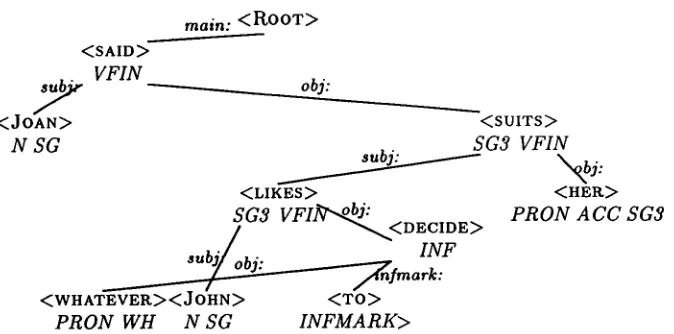
But obviously any recognition g r a m m a r should deal with non-projective phenomena to the extent they occur in natural languages as, for example, in the analysis shown in Figure 2. Our system has no in-built restrictions concerning projectivity, though the formalism allows us to state when crossing links are not permitted.
We maintain that one is generally also interested in the linear order of elements, and therefore it is presented in the tree diagrams. But, for some pur- poses, presenting all arguments in a canonical order might be more adequate. This, however, is a m a t t e r of o u t p u t formatting, for which the system makes several options available.
3.2 V a l e n c y a n d c a t e g o r i e s
The verbs (as well as other elements) have a valency that describes the number and type of the modifiers they may have. In valency theory, usually, comple- ments (obligatory) and adjuncts (optional) are dis- tinguished.
m a i n : <ROOT> <SAID>
V F I N
obj:
<JOAN> N SG
SG3 V F I I V ' ~ bj:
/ ~ < D E C I D E >
<WHATEVER><J OHN> <TO> P R O N W H N SG I N F M A R K >
<SUITS> SG3 V F I N
<LIKES> <HER> P R O N A C C SG3
Figure 2: A dependency structure for the sentence: Joan said whatever John likes to decide suits her.
Our notation makes a difference between valency (rule-based) and subcategorisation (lexical): the va- lency tells which arguments are expected; the sub- categorisation tells which combinations are legiti- mate. T h e valency merely provides a possibility to have an argument. Thus, a verb having three va- lency slots m a y have e.g. subcategorisation SV00 or SV0C. T h e former denotes: Subject, Verb, indirect Object and Object, and the latter: Subject, Verb, Object and Object Complement. T h e default is a nominal type of complement, but there might also be additional information concerning the range of possible complements, e.g., the verb say may have an object (SV0), which m a y also be realised as a to-infinitive clause, WH-clause, that-clause or quote structure.
T h e adjuncts are not usually marked in the verbs because most of the verbs m a y have e.g. spatio- temporal arguments. Instead, adverbial comple- ments and adjuncts that are typical of particular verbs are indicated. For instance, the verb decide has the tag <P/on> which means t h a t the preposi- tional phrase on is typically attached to it.
T h e distinction between the complements and the adjuncts is vague in the implementation; neither the complements nor the adjuncts are obligatory.
4 I n t r o d u c i n g t h e d e p e n d e n c i e s
Usually, b o t h the dependent element and its head are implicitly (and ambiguously) present in the Con- straint G r a m m a r type of rule. Here, we make this dependency relation explicit. This is done by declar- ing the heads and the dependents (complement or modifier) in the context tests.
For example, the subject label (@SUB J) is chosen and marked as a dependent of the immediately fol-
lowing auxiliary (AUXMOD) in the following rule:
S E L E C T (@SUBJ) IF (1C AUXMOD HEAD);
To get the full benefit of the parser, it is also use- ful to name the valency slot in the rule. This has two effects: (1) the valency slot is unique, i.e. no more than one subject is linked to a finite verb 5, and (2) we can explicitly state in rules which kind of valency slots we expect to be filled. T h e rule thus is of the form:
S E L E C T (@SUB J)
IF (1C AUXMOD HEAD = subject);
T h e rule above works well in an unambiguous con- text but there is still need to specify more tolerant rules for ambiguous contexts. T h e rule
INDEX (@SUB J)
IF (1C AUXMOD HEAD = subject);
differs from the previous rule in t h a t it leaves the other readings of the noun intact and only adds a (possible) subject dependency, while b o t h the previ- ous rules disambiguated the noun reading also.
But especially in the rule above, the contextual test is far from being sufficient to select the subject reading reliably. Instead, it leaves open a possibil- ity to attach a dependency from another syntactic function, i.e. the dependency relations remain am- biguous. T h e g r a m m a r tries to be careful not to introduce false dependencies but for an obvious rea- son this is not always possible. If several syntac- tic functions of a word have dependency relations, they form a dependency forest. Therefore, when the syntactic function is not rashly disambiguated, the correct reading may survive even after illegitimate
[image:3.612.174.511.82.249.2]linking, as the global pruning (Section 5) later ex- tracts dependency links t h a t f o r m consistent trees.
Links formed between syntactic labels constitute partial trees, usually around verbal nuclei. B u t a new m e c h a n i s m is needed to m a k e full use of the structural information provided by multiple rules. Once a link is formed between labels, it can be used by the other rules. For example, when a head of an object phrase (©0B J) is found and indexed to a verb, the noun phrase to the right (if any) is p r o b a b l y an object c o m p l e m e n t (©PCOMPL-0). It should have the s a m e head as the existing object if the verb has the proper subcategorisation tag (SV0C). T h e following rule establishes a dependency relation of a verb and its object complement, if the object already exists.
I N D E X ( @ P C O M P L - O )
IF (*-1 @OBJ B A R R I E R @ N P H E A D
L I N K 0 UP object SVOC H E A D = o - c o m p l ) ; T h e rule says t h a t a dependency relation (o-¢omp1) should be added b u t the syntactic functions should not be d i s a m b i g u a t e d (INDEX). T h e object comple- m e n t ©PCOMPL-0 is linked to the verb readings hav- ing the subcategorisation SV0C. T h e relation of the object c o m p l e m e n t and its head is such t h a t the noun phrase to the left of the object c o m p l e m e n t is an object (QOBJ) t h a t has established a dependency relation ( o b j e c t ) to the verb.
Naturally, the dependency relations m a y also be followed downwards (DOWN). B u t it is also possible to declare the last i t e m in a chMn of the links (e.g. the verb chain would have been wanted) using the key- words TOP and BOTTOM.
5 A m b i g u i t y a n d p r u n i n g
We pursue the following strategy for linking and dis- ambiguation.
* In the best case, we are sure t h a t some reading is correct in the current context. In this case, b o t h disambiguation and linking can be done at the s a m e t i m e (with c o m m a n d SELECT and keyword HEAD).
e T h e m o s t typical case is t h a t the context gives some evidence a b o u t the correct reading, but we know t h a t there are some rare instances when t h a t reading is not correct. In such a case, we only add a link.
e Sometimes the context gives strong hints as to what the correct reading can not be. In such a case we can remove some readings even if we do not know what the correct alternative is. This is a fairly typical case in the Con- straint G r a m m a r framework, but relatively rare
in the new dependency g r a m m a r . In practice, these rules are m o s t likely to cause errors, a p a r t f r o m their linguistic i n t e r p r e t a t i o n often being rather obscure. Moreover, there is no longer any need to remove these readings explicitly by rules, because the global pruning removes read- ings which have not obtained any "extra evi- dence".
Roughly, one could say t h a t the REMOVE rules of the Constraint G r a m m a r are replaced by the INDEX rules. T h e overall result is t h a t the rules in the new framework are m u c h m o r e careful t h a n those of E N G C G .
As already noted, the dependency g r a m m a r has a big advantage over E N G C G in dealing with a m - biguity. Because the dependencies are supposed to f o r m a tree, we can heuristically prune readings t h a t are not likely to a p p e a r in such a tree. We have the following hypotheses: (1) the dependency forest is quite sparse and a whole parse tree can not always be found; (2) pruning should favour large (sub)trees; (3) unlinked readings of a word can be removed when there is a linked reading present a m o n g the alterna- tives; (4) u n a m b i g u o u s subtrees are m o r e likely to be correct t h a n ambiguous ones; and (5) pruning need not force the words to be unambiguous. Instead, we can apply the rules iteratively, and usually some of the rules apply when the a m b i g u i t y is reduced. Pruning is then applied agMn, and so on. Further- more, the pruning m e c h a n i s m does not contain any language specific statistics, but works on a topolog- ical basis only.
Some of the m o s t heuristic rules m a y be applied only after pruning. This has two advantages: very heuristic links would confuse the pruning mecha- nism, and words t h a t would not otherwise have a head, m a y still get one.
6 T o y - g r a m m a r e x a m p l e
In this section, we present a set of rules, and show how those rules can parse the sentence "Joan said whatever John likes to decide suits her". T h e toy g r a m m a r containing 8 rules is presented in Figure 3. T h e rules are extracted f r o m the real g r a m m a r , and they are then simplified; some tests are o m i t t e d and some tests are m a d e simpler. T h e g r a m m a r is ap- plied to the input sentence in Figure 4, where the tags are almost equivalent to those used by the English Constraint G r a m m a r , and the final result equals Figure 2, where only the dependencies be- tween the words and certain tags are printed.
I N D E X (@SUBJ) I F
(1 @+F
HEAD --- subj:);I N D E X (INF @-FMAINV) I F (-1 INFMARK) (-2 PTC1-COMPL-V + SVO HEAD -- obj:); I N D E X (@INFMARK>) I F (1 (INF @-FMAINV) HEAD -- infmark:);
S E L E C T (PRON ACC @OBJ) I F (1C CLB) (-1 @MAINV HEAD -- obj:); I N D E X (PRON WH @OH J)
I F (*1 @SUBJ BARRIER @NPHEAD-MAIN L I N K 0 UP subj: @+F
L I N K 0 TOP v-ch: @MAINV
L I N K 0 BOTTOM obj: SVO + @-FMAINV HEAD = obj:); I N D E X @MAINV
I F (*-1 WH BARRIER @MV-CLB/CC L I N K -1 @MV-CLB/CC) (*IC @+F BARRIER @SUBJ OR CLB HEAD = subj:);
P R U N I N G I N D E X @MAINV
I F (NOT *1 @+F BARRIER SUB J-BARRIER)
(*-1 (PRON WH) BARRIER CLB L I N K -1 VCOG + SVO + @MAINV HEAD = obj:); I N D E X @+FMAINV
I F (NOT 0 @+FAUXV) (NOT "1 @+F BARRIER CLB)
(0 DOWN subj: @SUBJ L I N K NOT *-1 @CS) (@0 (<s>) HEAD = main:);
Figure 3: A toy grammar of 8 rules
#(1)
#(2)
#(3)
#(4)
#(5)
#(6)
#(*)
#(7)
#(8)
1. A simple rule shows how the subject (QSUBJ) is indexed to a finite verb by a link named subj.
2. The infinitives preceded by the infinitive marker to can be reliably linked to the verbs with the proper subcategorisation, i.e. the verb belongs to both categories PTCl-COHPL-V and SV0.
3. The infinitive marker is indexed to the infinitive by the link named infmaxk.
4. Personal pronouns have morphological ambigu- ity between nominative (NOM) and accusative (ACC) readings. Here, the accusative reading is selected and linked to the main verb imme- diately to the left, if there is an unambiguous clause boundary immediately to the right.
5. The WH-pronoun is a clause boundary marker, but the only reliable means to find its head is to follow the links. Therefore, the WH-pronoun is not indexed before the appropriate subject is linked to the verb chain which also has a verbal object.
The rule states: the first noun phrase head la- bel to the right is a subject (©SUB J), link subj exists and is followed up to the finite verb (©+F) in a verb chain (v-ch), which is then followed up to the main verb. Then object or comple- ment links are followed downwards (BOTTOH),
.
to the last verbal reading (here decide). If then a verb with subcategorisation for objects is en- countered, an object link from the WH-pronoun is formed.
This kind of rule that starts from word A, fol- lows links up to word B and then down to word C, introduces a non-projective dependency link if word B is between words A and C.
Note that the conditions TOP and BOTT0X follow the chain of named link, if any, to the upper or lower end of a chain of a multiple (zero or more) links with the same name. Therefore TOP v-ch: @MAINValways ends with the main verb in the verb chain, whether this be a single finite verb like likes or a chain like would have been liked.
The WH-clause itself may function as a subject, object, etc. Therefore, there is a set of rules for each function. The "WH-clause as subject" rule looks for a finite verb to the right. No in- tervening subject labels and clause boundaries are allowed.
Rules 1-5 are applied in the first round. After that, the pruning operation disambiguates finite verbs, and rule 6 will apply.
" < Joan>"
"joan" N NOM SG @NH @SUBJ @OBJ @I-OBJ @PCOMPL-S @PCOMPL-O @APP @A> @<P @O-ADVL "<said>"
"say" PCP2 @<P-FMAINV @-FMAINV "say" V PAST VFIN @+FMAINV
"say" A ABS ~PCOMPL-S @PCOMPL-O @A> @APP @SUBJ @OBJ @I-OBJ @<P @<NOM " < what ever>"
"whatever" ADV @ADVL @AD-A>
"whatever" DET CENTRAL WH SG/PL @DN>
"whatever" < C L B > PRON WH SG/PL @SUBJ ~ O B J @I-OBJ ~PCOMPL-S @PCOMPL-O @<P @<NOM " < John>"
"john" N NOM SG ~ N H @SUBJ ~ O B J ~I-OBJ @PCOMPL-S @PCOMPL-O ~ A P P ~ A > ~ < P ~O-ADVL "<likes>"
"like" N NOM PL @NH @SUBJ @OBJ @I-OBJ @PCOMPL-S @PCOMPL-O @APP @A> ~ < P @O-ADVL "like" V PRES SG3 VFIN ~ + F M A I N V
" < t o > "
"to" PREP @<NOM @ADVL "to" INFMARK> ~ I N F M A R K > "<decide>"
"decide" V SUBJUNCTIVE VFIN @+FMAINV "decide" V IMP VFIN @+FMAINV
"decide" V INF ~-FMAINV ~ < P - F M A I N V "decide" V PRES -SG3 VFIN ~ + F M A I N V "<suits>"
"suit" V PRES SG3 VFIN @+FMAINV
"suit" N NOM PL @NH @SUBJ @OBJ @I-OBJ @PCOMPL-S @PCOMPL-O @APP @A> @<P @O-ADVL " < h e r > "
"she" PRON PERS FEM GEN SG3 @GN> "she" PRON PERS FEM ACC SG3 ~ O B J " < . > "
Figure 4: A sentence after morphological analysis. Each line presents a morphological and @-signs mor- phosyntactic alternatives, e.g.
whatever
is ambiguous in 10 ways. T h e subcategorisation/valency information is not printed here.reading f r o m each word belongs to a subtree of which the root is
said
orsuits.
7. T h e syntactic relationship between the verbs is established by a rule stating t h a t the rightmost m a i n verb is the (clause) object of a m a i n verb to the left, which Mlows such objects.
8. Finally, there is a single m a i n verb, which is indexed to the root (<s>) (in position GO).
7 E v a l u a t i o n
7.1 E f f i c i e n c y
T h e evaluation was done using small excerpts of data, not used in the development of the system. All text samples were excerpted f r o m three different genres in the Bank of English (J~irvinen, 1994) data: American National Public Radio (broadcast), British Books d a t a
(literature),
and T h e Independent(news-
paper).
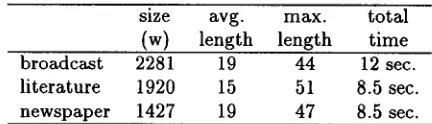
Figure 5 lists the samples, their sizes, and the average and m a x i m u m sentence lengths. T h e m e a s u r e is in words excluding punctuation.size avg. m a x . total (w) length length t i m e broadcast 2281 19 44 12 sec. literature 1920 15 51 8.5 sec. newspaper 1427 19 47 8.5 sec.
Figure 5: B e n c h m a r k used in the evaluation
In addition, Figure 5 shows the t o t a l processing t i m e required for the syntactic analysis of the s a m - ples. T h e syntactic analysis has been done in a nor- m a l P C with the Linux operating system. T h e PC has a P e n t i u m 90 MHz processor and 16 MB of m e m - ory. T h e speed roughly corresponds to 200 words in second. T h e t i m e does not include morphological anMysis and d i s a m b i g u a t i o n 6.
[image:6.612.100.581.96.403.2] [image:6.612.350.566.482.544.2]DG E N G C G succ. arab. succ. amb. broadcast 97.0 % 3.2 % 96.8 % 12.7 % literature 97.3 % 3.3 % 95.9 % 11.3 % newspaper 96.4 % 3.3 % 94.2 % 13.7 %
Figure 6: E N G C G syntax and morphosyntactic level of the dependency g r a m m a r
7.2 C o m p a r i s o n t o E N G C G s y n t a x
One obvious point of reference is the E N G C G syn- tax, which shares a level of similar representation with an almost identical tagset to the new system. In addition, b o t h systems use the front parts of the E N G C G system for processing the input. These in- clude the tokeniser, lexical analyser and morpholog- ical disambiguator.
Figure 6 shows the results of the comparison of the E N G C G syntax and the morphosyntactic level of the dependency grammar. Because b o t h systems leave some a m o u n t of the ambiguity pending, two figures are given: the success rate, which is the percent- age of correct morphosyntactic labels present in the output, and the ambiguity rate, which is the percent- age of words containing more than one label. T h e E N G C G results compare to those reported elsewhere (J~rvinen, 1994; Tapanainen and J/~rvinen, 1994).
T h e DG success rate is similar or m a y b e even slightly better than in E N G C G . More importantly,
the ambiguity rate is only a b o u t a quarter of that in the E N G C G output. T h e overall result should be considered good in the sense t h a t the o u t p u t con- tains information about the syntactic functions (see Figure 4) not only part-of-speech tags.
7.3 D e p e n d e n c i e s
T h e m a j o r improvement over E N G C G is the level of explicit dependency representation, which makes it possible to excerpt modifiers of certain elements, such as arguments of verbs. This section evaluates
the success of the level of dependencies.
7.3.1 U n n a m e d d e p e n d e n c i e s
One of the crude measures to evaluate depen- dencies is to count how m a n y times the correct head is found. T h e results are listed in Fig- ure 7. Precision is [ received correct links~ and re-
received links J
call /received correct links ~ T h e difference between desired links. J"
precision a n d recall is due to the fact that the parser does not force a head on every word. Trying out some very heuristic methods to assign heads would raise recall but lower precision. A similar measure
precision recall broadcast 93.4 % 88.0 % literature 96.0 % 88.6 % newspaper 95.3 % 87.9 %
Figure 7: Percentages of heads correctly attached
broadcast precision recall N subjects 95 % 89 % 244 objects 89 % 83 % 140 predicatives 96 % 86 % 57 literature precision recall N subjects 98 % 92 % 195 objects 94 % 9 1 % 118 predicatives 97 % 93 % 72 newspaper precision recall N subjects 95 % 83 % 136 objects 94 % 88 % 103 predicatives 92 % 96 % 23
Figure 8: Rates for main functional dependencies
is used in (Eisner, 1996) except t h a t every word has a head, i.e. the precision equals recall, reported as 79.2%.
7.3.2 N a m e d d e p e n d e n c i e s
We evaluated our parser against the selected de- pendencies in the test samples. T h e samples be- ing rather small, only the most c o m m o n dependen- cies are evaluated: subject, object and predicative. These dependencies are usually resolved more re- liably than, say, appositions, prepositional attach- ments etc. T h e results of the test samples are listed in Figure 8. It seems the parser leaves some a m o u n t of the words unlinked (e.g. 10-15 % of subjects) but what it has recognised is generally correct (precision 95-98% for subjects).
Dekang Lin (1996) has earlier used this kind of evaluation, where precision and recall were for sub- jects 87 % and 78 %, and for complements (includ- ing objects) 84 % and 72 %, respectively. T h e results are not strictly comparable because the syntactic de- scription is somewhat different.
8
C o n c l u s i o n
In this paper, we have presented some main features of our new framework for dependency syntax. T h e most i m p o r t a n t result is t h a t the new framework al- lows us to describe non-projective dependency gram- mars and apply them efficiently. This is a property
[image:7.612.376.531.81.132.2] [image:7.612.103.324.82.145.2] [image:7.612.363.549.170.320.2]that will be crucial when we will apply this frame- work to a language having free word-order.
Basically, the parsing framework combines the Constraint Grammar framework (removing ambigu- ous readings) with a mechanism that adds depen- dencies between readings or tags. This means that while the parser disambiguates it also builds up a dependency forest that, in turn, is reduced by other disambiguation rules and a global pruning mecha- nism.
This setup makes it possible to operate on several layers of information, and use and combine struc- tural information more efficiently than in the orig- inal Constraint Grammar framework, without any further disadvantage in dealing with ambiguity.
First preliminary evaluations are presented. Com- pared to the ENGCG syntactic analyser, the output not only contains more information but it is also more accurate and explicit. The ambiguity rate is reduced to a quarter without any compromise in cor- rectness. We did not have access to other systems, and care must be taken when interpreting the re- sults which are not strictly comparable. However, the comparison to other current systems suggests that our dependency parser is very promising both theoretically and practically.
Acknowledgments
We are using Atro Voutilainen's (1995) improved part-of-speech disambiguation grammar which runs in the CG-2 parser. Voutilainen and Juha Heikkil5 created the original ENGCG lexicon.
R e f e r e n c e s
Arto Anttila. 1995. How to recognise subjects in English. In Karlsson et al., chapt. 9, pp. 315-358.
Dekang Lin. 1996. Evaluation of Principar with the Susanne corpus. In John Carroll, editor, Work- shop on Robust Parsing, pages 54-69, Prague.
Jason M. Eisner. 1996. Three new probabilistic models for dependency parsing: An exploration. In The 16th International Conference on Compu- tational Linguistics, pages 340-345. Copenhagen.
David G. Hays. 1 9 6 4 . Dependency theory: A formalism and some observations. Language, 40(4):511-525.
Hans Jiirgen Heringer. 1993. Dependency syntax - basic ideas and the classical model. In Joachim Jacobs, Arnim von Stechow, Wolfgang Sternefeld, and Thee Venneman, editors, Syntax - An In- ternational Handbook of Contemporary Research, volume 1, chapter 12, pages 298-316. Walter de Gruyter, Berlin - New York.
Richard Hudson. 1991. English Word Grammar. Basil Blackwell, Cambridge, MA.
Arvi Hurskainen. 1996. Disambiguation of morpho- logical analysis in Bantu languages. In The 16th International Conference on Computational Lin- guistics, pages 568-573. Copenhagen.
Time J~rvinen. 1 9 9 4 . Annotating 200 million words: the Bank of English project. In The 15th International Conference on Computational Lin- guistics Proceedings, pages 565-568. Kyoto.
Fred Karlsson, Atro Voutilainen, Juha Heikkil~, and Arto Anttila, editors. 1995. Constraint Gram- mar: a language-independent system for parsing unrestricted text, volume 4 of Natural Language Processing. Mouton de Gruyter, Berlin and N.Y.
Fred Karlsson. 1990. Constraint grammar as a framework for parsing running text. In Hans Karl- gren, editor, Papers presented to the 13th Interna- tional Conference on Computational Linguistics, volume 3, pages 168-173, Helsinki, Finland.
Michael McCord. 1990. Slot grammar: A system for simpler construction of practical natural language grammars. In lq, Studer, editor, Natural Language and Logic: International Scientific Symposium, Lecture Notes in Computer Science, pages 118- 145. Springer, Berlin.
Igor A. Mel'~uk. 1987. Dependency Syntax: Theory and Practice. State University of New York Press, Albany.
Christer Samuelsson, Pasi Tapanainen, and Atro Voutilainen. 1996. Inducing constraint gram- mars. In Laurent Miclet and Colin de la Higuera, editors, Grammatical Inference: Learning Syntax from Sentences, volume 1147 of Lecture Notes in Artificial Intelligence, pages 146-155, Springer.
Daniel Sleator and Davy Temperley. 1991. Parsing English with a link grammar. Technical Report CMU-CS-91-196, Carnegie Mellon University.
Pasi Tapanainen and Time J/irvinen. 1994. Syn- tactic analysis of natural language using linguis- tic rules and corpus-based patterns. In The 15th International Conference on Computational Lin- guistics Proceedings, pages 629-634. Kyoto.
Pasi Tapanainen. 1996. The Constraint Grammar Parser CG-2. Number 27 in Publications of the Department of General Linguistics, University of Helsinki.
Lucien TesniSre. 1959. l~ldments de syntaxe stvuc- turale, l~ditions Klincksieck, Paris.