P R I M A R Y R E S E A R C H
Open Access
Exploring the interaction among EPHX1,
GSTP1, SERPINE2, and TGFB1 contributing
to the quantitative traits of chronic
obstructive pulmonary disease in Chinese
Han population
Li An
1, Yingxiang Lin
1, Ting Yang
2and Lin Hua
3,4*Abstract
Background:Currently, the majority of genetic association studies on chronic obstructive pulmonary disease (COPD) risk focused on identifying the individual effects of single nucleotide polymorphisms (SNPs) as well as their interaction effects on the disease. However, conventional genetic studies often use binary disease status as the primary phenotype, but for COPD, many quantitative traits have the potential correlation with the disease status and closely reflect pathological changes.
Method:Here, we genotyped 44 SNPs from four genes (EPHX1, GSTP1, SERPINE2, and TGFB1) in 310 patients and 203 controls which belonged to the Chinese Han population to test the two-way and three-way genetic
interactions with COPD-related quantitative traits using recently developed generalized multifactor dimensionality reduction (GMDR) and quantitative multifactor dimensionality reduction (QMDR) algorithms.
Results:Based on the 310 patients and the whole samples of 513 subjects, the best gene-gene interactions models were detected for four lung-function-related quantitative traits. For the forced expiratory volume in 1 s (FEV1), the best interaction was seen from EPHX1, SERPINE2, and GSTP1. For FEV1%pre, the forced vital capacity (FVC), and
FEV1/FVC, the best interactions were seen from SERPINE2 and TGFB1.
Conclusion:The results of this study provide further evidence for the genotype combinations at risk of developing COPD in Chinese Han population and improve the understanding on the genetic etiology of COPD and
COPD-related quantitative traits.
Keywords:COPD, SNP, Interaction, Quantitative traits, MDR
Background
Chronic obstructive pulmonary disease (COPD) is defined as airflow limitation that is not fully reversible [1]. Cigarette smoking is the major risk factor for COPD, but smokers show considerable variation in their risk of developing air-flow obstruction [2]. Although a series of studies have
found the genetics contributions from some genes by ana-lyzing individual effects of single nucleotide polymorphisms (SNPs) [3], but in most cases with a large proportion of the genetic component left unexplained, the genetic risk factors for COPD are still largely unknown. Recent studies have approved that complex traits cannot be explained by any single SNP variant, and the characterization of gene-gene interactions and gene-environment interactions may be the key to understand the underlying pathogenesis of complex diseases [4]. It is therefore suggested that identifying the possible jointed effects of gene-gene interaction will help discover the potential susceptibility factors of COPD risk.
* Correspondence:[email protected]
3School of Biomedical Engineering, Capital Medical University, Beijing
100069, China
4Beijing Key Laboratory of Fundamental Research on Biomechanics in Clinical Application, School of Biomedical Engineering, Capital Medical University, Beijing 100069, China
Full list of author information is available at the end of the article
© 2016 An et al.Open AccessThis article is distributed under the terms of the Creative Commons Attribution 4.0 International License (http://creativecommons.org/licenses/by/4.0/), which permits unrestricted use, distribution, and reproduction in any medium, provided you give appropriate credit to the original author(s) and the source, provide a link to the Creative Commons license, and indicate if changes were made. The Creative Commons Public Domain Dedication waiver (http://creativecommons.org/publicdomain/zero/1.0/) applies to the data made available in this article, unless otherwise stated.
Recent advances in genetic studies have implicated that COPD represents a complex disease with genetics contributions from multiple genes. For example, al-though many studies did not find the association be-tween EPHX1 and the susceptibility to COPD or disease severity [5, 6], Vibhuti et al. [7] approved that and the combination of 113H/139H alleles of mEPHX and 105V/114V alleles of GSTP1 genotypes with same alleles is associated with imbalanced oxidative stress and lung function in COPD patients. In addition, Artigas et al. [8] investigated the combined effect of the risk alleles at six loci (TNS1, GSTCD, HTR4, AGER, THSD4, and HHIP) and found their joint effects on lung function and COPD risk. Therefore, as a complex polygenic disease, COPD is likely affected by the operation of multiple genes and the coincident actions of several genetic events. However, most conventional genetic studies often use binary dis-ease status as the primary phenotype, but for COPD, many quantitative traits have been shown to correlate with the disease status and to have greater sensitivity in detecting early pathological changes. For example, a ra-tio between forced expiratory volume in 1 s (FEV1) and
forced vital capacity (FVC) has emphasized the import-ance of the functional assessment of usually progressive, non-fully reversible airflow limitation [9]. The BODE index, a multidimensional parameter including the body-mass index (B), the degree of airflow obstruction (O), functional dyspnea (D), and exercise capacity (E), was reported to be superior to FEV1in reflecting the
se-verity of COPD and effective in predicting the mortality in patients with COPD [10]. Therefore, it is suggested that important insight can be garnered from investigat-ing genotype combinations contributinvestigat-ing to the COPD-related quantitative traits, which will help improve the understanding of the genetic etiology of COPD.
Recently, some extension algorithms for detecting and characterizing epistatic interactions in the context of quantitative outcomes named as generalized multifactor dimensionality reduction (GMDR) [11] and quantitative multifactor dimensionality reduction (QMDR) were de-veloped [12], and these algorithms allow researchers to build more accurate models that involve multiple geno-type combinations contributing to disease-related quan-titative traits. By summarizing a group/body of evidence, we found four genes: EPHX1, GSTP1, SERPINE2, and TGFB1, that are reported to be associated with COPD, and these associations have been confirmed by replica-tion and meta-analysis [13]. Therefore, in the present study, we genotyped 44 SNPs (Additional file 1) involved in these four genes in 310 COPD patients and 203 con-trols which belonged to the Chinese Han population to explore the joint gene-gene interactions contributing to COPD-related quantitative traits based on the GMDR and QMDR algorithms. We also used a web-based tool
GeneMANIA [14] to find genes that interact in any way (physically, genetically, etc.) with our studied four genes in this paper. Our study provides further evidences to identify genotype combinations at risk of developing COPD in Chinese Han population and improve the un-derstanding of the genetic etiology of COPD.
Results
General characteristics of COPD-related quantitative traits for patients
The general characteristics of COPD-related quantitative traits for patients are shown in Additional file 2. Espe-cially, the distribution of the modified Medical Research Council dyspnea scale (MMRC) is as follows: 52 patients (16.8 %) MMRC 0, 144 (46.5 %) MMRC 1, 84 (27.1 %) MMRC 2, 11 (3.5 %) MMRC 3, and 19 (6.1 %) MMRC 4, with a median of 1 (P5–P95, 0–4). This MMRC
distribu-tion indicates that the degrees of various physical activities that precipitate dyspnea of the COPD patients in our study are mild. The distribution of BODE index is as fol-lows: 9 patients (2.9 %) BODE 0, 56 (18.1 %) BODE 1, 93 (30.0 %) BODE 2, 71 (22.9 %) BODE 3, 36 (11.6 %) BODE 4, 26 (8.4 %) BODE 5, 11 (3.5 %) BODE 6, 4 (1.3 %) BODE 7, 3 (1.0 %) BODE 9, and 1 (0.3 %) BODE 10, with a me-dian of 2 (P5–P95, 1–6). The BODE distribution also
indi-cates that the severity of our COPD patients is mild. In addition, in terms of the effect of a single SNP, except rs41266229 (EPHX1) and rs729631 (SERPINE2) which display the significant difference between the COPD pa-tients and normal controls after passing the multiple test-ing corrections [13], no significant differences were seen from other single SNP (Additional file 1).
Single marker analysis for COPD-related quantitative traits based on patients
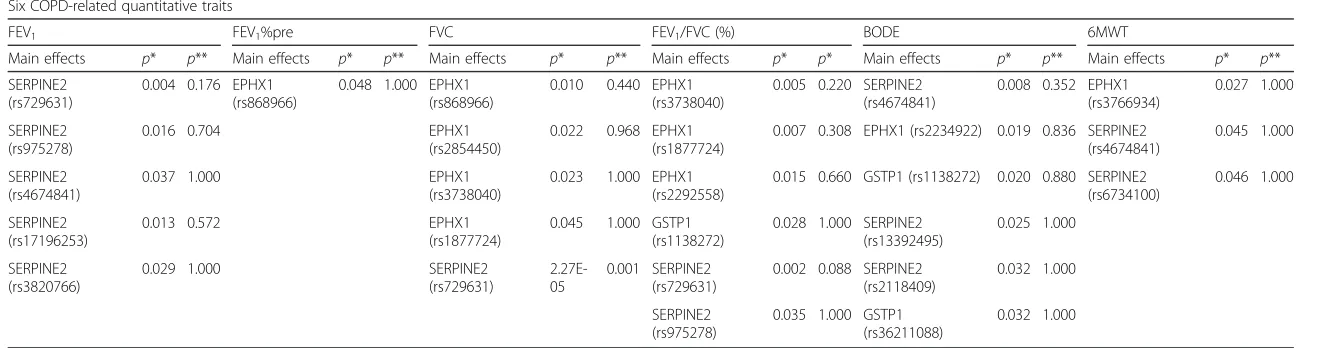
In the current study, we performed the analysis of single marker effect for seven COPD-related quantitative traits. We included covariates age, sex, and pack-years of smok-ing in the model. For the seven COPD-related quantitative traits, except rs729631 (SERPINE2) which showed a strong association with FVC, no single marker effects showed a significant association after being corrected by Bonferroni procedure (Table 1). It appears that most of these candidate SNPs do not show independent associa-tions with COPD-related quantitative traits.
The best two-way gene-gene interaction models for COPD-related quantitative traits using GMDR, QMDR, and traditional quantitative trait locus (QTL)
Table 1Single marker effects for sixaCOPD-related quantitative traits (n= 310 patients)
Six COPD-related quantitative traits
FEV1 FEV1%pre FVC FEV1/FVC (%) BODE 6MWT
Main effects p* p** Main effects p* p** Main effects p* p** Main effects p* p* Main effects p* p** Main effects p* p** SERPINE2
(rs729631)
0.004 0.176 EPHX1 (rs868966)
0.048 1.000 EPHX1 (rs868966)
0.010 0.440 EPHX1 (rs3738040)
0.005 0.220 SERPINE2 (rs4674841)
0.008 0.352 EPHX1 (rs3766934)
0.027 1.000
SERPINE2 (rs975278)
0.016 0.704 EPHX1
(rs2854450)
0.022 0.968 EPHX1 (rs1877724)
0.007 0.308 EPHX1 (rs2234922) 0.019 0.836 SERPINE2 (rs4674841)
0.045 1.000
SERPINE2 (rs4674841)
0.037 1.000 EPHX1
(rs3738040)
0.023 1.000 EPHX1 (rs2292558)
0.015 0.660 GSTP1 (rs1138272) 0.020 0.880 SERPINE2 (rs6734100)
0.046 1.000
SERPINE2 (rs17196253)
0.013 0.572 EPHX1
(rs1877724)
0.045 1.000 GSTP1 (rs1138272)
0.028 1.000 SERPINE2 (rs13392495)
0.025 1.000
SERPINE2 (rs3820766)
0.029 1.000 SERPINE2 (rs729631)
2.27E-05
0.001 SERPINE2 (rs729631)
0.002 0.088 SERPINE2 (rs2118409)
0.032 1.000
SERPINE2 (rs975278)
0.035 1.000 GSTP1 (rs36211088)
0.032 1.000
a
There was no significant main effect for MMRC before being corrected by Bonferroni procedure *p< 0.05 before corrected by Bonferroni procedure; **pafter corrected by Bonferroni procedure
An
et
al.
Human
Genomics
(2016) 10:13
Page
3
of
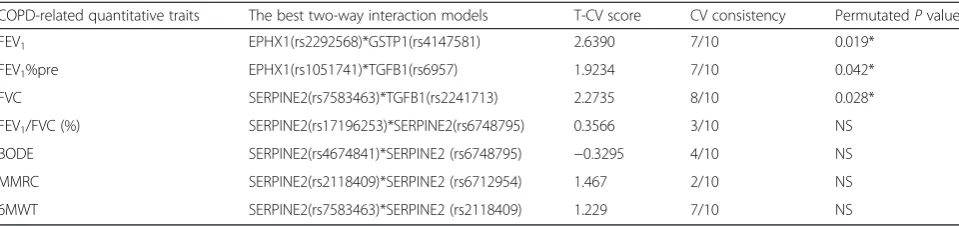
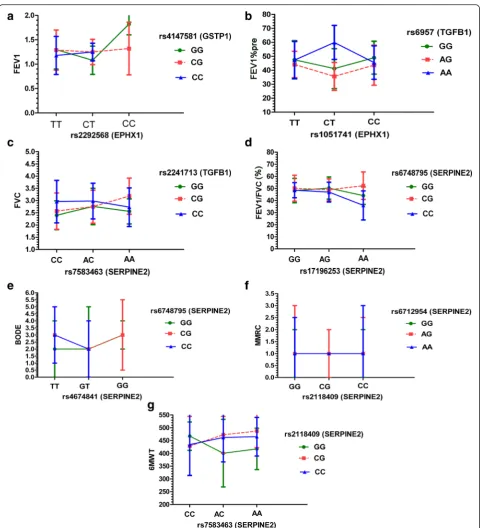
(rs2292568) and GSTP1 (rs4147581). The 1000 permuta-tion testing revealed a significant P value of 0.019. The average maximum of FEV1(1.82) was seen from rs2292568
(CC)*rs4147581 (GG), whereas the average minimum of FEV1 (1.08) was seen from rs2292568 (CT)*rs4147581
(GG) (Fig. 1a). This indicated that having two minor alleles for the EPHX1 gene corresponded to an average maximum value of FEV1. For FEV1%pre, the best interaction was
de-tected between rs1051741 (EPHX1) and rs6957 (TGFB1). The 1000 permutation testing also revealed a significant P value of 0.042. The average maximum of FEV1%pre (59.92)
was seen from rs1051741 (CT)*rs6957 (AA), whereas the average minimum of FEV1%pre (35.57) was seen from
rs1051741 (CT)*rs6957 (AG) (Fig. 1b). For FVC, the best model is the interaction between SERPINE2 (rs7583463) and TGFB1 (rs2241713) which shows a significantPvalue of 0.028 based on the 1000 permutation testing. The aver-age maximum of FVC (3.18) was seen from rs7583463 (AA)*rs2241713 (CG), whereas the average minimum of FVC (2.40) was seen from rs7583463 (CC)*rs2241713 (GG) (Fig. 1c). However, for the other four COPD-related quanti-tative traits, the best interaction models were found within the gene itself but not found between genes, and the 1000 permutation testing did not find their significance (P> 0.05). For FEV1/FVC, 6-min walk test (6MWT), BODE,
and MMRC, the best interactions are rs17196253 (SER-PINE2) and rs6748795 (SER(SER-PINE2) (Fig. 1d), rs7583463 (SERPINE2) and rs2118409 (SERPINE2) (Fig. 1e), rs4674841 (SERPINE2) and rs6748795 (SERPINE2) (Fig. 1f), and rs2118409 (SERPINE2) and rs6712954 (SERPINE2) (Fig. 1g), respectively. The description and comparison among multiple genotype combinations contributing to seven COPD-related quantitative traits are shown in Add-itional file 3. For the 310 patients, after being adjusted by covariates, the most significant gene-gene interactions iden-tified by traditional QTL were consistent with those inter-actions obtained from QMDR in five quantitative traits: FEV1, FEV1%pre, FVC, FEV1/FVC, and BODE (Additional
files 4 and 5). For MMRC and 6MWT, there were some discrepancies between QMDR and traditional QTL. We know that QTL is less sensitive in detecting the local
effects, whereas QMDR can find the genotype combina-tions that distinguish the high- and low-level groups opti-mally. Therefore, when there is good discrimination between the low- and high-level groups in terms of traits, these two methods can both detect the interactions with good power.
In addition, for lung-function-related quantitative traits (FEV1, FEV1%pre, FVC, and FEV1/FVC), we further
de-tected the two-way gene-gene interaction using GMDR, QMDR, and traditional QTL based on the whole samples (310 patients and 203 controls). GMDR, QMDR, and traditional QTL all found that the best interaction model was EPHX1 and GSTP1 for FEV1, SERPINE2 and TGFB1
for FVC, and FEV1/FVC (Table 3 and Additional file 4).
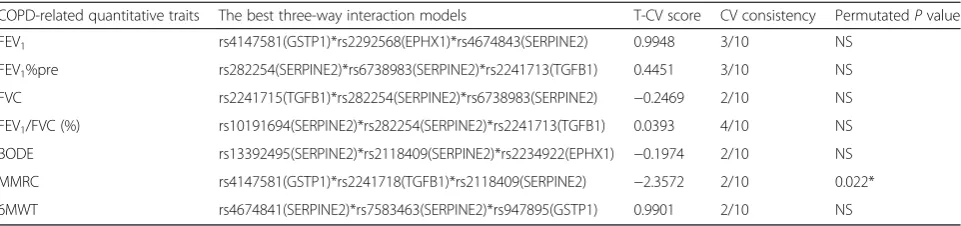
The best three-way gene-gene interactions models for COPD-related quantitative traits using GMDR and QMDR In Table 4, we listed the best three-way gene-gene inter-action models identified by QMDR from tenfold cross-validation for COPD-related quantitative traits after be-ing adjusted by covariates age, sex, and pack-years of smoking based on 310 patients. For FEV1, the best
model was seen from GSTP1, EPHX1, and SERPINE2. For FEV1%pre, FVC, and FEV1/FVC, the best models
were seen from SERPINE2 and TGFB1. For BODE, EPHX1 and SERPINE2 were found to be the best inter-action. For MMRC, interaction between GSTP1, TGFB1, and SERPINE2 was the best model with a significant permutatedP value of 0.022. For 6MWT, the best model was SERPINE2 and GSTP1.
In addition, for four lung-function-related quantitative traits, we also detected the three-way gene-gene interac-tions using GMDR and QMDR based on the whole sam-ples. GMDR and QMDR all found that the best interaction model was EPHX1, GSTP1, and SERPINE2 for FEV1and SERPINE2 and TGFB1 for FVC (Table 5).
Gene-gene interactions in the network
To extend/explore the potential joint genetic effects of these four genes (EPHX1, GSTP1, SERPINE2, and TGFB1), we also used a web-based tool GeneMANIA Table 2The best models identified by QMDR for COPD-related quantitative traits in Chinese Han population (n= 310 patients)
COPD-related quantitative traits The best two-way interaction models T-CV score CV consistency PermutatedPvalue
FEV1 EPHX1(rs2292568)*GSTP1(rs4147581) 2.6390 7/10 0.019*
FEV1%pre EPHX1(rs1051741)*TGFB1(rs6957) 1.9234 7/10 0.042*
FVC SERPINE2(rs7583463)*TGFB1(rs2241713) 2.2735 8/10 0.028*
FEV1/FVC (%) SERPINE2(rs17196253)*SERPINE2(rs6748795) 0.3566 3/10 NS
BODE SERPINE2(rs4674841)*SERPINE2 (rs6748795) −0.3295 4/10 NS
MMRC SERPINE2(rs2118409)*SERPINE2 (rs6712954) 1.467 2/10 NS
6MWT SERPINE2(rs7583463)*SERPINE2 (rs2118409) 1.229 7/10 NS
CVcross-validation,NSnot significant
*Pvalue obtained from the 1000 permutation testing
[14] to find their interactions in any way (physically, genetically, etc.) in the network. We found that ex-cept EPHX1 which interacted with GSTP1 directly in the network, these four genes interacted with each
other indirectly by passing a transcription factor named FOS (Fig. 2). Previous study confirmed the al-tered expression of gene encode for FOS in the lung tissues from COPD by using real-time quantitative
Fig. 1The best gene-gene interaction models for COPD-related quantitative traits using QMDR method.aFEV1.bFEV1%pre.cFVC.dFEV1/FVC
(%).eBODE.fMMRC.g6MWT. For FEV1, FEV1%pre, FVC, FEV1/FVC, and 6MWT, they-axisrepresents the mean of the trait and theerror bar
represents the standard deviation. For BODE and MMRC, they-axisrepresents the median of the trait and theerror barrepresents the quartile interval
Table 3The best two-way models identified by QMDR and GMDR for four lung-function-related quantitative traits in Chinese Han population (n= 310 patients + 203 controls)
COPD-related quantitative traits
The best two-way interaction models based on QMDR The best two-way interaction models based on GMDR
Gene-gene interaction CV consistency PermutatedPvalue Gene-gene interaction CV consistency PermutatedPvalue
FEV1 rs2260863(EPHX1)*rs4147581(GSTP1) 5/10 0.031* rs3766934(EPHX1)*rs947895(GSTP1) 3/10 NS
FEV1%pre rs10151740(EPHX1)*rs1800469(TGFB1) 2/10 NS rs2260863(EPHX1)*rs861442(SERPINE2) 3/10 NS
FVC rs7583463(SERPINE2)*rs2241713(TGFB1) 5/10 NS rs6748795(SERPINE2)*rs2241713(TGFB1) 4/10 0.036*
FEV1/FVC (%) rs17196253(SERPINE2)*rs2241713(TGFB1) 8/10 0.027* rs729631(SERPINE2)*rs2241713(TGFB1) 2/10 NS
CVcross-validation,NSnot significant
*Pvalue obtained from the 1000 permutation testing
An
et
al.
Human
Genomics
(2016) 10:13
Page
6
of
RT-PCR [15]. However, Demoly et al. found that FOS was rarely expressed in the normal and pathological chronic bronchitis and lung cancer proliferative com-partment of the human bronchi, suggesting its low role in cell proliferation of the large airways [16]. Considering that FOS is the center of the interaction network involved in these four genes, it should be fo-cused on in further studies.
Discussion
Up to now, although there are many different candidate genes which have been investigated for their potential roles in lung function impairment in smokers [17, 18], few works were interested to study the combinations of polymorphisms in COPD quantitative traits. In this paper, our study tested for the association of genetic interaction with seven COPD-related quantitative traits using recently developed GMDR and QMDR algorithms. We got the support for the lack of single marker associa-tions between these SNPs and COPD-related quantita-tive traits; however, our quantitaquantita-tive trait interaction analysis yielded several interesting candidate gene-gene interactions. For FEV1, the best interaction was seen
from EPHX1, SERPINE2, and GSTP1. For FEV1%pre,
FVC, and FEV1/FVC, the best interaction models were
seen from SERPINE2 and TGFB1. Interestingly, we found EPHX1 interact with GSTP1 directly for FEV1
trait for COPD patients, which is consistent with the interaction identified by GeneMANIA. In previous stud-ies, Lakhdara et al. have suggested that combined EPHX1, GSTP1, GSTM1 and GSTT1 genetic polymor-phisms may play a significant role in the development of COPD, emphysema and decline of the lung function based on the analysis for Tunisian population [18]. Salam et al. found that EPHX1 and GSTP1 variants con-tribute to the occurrence of childhood asthma and in-crease asthma susceptibility to exposures from major roads based on the analysis for white children in South-ern California [19]. Su et al. performed two-way and three-way gene-gene interactions to find the combining
effect of GSTP1, INSIG2, and IL4Ra to lifetime asthma based on the Taiwan seventh-grade children [20]. There-fore, our results provide new evidences that COPD can-didate genes may show interactive effects with lung-function-related traits. However, for 6MWT, MMRC, and BODE, the best interaction models only existed in SERPINE2 itself. Because COPD is a complex disease which is caused by the genetics contributions from mul-tiple genes, therefore, genes derived from mulmul-tiple gene-gene interactions may help reveal their cumulative effect effectively. SERPINE2 occurring in multiple gene-gene interactions has been approved for its association with COPD. In fact, many previous findings have confirmed that SERPINE2 gene polymorphisms are associated to COPD and may be involved particularly in the develop-ment of panlobular emphysema [21].
In addition, we know that the advantage of MDR is not only that it can deal with sparse and high-dimension data and therefore might uncover non-linear SNP-SNP interactions that are missed by QTL but also it can de-tect high-order interactions between genes which cannot be performed by QTL as the model complexity increases with the order of interactions. In the present study, we used GMDR and QMDR to detect the three-way interac-tions between genes and found that the best interacinterac-tions were seen from some of these four genes. Furthermore, we have determined that the genes more frequently de-tected by GMDR, QMDR, and QTL were more likely to be functional, such as SERPINE2 [22]. This suggests that our results do not occur only by chance but might reveal some real biological links between genes. Especially, the interaction between EPHX1 and GSTP1 were approved by GeneMANIA web-based tool. The interactions de-tected by GMDR and QMDR seem more diverse and less influenced by the SNP main effects.
Moreover, we know that the most common variable selection strategy for interaction studies often select SNPs with main effects to test for the interactions. How-ever, such an approach might cause the miss of some of the true interactions between genes. It has been reported Table 4The best three-way models identified by QMDR for COPD-related quantitative traits in Chinese Han population (n= 310 patients)
COPD-related quantitative traits The best three-way interaction models T-CV score CV consistency PermutatedPvalue
FEV1 rs4147581(GSTP1)*rs2292568(EPHX1)*rs4674843(SERPINE2) 0.9948 3/10 NS
FEV1%pre rs282254(SERPINE2)*rs6738983(SERPINE2)*rs2241713(TGFB1) 0.4451 3/10 NS
FVC rs2241715(TGFB1)*rs282254(SERPINE2)*rs6738983(SERPINE2) −0.2469 2/10 NS
FEV1/FVC (%) rs10191694(SERPINE2)*rs282254(SERPINE2)*rs2241713(TGFB1) 0.0393 4/10 NS
BODE rs13392495(SERPINE2)*rs2118409(SERPINE2)*rs2234922(EPHX1) −0.1974 2/10 NS
MMRC rs4147581(GSTP1)*rs2241718(TGFB1)*rs2118409(SERPINE2) −2.3572 2/10 0.022*
6MWT rs4674841(SERPINE2)*rs7583463(SERPINE2)*rs947895(GSTP1) 0.9901 2/10 NS
CVcross-validation,NSnot significant
*Pvalue obtained from the 1000 permutation testing
Table 5The best three-way models identified by QMDR and GMDR for four lung-function-related quantitative traits in Chinese Han population (n= 310 patients + 203 controls)
COPD-related quantitative traits
The best three-way interaction models based on QMDR The best three-way interaction models based on GMDR
Gene-gene interactions CV consistency
PermutatedP value
Gene-gene interactions CV consistency
PermutatedP value
FEV1 rs4147581(GSTP1)*rs2260863(EPHX1)*rs6736436(SERPINE2) 4/10 NS rs868966(EPHX1)*rs7583463(SERPINE2)*rs947895(GSTP1) 4/10 NS
FEV1%pre rs282254(SERPINE2)*rs6738983(SERPINE2)*rs2241713(TGFB1) 4/10 0.041* rs282254(SERPINE2)*rs729631(SERPINE2)*rs1051740(EPHX1) 2/10 NS
FVC rs2241715(TGFB1)*rs282254(SERPINE2)*rs6738983(SERPINE2) 2/10 NS rs2241713(TGFB1)*rs6748795(SERPINE2)*rs7579646(SERPINE2) 4/10 0.035*
FEV1/FVC
(%)
rs10191694(SERPINE2)*rs868966(EPHX1)*rs2241713(TGFB1) 4/10 NS rs4674843(SERPINE2)*rs282254(SERPINE2)*rs2241713(TGFB1) 5/10 0.039*
CVcross-validation,NSnot significant
*
Pvalue obtained from the 1000 permutation testing
An
et
al.
Human
Genomics
(2016) 10:13
Page
8
of
that the false positive report probability (FPRP) [23] de-pends on prior probability that the association is real and the statistical power of the test, therefore selecting genes based on their functions can clearly reduce the FPRP [24]. In the present study, we select four genes: EPHX1, GSTP1, SERPINE2, and TGFB1 to explore their interaction effects contributing to COPD-related quanti-tative traits. In fact, our selected genes are based on the priori evidences that they are functionally important in the COPD development [13]. This selection may help re-duce the FPRP. In the future, the further validation of the gene-gene interactions found in this study using other independent datasets will strengthen to confirm our results and provide further insight into the role of interacting genes in COPD etiology.
Furthermore, we must point out the limitations of the present study. Firstly, we limited our studies to interac-tions within four COPD-related genes, but interacinterac-tions between genes based on the other priori biology evi-dences or on pathways may be related to disease risk as well and warrant further exploration. Secondly, a newly developed multivariate quantitative multifactor dimen-sionality reduction (Multi-QMDR) algorithm is approved to have better performance than QMDR and GMDR when multiple quantitative phenotypes are available [25]. This method summarized the multivariate phenotypes into a univariate score by dimensional reduction analysis, and then classify the samples accordingly into high-risk and low-risk groups. Although GMDR and QMDR are ap-propriate for analyzing the interactions of smaller number of biomarkers, Multi-QMDR will outperform these two
methods when detecting the interactions between a greater number of biomarkers [25]. In our future work, Multi-QMDR will be used for exploring interaction effects between large numbers of variables including genetic and environment factors. Finally, a relatively small population was recruited and the relative small sample size might affect the results. After the patients were classified accord-ing to the genotype combinations, the size of the sub-groups became small and this may also affect the statistical power [26]. Indeed, we can see that some best interactions were not significant after being adjusted by the permutation tests. Maybe added sample size can change this case. Therefore, our findings should be con-sidered with caution. In the future, we will use a larger population and study more candidate genes taking into account the gene-gene or gene-environment interactions contributing to COPD phenotype or quantitative traits to elucidate the genetic pathogenesis of COPD.
Methods Study population
We recruited 310 unrelated COPD patients aged 40– 75 years from respiratory outpatient clinics at 12 hospitals in Beijing from October 2007 to March 2009. The cases are physician-diagnosed COPD; the pulmonary function test shows FEV1/FVC of less than 0.7 and FEV1%pre of less
than 0.8 predicted and no evidence of primary asthma or other respiratory diseases. The control group comprised of 203 subjects with the same age range as the case group. They have no history of respiratory symptoms and exhibit normal pulmonary function of FEV1/FVC of more than 0.7 Fig. 2The interaction of four genes in the network using GeneMANIA web tool. Thered circlesindicate the four genes studied in this paper, and otherpink circlesindicate the interacted genes in the network acquired from GeneMANIA web tool. Thelarger size circlesindicate the genes with the greater degree in the network
and FEV1%pre of more than 0.8 predicted. Written
in-formed consent was obtained from every participating sub-ject, and the study protocol was approved by the research ethics boards of all participating hospitals. The complete name of the ethics committee is Institutional Review Board of Beijing Chaoyang Hospital who approved this study. The detailed entry criteria and the baseline characteristics of study subjects were seen from our previous study [13, 27].
Genotyping of SNPs
Genomic DNA was isolated from whole blood leukocytes by the conventional phenol-chloroform method. SNPs were genotyped using Illumina VeraCode technology per-formed on BeadXpress genotyping platform (Illumina Inc., USA). Forty-four tagging SNPs (MAF > 0.05) were genotyped to capture the common variants of the four genes (EPHX1, GSTP1, SERPINE2, and TGFB1) under pairwise mode withr2threshold of 0.8. The detailed de-scription was seen from our previous study [13, 27].
COPD-related quantitative traits
In the present study, for COPD patients, we focused on seven COPD-related quantitative traits to perform our analysis. These traits were described simply as follows:
FEV1and FEV1%pre:FEV1is called the forced expiratory volume in one second, indicating the volume in a 1-s forced exhalation. It is then converted to a percentage of predicted based on your height, weight, and race normal named asFEV1%pre. FEV1%pre is a key value to be known by smokers and COPD patients in order to assess the severity of the disease [28]. In the present study, the FEV1%pre of COPD patients is less than 0.8.
FVCis called the forced vital capacity, indicating the amount of air exhaled forcefully and quickly after maximum inspiration [29].
FEV1/FVCis a calculated ratio used in the diagnosis of
obstructive and restrictive lung disease. It represents the proportion of a person’s vital capacity that they are able to expire in the first second of expiration [30]. In the present study, the FEV1/FVC of COPD cases is less than 70 %.
6MWTis the 6-min walk test which is the most com-monly used exercise test in pulmonary rehabilitation. In the current study, the 6MWT was carried out accord-ing to the ATS guidelines [31]. Each patient was or-dered to walk in a solid and flat corridor for 6 min as soon as possible. The test was repeated twice with an interval of at least 30 min. The best walking distances for two 6MWTs for each patient were recorded as the 6-min walking distance (6MWD).
MMRCis the modified Medical Research Council dyspnea scale which uses a simple grading system to
assess a patient’s level of dyspnea. The MMRC dyspnea scale classified the breathless into six grades (0 to 5) according to self-perceived breathlessness during daily activities [32]. Grade 5 represents the most severe category.
BODEindex is a multidimensional index comprising the BMI, degree of airway obstruction (FEV1%pre), functional dyspnea (MMRC dyspnea scale), and exercise capacity (6MWT). For the calculation of the BODE index, we used an empirical model as previously described [33]. For the first parameter, the value was 0 or 1. For the last three parameters, the patient received points ranging from 0 (lowest value) to 3 (highest value). The BODE index was the sum of points for each variable, ranging from 0 to 10. A higher BODE index score indicates a greater probability of patient mortality [34].
Considering that 6MWT, BODE, and MMRC are measure indexes only appropriate for COPD patients, therefore the quantitative traits measured for normal controls are four lung-function-related traits: FEV1,
FEV1%pre, FVC, and FEV1/FVC, which were subjected
to our further analysis.
Statistical analysis
General characteristics of COPD-related quantitative traits for COPD patients
The general characteristics of COPD-related traits for patients are described, and the comparison among mul-tiple genotype combination is performed using the ana-lysis of variance (ANOVA) or Kruskal-Wallis test. A P value of <0.05 is considered statistically significant. All statistical analysis was completed using SPSS version 19.0 (SPSS Inc., Chicago, IL).
Single marker analysis for COPD-related quantitative traits based on patients
For seven COPD-related quantitative traits for pa-tients, we used the QTL method (general linear model) to perform single marker analysis using the PLINK software (http://pngu.mgh.harvard.edu/~pur-cell/plink/), and we used an additive model for gene effects. We included covariates age, sex, and pack-years of smoking in the model. A correction for multiple comparisons was performed using the Bon-ferroni procedure [35].
Gene-gene interaction analysis for COPD-related quantita-tive traits
patients and the whole samples, respectively. GMDR uses score-related statistics derived from a general-ized linear regression model and allows covariates to be adjusted [11]. QMDR extends the MDR algorithm and works with quantitative or continuous pheno-types. Instead of comparing the case-control ratio of each multi-locus genotype to a fixed threshold, QMDR compares the mean value of each multi-locus genotype to the overall mean. The outcome between high- and low-level groups defined by the QMDR at-tribute is compared using a T test and then he T statistic is used as a training score to choose the best model [12]. In addition, we also used the QTL method (general linear model) to identify the two-way gene-gene interactions, and gene-gene pairs were considered significant if P value is smaller than 0.05. Those interactions with most significant P values were considered as the best two-way inter-action models. The QTL was performed with the PLINK software (http://pngu.mgh.harvard.edu/~pur-cell/plink/). Considering that the covariates like age, sex, and smoking status might have a strong main effect and may potentially interfere with the ability of MDR and QTL to achieve their goal [35], we therefore included age, sex, and pack-years of smok-ing in these methods, respectively.
Gene-gene interactions in the network
To extend/explore the potential joint genetic effects of these four genes (EPHX1, GSTP1, SERPINE2, and TGFB1) with other genes, we also used a web-based tool GeneMANIA [14] to find their interaction in any way (physically, genetically, etc.) in the network. Because GeneMANIA does not support pseudogenes, we thus manually queried the four genes: EPHX1, GSTP1, SER-PINE2, and TGFB1, and used the automatic weighting for the network. For the network creation, we used only physical interactions, predicted interaction, pathways, and co-expression. GeneMANIA was accessed on 31 May 2013.
Conclusion
In conclusion, our study suggests the potential inter-actions between EPHX1, SERPINE2, GSTP1, and TGFB1 contributing to COPD-related quantitative traits, such as FEV1, FEV1%pre and FVC. The MDR
approaches used in this paper that have the potential in the identification of complex biological links con-tribute to COPD development processes. Our study provides further evidence for the genotype combina-tions at risk of developing COPD in Chinese Han population and improves understanding on the gen-etic etiology of COPD.
Additional files
Additional file 1:Forty-four captured tagging SNPs involved in four genes (EPHX1, SERPINE2, GSTP1, and TGFB1) and their association with COPD phenotype using genotype-based chi-square tests. (DOC 103 kb) Additional file 2:The general characteristics of COPD-related quantita-tive traits for COPD patients (n= 310). (DOC 28 kb)
Additional file 3:The description and comparison among multiple genotype combination contributing to seven COPD-related quantitative traits based on QMDR (n= 310 patients). (DOC 102 kb)
Additional file 4:The best models identified by traditional QTL for COPD-related quantitative traits in Chinese Han population. (DOC 30 kb) Additional file 5:Gene-gene interaction models for COPD-related quan-titative traits using traditional QTL method based on 310 patients. (PDF 138 kb)
Competing interests
The authors declare that they have no competing interests.
Authors’contributions
LA gave the initial instructions for the work. LA, YL, and TY collected the data. LH analyzed the data. LA and LH wrote and edited the manuscript. All authors read and approved the final version of the manuscript.
Acknowledgements
This work is supported by the Beijing Natural Science Foundation (Grant Nos. 7142015) and the National Science Foundation of China (Grant Nos. 31100905). This study is also supported by the foundation-clinical cooperation project of the Capital Medical University (14JL43).
Author details 1
Beijing Key Laboratory of Respiratory and Pulmonary Circulation Disorders, Beijing Institute of Respiratory Medicine, Department of Respiratory and Critical Care Medicine, Beijing Chao-Yang Hospital, Capital Medical University, Beijing 100020, China.2Department of Respiratory and Critical Care Medicine, China-Japan Friendship Hospital, Beijing 100029, China.3School of Biomedical Engineering, Capital Medical University, Beijing 100069, China. 4
Beijing Key Laboratory of Fundamental Research on Biomechanics in Clinical Application, School of Biomedical Engineering, Capital Medical University, Beijing 100069, China.
Received: 18 March 2016 Accepted: 10 May 2016
References
1. Vestbo J, Hurd SS, Agustí AG, et al. Global strategy for the diagnosis, management, and prevention of chronic obstructive pulmonary disease: GOLD executive summary. Am J Respir Crit Care Med. 2013;187(4):347–65. 2. Pillai SG, Ge D, Zhu G, et al. A genome-wide association study in chronic
obstructive pulmonary disease (COPD): identification of two major susceptibility loci. PLoS Genet. 2009;5(3):e1000421.
3. Smolonska J, Wijmenga C, Postma DS, Boezen HM. Meta-analyses on suspected chronic obstructive pulmonary disease genes. Am J Respir Crit Care Med. 2009;180:618–31.
4. Yang P, Ho JW, Yang YH, Zhou BB. Gene-gene interaction filtering with ensemble of filters. BMC Bioinformatics. 2011;12 Suppl 1:S10.
5. Chappell S, Daly L, Morgan K, et al. Genetic variants of microsomal epoxide hydrolase and glutamate-cysteine ligase in COPD. Eur Respir J. 2008;32:931–7. 6. Siedlinski M, Postma DS, Smit HA, Boezen HM. No effects of EPHX1
polymorphisms on the level or change of FEV1 in the general population. Eur Respir J. 2009;33(2):446–9.
7. Vibhuti A, Arif E, Deepak D, Singh B, Pasha MAQ. Genetic polymorphisms of GSTP1 and mEPHX correlate with oxidative stress markers and lung function in COPD. Biochem Biophys Res Commun. 2007;359(1):136–42.
9. Guerra S. Asthma and chronic obstructive pulmonary disease: natural history, phenotypes, and biomarkers. Curr Opin Allergy Clin Immunol. 2009; 9(5):409–16.
10. Liu S-F, Tseng C-W, Tu M-L, et al. The clinical COPD questionnaire correlated with BODE index—a cross-sectional study. The ScientificWorld Journal. 2012; 2012:Article ID 361535.
11. Lou X-Y, Chen G-B, Yan L, Elston RC, Li MD, et al. A generalized combinatorial approach for detecting gene and gene-by-environment interactions with application to nicotine dependence. Am J Hum Genet. 2007;80:1125–37.
12. Gui J, Moore JH, Williams SM, et al. A simple and computationally efficient approach to multifactor dimensionality reduction analysis of gene-gene interactions for quantitative traits. PLoS One. 2013;8(6):e66545.
13. Hua L, An L, Li L, Zhang Y, Wang C. A bioinformatics strategy for detecting the complexity of chronic obstructive pulmonary disease in northern Chinese Han population. Genes Genet Syst. 2012;87:197–209.
14. Mostafavi S, Ray D, Warde-Farley D, Grouios C, Morris Q. GeneMANIA: a real-time multiple association network integration algorithm for predicting gene function. Genome Biol. 2008;9 Suppl 1:S4.
15. Ning W, Li C-J, Kaminski N, et al. Comprehensive gene expression profiles reveal pathways related to the pathogenesis of chronic obstructive pulmonary disease. PNAS. 2004;101(41):14895–900.
16. Demoly P, Chanez P, Pujol J-L, et al. Fos immunoreactivity assessment on human normal and pathological bronchial biopsies. Respir Med. 1995;89(5): 329–35.
17. Joos L, He J-Q, Shepherdson MB, et al. The role of matrix metalloproteinase polymorphisms in the rate of decline in lung function. Hum Mol Genet. 2002;11(5):569–76.
18. Lakhdara R, Dendena S, Knanib J, et al. Combined analysis of EPHX1, GSTP1, GSTM1 and GSTT1 gene polymorphisms in relation to chronic obstructive pulmonary disease risk and lung function impairment. Dis Markers. 2011;20: 253–63.
19. Salam MT, Lin PC, Avol EL, Gauderman WJ, Gilliland FD. Microsomal epoxide hydrolase, glutathione S-transferase P1, traffic and childhood asthma. Thorax. 2007;62(12):1050–7.
20. Su M-W, Tung K-Y, Liang P-H, et al. Gene-gene and gene-environmental interactions of childhood asthma: a multifactor dimension reduction approach. PLoS One. 2012;7(2):e30694.
21. Kukkonen MK, Tiili E, Vehmas T, Oksa P, Piirilä P, Hirvonen A. Association of genes of protease-antiprotease balance pathway to lung function and emphysema subtypes. BMC Pulm Med. 2013;13:36.
22. Fujimoto K, Ikeda S, Arai T, et al. Polymorphism of SERPINE2 gene is associated with pulmonary emphysema in consecutive autopsy cases. BMC Med Genet. 2010;11:159.
23. Wacholder S, Chanock S, Garcia-Closas M, Ghormli LE, Rothman N. Assessing the probability that a positive report is false: an approach for molecular epidemiology studies. J Natl Cancer Inst. 2004;96(6):434–42.
24. Briollais L, Wang Y, Rajendram I, Onay V, Shi E, Knight J, Ozcelik H. Methodological issues in detecting gene-gene interactions in breast cancer susceptibility: a population-based study in Ontario. BMC Med. 2007;5:22. 25. Yu W, MS Kwon MS, Park T. Multivariate quantitative multifactor
dimensionality reduction for detecting gene-gene interactions. Hum Hered. 2015;79:168–81.
26. Koran MEI, Hohman TJ, Meda SA, Thornton-Wells TA, Initiative ADN. Genetic interactions within inositol-related pathways are associated with
longitudinal changes in ventricle size. J Alzheimers Dis. 2014;38(1):145–54. 27. An L, Yang T, Zhang Y, Lin Y, Zhang H, Jiao X, Hua L, Dai H, Wang C.
Association of SERPINE2 gene with the risk of chronic obstructive pulmonary disease and spirometric phenotypes in northern Han Chinese population. Mol Biol Rep. 2011;39(2):1427–33.
28. Tashkin DP, Celli BR, Decramer M, Lystig T, Liu D, Kesten S. Efficacy of tiotropium in COPD patients with FEV1≥60 % participating in the UPLIFT® trial. COPD. 2012;9(3):289–96.
29. Yuan W, He X, Xu Q-F, Wang H-Y, Casaburi R. Increased difference between slow and forced vital capacity is associated with reduced exercise tolerance in COPD patients. BMC Pulm Med. 2014;14:16.
30. Swanney MP, Ruppel G, Enright PL, et al. Using the lower limit of normal for the FEV1/FVC ratio reduces the misclassification of airway obstruction. Thorax. 2008;63:1046–51.
31. Laboratories ATSCoPSfCPF. ATS statement: guidelines for the six-minute walk test. Am J Respir Crit Care Med. 2002;166:111–7.
32. Bestall JC, Paul EA, Garrod R, Garnham R, Jones PW, Wedzicha JA. Usefulness of the Medical Research Council (MRC) dyspnoea scale as a measure of disability in patients with chronic obstructive pulmonary disease. Thorax. 1999;54:581–6.
33. Celli BR, Cote CG, Marin JM, et al. The body-mass index, airflow obstruction, dyspnea, and exercise capacity index in chronic obstructive pulmonary disease. N Engl J Med. 2004;350:1005–12.
34. Regueiro EMG, Lorenzo VAPD, Basso RP, Pessoa BV, Jamami M, CostaI D. Relationship of bode index to functional tests in chronic obstructive pulmonary disease. Clinics (Sao Paulo). 2009;64(10):983–8.
35. Gui J, Andrew AS, Andrews P, Nelson HM, Kelsey KT, Karagas MR, Moore JH. A simple and computationally efficient sampling approach to covariate adjustment for multifactor dimensionality reduction analysis of epistasis. Hum Hered. 2010;70:219–25.
• We accept pre-submission inquiries
• Our selector tool helps you to find the most relevant journal
• We provide round the clock customer support
• Convenient online submission
• Thorough peer review
• Inclusion in PubMed and all major indexing services
• Maximum visibility for your research
Submit your manuscript at www.biomedcentral.com/submit