R E S E A R C H
Open Access
Improving SVD-based image watermarking via
block-by-block optimization on singular values
Huang-Nan Huang
1, Der-Fa Chen
2, Chiu-Chun Lin
2, Shuo-Tsung Chen
1*and Wei-Che Hsu
3Abstract
The purpose of this paper is to improve the robustness of traditional image watermarking based on singular value decomposition (SVD) by using optimization-based quantization on multiple singular values in the wavelet domain. In this work, we divide the middle-frequency parts of discrete-time wavelet transform (DWT) into several square blocks and then use multiple singular value quantizations to embed a watermark bit. To minimize the difference between original and watermarked singular values, an optimized-quality formula is proposed. First, the peak signal-to-noise ratio (PSNR) is defined as a performance index in a matrix form. Then, an optimized-quality functional that relates the performance index to the quantization technique is obtained. Finally, the Lagrange Principle is utilized to obtain the optimized-quality formula and then the formula is applied to watermarking. Experimental results show that the watermarked image can keep a high PSNR and achieve better bit-error rate (BER) even when the number of coefficients for embedding a watermark bit increases.
1 Introduction
With the rapid development of activity on the internet, much digital information is widely spread. Digital water-marking was developed to hide digital information and protect the copyright of multimedia signals, like audio, images, etc. Due to the fact that discrete-time wavelet transform (DWT) provides a useful platform, numerous DWT-based algorithms for digital watermarking have been proposed in recent years.
Watermarking in the spatial domain [1–11] is usu-ally more vulnerable than watermarking in the
fre-quency domain [12–29] with the same embedding
capacity due to the fact that spatial-domain methods are generally fragile to image-processing operations and other attacks [23–25]. The spatial-domain singu-lar value decomposition (SVD) for image watermark-ing was first introduced by Liu et al. [8]. In this paper, the authors used a spread-spectrum technique to embed a watermark by modifying the singular values of the host image in the spatial domain. Some authors embedded watermark toUandVcomponents to increase embedding capacity [9, 10] while Ghazy et al. [11] presented a
block-by-block SVD-based image-watermarking scheme to
increase embedding capacity. However, the robustness of SVD-based image watermarking in the spatial domain is low. In recent years, many image-watermarking techniques combine DWT and SVD to achieve better transparency and robustness [17, 18, 24, 25]. Bao et al. [17] proposed a novel, yet simple, image-adaptive watermarking scheme for image authentication by applying a simple quantization-index-modulation process on each single singular value of the blocks in the wavelet domain. Their watermarking scheme is blind and is robust against JPEG compression but extremely sensitive to malicious manipulation such as filtering and random noising. Ganic et al. [18] applied SVD to all details, approximating part of the DWT and water-mark image to increase embedding capacity. Gaurav and Balasubramanian [24] embedded a watermark into the ref-erence image by modifying the singular value of the refer-ence image using the singular values of the watermark. The robustness is slightly enhanced. However, the computation is significantly increased. Lai and Tsai [25] reduced the computation in [24] by directly embedding the watermark into the singular values in the wavelet domain.
In this work, we first divide the DWT middle-frequency parts LH3 and HL3 into several square blocks to have high embedding capacity. Unlike the traditional spread-spectrum technique on single singular values [24, 25], we use multiple singular value quantizations to embed a watermark bit. It does not only keep a high * Correspondence:[email protected]
1
Department of Applied Mathematics, Tunghai University, Taichung 407, Taiwan Full list of author information is available at the end of the article
embedding capacity but also achieves strong robustness against median filtering. On the other hand, an optimized-quality formula is proposed by minimizing the difference between original and watermarked singular values. First, the peak signal-to-noise ratio (PSNR) is defined as a per-formance index in matrix form. Then, an optimized-quality functional that relates the performance index to the quantization technique is obtained. Finally, the Lagrange Principle is utilized to obtain the optimized-quality formula; then, the formula is applied to watermark-ing. Experimental results show that the watermarked image can keep a high PSNR and achieve a better bit-error rate (BER) even when the number of coefficients for embedding a watermark bit increases. In particular, the robustness against median filtering is significantly improved.
This paper is organized as follows. In Section II, we review some mathematical preliminaries. Section III introduces the proposed watermark embedding and extraction. In Section IV, we rewrite PSNR as a per-formance index. An optimized-quality equation that relates the performance index to the quantization constraint is proposed, and the Lagrange Principle is used to solve the optimized-quality problem. The so-lution is utilized to embed the watermark, and we discover a very good result; the watermark is ex-tracted without the original image. In Section V, we present some experiments to test the performance of the proposed scheme. Finally, conclusions are drawn in Section VI.
2 Preliminaries
In this section, some related steps for the proposed image-watermarking scheme are reviewed.
2.1 Discrete-time wavelet transform (DWT)
The wavelet transform is obtained by a single prototype function which is regulated with a scaling parameter and shift parameter [28–31]. The discrete normalized scaling and wavelet basis function are defined as follows:
φj;lð Þ ¼t 2 j
2
= φ2jt−τ
ð1Þ ψj;lð Þ ¼t 2j=2ψ 2jt−τ
ð2Þ where j and τ are the dilation and translation parame-ters; from this, one can require that the sequence
0
f g⊂⋅⋅⋅⊂V1⊂V0⊂V−1⊂⋅⋅⋅⊂L2ð Þℝ ð3Þ
forms a mutiresolution analysis of L2(ℝ) and that the subspaces ⋅ ⋅⋅, W1, W0, W− 1, ⋅ ⋅ ⋅ are the orthogonal
differences of the above sequence; that is, Wj is the
or-thogonal complement of Vj inside the subspace Vj−1.
Then, the orthogonality relations follow from the ex-istence of sequences h = {hτ}τ∈ℤ and g = {gτ}τ∈ℤ that
satisfy the following identities:
hτ¼φ0;0;φ−1;τ andφð Þ ¼t ffiffiffi
2
p X
τ∈ℤ
hτφð2t−τÞ ð4Þ
gτ¼ψ0;0;φ−1;τ andψð Þ ¼t ffiffiffi
2
p X
τ∈ℤ
gτφð2t−τÞ ð5Þ
where h= {hτ}τ∈ℤ and g = {gτ}τ∈ℤare, respectively, the
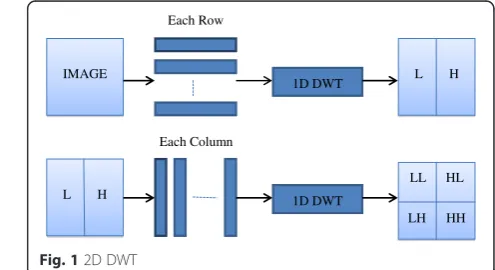
sequence of low-pass and high-pass filters. In this paper, we use a Haar scaling function and wavelet to transform the host image into the orthogonal DWT domain by three-level decomposition. A method to implement DWT is a filter bank that provides perfect reconstruc-tion. DWT has local analysis of frequency in the space and time domains, and it obtains image multi-scale de-tails step by step. If the scale becomes smaller, every part gets more accurate and ultimately all image details can be focalized accurately. If DWT is applied to an image, it will produce high-frequency parts, middle-frequency parts, and a lowest-frequency part. Figure 1 shows the procedure of applying one-level DWT to an image. In order to guarantee both image quality and robustness, this study embeds the watermark into the middle-frequency parts LH3 and HL3 in DWT level-three.
2.2 Singular value decomposition (SVD)
The singular value decomposition of a matrix A with
sizem×nis given by
A¼UDVT; ð6Þ
whereUandVare orthogonal matrices, andD= diag(λi)
is a diagonal matrix of singular values λi, i = 1, 2, ⋯,
which are arranged in decreasing order. The columns of Uare the left singular vectors, and the columns ofVare the right singular vectors of imageA.
IMAGE
L H
LL HL
LH HH L H
1D DWT 1D DWT Each Row
Each Column
2.3 Optimization solver
To find the extreme of the matrix function, some optimization methods are summarized in [29–31]. The operations of the matrix function are first shown as follows.
Theorem 1.IfWis a k×k constant matrix, and Xb is a k× 1column vector with k unknown variables, then
∂WXb
∂Xb ¼W ð7Þ
Theorem 2.IfXis a k× 1constant vector and Xb is a k× 1column vector with k unknown variables, then
∂ Xb−X
T
b
X−X
∂ Xb−X
¼2Xb−X: ð8Þ
In order to apply the Lagrange Principle, we have to introduce the gradient of a matrix functionf C as follows. Definition 1.Suppose thatXb ¼½^x1x^2⋅⋅⋅^xkT is a k× 1 unknown vector and f Xb is a function of the vectorX,b
the gradient of f bX is
∇f Xb ¼ ∂f
∂Xb¼
∂f
∂Xb1
∂f
∂Xb2
⋅⋅⋅ ∂f ∂Xbk
T
Now we consider the problem of minimizing (or
maxi-mizing) the matrix functionf Xb subject to a constraint
b
X ¼0. This problem can be described as follows:
minimize f Xb ð9aÞ
subject to g Xb ¼0 ð9bÞ
In order to solve (9), we apply the Lagrange Principle as follows.
Theorem 3. Suppose that g is a continuously differenti-able function ofXb on a subset of the domain of a function f.
Then if Xb0 minimizes (or maximizes) f Xb subject to the
constraint Xb ¼0; ∇f Xb0 and ∇g Xb0 are parallel.
That is, if Xb0 ≠0, then there exists a scalarξsuch that
∇f Xb0 ¼ξ∇g Xb0 : ð10Þ
Based on Theorem 3, if we let
IDWT
Watermarked image
DWT
Host image
Divide LH3 and HL3 into non-overlapping
blocksAk, 1, 2,k ,N.
Perform SVD on each block:
, 1, 2, ,
T k k k k
Embed watermark optimally into Singular Values of Each Block (see Figure 4.)
Fig. 2Watermark-embedding process
1
ˆ
ˆ
0.5 mod 2
r k i
k i
j
q
DWT
Watermarked image
ˆ
Watermark B
Group the optimized singular values of
SVD in each block
H Xb;ξ
¼f Xb þξg Xb ; ð11Þ then the original problem (9) becomes a function H
b
X;ξ
which has no constraint. The necessary condi-tions for existence of the extreme ofH Xb;ξ
are
∂H
∂ξ ¼0; ð12Þ
∂H
∂Xb ¼0: ð13Þ
3 Proposed optimization-based DWT-SVD watermarking scheme
The proposed watermarking scheme is introduced in this section. The watermark is extracted without the ori-ginal image.
3.1 Watermark embedding
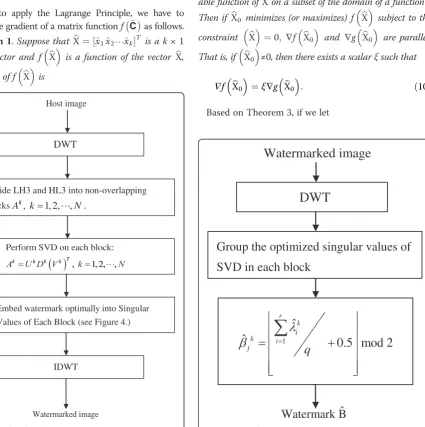
The proposed embedding process as shown in Fig. 2 is summarized as follows.
(1)Use three-level DWT to decompose the original image A into four subbands (i.e., LL3, LH3, HL3, and HH3). (2)Divide LH3 and HL3 into non-overlapping blocks
Ak,k= 1, 2,⋅ ⋅⋅,N.
(3)Apply SVD to each block, i.e.,
Ak ¼UkDk Vk T; k¼1;2;⋅⋅⋅;N ð14Þ where k represents the number of blocks in LH3 and HL3.
(4)WatermarkB= {βj} randomly generated using a binary PN sequence is embedded by modifying
singular valuesλik,i= 1,⋅ ⋅⋅,rof the matrixAkas follows: Let
μjk¼
$Xr
i¼1λ
k i
qþ
1 2
%
; ð15Þ
where ⌊⌋ indicates the floor function, and q∈ℝ+ is a quantization size which is adopted as another secret key K1. The embedding rules have three situations as follows:
Ifμjkmode 2 =βj, the singular values are modified to
y1¼μjkq ð16Þ
Ifμjkmode 2≠βjandμjk−
$Xr
i¼1λ
k i
q %
¼0, the singular values are modified to
y2¼ μjkþ1
q ð17Þ
Ifμjkmode 2≠βiandμkj−
$Xr
i¼1λ
k i
q %
≠0, the
singular values are modified to
y3¼ μjk−1
q ð18Þ
3.2 Watermark extraction
To detect the watermark, DWT is first performed and then the optimized singular values of SVD in each block are grouped. The embedded binary bits are extracted by using the following rule.
^ βj
k
¼
$Xr
i¼1^λ
k i
q þ0:5
%
mod2;
where ^βik denotes the extracted value and λ^i k
are the singular values which are optimized by the proposed optimization in the next section. The hidden water-mark bits (binary bits) are extracted as B¼ β^ik
n o
without the original image. In other words, the pro-posed scheme is a blind watermarking scheme. Figure3
shows the detailed process of the proposed watermark extraction.
4 Optimization of PSNR on singular values
Generally, the quality of a watermarked image is eva-luated by the peak signal-to-noise ratio (PSNR). Since a
tradeoff exists between image quality measured by PSNR and robustness measured by BER, a scalar parameterξis applied to connect the PSNR and the quantization equa-tion to optimize the tradeoff in this secequa-tion. The details are in the following:
Table 1Embedding capacity under fixed PSNR
Method Image genre Parameters Embedding capacity (bits)
Reference [24] Lena α= 28 256
Jet α= 25 256
Peppers α= 28 256
Cameraman α= 27 256
Reference [25] Lena α= 28 256
Jet α= 25 256
Peppers α= 28 256
Cameraman α= 27 256
Reference [27] Lena α= 28 256
Jet α= 25 256
Peppers α= 28 256
Cameraman α= 27 256 The proposed method Lena r= 2,q= 27 512 r= 4,q= 55 256 r= 8,q= 135 64 Jet r= 2,q= 26 512
r= 4,q= 44 256 r= 8,q= 129 64 Peppers r= 2,q= 28 512
r= 4,q= 51 256 r= 8,q= 131 64 Cameraman r= 2,q= 28 512
r= 4,q= 50 256 r= 8,q= 140 64
0 2 4 6 8 10 12 14 16
53.5 54 54.5 55 55.5
Number of coefficients k
PSN
R
First of all, the embedding technique can be rewritten as an equation according to Eqs. (16, 17, 18):
Wλ^Dk ¼y1;if}μkjmode 2¼βj}: ð19Þ
or
W^λDk ¼y2;if}μjkmode 2≠βiandμjk−
$Xr i¼1λ
k i
q
% ¼0}:
ð20Þ
or
W^λDk¼y3;if}μjkmode 2≠βiandμjk−
$Xr i¼1λ
k i
q
%
≠0}:
ð21Þ whereW ¼½1 ⋅⋅⋅ 1is a 1 ×rvector with all entries one, and the unknown vector ^λDk ¼ λ^1; ⋅⋅⋅ λ^r
T
is the watermarked singular value vector that corresponds toλDk ¼½λ1; ⋅⋅⋅ λrT.
Next, we will connect the above quantization equations to the PSNR. IfI(i,j) andĪ(i,j) are the values of the original and the corresponding modified pixel in the original image Iand watermarked image Ī, then is defined as
PSNR¼−10log10
Xm
i¼1
Xn
j¼1 Ið Þi;j−Ið Þi;j
2
2552mn 0
@
1 A;
ð22Þ where m and n represent the height and width of the host image. Based on the watermark embedding of sin-gular values, PSNR is expressed as
PSNR¼−10log10
^ λDk−λDk
2
2
2552mn
0 B @
1 C
A ð23Þ
For the optimization of the watermarked image quality, Eq. 23 is rewritten as a performance index:
f ^λDk
¼
^ λDk−λDk
2
2
2552mn ð24Þ
or
f ^λDk
¼ ^λDk−λDk
T
^ λDk−λDk
2552mn ð25Þ
(a) Lena (b) Jet
(c) Peppers (d) Cameraman
Based on the performance indexf λ^Dk
in Eq. 25 and
the constraint in Eq. 19, when “ μjk mode 2 = βi ”, the optimization-based quantization problem has the follow-ing form:
minimize
^ λDk−λDk
T
^ λDk−λDk
2552mn ð26aÞ
subject toW^λDk ¼y1 ð26bÞ
To embed the watermark B, we need to solve the
optimization problem (26). By Theorem 3, we set the Lagrange multiplierλ to combine (26a) and (26b) into a matrix function:
H λ^Dk;ξ
¼
^ λDk−λDk
T ^
λDk−λDk
2552mn þξ Wλ^Dk−y1
ð27Þ which has no constraint. Since 2552mnis a constant, we redefineH ^λDk;ξ
as follows:
H λ^Dk;ξ
¼ ^λDk−λDk
T ^
λDk−λDk
þ2552mnξ W^λDk−y1
ð28Þ
The necessary conditions for existence of the minimum ofH ^λDk;ξ
are ∂H
∂^λDk
¼2 λ^Dk−λDk
þ2552mnξWT ¼0 ð29aÞ
∂H
∂ξ ¼W^λDk−y1¼0 ð29bÞ
Multiplying (29a) by W, we observe that
2 W^λDk−WλDk
þ2552mnξWWT¼0 ð30Þ
Since W^λDk ¼y1 from (29b) and 2552mnis a scalar,
we rewrite (30) as
y1−Wλ^Dk
þ2552mn
2 ξWW
T ¼0 ð31Þ
Some operations yield the optimal solution for param-eterξas
(a) Lena (q=55) (b) Jet (q=44)
(c) Peppers (q 51) (d) Cameraman (q 50)
ξ¼ 2
2552mn WW T
−1
W^λDk−y1
ð32Þ
Replacing Eq. 32 with Eq. 29a yields the optimal em-bedded singular values
^ λDk
¼λDk−
2552mn
2 ξ
WT
¼λDk−WT WWT
−1
WλDk−y1
ð Þ ð33Þ
By using y2instead ofy1yields the optimal embedded
singular values
^ λDk
¼λDk−WT WWT
−1
WλDk−y2
ð Þ ð34Þ for the situation}μjkmode 2≠βiandμjk−
Xr i¼1λ
k i
q¼0}.
By using y3instead ofy1yields the optimal embedded
singular values
^
λDk ¼λDk−MT WWT
−1
WλDk−y3
ð Þ ð35Þ
for the situation}μjkmode 2≠β
iandμjk−
$Xr
i¼1λ
k i
q %
≠
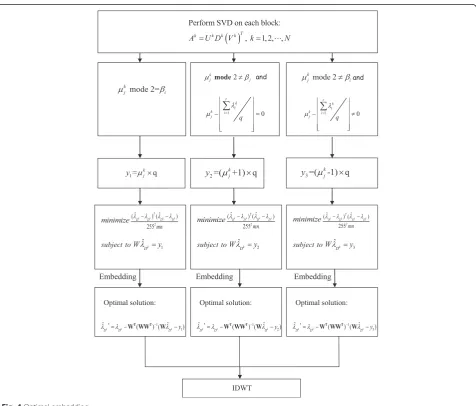
0}. Figure 4 shows the proposed optimal embedding process in detail.
5 Experimental results
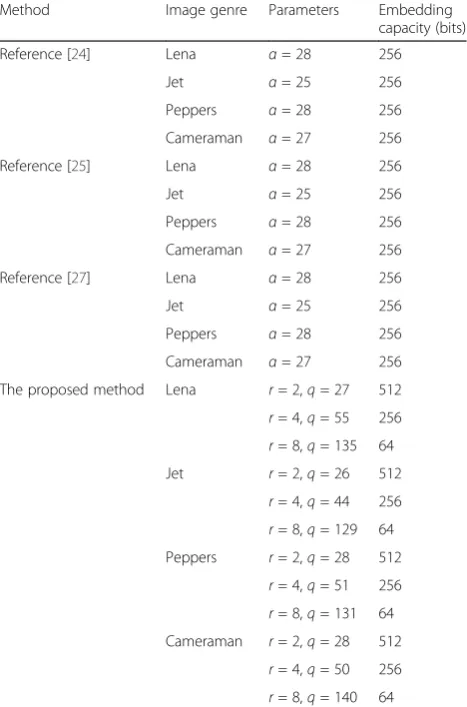
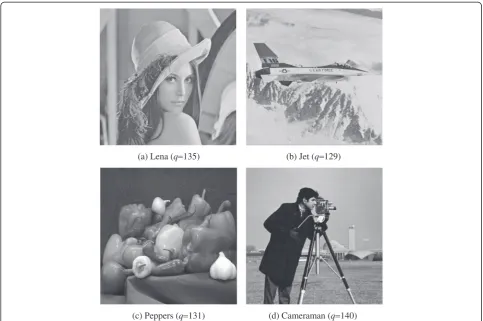
This section presents experimental results that indicate the performance of the proposed image-watermarking scheme. Forty host images including the four images, Lena,Jet,Peppers, andCameraman, each a size of 512 × 512, are decomposed into three levels by applying DWT; then, the watermark is embedded into the LH3 and HL3 coefficients. Figure 5 shows that the watermarked image can keep a high and stable PSNR (almost 54.5 dB) even when the number of coefficients for embedding a water-mark bit increases. This feature indicates the proposed optimization embedding formula using Lagrange principle. In order to compare with the SVD-based method [25], PSNR is fixed to be 55 dB. Table 1 shows the comparison (a) Lena (q 135) (b) Jet (q 129)
(c) Peppers (q 131) (d) Cameraman (q 140)
Fig. 8Watermarked images fork= 8.aWatermarked image of Lena (q= 55).bWatermarked image of Jet (q= 44).cWatermarked image of Peppers (q= 51).dWatermarked image of Cameraman (q= 50)
Table 2JPEG compression
Quality factor 10 20 30
Reference [24] 15.08 8.67 3.92
Reference [25] 13.22 9.12 4.03
Reference [27] 11.07 8.16 3.53
of the embedding capacity under fixed PSNR = 55. Figure 6 shows the original images, and Figs. 7 and 8 show the watermarked images obtained with different parameters.
To evaluate the robustness of the proposed method,
the 40 images including the four images, Lena, Jet,
Peppers, Cameraman, are tested. After the embedding process, four attacks are adopted to test the
robust-ness of the embedded watermark in cases k = 4 and
k = 8. The robustness is measured by BER defined by
BER¼Berror Btotal
100%
where Berror and Btotal denote the number of error
bits and the number of total bits, respectively. The method proposed herein is compared with the SVD-based method using the spread-spectrum technique in the DWT domain [25]. The test of robustness sup-ports the following conclusions:
(1)JPEG compression and JPEG2000 compression are the most popular compression methods. They are widely used to reduce the sizes of images. Usually, an image is compressed before it is transmitted over the Internet. Table2and Table3concern the compression of the 40 watermarked images by JPEG compression and JPEG2000 compression with different quality factors. The average BER of the proposed method is much lower than the other methods in casesk=r= 4 andk=r= 8. At the same time, the average BER of the proposed method decreases as the parameterkincreases.
(2)Table 4 shows the robustness against Gaussian noise with different means and variances. By testing the 40 watermarked images, the average BER of the proposed method is lower than other methods. As the parameter kincreases, the average BER of the proposed method decreases. (3)Table 5 shows the robustness against median
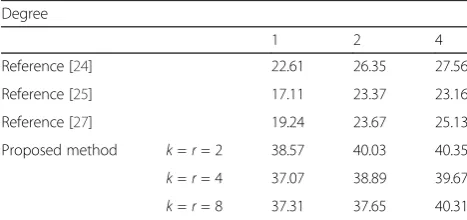
filtering with different radii in pixels. By testing the 40 watermarked images, the average BER of the proposed method is still much lower than other methods in cases k =r = 2 andk = r = 4. As the parameter k increases, the average BER of the proposed method also increases a little. (4)Table 6 shows the performance against rotation
attack with different degrees. By testing the 40 watermarked images, the average BER of the proposed method is slightly higher than other methods.
From the above discussion, the proposed method per-forms better than the method in [25] except for the rota-tion attack. And as the parameter k increases, the BER decreases as well except for the JPEG 2000 compression. To conclude, the proposed method is acceptable for its better performance except for the rotation attack.
6 Conclusions
This study improved the robustness of traditional SVD-based image watermarking by using optimization-SVD-based quantization on multiple singular values in the wavelet domain. Experimental results show that the watermarked
Table 3JPEG2000 compression
Quality factor 10 20 30
Reference [24] 16.36 9.88 3.42
Reference [25] 14.25 8.62 4.27
Reference [27] 15.18 9.13 3.58
Proposed method k=r= 2 13.25 7.08 4.96 k=r= 4 13.16 6.73 3.42 k=r= 8 13.22 5.13 1.12
Table 5Median filter
3 4 5
Reference [24] 29.06 33.91 32.03
Reference [25] 29.41 32.61 32.18
Reference [27] 29.08 30.14 30.27
Proposed method k=r= 2 5.71 24.21 21.58 k=r= 4 5.27 27.73 29.68 k=r= 8 8.59 35.15 48.43
Table 4Gaussian noise (mean = 0) Method and parameter
0.0002 0.0005 0.0009
Reference [24] 24.26 38.51 42.63
Reference [25] 19.92 33.20 38.28
Reference [27] 20.28 37.12 38.98
Proposed method k = r =2 7.13 21.73 34.96 k=r= 4 6.69 21.87 25.58 k=r= 8 5.46 13.28 22.65
Table 6Rotation Degree
1 2 4
Reference [24] 22.61 26.35 27.56
Reference [25] 17.11 23.37 23.16
Reference [27] 19.24 23.67 25.13
image can keep a high PSNR and achieve a better BER even when the number of coefficients for embedding a watermark bit increases. In particular, the robustness against JPEG compression, Gaussian noise, and median filtering is significantly improved. The future work is the consideration of improving robustness against rotation.
Acknowledgments
This work is partially supported under the grand MOST 103-2115-029-003.
Author details
1
Department of Applied Mathematics, Tunghai University, Taichung 407, Taiwan.2Department of Industrial Education and Technology, National Changhua University of Education, Changhua 500, Taiwan.3Department of Business Administration, Tunghai University, Taichung, Taiwan.
Received: 8 February 2015 Accepted: 1 June 2015
References
1. F Hartung, M Kutter,Multimedia watermarking techniques. Proceedings of the IEEE, 1999, p. 87
2. M Alghoniemy, AH Tewfik, Geometric distortion correction in image watermarking, inProceedings SPIE Security and Watermarking of Multimedia Contents II 3971, 2000, pp. 82–89
3. M Alghoniemy, AH Tewfik, Progressive quantized projection watermarking scheme, inProceedings 7thACM International Multimedia Conference, Orlando, FL, 1999, pp. 295–298
4. B Chen, GW Wornell, Quantization index modulation: a class of provably good methods for digital watermarking and information embedding. IEEE Trans. Inf. Theory47, 1423–1443 (2001)
5. P Kumswat, K Attakitmongcol, A Striaew, A new approach for optimization in image watermarking using genetic algorithms. IEEE Trans. Signal Process.
53(12), 4707–4719 (2005)
6. MU Celik, G Sharma, AM Tekalp, E Saber, Lossless generalized-LSB data embedding. IEEE Trans. Image Process.14(2), 253–266 (2005) 7. LC Lin, YB Lin, CM Wang, Hiding data in spatial domain images with
distortion tolerance. Elsevier: Computer Standards and Interfaces31, 458–464 (2009)
8. R Liu, T Tan, An SVD-based watermarking scheme for protecting rightful ownership. IEEE Transactions on Multimedia4(1), 121–128 (2002) 9. C-C Chang, P Tsai, C-C Lin, SVD-based digital image watermarking scheme.
Pattern Recogn. Lett.26(10), 1577–1586 (2005)
10. KL Chung, WN Yang, YH Huang, ST Wu, YC Hsu, On SVD-based watermarking algorithm. Application. Math. Comput.188, 54–57 (2007) 11. RA Ghazy, NA El-fishawy, MM Hadhoud, MI Dessouky, FEA El-Samie, An efficient block-by-block SVD-based image watermarking scheme, in2007 Radio Science Conference, Cairo, 2007, pp. 1–9
12. SF Lin, SC Shie, JY Guo, Improving the robustness of DCT-based image watermarking again JPEG compression. Elsevier: Computer Standards and Interfaces32, 57–60 (2010)
13. CC Lin, PF Shiu, High capacity data hiding scheme for DCT-based images. J. Inform. Hiding. Multimedia. Signal. Process.1(3), 220–240 (2010)
14. H Qaheri, A Mustafi, S Banerjee, Digital watermarking using ant colony optimization in fractional fourier domain. J. Inform. Hiding. Multimedia. Signal. Process.1(3), 179–189 (2010)
15. CH Manuel, GU Francisco, NM Mariko, HM Pérez-Meana, Robust hybrid color image watermarking method based on DFT domain and 2D histogram modification. Springer: Signal Image and Video Processing8(1), 49–63 (2014)
16. L Xiao, H Wu, Z Wei, Multiple digital watermarks embedding in wavelet domain with multiple-based number. J. Computer. Aided. Design. Computer. Graphics.15(2), 200–204 (2003)
17. P Bao, X Ma, Image adaptive watermarking using wavelet domain singular value decomposition. IEEE Transactions on Circuits and Systems for Video Technology15(1), 96–102 (2005)
18. E Ganic, AM Eskicioglu, Robust embedding of visual watermarks using DWT-SVD. J. Electronic. Imaging.14(4), 1–13 (2005)
19. M Sharkas, B Youssef, N Hamdy,An adaptive image-watermarking algorithm employing the DWT. the 23thNational Radio Science Conference, 2006, pp. 14–16
20. CT Li, Reversible watermarking scheme with image-independent embedding capacity. IEEE Proceedings on Vision, Image, and Signal Processing152(6), 779–786 (2006)
21. CV Serdean, MK Ibrahim, A Moemeni, MM Al-Akaidi, Wavelet and multiwavelet watermarking. IET Image Process.1(2), 223–230 (2007) 22. OZ Azza, M Achraf, B Ammar, Wavelet domain watermark embedding
strategy using TTCQ quantization. J. Computer Sci. Network Security.7(6), 165–170 (2007)
23. N Li, X Zheng, Y Zhao, H Wu, S Li,Robust algorithm of digital image watermarking based on discrete wavelet transform. International Symposium on Electronic Commerce and Security, 2008
24. B Gaurav, R Balasubramanian,A new robust reference watermarking scheme based on DWT-SVD. Elsevier: Computer Standards and Interfaces, 2009, pp. 1–12
25. CC Lai, CC Tsai, Digital image watermarking using discrete wavelet transform and singular value decomposition. IEEE Trans. Instrum. Meas.
59(11), 3060–3063 (2010)
26. S-T Chen, H-N Huang, C-Y Hsu, Optimization-based image watermarking scheme in the wavelet-domain, in2010 Fourth International Conference on Genetic Evolutionary Computing, ShenZhen, China, 2010, pp. 671–674 27. K Loukhaoukha, JY Chouinard, MH Taieb, Optimal image watermarking
algorithm based on LWT-SVD via multi-objective and colony optimization. J. Inform. Multimedia. Signal. Process.2(4), 303–319 (2011)
28. A Mishra, C Agarwal, A Sharma, P Bedi, Optimized gray-scale image watermarking using DWT- SVD and firefly algorithm. Elsevier: Expert Systems with Applications41, 7858–7867 (2014)
29. S-T Chen, H-N Huang, W-M Kung, C-Y Hsu,Optimization-based image watermarking with integrated quantization embedding in the wavelet domain. Springer: Multimedia Tools and Applications, 2015.
doi:10.1007/s11042-015-2522-8
30. S-T Chen, G-D Wu, H-N Huang, Wavelet-domain audio watermarking scheme using optimisation-based quantisation. IET Proceedings on Signal Processing4(6), 720–727 (2010)
31. S-T Chen, H-N Huang, C-C Chen, K-K Tseng, S-Y Tu,Adaptive audio watermarking via the optimization point of view on wavelet-based entropy. Elsevier: Digital Signal Processing, 2013, pp. 971–980
Submit your manuscript to a
journal and benefi t from:
7 Convenient online submission
7 Rigorous peer review
7 Immediate publication on acceptance
7 Open access: articles freely available online
7 High visibility within the fi eld
7 Retaining the copyright to your article