https://doi.org/10.5194/jsss-8-261-2019
© Author(s) 2019. This work is distributed under the Creative Commons Attribution 4.0 License.
Enabling a new method of dynamic field-effect gas
sensor operation through lithium-doped tungsten oxide
Marius Rodner1, Manuel Bastuck1,2, Andreas Schütze2, Mike Andersson1, Joni Huotari3,a, Jarkko Puustinen3,†, Jyrki Lappalainen3, and Tilman Sauerwald2
1Department of Physics, Chemistry and Biology, Linköping University, Linköping, 58183, Sweden 2Lab for Measurement Technologies, University of Saarland, Saarbrücken, 66123, Germany 3Faculty of Information Technology and Electrical Engineering, University of Oulu, Oulu, 90014, Finland
anow at: Toptester ltd., Rovaniemi, 96300, Finland †deceased
Correspondence:Tilman Sauerwald ([email protected])
Received: 20 November 2018 – Revised: 18 April 2019 – Accepted: 7 July 2019 – Published: 2 August 2019
Abstract. To fulfil today’s requirements, gas sensors have to become more and more sensitive and selective. Temperature-cycled operation has long been used to enhance the sensitivity and selectivity of metal-oxide semi-conductor gas sensors and, more recently, silicon-carbide-based, gas-sensitive field-effect transistors (SiC-FETs). In this work, we present a novel method to significantly enhance the effect of gate bias on a SiC-FET’s response, giving rise to new possibilities for static and transient signal generation and, thus, increased sensitivity and se-lectivity. A tungsten trioxide (WO3) layer is deposited via pulsed laser deposition as an oxide layer beneath a porous iridium gate, and is doped with 0.1 AT % of lithium cations. Tests with ammonia as a well-characterized model gas show a relaxation effect with a time constant between 20 and 30 s after a gate bias step as well as significantly increased response and sensitivity at+2 V compared to 0 V. We propose an electric field-mediated change in oxygen surface coverage as the cause of this novel effect.
1 Introduction
Dynamic operation of gas sensors has been known for decades to be able to increase sensitivity, selectivity, speed, and stability. The most prominent and abundant mode of operation is, arguably, temperature-cycled operation (TCO) used with resistive-type metal-oxide semiconductor gas sen-sors (Baur et al., 2015; Lee and Reedy, 1999; Leidinger et al., 2014). Fewer publications investigate the effect of electric fields on the surface reactions of this sensor type (Kiselev et al., 2011; Liess, 2002). The situation is similar for silicon-carbide-based gas-sensitive field-effect transistors (SiC-FETs): the benefits of TCO have recently been demon-strated in many publications (Bur, 2015), but only a few pub-lications study the influence of gate bias-cycled operation (GBCO) (Bastuck et al., 2014; Nakagomi et al., 2005; Pohle et al., 2010). Nevertheless, these studies suggest interesting effects that could enhance both the sensitivity and selectiv-ity of SiC-FETs. One promising property is the very quick
electric time constant for GBCO of the order of milliseconds (Bur et al., 2014), whereas the slow thermal time constant (seconds) is not able to excite responses based on a thermo-dynamic equilibrium like in e.g. Baur et al. (2015).
bil-lion) range (Leidinger et al., 2015). Furthermore, WO3layers with a catalytic material on top have been used as the sensing layer on top of the gate area of a silicon-carbide field effect transistor (SiC-FET) sensor structure (Puglisi et al., 2015). SiC is used as a substrate due to its chemical inertness and resilience to high temperatures, up to 1000◦C, without los-ing its semiconductlos-ing properties (Lloyd Spetz and Anders-son, 2012). An area where this is of interest is in the exhaust stream of diesel combustion engines where quantification of ammonia helps to monitor the selective catalytic reduction (SCR) (Morimune et al., 1998), which can be used to lower the concentration of hazardous NOx.
WO3films show relaxation and polarization effects caused by ion transport when applying an alternating voltage (Sauer-wald et al., 2005; Varpula et al., 2011). This polarization ef-fect can be used to enhance the sensitivity and selectivity of metal-oxide gas sensors (Sauerwald et al., 2007). Alkali cations like Li+can be added to promote this effect (Niklas-son and Granqvist, 2007). In the case of Li+, up to two ions per W atom can be inserted into the WO3 structure, with the intercalation being fully reversible up to a ratio of 0.7 (Berggren, 2004). The intercalation of Li+ions increases the electrical conductance by orders of magnitude (Berggren et al., 2004). Moreover, Li+ions are very mobile in the WO3 lattice. The diffusion coefficient for Li+in WO3at room tem-perature (RT) is approximately 10−12cm2s−1, with an ion mobility of approximately 4×10⁻¹¹cm2V−1s−1(Niklasson and Granqvist, 2007; Strømme Mattsson, 2000). Both posi-tive and negaposi-tive charge carriers are available in the material, but the gate electrode only conducts electrons and is imper-meable for the Li+ions. It is well known that the catalytic effect of surfaces can be changed with ionic polarization, i.e. the electrochemical potential of the surface. This effect is known as electrochemical promotion of catalysis (EPOC) or non-Faradaic electrochemical modification of catalytic ac-tivity (NEMCA) (Katsaounis, 2010). As indicated in the term NEMCA, the mobile ions are not necessarily part of the cat-alytic reaction itself, allowing a steady-state reaction on the gate electrode.
In this work, we aim at the preparation of dense WO3 thin films with a predominant epsilon (ε) phase. Tungsten oxide in ε phase has been used by some of the authors in a prior investigation (Leidinger et al., 2016) as there is evi-dence it might have a positive effect on sensitivity to reduc-ing gases reported at least for silicon- and chromium-doped ε-WO3(Righettoni et al., 2010; Wang et al., 2008). The WO3 layer was deposited on top of the native gate oxide, SiO2, of a SiC-FET gas sensor and doped with Li+. The effects ob-served with the thusly prepared sensor are analysed and dis-cussed compared to a non-doped sensor based on ammonia as a well-characterized model gas.
2 Experimental details
2.1 Sensor preparation
The FET transducer samples were supplied by SenSiC AB, Kista, Sweden, with 80 nm SiO2 as a native gate oxide and without any gate electrode. The detailed manufacturing pro-cess is described by Andersson et al. (2013); 20 nm HfO2 was deposited on the native gate oxide by thermal evapora-tion (2×10⁻⁶mbar background pressure) in order to prevent Li+ions diffusing in the SiO2. To ensure good quality of the amorphous HfO2 film with high stoichiometry, the samples were post-annealed in an oxygen atmosphere at 300◦C for 16 h using an alumina-lined tube furnace (LabStar 600, EN-TECH, Ängelholm, Sweden).
Subsequently, WO3 was deposited onto the HfO2 with pulsed laser deposition (PLD), an efficient method for pro-ducing metal-oxide films with well-defined properties (Ea-son, 2007; Willmott and Huber, 2000). The deposition and its pre- and post-treatments were done at the Microelectronics and Material Physics Laboratory at Oulu University, Finland. The utilized nanosecond laser is a Lambda Physik Compex 201 xenon chloride (XeCl) excimer laser with a wavelength of 308 nm and a pulse length of 25 ns. The beam fluence for a spot area of 0.05 cm2is approximately 1.25 J cm−2with a laser pulse frequency of 5 Hz. Before deposition, the pres-sure in the chamber is pumped down to between 2×10⁻⁵ and 5×10⁻⁵mbar and the oxygen partial pressure is held at 5×10⁻²mbar throughout the deposition to ensure a dense layer and to oxidize the tungsten; 60 nm of WO3, correspond-ing to 1000 laser pulses, was deposited on the sensor’s gate area. The sensor samples were heated to 550◦C during the deposition.
In a final step, a 20 nm thin, porous iridium film was deposited as a conductive gate electrode on top of the WO3by DC magnetron sputtering. The deposition rate was 0.67 nm s−1, the background pressure 6×10⁻⁸mbar, and the argon pressure 7×10⁻²mbar, and the power supply was set to 300 V with 480 mA.
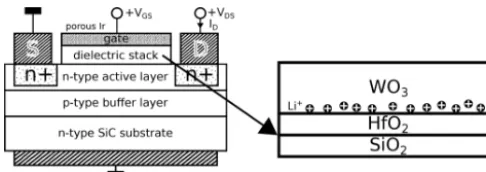
Figure 1.Schematic of the used FET structure adapted from An-dersson et al. (2013) highlighting the dielectric stack and the polar-ization effect with a positiveVGS. The schematics are not to scale.
of some sodium. Since sodium is also an alkali ion, i.e. silar to Li, we assume no negative influences from these im-purities. No spectroscopic investigations have been done to crosscheck these results.
A schematic drawing of the resulting device is shown in Fig. 1. Note that the WO3layer is associated with the dielec-tric stack of the FET structure despite its high conductivity in its doped state. The polarization effect is shown for a pos-itive gate biasVGS, with the result that the Li+ions move to the lower part of the WO3 film and accumulate there since further movement is inhibited by the HfO2diffusion barrier.
The as-deposited, both doped and undoped, sensor chips of approximately 2×2 mm2 in size, each containing two FET structures, were attached to a heater substrate (Her-aeus Sensor-Nite GmbH, Kleinostheim, Germany) for the electrical and gas characterizations, along with a Pt100 tem-perature sensor (Heraeus Sensor-Nite GmbH), using a high-temperature, non-conducting ceramic adhesive (AREMCO 571). The heater substrate was then mounted on a 16-pin TO8 header and electrically contacted together with the Pt100 temperature sensor by spot welding to pins on the TO8 header. The SiC-FET device was electrically connected to the pins of the TO8 header by gold wire bonding. Before the first measurement, each sensor was burned in using the inter-nal heater for at least 24 h at 400◦C.
2.2 Hardware and electronics
The electronic measurement equipment for setting the op-eration parameters (temperature and gate bias voltage) and read-out of the sensor signals was developed by 3S GmbH, Saarbrücken, Germany. It can adjust the sensor temperature between 70 and 400◦C with a resolution of 1◦C and controls the drain-source (VDS), gate-source (VGS), and substrate-source (or bulk) (VBS) voltages. The drain current ID was measured as a sensor signal within the range from 0 to 500 µA at a constantVDSof+4 V. During the measurement, the sensors were kept at 300◦C.
A gas mixing system using dynamic dilution was utilized to expose the sensors to defined gas concentrations similar to the system described in Helwig et al. (2014). A commercial gas cylinder with 500 ppm ammonia gas was diluted into a
carrier gas stream of dry zero air. The total flow over the sensor was kept at 100 mL min−1.
3 Results and discussion
3.1 Morphological and structural characterization The average roughness of the WO3 layer, calculated as the root mean square deviation (RMSD) of a 1×1 µm2 AFM micrograph, was 3 nm, indicating a very flat layer. The grain size of approximately 24 nm was determined from an XRD spectrum of the columnar layer. Further details about how these results have been achieved as well as more information about the following Raman measurements can be found in the Supplement.
The heat treatment has a strong influence on the layer morphology and distribution and orientation of crystalline phases. In the Raman spectra (Fig. 2), the change from amor-phous (blue, as-deposited) to more oriented (black, in situ annealed) WO3can be seen. Theεpeaks at Raman shifts of 268 and 425 cm−1as well as theγpeaks at 71 and 134 cm−1 are clearly visible, whereas theεpeak at 372 cm−1 and the γ peak at 187 cm−1 are not pronounced much (Cazzanelli et al., 1999). As most of theε andγ peaks are very close to each other and the peaks are mostly broad, it is difficult to determine which orientation is dominating. The peak at a Ra-man shift of 521 cm−1obviously belongs to the silicon sub-strate and exceeds the intensity measured for tungsten oxide by 1 order of magnitude. Above a shift of 600 cm−1, W–O stretching from the amorphous phase is observed for the as-deposited (RT) sample as a wide hump (Baserga et al., 2007). It has been stated in the literature that theεphase has a Ra-man mode at 678 cm−1, while theγphase has a distinct peak at 717 cm−1(Cazzanelli et al., 1999; Righettoni et al., 2010). Thus, the Raman measurement indicates that the in situ an-nealed sample contains more of theεphase.
3.2 Electrical characterization
Figure 2. Raman spectra for undoped WO3 layers deposited at
room temperature (blue, dashed) and at 550◦C (black, solid).
surface, so that more free electrons are available close to the surface. With the abundance of electrons, the surface cover-age with oxygen anions increases over time (Sauerwald et al., 2007), partly compensating for the positive gate bias and lowering the measured current until the oxygen surface cov-erage has reached its new equilibrium. The opposite happens for negative gate biases: lithium cations partly bind electrons close to the surface, resulting in a decreasing oxygen surface coverage and an increasing current. Alternatively, or addi-tionally, this observation could also be explained by an elec-trochemical variation of the surface reactions similar to the EPOC effect, which creates an effective double layer of Li+ ions hindering oxygen adsorption to the sensor surface when a negative bias is applied (Katsaounis, 2010).
The relaxation after the initial peak was fitted over 300 s to gain information about the time constantτ using the fol-lowing exponential equation:
I(t)=I0−A·exp
−t−t0 τ
. (1)
The fit parameters are the terminal current, I0, the ampli-tude, A, and the time constant, τ. The parameter t0 is the starting point of the fit in time. The relaxation exhibits time constants between 20 and 30 s. The high mobility of Li+ in WO3 (Niklasson and Granqvist, 2007) disqualifies ionic movement as the sole explanation for the observed relaxation – the time constant estimated from mobility and the electric field is already at room temperature one order of magnitude below the measured effect, supporting the slower oxygen sur-face coverage as an explanation. This would, at the same time, explain the lower transconductance, i.e. change in ID withUGS, observed in Fig. 3.
3.3 Gas response
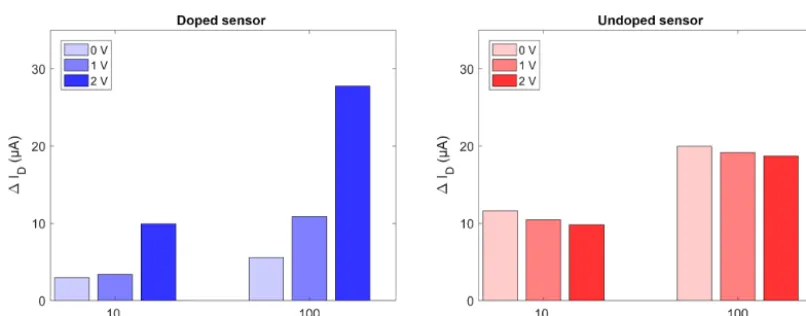
The FET sensor samples were exposed to two different am-monia concentrations (10 and 100 ppm) in dry air at a sensor temperature of 300◦C. Ammonia was selected as a model gas to investigate the influence of the gate bias: it is one of the most studied gases for SiC-FETs in particular and was shown to interact well with WO3as a sensing material (Wang et al., 2006). Each concentration was offered for 30 min with 60 min of zero air after each gas exposure to allow relaxation to the baseline. Figure 4 shows the different responses1ID, i.e. the difference between the measured drain current with and without gas exposure, of the doped (a) and undoped (b) sensors for gate biases of 0, +1, and +2 V. The quantiza-tion error of the response is ±60 nA. Both sensors exhibit a clearly concentration-dependent response. The higher re-sponse of the undoped sensor at 0 and 1 V is, most likely, due to variations in the manufacturing process of the transis-tor structure. It has been reported that the threshold voltage of these FET devices may vary within the same batch, influ-encing the sensitivity baseline (Andersson et al., 2013). The undoped sensor’s response is independent of the applied gate bias and is approximately 12 and 20 µA for 10 and 100 ppm NH3, respectively. In contrast, the doped sensor’s response is strongly influenced by the gate bias. While the response is 3 and 6 µA at 0 V, it increases to 9 and 28 µA, at 2 V for 10 and 100 ppm, respectively.
Figure 3.(a)IV curves at different gate biases for doped and undoped sensors with indication of the measurement set point ofVDS=4 V and(b)drain currentIDat different gate biases for doped and undoped samples annealed in situ with a circle exemplarily highlighting one
overshoot for the doped sensor. The different gate potentials−0.5, 0, and+0.5 V are shown in the lower subplot. The measurements in (a)and(b)were done some time apart, so that the slight baseline shift can be explained by sensor drift.
Figure 4.Sensor response at different gate biases of 0, 1, and 2 V for a doped(a)and an undoped(b)sensor at 10 and 100 ppm NH3.
oxide is increased by lithium doping as well (Niklasson and Granqvist, 2007). In the surface state trapping model this leads to an increase in surface oxygen (Ding et al., 2001). This increase in oxygen coverage is presumably the reason for the higher sensitivity of the doped sensors.
A second pair of sensors from a second production batch was tested with similar and different concentrations and gate biases to verify the doping effect. The results are shown in Figs. S3 and S4 in the Supplement.
4 Conclusions
Pulsed laser deposition parameters have been successfully optimized to deposit dense WO3films on top of SiC-FET de-vices. The distribution and orientation of crystalline phases can be adjusted by heat treatment during the deposition. In situ annealing leads to a more ordered and stable structure with a comparably high amount of the ε phase. This or-dered layer was deposited as the top-most layer of the
Data availability. Research data are available upon request to the authors.
Supplement. The supplement related to this article is available online at: https://doi.org/10.5194/jsss-8-261-2019-supplement.
Author contributions. MR, MB, TS, and MA planned the mea-surements. JH carried out the Raman measurements and evaluation and supervised the PLD process. MR carried out all other measure-ments and did most of the evaluation. JP performed the XRD data evaluation. MR, MB, and TS prepared a concept of the manuscript. MR wrote the manuscript. MB, TS, JL, MA, and AS contributed with substantial revisions.
Competing interests. The authors declare that they have no con-flict of interest.
Acknowledgements. The authors want to thank the technical support of the Center of Microscopy and Nanotechnology of the University of Oulu. We acknowledge the support by the Euro-pean Cooperation in Science and Technology (within COST Action TD1105-EuNetAir) and by the Deutsche Forschungsgemeinschaft (DFG, German Research Foundation) within the Open Access Pub-lishing funding programme.
Financial support. We have received support for scientific ex-change from the European Cooperation in Science and Technol-ogy and support for Open Access Publishing from the Deutsche Forschungsgemeinschaft and Saarland University.
Review statement. This paper was edited by Albert Romano-Rodriguez and reviewed by two anonymous referees.
References
Andersson, M., Pearce, R., and Lloyd Spetz, A.: New generation SiC based field effect transistor gas sensors, Sensors Actuators B Chem., 179, 95–106, https://doi.org/10.1016/j.snb.2012.12.059, 2013.
Baserga, A., Russo, V., Di Fonzo, F., Bailini, A., Cattaneo, D., Casari, C. S., Li Bassi, A., and Bottani, C. E.: Nanostruc-tured tungsten oxide with controlled properties: Synthesis and Raman characterization, Thin Solid Films, 515, 6465–6469, https://doi.org/10.1016/j.tsf.2006.11.067, 2007.
Bastuck, M., Bur, C., Lloyd Spetz, A., Andersson, M., and Schütze, A.: Gas identification based on bias induced hysteresis of a gas-sensitive SiC field effect transistor, J. Sens. Sens. Syst., 3, 9–19, https://doi.org/10.5194/jsss-3-9-2014, 2014.
Baur, T., Schütze, A., and Sauerwald, T.: Optimierung des temper-aturzyklischen Betriebs von Halbleitergassensoren, Tech. Mess., 82, 187–195, https://doi.org/10.1515/teme-2014-0007, 2015.
Berggren, L.: Optical Absorption and Electrical Conductivity in Lithium Intercalated Amorphous Tungsten Oxide Films, Uppsala University, 2004.
Berggren, L., Ederth, J., and Niklasson, G. A.: Electrical con-ductivity as a function of temperature in amorphous lithium tungsten oxide, Sol. Energy Mater. Sol. Cells, 84, 329–336, https://doi.org/10.1016/j.solmat.2004.02.049, 2004.
Bur, C.: Selectivity Enhancement of Gas Sensitive Field Effect Transistors by Dynamic Operation, Universität des Saarlandes, Saarbrücken, 2015.
Bur, C., Bastuck, M., Lloyd Spetz, A., Andersson, M., and Schütze, A.: Selectivity enhancement of SiC-FET gas sensors by com-bining temperature and gate bias cycled operation using mul-tivariate statistics, Sensors Actuators B Chem., 193, 931–940, https://doi.org/10.1016/j.snb.2013.12.030, 2014.
Cazzanelli, E., Vinegoni, C., Mariotto, G., Kuzmin, A., and Purans, J.: Low-Temperature Polymorphism in Tung-sten Trioxide Powders and Its Dependence on Me-chanical Treatments, J. Solid State Chem., 143, 24–32, https://doi.org/10.1006/jssc.1998.8061, 1999.
Ding, J., McAvoy, T. J., Cavicchi, R. E., and Semancik, S.: Surface state trapping models for SnO2-based
microhot-plate sensors, Sensors Actuators, B Chem., 77, 597–613, https://doi.org/10.1016/S0925-4005(01)00765-1, 2001. Eason, R. (Ed.): Pulsed Laser Deposition of Thin Films:
Applications-Led Growth of Functional Materials, John Wiley & Sons, New Jersey, 2007.
Eriksson, M. and Ekedahl, L.-G.: Hydrogen adsorption states at the Pd/SiO2interface and simulation of the response of a Pd metal–
oxide–semiconductor hydrogen sensor, J. Appl. Phys., 83, 3947, https://doi.org/10.1063/1.367150, 1998.
Fogelberg, J., Lundstrom, I., and Petersson, L. G.: Ammonia dissociation on oxygen covered palladium studied with a hy-drogen sensitive pd-mos device, Phys. Scr., 35, 702–705, https://doi.org/10.1088/0031-8949/35/5/017, 1987.
Helwig, N., Schüler, M., Bur, C., Schütze, A., and Sauerwald, T.: Gas mixing apparatus for automated gas sensor characterization, Meas. Sci. Technol., 25, 055903, https://doi.org/10.1088/0957-0233/25/5/055903, 2014.
Katsaounis, A.: Recent developments and trends in the electrochem-ical promotion of catalysis (EPOC), J. Appl. Electrochem., 40, 885–902, https://doi.org/10.1007/s10800-009-9938-7, 2010. Kim, Y. S., Ha, S. C., Kim, K., Yang, H., Choi, S. Y., Kim, Y. T.,
Park, J. T., Lee, C. H., Choi, J., Paek, J., and Lee, K.: Room-temperature semiconductor gas sensor based on nonstoichio-metric tungsten oxide nanorod film, Appl. Phys. Lett., 86, 1–3, https://doi.org/10.1063/1.1929872, 2005.
Kiselev, I., Sommer, M., and Sysoev, V. V.: Electric field-induced rearrangement of charged species in metal oxide devices with resistive change: thermodynamic limitations, Eur. Phys. J. B, 82, 7–12, https://doi.org/10.1140/epjb/e2011-20176-0, 2011. Lee, A. P. and Reedy, B. J.: Temperature modulation in
semi-conductor gas sensing, Sensors Actuators B Chem., 60, 35–42, https://doi.org/10.1016/S0925-4005(99)00241-5, 1999. Leidinger, M., Sauerwald, T., Reimringer, W., Ventura, G., and
Leidinger, M., Huotari, J., Sauerwald, T., Lappalainen, J., and Schütze, A.: Nanostructured WO3 Semiconductor Gas Sensor
for Selective Detection of Naphthalene, in: AMA Conferences 2015 – SENSOR 2015 and IRS22015, 723–728, 2015. Leidinger, M., Huotari, J., Sauerwald, T., Lappalainen, J., and
Schütze, A.: Selective detection of naphthalene with nanostruc-tured WO3 gas sensors prepared by pulsed laser deposition,
J. Sens. Sens. Syst., 5, 147–156, https://doi.org/10.5194/jsss-5-147-2016, 2016.
Liess, M.: Electric-field-induced migration of chemisorbed gas molecules on a sensitive film – a new chemical sensor, Thin Solid Films, 410, 183–187, https://doi.org/10.1016/S0040-6090(02)00209-2, 2002.
Llobet, E., Molas, G., Molinàs, P., Calderer, J., Vilanova, X., Brezmes, J., Sueiras, J. E., and Correig, X.: Fabrication of Highly Selective Tungsten Oxide Ammonia Sensors, J. Electrochem. Soc., 147, 776, https://doi.org/10.1149/1.1393270, 2000. Lloyd Spetz, A. and Andersson, M.: Technology and Application
Opportunities for SiC-FET Gas Sensors, in: Solid State Gas Sensors – Industrial Application, edited by: Fleischer, M. and Lehmann, M., 189–214, Springer, Berlin, 2012.
Morimune, T., Yamaguchi, H., and Yasukawa, Y.: Study of catalytic reduction of NO(x) in exhaust gas from a diesel engine, Exp. Therm. Fluid Sci., 18, 220–230, https://doi.org/10.1016/S0894-1777(98)10025-0, 1998.
Nakagomi, S., Fukumura, A., Kokubun, Y., Savage, S., Wingbrant, H., Andersson, M., Lundström, I., Löfdahl, M., and Lloyd Spetz, A.: Influence of gate bias of MISiC-FET gas sensor device on the sensing properties, Sensors Actuators B Chem., 108, 501–507, https://doi.org/10.1016/j.snb.2004.11.057, 2005.
Niklasson, G. A. and Granqvist, C. G.: Electrochromics for smart windows: thin films of tungsten oxide and nickel ox-ide, and devices based on these, J. Mater. Chem., 17, 127–156, https://doi.org/10.1039/b612174h, 2007.
Penza, M., Tagliente, M. A., Mirenghi, L., Gerardi, C., Martucci, C., and Cassano, G.: Tungsten trioxide (WO3) sputtered thin films
for a NOx gas sensor, Sensors Actuators B Chem., 50, 9–18, https://doi.org/10.1016/S0925-4005(98)00149-X, 1998. Pohle, R., Von Sicard, O., Fleischer, M., Frerichs, H. P.,
Wilbertz, C., and Freund, I.: Gate pulsed readout of floating gate FET gas sensors, Procedia Eng., 5, 13–16, https://doi.org/10.1016/j.proeng.2010.09.036, 2010.
Puglisi, D., Eriksson, J., Bastuck, M., Bur, C., Huotari, J., and An-dersson, M.: Exploring the gas sensing performance of catalytic metals and metal oxides on 4H-SiC field effect transistors, in: In-ternational Conference on Silicon Carbide and Related Materials, Giardini Naxos, 2015.
Righettoni, M., Tricoli, A., and Pratsinis, S. E.: Ther-mally stable, silica-doped ε-WO3 for sensing of
ace-tone in the human breath, Chem. Mater., 22, 3152–3157, https://doi.org/10.1021/cm1001576, 2010.
Sauerwald, T., Skiera, D., and Kohl, D.: Field induced polarisation and relaxation of tungsten oxide thick films, Thin Solid Films, 490, 86–93, https://doi.org/10.1016/j.tsf.2005.04.009, 2005. Sauerwald, T., Skiera, D., and Kohl, D.: Selectivity enhancement of
gas sensors using non-equilibrium polarisation effects in metal oxide films, Appl. Phys. A Mater. Sci. Process., 87, 525–529, https://doi.org/10.1007/s00339-007-3980-2, 2007.
Shaver, P. J.: Activated Tungsten Oxide Gas Detectors, Appl. Phys. Lett., 11, 255–257, https://doi.org/10.1063/1.1755123, 1967. Solis, J. L., Saukko, S., Kish, L., Granqvist, C. G., and
Lantto, V.: Semiconductor gas sensors based on nanos-tructured tungsten oxide, Thin Solid Films, 391, 255–260, https://doi.org/10.1016/S0040-6090(01)00991-9, 2001. Strømme Mattsson, M.: Li insertion into WO3: Introduction
of a new electrochemical analysis method and comparison with impedance spectroscopy and the galvanostatic intermit-tent titration technique, Solid State Ionics, 131, 261–273, https://doi.org/10.1016/S0167-2738(00)00674-3, 2000. Varpula, A., Novikov, S., Haarahiltunen, A. and Kuivalainen,
P.: Transient characterization techniques for resistive metal-oxide gas sensors, Sensors Actuators B Chem., 159, 12–26, https://doi.org/10.1016/j.snb.2011.05.059, 2011.
Wang, G., Ji, Y., Huang, X., Yang, X., Gouma, P. I., and Dudley, M.: Fabrication and characterization of poly-crystalline WO3 nanofibers and their application for
am-monia sensing, J. Phys. Chem. B, 110, 23777–23782, https://doi.org/10.1021/jp0635819, 2006.
Wang, L., Teleki, A., Pratsinis, S. E., and Gouma, P. I.: Ferroelec-tric WO3 nanoparticles for acetone selective detection, Chem.
Mater., 20, 4794–4796, https://doi.org/10.1021/cm800761e, 2008.