WIRELESS SENSSOR NETWORK TECHNOLOGY
Santosh Kumar
1, Shivani Singh Chauhan
21
Computer Science and Engineering,
2Information Technology, SRMSCET, Bareilly/ UPTU, (India)
ABSTRACT
Wireless Sensor Networks (WSNs) provide a new paradigm for sensing and disseminating information from various environments, with the potential to serve many and diverse applications. A smart WSN consists of a number of sensors spread across a geographical area; each sensor has wireless communication capability and sufficient intelligence for signal processing and networking of the data. We highlight potential applications to off-shore oilfields for seismic monitoring, equipment monitoring, and underwater robotics. We identify research directions in short-range acoustic communications, MAC, time synchronization, and localization protocols for high-latency acoustic networks, long duration network sleeping, and application-level data scheduling. The structure of WSNs are tightly application-dependent, and many services are also dependent on application semantics (e.g. application-specific data processing combined with data routing). Thus, there is no single typical WSN application, and dependency on applications is higher than in traditional distributed applications. The application/middleware layer must provide functions that create effective new capabilities for efficient extraction, manipulation, transport, and representation of information derived from sensor data. We focus on middleware technology, and describe details of some existing research prototypes, then address challenges and future perspectives on the middleware.
Keywords
:
Design Principles, Micro Sensors, Sensor Networks, Tracking And Classification,
Technologies Supporting Wsns, Wireless Networks.
I. INTRODUCTION
Sensor networks have the promise of revolutionizing many areas of science, industry, and government with their ability to bring computation and sensing into the physical world. The ability to have small devices physically distributed near the objects being sensed brings new opportunities to observe and act on the world, for example with micro-habitat monitoring [3, 4], structural monitoring [5], and wide-area environmental systems [6]. WSNs have recently received a lot of attention in the research literature; recent survey and overview papers are: [56, 227, 9, 52, 214, 69, 8, 66, 10, 7, 180, and 117]. These papers focus on operating systems, routing, or applications. In this paper we report the latest trends in WSN research, focusing on middleware technology and related areas, and including application design principles.
However, we do not cover every possible WSN technology; for example, mobile, ad hoc, communication technology may be important for WSNs, but it is out of scope of this paper because it already has an established base and hardware. First, we give an overview of WSNs and design aspects of applications, including existing research prototypes and industry applications.
of research that supports sensor network environments. We then highlight outstanding issues and conclude with future perspectives on middleware technology. This paper consist following section to describe WSNs: section 2 describes characteristics of WSNs, section 3 describes applications design principles, section 4 describes technologies supporting WSNs, section 5 summarizes middleware technologies, section 6 describes future challenges, and we conclude in section 7.
II. WIRELESS SENSOR NETWORKS
A WSN is a collection of millimeter-scale, self-contained, micro-electro-mechanical devices. These tiny devices have sensors, computational processing ability (i.e. CPU power), wireless receiver and transmitter technology and a power supply.
In future, a WSN could be a collection of autonomous nodes or terminals that communicate with each other by forming a multi-hop radio network and maintaining connectivity in a decentralized manner by forming an ad hoc network. Such WSNs could change their topology dynamically when connectivity among the nodes varies with time due to node mobility. But current, real-world deployment usually consists of stationary sensor nodes. Intuitively, a denser infrastructure would create a more effective sensor network. It can provide higher accuracy and has more energy available for aggregation. If not properly handled, a denser network can also lead to collisions during transmission, and network congestion. This will no doubt increase latency and reduce efficiency in terms of energy consumption. One distinguishing characteristic of WSNs is their lack of strong boundaries between sensing, communication and computation. Unlike the Internet, where data generation is mostly the province of end points, in sensor networks every node is both a router and a data source.
Fig: -1 Overview of Wireless Sensor Network
III. MICRO SENSORS
Networked micro sensors technology is a key technology for the future. In September 1999 [1], Business Week
heralded. It as one of the 21 most important technologies for the 21st century. Cheap, smart devices with
embedded processing capability, and will potentially have multiple onboard sensors, operating in the acoustic, seismic, infrared (IR), and magnetic modes, as well as imagers and micro radar. Also onboard will be storage, wireless links to neighboring nodes, and location and positioning knowledge through the global positioning system (GPS) or local positioning algorithms. Networked micro sensors belong to the general family of sensor networks that use multiple distributed sensors to collect information on entities of interest.
IV. DESIGN PRINCIPLE
A vision of future ubiquitous computing is that tiny processors and sensors will be integrated with everyday objects in order to make them smart. Smart objects can explore their environment, communicate with other smart objects, and interact with humans. Fig. 2 shows an application space and potential real applications of the distributed WSN that allow monitoring of a wide variety of environmental phenomena with adequate quality and scale.
Fig:-2 Application Space
V. TECHNOLOGIES SUPPORTING WSNS
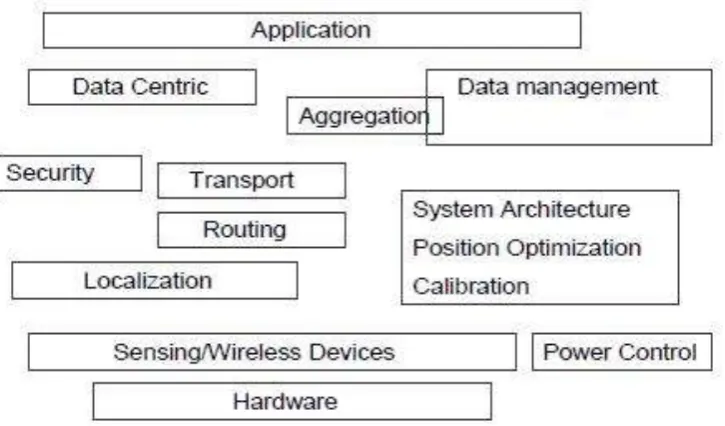
Fig:-3 Technologies for WSNs
This section describes various technologies supporting sensor networks. The issues related to the sensor node hardware is out of scope in this paper. We focus on the system and network communication technologies in this section and discuss the current state of these technologies.
VI. APPLICATION OF WSNS
1. New 3G Sensors Stream Photo and Video to the Cloud for new Security and Military Applications
Libelium today released a new generation of autonomous 3G sensors equipped with video cameras that enable the development of new security, surveillance and military applications on Waspmote, the wireless sensor network platform for the Internet of Things. These new video camera sensors fig 4, in conjunction with the 3G
Waspmote uses ZigBee, Bluetooth and Wi-Fi protocols to send low bandwidth data such as temperature, humidity and CO2 levels, and high speed W-CDMA and HSPA mobile networks to upload video. “This is the first time that a single battery-powered sensor device integrates both high and low bandwidth technologies,” said David Gascón, CTO of Libelium. “We are able to minimize operation costs by using the mobile network when it is really needed.”
For security applications that require night vision mode, the new video camera sensor nodes include dozens of high-power infrared (IR) LEDs, allowing Waspmote to take pictures in total darkness. The 3G module is equipped with an internal GPS that adds geolocation meta information to all multimedia files. Fig 5 show the security architecture.
Fig 5:- Security Application
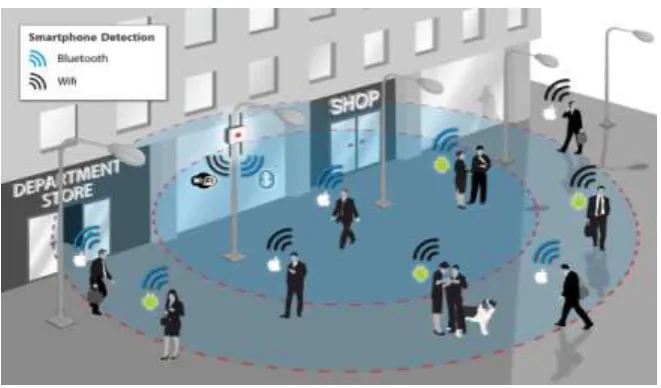
2. iPhone and Android devices detected by Smart Sensors
The new sensing technology integrated in Meshlium Xtreme is able to detect any Smartphone (iPhone,
Android) in the area by measuring Wi-Fiand Bluetooth activity; allowing to know in real time people and vehicle presence and fluency. Applications of this new technology go from street activity measurement to vehicle traffic management. Fig 6 show architecture of Meshlium Xtreme
3. Libelium Smart World Infographic: Sensors for Smart Cities, Internet of Things and beyond
After creating the inspirational and market research document 50 Sensor Applications for a Smarter World, we have comprised that information in a beautiful infographic comprising Smart Cities, Internet of Things (IoT) and other sensing applications. Just with a glance you can see all the verticals that are changing with the Internet of Things and understand why it is the next technological revolution. Fig 7 show Smart world architecture.
Fig:-7 Smart World View
VII. OBJECT TRACING
VIII. MIDDLEWARE TECHNOLOGY
Middleware usually lies between the operating system and the application in traditional environments, where functionality of the operating system is well established. For WSNs, however, the interfaces of operating systems are still a research issue, and many applications execute hardware operations directly without operating system components. Thus, middleware for WSNs needs to have a clear future vision so that all technologies supporting WSNs fit properly with future middleware.
Blumenthal [29] describes the task of middleware for WSN is providing easy access from the complex sensor networks, and followings are four key requirements:
•Scalable for resource constraints.
•Generic for different applications with common interface. •Adaptive to reconfigure its structure.
•Reflective to change the behavior depending on the environments and circumstances.
The middleware performs as a distributed software composed of multiple clusters. • Lightweight:
Middleware should be lightweight in terms of the computation and communication requirements. • Trading QoS of application:
Resource sharing when resources are limited means that it is very likely that the performance requirements of all the running applications cannot be satisfied simultaneously. Therefore, it is necessary for the middleware to trade the QoS of various applications against each other.
The main functionality of middleware for sensor networks is to support the development, maintenance, deployment, and execution of sensing based applications.
REFERENCES
[1].
“21 ideas for the 21st century,” Business Week, pp. 78–167, Aug. 30, 1999.[2]. “10 emerging technologies that will change the world,” Technol. Rev., vol. 106, no. 1, pp. 33–49, Feb. 2003.
[3]. Alberto Cerpa, Jeremy Elson, Deborah Estrin, Lewis Girod, Michael Hamilton, and Jerry Zhao. Habitat monitoring: Application driver for wireless communications technology. In Proceedings of the ACM SIGCOMM Workshop on Data Communications in Latin America and the Caribbean, San Jose, Costa Rica, April 2001. ACM.
[4]. Alan Mainwaring, Joseph Polastre, Robert Szewczyk, and David Culler. Wireless sensor networks for habitat monitoring. In Proceedings of the ACM Workshop on Sensor Networks and Applications, pages 88.97, Atlanta, Georgia, USA, September 2002. ACM.
[5]. D. Whang, N. Xu, S. Rangwala, K. Chintalapudi, R. Govindan, and J. Wallace. Development of an embedded sensing system for structural health monitoring. In Proceedings of the International Workshop on Smart Materials and Structures Technology, January 2004.
[7]. Vitaly Bokser, Carl Oberg, Gaurav S. Sukhatme, and Aristides A. Requicha. A small submarine robot for experiments in underwater sensor networks. In Proceedings of the Fifth IFAC Symposium on Intelligent Autonomous Vehicles, page to appear, Lisbon, Portugal, July 2004. International Federation of Automatic Control.
[8]. William S. Burdic. Underwater Acoustic Systems Analysis. Prentice-Hall, 1984