Patient Preference and Adherence
Dove
press
R e v i e w
open access to scientific and medical research
Open Access Full Text Article
Review of predialysis education programs: a need
for standardization
Judith van den Bosch1
D Simone warren1
Peter A Rutherford2
1Pallas Health Research and
Consultancy Bv, Rotterdam, the
Netherlands; 2Baxter Healthcare SA,
Zürich, Switzerland
Abstract: To make an informed decision on renal replacement therapy, patients should receive education about dialysis options in a structured program covering all modalities. Many patients do not receive such education, and there is disparity in the information they receive. This review aims to compile evidence on effective components of predialysis education programs as related to modality choice and outcomes. PubMed MEDLINE, Cochrane Library, and Ovid searches (from January 1, 1995 to December 31, 2013) with the main search terms of “predialysis”, “peri-toneal dialysis”, “home dialysis”, “education”, “information”, and “decision” were performed. Of the 1,005 articles returned from the initial search, 110 were given full text reviews as they potentially met inclusion criteria (for example, they included adults or predialysis patients, or the details of an education program were reported). Only 29 out of the 110 studies met inclu-sion criteria. Ten out of 13 studies using a comparative design, showed an increase in home dialysis choice after predialysis education. Descriptions of the educational process varied and included individual and group education, multidisciplinary intervention, and varying duration and frequency of sessions. Problem-solving group sessions seem to be an effective component for enhancing the proportion of home dialysis choice. Evidence is lacking for many components, such as timing and staff competencies. There is a need for a standardized approach to evaluate the effect of predialysis educational interventions.
Keywords: dialysis, end-stage renal disease, informed decision, modality choice
Introduction
While in-center hemodialysis (HD) remains the most common treatment modality of end-stage renal disease, home dialysis with peritoneal dialysis (PD), such as auto-mated PD and continuous ambulatory PD, and home HD are treatment options that can provide improved clinical and patient-reported outcomes. In addition, they can be less resource intensive and costly to the health care system.
There are some clinical factors that affect whether an individual patient is clinically suited for PD, but the majority (80%) of end-stage renal disease patients are capable
of using home dialysis as their treatment.1
To date, there is no clear evidence that suggests better survival between PD and conventional three-times-per-week in-center HD, although some studies also report that PD is advantageous compared to in-center HD, with higher short-term survival
rates and higher quality of life.2–4
All renal replacement therapies have different advantages and disadvantages, which may make them more or less appropriate for the patient depending on his or her clinical and personal situation. PD, which requires learning of technical skills by the patient, also requires a degree of responsibility and capability for self-care. However, it is advantageous in allowing the patient to remain independent, and to have more control over their own treatment and lifestyle. In-center HD is performed by trained nursing Correspondence: Peter A Rutherford
Quintiles, 500 Green Park, Reading, RG2 6UU, UK
Tel +44 118 450 1847
email [email protected]
Journal name: Patient Preference and Adherence Article Designation: Review
Year: 2015 Volume: 9
Running head verso: Van den Bosch et al
Running head recto: Predialysis education: need for standardization DOI: http://dx.doi.org/10.2147/PPA.S81284
Patient Preference and Adherence downloaded from https://www.dovepress.com/ by 118.70.13.36 on 26-Aug-2020
For personal use only.
Number of times this article has been viewed
This article was published in the following Dove Press journal: Patient Preference and Adherence
Dovepress
van den Bosch et al
staff within a health care setting but can be inconvenient with a rigid schedule of 4 hours treatment plus travel time three times weekly. Most commonly, clinical issues do not limit the treatment selection, and patient preference should be the
deciding factor in the selection of treatment modality.5
A growing body of research suggests that early referral to a nephrologist and patient education are associated with increased selection of PD among patients. When patients are presented with predialysis education clearly outlining the dif-ferent treatment options, they are more likely to select a home
dialysis modality.6 However, many patients do not receive
predialysis education, and when they do, there is variation
in what types of information they receive,7 as well as in the
educational methods and system of delivery and support. As a consequence, overall rates of PD use remain much lower than those of in-center dialysis, with a global average of only approximately 11%. In-center HD remains the dominant renal replacement therapy, but the rate of PD varies greatly between
countries8 and between centers within a country.9
The present review aims to review evidence on effective components of predialysis education programs as related to modality choice and selected clinical outcomes. This aids clinical teams in setting up educational processes to ensure patients make informed decisions.
Methods
Identification and screening
PubMed MEDLINE and Ovid databases as well as the Cochrane Library were used to search the academic literature. A tailored search string was defined in order to maximize the number of relevant results. As we were interested in articles specifically addressing the subject of predialysis education, we built the search string in a way that those terms needed to be in the title or abstract of the article: (predialysis[tiab] or pre-dialysis[tiab] or peritoneal dialysis[tiab] or home dialysis[tiab]) and (education[tiab] or information[tiab] or decision[tiab]).
To ensure data was relatively current, a limit was imposed on the search, with inclusion of studies from January 1, 1995 to December 31, 2013. A second limit was added; only papers available in English were accepted. After applying the filters, the total number of search hits returned amounted to 1,005.
eligibility, inclusion, and exclusion
Regarding the patient group the following inclusion criteria applied:
• Adults only ($18 years old)
• Predialysis education for renal replacement therapy for
chronic kidney disease (CKD) patients stage III, IV, and V
• Planned start patients, unplanned start patients, and
patients on dialysis, ie, incident and prevalent patients. With regard to the information presented on and the structure of the predialysis education programs, articles were only included if the following applied:
• A relatively detailed description of the program, such
as number and content of sessions, and descriptions of educators
• Multiple sessions – a single session education was not
considered a “program”
• Preferably, a duration greater than 1 month
• A multidisciplinary program involving physicians,
nurses, dieticians, etc.
Regarding outcomes of the predialysis education, the scope of the literature review was broad. The following outcomes were included, if articles were available:
• Dialysis modality choice and the numbers of patients
choosing each modality
• Any clinical outcome associated with predialysis
education
• Health-related quality of life
• Measures associated with patient choice
• Financial impact of patients choosing more home
therapies
• Patient satisfaction.
The literature was also reviewed for any information on processes, pathways, and organization of the predialysis education programs, such as:
• Patient decision making process
• Patient identification and enrolment
• Content, structure, and methodology of the predialysis
education program.
Studies were excluded if the following applied:
• The study addressed practical dialysis technique training
only (on PD for instance)
• Anecdotal stories on treatment option education only
• Education materials alone (ie, without process, resources,
etc)
• CKD patients stage I–II;
• Patient support groups only (instead of education
program)
• Too brief or unclear description of the predialysis
educa-tion program.
web search
In addition to the literature searches, a gray literature search was performed using Google. The web search was done on
October 19, 2012 with the following search string: (~
predialy-sis and [care or program or education or treatment option]).
Patient Preference and Adherence downloaded from https://www.dovepress.com/ by 118.70.13.36 on 26-Aug-2020
Dovepress Predialysis education: need for standardization
Searching in the first ten pages provided relevant infor-mation related to CKD educational program. Nineteen links were found to be relevant; information varied between papers, guidelines, annual reports, survey results, web infor-mation resources on CKD, web-based program descriptions,
and PowerPoint presentations.10–28
Papers were excluded if they were already included in the literature search. An additional search on websites of nephrol-ogy and patient association was done. This included the fol-lowing countries: Finland, Denmark, Norway, the Netherlands, UK, Canada, USA, Australia, and New Zealand. This search did not deliver data that was sufficiently detailed on the content, structure, and components of educational programs.
Results
Relevant papers
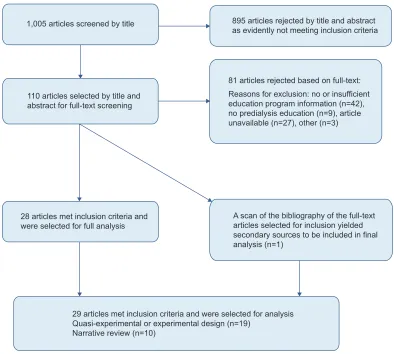
The literature searches yielded 29 relevant studies of which
19 had some sort of (quasi-) experimental design,29–47 and the
others were mostly narrative reviews (Figure 1).7,48–56 The 19
studies were analyzed for effective components of predialysis education programs. Studies with their design and outcomes
are summarized in Table 1. The Cochrane Library contained no directly relevant systematic reviews.
Predialysis education and clinical outcomes
Modality selectionWhile no quantitative analysis was conducted, studies reported more favorable outcomes for the patients attend-ing a predialysis education program than those patients who did not attend a predialysis education program. Of nine studies reporting on dialysis modality selection using an intervention and control group, six noted a higher pro-portion of patients selecting home dialysis (PD or another
home modality),30,35,38,40,41 while three found no significant
difference in modality choice.29,33,36 Four studies with
pre-and post- intervention (predialysis education) measurements showed higher levels of home dialysis use after the
predialy-sis education intervention.27,32,44,45
Patient knowledge
Four of 19 quasi-experimental studies reported on measures of patient knowledge. All reported higher levels of knowledge
DUWLFOHVVFUHHQHGE\WLWOH
DUWLFOHVVHOHFWHGE\WLWOHDQG DEVWUDFWIRUIXOOWH[WVFUHHQLQJ
DUWLFOHVUHMHFWHGE\WLWOHDQGDEVWUDFW DVHYLGHQWO\QRWPHHWLQJLQFOXVLRQFULWHULD
DUWLFOHVUHMHFWHGEDVHGRQIXOOWH[W 5HDVRQVIRUH[FOXVLRQQRRULQVXIILFLHQW HGXFDWLRQSURJUDPLQIRUPDWLRQQ QRSUHGLDO\VLVHGXFDWLRQQ DUWLFOH XQDYDLODEOHQ RWKHUQ
DUWLFOHVPHWLQFOXVLRQFULWHULDDQG
ZHUHVHOHFWHGIRUIXOODQDO\VLV $VFDQRIWKHELEOLRJUDSK\RIWKHIXOOWH[WDUWLFOHVVHOHFWHGIRULQFOXVLRQ\LHOGHG VHFRQGDU\VRXUFHVWREHLQFOXGHGLQILQDO DQDO\VLVQ
DUWLFOHVPHWLQFOXVLRQFULWHULDDQGZHUHVHOHFWHGIRUDQDO\VLV 4XDVLH[SHULPHQWDORUH[SHULPHQWDOGHVLJQQ
1DUUDWLYHUHYLHZQ
Figure 1 Flowchart of literature selection.
Patient Preference and Adherence downloaded from https://www.dovepress.com/ by 118.70.13.36 on 26-Aug-2020
Dovepress
van den Bosch et al
Table 1
Studies evaluating predialysis education programs: design, outcome, and summary of results
Author Year Country Study design Patient numbers Patient characteristics
Summary of results
Agraharkar et al 29 2003 USA
Patient survey 2001–2002
136 (all received education)
Age unknown, CKD
iv
–v
,
new patients on dialysis
Capture rate home dialysis (PD and HHD): 13% in 2001/2002, which is 117% growth as compared to 2000/2001.
Chanouzas et al
30
2012
UK
Patient survey
118 (questionnaires returned, 49%)
CKD iv –v , incident predialysis patients 20% of patients had chosen PD. 50% of patients choosing PD attended
a formal education day vs 33% of HD patients.
Cho et al
31
2012
Korea
Retrospective cohort 2007–2008
298 (149 in [intervention
=
education] and control group)
Mean age 57.8 years, predialysis patients, eGFR 17.3 mL/min per 1.73 m
2
Intervention group had significantly less unplanned urgent dialysis (8.7% vs 24.2%); shortened hospital days (2.16 vs 5.05 days/patient per year), less cardiac events (2.7% vs 9.4%), and less infections (4.0% vs 12.1%). No difference in modality choice.
Goovaerts et al
33
2005
Belgium
Retrospective review patient files 1994–2000 185 (all received predialysis education)
CKD
iv
–v
, mean age
53 years
eight patients preemptive transplantation, 177 on dialysis: 75 (40%) in-center HD, 102 patients self-care modality: 55 (31%) PD, 30 (16%) self-care dialysis in satellite unit, 17 (9%) home HD.
Gomez et al
32
1999
Spain
Multicenter patient survey 1996–1997 174 (86 informed, 88 uninformed patients) Mean age 55.8 years, any patient in predialysis program informed patients: 57% chose hemodialysis, 31.4% CAPD, 11.6% APD. Uninformed patients: 83% hemodialysis, 13.6% chose CAPD, 3.4% chose APD.
King et al
34
2008
USA
Patient survey 1994–2006
1,844 patients
Median age 61 years, 82% not yet on dialysis, CKD stage unknown Significant change in PD selection: 30% preferred PD before the education, 46% selected PD after education. Significant knowledge gains. No significant changes in feelings of hope and fear.
Klang et al
36
1999
Sweden
intervention study. Pre- and post- dialysis design, intervention is predialysis education 1991–1993 56 (28 intervention, 28 control group)
CKD
iv
–v
, mean age:
54 years treatment group, 58 years control group Significantly more patients in the intervention group stated that they had sufficient knowledge to participate in choosing dialysis modality. And they were significantly more informed in the post-education evaluation than in the pretest.
Klang et al
35
1998
Sweden
intervention study. Pre- post (dialysis) design, intervention is predialysis education 1991–1993 56 (28 intervention, 28 control group)
CKD
iv
–v
, mean age:
54 years treatment group, 58 years control group No significant differences in symptoms, duration of kidney disease, choice of dialysis treatment, cause of renal disease, symptoms, or overall health. The intervention group scored significantly better in terms of mood, less mobility problems, less functional disabilities, and lower levels of anxiety.
Lacson et al
37
2011
USA
Observational cohort 2006–2008 30,217 patients of which 3,165 exposed to educational program Mean age 63 years, CKD
iii
–v
Educational program group was significantly more likely to select PD (25.2% vs 4.1%; adjusted OR 5.13), and they had a significant better survival rate (adjusted HR 0.61).
Levin et al
38
1997
Canada
Prospective cohort study 1992–1995 76 (37 exposed to educational program, 39 standard care)
CKD
iii
–v
, age unknown
53% of the educational program group chose PD compared to 42% in th
e co nt ro l g ro up (n ot s ig ni fic an t) , a nd th ey h ad s ig ni fic an tly le ss ho sp ita l d ay s (6 .5 vs 13 .5 ). Th e ed uc at io na l-p ro gr am g ro up h ad b et te r
biochemical markers: blood pressure, calcium, phosphate, and anemia.
Little et al
39
2001
UK
Patient survey 1992–1998 254 (165 counseled before commencing dialysis; 89 after)
CKD
v
, mean age
62.2 years, patie
nt s st ar tin g
dialysis or just on dialysis
50.9% of patients educated/counseled before starting dialysis chose PD vs 34.8% of patients who received education after commencing dialysis.
Manns et al
40
2005
Canada
Randomized trial 2003 70 randomized patients Two-phase patient-centered educational intervention vs standard care and education
CKD
iii
–iv
, median age
64 years
82.1% of the intervention group chose SCD vs 50% of the control group. There was no increase in patients choosing SCD after receiving books and video. The small group education session was the only statistically significant factor in selecting SCD.
Patient Preference and Adherence downloaded from https://www.dovepress.com/ by 118.70.13.36 on 26-Aug-2020
Dovepress Predialysis education: need for standardization
McLaughlin et al
41
2008
Canada
Randomized trial 2003 (same as previous study) 70 randomized patients Two-phase patient-centered educational intervention vs standard care and education
CKD
iii
–iv
, median age
64 years
Freedom, lifestyle, and control were identified as three reasons to engage in SCD. Patients who received the educational intervention were more likely to perceive freedom and control as advantages and were more likely to select SCD.
Pagels et al
42
2000
Sweden
Observational cohort 2004 223 (70 exposed to nurse-led clinics, 153 comparison group)
CKD
iv
–v
, mean age
65.5 years
52% (n
=
11) of the nurse-led clinics group initiated home dialysis
(HHD: n
=
4, PD: n
=
7) as compared to 33% in the comparison group.
Piccoli
43
2006
italy
Questionnaire 1999 50 (18 followed educational program)
Mean age 62.9 years
12 of 18 patients (66%) who followed the education program chose home dialysis. Of another 31 patients who started dialysis in the center, 13 (42%) chose PD, 3 (10%) HHD, and 15 (48%) chose hospital dialysis.
Rasgon et al
44
1996
USA
Patient records review 1995 30 patients on home dialysis (2 HHD, 28 CAPD) Mean age 46.8 years, CKD stage not mentioned 74% (14 out of 19) of employed patients maintained their employment status after initiating home RRT.
Ribitsch et al
45
2013
Austria
Retrospective cohort study 2004–2008 227 patients (70 received predialysis education, 152 did not) Mean age 57.5 years education group, 56 years others CKD
v
in the group receiving education, 54.3% started with PD vs 28% in the comparison group; in the education group, 45.7% started with HD vs 72% among the standard-care comparators.
Rioux et al
46
2011
Canada
Retrospective observational cohort 2005–2009 228 patients (all receiving multimedia education) Mean age 58 years, emergency start renal therapy, CKD
v
35% of all acute starters adopted home dialysis after the implementation of the in-hospital education program vs 13% before the program.
w
atson
47
2008
Canada
Observational study: pre- and post- comparison advanced practice nurse 26 months
119 on chronic dialysis
CKD
v
The proportion of patients on in-center dialysis was reduced from 87% to 33% after the intervention, and the proportion of patients on home dialysis increased from 13% to 67%.
Abbreviations:
APD,
automated
PD;
CAPD,
continuous
ambulatory
PD;
CKD,
chronic
kidney
disease;
eGFR,
estimated
glomerular
filtration
rate;
HD,
hemodialysis;
HHD,
home
HD;
HR,
hazard
ratio;
PD,
peritoneal
dialysis;
OR,
odds
ratio; RRT, renal replacement therapy; SCD, self-care dialysis.
Patient Preference and Adherence downloaded from https://www.dovepress.com/ by 118.70.13.36 on 26-Aug-2020
Dovepress
van den Bosch et al
of end-stage renal disease and of different treatment options
for patients receiving predialysis education.32,36,40
Mortality and morbidity
Two studies reported on length of hospital stay, which was lower for the education groups (6.5 versus 13.5 total hospital
days; 2.2 versus 5.1 hospital days/patient per year).38,57 thus
leading to cost savings.36 Eight studies reported on mortality
and morbidity (including biochemical indicators,
cardiovas-cular incidents, infection rates, emotional status).31,35,37,46,58,59
All studies reported better rates for the treatment group.
Costs
Watson47 found a reduction of in-center dialysis from 87%
to 33% due to the introduction of an advanced practice nurse with an educating/counseling role. They calculated a theo-retical cost saving of $1,328,000 over a 2.5-year period as opposed to the situation without this reduction.
Components of predialysis education
programs
The articles retrieved from the literature and gray literature search addressed a wide range of aspects of predialysis education programs.
Multidisciplinary education
Predialysis care is delivered by a multidisciplinary team including, most of the time, a nephrologist, a nurse, a
dieti-cian, and a social worker.10,12,14,16,18,19,24,25,27,28,60 A
multidisci-plinary team can also include: a pharmacist who explains
information on the medicines needs;21,22 a psychologist
expert, which could be a specialized nurse for emotional
support when needed;10,24 a case manager;25 representatives
from the local patient kidney support group; and other
patients established on maintenance dialysis.27 It is often
not clear from the literature whether the members of the multidisciplinary care team are also the main educators for the patient. Of course there will be knowledge transfer during a patient’s visit to a nephrologist or dietitian. It is, however, most of the time not known whether this was in the setting of an educational program with defined cognitive and functional goals.
Seven articles retrieved from the scientific literature review
described multidisciplinary education program,29,30,35,36,40,41
which consists of multiple education sessions where patients are educated by three or more health care professionals such as nephrologist, nurse, dietitian, social worker, home-dialysis coordinator, pharmacist, technician, or by other dialysis
patients. An Australian survey revealed that although with multidisciplinary education patients are educated by three or more health care professionals, a high proportion of the education is done by the nurse specialist, as nephrologists
have limited time for one-on-one education.61 Others see an
important role of the nurse as a case manager in planning,
implementing, and evaluating educational programs.22
Delivery style
The education delivery style can either be one-on-one ses-sions or class room teaching style. But in general, a mix of one-on-one and group sessions is advocated. Educational programs should contain individualized one-on-one coun-seling sessions with a member/members of the multidisci-plinary team. This can be a physician, nephrologist, nurse,
dietician, social worker, etc.39,41,55 In addition to those small
group discussions, peer counseling and problem-solving or “brainstorming” sessions have been described wherein patients discuss treatment modalities, as well as barriers and benefits, and troubleshooting of possible problems with
other patients (or facilitators).7,40,41 The group sessions can
have a variety of formats such as group lectures, interactive workshops, or open forum sessions.
In the national Australian survey on predialysis education, most participating units combined group and one-on-one sessions. Group education sessions seemed to affect the choice of home dialysis; home dialysis rates increased from
20% to 38%.19
The most ideal design for investigating the effect of cer-tain components of a predialysis education program would be a head-to-head comparison of two programs that differ in a single aspect, while patients are randomly assigned to one of the programs. There was only one study making a
head-to-head comparison of two “programs”40 using
ran-domization. In this study, standard care was compared to a group of patients who received standard care plus two-phase education. The standard care consisted of receiving teach-ing about kidney disease, includteach-ing dietary instructions, and detailed information about the different modalities of renal replacement therapy. This occurred via an initial 3-hour one-on-one session where patients were seen by a nurse, dietician, and social worker. Patients were then followed by their nephrologist and the multidisciplinary care team every 3–6 months. The two-phase additional education consisted of phase 1, in which patients received four written manuals and a video, and phase 2, which consisted of a 90-minute problem solving group session. The small-group education (phase 2) turned out to be effective in enhancing the proportion of
Patient Preference and Adherence downloaded from https://www.dovepress.com/ by 118.70.13.36 on 26-Aug-2020
Dovepress Predialysis education: need for standardization
patients choosing self-care dialysis (including home- and self-care HD and PD) from 50% to 82%.
Frequency and duration
The number of sessions and duration per session varies by edu-cational program. There are reports of six individual sessions of
1 hour;14 four sessions, 1 night a week for 2 hours;27 or at least
four to five interviews.10 Table 2 contains a description of the
educational programs retrieved from the scientific literature.
In the national Australian survey,61 educators were asked
to fill out how much time each new patient spends receiving information regarding treatment options. Thirteen percent
of units (n=4) spent on average less than 1 hour providing
education. Thirteen units were educating for 1–2 hours and 13 units for over 2 hours. The rate of home dialysis was 36%
in the units offering the longest education hours (.3 hours)
compared to 20% in the units averaging less than 1 hour’s education.
Timing
Timing of education was seen as important to the patient and health care professional, but the studies did not allow firm conclusions to be reached over timing vs dialysis start. The more time a patient has to acquire knowledge prior to com-mencing dialysis, the better their clinical outcomes and the
more likely they are to select a home dialysis modality.56 An
estimated glomerular filtration rate of less than 30 mL/min (stage IV CKD) has been reported as ideal for referral to CKD
clinic.20,21 Others recommend that patients should be referred
as early as possible to renal education (.6 months).19
Learning theory
Basing the educational program on the principles of adult learning ensures the appropriateness of delivery of educa-tional materials and content in a manner best understood by
this patient population33 and can help expedite the process
of adult learning.7,52 One study58 tested a new PD home
training program based on adult learning theory in a quasi-experimental prospective study using a nonstandardized conventional training group as controls. The adult-learning-based program incorporated the different domains of learning and accommodated different perceptual styles (eg, visual and auditory). The new training program improved patient outcomes (eg, less exit-site infections, less dropout to HD after infection, better fluid balance scores, and better compli-ance scores). Although this study focused on patients who had already chosen PD, it is a good example of the benefits of a well-designed educational program.
Discussion
weak evidence base
Unfortunately, the findings presented in the previous sec-tion are not based on a strong evidence base since there are a number of limitations found within the studies available for analysis. The study quality was often poor; experimen-tal studies often lacked a control group, as well as pre- and postintervention measures. In some instances, data was presented in comparison to other reports or to previous find-ings of modality rates rather than in comparison to a control group of patients. Some studies used a quasi-experimental design but did not provide dialysis modality measures, again limiting full analysis.
Two studies reported rates of “self-care dialysis” but neglected to differentiate between home dialysis (PD or home HD) and self-care HD performed in a satellite unit.
There was only one study presenting a head-to-head comparison of educational programs showing that problem- solving group sessions were instrumental in modality
choice.40 There were no Cochrane Library systematic reviews
that related directly to educational programs for dialysis
options. One more-recent Cochrane systematic review62
compared studies examining early or late referral to renal units in terms of clinical outcomes including initial dialysis modality. The review did not examine educational programs but did note that studies show early referral results in greater use of PD. The overall better preparation for dialysis in early-referred patients probably relates in part to the education delivered at this time, but the evidence review did not allow for that conclusion.
Need for standardization
Because of the lack of studies comparing detailed com-ponents of educational programs, this literature review employed a qualitative rather than quantitative design. The data extraction was conducted with a quasi-systematic method. Keywords and phrases describing content were compared and grouped across studies. However, there is little standardization in the description of intervention (in this case, educational content). For this reason, studies may describe the same content in very different ways or use the same terms to describe very different methods and content. For example, when a program describes a patient’s “case worker”, they could be referring to an individual who meets with the patients to offer support and counseling, but they could also be referring to the role of a health care professional who manages the patient’s interactions between members of the nephrology team (ie, ensuring that the patient is seen
Patient Preference and Adherence downloaded from https://www.dovepress.com/ by 118.70.13.36 on 26-Aug-2020
Dovepress
van den Bosch et al
Table 2
Summary description of predialysis educational programs evaluated in (quasi-) experimental or observational studies
Author
Year
Country
Educational program
Agraharkar
et
al
29
2003
USA
Predialysis option education: • Meet with nephrologist, options explained. • Dialysis education by home dialysis coordinator (includes demonstration of PD on mannequin), video provided. • Meeting with current home dialysis patients. • Disposition meeting with multidisciplinary group for patient and family.
Chanouzas et al
30
2012
UK
Standard pre-dialysis education program: • w
hen GFR
,
25 mL/min, meeting with the kidney failure support team. Home visit is arranged.
•
Home visit: visual, verbal, and written formats (leaflets, booklets, and DVDs). All modalities are described in detail. Visits typically last 2–4 hours.
interpreter present if needed and family advised to be present.
•
Further education is offered at home if the patient is still uncertain.
•
invitations to PD and HD unit to meet patients and nurses. Option to meet expert patients.
•
A formal education day every 3 months: half-day workshop on lifestyle and dietary modifications for each modality.
•
All patients seen within 4 weeks to discuss modality choice, and encouraged to come to a decision within 3 months.
Cho et al
31
2012
Korea
Multidisciplinary predialysis education: • Group session by multidisciplinary team (2 hours).
education on: normal kidney function; pathophysiological alterations in CKD; nutritional
and medical treatment; and RRT options. Multidisciplinary team.
•
Individual session by nurse and dietician (1.5–2 hours): patient and family; slide presentation on diet and RRT options (benefits, complications, and outcomes); video on different RRT choices. Dietician prescribes diet, take home booklets.
Goovaerts et al
33
2005
Belgium
Predialysis education program for all patients with a GFR of
,
25 mL/min:
•
PD
eP run by a team of eight nurses. Patients are informed on an individual basis.
•
w
atch three in-house videos (one on each, HD, CAPD, and APD) (60 minutes in total).
•
Patients receive a brochure summarizing key points, are invited to speak with other patients on the different RRTs, and can visit centers if they wish.
•
Contact with a social worker and dietician is arranged.
•
The patient meets again with the nephrologist where a final decision on treatment is usually made.
Gomez et al
32
1999
Spain
Standardized information package from Baxter Healthcare: • First appointment. Flip chart explaining treatment options is shown. Patient is given guidebook to read at home. • Second appointment. Starts by discussing and clarifying doubts the patient may have, answering questions.
v
ideo is shown.
it is also
recommended that the patient sees how the various techniques of dialysis are carried out in practice.
King et al
34
2008
USA
Statewide kidney education program. Multidisciplinary education to patients prior to starting dialysis as well as to patients who wish to switch modality: • Six classes of 60–75 minutes each on the following topics: 1) introduction to kidney disease; 2) diet and kidney disease; 3) financing and coping with kidney disease; 4) hemodialysis; 5) peritoneal dialysis; and 6) kidney transplant. • Facilitators: social worker, various registered nurses, dietician, patients, and their families.
Klang et al
36
1999
Sweden
Specific educational salutogenic program based on relationship between health, stress and coping.
67
•
Four sessions (2 hours each) of group teaching with a classroom approach, covering one theme per session.
•
Themes: renal disease and dietary management; active renal replacement therapies; physical exercise training; and possible impact of renal failure on finances, family, and social life. For each series, 5–7 patients (of similar age) were invited to attend along with a relative. Patients were divided into three groups based on age: 1) young adults; 2) middle-aged; and 3) elderly. Throughout the program, the patients and their relatives had established contact with the nephrology team, consisting of a physician, a specialist-nurse, a clinical nutritionist, a physiotherapist, and a clinical social worker.
Klang et al
35
1998
Sweden
Same as the above
Patient Preference and Adherence downloaded from https://www.dovepress.com/ by 118.70.13.36 on 26-Aug-2020
Dovepress Predialysis education: need for standardization
Lacson et al
37
2011
USA
Treatment option education: a multiple-touch program. • initial education completed in a single group class session. • w
ith patient consent, followed up by contact at 30, 90, and 180 days thereafter to: 1) review treatment options; 2) inquire about each
patient’s kidney function/status and, if appropriate, dialysis access planning; and 3) provide feedback to the referring physician.
Levin et al
38
1997
Canada
A
ll
pa
tie
nt
s
w
er
e
re
fe
rr
ed
fo
r
a
fo
rm
al
o
rie
nt
at
io
n
to
d
ia
ly
sis
s
es
sio
ns
o
f 2
–3
h
ou
rs
d
el
iv
er
ed
b
y
a
nu
rs
e
ed
uc
at
or
a
nd
s
oc
ia
l w
or
ke
r.
Se
ss
io
n
co
ns
ist
ed
of an educational video; a standardized discussion of RRT options; demonstration of PD and HD techniques; and discussion of no
treatment.
in addition, the educational group following the multidisciplinary predialysis care clinic for CKD patients followed a predialysis clinic which included: discussions about renal function, blood pressure, bone disease, and diet therapy, delivered in a stepwise fashion over the course of multiple visits. Frequency of visits and lab tests determined by CKD stage and severity. initial visit lasted 3 hours, after that, visits are 1.5 hours, every 2, 3, or 6 months depending on CKD stage.
Little et al
39
2001
UK
Modality-choice education program of Birmingham dialysis center: • At initial interview written information on CAPD and HD. • At follow-up: more detailed counseling and assessment. Lasts 1–2 hours.
video package is provided in addition to verbal and written materials.
•
Patients given tour of HD unit and invited to discuss dialysis with HD and CAPD patients.
•
Patient’s initial modality choice recorded and a follow-up telephone call scheduled. Additional follow-up and counseling arranged as
required.
Manns et al
40
2005
Canada
in addition to multidisciplinary care, two-phase education: phase1: education materials, phase 2: small group problem solving education session. Timetable phase 2: • (10 minutes) introductions, overview, and goals of the course (nurse facilitator). • (10 minutes) introduction of topic: self-care dialysis (physician facilitator). • (20 minutes) brainstorming session (physician facilitator). • (20 minutes) what type of dialysis (patients discuss in small groups). • (10 minutes) group presentations (patient presenters). • (10 minutes) video presentation (nurse). • Feedback for the course and close (physician).
McLaughlin et al
41
2008
Canada
Same as the above
Pagels et al
42
2008
Sweden
Nurse-led educational clinics (duration, approximately 1 hour) in conjunction with physician outpatient care: the content of each visit was determined largely by each individual patient’s questions and wishes. Focus was on: • discussions aimed at motivating, guiding, and supporting the patient; • education (ie, kidney function, symptoms, test results, medication, treatment alternatives); • self-care (diet, controlling edema); • daily life with chronic illness; • well-being and quality of life; and • on health check-ups.
Piccoli
2000
italy
A multistep education program that follows patients along the extended path from chronic renal failure to dialysis. Monthly 2-hour lessons on the main aspects of
eSRD (dialysis, transplantation, diet, drugs, etc). Subjects are chosen in consultation with patients. Lessons consist
of
informal discussions held by the familiar caregivers, with the occasional help of experts.
Rasgon et al
44
1996
USA
Multidisciplinary predialysis education program: • Psychosocial assessment by LCS
w
.
•
education about dialysis and choices of modalities by LCS
w
and/or renal nurse educator.
•
Orientation to dialysis unit and counseling sessions with patient and family members by LCS
w
.
•
Peer counseling facilitated by LCS
w
and/or renal nurse educator.
(
Continued
)
Patient Preference and Adherence downloaded from https://www.dovepress.com/ by 118.70.13.36 on 26-Aug-2020
Dovepress
van den Bosch et al
Table 2
(
Continued
)
Author
Year
Country
Educational program
Ribitsch et al
45
2013
Austria
Multidisciplinary predialysis education program: • Two consecutive days, small groups (maximum 6 patients plus relatives). • Multidisciplinary team: nurse, dietician, nephrologist. • First day, 2-hour session: basic information on medical, dietary, and lifestyle issues. • Second day, 2-hour session: practical demonstration HD and PD.
Rioux et al
46
2011
Canada
Multidisciplinary education program: • Advanced nurse practitioner provides multimedia education on dialysis modalities to patients using manuals, flipcharts, pamphlets, and D
v
Ds.
•
in-hospital education occurs over 3–5 appointments. Family encouraged to attend.
•
Attempt is made to assess and match patient’s values, abilities, and lifestyle to their RRT modality needs.
•
Discharge plan of RRT is discussed. Different modalities are discussed, including benefits and barriers.
•
Patients invited to visit HHD and PD units.
w
atson
47
2008
Canada
Advanced practice nurses were hired to intervene on unplanned dialysis-start patients, to give them “predialysis education” after they had begun dialysis. Number of sessions not specified; flexible to patient’s needs. Topics covered among others: • Social situation (home? employed?). • v
alues and lifestyle (independence?).
•
educate the basics (fundamental renal function, RRT).
•
Find education medium that suits patient learning style (video, written).
•
Discuss modalities (positive and negative aspects).
•
Tours of dialysis facilities.
•
Assess patient coping styles (helps determine modality and give patient strength).
Abbreviations:
APD,
automated
peritoneal
dialysis;
CAPD,
continuous
ambulatory
peritoneal
dialysis;
CKD,
chronic
kidney
disease;
ESRD,
end-stage
renal
disease;
GFR,
glomerular
filtration
rate;
HD,
hemodialysis;
HHD,
home
HD;
LCS
w
, licensed social worker; PD, peritoneal dialysis; PD
eP, PD education program; RRT, renal replacement therapy.
Patient Preference and Adherence downloaded from https://www.dovepress.com/ by 118.70.13.36 on 26-Aug-2020
Dovepress Predialysis education: need for standardization
by the nephrologist, arranging appointments with dieticians and social workers as needed), or referring to something else entirely. Likewise, many papers do not use educational theory to describe the selection or design of the educational programs. Much of the creation and description of the edu-cational programs and their content is left to the discretion of the study authors, with no standardized method to describe this across the field.
This lack of standardization of education programs is also acknowledged by professionals in the field of predialysis education. The Provincial PD Joint Initiative in Ontario, Canada, acknowledges that standardized predialysis educa-tion supports patients in understanding their opeduca-tions but notes there are no recommendations as to its components
or content.22
The development of effective interventions is hampered by the absence of a nomenclature to specify and report their content. This limits the possibility of replicating effective interventions, synthesizing evidence, and understand-ing the causal mechanisms underlyunderstand-ing behavior change. In contrast, biomedical interventions are precisely specified (eg, the pharmacological “ingredients” of prescribed drugs, their dose and frequency of administration). For most com-plex interventions, the precise “ingredients” are unknown; descriptions (eg, “behavioral counseling”) can mean different things to different researchers or implementers. The lack of a method for specifying complex interventions undermines the precision of the methodology to review evidence and synthesise its effectiveness, posing a problem for secondary
as well as primary research.63
The UK Medical Research Council’s guidance for devel-oping and evaluating complex interventions acknowledges the need for improved methods of specifying and reporting intervention content. The CONSORT statement for ran-domized trials of nonpharmacologic interventions calls for precise details of the intervention, including a description
of the different intervention components.64 For example,
this issue of unspecified intervention content is found in other areas of chronic disease, not only renal education pro-grams. For example, researchers have been found to report low confidence in their ability to replicate highly effective
interventions for diabetes prevention.63
For the development of a taxonomy of education content and regulations for describing this taxonomy to be developed and promoted in the world of renal education, we could learn from other academic fields, such as a taxonomy of behavior change techniques and the use of theory in behav-ior change intervention design, which are two models that
could be expanded and adapted to the field of predialysis
education.65,66
Educating patients about dialysis options is important to allow informed decision making, but clinical evidence is lacking concerning the most effective educational methods and staff competencies to develop the education. There is a need for a standardized approach built on best evidence from CKD and also from other clinical conditions and existing knowledge on the evaluation of complex interventions to ensure formal evaluation of predialysis education programs, and their effects on clinical outcomes and modality choice.
Acknowledgment
This work was supported by Baxter Healthcare SA, Zürich, Switzerland.
Disclosure
Peter A Rutherford was an employee of Baxter Healthcare at the time of performing this research. The authors report no conflicts of interest in this work.
References
1. Mendelssohn DC, Mujais SK, Soroka SD, et al. A prospective evalu-ation of renal replacement therapy modality eligibility. Nephrol Dial
Transplant. 2009;24:555–561.
2. Heaf JG, Lokkegaard H, Madsen M. Initial survival advantage of peritoneal dialysis relative to haemodialysis. Nephrol Dial Transplant. 2002;17:112–117.
3. Fenton SS, Schaubel DE, Desmeules M, et al. Hemodialysis versus peritoneal dialysis: a comparison of adjusted mortality rates. Am J
Kidney Dis. 1997;30:334–342.
4. Mehrotra R, Marsh D, Vonesh E, Peters V, Nissenson A. Patient educa-tion and access of ESRD patients to renal replacement therapies beyond in-center hemodialysis. Kidney Int. 2005;68:378–390.
5. Covic A, Bammens B, Lobbedez T, et al. Educating end-stage renal disease patients on dialysis modality selection: clinical advice from the European Renal Best Practice (ERBP) Advisory Board. Nephrol Dial
Transplant. 2010;25:1757–1759.
6. Ludlow MJ, George CR, Hawley CM, et al. How Australian neph-rologists view home dialysis: results of a national survey. Nephrology
(Carlton). 2011;16:446–452.
7. Morton RL, Howard K, Webster AC, Snelling P. Patient INformation about Options for Treatment (PINOT): a prospective national study of information given to incident CKD Stage 5 patients. Nephrol Dial
Transplant. 2011;26:1266–1274.
8. ERA-EDTA Registry. ERA-EDTA Registry Annual Report 2011. Amsterdam: Academic Medical Center, Department of Medical Infor-matics: 2013.
9. Gild JRA, Fogarty D. Chapter 1 UK Renal Replacement Therapy Inci-dence in 2012: UK Renal Registry 16th Annual Report: National and Centre-specific Analyses, 2013. Availale from: https://www.renalreg.org/ wp-content/uploads/2014/09/01-Chap-01.pdf. Accessed 7 Aug 2015. 10. Alberghini E, Gambirasio MC, Sarcina C, et al. [The ambiguous concept
of predialysis: proposal for a model]. G Ital Nefrol. 2011;28(5):541–550. Italian.
11. Marrón B, Ocaña JCM, Salgueira M, et al. Analysis of patient flow into dialysis: role of education in choice of dialysis modality. Perit Dial Int. 2005;25 Suppl 3:S56–S59.
Patient Preference and Adherence downloaded from https://www.dovepress.com/ by 118.70.13.36 on 26-Aug-2020
Dovepress
van den Bosch et al
12. Bates M. Improving kidney health and awareness through community
based education. Available from: http://www.slideshare.net/Sammy17/
ckd-education. Accessed 7 August 2015.
13. Fortnum D, Mathew T, Johnson K. A model for home dialysis, Australia –
2012. Kidney Health Australia; 2012. Available from: http://www.
kidney.org.au/LinkClick.aspx?fileticket=BfYeuFvtJcI=&tabid=811&
mid=1886. Accessed 7 August 2015.
14. Glickman J. Chronic Kidney Disease Education. Available from: http://ispd.org/NAC/wp-content/uploads/2010/11/CKD-Education-Glickman-April-2011-Notes.pdf. Accessed 7 August 2015.
15. Pre Dialysis Education [webpage on the Internet]. Charlestown: Hunter Renal Resource Centre; 2012. Available from: http://users.hunterlink.
net.au/~mbbjan/pde.html. Accessed 7 August 2015.
16. Wu IW, Wang SY, Hsu KH, et al. Multidisciplinary predialysis education decreases the incidence of dialysis and reduces mortality – a controlled cohort study based on the NKF/DOQI guidelines. Nephrol
Dial Transplant. 2009;24:3426–3433.
17. Bernardini J, Price V, Figueiredo A. ISPD Guidelines/Recommenda-tions; Peritoneal dialysis patient training, 2006. Perit Dial Int. 2006;26: 625–632.
18. Roh K, Josland E, Martinez-Smith Y, et al. Renal Department Annual
Report and Quality Indicators 2011. Australia: St George Hospital; 2011.
Available from: https://stgrenal.org.au/sites/default/files/upload/Annual-Report-2011.pdf. Accessed 7 August 2015.
19. Kidney Healthy Australia. Treatment options-teaching patients
(includ-ing a summary of “Predialysis Education Survey”). 2012. Available
from: http://homedialysis.org.au/health-professional/educating-patients/ treatment-options-teaching-patients/. Accessed 7 August 2015. 20. Kimberly Renal Support Service (KRSS). The Role of Predialysis
Coor-dinator. Available from: http://www.kamsc.org.au/renal/downloads/
renalpresentations/predialysis_role.pdf. Accessed 7 August 2015. 21. Goldstein M, Yassa T, Dacouris N, McFarlane P. Multidisciplinary
predialysis care and morbidity and mortality of patients on dialysis.
Am J Kidney Dis. 2004;44(4):706–714.
22. Provincial Peritoneal Dialysis Coordinating Committee. Provincial
Peritoneal Dialysis Joint Initiative: Resource Manual: Detailed Strat-egy On Increasing Peritoneal Dialysis (PD) Use In Ontario. Ontario:
Provincial Peritoneal Dialysis Coordinating Committee; 2006. Avail-able from: http://www.renalnetwork.on.ca/common/pages/UserFile.
aspx?fileId=100547. Accessed 7 August 2015.
23. Walker R, Abel S, Meyer A. What do New Zealand pre-dialysis nurses believe to be effective care? Nurs Prax N Z. 2010;26(2).
24. Crowley ST. CKD Series: Improving the Timing and Quality of
Predialysis Care. Wayne: Turner White Communications Inc.; 2003.
Available from: http://www.turner-white.com/pdf/hp_aug03_care.pdf. Accessed 7 August 2015.
25. Satellite Healthcare. Satellite WellBound Offers Superior Patient Education
Through its Better LIFE™ Wellness Classes. San Jose: Satellite Healthcare;
2012. Available from: http://www.satellitehealth.com/medical_community/ satellite_wellbound/wellness_classes.php. Accessed 7 August 2015. 26. The Renal Association. RA Guidelines – Planning, Initiating and
Withdrawal of Renal Replacement Therapy. UK: 2009. Available
from: http://www.renal.org/guidelines/modules/planning-initiating-and-withdrawal-of-renal-replacement-therapy#sthash.ZpW4QQaN. dpbs. Accessed 7 August 2015.
27. Wilson V, Clarke M. Pre-Dialysis Education and Care – An Important Factor in ESRD Management. Fresenius Medical Care North America; 2004. Available from: http://www.advancedrenaleducation.com/Litera-ture/PDServeConnectionPastArticles/PreESRDANecessity/tabid/347/ Default.aspx. Accessed 7 August 2015.
28. Spijkens YWJ, Berkhout-Byrne NC, Rabelink TJ. Optimal predialysis care. NDT Plus. 2008;1(Suppl 4):iv7–iv13.
29. Agraharkar M, Patlovany M, Henry S, Bonds B. Promoting use of home dialysis. Adv Perit Dial. 2003;19:163–167.
30. Chanouzas D, Ng KP, Fallouh B, Baharani J. What influences patient choice of treatment modality at the pre-dialysis stage? Nephrol Dial
Transplant. 2012;27:1542–1547.
31. Cho EJ, Park HC, Yoon HB, et al. Effect of multidisciplinary pre-dialysis education in advanced chronic kidney disease: Propensity score matched cohort analysis. Nephrology (Carlton). 2012;17:472–479.
32. Gómez CG, Valido P, Celadilla O, Bernaldo de Quirós AG, Mojón M. Validity of a standard information protocol provided to end-stage renal disease patients and its effect on treatment selection. Perit Dial Int. 1999; 19:471–477.
33. Goovaerts T, Jadoul M, Goffin E. Influence of a pre-dialysis education programme (PDEP) on the mode of renal replacement therapy. Nephrol
Dial Transplant. 2005;20:1842–1847.
34. King K, Witten B, Brown JM, Whitlock RW, Waterman AD. The Missouri Kidney Program’s Patient Education Program: a 12-year retrospective analysis. Nephrol News Issues. 2008;22:44–45,48–52, 54.
35. Klang B, Björvell H, Berglund J, Sundstedt C, Clyne N. Predialysis patient education: effects on functioning and well-being in uraemic patients. J Adv Nurs. 1998;28:36–44.
36. Klang B, Björvell H, Clyne N. Predialysis education helps patients choose dialysis modality and increases disease-specific knowledge.
J Adv Nurs. 1999;29:869–876.
37. Lacson E Jr, Wang W, DeVries C, et al. Effects of a nationwide pre-dialysis educational program on modality choice, vascular access, and patient outcomes. Am J Kidney Dis. 2011;58:235–242.
38. Levin A, Lewis M, Mortiboy P, et al. Multidisciplinary predialysis programs: quantification and limitations of their impact on patient out-comes in two Canadian settings. Am J Kidney Dis. 1997;29:533–540. 39. Little J, Irwin A, Marshall T, Rayner H, Smith S. Predicting a patient’s
choice of dialysis modality: experience in a United Kingdom renal department. Am J Kidney Dis. 2001;37:981–986.
40. Manns BJ, Taub K, Vanderstraeten C, et al. The impact of education on chronic kidney disease patients’ plans to initiate dialysis with self-care dialysis: a randomized trial. Kidney Int. 2005;68:1777–1783. 41. McLaughlin K, Jones H, Vanderstraeten C, et al. Why do patients choose
self-care dialysis? Nephrol Dial Transplant. 2008;23:3972–3976. 42. Pagels AA, Wång M, Wengström Y. The impact of a nurse-led clinic
on self-care ability, disease-specific knowledge, and home dialysis modality. Nephrol Nurs J. 2008;35:242–248.
43. Piccoli GB, Mezza E, Iadarola AM, et al. Education as a clinical tool for self-dialysis. Adv Perit Dial. 2000;16:186–190.
44. Rasgon SA, Chemleski BL, Ho S, et al. Benefits of a multidisciplinary predialysis program in maintaining employment among patients on home dialysis. Adv Perit Dial. 1996;12:132–135.
45. Ribitsch W, Haditsch B, Otto R, et al. Effects of a pre-dialysis patient education program on the relative frequencies of dialysis modalities.
Perit Dial Int. 2013;33:367–371.
46. Rioux JP, Cheema H, Bargman JM, Watson D, Chan CT. Effect of an in-hospital chronic kidney disease education program among patients with unplanned urgent-start dialysis. Clin J Am Soc Nephrol. 2011;6: 799–804.
47. Watson D. Post-dialysis “pre-dialysis” care: the cart before the horse – advanced practice nurse intervention and impact on modality selection.
CANNT J. 2008;18:30–33.
48. Baillod RA. Home dialysis: lessons in patient education. Patient Educ
Couns. 1995;26:17–24.
49. Ballerini L, Paris V. Nosogogy: when the learner is a patient with chronic renal failure. Kidney Int Suppl. 2006:S122–S126.
50. Golper T. Patient education: can it maximize the success of therapy?
Nephrol Dial Transplant. 2001;16 Suppl 7:20–24.
51. Golper TA, Mehrotra R, Schreiber MS. Is Dorothy correct? The role of patient education in promoting home dialysis. Semin Dial. 2013;26: 138–142.
52. Keeping LM, English LM. Informal and incidental learning with patients who use continuous ambulatory peritoneal dialysis. Nephrol Nurs J. 2001;28:313–314, 319–322; discussion 323.
53. Kong IL, Yip IL, Mok GW, et al. Setting up a continuous ambulatory peritoneal dialysis training program. Perit Dial Int. 2003;23 Suppl 2: S178–S182.
Patient Preference and Adherence downloaded from https://www.dovepress.com/ by 118.70.13.36 on 26-Aug-2020
Patient Preference and Adherence
Publish your work in this journal
Submit your manuscript here: http://www.dovepress.com/patient-preference-and-adherence-journal
Patient Preference and Adherence is an international, peer-reviewed, open access journal that focuses on the growing importance of patient preference and adherence throughout the therapeutic continuum. Patient satisfaction, acceptability, quality of life, compliance, persistence and their role in developing new therapeutic modalities and compounds to optimize
clinical outcomes for existing disease states are major areas of interest for the journal. This journal has been accepted for indexing on PubMed Central. The manuscript management system is completely online and includes a very quick and fair peer-review system, which is all easy to use. Visit http://www. dovepress.com/testimonials.php to read real quotes from published authors.
Dovepress
Dove
press
Predialysis education: need for standardization
61. D. F. Pre-dialysis education – A National Australian Survey (Jan 2012). 2012. Available from: http://www.kidney.org.au/LinkClick.aspx?fileticket= 4u5Qky3opAc%3D&tabid=635&mid=1590. Accessed 7 August 2015. 62. Smart NA, Dieberg G, Ladhani M, Titus T. Early referral to specialist
nephrology services for preventing the progression to end-stage kidney disease. Cochrane Database Syst Rev. 2014;6:CD007333.
63. Michie S, Abraham C, Eccles MP, Francis JJ, Hardeman W, Johnston M. Strengthening evaluation and implementation by specifying compo-nents of behaviour change interventions: a study protocol. Implement
Sci. 2011;6:10.
64. Boutron I, Moher D, Altman DG, Schulz KF, Ravaud P; CONSORT Group. Extending the CONSORT statement to randomized trials of nonpharmacologic treatment: explanation and elaboration. Ann Intern
Med. 2008;148:295–309.
65. Michie S, Prestwich A. Are interventions theory-based? Development of a theory coding scheme. Health Psychol. 2010;29:1–8.
66. Abraham C, Michie S. A taxonomy of behavior change techniques used in interventions. Health Psychol. 2008;27:379–387.
67. Antonovsky A. The salutogenic model as a theory to guide health promotion. Health Promotional Int. 1996;11(1):11–18.
54. Lewis AL, Stabler KA, Welch JL. Perceived informational needs, problems, or concerns among patients with stage 4 chronic kidney disease. Nephrol Nurs J. 2010;37:143–148; quiz 149.
55. Luongo M, Kennedy S. Interviewing prospective patients for peritoneal dialysis: a five-step approach. Nephrol Nurs J. 2004;31:513–520. 56. Owen JE, Walker RJ, Edgell L, et al. Implementation of a pre-dialysis
clinical pathway for patients with chronic kidney disease. Int J Qual
Health Care. 2006;18:145–151.
57. Dixon J, Borden P, Kaneko TM, Schoolwerth AC. Multidisciplinary CKD care enhances outcomes at dialysis initiation. Nephrol Nurs J. 2011; 38:165–171.
58. Hall G, Bogan A, Dreis S, et al. New directions in peritoneal dialysis patient training. Nephrol Nurs J. 2004;31:149–154, 159–163. 59. Souqiyyeh MZ, Al-Wakeel J, Al-Harbi A, et al. Effectiveness of a
separate training center for peritoneal dialysis patients. Saudi J Kidney
Dis Transpl. 2008;19:574–582.
60. Wauters JP, Lameire N, Davison A, Ritz E. Why patients with pro-gressing kidney disease are referred late to the nephrologist: on causes and proposals for improvement. Nephrol Dial Transplant. 2005;20: 490–496.
Patient Preference and Adherence downloaded from https://www.dovepress.com/ by 118.70.13.36 on 26-Aug-2020