© 2016 IJSRSET | Volume 2 | Issue 2 | Print ISSN : 2395-1990 | Online ISSN : 2394-4099 Themed Section: Engineering and Technology
A Study of Architectural Elements of Internet of Things and its
Applications
Amarbir Singh
Department of Computer Science, Guru Nanak Dev University, Amritsar, Punjab, India
ABSTRACT
The Internet of Things (IoT) refers to the use of intelligently connected devices and systems to leverage data gathered by embedded sensors and actuators in machines and other physical objects. IoT is expected to spread rapidly over the coming years and this convergence will unleash a new dimension of services that improve the quality of life of consumers and productivity of enterprises, unlocking an opportunity that is generally refer to as the ‗Connected Life‘. For consumers, the IoT has the potential to deliver solutions that dramatically improve energy efficiency, security, health, education and many other aspects of daily life. For enterprises, IoT can underpin solutions that improve decision-making and productivity in manufacturing, retail, agriculture and other sectors. In this paper details about architectural layers and applications of internet of things is presented.
Keywords: Internet of Things, Sensor Layer, LAN, PAN, GSM, GPRS, LTE, Dynamic Ordering Management Tool, Intelligent Lampposts, CEP
I.
INTRODUCTION
The term Internet of Things was first coined by Kevin Ashton in 1999 in the context of supply chain management [1]. However, in the past decade, the definition has been more inclusive covering wide range of applications like healthcare, utilities, transport, etc [2]. Although the definition of ‗Things‗has changed as technology evolved, the main goal of making computer sense information without the aid of human intervention remains the same. A radical evolution of the current Internet into a Network of interconnected objects that not only harvests information from the environment (sensing) and interacts with the physical world (actuation/command/control), but also uses existing Internet standards to provide services for information transfer, analytics, applications, and communications.
The Internet of Things promises to deliver a step change in individuals‘ quality of life and enterprises‘ productivity. Through a widely distributed, locally intelligent network of smart devices, the IoT has the potential to enable extensions and enhancements to fundamental services in transportation, logistics, security, utilities, education, healthcare and other areas, while
providing a new ecosystem for application development [3].
II.
METHODS AND MATERIAL
1. IoT ACHITECTURE LAYERS
IOT architecture consists of different suite of technologies supporting IOT. It serves to illustrate how various technologies relate to each other and to communicate the scalability, modularity and configuration of IOT deployments in different scenarios. Various layers of internet of things architecture are sensor layer, gateways and networks layer, management service layer and application layer [4] and the functionality of each layer is described below:
A. Sensor Layer
various types of sensors for different purposes. The sensors have the capacity to take measurements such as temperature, air quality, movement and electricity. In some cases, they may also have a degree of memory, enabling them to record a certain number of measurements. A sensor can measure the physical property and convert it into signal that can be understood by an instrument [5]. Sensors are grouped according to their unique purpose such as environmental sensors, body sensors, home appliance sensors and vehicle telematics sensors, etc.
Most sensors require connectivity to the sensor aggregators (gateways). This can be in the form of a Local Area Network (LAN) such as Ethernet and WiFi connections or Personal Area Network (PAN) such as ZigBee, Bluetooth and Ultra- Wideband (UWB). For sensors that do not require connectivity to sensor aggregators, their connectivity to backend servers/applications can be provided using Wide Area Network (WAN) such as GSM, GPRS and LTE. Sensors that use low power and low data rate connectivity, they typically form networks commonly known as wireless sensor networks (WSNs). WSNs are gaining popularity as they can accommodate far more sensor nodes while retaining adequate battery life and covering large areas [6].
B. Gateways and Networks Layer
Massive volume of data will be produced by these tiny sensors and this requires a robust and high performance wired or wireless network infrastructure as a transport medium. Current networks, often tied with very different protocols, have been used to support machine-to-machine (M2M) networks and their applications [7].
With demand needed to serve a wider range of IOT services and applications such as high speed transactional services, context-aware applications, etc, multiple networks with various technologies and access protocols are needed to work with each other in a heterogeneous configuration. These networks can be in the form of a private, public or hybrid models and are built to support the communication requirements for latency, bandwidth or security.
C. Management Service Layer
The management service renders the processing of information possible through analytics, security controls, process modelling and management of devices.
One of the important features of the management service layer is the business and process rule engines. IOT brings connection and interaction of objects and systems together providing information in the form of events or contextual data such as temperature of goods, current location and traffic data. In the area of analytics, various analytics tools are used to extract relevant information from massive amount of raw data and to be processed at a much faster rate. Analytics such as in-memory analytics allows large volumes of data to be cached in random access memory (RAM) rather than stored in physical disks. In-memory analytics reduces data query time and augments the speed of decision making. Streaming analytics is another form of analytics where analysis of data, considered as data-in-motion, is required to be carried out in real time so that decisions can be made in a matter of seconds. For example, this requirement is typical in the transportation sector where real-time traffic information enables drivers to optimise their routes and travelling times [8].
Lastly, security must be enforced across the whole dimension of the IOT architecture right from the smart object layer all the way to the application layer. Security is of the utmost importance as the integrity of the data must be protected as data travels across the entire system.
D. Application Layer
There are various applications from industry sectors that can leverage on IOT. Applications can be categorized, ones that are specific to a particular industry sector and other applications such as Fleet Management, Asset Tracking, and Surveillance can cut across multiple industry sectors [9].
2. Various Applications
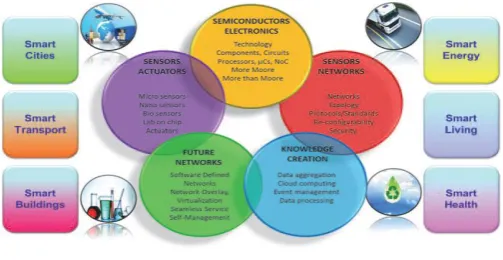
Figure 1. IoT Applications
A. Supply Chains
1) Dynamic Ordering Management Tool
Traditionally, the order picking management in the warehouse picks up multiple types of commodities to satisfy independent customer demands. The order picker (done manually) tries to minimise the travelling distance for time and energy savings via route optimisation and order consolidation. Using the dynamic ordering tool, the network of smart objects will identify the types of commodities and decompose the order picking process to distributed sub-tasks based on area divisions. The application will plan the delivery routes centrally before activating order pickers for the delivery. Using executable algorithms in active tags, the tags can choose the best paths for the order pickers to take, as well as paths that are within their responsible areas. This results in a more optimised order processing, time savings and lower cost of delivery.
B. Government
1) Crowd Control during Emergencies and Events
The crowd control application will allow relevant government authorities to estimate the number of people gathering at event sites and determine if necessary actions need to be taken during an emergency. The application would be installed on mobile devices and users would need to agree to share their location data for the application to be effective. Using location-based technologies such as cellular, WiFi and GPS, the application will generate virtual ―heat maps‖ of crowds. These maps can be combined with sensor information obtained from street cameras, motion sensors and officers on patrol to evaluate the impact of the crowded
areas. Emergency vehicles can also be informed of the best possible routes to take, using information from real-time traffic sensor data, to avoid being stuck among the crowds.
2. Intelligent Lampposts
The intelligent streetlamp is a network of streetlamps that are tied together in a WAN that can be controlled and monitored from a central point, by the city or a third party. It captures data such as ambient temperature, visibility, rain, GPS location and traffic density which can be fed into applications to manage road maintenance operations, traffic management and vicinity mapping. With the availability of such real-time data, government can respond quicker to changing environments to address citizen needs.
C. Retail
1) Shopping Assistants
In the retail sector, shopping assistant applications can be used to locate appropriate items for shoppers and provide recommendations of products based on consumer preferences. Currently, most of shopping malls provide loyalty cards and bonus points for purchases made in their stores but the nature of these programmes are more passive, i.e., they do not interact with, and often do not make any recommendations for, the buyers. The application can reside in the shopper‘s personal mobile devices such as tablets and phones, and provide shopping recommendations based on the profile and current mood of the shopper. Using context-aware computing services, the application captures data feeds such as promotions, locations of products and types of stores, either from the malls‘ websites or open API if the mall allows it. Next the application attempts to match the user‘s shopping requirements or prompts the user for any preferences, e.g., ―What would you like to buy today?‖ If the user wants to locate and search for a particular product in the mall, the application guides the user from the current location to the destination, using local-based technology such as WiFi embedded on the user‘s mobile phone [11].
D. Healthcare
This application creates the freedom for the elderly to move around safely outdoors, with family members being able to monitor their whereabouts. The elderly sometimes lose their way or are unable to identify familiar surroundings to recall their way back home. Family members who do not know their relatives‘ whereabouts may be at a loss to know where and how to start searching. The application can be a tiny piece of wearable device such as a coil-on-chip tag attached to the elderly. This tag will be equipped with location-based sensors to report the paths that the wearer has travelled. It can emit signals to inform family members if the wearer ventures away from predetermined paths. It can also detect deviations in their daily routines. Family members can also track the location of their elderly online via the user interface (UI) application.
2. Continuous Patient Monitoring
Continuous patient monitoring can be an extension to the ―Elderly Family Member Monitoring‖ application; this application, however, requires the medical services companies to support it. Continuous patient monitoring requires the use of medical body sensors to monitor vital body conditions such as heartbeat, temperature and sugar levels. The application examines the current state of the patient‘s health for any abnormalities and can predict if the patient is going to encounter any health problems. Analytics such as predictive analytics and CEP can be used to extrapolate information to compare against existing patterns and statistics to make a judgment. Energy harvesting sensors can be used to convert physical energy to electrical energy to help power these sensors to prevent the patient from having to carry bulky batteries or to perform frequent re-charging.
3) Smart Pills
Smart pills are essentially ingestible sensors that are swallowed and can record various physiological measures. They can also be used to confirm that a patient has taken his or her prescribed medication, and can measure the effects of the medication.
E. Transportation
1) Special Needs and Elderly Transportation Assistant
The transportation assistant application serves to address the group of commuters with special needs and who require assistance as they commute using public transportation. When these commuters travel, e.g., using the public train service, the transport assistant will inform the nearest transport staff so they can provide special assistance such as audio and visual services, and physical assistance for the passengers. When commuters are outdoors, the transport assistant will alert oncoming public vehicles to slow down as the passengers require special assistance to board the vehicle. The transportation assistant application can embedded into watches, bracelets and panic button devices with built-in intelligent capabilities such as context-aware computing services and predictive analytics. Depending on the wearer‘s (user‘s) profile, the application recommends the most suitable assistance required by the wearer, gathering inputs from the current surroundings to make the decision. Using sensors on these wearable devices, the application communicates with other sensors or receivers, e.g., staff badges using radio frequency or Zigbee, to establish connectivity and make the request.
2) Accident Avoidance Detection
Vehicles can play a part in providing better road safety by monitoring and sensing each other on the roads. The accident avoidance detection application can be programmed into vehicles' on-board equipment (OBE). With the use of sensors placed within the vehicles, the application can warn the drivers of accidents or dangers that may lie ahead on the road. For example, the application is capable of interpreting a series of complex events such as poor visibility conditions resulting from heavy rain, slippery roads and strong wind to the possibility of vehicles suddenly stopping. Consequently, it can alert and advise the driver on how to drive in such conditions. Sensors using infrared (IR) can help to detect the distance between each vehicle or the conditions of the road (e.g., rain levels and fallen debris), feeding the application with the information to alert drivers to avoid and steer clear of a potential accident site.
3) Distributed Urban Traffic Control systems
emergency such as setting up of fast lane corridors for emergency services, i.e., ambulances, police cars and fire brigades, to pass through during heavy traffic conditions.
F. Energy Management
1) Facilities Energy Management
Facilities energy management involves the use of a combination of advanced metering and IT and operational technology (OT) that is capable of tracking, reporting and alerting operational staff in real time or near real time. Systems are capable of allowing highly dynamic visibility and operator influence over building and facility performance. They also provide dashboard views of energy consumption levels, with varying degrees of granulation, and allow data feeds from a wide range of building equipment and subsystems.
2) Home Energy Management/Consumer Energy Management
Home energy management (HEM) optimises residential energy consumption and production. Solutions include software tools that analyse energy usage, and home-area network (HAN) energy management sensors that respond to variable power prices. A combination of these solutions contributes towards reducing overall carbon emissions for homes.
G. Cross Domain Examples
1) Automotive Industry and Financial Institutions
Automotive vehicles can be embedded with location sensors to track the movement and interactions of them with other vehicles on the road. This information can be used by insurance companies to base the price of insurance policies on how well the vehicle has been driven and the places and distances it has travelled. The pricing can be customized to the actual risks of operating the vehicle rather than based on requirements such as a driver‘s age, years of driving experiences, gender, etc.
2) Retail, Manufacturing and Supply Chain Industries
For retail owners, smart store manager applications can be used to facilitate the tracking of inventory in the store warehouse for inventory management and control. The application can be provided by an augmented reality service that uses cameras to scan RFID tags to determine the availability of inventory on each level. When the application detects that an inventory level is low or below a certain threshold, it can automatically inform Manufacturer whom will determine the production of goods. The information will also be shared with the Supply Chain to optimise the next delivery of goods to the store warehouse.
3) Logistics Industry
Logistics companies are tapping on traffic patterns, road congestions information from road cameras and sensors and early knowledge of weather conditions to make constant routing adjustments for their delivery trips. This cross-domain information helps them increase their delivery efficiencies and reduce overall congestion costs.
III.
RESULTS AND DISCUSSION
Challenges To Achieve Full IoT Potential
There are key challenges and implications today that need to be addressed before mass adoption of IOT can occur.
A. Connectivity
There will not be one connectivity standard that ―wins‖ over the others. There will be a wide variety of wired and wireless standards as well as proprietary implementations used to connect the things in the IoT. The challenge is getting the connectivity standards to talk to one another with one common worldwide data currency.
B. Power management
add power management to these devices and equipment. Wireless charging will incorporate connectivity with charge management.
C. Security
With the amount of data being sent within the IoT, security is a must. Built-in hardware security and use of existing connectivity security protocols is essential to secure the IoT. Another challenge is simply educating consumers to use the security that is integrated into their devices.
D. Complexity
Manufacturers are looking to add connectivity to devices and equipment that has never been connected before to become part of the IoT. Ease of design and development is essential to get more things connected especially when typical RF programming is complex. Additionally, the average consumer needs to be able to set-up and use their devices without a technical background.
E. Rapid evolution
The IoT is constantly changing and evolving. More devices are being added every day and the industry is still in its naissance. The challenge facing the industry is the unknown. Unknown devices, unknown applications, unknown use cases. Given this, there needs to be flexibility in all facets of development. Processors and microcontrollers that range from 16–1500 MHz to address the full spectrum of applications from a microcontroller (MCU) in a small, energy-harvested wireless sensor node to high-performance, multi-core processors for IoT infrastructure. A wide variety of wired and wireless connectivity technologies are needed to meet the various needs of the market. Last, a wide selection of sensors, mixed-signal and power-management technologies are required to provide the user interface to the IoT and energy-friendly designs.
IV.
CONCLUSION
The IoT is expected to transform how we live, work and play. From factory automation and automotive connectivity to wearable body sensors and home appliances, the IoT is set to touch every facet of our lives. We will ―author‖ our life with networks around us
that constantly change and evolve based on our surroundings and inputs from other systems. It will make our lives safer with cars that sense each other to avoid accidents. It will make our lives more green with lighting systems that adjust based on the amount of daylight from windows. It will make our lives healthier with wearables that can detect heart attacks and strokes before they happen. There is a long road ahead to the IoT of 2020. But one thing is for sure, it is going to be amazing. A concerted effort is required to move the industry beyond the early stages of market development towards maturity, driven by common understanding of the distinct nature of the opportunity. This market has distinct characteristics in the areas of service distribution, business and charging models, capabilities required to deliver IoT services, and the differing demands these services will place on mobile networks.
V.
REFERENCES
[1] K. Ashton, That Internet of Things‖ Thing, RFiD Journal.
(2009).
[2] H. Sundmaeker, P. Guillemin, P. Friess, S. Woelfflé, Vision
and challenges for realising the Internet of Things, Cluster of European Research Projects on the Internet of Things - CERP IoT, 2010.
[3] Flouris, G., Plexousakis, D., Antoniou, G, ―A Classification
of Ontology Change". In: The Poster Session of Semantic Web Applications and Perspectives (SWAP), 3rd Italian Semantic Web Workshop, PISA, Italy, 2006.
[4] IoT-A consortium, ―Mission-IoT-A: Internet of Things
Architecture," Online].Available:
http://www.iot-a.eu/public/introduction/mission-collage. Last accessed May 2013].
[5] IoT-I consortium, ―The Internet of Things Initiative — IoT-i:
Internet of Things Iniciative," Online]. Available:
http://www.iot-i.eu/public. Last accessed May 2013].
[6] CASAGRAS2, consortium, ―About us | CASAGRAS2 —
INTERNET OF THINGS," Online]. Available:
http://www.iot-casagras.org/about_us. Last accessed May 2013].
[7] Ebbits consortium, ―ebbits — News," Online]. Available:
http://www.ebbitsproject. eu/news.php. Last accessed May 2013].
[8] Community Research and Development Information
Service, ―ELLIOT. Experimental Living Lab for The
Internet of Things," Online]. Available:
http://cordis.europa.eu/ projects/rcn/95205_en.html. Last accessed May 2013].
[9] IERC Cluster, ―IERC-European Research Cluster on the
Internet of Thins," Online]. Available: http://www.internet-of-things-research.eu/partners. htm. Last accessed May 2013].
[10]Spitfire consortium, ―SPITFIRE. SemanticWeb interaction
with Real Objects," Online]. Available: http://spitfire-project.eu/. Last accessed May 2013].