Volume 12, Number 1, March 2017
Adoption of Cloud Computing in Business:
A Multi-Case Approach to Evaluate
the Fit-Viability Model (FVM)
Shailja Tripathi
IFHE University, Hyderabad, India [email protected]
Jigeesh Nasina
IFHE University, Hyderabad, India [email protected]
ABSTRACT
The success of cloud computing adoption depends on several factors. These include how well task requirements fit the features of the technology and how viable the technology is, based on economic feasibility, maturity of the IT infrastructure, and social readiness of the organization. The purpose of this paper is to study the adoption of cloud computing in business and the use of the fit-viability framework for assessing the likely success or failure of cloud computing in an organization. The study analyzes cloud computing adoption in four multinational software companies in order to explore the application of the fit-viability model (FVM). This multi-case analysis involved detailed interactions with project managers and senior managers in all four firms and the analysis of feedback data collected from them. The results indicate that cloud computing adoption in all the firms has a high fit with the task requirements and that most of the firms exhibit a high viability regarding the technology. The findings of this study would be helpful to the managers in understanding the fit and viability of cloud computing to perform their jobs and would further enhance the benefits of cloud computing in their organizations.
International Journal of Business and Information
1. INTRODUCTION
Cloud computing allows users to access software applications, hardware, storage, and technology processes directly from the web. Sharif (2010) stated that cloud computing is progressively being regarded as a technology that has the capability of changing how the Internet and information systems are currently being operated and used. Ercan (2010) reported that cloud computing is becoming an adaptable technology for many organizations with its dynamic scalability and use of virtualized resources as a service through the Internet. According to Marston et al. (2011), cloud computing is an information technology service model in which computing services (both hardware and software) are delivered on demand to customers over a network in a self-service fashion, independent of device and location. Similarly, mobile cloud computing also comes under cloud technology and is treated as cloud2 technology, which is used for collaboration and mobility. Mobile cloud computing obtains cloud computing resources – i.e., storage, processing power, development, and software – for mobile value services accessible through a blend of wireless networks and mobile devices, using resources available in the platform within the networks or combined with a shared pool of technology resources available on mobile devices (Dihal et al., 2013).
The three service models of cloud computing are:
Software as a Service (SaaS). This is a service model in which applications are hosted by a cloud service provider and made accessible to customers over the Internet.
Platform as a Service (PaaS). In this model, operating systems and related services are delivered over the Internet, devoid of downloads or installation.
Infrastructure as a Service (IaaS). This model involves outsourcing the infrastructure used to support operations, including storage, hardware, servers, and networking components.
The four deployment models of cloud computing are:
Volume 12, Number 1, March 2017
Private cloud. This model is used by a single organization encompassing multiple consumers or business units. Third-party or some organization may own, manage, and operate a private cloud on or off premises.
Community cloud. This model is used for sharing purposes by a particular community of consumers from organizations having common interests. It may be managed, owned, and operated by one or more of the organizations in the community, and it may exist on or off premises.
Hybrid cloud. This model is a combination of two or more different cloud deployments (private, community, or public) that remain separate entities but are connected by uniform technology, which allows portability of data and applications.
Large organizations will benefit from private cloud, whereas smaller businesses will benefit from public cloud. As cloud computing continues to grow, businesses will continue to move back and forth through these four major service models.
Efficient use of business resources is one of the main benefits of the cloud. According to the National Institute of Standards and Technology (NIST), the five most significant features of cloud computing are:
Broad network access, in which services are delivered over a network
On-demand self-service, which refers to unilateral provisioning of resources without human interaction with the provider
Resource pooling, which is the aggregation of resources such as memory, band-width, storage, and processing for multiple customers
Rapid elasticity, which indicates that resources are dynamically scaled up and down with demand
Measured service, which refers to the automatic control and optimization of resources through pay-per-use metering capabilities
International Journal of Business and Information the adoption of cloud computing in four large-sized multinational software firms. All four have been using cloud computing for more than two years.
The study is organized as follows. Section 2 presents a detailed literature review. Section 3 defines the research framework. Section 4 discusses the sample design, and section 5 presents the case studies for the four firms, highlighting the performance of cloud computing in terms of the fit-viability framework. Section 6 includes an analysis and interpretation of cloud computing performance in the case studies. In Section 7, the authors present their conclusions and discuss managerial limitations of the study and areas for future research.
2. LITERATURE REVIEW
This section presents a review of the literature pertaining to cloud computing, task-technology fit, and the fit-viability model (FVM).
2.1 Cloud Computing
Sharif (2010) discussed the emerging IT platform of cloud computing and explained why cloud computing would be driven not by computing architectures, but by primary information and communication technology (ICT) consumption behaviors.
Dwivedi & Mustafee (2010) analyzed the adoption of cloud computing in organizations by evaluating several enabling factors, such as development of parallel programming paradigms and open-source software, cloud access to high- performance computing, green IT, and investment in low-cost access-cum-computing devices and high-speed networks.
With regard to the growth of cloud computing, Armbrust et al. (2010) highlighted the top ten obstacles that affect adoption, growth, and policy and business. They also paired each obstacle with an opportunity to overcome it, ranging from product development to research projects.
Wang et al. (2011) summarized the analysis of current gaps and new trends in cloud computing research based on extant information systems literature, industry reports, and practical experience reflections, They argued that computing has become an inexpensive commodity that is reachable and affordable to many businesses and individual customers.
Volume 12, Number 1, March 2017
users, removal of IT barriers to innovation, provision of scalability to enterprises to fulfill the client demand efficiently, new classes of applications, parallel batch processing to take advantage of huge amounts of processing power, and applications for business analytics. Marston et al. (2011) also identified the various issues that would affect the different stakeholders of cloud computing, such as data security, reliability, and privacy.
According to Sultan (2011), cloud computing is likely to prove commercially feasible for many small- and medium-sized enterprises (SMEs) because of its pay-as-you-go cost structure and flexibility. Romero (2012) stated that cloud computing is a highly scalable platform promising quick access to hardware and software over the Internet and is being used by firms ranging in size from SMEs to multinational corporations. Berman et al. (2012) identified six game-changing business enablers powered by cloud computing; namely: cost flexibility, business scalability, market adaptability, masked complexity, context-driven variability, and ecosystem connectivity.
Dhar (2012) evaluated and compared global IT outsourcing supported by cloud computing with the evolution of traditional IT services. The study suggested that cloud computing has created new opportunities for IT services providers and outsourcing vendors to modify their strategy.
Lin et al. (2012), through interviews, investigated the impacts of five attributes – namely, relative advantage, compatibility, complexity, observability, and trialability – on the attitudes of IT professionals toward cloud computing and their intentions regarding its adoption.
Ross and Blumenstein (2013) examined the potential role of human resources management (HRM) departments in supporting the organizational changes required for the introduction of cloud-based business strategies. Their study found that cloud computing business models place at the nexus of information communication technology (ICT) and business strategies.
2.2 Task-Technology Fit
International Journal of Business and Information theory, IT is more likely to have a positive influence on individual performance if the characteristics of the IT meet the task requirements in the organization. Cloud computing supports organizations in resource sharing, automation of tasks, remote implementation, and multi-tasking (Marston et al., 2011; Obeidat & Turgay, 2013). These salient characteristics can therefore be considered as task characteristics for assessing the fit in the context of cloud computing.
Cloud computing applications have been used in many areas, including e-mail, wikis, word processing, web development, social media, project management, time management, payroll management systems, online chatting, discussion groups, customer relationship management, data storage, accounting, presentations, file hosting, and note taking. Some examples of these applications include Google Apps, YouTube, Flickr, Campfire, Carbonite, LogMeln, BaseCamp, Zero, PayCycle, Highrise, WorkFlowMax, and Evernote. Technology characteristics related to cloud computing include free management and maintenance, virtualization, scalability (provision of scalable resources on demand), and service-oriented architecture (Obeidat & Turgay, 2013).
2.3 Fit-Viability Model
Tjan (2001) proposed the use of two dimensions to evaluate Internet initiatives; namely, fit and viability. Fit measures the extent to which core competence, structure, value, and the culture of the organization are consistent with the new network applications. Viability measures the extent of the enhanced potential of new network applications, human resource requirements, capital requirements, etc. These two dimensions form a simple matrix, with fit as the horizontal axis and viability as the vertical axis. A company gains a rough guide to the best strategic course for each initiative by dividing the matrix into four quadrants such as invest more in it, redesign it, sell it or spin it out, or kill it.
Volume 12, Number 1, March 2017
Mobile applications that have a high rate for viability but are low in fit represent the situation that the organization is ready, but the tasks do not fit the nature of mobile technology; hence, the organization needs to find alternative technology. The application that rates high in fit but low for viability means that the organization needs restructuring to improve its economic prospects before actual implementation of mobile technology. Those applications with good fit and strong organizational viability are the only good targets.
Liang et al. (2007) examined the success or failure of mobile technology applications in business, based on the fit-viability framework through a multi-case study with the help of fit and viability dimensions. They developed a set of measurement instruments and interviewed 16 key informants from four firms in different industries. Their findings showed that most of the firms had high fit, but one firm had low viability. They found that six of the mobile applications fell in the category of good target and one fell in the category of organizational restructuring. These results indicated that there was a good possibility of success for most of the mobile applications and that only one mobile application needed organizational restructuring to ensure its success before actual implementation. Their study ensures that the fit-viability model (FVM) provides useful guidelines for enterprises to decide whether to adopt a mobile technology.
Turban et al. (2011) used FVM to assess whether social software fits a decision task and which organizational factors are important in order for social software or collaboration 2.0 tools (wikis, blogs, microblogs, discussion forums, and social networking platforms) to be effective. They proposed a framework for exploring the fit among the major activities in the group decision-making process and social software. They discussed successful adoption of social software and suggested that firms should ensure (1) the viability of social software economically, (2) the technological capabilities of the organization to support social software, and (3) the readiness of the organization to adopt and support it. Once social software is considered to be fit and viable, the organization needs to develop a good deployment strategy and plan for adopting the technology.
International Journal of Business and Information Larosiliere & Carter (2013) investigated electronic government maturity and its determinants with the help of the FVM. Their analytical approach consisted of factor analysis, convergent validity, and discriminant validity, by using partial least squares (PLS). The results indicated that there was a 59% variance in fit and that viability accounted for 82% of the variance in the model.
The current study conducts a qualitative multiple-case study to answer the following research questions:
RQ1: How sufficient is the fit-viability model (FVM) in exploring the factors that affect the performance of adopting cloud technology in an organization?
RQ 2: How is the fit-viability framework used to assess the likely success or failure of cloud computing?
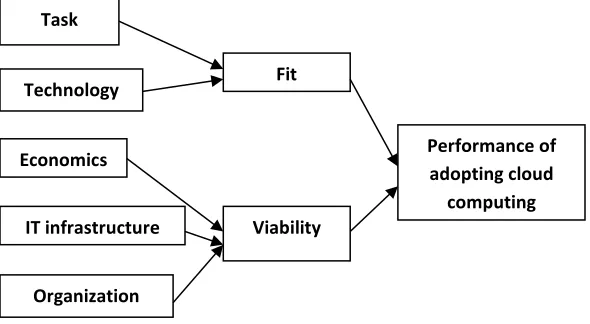
The study uses FVM to examine the performance of adopting cloud technology in the organization by combining the fit and viability dimensions. Fit considers the characteristics of cloud computing technology and their fit to task requirements. Individual performance factors are considered to be part of the organizational viability. The fit-viability model (FVM) combines the theory of TTF with the general concept of the organizational impact of cloud computing technology.
3. RESEARCH FRAMEWORK
The task characteristics of cloud computing include automation, sharing of resources, remote implementation, and multi-tasking. Automation means autonomic computing that aims at building computing systems capable of self-management; that is, responding to external and internal observations without human interference. Autonomic computing overcomes the management intricacy of computer systems in the current arena. Apart from automatic resource provisioning, the objective of cloud computing is to lower the resource cost rather than to reduce system complexity (Zhang, 2010).
Volume 12, Number 1, March 2017
tasks/processes can be performed over a certain period by executing them concurrently in the multi-tasking environment.
Remote implementation takes place on a remote server, which lowers the user’s hardware requirements and helps reduce both cost and maintenance requirements (Behrend et al., 2011). The characteristics of cloud computing technology include free management and maintenance, virtualization, scalability (provision of scalable resources on demand), and service-oriented architecture (Obeidat & Turgay, 2013). Virtualization is the fundamental technology that powers cloud computing by separating physical infrastructures and creates various dedicated resources (Marston et al., 2011). Through the Internet platform, cloud computing stores resources in virtual machines with the help of virtualization technology by increasing its accessibility and enabling interconnectivity between users and service providers (Truong, 2010).
The vendor takes care of all the maintenance and management responsibilities, freeing users from such time- and cost-consuming tasks (Truong, 2010). According to Truong (2010), cloud computing supports the provision of scalable resources on demand; that is, users can order and use as many resources as necessary based on demand. These resources are dynamically scalable. The necessary computer, storage, and network capacity can be adjusted on an hourly basis as demand from users grows or shrinks. From a technical perspective, cloud computing provides a scalable services delivery platform with the help of service- oriented architecture (SOA) infrastructure and virtual applications of both software and hardware (Kaufman, 2009). Cloud computing is said to fit the organization if these characteristics of cloud computing meet the task requirement.
Based on the preceding discussion of the concepts of FVM, the authors of the current study developed the research framework shown in Figure 1.
4. SAMPLE DESIGN
After an extensive search, four large multi-national companies (MNCs) in the IT sector were selected for evaluation of the research model shown in Figure 1. To maintain confidentiality, the four firms are referred to as A, B, C, and D. Each has implemented and has been using cloud computing for more than one year.
International Journal of Business and Information infrastructure, organization, and performance of adopting cloud computing. Since this research is exploratory in nature, the multi-case approach was applied to demonstrate the use of FVM.
Figure 1. Research Framework for Current Study
For each firm, email communications were held with senior project managers who deal regularly with cloud computing services. With their help, the questionnaire was passed to a select list of people at the managerial level. Firm A had responses from five people; firm B, three people; firm C, four people; and firm D, four people. A total of 16 responses were received from the four firms. All information collected through the questionnaire was analyzed in-depth to understand the performance of cloud technology in the four organizations.
5. CASE STUDIES
The four companies (A, B, C, and D) included in the current study are large multi-national corporations spread around the globe. A profile of the companies is presented in Table 1. Following is a case-by-case analysis of the firms.
5.1 Case Study 1: Firm A
Firm A is a global information technology, consulting, and outsourcing company based in Bangalore, India. The firm has been using cloud computing technology mostly for storing and maintaining huge data, but also to share resources needed to perform tasks. The firm uses cloud computing at least once a week for more than two hours to handle tasks related to automation, multi-tasking,
IT infrastructure Task
Technology
Economics
Organization
Fit
Viability
Performance of adopting cloud
Volume 12, Number 1, March 2017
and remote implementation. The characteristics of cloud computing include service-oriented architecture (SOA), virtualization, scalability, flexibility, and free maintenance and management.
Table 1. Profile of the Four Large Multi-National Firms
*APM = application performance management; ** ITOA = IT operations analytics
SaaS = software as a service; PaaS = platform as a service; IaaS = infrastructure as a service; BPaaS = business process as a service
5.2 Case Study 2: Firm B
ITEM
FIRMS
A B C D
Nature of firm Indian multi-national IT service corporation headquartered in Bangalore, India American privately held APM* and ITOA** company based in San Francisco, with1,600 enterprise customers American multi-national publicly held company headquartered in New York
American multi-national technology and consulting corporation headquartered in Armonk, New York
Founded 1945 2008 1976 1911
Total number of employees
170,000+ in year 2016
600 in year 2015
11,500 in year 2015
377,757 in year 2015
Annual revenue (US$)
$7.7 billion for year 2016
Estimated $79 million for year 2015
$4.4 billion for fiscal year end-ing March 31, 2014)
$81.74 billion for year 2015
Adoption period (in years)
More than 4 years
More than 2 years
More than 4 years
More than 5 years
Service model
SaaS, PaaS, IaaS, BPaaS
SaaS SaaS SaaS, PaaS, IaaS
Deploy-ment model Hybrid cloud, private cloud Private cloud, hybrid cloud
International Journal of Business and Information Firm B is an American privately held application performance management (APM) and IT operations analytics (ITOA) company based in San Francisco, Calif. The company focuses on administration of the performance and accessibility of applications across cloud computing environments and within the data center. The firm uses cloud computing at least once a day for more than three hours for automation, multi-tasking, and remote implementation. It also uses cloud computing for sharing of resources to perform tasks. In the firm, cloud computing supports service-oriented architecture (SOA), virtualization, scalability, flexibility, and free maintenance and management.
5.3 Case Study 3: Firm C
Firm C is an American multi-national publicly held company headquartered in New York. The company creates systems software that runs in mainframe, distributed computing, virtual machine, and cloud computing environments. The firm uses cloud computing at least once a day for more than two hours. In the firm, cloud computing is used for multi-tasking, automation, and remote implementation.
5.4 Case Study 4: Firm D
Firm D is an American multi-national technology and consulting corporation headquartered in New York. The company focuses on manufacturing and marketing computer hardware and software. It also provides infrastructure, consulting, and hosting services in numerous areas, from mainframe computers to nanotechnology. The firm uses cloud computing at least once a day for more than three hours.
6. ANALYSIS OF PERFORMANCE OF CLOUD COMPUTING
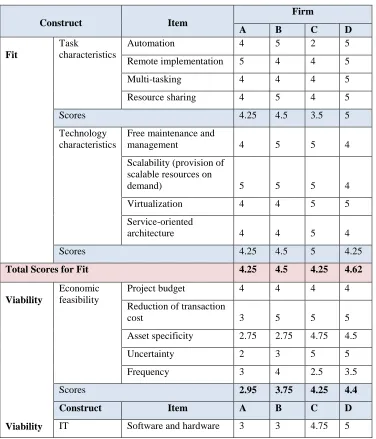
The feedback data that was collected for all of the items related to all of the constructs in the research model was analyzed statistically by the authors. The means of the feedback data collected for each item under each construct were computed. The results are presented in Table 2.
Volume 12, Number 1, March 2017
four firms, the technology characteristics of cloud computing fit the task requirement very well.
Table 2. Summary of Feedback on Performance of Cloud Computing in the Four Multi-National Companies
Construct Item
Firm
A B C D
Fit
Task
characteristics
Automation 4 5 2 5
Remote implementation 5 4 4 5
Multi-tasking 4 4 4 5
Resource sharing 4 5 4 5
Scores 4.25 4.5 3.5 5
Technology characteristics
Free maintenance and
management 4 5 5 4
Scalability (provision of scalable resources on
demand) 5 5 5 4
Virtualization 4 4 5 5
Service-oriented
architecture 4 4 5 4
Scores 4.25 4.5 5 4.25
Total Scores for Fit 4.25 4.5 4.25 4.62
Viability
Viability
Economic feasibility
Project budget 4 4 4 4
Reduction of transaction
cost 3 5 5 5
Asset specificity 2.75 2.75 4.75 4.5
Uncertainty 2 3 5 5
Frequency 3 4 2.5 3.5
Scores 2.95 3.75 4.25 4.4
Construct Item A B C D
International Journal of Business and Information For the construct of economic feasibility under Viability, firm D received the highest score, followed immediately by firm C and firm B. The scores mean that, in firms D, C, and B, investment in cloud computing brings adequate financial return and reduces the transaction costs, thus creating competitive advantage.
For the construct of IT infrastructure under Viability, firm C received the highest score (4.83), followed by firm D (4.5). Firm B received the lowest score (3.75) for this construct. From these scores, it can be interpreted that the IT infrastructure in firm B does not provide the necessary foundation to support technological operation and to enhance business operations, whereas the IT infrastructure in firm C and firm D fully provides computing, information management, and communication platforms to support technological operations.
For the construct of organization support under Viability, firm B again received the highest score (4.3). Firm A received the lowest score (3.1). These (cont’d) infrastructure Data management 5 4 5 4
Competence of IS staff 4.25 4.25 4.75 4.5
Scores 4.08 3.75 4.83 4.5
Organization support
Business process
reengineering 4 4 4 4
User competence 3.3 4 4 4.3
Top management
support 2 5 4 4
Scores 3.1 4.3 4 4.1
Total Scores for Viability 3.37 3.93 4.36 4.3
Performance of adopting cloud computing
Cloud computing use consistent with
expectation 3 4 4 5
User’s positive attitude
toward cloud computing 4 4 4 4 Extent to which cloud
computing satisfies user
needs 3 4 5 5
Volume 12, Number 1, March 2017
scores mean that firm B has the highest top management and employee support for adopting cloud computing.
With regard to the total score for Viability, firm C received the highest score (4.36) and firm A received the lowest (3.37). The scores indicate that firm C has high economic feasibility, IT infrastructure, and top management support, which means that the infrastructure of firm C is ready for cloud computing implementation. Firm A, on the other hand, has low support from top management, low user competence, low economic feasibility, and less software and hardware maturity to implement cloud computing. Firm D received the highest score (4.6) for performance of adopting cloud computing, whereas firm A received the lowest score (3.3). These scores mean that, in firm D, the user has the highest positive attitude toward the cloud computing system and that the system satisfies user needs and expectations.
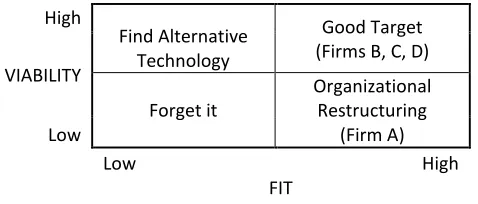
According to the fit-viability framework, firms B, C, and D fall in the category of good target, and firm A falls in the category of organizational restructuring, as shown in Figure 2.
Figure 2. The Fit-Viability Framework Analysis
As shown in Figure 2, cloud computing implementation at firms B, C, and D has high fit and strong organizational viability, which means that it has a good possibility of success in these firms. Firm A needs organizational restructuring to ensure success before the actual adoption of cloud computing. In firm A, cloud computing has high fit, but low viability because of the lack of top management support and the lack of user competence. These results confirm that top management support is essential for success of cloud computing implementation in an organization. Firm A also has low economic feasibility, a fact that creates less motivation for the user to adapt cloud computing. User competence may be
High
Find Alternative Technology
Good Target (Firms B, C, D) VIABILITY
Forget it
Organizational Restructuring
(Firm A) Low
Low High
International Journal of Business and Information built through proper training. Overall, firm A needs business process re-engineering (BPR) in order to improve its economic prospects.
Table 2, shown earlier, indicates that different items of different constructs received different feedback regarding their importance. Regarding task characteristics under the construct Fit, most of the firms agreed that the automation of tasks is possible through cloud computing anytime and anywhere by paying for the service according to use. This result means that the majority of the firms agreed that, by implementing cloud computing in the organization, repeated and straightforward tasks like configuring server, storage, network, and database will be automated. All four firms agreed that cloud computing supports multi-tasking, remote implementation, and sharing of resources to perform tasks.
With regard to technology characteristic under the construct Fit, all four firms concurred that free maintenance and management and provision of scalable services on demand are possible through cloud computing. All four also agreed that virtualization and service-oriented architecture (SOA) are necessary for cloud computing. All of the firms agreed that virtualization is a vital element of cloud implementation and is used to provide the necessary cloud characteristics of location independence, resource pooling, and rapid elasticity. With automation, computing infrastructure is much better used, leading to lower upfront and operational costs. Service-oriented architecture allows both enterprise back-end servers and user front-end applications to access cloud services easily.
Under the construct Viability, economic feasibility includes two aspects. One is assessment of the cost benefit of a particular IT project to see whether the investment can produce adequate financial or intangible returns. The other is determination of whether IT can affect transaction costs and hence lead to competitive advantage for the organization. The need for special investment (physical assets and human assets) and use frequency are factors that affect the transaction costs of cloud computing (Liang et al., 2007).
Volume 12, Number 1, March 2017
cloud technology is a frequent activity of the organization. Only firm B indicated that cloud technology is frequently used for information or decision-making.
An organization’s IT infrastructure comprises software and hardware maturity, data management, and the competence of the information systems (IS) staff. It consists of the IT platform and various information services necessary for the support of a particular application, such as communication channels, information management, different functional application systems, and structure and control of the platform (Liang et al., 2007).
Regarding software and hardware requirement, all of the firms agreed that the organization should have sufficient maturity in proper use of the Internet and related technology. Firms C and D agreed that the organization must have adequate hardware for operating the cloud computing system and must have integrated databases or a data warehouse. They also agreed that the organization must have a qualified network management system. Regarding data management, all of the firms agreed that the organizations must have established policies on data management and security. With regard to competence of the IS staff, all of the firms agreed that the IS department must know the business process well enough to implement cloud technology and must be experienced in system development and maintenance. They also agreed that the project leader must have prior experience in cloud applications.
The construct organization support includes business process re-engineering, top management support, and user competence; that is, user personality and past experience. All of the firms except firm A stated that top management support is necessary to use cloud computing technology in their organization. They agreed that users should have adequate knowledge of IT and cloud computing, be efficient in using cloud computing, and have a high intention of accepting new technology. Performance of adopting cloud computing is measured by system use and user satisfaction. Firms B, C and D agreed that cloud computing system use is consistent with their expectation. Firms A, C, and D agreed that the user should have a positive attitude toward the cloud computing system. Firms B and D agreed that that the cloud computing system satisfies the user needs.
7. CONCLUSIONS
International Journal of Business and Information computing and performed a multi-case analysis. The results of the surveys conducted among four multi-national corporations provided empirical support of the FVM model in assessing performance of adopting cloud computing by evaluating various factors of the fit and viability constructs.
The findings indicate that cloud computing implementation at all four firms has a high fit; that is, the nature of cloud computing fits the task requirements in the firms. Only firm A has a low viability because of the lack of top management support, and therefore needs organizational restructuring. The other three firms have high fit and high viability, which means that these firms fall in the category of good target, where there is good possibility of success of cloud computing implementation.
All four firms indicated that they use cloud computing for multi-tasking, automation, resource sharing, and remote implementation. All four identified the following features of cloud computing: SOA, virtualization, scalability, flexibility, and free maintenance and management. Regarding economic feasibility, all of the firms agreed that the organization should provide an adequate budget for developing and maintaining the cloud computing system. In the context of performance of adopting cloud computing, the majority of the firms agreed that cloud computing system use is consistent with their expectation.
7.1 Managerial and Theoretical implications
The current study is based on a literature review and an analysis of empirical data related to the fit-viability framework for cloud computing adoption in organizations. On the theoretical side, this study used both fit and viability constructs to explain the performance of adopting cloud computing. The fit construct is explained by both task and technology characteristics, whereas viability is explained by three variables -- economic feasibility, IT infrastructure, and organizational support. On the managerial side, this study collected useful information from project managers and senior managers at four large multi-national firms for empirical analysis of the proposed research model.
Volume 12, Number 1, March 2017
The most significant implication of this study is that managers can use the developed instrument to measure the performance of adopting cloud computing in the organization by taking into account both the fit and viability measures of the technology. This action enables firms to increase the possibility of the success of cloud computing. The results of this study can provide useful guidelines for practitioners and for organizations in their decisions on whether to adopt cloud computing. This study is one of the first to combine the fit and viability aspects in the context of cloud computing and to empirically demonstrate the value of this two-dimensional model.
7.2 Limitations
This study has some limitations, primarily with regard to sample size. A larger sample would provide sufficient scope for further data analysis. Since this study is exploratory, there is a need for in-depth surveys and analyses to confirm the findings. There is also a need for future studies to thoroughly investigate the propositions presented below.
7.3 Propositions for Future Study
The results of the current study show empirical support of the FVM model in assessing cloud computing performance, measured by system use and satisfaction. The findings of this study lead to four propositions for future study.
P1. The fit between the characteristics of cloud computing and task requirement is a critical factor for an organization to adopt cloud computing
In this exploratory study, task is construed as the activities that cloud technology performs in the organization. Results of this study show that cloud computing has a high degree of fit in all four of the firms. It is important to assess the effect of different fit levels on the performance of adopting cloud computing.
P2. Organizational viability plays a key role in cloud computing performance.
International Journal of Business and Information P3. Economic feasibility – measured by the cost benefit of the particular IT project, transaction cost, asset specificity, use frequency, and uncertainty – is critical to cloud computing performance.
In the current study, firm A has low economic feasibility because of the lack of reduction of transaction costs. Reducing transaction cost can increase a user’s willingness to adopt a technology. Factors affecting transaction costs are asset specificity, frequency, and uncertainty. Asset specificity – that is, the need for special investment in hardware and software and employee training cost and low use frequency – can increase transaction costs and thus reduce the use of cloud computing in an organization. In the current study, firm A needs special investment in training of employees for better use of cloud computing. Tasks supported by cloud computing are not a frequent activity in firm A, and task requirements in firm A do not use cloud computing frequently for information or decision-making. This situation, in turn, increases the transaction cost for firm A and thus lowers economic feasibility.
P4. Organizational support – as measured by user competence, top management support, and business process reengineering – has a significant impact on the performance of cloud computing.
In the current study, firm A requires organizational restructuring because of the lack of top management support and user competence. Without the support of top management, the implementation of cloud computing will be unsuccessful. Firm A need organizational restructuring before the implementation process begins in order to ensure its success.
APPENDIX
Volume 12, Number 1, March 2017
Cloud Computing in the Organization
Questions
Feedback 1 2 3 4 5 1. Automation of tasks is possible through cloud computing
technology.
2. Cloud computing provides remote implementation of tasks. 3. Cloud computing supports multi-tasking.
4. Cloud computing provides sharing of resources to perform tasks. 5. Free maintenance and management of cloud computing technology
is possible.
6. Virtualization is necessary for cloud computing technology. 7. Cloud technology enables provision of scalable resources on
demand.
8. Service-oriented architecture is necessary for cloud computing. 9. The organization provides adequate budget for developing the
cloud computing system.
10. The organization provides adequate budget for maintaining the cloud computing system.
11. Use of cloud computing technology reduces transaction cost. 12. The adoption of cloud technology needs to obtain special
hardware/software.
13. The use of cloud technology reduces the need for physical asset on hand.
14. Users use cloud technology to better perform with no need of more training.
--Continued
International Journal of Business and Information 15. The adoption of cloud technology requires the hiring of employees
with special expertise.
16. The task supported by the cloud technology is a frequent activity of the organization.
17. The task frequently needs to use the cloud technology for information or decision making.
18. The environment and business process in cloud technology are subject to frequent changes.
19. The organization must have adequate hardware for operating the cloud computing system.
20. The organization should mature in using the Internet and related technology.
21. The organization must have a qualified network management system.
22. The organization must have integrated databases or a data warehouse.
23. The organization must have established policies on data management and security
24. The IS department must know the business process well enough to implement the cloud technology.
25. The IS personnel must be experienced in system development and maintenance.
26. The project leader must have prior experience in cloud applications.
27. The user must have adequate knowledge of IT and cloud technology.
28. The user must have a high intention of accepting new technology. 29. The user has high efficacy in using cloud technology.
--Continued
Volume 12, Number 1, March 2017
30. Top management support is necessary to use cloud computing technology.
31. The cloud computing system use is consistent with expectation. 32. The user has a positive attitude toward the cloud computing
system.
33. The cloud computing system satisfies the user needs. 34. The intensity level of
job-related use of cloud
computing technology in the organization (minutes per day, at work)
<30 min 30-45 min 60-90 min
120 min >120 min
35. Frequency of general use of cloud computing technology in the organization
Once or twice per week Once or twice per month About once per day Several times per day Several times per week REFERENCES
Aleem, A., & Ryan Sprott, C. (2012). Let me in the cloud: Analysis of the benefit and risk assessment of cloud platform, Journal of Financial Crime, 20(1), 6-24.
doi: https://doi.org/10.1108/13590791311287337
Alshamaila, Y., Papagiannidis, S., & Li, F. (2012). Cloud Computing Adoption-An Exploratory Study. In WEBIST (pp. 518-524).
Armbrust, M., Fox, A., Griffith, R., Joseph, A. D., Katz, R., Konwinski, A., & Zaharia, M. (2010). A view of cloud computing, Communications of the ACM, 53(4), 50-58. doi: https://doi.org/10.1145/1721654.1721672
Behrend, T.S., Wiebe, E.N., London, J.E., & Johnson, E.C. (2011). Cloud computing adoption and usage in community colleges, Behaviour & Information Technology, 30(2), 231-240. doi: https://doi.org/10.1080/0144929X.2010.489118 Berman, S.J., Kesterson-Townes, L., Marshall, A., & Srivathsa, R. (2012). How cloud
computing enables process and business model innovation, Strategy & Leadership, 40(4), 27-35. doi: https://doi.org/10.1108/10878571211242920 Dhar, S. (2012). From outsourcing to cloud computing: Evolution of IT
International Journal of Business and Information doi: http://dx.doi.org/10.1108/01409171211247677
Dihal, S.. Bouwman, H., de Reuver, M., Warnier, M., & Carlsson, C. (2013). Mobile cloud computing: State of the art and outlook. Info, 15(1), 4-16.
doi: http://dx.doi.org/10.1108/14636691311296174
Dwivedi, Y.K., & Mustafee, N. (2010). It’s unwritten in the cloud: The technology enablers for realising the promise of cloud computing, Journal of Enterprise Information Management, 23(6), 673-679. doi: http://dx.doi.org/10.1108/17410391011088583 Ercan, T. (2010). Effective use of cloud computing in educational institutions,
Procedia-Social and Behavioral Sciences, 2(2), 938-942. doi: http://dx.doi.org/10.1016/j.sbspro.2010.03.130
Goodhue, D.L., & Thompson, R.L. (1995). Task-technology fit and individual performance, MIS Quarterly, 19(2), 213-236. doi: http://dx.doi.org/10.2307/249689 Kaufman, L.M. (2009). Data security in the world of cloud computing, security &privacy,
IEEE, 7(4), 61-64. doi: http://dx.doi.org/10.1109/MSP.2009.87
Larosiliere, G D., & Carter, L.D. (2013). An empirical study on the determinants of e-government maturity: A fit-viability perspective, ECIS 2013 Completed Research. Liang, T.P., & Wei, C.P. (2004). Introduction to the special issue: Mobile commerce
applications, International Journal of Electronic Commerce, 8(3), 7-17.
Liang, T P., Huang, C.W., Yeh, Y.H., & Lin, B. (2007). Adoption of mobile technology in business: A fit-viability model, Industrial Management & Data Systems, 107(8), 1154-1169. doi: http://dx.doi.org/10.1108/02635570710822796
Lin, A., & Chen, N.C. (2012). Cloud computing as an innovation: Perception, attitude, and adoption, International Journal of Information Management, 32(6), 533-540. doi: http://dx.doi.org/10.1016/j.ijinfomgt.2012.04.001
Lloret Romero, N. (2012). “Cloud computing” in library automation: Benefits and drawbacks, The Bottom Line, 25(3), 110-114.
doi: https://doi.org/10.1108/08880451211276566
Marston, S., Li, Z., Bandyopadhyay, S., Zhang, J., & Ghalsasi, A. (2011). Cloud computing: The business perspective, Decision Support Systems,51(1), 176-189.
doi: http://dx.doi.org/10.1016/j.dss.2010.12.006
Volume 12, Number 1, March 2017
Muhammad, I., Seitz, J., & Wickramasinghe, N. (2013). Understanding the cross-cultural ERP implementation impact: An FVM perspective. In 26th Bled eConference eInnovations: Challenges and Impacts for Individuals, Organizations and Society (pp. 130-140), Maribor, Slovenia: University of Maribor.
Obeidat, M.A., & Turgay, T. (2012). Empirical analysis for the factors affecting the adoption of cloud computing initiatives by information technology executives, Journal of Management Research, 5(1), 152-178.
doi: https://doi.org/10.5296/jmr.v5i1.2764
Oliveira, T., Thomas, M., & Espadanal, M. (2014). Assessing the determinants of cloud computing adoption: An analysis of the manufacturing and services sectors, Information & Management, 51(5), 497-510.
doi: http://dx.doi.org/10.1016/j.im.2014.03.006
Ross, P., & Blumenstein, M. (2013). Cloud computing: The nexus of strategy and technology, Journal of Business Strategy, 34(4), 39-47.
doi: http://dx.doi.org/10.1108/JBS-10-2012-0061
Sharif, A.M. (2010). It’s written in the cloud: The hype and promise of cloud computing, Journal of Enterprise Information Management, 23(2), 131-134. doi: http://dx.doi.org/10.1108/17410391011019732
Sultan, N. A. (2011). Reaching for the “cloud”: How SMEs can manage, International Journal of Information Management, 31(3), 272-278.
doi: http://dx.doi.org/10.1016/j.ijinfomgt.2010.08.001
Tjan, A.K. (2001). Finally, a way to put your Internet portfolio in order, Harvard Business Review, 79(2), 76-85.
Tornatzky, L.G.; Fleischer, M.; & Chakrabarti, A.K. (1990). Processes of Technological Innovation, Landham, MD: Lexington Books.
Truong, D. (2010). How cloud computing enhances competitive advantages: A research model for small businesses, The Business Review, Cambridge, 15(1), 59-65. Turban, E., Liang, T. P., & Wu, S.P. (2011). A framework for adopting collaboration 2.0
tools for virtual group decision making, Group Decision and Negotiation, 20(2), 137-154. doi: https://doi.org/10.1007/s10726-010-9215-5.
International Journal of Business and Information Zhang, Q.; Cheng, L.; & Boutaba, R. (2010). Cloud computing: State-of-the-art and
research challenges, Journal of Internet Services and Applications, 1(1), 7-18. doi: https://doi.org/10.1007/s13174-010-0007-6
Zissis, D., & Lekkas, D. (2012). Addressing cloud computing security issues, Future Generation computer systems, 28(3), 583-592.
doi: http://dx.doi.org/10.1016/j.future.2010.12.006
ABOUT THE AUTHORS
Shailja Tripathi, B.Sc, PGDCA, and MBA (IT), is pursuing her Ph.D. in IT and operations – cloud computing. She is a research scholar at IBS Hyderabad, IFHE University, India. She has two years of work experience at NIIT. She also worked at the Institute for Chartered Accountants of India (ICAI) for two years as an IT trainer. She has taught courses in database management systems, information systems for managers, and business process integration for MBA and BBA students. Her research areas are mainly cloud computing and social media. She has publications in both national and international journals and has presented papers at both national and international conferences.