Volume-7 Issue-2
International Journal of Intellectual Advancements
and Research in Engineering Computations
A study on partial replacement of fine aggregate to quarry dust
S.DhivyaBharathi
1, M.Ranjitham
1, M.MadhanKumar
2,
R.Monojkumar
2and Nithish
Kumar
2¹Assistant Professor, Department of Civil Engineering, Bannari Amman Institute of Technology,
Sathyamangalam.
²Under Graduate Student, Department of Civil Engineering, Bannari Amman Institute of Technology,
Sathyamangalam.
ABSTRACT
In this paper we will introduce the utilization of Quarry dust as a substitute for stream sand in mortar. It is acquired by squashing of rocks and the residue picked up from it is known as quarry dust. Quarry dust is utilized to diminish the expense for the creation of cement. Quarry dust have properties that were resolved are total smashing quality, soundness, retention, particular gravity. Compressive quality of cement with the supplanting of waterway sand with quarry dust were honed, and furthermore reve aled for correlation purposes. It will give most extreme compressive quality up to the supplanting of sand with quarry residue of 0%.20%, 30% and40%. At that point its quality bit by bit diminishes when the substitution has been gotten half and past. Subsequently we can reason that the properties of the quarry dust which may go past the cut off will influences and makes negative effects the quality. The consequence of the examination likewise shows that the compressive quality can likewise be get by the substitution of waterway sand by quarry dust.
Index Terms
:
Quarry dust, Compressive quality, Alternative.INTRODUCTION
Quarry dust is a spinoff of the devastating strategy which is a concentrated fabric to use as cementing cause, specifically as extraordinary totals. In quarrying sports, the stone has been beaten into differing sizes; for the term of the strategy the residue created is known as quarry earth and it is designed as waste. Most extreme of the developing nations are underneath strain to refresh incredible total in cement by utilizing an open door texture likewise to some degree or unquestionably without trading off the charming of cement. Quarry has been utilized for one of a kind exercises inside the development business, which incorporate building substances, road enhancement substances, totals, blocks, and tiles. The present research think about uncommonly manages the impact of various Substitute offer of sand with quarry
dust on the homes on cement. The essential piece of texture amassed from kondapalli area that is view territory is compound of shake sorts like hornblende, biotite, hypersthene’s and gneiss.
The possibility of option of natural best total by methods for quarry dust that is featured in the take a gander could improve the utilization of quarry dust produced from quarries. By methods for option of quarry soil, the necessity of land fill zone might be diminished and can likewise cure the issue of regular sand deficiency. The arrangement of sand at low an incentive as a pleasant total in cement isn't fitting and this is the motivation to search for an elective material. Quarry earth fulfills the reason in the back of the elective material rather for sand easily. It even reasons weight to auction the crusher soil at one region which causes ecological toxins. From the outcomes
of test examinations completed, it's far presumed that the quarry soil might be utilized as a substitution for superb blend. It's miles discovered that forty% substitute of charming blend by means of quarry dust offers most extreme outcome in power than customary cement after which diminishes from half. The compressive vitality is measured for different percent and grades of cement by utilizing option of sand with quarry dust
Quarry dust is a side-effect of the devastating strategy that is an engaged fabric to apply as totals for cementing reason, extraordinarily as top of the line totals. In quarrying exercises, the stone has been pounded into various sizes; over the span of the strategy the earth created is called quarry soil and it's far formed as waste. So it moves toward becoming as a vain fabric and furthermore results in air contamination. Along these lines, quarry dust must be utilized in creation works, a great method to diminish the estimation of development and the advancement material would be spared and the home grown sources might be utilized well. Most extreme of the creating worldwide areas are beneath worry to supplant top notch blend in cement through a change fabric likewise to a point or totally without trading off the best of cement. Quarry earth has been utilized for particular exercises inside the generation venture, alongside building substances, road enhancement substances, totals, blocks, and tiles.
The current examinations work specifically manages the effect of different elective offer of sand with quarry dust at the properties of cement. The present examine is conscious to take a gander at the impacts of quarry earth expansion in regular cement and to assess the cost of compressive power improvement.
LITERATURE REVIEW
Radhikesh et al (2010) have directed a trial concentrate to research the appropriateness of quarry dust as fine total for creating clearing squares. The test outcomes demonstrate that the substitution of fine total by quarry dust up to half negligibly affects the decrease of physical and mechanical properties while there is a sparing of 56% of cash and the level of sparing would be more for large scale manufacturing of clearing squares.
Manasseh Joel (2010) have researched the reasonableness of squashed stone fines to supplant stream sand in solid generation for unbending asphalt. It is reasoned that, in view of financial investigation and quality test outcomes, waterway sand supplanted with 20% of pulverized stone fines is suggested for generation of cement for inflexible asphalt. The utilization of concrete substance, usefulness, compressive quality and cost of cement made with quarry dust were considered by analysts.
The investigations (Ilangovan 2008) directed on quality and sturdiness properties of cement containing quarry dust as fine total uncovered that the general usefulness estimation of quarry dust concrete is less, at the point when contrasted with regular cement. Quarry dust solid encounters better sulfate and corrosive obstruction and its penetrability is less, contrasted with that of customary cement. Be that as it may, the water ingestion of quarry dust concrete is marginally higher than customary cement. The utilization of higher water bond proportion requests high concrete substance for a required quality. The impact of halfway supplanting of fine total with smashed stone residue (molecule measure under 75micron) was examined by Raman et al (2007) and it was watched that droop esteem diminished as the level of residue content expanded. Moreover for higher residue substance, the compressive quality, flexural quality and affect obstruction diminished step by step though ingestion expanded. The utilization of quarry sand is for the most part constrained because of the high bond glue volume expected to acquire a sufficient functionality of cement. The measure of extra glue content relies upon shape, surface, reviewing and dust content of the sand. The expansion of water request of solid blends delivered by the unfavorable impacts of shape and surface of quarry sand can be alleviated utilizing a high-extend water-decreasing admixture too.
cement and strength of quarry shake dust concrete under sulfate and corrosive activity is higher to that of regular cement. Porousness test results plainly exhibit that the penetrability of quarry shake dust concrete is not exactly the regular cement. The water ingestion of quarry shake dust concrete was observed to be somewhat higher than ordinary cement.
Sahu et al (2003) have detailed that solid containing quarry dust as fine total is promising ore noteworthy quality, bring down porousness and more noteworthy thickness which empower it to give better protection from stop/defrost cycles and strength in unfavourable condition. As detailed by Hameed et al (2009), the utilization of quarry dust as fine total will likewise lessen ecological effect, if devoured by the development business in substantial amounts.
Raman et al (2007) analyzed the impact of incomplete substitution of waterway sand by 20% of quarry dust in streaming concrete and inferred that the utilization of quarry dust did not influence physical properties and flow ability of the concrete. It was discovered that, the utilization of quarry squander caused a slight decrease in compressive quality because of exorbitant flakiness and need in degree and additionally brought about higher starting surface assimilation which was enhanced in nearness of silica smolder. At long last it was presumed that, quarry waste can be used to create streaming cement with 10% of silica smolder as fractional substitution of bond.
Murugesan et al (2006) analyzed the impact of super plasticizer in quarry dust supplanted concrete and detailed that the compressive quality and usefulness of quarry dust cement can be enhanced with plasticizers. The quarry dust was blended in different extents, supplanting sand by 30-90% in customary cement. Solid 3D squares of review M15 and M20 have been thrown what's more, tried for compressive quality and the outcomes were contrasted and traditional cement. It was discovered that, 60% substitution of sand by quarry dust without plasticizer and 70% - 80% supplanting with plasticizer delivered indistinguishable compressive quality from that of regular cement. It is suggested that, to defeat the issue of poor functionality with the substantial extents of quarry dust in fine total, super
plasticizer at the dose of 0.4% by weight of concrete can be utilized.
Nagaraj and ZahidaBanu (1996) have inspected the impact of substitution of fine total in bond concrete by quarry dust and produced sand. It was seen that sand and half quarry dust mix gives higher quality when thought about than the customary concrete because of the sharp edges of stone furnishing more grounded bond with concrete contrasted with the adjusted state of common sand. It was seen that solid utilizing quarry fines demonstrates enhancement in higher flexural quality, scraped area obstruction and unit weight which are imperative for diminishing erosion or filtering.
Naidu et al (2003) have led an exploratory examination to examine the impact of fractional supplanting of sand with quarry dust in the compressive quality and haul out power of cement. Four sorts of cement, with two water-cover proportions of 0.40 and 0.45 were attempted in this investigation. Supplanting extent of 20% sand with quarry dust was rehearsed in all the cements aside from in the controlled solid blend. All cements were restored by dry air in the relieving room at 20ºC, and their compressive quality and haul out drive were estimated on the seventh, fourteenth, 28th and 56th day. Test outcomes demonstrate that solid consolidating quarry dust and without the consideration any mineral admixtures showed a lower compressive quality however a higher haul out power than the controlled cement at all ages. Incorporation of fly fiery remains as 10% folio into the quarry dust concrete brought about an expansion in the compressive quality and haul out power at all conditions. The quarry dust concrete consolidating 10% silica rage as folio displayed the most noteworthy compressive quality and haul out power in all conditions.
additionally shows that quarry residue can be used as fractional substitution material to sand, within the sight of silica smoke or fly fiery remains to deliver concrete with reasonable scopes of compressive quality.
Naidu et al (2003) have explored the impact of incomplete supplanting of sand with 20% of quarry residue and mineral admixtures in the compressive and haul out power of cement. Test outcomes demonstrate that solid joining quarry dust and without the incorporation of mineral admixtures shown a lower compressive quality yet a higher haul out power then the controlled cement at all the ages. Consideration of fly fiery remains as 30% cover into the quarry dust concrete brought about an expansion in the compressive quality.
MATERIALS AND METHODS
Cement
Concrete is a fine, delicate, fine compose substance. It is produced using a blend of components that are found in regular materials, for example, limestone, earth, sand as well as shale. At the point when bond is blended with water, it can tie sand and rock into a hard, strong mass called concrete. Portland bond is produced by squashing, processing and proportioning the accompanying materials.
Lime or calcium oxide, CaO: from limestone, chalk, shells, shale or calcareous shake
Silica, SiO2: from sand, old containers, mud or argillaceous shake
Alumina, Al2O3: from bauxite, reused aluminum, earth
Iron, Fe2O3: from earth, press mineral, piece iron and fly powder
Gypsum, CaSO4.2H20: found together with limestone.
Aggregates
Total, in building and development, material utilized for blending with bond, bitumen, lime, gypsum, or other glue to shape cement or mortar. The total gives volume, soundness, protection from wear or disintegration, and other wanted physical properties to the completed item.
Quarry dust
The pounded shake totals quarrying creates extensive volumes of quarry fines, named quarry dust. The quarry dust is utilized as the main fine totals.
Sand
Sand is utilized as the second fine totals. The locally accessible waterway sand at the site is utilized for the investigation. Properties of elements of concrete and compressive quality of mortar 3D shapes have been found. In second stage, the compressive quality of cement has been found. The grouping of cement was finished by gauging the materials of blend proportions of 1:2:4. The materials were then blended altogether and endorsed amount of water was added and afterward blended to deliver crisp cement.
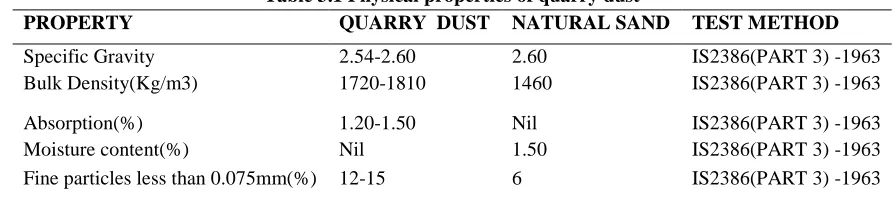
Table 3.1 Physical properties of quarry dust
PROPERTY QUARRY DUST NATURAL SAND TEST METHOD
Specific Gravity 2.54-2.60 2.60 IS2386(PART 3) -1963
Bulk Density(Kg/m3) 1720-1810 1460 IS2386(PART 3) -1963
Absorption(%) 1.20-1.50 Nil IS2386(PART 3) -1963
Moisture content(%) Nil 1.50 IS2386(PART 3) -1963
Fine particles less than 0.075mm(%) 12-15 6 IS2386(PART 3) -1963
Table 3.2 Chemical Properties Of Quarry Dust
Constituents Quarry dust (%) Natural sand (%) Test method
SiO2 62.48 80.78 IS 4032-1968
Fe2O3 6.54 1.75 IS 4032-1968
CaO 4.83 3.21 IS 4032-1968
MgO 2.56 0.77 IS 4032-1968
Na2O Nil 1.37 IS 4032-1968
K2O 3.18 1.23 IS 4032-1968
TiO2 1.21 Nil IS 4032-1968
Specific gravity
1. In solid innovation, particular gravity of totals is made utilization of In Design estimation of cement blends.
2. Particular gravity of totals is likewise utilized for computing the compaction factor in connection to usefulness estimations.
3. Particular gravity of total is additionally required to be considered when we manage light weight and overwhelming weight concrete. Normal particular gravity of rocks differs from 2.6 to2.8. 4. The particular gravity of soil solids is controlled
by pycnometer.
5. The blaze or pycnometer is utilized just for course grained soils.
Specific gravity of cement
Specific gravity of cement is formed to be 3.15
Specific gravity of fa
The specific gravity is calculated as 2.65
Specific gravity of ca
The specific gravity is calculated as 2.66
Initial setting time
Introductory setting time is viewed as the time slipped by between the minute that the water is added to the bonds to the time that the glue begins losing its Plasticity.
Test procedure
1. 1.A Sample of bond weight 300gms is taken and the glue is set up by blending the concrete mind 0.85 times of water required to give a glue of standard consistency.
2. The glue is filled to the form of vicat's mechanical assembly and the plunger of 1mm
dia having length of 50mm is permitted to enter the glue at a separation of 5mm from the base. 3. The time between when the water is added to the
bond and the needle enter through a separation of 5mm from base is noted .
4. The outcome are organized in tabulated in table no.
5. From the table, beginning setting time =90 minutes Last settings.
Initial setting time
A similar system is pursued as that of the underlying setting time. Here notwithstanding utilizing 1mm dia needle, 10mm dia needle is utilized. According to analyze result the setting time for 53 review bond is 260 minutes.
Tests on hardened concrete
Compressive strength
Concrete is exceptionally solid in pressure it is this property which is made utilization of in current development. The compressive quality of cement is viewed as the essential nature of good concrete. Since it is seen that all properties, for example, solidness bond, resistance to abrasion, improve with enhancement of compressive quality.
Testing procedure
S.NO Specimen Name Quarrydust(kN/mm2)
1 1:3 A1 22.54
2 1:3 A2 23.68
3 1:3 A3 23.68
4 1:3 A4 23.92
CONCLUSION
It is seen that the quality attributes of quarry dust is same as sand. The substance creation of quarry residue and sand have that the quality property stays consistent for both the materials. The quarry dust replacement of fine aggregate gives maximum compressive strength at 40% which gives the high quality as same sand. It is seen that the distinction of compound structure for the quarry dust tests gathered from different crushers. All the crusher's examples are seen satisfactory outcomes. The particular gravity and strainer examination results demonstrates that the quarry residue can be utilized as choice to sand. The particular gravity of all the crusher tests is lies
between 2 to 2.7 which satisfy the sand prerequisite. The sifter investigation is done for the gathered quarry dust crusher Sample and sand which have the sand zone.
From the analysis ponder it is presumed that the quarry residue can be utilized as a substitute for sand. It is distinguished that 40% substitution of sand by quarry dust give great outcome in quality than typical cement mortar 1:3. The outcomes have that the 40% substitution of sand by the quarry dust actuated higher compressive quality and the usefulness of solid declines as substitution increments. Subsequently the ecological impacts and the waste can be fundamentally diminished.
REFERENCE
[1]. Anzar Hamid Mir, “Improved Concrete
[2]. Properties Using Quarry Dust as Replacement for Natural Sand”. International Journal Engineering Research and development, 11(3), 2015, 46-52.
[3]. BurakFelekogiu, “The effect of fly ash and limestone fillers on the viscosity and compressive strength of self compactingrepair mortars” Cement and Concrete Research. 36, 2006, 1719-1726. Dui:10.1016/j. cemconres /2006.04.002.
[4]. Binusukumar, k. Nagamani and R, Srinivasa
[5]. Raghavan, “Evaluation of strength at early ages of self-compacting concrete with high volume fly ash”, Construction and Building Material. 22, 2008, 1394 -1401.
21.5 22 22.5 23 23.5 24 24.5
day 3/S1 day 3/S2 day 3/S3 day 3/S4
Mrs. S.DhivyaBharathi was born in Tamil Nadu, India, in 1991. She received his Bachelor of Engineering degree in Civil Engineering in 2012 and Master of Engineering in Structural Engineering in 2015.
She started his carrier as a lecturer in 2012 in BIEW, Attur, after completing her PG she joined as Assistant professor at AVS College of technology, Salem in 2015. Now currently working as AP in Bannari Amman College of Technology, Sathyamangalam since 2017. Her research Interest includes Geopolymer concrete, high performance concrete, Ferro cement. She has presented in nine national conference and 3 international Conference and published two journal (one is Scopus indexed)
Mrs. M. Ranjitham was born in Tamil Nadu, India, in 1991. She received his Bachelor of Eng ineering degree in Civil Engineering in 2012 and Master of Engineering in Structural Engineering in 2014.