WWJMRD 2018; 4(2): 134-138 www.wwjmrd.com
International Journal Peer Reviewed Journal Refereed Journal Indexed Journal UGC Approved Journal Impact Factor MJIF: 4.25 E-ISSN: 2454-6615
N.Nagarathinam
Assistant Professor & Ph.D., Part-Time Research Scholar, PG. And Research Department Of Commerce And
Management Studies, 197-Sudharsan College Of Arts And Science,(Affiliated To Bharathidasan University, Trichy-24) Perumanadu Post, Pudukkottai District Of Tamil Nadu, India
Dr. C.Subramanian
Assistant Professor, PG. And Research Department Of Commerce And Management Studies, 197-Sudharsan College Of Arts And Science,(Affiliated To Bharathidasan University, Trichy-24) Perumanadu Post, Pudukkottai District Of Tamil Nadu, India
Correspondence: N.Nagarathinam
Assistant Professor & Ph.D., Part-Time Research Scholar, PG. And Research Department Of Commerce And
Management Studies, 197-Sudharsan College Of Arts And Science,(Affiliated To Bharathidasan University, Trichy-24) Perumanadu Post, Pudukkottai District Of Tamil Nadu, India
Effectiveness of FMCG’S Advertisement with Special
Reference to Pudukkottai District of Tamilnadu
N.Nagarathinam,
Dr. C.Subramanian
Abstract
As customers, we buy millions of products every year. And just like us, these products have a life cycle. Any product that is introduced into a market has a shelf life; this can be overcome easily by making or purchasing new products. Older, long-established products eventually become less popular, while in contrast, the demand for new, more modern goods usually increases quite rapidly after they are launched. A product in general has a product life cycle; usually it goes through four major stages in its lifecycle. FMCG. Products or fast moving consumer goods have a long product life cycle; people continue to buy the product for a number of years as long as it is in stock. Over the years people have observed many products are no longer available in the markets that they go to, this usually happens when the product has completed its lifecycle. This article is an attempt focusing upon the different opinion of customer that a fast moving consumer product has to pass through and it also makes an effort to highlight the purchasing strategies that can be adopted in the various opinion of the life cycle of the product.
Keywords
:
FMCG, Effectiveness of Advertisements.Introduction
In every Industry, various types of functions are being performed like manufacturing, research, storage, transportation, marketing human resource and public relations. Marketing is one of the important function through this the products and services reach to the end users.(customers). It is an important activity in a business through which gets its return from business efforts. According to Bartle, “Marketing is the process whereby society, to supply its consumption needs, evolves distributive systems composed of participants, who, interacting under constraints-technical (economic) and ethical (social)-create the transactions or flows which resolve market separations and result in exchange and consumption”. Further Kotler defined, “Marketing is the social process by which individuals and groups obtain what they need and want through creating and exchanging products and value with others”. Peter Druker opined that, “Marketing is not only much broader than selling, it is not a specialized activity at all, it encompasses the entire business. It is the whole business seen from the point of view of the final result, that is, from the customer’s point of view. Concern and responsibility for marketing must therefore permit all areas of the enterprise”. The main elements of marketing are:-
Marketing focuses on the satisfaction of customer needs, wants and requirements.
The philosophy of marketing needs to be owned by everyone within the organization.
Future needs have to be identified and anticipated.
There is normally a focus upon profitability, especially in the corporate sector. However, as public sector organizations and non-profit organizations adopt the concept of marketing, this need not always is the case.
More recent definitions recognize the influence of marketing upon society.
Advertising is a very important communication tool, highly visible and more effective. It helps to create awareness, remind, persuade to buy and retain the existing customers. People in markets feel that is the need of the time for business.
We may like or not but advertisements are visible everywhere in our surrounding. It is very difficult to live in isolation without noticing advertisement in present time. It has become part of our social, economic, cultural and business environment. It is the indicator of advancement and progress of human civilization. Advertisements have affected our life style to a great extent. Advertising has been defined by experts as follows: “Advertising is any paid form, non-personal presentation of ideas products and services by an identified sponsor”. –
American Marketing Association.
“Advertising is the non-personal communication of marketing related information to a target audience, usually paid for by the advertiser and delivered through mass media in order to achieve the specific objectives of the sponsor”. – J.J. Burnett.
Scope of the Study
The study is relating to advertisement of business in FMCG sector in India. It covers the important attributes while purchase of FMCG. Products and the advertising as tool of promotion which influences purchasing decisions. It will study the relation of advertising and media planning and its impact on effectiveness of promotion activities. In brief Brand Ambassador, major decision area media selection and known factors in advertising the accomplishes audience persuasion in reference to FMCG advertising and effectiveness in leading companies in Indian market.
Statement of the Problem
In this fast and technological world, advertisement plays a vital role in the mind of the consumers. There are many advertisements we come across daily through different medias but only few we remember that is why this study is to be undertaken which advertisement is effectiveness. As there are many industries which gives lot of advertisement in many Medias whereas this research is only focusing on FMCG. (Fast Moving Consumer Goods) industry as now-a-days FMCG. are mandatory in our everyday life. It also closely related to nation’s economic growth and income level. FMCG ads are channelized in many medias but the researcher has concentrated only on few medias such as TV, Radio, Press and outdoor advertising because now a day’s these becomes a comfortable item where once upon a time these medias was considered as luxury item. Everywhere in the world even in the remote places also one’s having a Television set. People spent 40% of their time to watch programs in the TV. That is why researcher is keen to know about FMCG’s advertisement effectiveness whether the ad makes the people to buy the product, in what way how, when and why. This research study deals with various issues like impact of advertisement on rural consumer’s behavior whether the FMCG advertisements telecasted creates the desire in the mind of rural consumer to purchase. The rural consumers use FMCG in daily routine and demand uniqueness and variety among them that is why the researcher focused heavily to judge psyche of rural consumers. What they like in the advertisement, why they like and what will be appreciable in FMCG products.
Need for the Study
In present scenario across the global market, tough
competition is being faced. Even for MNCs, it has become very import to communicate to target rural customers regarding their products and service feature. Advertising is a tool of marketing communication or promotion. It created awareness, reminds, persuades and retains the existing customers. It helps to increase the new customers and retain the existing customers. It contributes in growth of the business. Further, if advertising is done with proper media planning the communication effectiveness will be higher. Therefore, the advertising and strategic media planning is of great significance for promotion of the business in present competitive situation. Due to its greater importance this topic has been selected to research study.
Review of Related Literature
Studies relating to the effectiveness of FMCG advertisement in consumer sales promotion on consumer behavior, sales, profit, market share etc., are included in this section. Anderson, T.Eric and Simester I. Duncan (2004)1 Invested how the depth of a current price
promotion affect future purchasing of first time and established customers based on three large scale field experiments on durable goods and through a direct male catalogue. The findings reveal different effect for first-time and established customers. Deeper price discounts in the current period increased future purchases by the first time customers (a positive long-run effect) but reduced future purchases by established customers (a negative long-run effect). Kumar, V. and Swaminathan (2005)2 studied the
impact of coupons on brand sale and how that impact decays over the life of the coupon. The authors use an econometric model to demonstrate the coupon effect in terms of equivalent price reduction, account for coupon effect over time, allow inference of coupon effects when retailers decide to double or triple the coupon value and provide both self-coupon and cross-coupon elasticity’s at different levels of aggregation. Results indicate that the effect of doubling the face value of coupon result in more than a proportionate increase in elasticity and both self and cross-coupon elasticity’s are much smaller in magnitude than the average self-cross price elasticity. Laroche, Michel et.al., (2005)3 studied the effect of coupons on consumer’s
brand categorization and choice process using fast-food restaurants in china. Results suggest that there are both direct and cross-advertising effects i.e., the presence of a coupon for a focal brand has an impact on consumer’s attitudes and intentions towards that brand. Lewis, Michel (2004)4 developed an approach for simultaneous
measurement of the influence of a dynamic loyalty programme and more traditional short-term promotions. They argue that the loyalty programmes under examination successfully alter behavior and increase retention rates. E-mail based coupons; shipping fee general price levels all significantly affect customers purchase decisions. Ndubisi, Oly, Nelson and Moi, Tung, Chiew (2005)5 in their study
determines repurchase behavior and also mediated in the relationship between sales promotions and repurchase. Fear of losing face significantly moderates the relationship between in-store display and product trial. Vecchio, Del Devon et.al. (2006)6 report the results of the study, which
examined the effect of sales promotion on brand preference through Meta analysis. Results of 51 studies had been integrated. As per the study sales promotions do not affect post promotion brand preferences in general. But depending upon characteristics of sales promotion and the promoted product, product can either increase or decrease preference for a brand.
Objectives of the Study The main objectives studies are
To study the important attributes considered while purchase of FMCG products.
To analyze the key areas for effective FMCG advertisement that affects and influence the purchasing decisions of the common people.
To find the suitable and applicable Brand Ambassador for FMCG products.
To identify known factors in advertising that accomplishes audience persuasion in reference to FMCG advertising.
To study the various dimensions of factors influencing the selection of media for FMCG product advertising.
Research Methodology
A good research work requires a clear scientific methodology because only through the application of correct methodology in selection of sampling techniques, appropriate tools of data collection etc., so that well founded conclusion can be drawn on the phenomenon under consideration. The validity of a research depends upon the method of collecting the data and analyzing the same. In the present study, extensive use of both primary and secondary data was collected systematically.
Data Collection
The study was based on survey method. Taking the objective in account to this study, the information and data was totally collected from both primary and secondary sources.
Primary Data
In order to fulfill the objectives set out, a sample study was undertaken using well-framed questionnaire and got it duly filled in by the sampled respondents. Respondents of varying nature were selected based on the important aspects
of their Gender, Age, Education, Income, Occupation and schedule were pre-tested and suitable modifications were carried out later.
Secondary Data
The primary data were supplemented by enough secondary sources of data. The secondary data pertaining to the study were gathered from company profile, newspapers, magazines, journals, periodicals, reports, books, web portals and well-equipped universities libraries at Bangalore, Chennai, Coimbatore, Pondicherry and Trichy. They were utilized to get the necessary past and latest informationrequired for the study.
Period of the Study
The research has been conducted during the period from 2015 onwards. The data collected from primary sources and secondary sources, the researcher tries level best to obtain the recent reviews also.
Sample Size
Samples were collected from respondents to find the effects of advertisements on FMCG products from both male and female respondents. The sample sizes are totally 1000.
Sampling Design and Area of Sampling
Sample design is determined before data is collected. There are many sampling designs from which the researcher selected systematic sampling design method in which sample members from a larger population are selected according to a random starting point and a fixed, periodic interval. This interval, called the sampling interval (k), is calculated by dividing the population size (N) by the desired sample size (n), is K = N/n
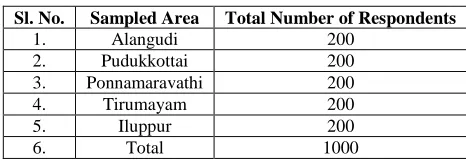
The totals of 1000 samples were collected from respondents in selected five taluks in the districts of Tamilnadu and are clearly mentioned in the following Table 1
Table 1: Area of Sampling
Sl. No. Sampled Area Total Number of Respondents
1. Alangudi 200 2. Pudukkottai 200 3. Ponnamaravathi 200 4. Tirumayam 200
5. Iluppur 200
6. Total 1000
Source: Primary Data
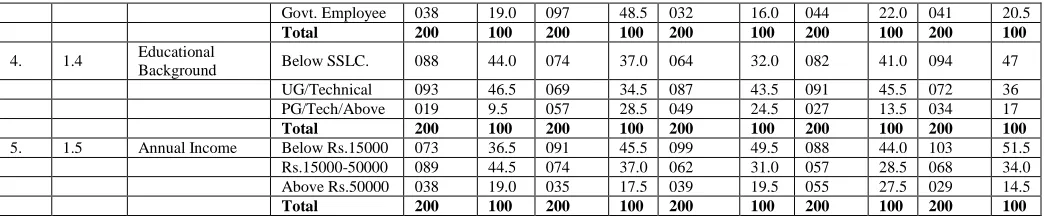
Table 2 Customer Opinion of Purchasing Decisions Fmcg’s Product
Pudukkottai District – Type Of Talukas Sl.
No
Table
No. Variables Characteristics Alangudi Pudukkottai Ponnamaravathi Tirumayam Iluppur
Respon. % Respon. % Respon. % Respon. % Respon. %
1 1.1 Gender Male 081 40.5 056 28 077 38.5 098 49 032 16
Female 119 59.5 144 72 123 61.5 102 51 168 84
Total 200 100 200 100 200 100 200 100 200 100
2. 1.2 Age Below 20 099 49.5 093 46.5 107 53.5 067 33.5 081 40.5
20-50 074 37.00 058 29.0 069 34.5 048 24.0 056 28.0
Above 50 027 13.5 049 24.5 024 12.0 085 42.5 063 31.5
Total 200 100 200 100 200 100 200 100 200 100
3. 1.3 Occupation Farmer 095 47.5 026 13.0 111 55.5 087 43.5 107 53.5
Private
Govt. Employee 038 19.0 097 48.5 032 16.0 044 22.0 041 20.5
Total 200 100 200 100 200 100 200 100 200 100
4. 1.4 Educational
Background Below SSLC. 088 44.0 074 37.0 064 32.0 082 41.0 094 47
UG/Technical 093 46.5 069 34.5 087 43.5 091 45.5 072 36
PG/Tech/Above 019 9.5 057 28.5 049 24.5 027 13.5 034 17
Total 200 100 200 100 200 100 200 100 200 100
5. 1.5 Annual Income Below Rs.15000 073 36.5 091 45.5 099 49.5 088 44.0 103 51.5
Rs.15000-50000 089 44.5 074 37.0 062 31.0 057 28.5 068 34.0
Above Rs.50000 038 19.0 035 17.5 039 19.5 055 27.5 029 14.5
Total 200 100 200 100 200 100 200 100 200 100
Source: Field Survey
i. From the above table (1.1) it is clear that the Female customer high level attitude using the FMCG products in the districts of Alangudi (59.5%), Pudukkottai (72%), Ponnamaravathi (61.5%), Tirumayam (51%) and Iluppur (84%).
ii. The above table (1.2) Age is a vital factor in human beings life, because age determines the individual taste and preference. It is inference that the below 20 high level of preference using the FMCG products (i.e) 49.5% of Alangudi, 46.5% of Pudukkottai, 33.5% of Tirumayam, and 40.5% Iluppur taluks.
iii. The table (1.3) Occupation of the customer is different types of characteristics such as Farmer, Private and Government Employee. The high range of Government employee utilized of the FMCG product is 48.5% in the taluks of Pudukkottai. The low using the product of 13% in the same place.
iv. The table (1.4) inference that clearly educational background is three type of classified (i.e) Below SSLC, UG/Technical, PG/Technical and above. The customer attitude high level of 47% of the Iluppur taluk then the lower attitude of the purchasing behavior of PG/Technical and above category is 9.5% of Alangudi taluk.
v. The final table (1.5) the customer level of Annual Income is three categories such as Below Rs.15000, Rs.15000-Rs.50000, Above Rs.50000. The high level attitude is 51.5% of Iluppur taluk in the category under below Rs.15000. The mostly using the FMCG product is rural consumer in the taluk of Iluppur.
Chi-Square Test
Chi-Square test is used to test if the two variables are statistically associated with each other significantly. The degree of influence of the following independent variables is pertaining to attribute considered while purchasing of FMCG. The variables are respondents Gender, Age, Occupation, Educational background and Annual Income. H0 : There is no significance relationship between Sex, Age, Occupation, and Educational Background and Annual Income and the using the FMCG products through the Advertisements.
H1: There is significance relationship between the Sex, Age, Occupation, and Educational Background and Annual Income and the using the FMCG products through the Advertisements.
Table 3: Statistical Analysis of Chi-Square Test
Level of chi-square tests
Sl. No. Variables Characteristics Computed Value df. Significance Value Inference
1. Gender
Male
68.599 04 9.488 Rejected Female
2. Age
Below 20
573.343 08 15.507 Rejected 20-50
Above 50
3. Occupation
Farmer
294.830 08 15.507 Rejected Private Employee
Govt. Employee
4. Educational Background
Below SSLC
281.793 08 15.507 Rejected UG/Technical
PG/Technical and Above
5. Annual Income
Below Rs.15000
579.511 08 15.507 Rejected Rs.15000-Rs.5000
Above Rs.50000
Hence the table value of χ2 test for 8 degree of freedom at
5 per cent level significance is 9.488, 15.507. The calculated value Chi square is much higher than the table value and hence the result of the experiment does not support hypothesis. We can draw the inference that Gender, Age, Occupation, Educational Background, and Annual Income of the customer using the FMCG products through watch the advertisement.
Limitations of the Study
Few of the sampled respondents neglected in sharing
information because of their bus schedule of business and work.
To overcome the expected difficulties and to complete the study, sincere and timely efforts have been put.
Sample size may be less representative of whole universe. The survey was limited to some parts of central Tamilnadu state only which covers selected district of Pudukkottai only.
may have prompted the people to alter some information.
Findings
1. Different sales promotional schemes changes with change in income, Gender and Education, Occupation are more deal prone than male.
2. Cash discount is preferred to free gifts as sales promotion schemes by middle class consumers. The female considers cash discount as best sales promotion scheme of advertisements.
3. The media are not equally preferred. Television is the most preferred than all other and point of purchase material is least preferred.
4. Income and education affects brand equity female have highly for brand loyalty and brand awareness while male have rated highly to perceived quality.
Recommendations
(i) Cash Discount preferred most than Free Gift, hence, marketer should offer attractive cash discounts. (ii) Immediate benefits consider better than delayed
benefits, so, marketer should offer sales promotions considering this as well.
(iii)Cash discount if most preferred, so, company should think more on cash discount/ price of than gift or value added.
(iv)Television is most preferred knowledge source and it reaches mass level, so, this medium should be considered as very effective medium to reach to customers.
(v) Females are Brand Loyal and they are Deal Prone than Males, so, this category should cater promptly.
(vi)Research shows below SSLC standard educated prefer cash discount very much, so, there is a scope of promotional scheme customization for rural area. (vii)Middle class consumers’ purchasing power is growing
and over the years this class would be big chunk of the Indian population, so, by the years business will much depend on this class. This fact will attract International players to India and Domestic players should cater this class very efficiently, so that they will face less competition by International companies.
Conclusion
Product management is a middle level management function that can be used to manage a product life cycle and enables a company to take all the decisions needed during each phase of a product life cycle. We can conclude that the business strategies of firms vary depending on the corresponding stage of the product, where each phase inherently requires a different, innovative business strategy. It can be noted that different ways of overcoming growing complexity of the environment manifest as a need for different, innovative business strategies. Each of the phases in the industry life cycle requires an appropriate business strategy, which in turn demands innovative knowledge of relationships that link the past, the present and the future of the firm and/or its parts. In managing a firm this implies that, due to increasing complexity of the globalised environment, there is constant need for more interdisciplinary knowledge.
References
1. Aakar D. (1995) Strategic Market Management, Willey .
2. Anderson, T Ecic Simester, I Duncan (2004)1
“Long-Run Effect of Promotion Depth in New versus Established Customers: Three Field Studies”, Marketing Science Vol.23, No.1, Winter Pp. 4-20 3. Clifford D. (1969) “Managing the Product Life Cycle”
European Business Journal.
4. Jain, Ashok (2011), Principles of Marketing: Product Life Cycle.
5. Jensch J (1999) “Strategies Marketing and the Product Life Cycle”.
6. Kumar, V. and Swaminathan, Srinivasan (2005),2
“Two Different Faces of Coupon Elasticity”, Journal of Retailing, Vol. 81, Issue 1, Pp. 1-13.
7. Laroche, Michel et.al (2005)3 “Effect of Coupon on
Brand Categorisation and choice of Fast Food in China”, Journal of Business Research, Vol.58, Issue 5, May, Pp. 674-686.
8. Lewis, Michel (2004)4 “The influence of Loyalty
Programmes and Short-term promotions on Customer Retention”, Journal of Marketing Research, Vol.41, Issue 3, Aug., Pp. 339-350.
9. Lightfoot .W (2000) “Product Life Cycle Stages”, McGrath M. Product Strategy of High-Technology Companies, McGraw-Hill.
10. Ndubisi, Oly, Nelson and Moi, Tung, Chiew (2005)5
“Customers Behavioural Response to Sales Promotion: The Role of Fear of Losing Face”. Asia Pacific Journal of Marketing and Logistics, Vol. 17, Number 1, Pp. 2-49.
11. Vecchio, Del, Devon et.al, (2006)6 “The Effect of