R E S E A R C H A R T I C L E
Open Access
Development and process evaluation of an
educational intervention for overdose
prevention and naloxone distribution by
general practice trainees
Jan Klimas
1,2,3*, Mairead Egan
1, Helen Tobin
1, Neil Coleman
1and Gerard Bury
1Abstract
Background:Overdose is the most common cause of fatalities among opioid users. Naloxone is a life-saving
medication for reversing opioid overdose. In Ireland, it is currently available to ambulance and emergency care services, but General Practitioners (GP) are in regular contact with opioid users and their families. This positions them to provide naloxone themselves or to instruct patients how to use it. The new Clinical Practice Guidelines of the Pre-hospital Emergency Care Council of Ireland allows trained bystanders to administer intranasal naloxone. We describe the development and process evaluation of an educational intervention, designed to help GP trainees identify and manage opioid overdose with intranasal naloxone.
Methods:Participants (N= 23) from one postgraduate training scheme in Ireland participated in a one-hour training session. The repeated-measures design, using the validated Opioid Overdose Knowledge (OOKS) and Attitudes (OOAS) Scales, examined changes immediately after training. Acceptability and satisfaction with training were measured with a self-administered questionnaire.
Results:Knowledge of the risks of overdose and appropriate actions to be taken increased significantly post-training [OOKS mean difference, 3.52 (standard deviation 4.45);P< 0.001]; attitudes improved too [OOAS mean difference, 11.13 (SD 6.38);P< 0.001]. The most and least useful delivery methods were simulation and video, respectively.
Conclusion:Appropriate training is a key requirement for the distribution of naloxone through general practice. In future studies, the knowledge from this pilot will be used to inform a train-the-trainer model, whereby healthcare professionals and other front-line service providers will be trained to instruct opioid users and their families in overdose prevention and naloxone use.
Keywords:Overdose, Feasibility study, Naloxone, Heroin, Education, General practice
Background
Overdose is the most common cause of death among people with opioid disorders and its prevention and management are thus priorities for healthcare agencies [1]. Europe has on average 17 drug-related deaths per million people (15–64 years) per year, varying from country to country [2]. With 70 drug-related deaths per
million, Ireland has the third highest rate in Europe [2, 3]. Ambulance services in Dublin attend to an opioid over-dose every day [4]. The use of the opioid antagonist nalox-one is well recognised as an effective treatment for opioid overdose, and constitutes standard medical treatment in such situations. However, to prevent death, naloxone must be given very soon after the opioid has caused respiratory depression or arrest [5]. To date, naloxone has generally been used in injectable form, delivered via intramuscular, intravenous or intraosseous routes. A number of interven-tions to introduce naloxone to families, friends and drug workers have been established in countries other than * Correspondence:[email protected]
1
Centre for Emergency Medical Science, School of Medicine and Medical Science, University College Dublin, Dublin, Ireland
2
British Columbia Centre for Excellence in HIV/AIDS, St. Paul’s Hospital, 608-1081 Burrard Street, Vancouver, British Columbia V6Z 1Y6, Canada Full list of author information is available at the end of the article
Ireland and report positive effects [1, 6, 7], such as reduced death rates, less risk of needle stick injury or increased opi-oid overdose-related knowledge and competence. Ireland currently has no layperson distribution of naloxone; how-ever, the government recently announced a lay demonstra-tion project [8] which commenced in May 2015. Under this project, a total of 600 people with opioid use disorders will receive a multi-dose naloxone injector, a product with up to five injectable doses, to take home. Given the preva-lence of blood-borne infections among the target group, the recent upsurge in HIV infections and many years of strenuous efforts to minimise injecting risks, the pitfalls of distributing a multi-dose injector have to be assessed. The feasibility of expanding the distribution of less risky intra-nasal naloxone via other channels such as primary care has yet to be determined [9, 10].
Bystanders, specifically frontline service providers, peers or family members of opioid users, are best posi-tioned to intervene immediately when symptoms of overdose first appear [11]. General Practitioners (GP) in Ireland are also in regular contact with opioid users and their families, either via methadone maintenance treat-ment or other medical services in general practice. This access should allow GPs to provide naloxone themselves, or to instruct patients or family members on how to use it. However, no structured provision of naloxone exists in Irish general practice, and previous research else-where has shown that GPs lack skills and knowledge regarding naloxone administration and require more training [12]. Our preliminary work suggested that this training should include elements of the‘Clinical Practice Guidelines (CPG) approved by the Pre-Hospital Emergency Care Council of Ireland in October 2013 (Emergency First Response)’, specifically initiating contact with emergency services, cardio-pulmonary resuscitation (CPR), and the administration of intranasal naloxone (INN) [13, 14]. How-ever, the feasibility and acceptability of such training for GPs has not been previously reported. Therefore, the current study aimed to:
– Develop an educational intervention that enables doctors in specialist training for general practice to support bystander response to overdose (i.e., initiating contact with emergency services, CPR, etc.), and the administration of intranasal naloxone (INN).
– Determine the potential feasibility, acceptability and usefulness of this training to junGP trainees.
– Describe the process of development and evaluation.
Methods
Design, sample and intervention
Ireland’s population of 4.6 m is served by approximately 2,600 GPs; around 160 doctors enter one of 14 specialist-training programmes in GP each year. Each
programme is accredited nationally and follows a standard four-year programme, the final two years of which are spent in supervised training practices. 23 GP trainees from the Dublin Mid Leinster Specialist Training Programme in general practice, affiliated with University College Dublin, were invited to participate in a one-hour training session. All accepted and took part in the study voluntarily. At the time, they were based in designated training general practices under the supervi-sion of an accredited GP trainer.
Most practices were in Dublin (43 %), with 1000 or more patients on their General Medical Services list–this is a government subsidised health plan providing free point of care primary care and medicines for those on low incomes. Only six practices (26 %) prescribed methadone.
Most practices had one to three full-time GPs (16, 70 %) and one to four part-time GPs (15, 83 %). More than half of the practices had a practice nurse. Most trainees (91 %) ranged from 25–34 years old, and most were female (78 %). Eight (35 %) were trained methadone prescribers and 11 (48 %) had witnessed an opioid overdose (Table 1).
Ethical considerations/adherence to the International guidelines
The Irish College of General Practitioners Research Ethics Committee approved this study on August 27th, 2014. The research on human participants carried out in this study is in compliance with the Helsinki Declaration (http:// www.wma.net/en/30publications/10policies/b3/index.html). This study adheres to the RATS guidelines on qualitative research (http://www.biomedcentral.com/ifora/rats). We informed the trainees about the study and gained their consent one week before the educational session. Our convenience sample is likely to be unrepresentative of the national profile of doctors in specialist training for GP.
Development of the educational session
The educational session was developed as part of an evolving system of lay delivered INN. The key compo-nents of the system include:
1. A one-year prospective audit of the characteristics of opioid overdoses reported to ambulance services in Dublin [4,15].
2. The development and implementation of CPG-led administration of naloxone [16].
3. The exploration of mechanisms for roll-out of naloxone by registered Medical Practitioners, since it remains a prescription-only drug in Ireland.
formulation. While it appears to address safety, efficacy and utility criteria, INN has not yet been approved by the Irish Department of Health for general use; intra-muscular naloxone is currently available for prescription by doctors. However, an INN formulation is likely to become available in coming months, and INN-oriented training was identified as a long-term goal of the initiative. Our subsequent steps followed the Medical Research Council’s (MRC) framework, which advocates core phases in the development of health services interventions: pre-clinical, theoretical, modelling, exploratory trial, definitive trial and long-term implementation [17]. While the term preclinical usually refers to testing of interventions or medications in non-humans, the MRC framework defines its goal as: “Identifying the existing evidence and any theoretical basis for the intervention in order to describe the components of the intervention” (www.mrc.ac.uk/ complex_packages.html).
In the preclinical stage of the intervention develop-ment, we identified a need and targets for naloxone distribution by geo-locating urban overdose hotspots in Dublin city – areas with high rates of overdoses [4]. They helped us to concentrate our efforts on general Table 1Sample characteristics
Number Percent
Profiles of training practices
County of practice
Dublin 10 43 %
Wicklow 8 35 %
Other 3 12 %
Missing data 2 10 %
GMS list size
<500 1 4 %
500–1000 4 17 %
1000–1500 7 30 %
1500–2000 2 9 %
>2000 8 35 %
Missing data 1 5 %
Practice setting
Urban 9 39 %
Rural 5 22 %
Mixed 8 35 %
Missing data 1 5 %
Mean number of GPs (excluding GP registrars)
Full time 2.6 (SD 2.0)
Part time 1.6 (SD 1.2)
Practice nurse 12 52 %
Active member of a Primary Care Team 11 48 %
Ever attended a primary care team meeting 6 26 %
Methadone prescribing 6 26 %
Level of methadone prescribing
Level 1 4 17 %
Level 2 2 9 %
N of patients receiving methadone in the practice
0–5 1 4 %
5–10 1 4 %
10–15 2 9 %
15–20 1 4 %
Years prescribing methadone
3 years 1 4 %
15+ years 2 8 %
Trainee profile
Age
25–34 years 21 91 %
35+ years 2 9 %
Year of Graduation
2008 5 22 %
2009 5 22 %
2010 4 17 %
Table 1Sample characteristics(Continued)
2011 5 22 %
Other 3 12 %
Training in addiction
0 h 1 4 %
<4 h 3 13 %
4–10 h 7 30 %
11–40 h 2 9 %
>40 h 1 4 %
Trained in methadone prescribing
Level 1 8 35 %
None/Planned during training 15 65 %
(i) Ever witnessed an opioid overdose:
Hospital 9 39 %
Community 2 9 %
(ii) Total No of Witnessed Hospital overdoses 39a+
(iii) Total No of Witnessed Community overdoses 2
(iv) Ever administered Naloxone outside of Emergency Department
5 22 %
Knowledge on Drugs in Ireland–Multiple-choice questions
No of trainees who know how many people die due to overdose every year in Ireland
10b 43 %
No of trainees who know how many people are currently in methadone treatment in Ireland
8c 35 %
a
One trainee witnessed more than 10 hospital overdoses
b
Multiple-choice question options: (i) < 100___(ii)200-300___(iii) > 300___
c
and addiction care services in inner city Dublin. Our participants were on training placements in practices neighboring the inner city hotspots. The subsequent modelling phase formulated clinical practice guidelines (CPG). The Pre-hospital Emergency Care Council (PHECC, the Statutory Regulator for Pre-Hospital Emergency Care in Ireland) approved these guidelines in October 2013. The UCD Centre for Emergency Medical Science concurrently collaborated with PHECC and the Naloxone Advisory Group to develop and pilot an educational session led by the guidelines. The guidelines allow for the training of lay people and health professionals in overdose prevention and naloxone use, subject to previous CPR training.
The PHECC Clinical Practice Guidelines recommend that naloxone training be provided as part of an overall emergency care package that includes Basic Life Support (BLS) skills training. There are two BLS levels prescribed by PHECC:
– Cardiac First Response - Community (CFR).
– Cardiac First Response - Advanced (CFR-A).
All trainees were required to achieve the CFR stand-ard as a prerequisite of the session - this was already held by all participants. After the completion of this pilot study, the session will be evaluated by a group of community health professionals. Data from this feasi-bility evaluation will inform the design of the final stage of developing a national implementation for INN distribution.
Content and delivery of the educational session
We based the intervention on our previous work, on pre-implementation assessments from Scotland and on training of family members to manage opioid overdose and administer naloxone in England [6]. More specific-ally, factors enabling naloxone distribution and use were incorporated into the educational session: evidence of effectiveness, appropriate training, and the development of a policy regulation–the CPG –that would allow in-tranasal administration [12, 18]. The intervention was facilitated by:
– a small group session.
– a practical exercise.
– a video clip using content from: a) the family work described in the above English study, b) the introduction of take-home IN naloxone within the National Health Service (NHS) Highland area [18].
– anonymous evaluation/feedback.
The video clip ensured the fidelity and consistency of the information distribution. This is an evidence-based methodology in emergency care training, and is used by
emergency services globally [19]. Multi-media theory was reinforced at each stage with practical application and exercises. The video was three minutes in duration and its headings included:
– Recognition of overdose.
– Assembly of the drug administration system.
– INN administration.
The educational session was delivered by two facilitators in a group setting, and lasted approximately 45 min. It was held in the UCD Medical School. A manual for the trainers was developed before the delivery of the session in collaboration with the Naloxone Advisory Group, formed in the pre-clinical stages (http://drugs.ie/features/ feature/naloxone_the_welsh_experience).
Our approach was informed by the experiential learn-ing theory that allowed trainees to experience the process of Naloxone administration. Similar experiential curricula have improved addiction management skills and knowledge in medical students and paediatric resi-dents elsewhere [20, 21]. The aims of the educational session, described in the current study, were to ensure that GP trainees had the skills to manage an overdose, i.e. initiating contact with emergency services, perform-ing CPR, usperform-ing INN and acquirperform-ing sufficient knowledge, understanding and motivation to be willing to undertake INN distribution and training. The key learning out-comes of the educational session were to teach GPs how to i) recognise opioid overdose, ii) assemble INN, and iii) administer INN (Table 2). Specific teaching and dis-semination strategies for those receiving naloxone kits will depend on the recommendations of the current pilot project about whom should receive these kits (e.g. people who use drugs, family members, lay health/social care workers). Teaching and dissemination strategies will then be developed and included for recipient groups.
Table 2Learning outcomes, delivery method/content and initial evaluation of the session
Learning outcomes
•To recognise opioid overdose
•To assemble naloxone
•To administer INN Delivery method
•Formal presentation
•Video demonstrations of how to i) recognise opioid overdose, ii) assemble naloxone, and iii) administer INN
•Practical exercises on how to assemble and administer INN
•Q & A discussion
•Repeated measures assessment/feedback Evaluation of education session
•Perceived changes in knowledge and attitudes
•Qualitative data on strengths/weaknesses
Data collection
A repeated-measures design using the validated Opioid Overdose Knowledge (OOKS) and Attitudes (OOAS) Scales examined changes immediately after the training session [22]. The acceptability of and satisfaction with this training were measured with a self-administered questionnaire immediately after the session, which in-cluded the acceptability of the session, learning needs and suggested improvements.
OOKS has 45 items organised in four sub-scales (risks, signs, actions and naloxone use, range 0–45). The OOAS has 28 items grouped in three sub-scales (compe-tence, concerns and readiness, range 28–140). Both scales were developed and psychometrically evaluated with a convenience sample of friends and family members of heroin users and healthcare professionals in England. Both OOKS and OOAS were shown to be internally reliable (Cronbach’s alpha = 0.83 and 0.90, respectively). Retest after 14 days also showed fair-to-excellent values (OOKS, ICC = 0.90 and OOAS, ICC = 0.82). Professionals scored significantly higher on both scales than family members [22]. We changed two questions about “needles” and de-leted two items about“injecting”naloxone in the attitudes scale (new range 26–130). The original scales were for injectable Naloxone; we used the intranasal formulation. We acknowledge the potential threat to validity and reli-ability, although the changes were minor.
The acceptability of the single session to trainees was assessed with open-ended questions that asked them to write what was good or bad about each of the five training delivery methods, or teaching modalities. The trainees rated each session based on its usefulness (5-point Likert scales); the rating scales were taken from our previous study [23].
Data analysis
We used the non-parametric Wilcoxon Paired Signed Rank test for our analysis (IBM SPSS, version 20). We report means and standard deviations. For the composite usefulness score, all participants’ Likert scale scores were added together, and the means and standard deviations (SD) calculated. Answers to open-ended questions under-went content analysis using the questions as the codes; similar responses were grouped, groups were titled and the number of responses counted. Using conventional content analysis, coding groups (categories) were derived directly from the text data [24].
Results
Pre-training and post-training knowledge
The educational session elicited significant changes in three out of four knowledge categories (i.e., risks, actions and use of naloxone, see Table 3). Furthermore, the
median composite knowledge score increased from 28 pre-training to 31 post-training (p< 0.001).
Skills
All participants were directly observed to have acquired the skills needed to assemble and effectively deliver the correct dose of naloxone in a safe manner. All delivered INN following the procedures described by the CPG, rather than simply spraying the dose into the nose.
Pre-training and post-training attitudes
There was a significant increase in all three categories (competencies, concerns and readiness) of positive attitudes towards overdose management (Table 3). The median composite score for attitudes increased from 96 pre-training to 108 post-pre-training (p< 0.001).
Evaluation of the educational session
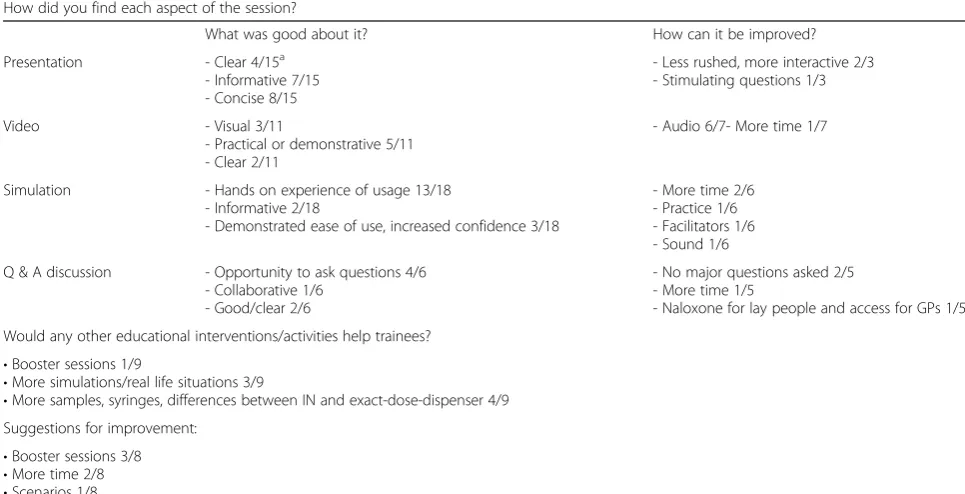
The group mean for the session usefulness score was 21.9 (out of 25); the most and the least useful delivery methods were simulation and video respectively (see Table 4).
Most of the participants (74 %) felt their questions were answered and saw a potential for the INN or over-dose prevention in their training practice. The part of the presentation that trainees liked the most was that it “provided answers to the questions I had just asked”
(participant quote). It could have been“less rushed, more interactive”(participant quote).
In the video, the trainees were able to“actually see the device [Mucosal Atomiser Device]” (participant quote). The video’s sound could be improved. During the practical simulation it was “helpful to see how easy it is [administration]” (participant quote); more time could be spent on this. The trainees perceived the small Q & A discussion as an“opportunity to ask questions”(participant quote). One commented, “would be nice to discuss pros/ cons of lay people having naloxone and where GP would avail of it”.
Finally, trainees were given an opportunity to com-ment on their educational needs or provide suggestions for improving the session (Table 4). Several wanted more examples or real life situations to try, and two other trainees wished for more time or booster sessions: “very quick session so difficult to fully answer all Q’s [questions], however, very useful and would definitely allow us/help us to know what to do in OD setting” (participant quote).
Discussion
simulation, presentation and Q & A discussion, with GP trainees appreciating the opportunity to ask questions.
Our findings are consistent with the literature that highlights the effectiveness of education in improving knowledge of and attitudes towards overdose management [25, 26]. Other studies successfully trained people who used
drugs [27], their families or friends [6], needle exchange workers [28], police and fire-fighters [29]. The various lengths and formats of training reported in this literature suggest that less training may be needed than we thought [30]; for instance, participants in a recent UK trial saved a comparable number of people with naloxone regardless of Table 3Self-reported change in knowledge and attitudes pre-/post-training, and usefulness of the session
Knowledge/attitudes Pre-training median/mean (SD)
Post-training median/mean (SD)
Mean diff (SD) Wilcoxon Z/P-value
Knowledge: 28/27.9 (4.5) 31/31.4 (1.5) 3.5 (4.5) −3.50, 0.000
Risks 8/7.5 (1.9) 9/8.7 (0.7) 1.17 (2.1) −2.69, 0.007
Signs 6/6.0 (1.8) 6/6.4 (0.7) 0.4 (1.9) −0.80, 0.422
Actions 6/5.5 (1.2) 6/6.4 (1.1) 1.0 (1.3) −3.04, 0.002
INN use 9/9.0 (1.2) 10/10.0 (0.7) 1.1 (1.3) −3.09, 0.002
Attitudes: 96/97.4 (7.2) 108/108.6 (8.1) 11.1 (6.4) −4.11, 0.000
Competencies 33/33.7 (4.7) 41/41.0 (3.9) 7.4 (5.0) −4.11, 0.000
Concerns 22/22.1 (2.6) 24/24.0 (2.9) 2.0 (2.2) −3.46, 0.001
Readiness 40/41.7 (3.3) 43/43.5 (3.9) 1.7 (2.8) −2.63, 0.008
The following were useful in education Completely agree/agree N (%)
Unsure Completely disagree/disagree N (%)
Mean score post-training (SD)
Presentation 23 (100) 0 0 4.5 (0.5)
Video 19 (82.6) 3 (13.0) 1 (4.3) 4.2 (0.8)
Simulation 23 (100) 0 0 4.6 (0.5)
Q & A discussion 21 (91.3) 2 (8.7) 0 4.3 (0.6)
Guideline demonstration 20 (87) 3 (13.0) 0 4.4 (0.7)
Table 4Acceptability of the educational session
How did you find each aspect of the session?
What was good about it? How can it be improved?
Presentation - Clear 4/15a - Informative 7/15 - Concise 8/15
- Less rushed, more interactive 2/3 - Stimulating questions 1/3
Video - Visual 3/11
- Practical or demonstrative 5/11 - Clear 2/11
- Audio 6/7- More time 1/7
Simulation - Hands on experience of usage 13/18 - Informative 2/18
- Demonstrated ease of use, increased confidence 3/18
- More time 2/6 - Practice 1/6 - Facilitators 1/6 - Sound 1/6
Q & A discussion - Opportunity to ask questions 4/6 - Collaborative 1/6
- Good/clear 2/6
- No major questions asked 2/5 - More time 1/5
- Naloxone for lay people and access for GPs 1/5
Would any other educational interventions/activities help trainees?
•Booster sessions 1/9
•More simulations/real life situations 3/9
•More samples, syringes, differences between IN and exact-dose-dispenser 4/9 Suggestions for improvement:
•Booster sessions 3/8
•More time 2/8
•Scenarios 1/8
•Very/good 2/8
a
whether they received the full training or information only (five vs three controls), over a three months follow up [6]. Our training session produced slightly higher changes in positive attitudes, and compared to the UK trial it was linked with greater competence and confidence, though we could not demonstrate impact on the provider behaviour in an overdose situation. The changes in the attitudes towards and willingness to intervene in an opioid overdose suggest that our trainees would have used naloxone should they be provided with a take-home dose.
The feasibility and acceptability of our session for GP trainees were comparable with previous research in other groups [29, 31–33]. In this study, some aspects of the edu-cational session were more helpful than has been reported in previous literature, i.e. hands-on experience with mate-rials and GP access to INN kit [27].
The focus of the training session developed in this pilot project was on intranasal naloxone and general practice (GP). This hasn’t been done before. While the target population of the training session was unusual, the GP trainees clearly demonstrated improved skill, knowledge and willingness to intervene in a possible opi-oid overdose. Recognising this implication should shift our thinking about the role of GPs in the management and prevention of overdoses. In the literature, GPs tend to be overlooked as a possible training or distribution avenue. This route may be a unique component of a national roll-out of the naloxone strategy [34], and, as evident in our findings, one acceptable to doctors in training. The decision to focus the educational session on the GP trainees was influenced mainly by a recent Scottish pre-implementation study [12], and the frequent contact that GPs have with patients in methadone main-tenance treatment in Ireland [35] or elsewhere [36]. The Scottish pre-implementation study indicated that general practice may be a viable route for distributing naloxone in the community; while half of the GPs were unsure about GP-based naloxone, the other half were willing to provide this drug to family or buddies of opioid users.
Intranasal naloxone (INN) is a needleless, safe and effective alternative to intramuscular formulations [13, 14, 37–39]. Future studies should use INN for training and distribution, especially because of its safety for both bystanders (e.g. reduced fear of injury), and for opioid users (e.g. less suspicion from police if naloxone is found, although in the United States, it does not mean less suspicion or problems with the police and people may fear that possession of naloxone means that the person is using drugs.). The legal situation in Ireland is currently under governmental review and changes in the legal status of Naloxone are expected to make it more broadly available [40]. If the current prescription-only status is relaxed, GPs may have greater clarity about their prescribing responsi-bilities and more flexibility in their dissemination of these
kits. The challenge for future research and education is also to incorporate INN training into medical education and to engage other groups of service providers and clients to use INN and to prevent overdoses.
The current study is limited in several ways. Our find-ings are not generalizable to the larger population of GPs involved in addiction treatment. The GP trainees participated voluntarily, and were not obliged to take part in the training or to apply their learning in practice. Just because doctors can use naloxone does not imply that they can or will train others in its use. It would be useful to include qualitative questions about provider in-tent to use their new knowledge. Our core focus on the application of a validated Framework For Development Of Complex Health Interventions by U.K. Medical Re-search Council (MRC) [17], together with the repeated-measures design, suggests the intervention’s potential, and future research may determine whether it is general-isable to other GPs inside or outside of Ireland. For ex-ample, because providers in different locations were not assessed, it would be worthwhile to pursue this in a future study. The results from this study can be used to tailor the training session for physicians and re-evaluate it. It would be worthwhile to do longer-term follow up of this group to see if they retained their knowledge or positive atti-tudes, changed their practice, or both. Given the previous trial among British families [6], a randomized evaluation of the INN would be worthwhile.
Conclusion
General practice trainees can be trained to support bystander response to overdose with intranasal naloxone. Appropriate training is a key requirement for the distribu-tion of naloxone through general practice. In future studies, our educational session should be used to inform a train-the-trainer model, whereby GPs and healthcare pro-fessionals or other frontline service providers are trained to train opioid users and their families in overdose prevention and naloxone use. If feasible, such research can ex-pand the role of general practice in the management of opioid overdose and the distribution of naloxone to opioid users, friends, families, frontline service providers and other professions.
Availability of supporting data None.
Abbreviations
BLS:Basic Life Support; CFR: Cardiac First Response - Community (CFR); CFR-A: Cardiac First Response - Advanced (CFR-A); CPG: Clinical Practice Guidelines; CPR: cardio-pulmonary resuscitation; GP: General Practice; ICC: intracluster correlation coefficient; INN: intranasal naloxone;
Competing interests
None reported.
Authors’contributions
GB and JK designed the study. ME, HT, GB and JK composed the training manual and study instruments. HT and ME organized the session. GB and NC delivered the educational session. HT and JK entered the data for analyses. JK conducted the statistical analyses. JK drafted the first draft of manuscript and incorporated suggestions from all coauthors. All authors have read and approved the final version of the article.
Acknowledgements
The authors wish to thank the study participants; colleagues from UCD; Dr Daragh O’Neill and Ms Mary Headon for their help with organisation; the Ana Liffey Drug Project (ALDP); the‘SafetyNet’Primary Care Network; and the Naloxone Advisory Group.
Work on this paper was supported by grants from the Irish College of General Practitioners, the Health Research Board of Ireland (Grant ID: HRA-HSR-2012-14), the Irish Research Council, Government of Ireland
‘New Foundations’Scheme 2013 (PINTA-TOUR), and“ELEVATE: Irish Research Council International Career Development Fellowship–co-funded by Marie Cure Actions (ELEVATEPD/2014/6)”.
Work on this project was supported by the Research & Education Foundation grant from the Irish College of General Practitioners. We thank the members of the Naloxone Advisory Group.
Author details
1
Centre for Emergency Medical Science, School of Medicine and Medical Science, University College Dublin, Dublin, Ireland.2British Columbia Centre for Excellence in HIV/AIDS, St. Paul’s Hospital, 608-1081 Burrard Street, Vancouver, British Columbia V6Z 1Y6, Canada.3c/o Coombe Family Practice, Dolphins barn, Dublin, Ireland.
Received: 9 January 2015 Accepted: 10 November 2015
References
1. Walley AY, Xuan Z, Hackman HH, Quinn E, Doe-Simkins M, Sorensen-Alawad A, et al. Opioid overdose rates and implementation of overdose education and nasal naloxone distribution in Massachusetts: interrupted time series analysis. BMJ. 2013;346:f174.
2. EMCDDA: Overall reduction in deaths but rises in some countries. In: Drugnet Europe. vol. June. Lisbon: EMCDDA; 2014: 8.
3. HRB. Drug-related deaths and deaths among drug users in Ireland: 2011 figures from the National Drug-Related Deaths Index. Dublin: Health Research Board; 2014. 4. Klimas J, O’Reilly M, Egan M, Tobin H, Bury G. Urban Overdose Hotspots:
A 12-Month Prospective Study in Dublin Ambulance Services. Am J Emerg Med. 2014;32(10):1168–73.
5. George S, Moreira K. A guide for clinicians on“take home”naloxone prescribing. Addictive Disorders & Their Treatment. 2008;7(3):163–7. 110.1097/ADT.1090b1013e31812f35643.
6. Williams AV, Marsden J, Strang J. Training family members to manage heroin overdose and administer naloxone: randomized trial of effects on knowledge and attitudes. Addiction. 2013;109(2):250–9.
7. Merlin MA, Saybolt M, Kapitanyan R, Alter SM, Jeges J, Liu J, et al. Intranasal naloxone delivery is an alternative to intravenous naloxone for opioid overdoses. Am J Emerg Med. 2010;28(3):296–303.
8. Department of Health. Ministers welcome availability of life saving antidote to heroin related overdoses aimed at reducing drug related deaths. Dublin: Press Release; 2015.
9. Bury G. Take home naloxone in Ireland. Ir Med J. 2015;108(3):70. 10. De Gascun CF, Waters A, Regan C, O’Halloran J, Farrell G, Coughlan S, et al.
Documented prevalence of HIV type 1 antiretroviral transmitted drug resistance in Ireland from 2004 to 2008. AIDS Res Hum Retroviruses. 2011;28(3):276–81. 11. Kim D, Irwin KS, Khoshnood K. Expanded access to naloxone: options for
critical response to the epidemic of opioid overdose mortality. Am J Public Health. 2009;99(3):402–7.
12. Matheson C, Pflanz-Sinclair C, Aucott L, Wilson P, Watson R, Malloy S, et al. Reducing drug related deaths: a pre-implementation assessment of knowledge, barriers and enablers for naloxone distribution through general practice. BMC Fam Pract. 2014;15(1):12.
13. McDermott C, Collins NC. Prehospital medication administration: a randomised study comparing intranasal and intravenous routes. Emergency medicine international. 2012;2012:476161.
14. Sabzghabaee AM, Eizadi-Mood N, Yaraghi A, Zandifar S. Naloxone therapy in opioid overdose patients: intranasal or intravenous? A randomized clinical trial. Archives of medical science : AMS. 2014;10(2):309–14.
15. Cullen W, Bury G, Langton D. Experience of heroin overdose among drug users attending general practice. Br J Gen Pract. 2000;50(456):546–9.
16. Council P-h E C. Clinical practice guidelines. Dublin: PHECC; 2013. 17. Campbell M, Fitzpatrick R, Haines A, Kinmonth AL, Sandercock P,
Spiegelhalter D, et al. Framework for design and evaluation of complex interventions to improve health. BMJ. 2000;321(7262):694–6. 18. McAuley A, Best D, Taylor A, Hunter C, Robertson R. From evidence to
policy: The Scottish national naloxone programme. Drugs: Education, Prevention, and Policy. 2012;19(4):309–19.
19. Soar J, Monsieurs K, Ballance J. European resuscitation council guidelines for resuscitation 2010. Section 9. Principles of education in resuscitation. Resuscitation. 2010;10:1434–44.
20. Kokotailo PK, Langhough R, Neary EJ, Matson SC, Fleming MF. Improving pediatric residents’alcohol and other drug use clinical skills: use of an experiential curriculum. Pediatrics. 1995;96(1):99–104.
21. Barron R, Frank E, Gitlow S. Evaluation of an experiential curriculum for addiction education among medical students. Journal of addiction medicine. 2012;6(2):131–6.
22. Williams AV, Strang J, Marsden J. Development of Opioid Overdose Knowledge (OOKS) and Attitudes (OOAS) Scales for take-home naloxone training evaluation. Drug Alcohol Depend. 2013;132(1–2):383–6. 23. Klimas J, Lally K, Murphy L, Crowley L, Anderson R, Meagher D, et al.
Development and process evaluation of an educational intervention to support primary care of problem alcohol among drug users. Drugs and Alcohol Today. 2014;14(2):76–86.
24. Hsieh H-F, Shannon SE. Three approaches to qualitative content analysis. Qual Health Res. 2005;15(9):1277–88.
25. Clark AK, Wilder CM, Winstanley EL. A systematic review of community opioid overdose prevention and naloxone distribution programs. Journal of addiction medicine. 2014;8(3):153–63.
26. Behar E, Santos G-M, Wheeler E, Rowe C, Coffin PO. Brief overdose education is sufficient for naloxone distribution to opioid users. Drug Alcohol Depend. 2015;148:209–12.
27. Doe-Simkins M, Walley AY, Epstein A, Moyer P. Saved by the nose: bystander-administered intranasal naloxone hydrochloride for opioid overdose. Am J Public Health. 2009;99(5):788–91.
28. Maxwell S, Bigg D, Stanczykiewicz K, Carlberg-Racich S. Prescribing naloxone to actively injecting heroin users: a program to reduce heroin overdose deaths. J Addict Dis. 2006;25(3):89–96.
29. Davis CS, Ruiz S, Glynn P, Picariello G, Walley AY. Expanded access to naloxone among firefighters, police officers, and emergency medical technicians in Massachusetts. Am J Public Health. 2014;104(8):e7–9. 30. Doe-Simkins M, Quinn E, Xuan Z, Sorensen-Alawad A, Hackman H,
Ozonoff A, et al. Overdose rescues by trained and untrained participants and change in opioid use among substance-using participants in overdose education and naloxone distribution programs: a retrospective cohort study. BMC Public Health. 2014;14(1):297.
31. Strang J, Manning V, Mayet S, Best D, Titherington E, Santana L, et al. Overdose training and take-home naloxone for opiate users: prospective cohort study of impact on knowledge and attitudes and subsequent management of overdoses. Addiction. 2008;103(10):1648–57.
32. McAuley A, Lindsay G, Woods M, Louttit D. Responsible management and use of a personal take-home naloxone supply: A pilot project. Drugs: Education, Prevention, and Policy. 2010;17(4):388–99.
33. Bennett T, Holloway K, Bird SM. Does take-home naloxone reduce non-fatal overdose? Lancet. 2014;383(9912):124–5.
34. Lyons S. Preventing opiate-related deaths in Ireland: the naloxone demonstration project. Drugnet Ireland. 2014;13(49):13.
35. Keenan E, Barry J. Managing drug misuse in general practice. Republic of Ireland has set up scheme to regulate methadone prescribing by GPs. Br Med J. 1999;319(7223):1497.
37. Kerr D, Kelly AM, Dietze P, Jolley D, Barger B. Randomized controlled trial comparing the effectiveness and safety of intranasal and intramuscular naloxone for the treatment of suspected heroin overdose. Addiction. 2009;104:2067–74.
38. Barton ED, Ramos J, Colwell C, Benson J, Baily J, Dunn W. Intranasal administration of naloxone by paramedics. Prehosp Emerg Care. 2002;6(1):54–8.
39. Leavitt SB. Intranasal naloxone for at-home opioid rescue. Practical Pain Management. 2010;42(2010):46.
40. Department of Health. Varadkar announces public consultation on easier access to‘rescue’drugs in emergencies–including epipens Adrenaline, salbutamol, glucagon, naloxone and glyceryl trinitrate. Dublin: Press Release; 2015. DoH.
Submit your next manuscript to BioMed Central and take full advantage of:
• Convenient online submission
• Thorough peer review
• No space constraints or color figure charges
• Immediate publication on acceptance
• Inclusion in PubMed, CAS, Scopus and Google Scholar
• Research which is freely available for redistribution