A Study on Effect of Addition of Natural Rubber
on the Properties of Bitumen & Bituminous Mixes
Kintali Sai Nanda Kishore Anirudh Gottala
M. Tech Student M. Tech Student
Department of Civil Engineering Department of Civil Engineering
Andhra University College Of Engineering Andhra University College Of Engineering
Abstract
Many studies have been done to find other alternative material to use as modifiers in bitumen mixes on the improvement of its properties and highway quality. In this research Natural Rubber latex (in the form of balloons) has been used as bitumen modifier. Proper blending of bitumen with Natural Rubber in fixed proportion confers good elastic recovery to the blend. Incorporation of 2-4% natural rubber into bitumen thus improves the property of the later substantially. The Rubberized bitumen formed minimizes permanent deformations due to overload on the road and thus unaffected by the changes in atmospheric temperature and improves skid resistance. Rubber increases resistance to flow of bitumen at higher temperature and improves the resistance to brittle fracture at low temperature. Bitumen is sensitive to rate of traffic load and temperature susceptibility. The behaviours of the two modifiers were investigated by comprehensive laboratory testing and evaluation. It was observed that the addition of natural rubber gave better overall performance in the bituminous mixes. Thus, this shows natural rubber may contribute toward better flexible roads in the future. The above properties increase the service life of rubberized roads in many cases to more than hundred percent when compared to that of bituminous roads. Thus, Rubberization of roads will combine savings with safety.
Keywords: Natural Rubber (Balloons), Bitumen, Bitumen Modifier
________________________________________________________________________________________________________
I.
I
NTRODUCTIONPolymer modified bitumen is emerging as one of the important construction materials for flexible pavements. Use of polymers in the construction of flexible pavement is gaining importance because of the several reasons. The polymer modified bitumen show better properties for road construction and plastics waste, otherwise considered to be a pollution menace, can find its use in this process and this can help solving the problem of pollution.
Bitumen is a useful binder for road construction. Different grades of bitumen like 30/40, 60/70 and 80/100 are available on the basis of their penetration values. The steady increase in high traffic intensity in terms of commercial vehicles and the significant variation in daily and seasonal temperature demand improved road characteristics. Any improvement in the property of the binder is the needed.
The availability of the Natural Rubber (Latex) is enormous, as the rubber is a product obtained from Latex (e.g., mattresses, gloves, swim caps, balloons) has become part of daily life. If it is not recycled, its present disposal is either by land filling or by incineration. Both the processes have certain impact on the environment.
Various studies are being carried out to improve the quality of bitumen used in bituminous road construction. One of the results of such studies is to use polymer-modified bitumen. Use of Natural Rubber (Latex) is the need of the hour. The studies on the thermal behaviour and binding property of the Natural Rubber promoted a study on the preparation of Natural Rubber-bitumen blend and its properties to find the suitability of the blend for road construction.
Natural rubber is an Elastomer that was originally derived from milky latex found in the sap of some plants. The purified form of natural rubber is the chemical Polyisoprene, which can also be produced synthetically. Natural rubber is used extensively in many applications and products, as is synthetic rubber. Natural rubber is an ideal polymer for dynamic or static engineering applications. Natural rubber features:
Excellent dynamic properties with a low hysteresis loss Good low temperature properties
Strong bonding to metal parts
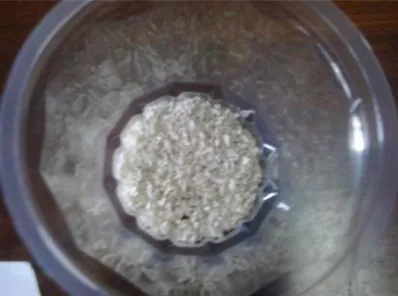
Fig. 1: Natural rubber (balloons) used as additive
Properties of Natural Rubber A.
Natural rubber has been successfully used as an engineering material for many years. The following range of properties shows just how versatile of a material natural rubber has proven to be to engineers:
Natural rubber combines high tensile and tear strength with an outstanding resistance to fatigue
Excellent green strength and tack — has the ability to stick to itself and other materials, making bonded natural rubber products easier to fabricate
Exhibits excellent dynamic properties with a low hysteresis which leads to low heat generation Adjustable hardness from very soft to very hard (ebonite)
Appearance and colour ranges from translucent (soft) to black (hard) Compounded to meet nearly any mechanical requirement
The ability to be electrically insulating or fully conductive Protect, insulate and sealing properties
Absorb vibration and silence noise
Available in any surface roughness and shape
To achieve the specific properties required for a given product, raw natural rubber has to be compounded using ingredients such as carbon black, anti-degradants, softeners and a vulcanization system. Some of the compounding rules to achieve the properties desired include:
Fig. 2: Bitumen modifier (sieved latex balloon pieces)
Polyisoprene B.
One of the most well-known natural polymers is Polyisoprene, or natural rubber. Ancient Mayans and Aztecs harvested it from the hevea tree and used it to make waterproof boots and the balls which they used to play a game similar to basketball. It is what we call an elastomer, that is, it recovers its shape after being stretched or deformed. Normally, the natural rubber is treated to give it crosslink's, which makes it an even better elastomer.
Table - 1
Type of Additives For Bitumen Modification And Their Indicative Doses Sl.
No. Types of Modifiers Examples
Indicative Dose Level, per cent by wt. of bitumen
1.
Plastics Thermoplastics
Thermosets
Low Density Polyethylene(LDPE) Ethylene Vinyl Acetate (EVA) Ethylene Butyl Acrylate (EBA)
Epoxy Resins
3-6 3-5
2.
Elastomers Natural Rubber
Synthetic Elastomers
Latex or Dry Rubber Powder Styrene Butadiene Styrene
Block Copolymer (SBS), Styrene Butadiene Rubber (SBR)
2-4 3-5
3. Reclaimed
Rubbers
Type Crumb Rubber Powder from discarded
truck, tyres further improved by additives 10-12
Scope of the study C.
The present study aims on the use of Polyisoprene in bitumen blend for road construction. Various tests are conducted on plain bitumen and bitumen blended with polyisoprene and the change in the properties is observed. Improvement of properties of bitumen on addition of polymer is also observed.
For the present study polymer used is Polyisoprene (Natural rubber) as the availability of these materials is high and the preparation of blend is simple. Mix design for the blend is also done for marshal stability value to determine the optimum binder content level.
The results obtained from plain bitumen are compared with those obtained from addition of Polyisoprene polymer. The benefits obtained with addition are analyzed.
The experiments are done with 1%, 2%,3%,4%,5%,6% and 7% of bitumen modifier which on further increase from 0.5% of bitumen modifier we can get better results.
II.
M
ETHODOLOGYBitumen A.
Bitumen is a common binder used in road construction. It is principally obtained as a residual product in petroleum refineries after higher fractions like gas, petrol, kerosene and diesel etc. are removed. Indian Standard Institution (ISI) defines Bitumen as a black or dark brown non-crystalline soil or viscous material having adhesive properties derived from petroleum crude either by or by refinery process.
General uses of Bitumen B.
For Civil Engineering works
Construction of roads, runways, platforms Water proofing to prevent water seepage Mastic floorings for factories and godowns Canal lining to prevent erosion
Dump-proof courses for masonry Tank foundation
Joint filling material for mason
Requirements of bitumen: C.
The desirable properties of bitumen depend on the mix type and construction. The general problems while using bitumen in paving mixes are
1) Mixing
2) Attainment of desired stability under adverse weather conditions. 3) To maintain the stability under adverse weather conditions.
5) To have sufficient adhesion with the aggregates in the mix in the presence of water.
Tests on Bitumen: D.
The various tests that have to be conducted of bitumen are Penetration test
Softening point test Viscosity test Ductility test Flash & fire point
Materials: E.
Materials used in this study include 60/70 penetration grade base bitumen. The polymer used for modification was POLYISOPRENE in the form of balloons. The concentration of polymer was 1 to 7% by weight of bitumen.
The particle size distribution of the balloon pieces should conform to the following requirements.
Sample Preparation: F.
Samples were prepared using melt bending technique. The bitumen about 500gm was heated in pan to a temperature of about 150 to 180°C. The polymer was slowly added, while stirring is continued for 30 minutes to produce homogeneous mixtures.
The concentrations of polymer were 1.0, 2.0, 3.0, 4.0, 5.0, 5.5, 6.0 and 7.0% by weight of bitumen. The modified bitumen was then cooled and later used for further testing. Empirical tests such as penetration, softening point, ductility, viscosity, flash and fire point test and Marshall stability test were then conducted on the prepared samples.
Processing Details: G.
Collection of materials
Cutting and preparation of materials Mixing of bitumen with polymer
Conducting various tests on mixed bitumen Collection of materials:
1)
Bitumen of grade 60/70 used in our study is taken from our transportation laboratory. Polymer material used in this study is Natural Rubber (Latex). In this experimental process we used small pieces of balloons specified in is used in the place of Natural Rubber. Basically rubberized bitumen comprises of bituminous compound into which rubber in suitable form and proportion is incorporated using appropriate technique. The rubber must dissolve in bitumen (binder) properly.
Cutting and preparation of materials: 2)
For effective mixing of material and to reduce time for mixing, balloons collected were cut into small pieces of specified size according to our convenience. Scissors were used for this purpose. The particle size distribution of the balloon pieces should conform to the following requirements.
SIEVE SIZE (mm) PERCENTAGE PASSING (BY MASS)
2.36 100
1.18 95-100
0.15 10 maximum
0.075 2 maximum
This cutting work was done before the experiment and cut pieces were stored for further process according to the determined proportion.
Mixing of bitumen with polymer: 3)
At first 500gm of bitumen was taken in a dish
weight of balloons according to the percentage of polymer is calculated and balloons of calculated weight was taken in a paper
Bitumen was heated to a temperature of 150 to 180°C until it flows like a liquid. Then balloons were slowly added to the bitumen.
While adding balloons manual stirring was carried on to mix the materials thoroughly. This mix was heated for 30 minutes to obtain a homogeneous mix of materials Later this was cooled down to required temperature
This process is continued for different percentages of polymers Conducting various tests on sample:
4)
III.
R
ESULTS ANDD
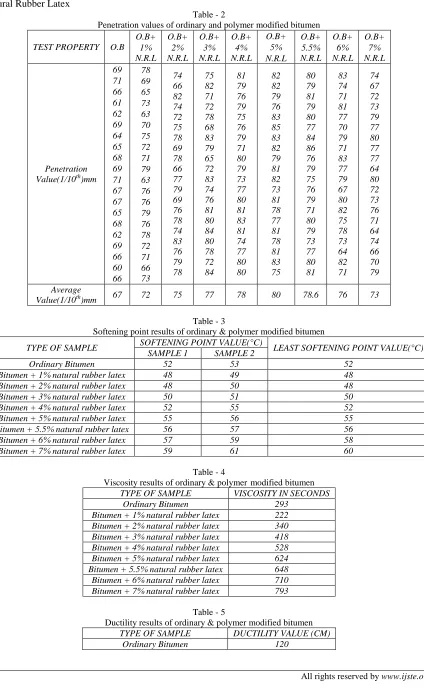
ISCUSSIONSO.B = Ordinary Bitumen N.R.L= Natural Rubber Latex
Table - 2
Penetration values of ordinary and polymer modified bitumen
TEST PROPERTY O.B
O.B+ 1% N.R.L O.B+ 2% N.R.L O.B+ 3% N.R.L O.B+ 4% N.R.L O.B+ 5% N.R.L O.B+ 5.5% N.R.L O.B+ 6% N.R.L O.B+ 7% N.R.L Penetration Value(1/10th)mm
69 71 66 61 62 69 64 65 68 69 71 67 67 65 68 62 69 66 60 66 78 69 65 73 63 70 75 72 71 79 63 76 76 79 76 78 72 71 66 73 74 66 82 74 72 75 78 69 78 66 77 79 69 76 78 74 83 76 79 78 75 82 71 72 78 68 83 79 65 72 83 74 76 81 80 84 80 78 72 84 81 79 76 79 75 76 79 71 80 79 73 77 80 81 83 81 74 77 80 80 82 82 79 76 83 85 83 82 79 81 82 73 81 78 77 81 78 81 83 75 80 79 81 79 80 77 84 86 76 79 75 76 79 71 80 79 73 77 80 81 83 74 71 81 77 70 79 71 83 77 79 67 80 82 75 78 73 64 82 71 74 67 72 73 79 77 80 77 77 64 80 72 73 76 71 64 74 66 70 79 Average
Value(1/10th)mm 67 72 75 77 78 80 78.6 76 73
Table - 3
Softening point results of ordinary & polymer modified bitumen
TYPE OF SAMPLE SOFTENING POINT VALUE(°C) LEAST SOFTENING POINT VALUE(°C)
SAMPLE 1 SAMPLE 2
Ordinary Bitumen 52 53 52
Bitumen + 1% natural rubber latex 48 49 48
Bitumen + 2% natural rubber latex 48 50 48
Bitumen + 3% natural rubber latex 50 51 50
Bitumen + 4% natural rubber latex 52 55 52
Bitumen + 5% natural rubber latex 55 56 55
Bitumen + 5.5% natural rubber latex 56 57 56
Bitumen + 6% natural rubber latex 57 59 58
Bitumen + 7% natural rubber latex 59 61 60
Table - 4
Viscosity results of ordinary & polymermodified bitumen
TYPE OF SAMPLE VISCOSITY IN SECONDS
Ordinary Bitumen 293
Bitumen + 1% natural rubber latex 222
Bitumen + 2% natural rubber latex 340
Bitumen + 3% natural rubber latex 418
Bitumen + 4% natural rubber latex 528
Bitumen + 5% natural rubber latex 624
Bitumen + 5.5% natural rubber latex 648
Bitumen + 6% natural rubber latex 710
Bitumen + 7% natural rubber latex 793
Table - 5
Ductility results of ordinary & polymer modified bitumen
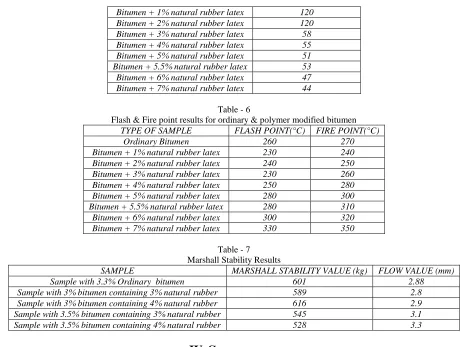
Bitumen + 1% natural rubber latex 120
Bitumen + 2% natural rubber latex 120
Bitumen + 3% natural rubber latex 58
Bitumen + 4% natural rubber latex 55
Bitumen + 5% natural rubber latex 51
Bitumen + 5.5% natural rubber latex 53
Bitumen + 6% natural rubber latex 47
Bitumen + 7% natural rubber latex 44
Table - 6
Flash & Fire point results for ordinary & polymer modified bitumen
TYPE OF SAMPLE FLASH POINT(°C) FIRE POINT(°C)
Ordinary Bitumen 260 270
Bitumen + 1% natural rubber latex 230 240
Bitumen + 2% natural rubber latex 240 250
Bitumen + 3% natural rubber latex 230 260
Bitumen + 4% natural rubber latex 250 280
Bitumen + 5% natural rubber latex 280 300
Bitumen + 5.5% natural rubber latex 280 310
Bitumen + 6% natural rubber latex 300 320
Bitumen + 7% natural rubber latex 330 350
Table - 7 Marshall Stability Results
SAMPLE MARSHALL STABILITY VALUE (kg) FLOW VALUE (mm)
Sample with 3.3% Ordinary bitumen 601 2.88
Sample with 3% bitumen containing 3% natural rubber 589 2.8
Sample with 3% bitumen containing 4% natural rubber 616 2.9
Sample with 3.5% bitumen containing 3% natural rubber 545 3.1
Sample with 3.5% bitumen containing 4% natural rubber 528 3.3
IV.
C
ONCLUSIONS Penetration test at 25°C is the most commonly adopted test on bitumen to grade the material in terms of hardness. So, in warmer regions lower penetration grades are preferred and in colder regions higher penetration values are used. Since the obtained value is in between 60mm(1/10thmm) and 80mm(1/10thmm), it can be used for both regions in pavement construction.
Softening point test gives an idea of temperature at which the bituminous material attains a certain viscosity. So bitumen with higher softening point preferred in warmer place and it is also used to specify hard bitumen. Since the obtained value is between 50°C and 55°C, it can be preferred in warmer places.
From the viscosity values, it can be concluded that resistance to flow increases with increase of % bitumen modifier. So, higher the duration more viscous is the material. As viscosity value is more, it can be used in pavement construction. The minimum value specified by Indian Standards Institution is 50 cm, % of bitumen modifier more than 5.5 should not
be used in pavement construction. As it is less than 50cm after 5.5% of bitumen modifier, due to its low ductility value, the pavement may crack especially in cold weather.
Flash & fire point has no significance about strength of bitumen. They are used to know the working temperatures of the bitumen. If the working temperatures are more than flash & fire point values, then fire hazards may occur.
Since Bitumen gets soften at 1% it is ruled out and percentages above 5.5% are ruled out in ductility. Hence from 2-4% we can get the optimum binder content value for determining Marshall stability test.
Based on trials conducted it is possible to get about 100% increased service life for rubberized roads and cost for periodic maintenance can be reduced compared to that of bituminous roads. Better fuel savings are also possible with rubberisation.
Thus it can be concluded from the all results and graphs bitumen blended with Natural Rubber can be used in warmer regions.
R
EFERENCES[5] Indian Standard Methods of Testing Tar and Bitumen:Determination of Flash and Fire Point, IS:1209 Indian Standards Institution. [6] SK khanna and CEG Justo, Highway Material Testing Laboratory Manual, Nem Chand Bros; Rourkee
[7] Highway Engineering Materials by Khanna and Justo
[8] Recommended Practice for Bituminous Penetration Macadam(Full Grout),IRC
[9] Indian Standard Specifications for Paving Bitumen ,IS:73-1961;Indian standards Institution [10] Bituminous Road Construction, Barmah Shell
[11] Manual for Construction and Supervision of Bituminous Works, Published by IRC on behalf of the Government of India;Ministry of Road Transport and Highways ,New Delhi;2001
[12] Journal on “Bitumen Scrap Rubber Seals”, Engineering Road Note No.7 ( October 2003 ), Main Roads Government of Western Australia
[13] IRC:SP:53-1999 “Tentative Guidelines on use of Polymer and Rubber Modified Bitumen Road Construction”, Published by the Indian Roads Congress, Special Publication 53
[14] International Journal of Engineering and AdvancedTechnology(IJEAT).ISSN:2249-8958,Volume-2,Issue-3,February 2013 on Pavement Performance with Carbon Black and Natural Rubber (latex)
[15] http://rubberboard.org.in/ManageTechnical.asp?Id=34