e-ISSN: 2278-067X, p-ISSN: 2278-800X, www.ijerd.com Volume 6, Issue 10 (April 2013), PP. 83-89
Zigbee Transceiver Protocol Based Wireless Sensor
Networks for Emergency Response Notification for Indoor
Situations
Jeetender Singh Chauhan
1,
Gyan Prabhakar
2,
Sunil Semwal
3, Atul Kumar
Pandey
41
Research Scholar, Instrumentation & Control Engineering Dep’t Graphic Era University, Dehradun
2
Head Electronics & Communication Engineering Dep’t Saroj Institute of Technology & Management, Lucknow
3
Asst. Professor, Electrical and Electronics Engineering Dep’t Graphic Era University, Dehradun
4
Asst. Lecturer, Electronics & Communication Engineering Dep’t Saroj Institute of Technology & Management, Lucknow
Abstract: - In today’s world we are faced with many different types of emergencies in the indoor environment. Response to such emergencies is critical in order to protect resources including human life. In this paper, we present an emergency response system which is easy to deploy and can report the emergency to the users in various forms, such as pop-ups on a computer screen, SMS on their cell phones and so on. Due to this flexibility of reporting, low cost and easy of deployment, wireless sensor network (WSN) emergency response systems will be the preferred emergency response systems of the future. We show a design for a WSN emergency response system using temperature sensors as a proof of concept. Comparison to other emergency response systems within the SIUC
campus is also drawn out.
Keywords: - Emergency response, WSN, ZigBee, Sensors Emergency Services, Networks.
I. INTRODUCTION
In today’s world we are faced with increasingly many types of emergencies in our environments. One example which stands out is the gun violence which has plagued our universities and communities alike. In
addition, institutions withpoor infrastructure may not be able to minimize loss of resources and human life in
times of natural catastrophes. The objective of this project is to design a wireless network using 802.15.4 and Zigbee to respond to any emergency and inform appropriate individuals in a timely and cost effective manner. The project further aims to enable ease of installations of variety of sensors and networking possibilities with a variety of networks such as CISCO messaging client or a desktop program in order to make messaging easily integrated with existing systems.
II. WIRELESS SENSOR NETWORK
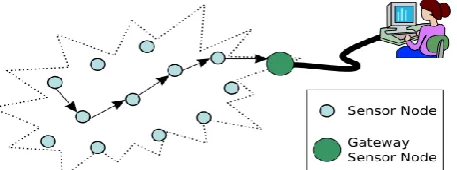
Fig 1: Typical Multihop Wireless Sensor Network Architecture
III. CURRENT EMERGENCY SYSTEMS ON SIUC CAMPUS
Before ZigBee based wireless sensor networks are tested for their efficacy, we first present existing technology in place to do emergency response. The efficacy of ZigBee based wireless sensor networks is studied over and above existing systems.
a. Wireless Emergency Notification System
Wireless Emergency Notification System by Inspiron Logistics uses True text messaging to notify people on campus of an emergency. True text messaging or SMS is the top recommendation for implementing a campus-wide notification solution as indicated in the Governor of Virginia’s report on the Virginia Tech Incident that came out in September of 2007.The WENS connectivity protocols to the Carriers ensure delivery in a timely manner, even during phone network overloads similar to the VA Tech campus scenario. WENS has a high reliability rate because they have gone through the proper process with all North American Carriers .The
cost for a WENS system ismuch lower when offering service to unlimited users. The WENS system can be
initiated by a mobile device by texting to 69310. Most systems rely on a phone call or web access to initiate a notification. In the WENS system a authorized person chooses a group to notify, types the message and hits send [2]. The WENS system tries every 5 seconds, indefinitely, until the text message is delivered. WENS can track each and every text message with a delivery receipt and subsequent report [2]. This gives school officials a way to know that the message was delivered. The WENS system has a proprietary service called an Imaging and Video Delivery System (IVDS). IVDS provides the campus community with the ability to send images and video to campus police.
b. Internet
Southern Illinois University Carbondale (SIUC) continuously puts the latest alerts on their website at http://www.siuc.edu/emergency. The website has listed various procedures to be taken in emergencies [1]. This method is passive emergency response and hence does not compete with others in its time efficiency.
C. E-MAIL
All employees and students of SIUC receive a @siu.edu e-mail without charge. SIUC Alerts are sent by e-mail to all employees with a @siu.edu address and to all individuals who register for the wireless emergency notification system (WENS) [1].
d. Telephone
SIUC has established a toll-free and a local telephone number that you can call to receive the latest SIUC Alert [1]. Those numbers are (866) 264-6420 and (618) 453-5375. This is also passive emergency information. In the event of emergency, other options, including call-centers, media alerts, and other pre-recorded messages may be available using the same toll-free number [1].
e. Emergency Radio Notification Network (ERNN)
SIUC has selected a network of locations and personnel on campus to receive SIUC Alerts from the Department of Public Safety (DPS) and in turn, notify the occupants of their building of the emergency [1]. These messages are communicated through a radio notification system that can reach the Southern Illinois Airport, the SIUC Carterville campus, and Touch of Nature (Environmental Center which serves SIUC as a field site for research). Over 200 scanners were provided to campus personnel for the network. You can listen to the SIUC emergency broadcasts on 453.800 MHz
IV. RESPONSE TIME
Based on the study from WENS website [2], in the event of an emergency it will take four minutes
current load, emergency type and how quickly it is detected [3]. Data suggests that the average response time to emergency calls on campus has been in the range of three to four minutes. Effort is being made to reduce response time to as short as possible such as increase patrol of campus police, easy emergency reporting platforms and installation of smart sensors [3]. Given below are some key factors we look into, as we develop a wireless emergency notification network:
1. Effectiveness of the sensors to detect an emergency.
2. Transmission delay between sensing and reporting of information from the sensor to the central
processing unit, personal area network coordinator (PANC)?
3. Threat validation delay once the emergency has been detected.
4. Overall notification delay to end user.
V. IMPLEMENTATION PLAN
The project will utilize open hardware for realizing its goals. Specifically we intend to use Arduino’s Xbee solution to conduct a feasibility study. The reason to choose Arduino platform is also to have a cost effective and a robust design. The eventual goal is for the project to use PC’s as the 'sink' in order to collect data
from various sensors and provide them in a user friendly fashion. This data can then bestored appropriately as
well. Client software can be developed and can beprogrammed to read out messages or pop out notifications
that are deemed as emergency based on a preexisting criterion. Our project will focus on fire emergency and
temperature sensors are used to conduct the feasibility study of the system.
VI. IEEE 802.15.4 PHY AND MAC STANDARD
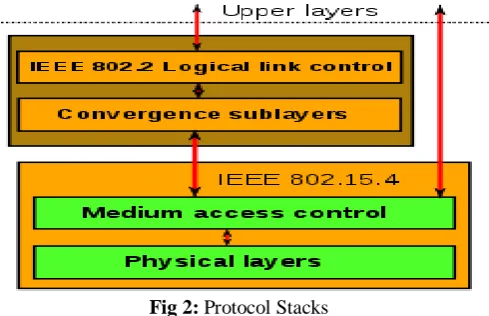
IEEE 802.15.4 standard offers an implementation for the lower layers, PHY and MAC, for a typical WSN as discussed in 802.15.4 focuses mainly on low-cost, low-speed communication between devices. The basic IEEE 802.15.4 framework defines a 10-meter communications area with a maximum transfer rate of
250kbits/s. It is the basis for the ZigBee specification, which further attempts to offer a complete networking
solution by developing the upper layers which interface with the IEEE 802.15.4 MAC .The protocol structure of 802.15.4 contains PHY and MAC layers only. The upper layers are user defined.
Fig 2: Protocol Stacks
a. Physical layer
The physical layer (PHY) provides the data transmission service, as well as the interface to the physical layer management entity. It manages the physical RF transceiver and performs channel selection and energy and signal management functions.
The PHY is responsible for the following tasks:
Activation and deactivation of the radio transceiver
Energy detection (ED) within the current channel
Link quality indicator (LQI) for received packets
Channel frequency selection
Data transmission and reception
The standard specifies the following four PHYs:
An 868/915 MHz direct sequence spread spectrum (DSSS) PHY.
Employing binary phase-shift keying (BPSK) modulation.
An 868/915 MHz DSSS PHY employing offset quadrature phase-shift keying (O-QPSK) modulation.
An 868/915 MHz parallel sequence spread spectrum (PSSS) PHY.
Employing BPSK and amplitude shift keying (ASK) modulation.
b. Medium access control (MAC) layer
The MAC layer is responsible for point-to-point delivery between nodes. Besides the data service, it offers a management interface and itself manages access to the physical channel and network beaconing. It also controls frame validation, guaranteed time slots (GTS) and handles node associations.
The MAC sub layer handles all access to the physical radio channel and is responsible for the following tasks: - Generating network beacons if the device is a coordinator
- Synchronizing to network beacons
- Supporting PAN association and disassociation - Supporting device security
- Employing the CSMA-CA mechanism for channel access - Handling and maintaining the GTS mechanism
- Providing a reliable link between two peer MAC entities
The MAC sub layer provides an interface between the service specific convergence sub layerand the PHY. The
MAC sub layer conceptually includes a management entity called the MLME. This entity provides the service interfaces through which layer management functions may be invoked. The MLME is also responsible for maintaining a database of managed objects pertaining to the MAC sub layer. This database is referred to as the
MAC sub layer PIB.
VII. OTHER WIRELESS STANDARDS
The standards given below are version of 802.11 and 802.15 which apply to low-latency WSNs only, a compressive study is found in.
a. IEEE 802.11 - WLAN/Wi-Fi
Wireless LAN (WLAN, also known as Wi-Fi) is a set of low tier, terrestrial, network technologies for data communication. The WLAN standard’s operates on the 2.4 GHz and 5 GHz Industrial, Science and Medical (ISM) frequency bands. It is specified by the IEEE 802.11 standard and it comes in many different variations like IEEE 802.11a/b/g/n. The application of WLAN has been most visible in the consumer market where most portable computers support at least one of the variations. use 802.15.4 due to its low power requirements.
Wireless networks can have two distinct modes of operation: Ad hoc and infrastructure. Infrastructure wireless networks usually have a base station which acts as a central coordinating node. The base station is usually AC provided in order to enable access to the Internet, an intranet or other wireless networks. Base stations are normally fixed in location. The disadvantage over ad hoc networks is that the base station is a central point of failure. If it stops working none of the wireless terminals can communicate with each other suggests a protocol for providing a WSN with a hierarchical organization. Differently from previously proposed solutions, the protocol, termed clique clustering (CC), includes in its operation a fail-safe mechanism for dealing with node failure or removal, which are typical of WSN. More specifically, the network is partitioned into clusters that are cliques i.e., nodes in each cluster are directly connected to each other. An efficient mechanism for building a connected backbone among the clique clusters is provided. Clustering, backbone formation and backbone maintenance are completely localized, in the precise sense that only nodes physically close to a failing node are involved in the reconfiguration process. Both the standards described earlier differ by the frequencies they use and this affects the data rate and range they can cover. The given table shows the comparison of the frequency data rate and the range of the standard. One of our main design goals is to be able to interface Zigbee devices to a PC. ZUXPProXR Zigbee Interface Module allows for this to happen. Zigbee Interface Module with XR Allows us to Add more relays to this Device and UXP allows us to Add I/O Expansion Modules to the Device expansion ports. This Device Acts like it is Directly Connected to the Serial Port of a PC. This ProXR series controller offers wireless serial communications, requiring only a 12VDC Power Supply. Once powered up, the relay controller waits for a command. A command consists of a few bytes of data, usually between 2
and 6 bytes. You can send commands to activate relays, deactivate relays, control all the relays at one time, plus you can send commands that tell a relay to turn on for a few seconds, minutes, or hours.
VIII. SENSORS
A sensor node is also typically known as a 'mote' a term which is chiefly used in North America. A sensor node in a wireless sensor network is capable of gathering sensory information, processing and communicating with other connected nodes in the network. The microcontroller in the sensor performs tasks such as data processing and controls the functionality of other components in the sensor node [5].
Microcontrollers are most suitable for sensor nodes [4]. Most of the sensor nodes make use of the ISM band
which gives free radio, a huge spectrum allocation and global availability. The Radio Frequency (RF) based communication is the most relevant form of communication that fits to most of the WSN applications. The
WSN use the communication frequencies between about 433 MHz and 2.4 GHz, Table 1.Transceivers lack a
unique identifier. The operational states are Transmit, Receive, Idle and Sleep from an energy perspective, the most relevant kinds of memory are on-chip memory of a microcontroller and FLASH memory - off-chip RAM is rarely if ever used. Flash memories are used due to its cost and storage capacity. The power is stored either in Batteries or Capacitors. Batteries are the main source of power supply for sensor nodes. They are also classified according to electrochemical material used for electrode such as NiCd cadmium), NiZn (nickel-zinc),Nimh (nickel metal hydride), and Lithium-Ion. It is also possible to power sensor using alternatives energies such as solar power, wind and many others as research in those areas are making breakthroughs.
a. Temperature Sensing
In this paper, we use temperature sensing as a case study to show the validity of WSN in the field of emergency responses. We use the WML-WSO-04002; Zigbee Wireless Temperature Sensor from Wireless
Measurement Ltd for temperature sensing. Atemperature sensor produces a voltage that is proportional to the
temperature of the die in the device. This voltage is supplied as one of the single-ended inputs to the Analog to Digital Converter (ADC) multiplexer. When the temperature sensor is selected as the ADC input source and the ADC initiates a conversion, the resulting ADC output code can be converted into a temperature in degrees. The increase of temperature in the room due to fire will increase the voltage of the sensor in this case the die in the device .In order to find the ambient temperature, the temperature increase due to self-heating must be subtracted from the result The value of this temperature increase can be calculated or measured. There are many factors that contribute to the amount of device self-heating. Chief among these are: power supply voltage, operating frequency, the thermal dissipation characteristics of the package, device mounting on the PCB, and airflow over the package. The temperature increase can be calculated to the first order by multiplying the device's power dissipation by the thermal dissipation constant of the package, usually called θJA.For a C8051F005 chip from Silicon Labs operating at 11.0592 MHz and a 3.3 V power supply, the power dissipation is approximately 35 mW. The θJA value for the 64-pin TQFP package is 39.5 degrees C/W. This equates to a self-heating number of 39.5 * 35e-3 ~1.4 degrees C. The temperature increase due to self-heating can be measured in a number of ways. One method is to initiate a conversion soon after applying power to the device to get a 'cold' temperature reading, and then measure again after about a minute of operation, to get a 'hot' temperature reading .
IX. APPLICATION OF THE EMERGENCY RESPONSE SYSTEM
a. Autonomous early detection
b. Self Powered/ Renewable Energy System
With current advancements in alternative energy the sensors used in the system can be solar powered. Such systems can benefit outdoor sensing and indoors where there are huge skylights or open areas with access to sunlight. Power consumption is a problem currently being addressed in WSN. Solar powered sensors can provide value to WSN for emergency response by prolonging the life-times of the sensing nodes. Experimental results have proved that certain prototypes like the MPWiNodeX, can manage simultaneously energy from solar, wind and for charging a NiMH battery pack, resulting in an almost perpetual operation of the evaluated ZigBee network router. In addition to this, the energy scavenging techniques double up as sensors, yielding data on the amount of solar radiation, water flow and wind speed, a capability that avoids the use of specific sensors.
c. Digital Image Threat Verification System
WSN can be attached with a camera as a sensor instead of a temperature sensor, to record a certain area in the building. This systems can be then use as a surveillance network. Existing research discusses optimizing image segmentation algorithms based on image properties without manual intervention [5]. These methodologies compute image properties such as average edge gradient strength, inter- vs. intra-cluster distances using image color features, and color purity of resultant regions, to train a neural network that maps these to ground-truth labeling on the acceptability whether it is good or bad of the solution in the resultant segmentation [5]. There are methodologies that perform extremely well by correctly predicting the optimal parameters of image segmentation algorithms used. Improvement of data quality Images viewed by human operators can be enhanced by the computer so that contraband appears in stark contrast to its surroundings so that humans can easily detect it [5].Automated detection of dangerous explosives: The methodology will depend on the modality of gathering data. In the case of images, the system will have to automatically process such data to enhance its quality, segment objects of interest and then use some features to characterize the resulting regions [5]. However, if the data for analysis is a one-dimensional signal or spectra, the task involves template matching where test spectra are matched with known templates [5]. The data could be simply a measurement or a point in n-dimensional feature space that needs to be classified using pattern recognition techniques [5].
X. COMPARISON WITH OTHER SYSTEMS
There is currently no emergency notification which is specially developed for campus emergencies. However the technology has been used in other types of emergency situations such as forest fire detection, navigation during emergency situations, wireless internet information system for medical response in disasters and many more.
XI. CONCLUSION
It is feasible to construct a WSN for emergency response notification using IEEE 802.15.4 and Zigbee. Moreover there is a range of sensing applications which can be developed using 802.15.4 MAC and PHY along with ZigBee stack. This system has the potential to reduce the response time in a cost-effective way. The system is robust and efficient methods can be incorporated to validate the threat by adding some additional options to the sensors, such as image processing and multiple sensors. This can help reduce false positives. This system at the moment will be focusing on one aspect of the emergency detection which is fire which occurs mostly in many campuses across the states. The system can be further developed to detect other emergencies such as gas leaks, gunman on campus and severe weather changes.
ACKNOWLEDGEMENT
We hereby acknowledge our advisors Sunil Semwal and Dr. Rajesh Kumar for guiding us in the right direction and for giving tremendous support and encouragement to make this project a success.
REFERENCES
[1]. Southern Illinois University Carbondale, “SIUC::Emergency Response Site” March 2008. [Online].
Available: http://www.siuc.edu/emergency/ [Accessed: March 13, 2009].
[2]. Inspiron Logistics, Leveraging Mobile Technologies, “Inspiron Logistic Cooperation-WENS-Wireless
Emergency Notification System for Emergency Mobile Alert” 2009. [Online], Available: http://www.inspironlogistics.com/[Accessed: March 13, 2009].
[3]. Facilities net, “Evaluating Campus Emergency Response Plans After Virginia Tech” April
[4]. R. Morais, et.al, ”Sun, wind and water flow as energy supply for small stationary data acquisition
platforms” in Computers And Electronics In Agriculture, Vol 64, 2nd issue, Oxon England: Elsevier Sci
LTD, DEC 2008, pp. 120-132.
[5]. M. Singh and S. Singh, “Image Segmentation Optimization for X-Ray Images of Airline Luggage” in
CIHSPSZOW-IEEE International Conference On Computational Intelligence for Homeland Security and Personal Safety Venice, Italy, 21-22 July, 2004, pp. 10
[6]. Rajesh Singh, Akanksha, Shashank Mishra, Ankit Joshi “ WIRELESS PERSONAL AREA
NETWORK NODE DESIGN AND SIMULATON OF ALCOHOL SENSOR USING ZIGBEE TRANSCEIVER MODULE” International Journal of Engineering Research and Applications (IJERA) ISSN: 2248-9622 www.ijera.com Vol. 2, Issue 3, May-Jun 2012, pp.133-138.
[7]. SINGH R, MISHRA S, JOSHI P, “Wireless pressure monitoring in wireless sensor network using 2.4
GHz transceiver module” “ ICCCT 2011, IEEE conference on computer and communication technology “ at MNNIT Allahabad ISBN: 978-1-4577-1385-9, Page no 225-229.
[8]. Mike Horton, John Suh, A Vision for Wireless Sensor Networks, IEEE 2005.
[9]. C.S Raghavendra, Krishna M. Siva lingam, Taieb Znati, Wireless Sensor Networks.