Research Article
CODEN: IJPNL6
ANALYTICAL
METHOD
DEVELOPMENT
AND
VALIDATION
FOR
THE
DETERMINATION OF ONDONSETRAN USING REVERSE PHASE HPLC METHOD
&IT’S APPLICATION TO DIFFERENT PHARMACEUTICAL DOSAGE FORMS
R. Vani
1*, B.Vijaya kumar
2, G. Krishna Mohan
31
Research Scholar, JNTU-K, Kakinada & Deccan School of Pharmacy, Hyderabad
2Jangaon Institute of Pharmaceutical Sciences, Jangaon, Telangana, India
3Center for Pharmaceutical Sciences, JNTU-H Hyderabad, India
*Corresponding author e-mail: [email protected]
ABSTRACT
A new simple, accurate, precise and reproducible RP-HPLC method has been developed for the estimation of Ondonsetran in it’s bulk & different pharmaceutical dosage forms using inertsil ODS C18 column ( 250 x 4.6 mm, 5 μm) in isocratic mode. The mobile phase consists of 0.1MKH2PO4:ACN: MeOH (30:40:30)v\v pH6.0 . The detection was carried out at 216 nm for Ondonsetran. The method was linear over the concentration range 48-112 μg/ml. The validation of method was carried out utilizing ICH-guidelines.
Keywords: Ondonsetran, reverse phase HPLC, validation.
INTRODUCTION
Ondonsetran, Chemically it is (±) 1, 2, 3, 9-tetrahydro-9-methyl-3-[(2-methyl-lH-imidazol-l-yl) methyl]-4H-carbazol-4-one, monohydrochloride, dehydrate (Fig 1). is a serotonin 5-HT3 receptor
antagonist used to prevent nausea and vomiting caused by cancer chemotherapy, radiation therapy, and surgery.It has little effect on vomiting caused by motion sickness, and does not have any effect on dopamine receptors or muscarinic receptors.It is on the World Health Organization's List of Essential Medicines, a list of the most important medication needed in a basic health system.
Ondansetron is a selective serotonin 5-HT3 receptor
antagonist. The antiemetic activity of the drug is brought about through the inhibition of 5-HT3 receptors present both centrally (medullary
chemoreceptor zone) and peripherally (GI tract). This inhibition of 5-HT3 receptors in turn inhibits the
visceral afferent stimulation of the vomiting center, likely indirectly at the level of the area postrema, as well as through direct inhibition of serotonin activity within the area postrema and the chemoreceptor trigger zone[1].
According to literature survey few spectrophotometric [1-6], HPLC [7-11] methods have been reported for the determination of Ondonsetran in single and in combination with other drugs. Analytical methods are reported for the determination of Ondonsetran in it’s different dosage forms like tablet, suspension, injection by spectrophotometric and HPLC have been reported.. However very few HPLC methods were reported for the estimation of ondonsetran &it’s application to different dosage forms like tablet, suspension, injection.
The aim of present work was to develop and validate as per ICH guidelines [18-19], a sensitive HPLC method that can be applied for the estimation of Ondonsetran in different dosage forms.
MATERIALS
Ondonsetran was received gratis from Hetero drugs, Hyderabad and was used as received. HPLC grade acetonitrile was purchased from SD Fine Chem Pvt. Ltd. (Mumbai, Maharashtra). Ultra-pure water was obtained from ELGA (Bucks, UK) water purification
International Journal of Pharmacy
unit. All other chemicals were of analytical reagent grade.
EXPERIMENTAL WORK
Chromatographic conditions: The HPLC system (AGILENT 1200 series) consisted of quaternary gradient system (600 Controller), in-line degasser, UV Detector and manual sampler (Waters, model 717 plus). Data was processed using Spin chrome software.
Isocratic elution of the mobile phase 0.1 M Dipotassium Phosphate buffer (pH 6) acetonitrile and Methanol in the ratio of 30:40:30 v/v with the flow rate of 1 ml/min. Separation was performed on a Waters C18 (250 x 4.6 mm i.d, 5 μ particle size)
analytical column and a pre-column to protect the analytical column from strongly bonded material. Integration of the detector output was performed using the spin chrome software to determine the peak area. The contents of the mobile phase were filtered through a 0.45 µm membrane filter and degassed by sonication before use. Mobile phase was used as diluents.
The flow rate of the mobile phase was optimized to 1 ml/min which yields a column back pressure of 110– 112 kg/cm. The run time was set at 7 min and a column temperature was maintained at 35°C. The volume of injection was 10 µl, prior to injection of the analyte, the column was equilibrated for 30–40 min with the mobile phase. The eluent was detected at 216 nm. The developed method was validated in terms of specificiy, linearity, accuracy, limit of detection (LOD), limit of quantification(LOQ), intra-day and inter-intra-day precision and robustness for the assay of Ondonsetran in it’s different dosage forms as per ICH guidelines.
Preparation of standard solution: Ondonsetran was weighed (100 mg ) and transferred to a separate 100 ml volumetric flask and dissolved in 50 ml of mobile phase and make up the volume upto the mark with mobile phase. Working standards of the drug was prepared from this solution.
Preparation of sample solution(Tablet): Twenty tablets (zorfan, Make: GSK) were weighed. An accurately weighed amount of the finelypowdered tablets equivalent to 4 mg of was made up to 100 mL with mobile phase. The solution was filteredfollowed by serial dilution to the required concentrations for each experiment.
The solution was filtered followed by serial dilution to the required concentrations for each experiment.
Preparation of sample solution(injection): (zorfan, Make: GSK) were weighed. An accurately weighed amount of the Ondonsetran injection equivalent to 2mg was made up to 100 mL with mobile phase. The solution was filtered followed by serial dilution to the required concentrations for each experiment.
RESULTS AND DISCUSSION
Method Development: Number of mobile phase and their different proportionswere tried and finally was selected as 0.1 M Dipotassium Phosphate buffer (pH 6), acetonitrile & methanol in the ratio of 30:40:30 v/appropriate mobile phase which gave good resolution and acceptable system suitabilityparameters. The results of system suitability parameters were shown in table 2. The chromatogram of working standardsolution is shown in Fig 3. The summaries of Chromatographic conditions were given in table 1.
Method Validation:
Accuracy: Recovery assessment was obtained by using standardaddition technique which was by adding known quantitiesof pure standards at three different levels in 50%, 100%and 150% to the pre analysed sample formulation. Fromthe amount of drug found, amount of drug recoveredand percentage recovery were calculated which sense toconformation that the proposed method was accurate. The results were tabulated in Table 3.
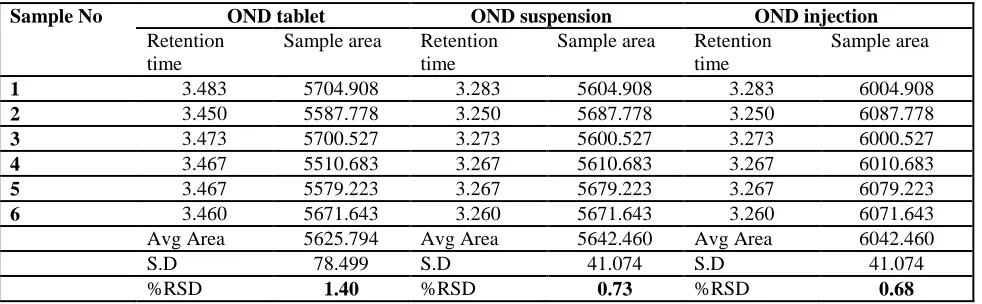
Precision: The intraday and interday precision of the proposed methodwas determined by analyzing mixed standard solution of Ondonsetran at100% concentration 3 times on the same dayand on 3 different days. The results shown in table 4 were reported in terms of relative standard deviation.
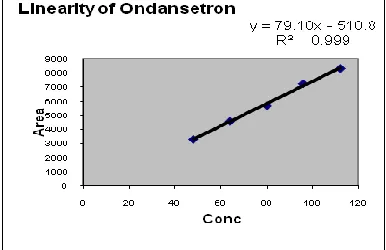
Linearity: Calibration graphs were constructed by plotting peak area vs concentration of OND and the regression equationswere calculated. The calibration graphs were plotted over 5different linear concentrations in the range of 48-112µg/ml for OND in Tablets, suspension,injection. Aliquots (10 ml) of each solution were injected under the operating chromatographic condition describedabove [Number of replicates (n =5)]. The linearity graphs were shown in fig 4 & 5,6
determined by calculating the signal-to-noise(S/N) ratio of 3:1 and 10:1, respectively according to InternationalConference on Harmonization guidelines. LOD values for OND tablet, suspension, injection were found to be 1.05mcg/ml. LOQ values OND tablet, suspension, injection were found to be 3.19mcg/ml respectively.
Assay of the dosage forms: The proposed validated method was successfully applied to determine ONDONSETRAN in different dosage forms. The results obtained were comparable with corresponding labeled amounts. The results were tabulated in table 5.
CONCLUSIONS
The proposed method has advantage of simplicity and convenience for the separation and quantitation
of Ondansetran in different dosage forms which can be used for the assay of their dosage form. Also, the low solvent consumption and shortanalytical run time lead to environmentally friendly chromatographic procedure. The method is accurate, precise,rapid and selective for estimation of Ondonsetran & it’s application to different pharmaceutical dosage forms. Hence it can be conveniently adopted for routine analysis.
ACKNOWLEDGMENTS
The authors are grateful to Principal, Management of Deccan School of Pharmacy, Hyderabad, India for providing necessary facilities to carry out this research project. Authors are thankful for Dr Reddy’s, Hyderabad, AP for kindly providing the gift sample of Ondonsetran.
Fig 1: Chemical Structure of Ondonsetran.
Fig.3 Typical Chromatogram of Ondonsetran injection
Fig.4 Typical Chromatogram of Ondonsetran suspension
Fig 5 Linearity of Tablet
Fig 7 Linearity of Suspension
Table 1: Summary of Chromatographic conditions
S. No Parameter Description/Value
1. Stationary Phase inertsil C18 (250X4.6X5)
2 Mobile Phase 0.1 M potassium di hydrogenPhosphate buffer (pH 6) , acetonitrile& methanol in the ratio of 30:40:30 v/v
3 Flow rate 1 ml/min
4 Detection Wavelength 216 nm
5 Detector UV detector
6 Injection Manual sampler -Waters, model 717 plus
7 Rt’s Tablet-3.4, injection- 3.277,suspension 3.277
8 Injection volume 10 μl
9 Column Temperature 35 °C
10 Run time 7 mins
11 Diluents Mobile Phase
Table 2: System suitability parameters
S. No Parameter Result
OND tablet ONDsuspension ONDinjection 1 Retention Time 3.477 3.277 3.277
2 Tailing 1.079 1.581 1.522
3 Theoretical Plates (n) 3838 3226 3026
Table 3: Results of Accuracy
S.NO % conc at specific level
OND tablet OND suspension OND injection
Amount added (mcg\ml)
Amount found
Mean % recovery
Amount added
Amount found
Mean % recovery
Amount added
Amount found
Mean % recovery
1 80* 80 81.11 101.38 80 79.37 99.22 80 80.74 100.93
2 100** 96 96.08 100.09 96 96.5 99.65 96 96 96.87
3 120* 112 113.41 101.26 112 111.52 98.68 112 112.94 100.84
Table 4: Results of Precision (%Assay)
Sample No OND tablet OND suspension OND injection
Retention time
Sample area Retention time
Sample area Retention time
Sample area
1 3.483 5704.908 3.283 5604.908 3.283 6004.908
2 3.450 5587.778 3.250 5687.778 3.250 6087.778
3 3.473 5700.527 3.273 5600.527 3.273 6000.527
4 3.467 5510.683 3.267 5610.683 3.267 6010.683
5 3.467 5579.223 3.267 5679.223 3.267 6079.223
6 3.460 5671.643 3.260 5671.643 3.260 6071.643 Avg Area 5625.794 Avg Area 5642.460 Avg Area 6042.460 S.D 78.499 S.D 41.074 S.D 41.074 %RSD 1.40 %RSD 0.73 %RSD 0.68 Table 5: Results of Assay in different dosage forms
Sampl e No.
OND TAB OND INJ OND SUS
Labeled amount (mg/tablet)
Amount Found (mg/tablet)
% Assay
Labeled amount (mg/1ml)
Amount Found (mg/1ml)
% Assay
Labeled amount (mg/5ml)
Amount Found (mg/5ml)
% Assay
1
4
3.98 99.5
2
1.996 99.8
2
1.996 99.8
2 3.96 99 1.999 99.0 1.992 99.6
3 3.99 99.75 1.992 99.64 1.96 98.0
4 4.0 100 2.0 100 2.0 100
5 3.8 95 1.996 99.8 1.996 99.8
6 3.99 99.75 1.988 99.4 1.998 99.9
Average Assay: 98.84 Average Assay: 99.60 Average Assay: 99.51
STD 1.74 STD 0.32 STD 0.68
% RSD 1.76 % RSD 0.32 % RSD 0.68
REFERENCES
1.P. Ravi Kumar, M. Murali Krishna, P. Bhanu Prakash , E-Jour of Chem, 206; 3(3): 134-136. 2. Shirish Patel, Dr. LJ Patel, . Ajpcr, 2012; 5(2).
3. S Pilai, I Singhvi, Ijps, 207; 69(4):601-604.
4. S. Ashok Redy, K.B. Chandra Shekar, . ijapr Res, 230 7583. 5. Asad Raza, Abdul Subhan , . Jour Chin Chem Soc, 207; 54: 23-27. 6. Lahuerta Zamora , Extractive . Taylor Francis online, 196; 29(5):785-792. 7. Ravi sheshala, Yusrida Darwis, Nurzalina Khan,j Chrom, 209; 70:75-81. 8. Andrea varvara, Crina - Maria Monciu , Farmacia, 209; 57: 5.
9. Kely JW . J Chrom, 193; 62:291-295. 10. Siluveru M , J Chrom,197; 691: 217-22.
11. Shirish R. Patel, J. Patel, Yogeshvar P , Ijctr, 2010; 2(3):1531-1536.
12. Zarna Dedania, Ronak Dedania, Vaishali Karkhanis . Asian J. Res Chem, 209; 2(2). 13. Dotsikas Y, Kousoulos C, Tsatsou G , J Chrom 206; 836: 79-82.
14. P. B. Raval, S. J. Wadher, and P. G. Yeole, ijps, 208; 70(3): 386-390.
15. Lingxia pang, Qing Wang, Youpei Wang , Lat Amer Jou Pharm 2012; 31(2): 305-9.