Mechanical Properties of Prepared Graphene Oxide
in Concrete Nanocomposites
Mohammed A. Mutar1,Ahmed A. Moosa2, Zainab H. Mahdi3
1- Master’s Student in Department of Materials Engineering Technology, Technical Engineering College – Baghdad, Middle Technical University, Baghdad, Iraq, [email protected] .
2- Professor in Department of Materials Engineering Technology, Technical Engineering College – Baghdad, Middle Technical University, Baghdad, Iraq, [email protected] .
3-Assis Prof in Department of Building and Construction Technology Engineering, Technical Engineering College– Baghdad, Middle Technical University, Baghdad, Iraq, [email protected] .
Abstract-- Graphene oxide (GO) is important in engineering applications such as in concrete technology. After prepared GO from EG in a domestic microwave heating time(80s). GO was added to the mixtures at five different ratios (0.01, 0.05, 0.1, 0.3, and 0.5) % by weight of cement. These ratios were studied to choose the optimum percent of GO in concrete. Thus, the best ratio was 0.05% of GO by weight of cement, which gives the highest compressive strength in graphene oxide concrete nanocomposite (GOCNC). So, the percentages increase in the compressive strength, flexural strength and split tensile strength of GOCNC with 0.05% GO and 3% superplasticizer by weight of cement were 64% ,29% and 22.2% respectively at curing time 28 days compared to the reference specimens. Thus, the addition of GO to concrete mixture enhances the compressive, split tensile and flexural strengths. Using scanning electron microscopy (SEM) images for 0.05%GOCNC showed that GO layers is well dispersed and no GO agglomeration.
Index Term-- Exfoliated graphite(EG), Graphene Oxide (GO),
Oxidation, Graphene Oxide Concrete
Nanocomposite(GOCNC), compressive strength, flexural strength, split tensile strength.
1.INTRODUCTION
Over the past few decades, the need for high-performance materials and structural components led to the rapid development of new categories of materials. The revolutionary vision of nanotechnology states that the essence of nanotechnology is the ability to work at the molecular level, atom by atom, to create large structures with a fundamentally new molecular organization (Alkhateb et
al.,2013)[1]. Carbon, for a long period of time is known to
exist in two natural crystalline allotropic forms known as graphite and diamond. The carbon atoms arrangement in these materials give different properties. For example, graphite is soft and black and the stable while diamond is hard and transparent (Dai et al.,2012)[ 2]. Graphene as a
two-atoms packed into a honeycomb crystal plane (Geim ,
2009)[4]. Graphene has considered as the fundamental
building block for all sp2 graphitic materials including (0D)
fullerenes, (1D) carbon nanotubes and stacked into (3D) graphite. Graphene has attracted great interests from scientists and engineers because of the extraordinary properties and wide applications (Geim and Novoselov
,2007)[5]. Graphene oxide (GO) is a layer of graphene
enhance the mechanical properties by inhibiting the propagation of cracks microstructural. It can also be used as oil adsorption material in underwater construction structures
(Rafiee et al., 2013)[9]. The main aim of the present study
was to prepare GO from EG. Then to investigate the effect of GO on some mechanical properties of graphene oxide concrete nanocomposite (GOCNC), such as the compressive strength, flexural strength or modulus of rupture, splitting tensile strength tests.
2. MATERIALS AND EXPERIMENTAL
Natural graphite powders (99.8%, Sigma, Germany), nitric acid (HNO3,69 %), concentrated sulphuric acid (H2SO4, 98%,
ROMIL, UK), Potassium Permanganate (KMnO4),
Hydrochloric acid (HCl, 37%, CDH), Hydrogen Peroxide (H2O2, 30%, GMBH, Germany) were used for the preparation
of graphene oxide. Sand is sieved particles size range between (150-600 µm) which was (SO3 = 0.041),
Superplasticizer: Sika Visco Crete(hi–tech1316), and commercially available ordinary Portland cement, Baziyany brand type I.
The experimental methods have been used to prepare expanded graphite (EG), graphene oxide (GO) and graphene
prepared from graphite powder and then GO was prepared from EG. Characterization methods were Fourier Transform Infrared spectrophotometer (FTIR), X-ray Diffraction (XRD), and Atomic Force Microscopy (AFM) have been used to confirm the success of conversion EG to GO layers. Furthermore, GOCNC mixture would be prepared using different percent of GO to study its mechanical properties, such as compressive strength, splitting tensile strength, flexural strength and using scanning electron microscopy (SEM) of GOCNC.
3.PREPARATION OF EXPANDED GRAPHITE BY
MICROWAVE IRRADIATION
The EG was prepared by mixing graphite powder (1g) with concentrated HNO3 (2g) and KMnO4 (1g) in weight ratio
(1:2:1) (Wei et al., 2008) [10]. To obtain expanded graphite(EG), the mixture was stirred by hand in a glass flask at room temperature. Then, the mixture was put in a domestic microwave to be irradiated for 80 sec. Figure1shows the obtained EG powder before and after washed using distilled water for several times until the pH of 7. Thereafter, the wet EG powder was dried at 110°C for six hours .
Fig. 1: (a) Expanded graphite (EG), (b) EG after washing and filtration
4.PREPARATION OF GRAPHENE OXIDE (GO)USING EG
Graphene oxide (GO) was prepared by using the EG(80s) (1g) with mixed H2SO4 (20ml). Then, the mixture was transferred to
an ice bath at temperature (0-5OC) to prevent overheating and explosion. Under magnetic stirring KMnO
4 (3g) have been slowly
added to the mixture for 20 min. The mixture color has become dark blue, which was transferred to water bath at (35- 45OC) for
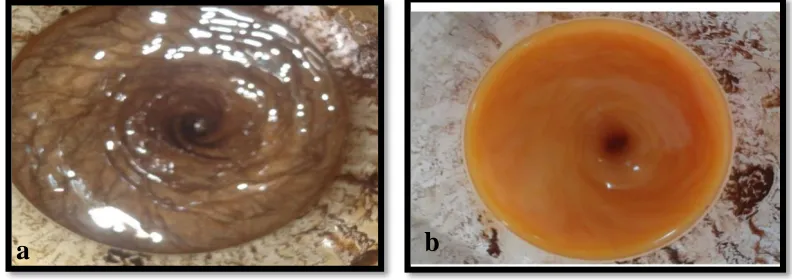
30 min. Afterwards, distilled water (50 ml) was slowly added with continuous stirring. The mixture was transferred to water bath at (80-98OC) with stirring for 15 min. until mixture color become Brown, as shown in Figure 2a. Thereafter, 140 ml of water
was added to the mixture with magnetic stirring for 15 min. The reaction terminated by adding 15 ml of hydrogen peroxide (H2O2 30%) with stirring for one hour, until the color become bright Yellow, as shown in Figure2b.
Fig. 2:(a) Mixture color became Brown, (b) Color was changed to bright Yellow
Then, the GO washed in distilled water and dried in an oven at 50OC, Figure 3 shows the prepared GO in the present study.
Fig. 3: prepared graphene oxide(GO)
5.CONCRETE MIX DESIGN
The key features of GOCNC mixtures design include high ratio of weight of sand / weight of cement (WS /WC =1/1),
fine sand with a particle size between 150 -600 µm, the dosage of ratio of weight of water/ weight of cement (WW/WC=0.35) and the weight of superplasticizer(PCE) /
weight of cement (WPCE/Wc) is 0.03. GO added to the
mixtures at five different ratios (0.01, 0.05, 0.1, 0.3, and 0.5) % by weight of cement (weight of GO/weight of cement=WGO /WC). These ratios of GO have been studied to
choose the optimum percent of GO, which gives the higher compressive in nanocomposite. These mixtures have been carried out in rotary mixer as follows.
Graphene Oxide has been added to water under sonication. Then, superplasticizer was added to GO solution and the mixture has been sonicated for 60 min. Then, the cement
added to the mixture (GO, water and superplasticizer) with mixing for 60 sec. at low speed. The mixture was allowed to rest for 2.5 min. and then, mixing was continued for 60s at high speed.After that, the sand has been added gradually in rotary mixer into (GO, water, superplasticizer and cement) for 60 sec. at low speed, and at medium speed for a 120 sec, then continuous for 30 sec. in high speed. Next, the fresh concrete has been poured into the mold directly. The results indicated that the additive 0.05%GO by weight of cement gives compressive strength higher than other ratios when tested at 7 days as shown in Table I, therefore this ratio adopted to find compressive strength, flexural strengths and splitting tensile strength at 7, 14 and 28 days. Table I shows the details of weights materials that used in reference specimens (Re) and GOCNC mixtures that used throughout this investigation.
Mixes Wc (g) Ww (g) Ws (g) WGO (g) WPCE (g) Compressive strength )MPa( at 7days
Re
0.01% GOCNC
0.05% GOCNC
0.1% GOCNC
0.3 % GOCNC
0.5% GOCNC
435
433.56
434
434.7
434
434
152
152
152.88
152
152
152
435
435
435
434.7
434.7
434
0.0
0. 44
0.22
0.44
1.3
2.17
13
13
13
13
13
13
39.5
66.5
71
63.5
51
45
6.RESULTS AND DISCUSSION
The prepared GO from EG by using microwave (700W) for 80 sec. was characterized by X-Ray Diffraction (XRD) (MiniFlex II, Rigaku Co., Japan), Fourier Transform Infrared ((FTIR)-Prestige 21 Shimadzu Co., Japan) and Atomic Force Microscope ((AFM) Model: NT-MDT Ntegra, Russian Federation) to prove successful production of GO.
6.1.X-RAY DIFFRACTION(XRD)
Figure 4(a) shows the XRD pattern of prepared EG confirmed the crystalline structure of EG with a sharp peak at (2θ=25.9o) corresponds to d-spacing of 0.344nm, in plane
(002). While the peak of the pristine graphite was at (2θ=26.6°) in plane (002), which corresponds to an interlayer distance of 0.338 nm (Moosa and Jaafar, 2017)[11], as shown in Figure 4(b).
Fig. 4:XRD of (a) EG, (b) pristine graphite(Moosa and Jaafar, 2017)[11]
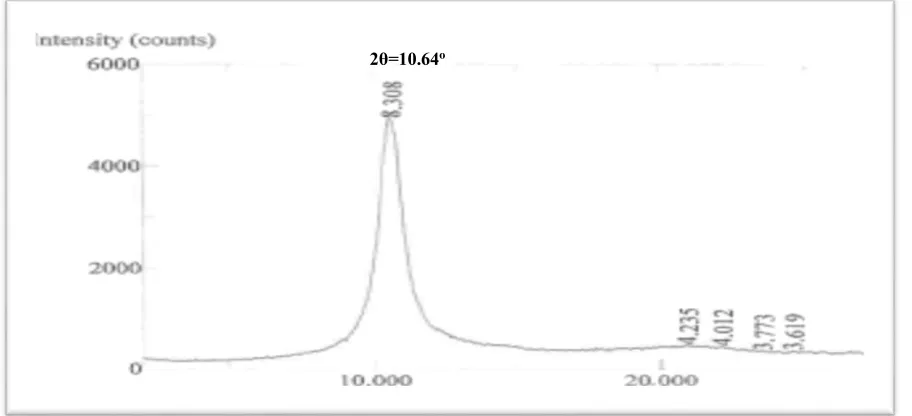
Thus, the GO that has been prepared from EG (80 s) , which it had ratio of WGO/ WW (0.5 mg/mL) was sonicated in ultrasonication
bath for one hour in distilled water. XRD pattern of sonicated GO shows new sharp peak (2θ=10.64o) with new interlayer distance (d-spacing=0.83 nm) as shown in Figure 5.
b
Fig. 5: XRD of GO prepared from EG at (80s)
The results confirmed complete conversion of EG into GO. Additionally, the absence of impurity peaks explained the high purity of the prepared GO. The oxidation process of graphite to GO occurred due oxygen-group intercalation on the inner and outer surfaces of graphite, which lead to the loose stack of GO sheets (Viana et al.,2015)[12]. During the steps oxidation of the graphite sheets react with oxygen functional groups increased the distance between the layers in accordance with the degree of oxidation of EG and the quantity of molecules inserted into the interlayer spacing
(Esmaeili, et al.,2014)[13],(Song et al., 2014)[14].
6.2.ATOMIC FORCE MICROSCOPY (AFM)
Atomic force microscopy (AFM) has been used to measurement and characterization graphene oxide (GO). Figure 6 shows the thickness, lateral size and morphology of GO, that was prepared from EG (80s). The thickness and lateral size of GO layers were 0.52 nm and 439 nm respectively. (Song et al., 2014)[14] reported that the GO layers have a thickness of 2∼3 nm, and this was slightly thicker than single layer of graphene. Therefore, this study result indicated to formation single layer of GO.
Fig. 6: AFM of GO from EG (80s)
6.3FOURIER TRANSMISSION INFRARED (FTIR) OF GO
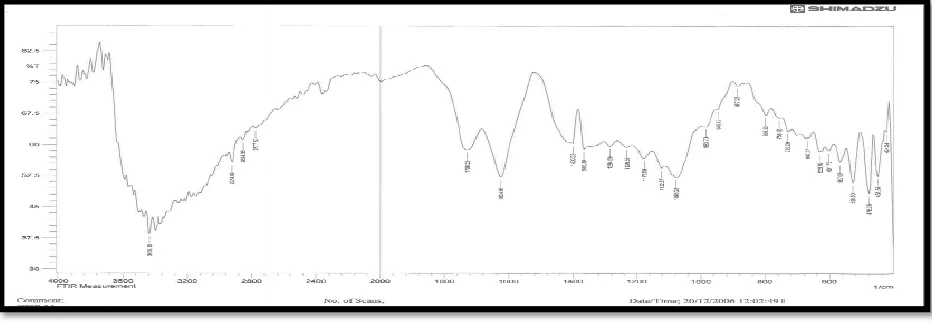
The surface of GO had oxygenated groups such as epoxy (C-O), hydroxyl (-OH), carboxyl(C=O) groups, which were measured by FTIR. Figure 7 shows FTIR peaks for GO prepared from oxidation of EG. The peak 3437 cm-1 exhibit
the characteristic of hydroxyl(O-H). The peak at 1728 cm-1
carboxyl bands (C=O) and the peak at 1400 cm-1 is for
aromatic (C=C). The peak at 1076 cm-1 indicated the
presence of epoxy (C-O) (Gholampour et
al.,2017)[15],(Pang and Sun, 2014) [16],(Senevirathna et
Fig. 7: FTIR of GO prepared from EG (80 sec)
In this work, the result of the d-spacing was 0.831 nm, 2θ=10.64o and the minimum thickness of GO layer is 0.512 nm
for GO prepared from EG (80s). Thus, the data of AFM, XRD and FTIR images showed successful preparation of GO form graphite.
7.MECHANICAL PROPERTIES OF GRAPHENE OXIDE-CONCRETE NANOCOMPOSITE (GOCNC)
7.1COMPRESSIVE STRENGTH
The compressive strength test was performed of GOCNC, through numerous experiments were conducted using several percent of GO (0.0, 0.01, 0.05, 0.1, 0.3 and 0.5) % by weight of cement. The results showed the highest compressive strength for specimens containing 0.05%GO of the cement weightat curing time 7 days , as shown in Table II and Figure 8. The reason may be due to this ratio is the quantity required to interact with cement compounds and formation of a solid material or the quantity necessary for the full staffed spaces of existing through the structure of specimens. The results indicated that the compressive strength increases with increasing GOratios until it reaches 0.05% of the cement weight. However, after 0.05% the compressive strength decreases because of the agglomeration of GO. This result is an agreement with other researchers (Lu and
Ouyang.,2017)[18],(Gholampour et al.,2017)[15]. The effect of 0.5%GO on compressive strength with curing time is shown
in Table II and Figure 8. The compressive strength of 0.05%GOCNC specimens increases with progress curing time. The percentages of increases were 79.7% at 7 days, 65.9% at 14 days and up to 64 % at 28 days as shown in Figure 9. These results are in agreement with other researchers (Devasena and Karthikeyan,2015)[19], (Lu and Ouyang ,2017) [18].
Table II
Compressive strengths for various types of mixtures
Mixes
Compressive strength (MPa)
7days 14 days 28 days
Re 39.5
66.5
71
63.5
51
47
_
78
_
_
51.2
_
84
_
_ 0.01% GOCNC
0.05%GOCNC
0.1%GOCNC
Fig. 8: Compressive strengths of GOCNC at 7 days
Fig. 9: Effect of curing time on compressive strength of 0.05%GO
7.2FLEXURAL STRENGTH
Figure 10 shows the flexural strength of 0.05%GOCNC mixtures that contain 0.05% of GO at curing time 7, 14 and 28 days. The flexural strength of 0.05% GOCNC and Re increased with increasing of curing time. The percentages were increased of the flexural strength at 0.05%GOCNC specimens were 117% at 7 days, 64.4 % at 14 days and up to 29 % at 28 days. The increases in flexural strength of 0.05% GOCNC is due to the reductions in the total porosity and due to the increases in the degree of hydration of the cement paste which increase the density of concrete as explained by (Devasena and Karthikeyan,2014)[19] ,
(Lu and Ouyang.,2017)[18].
Fig. 10: Effect of curing time on flexural strength of 0.05%GOCNC and Re
0 0.01 0.05 0.1 0.3 0.5
GOCNC at (7day) 39.5 66.5 71 63.5 51 45
0 10 20 30 40 50 60 70 80
C
o
m
pr
es
si
v
e
S
tr
eng
th
(M
P
a)
WGO /WC %
7 14 28
GOCNC 11.7 12.5 14
Re 5.4 7.6 11.23
0 2 4 6 8 10 12 14 16
Fl
e
xu
ra
l
St
re
n
gt
h
s(
M
P
a)
Age(days)
7 14 28
GOCNC 71 73 84
Re 39.5 47 51.2
0 20 40 60 80 100
C
om
pr
es
si
ve
St
ren
gt
h(
M
P
a)
densification of matrix (Kim et al.,2017)[20], (Babak et al.,2014)[21].
Fig. 11: Effect of curing time on splitting tensile strength of 0.05%GOCNC and Re
8.SEM OF CONCRETE NANOCOMPOSITE
The scanning electron microscopy (SEM) microstructural analysis of the Re and 0.05%GOCNC specimens cured to 28 days are shown in Figure 12 and Figure 13. The reference concrete specimen was porous as shown in Figure 12 (a) and (b).
Fig. 12: SEM images of fracture surface of Re (a) low magnification; (b) Higher magnification
SEM images of 0.05%GOCNC shows that GO layers are well dispersed and no GO agglomeration. The 0.05%GOCNC specimen was dense with low porosity as shown in Figure 13. The reduction in the porosities were the reason for the increases in the values of mechanical properties and improvement durability of concrete.
Fig. 13: SEM images of fracture surface of 0.05% GOCNC (a) low magnification; (b) Higher magnification
7 14 28
GOCNC 7.3 7.8 7.97
Re 4.1 5 6.52
0 2 4 6 8 10
Spl
it
ti
ng
ten
si
le(
M
P
a)
Age(days)
a
b
9.CONCLUSIONS
In this research was prepared EG, then confirmed complete conversion of exfoliated graphite (EG) to graphene oxide (GO). Afterward, GO was added to concrete, the compressive strength of GOCNC was increased with increasing WGO /WC ratio. The best ratio of WGO/ WCwas
0.05% for GOCNC which gives the highest value of compressive strength. Less than 0.05% GO is uniformly distributed in concrete, and greater than 0.05% the compressive strength decreased because of the agglomeration of GO. The percentages of increases in the compressive strength, flexural strength and splitting tensile strength of GOCNC with 0.05% GO and 3% Sika Visco Crete (hi –tech 1316) were 64% ,29% and 22.2% respectively at curing time 28 days compared to the reference sample(Re). The addition of GO to concrete mixture enhanced the compressive, split tensile and flexural strengths. SEM of the best ratio (WGO/
WC = 0.05%) in GOCNC showed that GO was well dispersed
and no agglomeration.
10.REFERENCE
[1] H. Alkhateb, M. ASCE, A. Al-Ostaz, M. ASCE, A.H. D. Cheng,
M. ASCE, X. Li,"Materials Genome for Graphene-Cement Nanocomposites ", American Society of Civil Engineers, Vol. 3, pp. 67-77, (2013), doi: 10.106 1/(ASCE)NM.2153-5477.0000055.
[2] L. Dai , D. W. Chang , J. Baek , W. Lu, "Carbon
Nanomaterials for Advanced Energy Conversion and Storage ", Small, pp.1-37, (2012), doi: 10.1002/smll.201101594.
[3] K. S. Novoselov, A. K. Geim, S. V.Morozov, D. Jiang, Y.
Zhang, S. V. Dubonos, I. V. Grigorieva, A. A. Firsov," Electric Field in Atomically Thin Carbon Films", Science, Vol. 306,
No. 5696, pp.666–669, (2004), www.sciencemag. org.
[4] A. K. Geim, " Graphene: Status and Prospects", Science,
Vol. 324, Issue 5934, pp. 1530–1534, (2009), doi: 10.1126/science.1158877.
[5] A. K. Geim , K. S. Novoselov, " The Rise of Graphene",
Nature Materials, , Vol. 6, pp. 183-191,(2007 ).
[6] D.R. Dreyer, S. Park, C. W. Bielawski, R. S. Ruof, "The
Chemistry of Graphene Oxide", Chemical Society Rev., Vol.39, pp. 228-240,(2010), doi: 10.1039/b917103g.
[7] S.P. Shah, M.S. K. Gdoutos, Z.S. Metaxa," Advanced Cement
Based Nanocomposites", Suite A130, Evanston, IL 60208, USA, pp. 1-2, (2011).
[8] S. Lv, J. Liu, T. Sun, Y. Ma, Q. Zhou," Effect of GO
Nanosheets on Shapes of Cement Hydration Crystals", Construction and Building Materials, Vol.64, pp.231–239, (2014), doi.org/10.1016/j. conbuildmat. 04.061.
[9] M. A. Rafiee, T. N. Narayanan, D. P. Hashim, N. Sakhavand,
R. Shahsavari, R.Vajtai, P. M. Ajayan, "Hexagonal Boron
Nitride and Graphite Oxide Reinforced Multifunctional Porous Cement Composites", Advanced Functional Materials, pp.1-7,(2013), doi:10.1002 /adfm.201203866.
Microwave Irradiation", Carbon, Vol. 47, pp. 337 –3 4 7, (2 0 0 8), doi: 10.1016/j.carbon.2008.10.013.
[11] A. A. Moosa , J. N. Jaafar," Green Reduction of Graphene
Oxide Using Tea Leaves Extract with Applications to Lead Ions Removal from Water",Nanosicence and Nanotechnology, Vol. 7(2) , pp. 38-47,( 2017), doi: 10.5923/j.nn.20170702.03.
[12] M.M. Viana, M. C. F. S. Lima, J. C. Forsythe, V. S. Gangoli,
M. Cho, Y. Cheng, G. G. Silva, M. S. Wong, V.
Caliman,"Facile Graphene Oxide Preparation by
Microwave-Assisted Acid Method", J.Braz. Chem. Soc, Vol.
26, No. 5, pp. 978-984,( 2015),
doi.10.5935/0103-5053.20150061.
[13] A. Esmaeili , M.H. Entezari," Facile And Fast Synthesis of
Graphene Oxide Nanosheets Via Bath Ultrasonic Irradiation",Journal of Colloid and Interface Science ,Vol. 432 , pp. 19–25, (2014), doi: 10.1016/j.jcis. 2014.06.055.
[14] J. Song, X. Wang, C.T. Chang, "Preparation and
Characterization of Graphene Oxide", Nanomaterials, Vol. 2014, pp.1-7 (2014), doi:10.1155 /2014/276143.
[15] A. Gholampour, M. V. Kiamahalleh, D. N. H. Tran, T.
Ozbakkaloglu , D.Losic,"Revealing the Dependence of The Physiochemical and Mechanical Properties of Cement Composites on Graphene Oxide Concentration", the Royal Society of Chemistry Adv., Vol .7, pp. 55148–55156, (2017), doi:10.1039/c7ra10066c.
[16] X. Pang, S. Sun,"Preparation and Characteristics of
Expanded Graphite loaded with ZnO ", International Journal of Chem.Tech. Research, Vol.6, No.5, pp. 3137-3145, (2014), ISSN: 0974-4290.
[17] T. C. Senevirathna, H. P. T. S. Hewathilake, H. W. M. A.
C.Wijayasinghe, N. W. B.Balasooriya, H. M. T. G. A. Pitawala, " A Rapid Method to Prepare Exfoliated Graphite Using Sri Lankan Vein Graphite", this is the proceedings of 6th International Symposium held on 20 -21 December, 2016 at the South Eastern University of Sri Lanka, pp. 304- 309, (2014).
[18] L. Lu, D. Ouyang," Properties of Cement Mortar and
Ultra-High Strength Concrete Incorporating Graphene Oxide Nanosheets", Nanomaterials, Vol. 7, pp. 1-14, (2017), doi:10.3390/nano7070187.
[19] M. Devasena , J. Karthikeyan," Investigation on Strength
Properties of Graphene Oxide Concrete," International Journal of Engineering Science Invention Research & Development;, Vol. I, Issue VIII ,pp. 307 - 310, (2015), e-ISSN: 2349-6185.
[20] B. Kim , L. Taylor , A. Troy , M. M. Arthur, M.
Ptaszynska,"The Effects of Graphene Oxide Flakes on the Mechanical Properties of Cement Mortar",advances in structural engineering and mechanics, Computers and Concrete, pp. 1-14, (2017).
[21] F. Babak, H. Abolfazl , R. Alimorad, G. Parviz ,"Preparation
and Mechanical Properties of Graphene Oxide: Cement Nanocomposites", the Scientific World Journal, Vol.2014,
![Fig. 4:XRD of (a) EG, (b) pristine graphite(Moosa and Jaafar, 2017)[11]](https://thumb-us.123doks.com/thumbv2/123dok_us/1350005.1643452/4.612.61.552.391.535/fig-xrd-eg-pristine-graphite-moosa-and-jaafar.webp)