Analysis of EDM Process Parameters by
Using Coated Electrodes
D. L. Panchal
1, S. K. Biradar
2, V. Y. Gosavi
31AssociateProfessor, Mechanical Engineering, CHH.SH College of Engineering, Aurangabad (MH), India. 2Professor, Mechanical Engineering, CHH.SH College of Engineering, Aurangabad (MH), India. 3
Assistant Professor, Mechanical Engineering, CHH.SH College of Engineering, Aurangabad (MH), India.
Abstract Electrical discharge machining (EDM) is the thermal erosion process in which metal is removed by a series of recurring electrical discharges between an electrode and a conductive work piece, submerged in a dielectric fluid. EDM is one of the option for manufacturing, geometrically complex or hard material parts that are extremely difficult-to-machine by conventional machining processes. Its unique feature of using thermal energy to machine electrically conductive parts regardless of hardness has been its distinctive advantage in the manufacture of mould, die, automotive, aerospace and surgical components. In this work, experimental investigation has been carried out with coated electrodes for machining HCHCr die steel. Standard copper electrode is coated with different coating material. Experiments were conducted with three types of electrodes: standard copper electrode, TiN coated copper electrode and TiAlN coated copper electrode. The influence of EDM parameters is studied on two of the most important technological characteristics: material removal rate (MRR) and electrode wear (EW). It was observed that TiN coated electrode shows better results as compared to other electrode.
Keywords— EDM, Coated Electrode, MRR, EW
I. INTRODUCTION
The EDM is one of the most promising and widely used nonconventional machining process. New developments in the field of material science have led to new engineering metallic materials, composite materials, and high tech ceramics, having good mechanical properties and thermal characteristics as well as sufficient electrical conductivity so that they can readily be machined by spark erosion. Many researchers reported that although this process carries advantages but it is time consuming. EW is another problem that varies with type of material. H.K et al. (2007) studied the effect of Silicon Powder Mixed EDM on Machining Rate of AISI D2 Die Steel and observed that Peak current, concentration of the silicon powder, pulse-on time, pulse-off time, and gain significantly affect the MRR in PMEDM, Peak current and concentration of silicon powder are the most influential parameters for causing material removal and the nozzle flushing when applied at the interface of tool electrode and
work piece does not significantly affect the MRR. Jose Mara and Catherine Wykes, (2000) have found that it is possible to improve the material removal rate for a given tool wear ratio using two-stage processing method. This work has led to the development of a two-stage EDM machining process where different EDM settings are used for the two stages of the process giving a significantly improved material removal rate for a given tool wear ratio. Chena .S.L et al., (2007) performed Electrical discharge machining of TiNiCr and TiNiZr ternary shape memory alloys and observed that the roughness of EDMed surface increases with the discharge current and pulse duration. Narender Singh .P et al. (2004) have performed the optimization by grey relational analysis of EDM parameters and observed that this technique converts the multiple response variable to a single response grey relational grade and, therefore, simplifies the optimization procedure. Iqbal and Khan (2010) used a Central Composite Design (CCD) for combination of variables and Response Surface Method (RSM) has been used to analyse the performance of EDM process. Petropoulos G et al. (2004) have done modeling of surface finish in electro-discharge machining based upon statistical multi-parameter analysis and identified that the mutually independent parameters
In EDM, commonly cupper and graphite tools are used as electrodes. But high tool wear is the major drawback of these electrodes for prolonged machining. Research is going on to develop a tool material for EDM, which has a high electrical and thermal resistance, high wear resistance and easy availability. In this work attempt has been made to investigate the effect of coating on important technological characteristics of EDM: MRR and EW. The materials selected for study is HCHCr die steel since it is commonly used materials in mould industries.
II. EXPERIMENTAL PROCEDURE
Electric Discharge Machine PS 5535 (PS 50) was used to conduct the experiments. Based on literature survey and the preliminary investigations, the following three parameters i.e. current, voltage and pulse on time are selected as input parameters where MRR and EWR are taken as response. A well
for three input variables at three levels were conducted. The range of each factor set at three levels are shown in table 1.
TABLE 1: LEVELS OF INPUT PARAMETERS
variables Levels
-1 0 1
Current 6 8 10
Voltage 45 50 55
pulse on time 50 100 200
In order to realize precision machining in EDM, it is necessary to avoid wear of the electrode. Electrode wear increases with the progress of time and reaches to a certain value, which depend on the machining condition and the material of the electrode and work piece. Hence in this paper attempt has been made to find the effect of operating parameters as well as different coating over electrode surface.
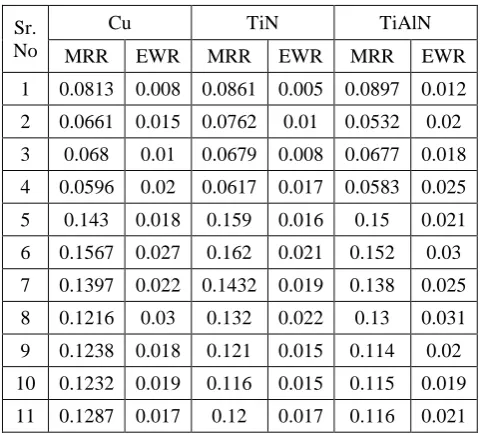
Experiments were performed with three electrodes: Standard copper electrode, Titanium Nitride (TiN) coated electrode and Titanium Aluminium Nitride (TiAlN) coated electrode. The experimental results are listed in table 3.
TABLE 2: DESIGN MATRIX
Sr. No Current Voltage Pulse On
1 -1 -1 -1
2 -1 -1 1
3 -1 1 -1
4 -1 1 1
5 1 -1 -1
6 1 -1 1
7 1 1 -1
8 1 1 1
9 0 0 0
10 0 0 0
11 0 0 0
TABLE 3:EXPERIMENTAL RESULTS WITH
DIFFERENT ELECTRODES
Sr. No
Cu TiN TiAlN
MRR EWR MRR EWR MRR EWR
1 0.0813 0.008 0.0861 0.005 0.0897 0.012
2 0.0661 0.015 0.0762 0.01 0.0532 0.02
3 0.068 0.01 0.0679 0.008 0.0677 0.018
4 0.0596 0.02 0.0617 0.017 0.0583 0.025
5 0.143 0.018 0.159 0.016 0.15 0.021
6 0.1567 0.027 0.162 0.021 0.152 0.03
7 0.1397 0.022 0.1432 0.019 0.138 0.025
8 0.1216 0.03 0.132 0.022 0.13 0.031
9 0.1238 0.018 0.121 0.015 0.114 0.02
10 0.1232 0.019 0.116 0.015 0.115 0.019
11 0.1287 0.017 0.12 0.017 0.116 0.021
III.RESULT AND DISCUSSION
Based on experimental data study has been carried out for effect of process parameters on MRR and EWR.
A. Material Removal Rate
Material removal rate (MRR) is the amount of material removed in unit time of machining. The Figures 1, 2 and 3 shows the effect of current, voltage and pulse on time on MRR while machining carried out with different electrodes respectively.
From Fig 1, it can be inferred that TiN coated copper electrode has the highest MRR than the other electrodes at lower values of input parameter. MRR increases with increase in current. TiN coated electrode has better results followed by cu and TiAlN coated copper electrode.
From Fig 2, it can be inferred that TiN coated copper electrode has the highest MRR at lower voltage values than the other electrodes. MRR decreases with increase in voltage. TiN coated electrode has better results followed by Cu and TiAlN coated copper electrode. For standard copper electrode there is slight increase in MRR with voltage, after that it decreases.
Fig. 2 Effect of voltage on MRR with different electrode
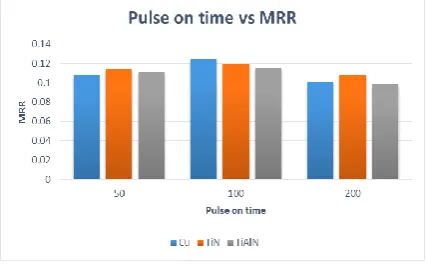
From Fig 3, it can be inferred that TiN coated copper electrode has the highest MRR at lower pulse on time than the other electrodes. Increase in MRR is observed initially then it decreases with increase in pulse on time. TiN coated electrode has better results followed by TiAlN and Cu coated copper electrode but for moderate value of pulse on Cu electrode shows better results. For standard copper electrode there is slight increase in MRR with pulse on time after that it decreases.
Fig.3 Effect of pulse on time on MRR with different electrode
B. Electrode Wear Rate
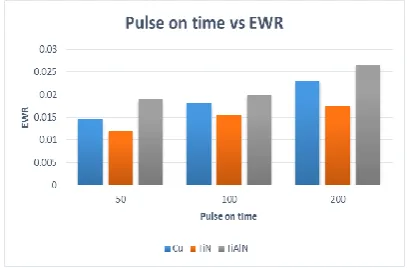
The loss of tool material in the process of machining in unit time of machining is known as electrode wear rate (EWR). The increase in discharge energy leads to strong sparks, which heats up the workpiece material to a very high temperature and enhances the erosion process, resulting in higher electrode wear. The Figures 4, 5 and 6 shows the effect of current, voltage and pulse on time on EWR machined with different electrodes respectively.
From Fig 4, it can be inferred that TiN coated copper electrode has the lowest EWR than the other electrodes under most of the varied values of input parameters. EWR increases with increase in current up to certain value and then decreases. TiN coated electrode has better results followed by Cu and TiAlN coated copper electrode.
Fig. 4 Effect current on EWR with different electrode
From Fig 5, it can be inferred that TiN coated copper electrode has the lowest EWR than the other electrodes under most of the varied values of input parameters. There is slight increase in EWR with increase in voltage. TiN coated electrode has better results followed by TiAlN and copper electrode.
Fig. 5 Effect of voltage on EWR with different electrode
Fig. 6 Effect of pulse on time on EWR with different electrode
C. Mathematical modelling
A comprehensive model has been developed to correlate the effects of the process parameters on the response criteria, utilizing the relevant experimental data as observed (Table 3) during the course of machining for such purposes as varying parametric combinations. The mathematical relations thus obtained for analyzing the influences of the various dominant machining parameters on the TWR criteria is given by:
1. Standard copper electrode (Cu)
MRR = 0.103 I 0.1553 V -0.030 Ton -0.021 …………..… (1)
EWR = 0.174 I 0.141 V 0.044 Ton 0.1106 …………...…. (2)
2. Titanium Nitride coated copper electrode (TiN)
MRR = 0.1076 I 0.1560 V -0.0411 Ton -0.0152 ……..…… (3)
EWR = 0.0138 I 0.1643 V 0.066 Ton 0.101 ………….… (4)
3. Titanium aluminium Nitride coated copper electrode (TiAlN)
MRR = 0.1014 I 0.1671 V -0.023 Ton -0.038 ………….... (5)
EWR = 0.021 I 0.082 V 0.0454 Ton 0.0766 ………….…. (6)
IV.CONCLUSIONS
In this work EDM process is used to machine HCHCr die steel with different electrode. Change in
process parameters along with electrode,
significantly affect the MRR and EWR. Based on experimental results following conclusions are drawn:
1. Current is the most significant parameter followed by voltage and pulse on time.
2. MRR using TiN coated copper electrode is more as compare to other electrodes. Which implies that at high current, low voltage and low pulse on time using TiN electrode is more economical. But as the value of the parameters increases, MRR with standard copper electrode increases more rapidly in respect of TiN electrode.
3. TiN shows good compromise for EWR as compared to other electrodes under most of the varied values of input parameters.
4. Finally, it can be concluded that TiN coated copper electrodes are best suitable for lower values of parameters and mainly for finishing work as TiN coated copper electrode gives better surface finish due to lower EWR.
ACKNOWLEDGMENT
I am thankful to all the staff of Kishor industries Aurangabad and Balzers india Ltd. Pune for their kind support.
REFERENCES
[1] Asif Iqbal and Khan A. A. “Modelling and Analysis of MRR, EWR and Surface roughness in EDM” American journal of Engineering and Applied Science 3 (4): 611-619, 2010.
[2] Jose Marafona, Catherine Wykes, A new method of optimising material removal rate using EDM with copper-tungsten electrodes, International Journal of Machine Tools & Manufacture 40 (2000) 153 – 164.
[3] Narender Singh .P, Raghukandan .K and Pai .B.C, Optimization by Grey relational analysis of EDM parameters on machining Al-10%SiC composites, International Journal of Machine tools & Manufacture 155-156 (2004) 1658-1661.
[4] Chen .S.L, Hsieh .S.F, Lin .H.C, Lin .M.H and Huang .J.S, Electrical discharge machining of TiNiCr and TiNiZr ternary shape memory alloys, Materials Science and Engineering A 445-446 (2007) 186-492.
[5] Petropoulos .G, Vaxevanidis .N.M and Pandazaras .C, Modeling of surface finish in electro-discharge machining based upon statistical multi-parameter analysis, Journal of Materials Processing Technology 155-156 (2004) 1247-1251.
[6] Kansal .H.K, Sehijpal Singh and Pradeep Kumar, Effect of Silicon Powder Mixed EDM on Machining Rate of AISI D2 Die Steel, Journal of Manufacturing Processes Vol. 9/No. 1, 2007.
[7] Shankar Singh, S. Maheshwari , P.C. Pandey “Some investigations into the electric discharge machining of hardened tool steel using different electrode materials” Journal of Materials Processing Technology 149 (2004) 272–277
[8] A.K. Khanra , B.R. Sarkar , B. Bhattacharya ,L.C. Pathak , M.M. Godkhindi “Performance of ZrB2–Cu composite as an EDM electrode”, Journal of Materials Processing Technology 183 (2007) 122–126
[9] C.J. Luis, I. Puertas, G. Villa, “Material removal rate and electrode wear study on the EDM of silicon carbide”, Journal of Materials Processing Technology 164–165 (2005) 889–896
[11] I. Puertas, C.J. Luis, “A study on the electrical discharge machining of conductive ceramics”, Journal of Materials Processing Technology 153–154 (2004) 1033–1038. [12] K.H. Ho, S.T. Newman, State of the art electrical discharge
machining (EDM), Int. J. Mach. Tools Manuf. 43 (2003) 1287–1300.
[13] A. Kulkarni, R. Sharan, G.K. Lal, An experimental study of discharge mechanism in electrochemical discharge machining, Int. J. Mach. Tool Manuf. 42 (August (10)) (2002).
[14] I. Puertas, C.J. Luis, A revision of the applications of the electrical discharge machining process to the manufacture of conductive ceramics, Rev. Met. Madrid 38 (5) (2002) 358– 372.