1543
Soft Computing Based Economic And Emission
Load Dispatch In Micro Grid
K.Thenmalar, G.Sophia Jasmine , V.Vanitha
Abstract : Distribution of energy from various resources in micro grids is the emerging trend for efficient method of power generation and distribution. Due to the penetration of distributed generation into microgrid, it has become a critical issue for the microgrid operators to accomplish optimal dispatch balancing the economic as well as environment factors satisfying power demand and security constraints. The Economic Dispatch (ED) is described as the method to obtain an optimal solution for the minimization of generation cost taking into account all the necessary constraints. Combined environmental-economic dispatch (CEED) technique for smart micro grids is discussed in this work, with an objective of curtailing the generation and emission costs considering two different algorithms Multi-objective Economic Emission Dispatch (MOEED) algorithm and Modified Evolutionary Multi Objective Algorithm (MEMO) Smart grid management is considered such that each of the generators communicate about their generation cost, demand and the deviations to their consumers. Simulation of the algorithms is carried out in PROTEUS and results are presented.
Index Terms: Economic dispatch, Emission, Energy management system, MOEED, MEMO, PROTEUS
—————————— ——————————
1 INTRODUCTION
Microgrid is an emerging system, which has several loads supplied by distributed energy sources operating in conjunction with grid or independently. Owing to itsremarkable cost-effective and functional tractability,
microgrid is extensively considered as a unique producer of electrical power under the smart-grid model. Microgrid is advantageous in system investment rescheduling, pollution minimization, enhanced power consumption efficiency and reliability. As the load dispatch method of usual grid and microgrid varies, it is very essential to explore the suitable dispatch method for microgrid. Hence it is necessary to formulate suitable algorithm for optimizating dispatch problem in microgrid. A new multi-objective economic emission dispatch framework, based on a new optimization technique, Pareto Concavity Elimination Transformation (PaCcET) has been described in [1]. Various optimization algorithms such as artificial bee colony algorithm [2], ant colony optimization [3], harmony search algorithm [4] are discussed with ambient test cases in various literatures. The author discussed on the methodology based on iterative objective space transformation to arrive at the best pareto front solution. Economic and emission load dispatch (EELD) problem is solved using Teaching Learning Based Optimization (TLBO) algorithm[7],[5]. Combined emission and economic dispatch including renewable sources is discussed in [6],[3]. Apart from generation-demand equality constraint, pollution emission constraint and operating limit constraint are considered. In [8], the author explained about quasi oppositional self-learning teacher-learner based optimization algorithm (QOSLTLBO)
for solving ED problem, which aims to allocate the optimal
power generation to each unit such that the cost of generation is minimum.. In this work, an Economic Emission Dispatch model for smart microgrids (SMG) is developed that minimizes the cost of generation and emission. Combined Evolutionary and Meta-heuristic search Algorithm (CEMS) is incorporated in Micro grid
management such that each of the generators
communicate about their generation cost and the demand as well as the deviations to their neighboring units. The generators regulate their power output in accordance with the data thus acquired ensuring the minimal cost of production. Two optimization algorithms are used to solve both the economic load dispatch and emission dispatch
(EED) problems considering transmission losses.
Simulation studies are carried out in PROTEUS software.
2
PROBLEM
STATEMENT
MOEED is an efficient method to solve the problem of fuel cost minimization subject to constraints such as power balance, generator limit, transmission line and tie-line flow. Besides economic dispatch, emission from generating plants is also considered in the multi-objective problem.
The primary objectives of the work are outlined below:
1. To formulate the CEED problem in quadratic
programming technique.
2. To develop flexible and extensible computational
frame work as general environment to CEED.
3. To analyze the performance of algorithm for
combined economic emission dispatch.
4. To develop feasible and high efficiency results.
The formulated objective function, inequality and equality constraints are summarized as follows:
(1)
(2)
where
C=cost function
_________________________________
• K.Thenmalar is currently working as Professor in Department of Electrical and Electronics in Vivekanandha College of Engineering for Women, Tiruchengode. Mail ID:[email protected].
• G.Sophia Jasmine is currently working as Associate Professor in Department of Electrical and Electronics in Sri Krishna College of Technology, Coimbatore. Mail ID: [email protected] • V.Vanitha is currently working as Professor in Department of Electrical
C(i)=individual production cost PG(i)=power generation of ith unit. Equality constraint:
(3)
Where, Pd =Power demand Inequality constraints: (i)GeneratorConstraint:
(4)
(5) (ii) Voltage Constraint:
(6)
The total emission level E of the generating units is given by
(7)
Where are the emission curve coefficients of the
ith generation unit.
The cost function for economic dispatch is given by,
(8)
(9)
3
PROPOSED
SYSTEM
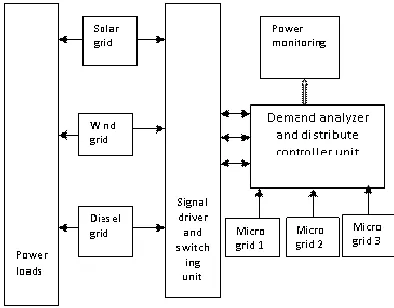
The economic dispatch and Emission dispatch is described as the method for searching the optimal solution for the minimization of the generation cost. For optimization, MEMO algorithm and combined Evolutionary and Meta-heuristic search Algorithm have been used in Micro grid management, in which each of the generators communicate about their generation cost and the demand and the deviations to their consumer. Figure 1 represents the block diagram of the proposed system. It comprises of different grids such as solar, wind and diesel and signal driver with switching unit, demand analyzer with distribute controller unit and power monitoring unit and multiple Microgrid agents. Each renewable and non-renewable grid is generating the power when it collects the input source from natural or artificial parameters. The range of output power level of the each grid is based on their input source. The generating power continuously delivered to the corresponding loads through distributed electrical network from the energy storage units. The signal driver is used to identifying the power level as well as load conditions from each grid.
Figure 1 Block diagram of the proposed system
The output of the signal driver is applied to the input of the demand analyzer. The demand analyzer is connected with different Microgrid agents. The ‗N‘ number of Microgrid agents generating the power and it can operated independent as well as collaborate with distribute controller. The demand analyzer and distributed unit are used to increasing the power level from the Microgrid agents based on input demand of the each grid. The power from the Microgrids is supplied to the main grids through distributed controller network. The distributed network is designed by multi-evolutionary algorithm which is reduced the cost for economic dispatch of the electrical power generation and distribution. The power monitoring unit shows the status of the grids as well as their parameters.
4 COMBINED
EVOLUTIONARY
AND
METAHEURISTIC
SEARCH
ALGORITHM(CEMSA)
CEMSA is the algorithm that operates with the combination of Genetic Algorithm with the meta heuristic algorithm. The flow chart of CEMSA is illustrated in figure 2.
1545
5 MEMO
ALGORITHM
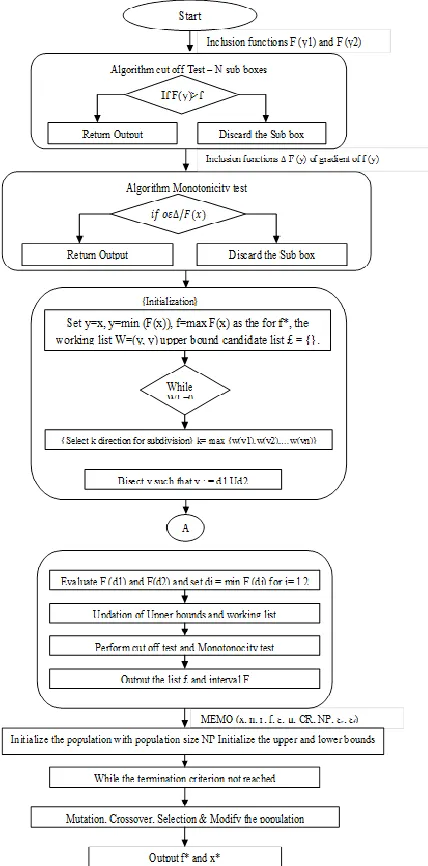
In the Modified Evolutionary Multi Objective Algorithm (MEMO) the interval will be considered as three sources. The first MEMO, then global will be approximately low. Predictable function then its calculation will be in higher to lower. Then the second consists of monoton test and cut off test then the width is small then its consist of higher and lower function. Then the last is depends on no.of single subset and it acts as a group. The flow chart of MEMO algorithm is given in Figure 3.
6 SIMULATION
RESULTS
Simulation was carried out in Proteus software (Figure 4,5). The solar and wind data are tabulated in Table 1,2. The control parameters used in simulation are tabulated in Table 3,4 and 5.
Figure 3 Flow Chart of MEMO algorithm
Figure 4 Simulation representation
Figure 5 Execution of simulation
Table 2 Wind Generation details for 24 hours
Table 3 Control Parameter for Woa
Table 4 Parameters used in simulation
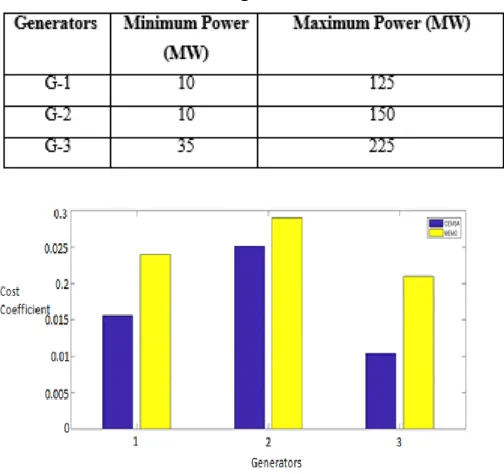
Table 5 Power generation Limits
Figure 6 Comparison of Fuel Cost Coefficients of CEMSA and MEMO
The fuel emission coefficient of three generators in the generating unit is furnished in Table 6. The comparison of fuel
emission of the generators using MEMO and CEMSA algorithm is shown in figure 7.
Table 6 Fuel Emission Coefficient of Three Generators
Units α(kg/MW2
h) β (kg/MWh) γ (kg/h)
Generator-1 0.00683 -0.54551 40.26690
Generator-2 0.00461 -0.514116 42.89553
Generator-3 0.00491 -0.32767 13.85932
Figure 7 Comparison of Emission Coefficients of different generators -MEMO and CEMSA
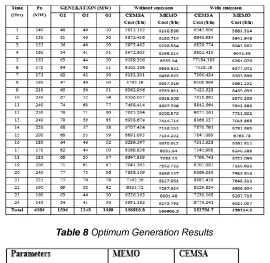
The minimization of fuel cost using MEMO algorithm is shown in figure 8. The results of MEMO are compared with PaCceT method also. The comparison reveals the reduction in cost by 0.09% when emission is not considered and 0.22% when emission is considered. Table 7 shows the detailed cost of generation using CESMA and MEMO algorithm including and excluding emission. The consolidated results are tabulated in Table 8.
1547 Table 7 Generation with all Sources with and without emission
Table 8 Optimum Generation Results
6 CONCLUSION
The proposed EED model shows the reduction of generation and fuel emission costs considering various operating constraints. The effectiveness of the technique is verified by correlating the acquired results with other techniques quoted in literatures. From the results, it is shown that the economical scheduling attained by the proposed model results in greater economic and social benefits. MEMO has better convergence, robustness and has a meager computational difficulties as compared to other methods. CEMSA is found to be superior over MEMO.
7
REFERENCE
[1]. Ahidsarfi, haniflivani, logan yliniemi, ―A new multi objective economic emission dispatch in microgrids‖, IEEE Power & Energy Society General Meeting, DOI: 10.1109/PESGM.2017.8274401,2017.
[2]. Bhongade and Sourabh Agarwal, ―An optimal solution for combined economic and emission dispatch problem using artificial bee colony algorithm‖, Proceedings of Biennial International Conference on Power and Energy Systems: towards Sustainable Energy
(PESTSE),DOI:10.1109/PESTSE.2016.7516478, 2016.
[3]. EhabE.Elattar, ―Modified harmony search algorithm for combined economic emission dispatch of microgrid incorporating renewable sources‖, Energy,
Vol.159, pp. 496-507, 2018.
[4]. Gopalakrishnan R. and Krishnan A., ―An efficient technique to solve combined economic and emission dispatch problem using modified ant colony optimization‖, Proceedings in Engineering Sciences,Vol. 38, No. 4, pp. 545-556, 2013.
[5]. Mojtaba Ghasemi,Sahand Ghavidel, Mohsen Gitizadeh and Ebrahim Akbari, ―An improved teaching–learning based optimization algorithm using lévy mutation strategy for non-smooth optimal power flow‖, International Journal of Electrical Power & Energy Systems, Vol 65, pp. 375-384, 2014. [6]. Naveed Ahmed Khan, Ahamed Bilal Awan and Anzar
Mahmood, ―Combined emission economic dispatch of power system including solarphoto voltaic generation‖,International Journal of Energy Conservation and Management, Vol. 92, pp. 82-91, 2014.
[7]. Sneha Rani, Subhajit Roy and kuntal bhattacharjee, ―Teaching learning based optimization to solve economic and emission scheduling problems‖, Proceedings of 2nd International Conference on Control, Instrumentation, Energy & Communication (CIEC), DOI:10.1109/CIEC.2016.7513790, 2016.
[8]. Tapan prakash, Singh V.P, Sugandh P. Singh,