641 | P a g e
TO STUDY THE BEHAVIOUR OF STRENGTH GAIN
IN CLAYEY SOIL USING QUARRY DUST AS A
STABILIZER
Mandeep Pathania
1, D.K.Soni
21
M.Tech Student, Department of Civil Engineering, NIT Kurukshetra, (India)
2
Professor, Department of Civil Engineering, NIT Kurukshetra, (India)
ABSTRACT
Quarry dust is a solid waste material and is generated by its crushing industry about 15 to 20%.Disposal of this
waste create a lot of geo-environmental problems. Clayey soil is a soil which possess high swelling & shrinkage
properties. It may be cause of damage in various civil engineering projects because of its alternative swelling
&shrinkage behavior. This paper presents the environment friendly & cost effective way to deal these problems.
The aim of this paper are to conduct an experimental study & to stabilize the soil which is locally collected from
village-Dayalpur distt.-kurukshetra (Haryana). Due to mixing of quarry dust from 0 to 25 % @ 5 % increment it
become more stable soil. Therefore a number of laboratory experiment are conducted to stabilize the soil and
various properties like specific gravity, liquid limit, plastic limit, shrinkage limit, dry density, have been checked
with and without addition of this waste. A comparative study has been done. From the analysis of test results it
was found that liquid limit, plastic limit, & optimum moisture content decreased and unconfined compressive
strength, dry density both increased due to addition of quarry dust.
Keywords:
Quarry dust, Stabilization, UCS, OMC, MDD.1. INTRODUCTION
Clays exhibit generally undesirable engineering properties. They tend to have low shear strengths and to lose
shear strength further upon wetting or other physical disturbances. Soil is defined as sediments or other
accumulation of mineral particles produced by the physical or chemical disintegration of rocks plus the air,
water, organic matter and other substances that may be included. Soil is typically a non-homogeneous porous,
earthen material whose engineering behaviour is influenced by changes on moisture content and density. Based
on the origin, soil can be broadly classified as organic and inorganic. "Expansive soil" means soil which
contains clay and which expands to a significant degree upon wetting and shrinks upon drying. Clay soils
contain a high percentage of certain kinds of clay particles that are capable of absorbing large quantities of
water. Soil volume may expand 10 percent or more as the clay becomes wet. Stabilizing soil with admixtures
like lime, fly ash, quarry dust, cement is now an extremely cost effective method of converting poor quality soil
into strong impermeable medium and making it into the constructing material.It cannot be very easily defined in
precise terms. The word has a popular and also a series of technical meanings. The Foundation Engineer's
concept of clay may be rejected by a potter, a brick manufacturer, an agronomist, or a farmer. Nevertheless, in
642 | P a g e
all clay minerals can be considered very fine soil particles having a pronounced basal cleavage. As aconsequence, individual clay particles are flat and flake-shaped. In general, the term “clay” implies a natural,
earthy, fine-grained material which when mixed with a limited amount of water develops plastic properties.
Plasticity, as related to Soil Mechanics, is that property which allows a material to undergo rapid deformation
without rupture, volume change, or elastic rebound. Chemical analyses of clays show them to have essentially
silica, alumina, iron, alkalis, and alkaline earths. The term "clay" is sometimes used to signify a material that is
the product of weathering that formed by hydrothermal action, or that deposited as sediment. As a particle-size
term, soil investigators tend to consider two microns as the upper limit of the clay particle size. Recent decades
have seen a marked upsurge in industrial and economic growth, contributing to an improved quality of life and
well-being for citizens. However, we should not lose sight of the fact that every production system creates
by-products and waste by-products which can affect the environment. These effects may occur at any point in the
life-cycle, whether during the initial phase of obtaining raw materials, during the transformation and production
phase, during product distribution or when the end user must dispose of products which are no longer required.
As a result, recent years have witnessed rising social concern about the problem of waste management in
general, and industrial waste and waste from the construction industry in particular. This problem is becoming
increasingly acute due to the growing quantity of industrial, construction and demolition waste generated.
II. OVERVIEW OF EARLIER RESEARCH
The quarry dust is obtained as an aggregate waste, during crushing of rubble to obtain aggregates. Sabat and Das
(2009) had stabilized expansive soil using quarry dust and lime for strengthening the subgrade of a rural road for
low volume traffic. The properties tested were compaction (standard proctor), UCS, soaked CBR and Ps. The
stabilizer strengthened road was found to be cost effective for low volume traffic. Sabat (2012) had investigated
the effect of lime on Atterberg’s limit, compaction(modified proctor), shear strength parameters and durability
of an expansive soil stabilized with optimum percentage of quarry dust (40%).The lime added were 2 to 7 % at
an increment of 1%. The effect of 7 and 28 days of curing were also studied on shear strength parameters.
Sabat (2012) had developed statistical models for prediction of Ps of expansive soil (Bentonite) stabilized with
quarry dust and lime by correlating the percentage of stabilizers, MDD, OMC, curing period and activity.
Models were also developed to predict the Ps of stabilized expansive soil cured at 7 and 28 days from the Ps of
the expansive soil cured at 0 day and the Ps of expansive soil cured at 28 days from the Ps of the expansive soil
cured at 7 days. The models developed were found to be very accurate in predicting the swelling pressure. Sabat
and Bose (2013) had studied the effect of fly ash –quarry dust mixes with fly ash: quarry dust as 1:2, on
engineering properties of an expansive soil. The optimum proportion of fly ash –quarry dust mix was found to
be Quadri Syed Ghausuddin (2011) conducted studies on evaluation of Soil-Quarry Dust Mixtures Reinforced
with Polypropylene Fibres. The objective of this paper is to analyse the replacement of weak earth material with
quarry dust using polypropylene fibres as reinforcements and to investigate the influence of selected fibre
parameters like fibre content and fibre length on the strength and ductility behaviour of soil-quarry dust
mixtures. A series of tests like Compaction test &California bearing ratio tests were carried out. Polypropylene
fibres with different fibre length (12mm, 24mm and 40mm) were used as reinforcement. The conclusion drawn
643 | P a g e
1.00% by weight of soil quarry dust mixtures. Thus, inclusion of randomly oriented fibres greatly influences theperformance of soil quarry dust.
Panagiotis Ch. Eskioglou (2009) examined the adequacy of marble dust as a soil stabilizer. The study revealed
that the geotechnical parameters of black cotton soils are enhanced significantly by the addition of marble dust.
Huge plasticity index reductions happened with marble dust treatment, particularly for high PI soils. Results
demonstrated that plasticity decreased by 15 to 30% and strength increased by 25 to 50 %. The most noteworthy
strength increase was accomplished at 8% marble dust after 28 days. Increments in the unconfined compressive
strength of soil occurred with the addition of marble dust
.
III. MATERIALS AND METHODS
3.1 Soil Sample
The soil planned to use in this study was obtained from village-Dayalpur District:Kurukshetra Haryana . The top
soil was excavated up to a depth of 1.0m. The samples taken were disturbed soil sample. In the dry state
shrinkage-soil has distinct shrinkage cracks having width about 20mm and the cracks are deep. . The index
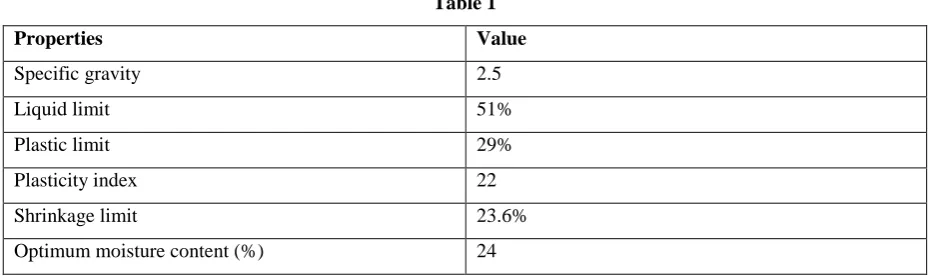
properties of quarry dust determined as per IS codes and are presented in Table 1.
Table 1
Properties Value
Specific gravity 2.5
Liquid limit 51%
Plastic limit 29%
Plasticity index 22
Shrinkage limit 23.6%
Optimum moisture content (%) 24
3.2 Quarry dust
Quarry dust for this study was collected from Shiva building material District of Kurukshtra Haryana. The index
properties of quarry dust determined as per IS codes and are presented in Table 2.
Table 2
Properties Value
Specific gravity 2.71
Liquidlimit NIL
Plastic limit Non plastic
Plasticity index Non plastic
IV. EXPERIMENTAL TESTS
4.1 Standard Proctor Tests
Standard Proctor tests were conducted to determine optimum moisture content and maximum dry density of
644 | P a g e
IS sieve.These tests were conducted in order to prepare specimens at maximum dry density by adding desired optimum
moisture content as per specifications of IS: 2720 (Part 7) (1974).
4.2 Liquid limit test
Liquid limit test was conducted by using casagrandae apparatus as per specifications of IS: 2720 (Part 4) 1970.
4.3 Shrinkage limit test
Shrinkage limit test was conducted as per specifications of IS: 2720 (Part 4) 1972.
4.4 Plastic limit test
Plastic limit test was conducted as per specifications of IS: 2720 (Part 4) 1970.
4.5
Unconfined compression test
UCS test on scaly treated with different percentage of quarry dust & ceramic dust as per specifications of IS:
2720.The UCS test were conducted on soil sample waste ceramic & quarry dust mixture prepared at OMC &
MDD obtained corresponding to that soil.
V. EXPERIMENTAL RESULTS
5.1 PARENT SOIL
0 0.1 0.2 0.3 0.4 0.5 0.6 0.7
0 0.01 0.02 0.03 0.04 0.05 0.06 0.07 0.08
A
xi
al
S
tr
es
s
in
kg
/c
m
2
Axiial strain
Parent soil stress strain graph
Interpretation and reporting
Unconfined compressive strength of the soil = 0.589841
645 | P a g e
5.2 SOIL WIITH 5% QUARRY DUST
Interpretation and reporting
Unconfined compressive strength of the soil = 0.611088
Shear strength of the soil = 0.611088/2 = 0.3055441
5.3 SOIL WITH 10% QUARRY DUST
Interpretation and reporting
Unconfined compressive strength of the soil = 0.648054
646 | P a g e
5.4 SOIL WITH 15% QUARRY DUST
Interpretation and reporting
Unconfined compressive strength of the soil = 0.739177
Shear strength of the soil = 0.739177/2 = 0.369588
5.5 SOIL WITH 20% QUARRY DUST
Interpretation and reporting
Unconfined compressive strength of the soil = 1.236901
647 | P a g e
5.6 SOIL WITH 25% QUARRY DUST
Interpretation and reporting
Unconfined compressive strength of the soil = 1.517064
Shear strength of the soil = 1.517064/2 =0.758532
VI. CONCLUSION
1. It was observed that the liquid limit and plastic limit decreasing irrespective of the percentage of addition of
Quarry Dust.
2. It was found that the maximum dry density attained at 25% Quarry dust and optimum moisture content goes
on decreasing with increasing in percentage of addition of Quarry Dust.
3. The study has been successfully conducted to assess the geotechnical properties of the clay improved the
quarry dust and also increased the shear strength.
4. Maximum unconfined compressive strength of sample is = 1.517064 for 25 % of Quarry dust addition.
0 0.2 0.4 0.6 0.8 1 1.2 1.4 1.6 1.8
0 0.01 0.02 0.03 0.04 0.05 0.06 0.07 0.08 0.09
648 | P a g e
VII. ACKNOWLEDGEMENT
This work was done in the laboratory of geotechnical as well as environmental engineering of National Institute
of Technology with the help of various peoples in the laboratory. The authors are grateful for this support. Any
opinions expressed in this paper are opinions of authors only and do not reflect any opinions of NIT
Kurukshetra Civil Engineering Department.
REFERENCES
Journal Papers
[1.] R.Deepiya,N.durga,j.Steffi,S.Ayyappan(2014)”Effect of quarry dust and lime mixing with clay".
International journal of advance information science & technology.vol.32,No.32.
[2.] H,Venkateswarlu, A.C.S.V PP a g e | 648rasad, Dr. DSV Prasad & Dr. GVR Prasada Raju(2015)”. Study
on behavior of soil treated with quarry dust.” IJEIT. Vol.4
[3.] Sabat, A.K. (2012) “Stabilization of Expansive Soil using Waste Ceramic Dust,” Electronic Journal of