227 | P a g e
A SURVEY ON GESTURE RECOGNITION
TECHNOLOGY
Deeba Kazim
1, Mohd Faisal
21
MCA Student, Integral University, Lucknow (India)
2
Assistant Professor, Integral University, Lucknow (india)
ABSTRACT
Gesture recognition is a technology through which inputs are given to the devices through human
gestures. It is a human-machine interaction. By implementing the gesture recognition technology a
device can identify and respond to the various gestures of a human. Gestures are movements or
positions of the person’s hands, face, fingers, to convey any information. These are non-verbal
communication. Hand gestures can be mainly used for expressing ones ideas. This hand recognition
approach can be mainly divided into Data-Glove Based and Vision Based approaches. Facial Gesture
Recognition uses the different face expressions to interact with the machine. Nose tip being
the highest
point on the face can be considered as an important feature to indicate the head pose.
Keywords
:
Facial gesture, Gestures, Hand gestures, Nose tips.
I. INTRODUCTION
Gestures are non-verbal means of communication which includes the movements or positions of the person’s
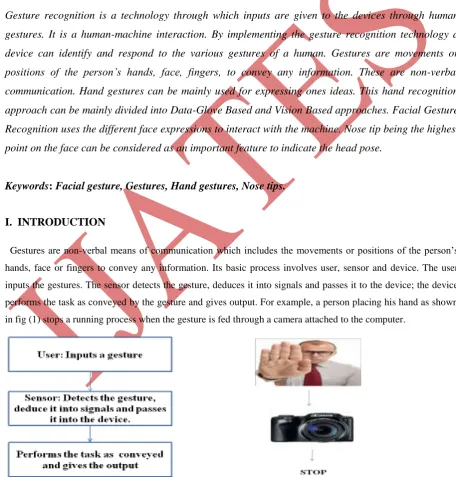
hands, face or fingers to convey any information. Its basic process involves user, sensor and device. The user
inputs the gestures. The sensor detects the gesture, deduces it into signals and passes it to the device; the device
performs the task as conveyed by the gesture and gives output. For example, a person placing his hand as shown
in fig (1) stops a running process when the gesture is fed through a camera attached to the computer.
228 | P a g e
1.1 Input Devices
These are the devices which take gestures (positions and movements) as inputs and convey the signals to the
processing unit to deduce the information. In the beginning humans interacted with the machine through input
devices such as mouse and keyboard. With the advent of technology there felt a need to interact with the machine
as humans convey information to each other, through speech and gestures.
Various devices which make natural hand gestures to be taken as input by the machine are:
1.1.1 Wired Gloves
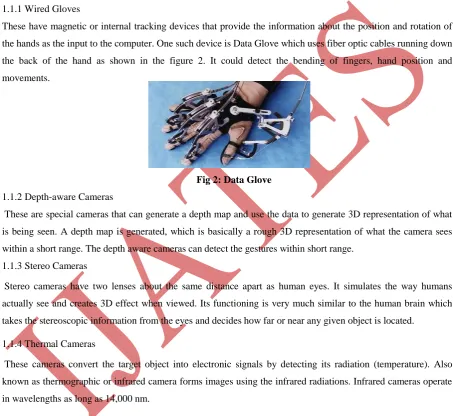
These have magnetic or internal tracking devices that provide the information about the position and rotation of
the hands as the input to the computer. One such device is Data Glove which uses fiber optic cables running down
the back of the hand as shown in the figure 2. It could detect the bending of fingers, hand position and
movements.
Fig 2: Data Glove
1.1.2 Depth-aware Cameras
These are special cameras that can generate a depth map and use the data to generate 3D representation of what
is being seen. A depth map is generated, which is basically a rough 3D representation of what the camera sees
within a short range. The depth aware cameras can detect the gestures within short range.
1.1.3 Stereo Cameras
Stereo cameras have two lenses about the same distance apart as human eyes. It simulates the way humans
actually see and creates 3D effect when viewed. Its functioning is very much similar to the human brain which
takes the stereoscopic information from the eyes and decides how far or near any given object is located.
1.1.4 Thermal Cameras
These cameras convert the target object into electronic signals by detecting its radiation (temperature). Also
known as thermographic or infrared camera forms images using the infrared radiations. Infrared cameras operate
in wavelengths as long as 14,000 nm.
II. RELATED WORK
The user’s cultural background can be utilized for analyzing the gesture expressivity in a model based on cultural
dimensions [1]. Users make different gestures for the same purpose differently according to their cultural
background. Thus in future gesture recognition technology can be used to predict ones culture through his
229 | P a g e
various facial gesture recognition algorithms. Eyes and nose can be detected computationally. One of its
approaches is by using template based methods.
In the template based methods, a generic eye model, based on the eye shape, was designed at first [2]. Template
matching is then used to search the image for the eyes. While these methods can detect eyes accurately, they are
normally time-consuming.
Latest work related to gesture recognition is ‘Sixth Sense’. It is a wearable gestural interface that converts the
physical world into digital information. It bridges the gap digital information and hand gestures. Using it we can
access, change and data very easily, without the use of keyboard and mouse.
Fig 3: a, b , c and d shows different hand movements.
2.1 Hidden Markov Model
This method [3] deals with the dynamic aspects of gestures. Gestures are extracted from a sequence of video
images by tracking the skin-color blobs corresponding to the hand into a body– face space centered on the face of
the user. Hidden Markov Models (HMMs) are popular tools for modeling a large time series data and for
generating sequences of dependent observations.
2.2YUV Colour Space and CAMSHIFT ALGORITHM
This method deals with recognition of hand gestures [4]. It is done in the following five steps:
a. First, a digital camera records a video stream of hand gestures.
b. All the frames are taken into consideration and then using YUV colour space skin colour based segmentation is
performed. The YUV colour system is employed for separating chrominance and intensity. The symbol Y
indicates intensity while UV specifies chrominance components.
c. Now the hand is separated using CAMSHIFT algorithm .Since the hand is the largest connected region, we can
segment the hand from the body.
d. After this is done, the position of the hand centroid is calculated in each frame. This is done by first calculating
the zeroth and first moments and then using this information the centroid is calculated.
e. Now the different centroid points are joint to form a trajectory .This trajectory shows the path of the hand
230 | P a g e
2.3Vision Based Hand Gesture Recognition
In vision based hand gesture recognition system [5], the movement of the hand is recorded by video camera(s).
This input video is decomposed into a set of features taking individual frames into account.
III NOSE DETECTION AND RECOGNITION
3.1Using Hough Transform
In this method (Hough Transform [6]), the face vertexes in proximity of the found sphere are extracted, and
magnifying the extracted cloud of a factor of 10, in order to center the sphere on the nose. The mean value of
normal vectors of each face vertex is evaluated with the purpose of obtaining information about face orientation
in the three-dimensional space.
3.2 Effective Energy Calculation
Since the Nose is the protruding area on the facial front, this method uses Edge Detection techniques [7] to
identify potential nose tip candidates by investigating the neighboring pixels. The nose tip is then identified from
the potential candidates by their effective energy, mean and variance values obtained from Principal Component
Analysis Technique. This method has the ability to locate the nose tip in Frontal as well as Non-Frontal Faces.
3.3 Template Based Method
In this approach the convex shape of the nose is used to identify the nose region. It involves calculating the local
search area which was used as a template. The template was scanned through the image and the pixel and one
which had maximum correlation was identified. The position of best match was refined using Evident Based
Convolution Filter [8].
3.4 Colour Data Model
The human facial features such nose tip and the nose ridge were identified using a shading technique on the
colour data of the image. But, the highly sensitive nature of the nose region to light made the system
disadvantageous.
IV CHALLENGES
There are many challenges related to gesture recognition software. The usefulness and accuracy are the main
challenges associated. In order to capture human gestures by visual sensors, robust computer vision methods are
also required.
4.
1
Latency: Gesture recognition software can be slow creating unacceptable latency for video games and othersimilar applications. In real life, humans do very fast movements of hands and facial parts which is a big
challenge for the software to grasp accurately and efficiently.
4.2Robustness: The input devices do not read accurately. Different people make different signs and gestures for
231 | P a g e
devices. The gesture recognition software requires complex devices and algorithms to perform according to the
input.
4.4Difficult to develop: The system for recognizing gestures are complex, thus difficult to develop.
4.5High cost of implementation:The implementation of the software is expensive.
IV CONCLUSION
This paper provides information of the gesture recognition technology. This technology can be used in various
spheres of life. It can be used in Sign language recognition, Remote controllers, aid to physically challenge and in
gaming. Gesture recognition is a developed technology which identifies human position and actions.
V FUTURE SCOPE
In the near future we will be seeing the use of gestures in almost all the interactions with the system. It will play
an increasingly important role in human-computer interaction in the future. Reduced complexity will provide
less computation time so that system works in real time. Gesture recognition can be a boon for the physically
challenged people, who by using simple finger gestures can control their surroundings. Various fields where we
can extensively apply gesture recognition technology in the near future are:
1) Robotics
2) Directional indication through pointing
3) Sign Language
4) Games
5) Desktop and Tablet PC Applications
6) Monitoring automobile driver’s alertness/drowsiness levels etc.
REFERENCES
[1] Matthias Rehm, Nikolaus Bee, Elisabeth André “Wave Like and Egyptian: Accelerometer Based Gesture
Recognition for Culture Specific Interactions” Journal of science & Technology, Sep 2006.
[2] Kun Peng et.al, “A robust algorithm for eye detection on gray intensity face without spectacles”, Journal of
Computer Science & Technology, Oct, 2005
[3] Chih-Ming Fu et.al, “Hand gesture recognition using a real-time tracking method and hidden Markov
models”, Science Direct – Image and Vision Computing, Volume 21, Issue 8, 1 August 2003, pp.745-758 [4] Harshith.C, Karthik.R.Shastry, Manoj Ravindran,.S Srikanth, Naveen Lakshmikhanth, “Survey on Various
Gesture RecognitionTechniques for interfacing machines based on ambient intelligence”, International
Journal of Computer Science & Engineering survey (IJCSES) Vol.1, No.2, November 2010
[5] Pragati Garg et.al, “Vision Based Hand Gesture Recognition”, World Academy of Science, Engineering and
232 | P a g e
[6] Vitoantonio B et.al, “Extending Hough Transform to a Points’ Cloud for 3D-Face Nose-Tip Detection”,
Advanced Intelligent Computing Theories and Applications with Aspects of Artificial Intelligence Lecture
Notes in Computer Science, 2008, Volume 5227/2008, pp. 1200-1209.
[7] Wei Jen Chew et.al, “Nose Tip Detection on a Three-Dimensional Face Range Image Invariant to Head
Pose”, International MultiConference of Engineers and Computer Scientists 2009 Vol I IMECS 2009, March
18 - 20, 2009, Hong Kong.
[8] Jan-Mark Geusebroek et.al,”Fast Anisotropic Gauss Filtering”, Lecture Notes in Computer Science, 2002,
Volume 2350/2002,pp.99-112.
Biographical Notes
Ms Deeba Kazim is presently pursuing MCA final year in Department of Computer Application, Integral
University, India.
Mr. Mohammad Faisal is working as an Assistant Professor in Department of Computer Application, Integral
University, India.