This is a repository copy of
Hate speech detection on Twitter : feature engineering v.s.
feature selection
.
White Rose Research Online URL for this paper:
http://eprints.whiterose.ac.uk/153929/
Version: Accepted Version
Proceedings Paper:
Robinson, D., Zhang, Z. orcid.org/0000-0002-8587-8618 and Tepper, J. (2018) Hate
speech detection on Twitter : feature engineering v.s. feature selection. In: Gangemi, A.,
Gentile, A.L., Nuzzolese, A.G., Rudolph, S., Maleshkova, M., Paulheim, H., Pan, J.Z. and
Alam, M., (eds.) The Semantic Web: ESWC 2018 Satellite Events. ESWC: European
Semantic Web Conference, 03-07 Jun 2018, Crete, Greece. Springer , pp. 46-49. ISBN
9783319981918
https://doi.org/10.1007/978-3-319-98192-5_9
This is a post-peer-review, pre-copyedit version of an article published in ESWC 2018
Proceedings. The final authenticated version is available online at:
http://dx.doi.org/10.1007/978-3-319-98192-5_9.
[email protected] https://eprints.whiterose.ac.uk/ Reuse
Items deposited in White Rose Research Online are protected by copyright, with all rights reserved unless indicated otherwise. They may be downloaded and/or printed for private study, or other acts as permitted by national copyright laws. The publisher or other rights holders may allow further reproduction and re-use of the full text version. This is indicated by the licence information on the White Rose Research Online record for the item.
Takedown
If you consider content in White Rose Research Online to be in breach of UK law, please notify us by
Hate Speech Detection on Twitter: Feature
Engineering v.s. Feature Selection
David Robinson1, Ziqi Zhang⋆2
, and Jonathan Tepper1
1
Nottigham Trent University, UK
2
University of Sheffield, UK
[email protected], [email protected], [email protected]
Abstract. The increasing presence of hate speech on social media has drawn significant investment from governments, companies, and empiri-cal research. Existing methods typiempiri-cally use a supervised text classifica-tion approach that depends on carefully engineered features. However, it is unclear if these features contribute equally to the performance of such methods. We conduct a feature selection analysis in such a task using Twitter as a case study, and show findings that challenge conven-tional perception of the importance of manual feature engineering: au-tomatic feature selection can drastically reduce the carefully engineered features by over 90% and selects predominantly generic features often used by many other language related tasks; nevertheless, the resulting models perform better using automatically selected features than care-fully crafted task-specific features.
1
Introduction
In recent years, social media has been increasingly exploited for the propagation of hate speech and the organisation of hate based activities [1]. Although social media companies are spending millions of euros every year on manually reviewing online contents and deleting offensive materials [3,7], they are still criticised for not doing enough and facing increasing pressure to address this issue.
The pressing situation has attracted increasing research using semantic con-tent analysis techniques based on Natural Language Processing (NLP) and Ma-chine Learning (ML) [1,2,3,4,8] to develop scalable, automated methods of hate speech detection. Substantial effort has been spent on developing novel, effective features (feature engineering) that better capture hate speech on the social media[1,2,7,6]. However, little work is done to understand how these distinctive features have - or not - contributed to the task and whether afeature selection
process can further enhance the performance of such methods. This work fills this gap by analysing the effect of automatic feature selection on state-of-the-art ML based methods for hate speech detection using Twitter as a case study. We show surprising insights that challenge our existing perception of the importance
of feature engineering. We prove that on this specific task, the automatic feature selection algorithm drastically reduces the carefully engineered feature space by over 90%, but improves ML algorithms to perform better using automatically selected features that are predominantly generic and used by many other tasks. We structure the remainder of this work as follows: related work in Section 2, methodology in Section 3, experiments and conclusion in Sections 4 and 5.
2
Related Work
State-of-the-art typically cast hate speech detection as a supervised text classi-fication task [5]. These can be either classic methods that rely on manually engineered features consumed by ML algorithms such as SVM [1,2,7,6]; ordeep neural networks(DNN) based methods that automatically learn multi-layers of abstract features from raw data [3,4,8]. While our earlier work [8] looked at DNN based methods, here we study the effects of feature engineering in classic methods.
Feature engineering is the process of analysing and designing predicative fea-tures for classifying hate speech. A wide range of feafea-tures have been summarised in [5]. In short, these can includesimple surface features such as word n-grams;
word generalisation using, e.g., word clusters; lexical resources such as lists of abusive words;linguistic features such as Part of Speech (PoS) and dependency relations;knowledge-based featuressuch as stereotypical concepts in a knowledge base; andmultimodal information such as image captions. However, it is unclear how these different types of features contribute to the performance of the classi-fier. Most methods simply ‘use them all’, which creates high-dimensional, sparse feature vectors - particularly for short texts such as Tweets - that are prone to over-fitting.
3
Methodology
Our method is based on a state-of-the-art linear SVM based hate speech classifier introduced in [2]. It uses a number of different types of features, which are: 1)
surface features, including word unigrams, bigrams and trigrams each weighted by TF-IDF, and filtered by a minimum frequency of 5; number of mentions (#mentions), and hashtags (#hashtags); number of characters, and words; 2) linguisticfeatures, including Part-of-Speech tag unigrams, bigrams (i.e., two consecutive PoS tags), and trigrams, also weighted and filtered the same way as above; number of syllables; Flesch-Kincaid Grade Level (FKGL) and Flesch Reading Ease (FRE) scores to measure the ‘readability’ of a document; and 3)
sentiment feature in terms of sentiment polarity scores of the tweet.
Extending this, we add additional surface based features as follows: the ratio between the number of misspelled words and the number of all words in the tweet; the number of emoji’s (based on regular expressions); the number of special punctuations such as question and exclamation marks as they can be
used as an expletive; the percentage of capitalised characters; and the lowercase hashtags from tweets.
We use SVM to denote the model using the Original feature set, and
SVM+to denote that using both the original and extended feature sets (enhanced). Next, we use a state-of-the-art feature selection process based on Logistic Re-gression with L1-regularization as the estimator on the training data3. This calculates a ‘feature importance’ score for each feature, which is discarded if its score is below the default threshold. We use SVMfs and SVMfs+ to denote
the SVM and SVM+ model with feature selection respectively.
4
Experiment
We use a total of 7 public datasets compiled in [8]. Briefly,WZ-L contains over 16k Tweets annotated for ‘sexism’, ‘racism’, and ‘neither’ [7], WZ-S.amt
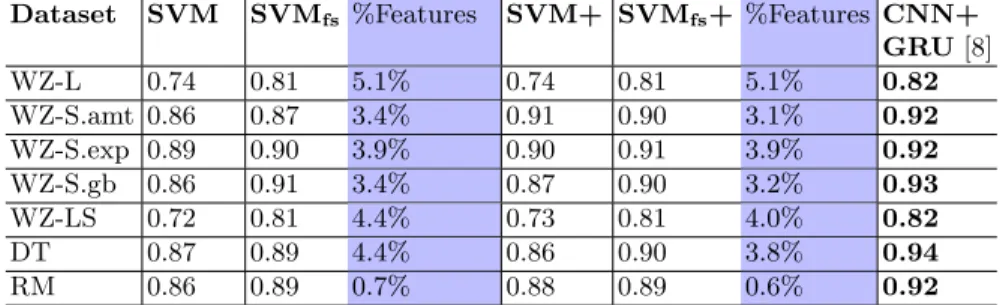
andWZ-S.expcontain the same set of some 6k Tweets annotated for the same classes by different groups of people [6];WZ-S.gb merges S.amt and WZ-S.exp [3]; WZ-LS merges WZ-L and WZ-S.exp [4]; DT [2] and RM [8] each contains some 24k and 2k Tweets classified into hate or non-hate. We also use the CNN+GRU deep learning model described in [8] as state-of-the-art reference. For each dataset, we split it into 75:25 to use 75% for parameter tuning using 5-fold cross-validation experiments, and test the optimised model on the 25% held-out data. We report our results using in micro F1 in Table 1.
Dataset SVM SVMfs %Features SVM+ SVMfs+ %Features CNN+
GRU[8] WZ-L 0.74 0.81 5.1% 0.74 0.81 5.1% 0.82 WZ-S.amt 0.86 0.87 3.4% 0.91 0.90 3.1% 0.92 WZ-S.exp 0.89 0.90 3.9% 0.90 0.91 3.9% 0.92 WZ-S.gb 0.86 0.91 3.4% 0.87 0.90 3.2% 0.93 WZ-LS 0.72 0.81 4.4% 0.73 0.81 4.0% 0.82 DT 0.87 0.89 4.4% 0.86 0.90 3.8% 0.94 RM 0.86 0.89 0.7% 0.88 0.89 0.6% 0.92 Table 1. Comparing micro-F1 on the different models (best figures in bold). The shaded columns show the percentage of features retained after feature selection
.
Table 1 shows that, comparing SVMfs against SVM, or SVMfs+ against SVM+, clearly feature selection can further enhance the performance of the linear SVM classifier on this task. Sometimes the improvement due to feature selection can be quite significant (e.g., WZ-LS). Although none of the SVM based classifiers can outperform the CNN+GRU model, on the WZ-L, WZ-S.exp and
3
http://scikit-learn.org/stable/modules/generated/sklearn.feature_ selection.SelectFromModel.html
WZ-LS datasets, the feature selected models can get very close to state-of-the-art performance. Table 1 also shows that after applying feature selection, the majority of both the Original and Enhanced features are discarded. In some cases (e.g., RM), the reduction is quite extreme. This has however, improved classification accuracy. Further analysis shows that, out of the Original feature set, features such as #mentions, #hashtags, FRE, and FKGL are completely discarded on all datasets. Word and PoS n-grams are the most predictive fea-tures as they are selected on all datasets. Other feature types appear to be only useful on isolated cases (i.e., 1 or 2 datasets). Similar situation is found for the Enhanced feature set, with only 2 out of the 5 added feature types selected for at least one dataset. This raises a controversial question that is whether the practice of feature engineering found to be fundamental to classic methods is really worthwhile. As it appears that with generic features such as word and PoS n-grams combined with feature selection, the systems can even outperform using a sophisticated sets of unselectd features.
5
Conclusion
This work studied the effect of feature selection on the task of hate speech detection from Twitter. We have shown feature selection to be a very powerful technique as it is able to select a very small set of the most predictive features that are often generic and widely used in many other language-related tasks, to achieve much better results than models using carefully engineered features. In future, we will analyse the effect of feature selection in other tasks.
References
1. P. Burnap and M. L. Williams. Cyber hate speech on twitter: An application of machine classification and statistical modeling for policy and decision making.
Policy and Internet, 7(2):223–242, 2015.
2. T. Davidson, D. Warmsley, M. Macy, and I. Weber. Automated hate speech detec-tion and the problem of offensive language. InProc. of ICWSM’17, 2017.
3. B. Gamb¨ack and U. K. Sikdar. Using convolutional neural networks to classify hate-speech. InProc. of the Abusive Language Online Workshop, pages 85–90, 2017. 4. J. H. Park and P. Fung. One-step and two-step classification for abusive language
detection on twitter. InALW1: 1st Workshop on Abusive Language Online, 2017. 5. A. Schmidt and M. Wiegand. A survey on hate speech detection using natural
language processing. InProc. of the Workshop on Natural Language Processing for Social Media, pages 1–10. Association for Computational Linguistics, 2017. 6. Z. Waseem. Are you a racist or am i seeing things? annotator influence on hate
speech detection on twitter. InProc. of the Workshop on NLP and Computational Social Science, pages 138–142. Association for Computational Linguistics, 2016. 7. Z. Waseem and D. Hovy. Hateful symbols or hateful people? predictive features
for hate speech detection on twitter. In Proc. of the NAACL Student Research Workshop, pages 88–93. Association for Computational Linguistics, 2016.
8. Z. Zhang, D. Robinson, and J. Tepper. Detecting Hate Speech on Twitter Using a Convolution-GRU Based Deep Neural Network. InProc. of ESWC’18, 2018.