Technical Efficiency Effects of Technological Change:
Another Perspective on GM Crops
Robert D. Weaver, Jarmila Curtiss, Bernhard Brümmer*
* Respectively, Professor at Pennsylvania State University, USA, Research Fellow at the
Institute of Agricultural Development in Central and Eastern Europe, Halle, Germany, and
Assistant Professor at Institute of Agricultural Economics, George August Universität
Göttingen, Germany.
Corresponding author:
Robert D. Weaver
207D Armsby Building
University Park, PA 16802
(O) 814-863-8632(F) 814-865-3746
Pennsylvania State University
[email protected]
Paper prepared for presentation at the 11th Congress of the EAAE
(European Association of Agricultural Economists),
‘The Future of Rural Europe in the Global Agri-Food System’, Copenhagen, Denmark,
August 24-27, 2005
Copyright 2005 by Robert D. Weaver, Jarmila Curtiss and Bernhard Brümmer. All
rights reserved. Readers may make verbatim copies of this document for non-commercial
purposes by any means, provided that this copyright notice appears on all such copies.
TECHNICAL EFFICIENCY AND DRASTIC TECHNOLOGICAL
CHANGE FROM GENETICALLY MODIFIED CROPS
Robert D. Weaver, Jarmila Curtiss, Bernhard Brümmer
Abstract
An important approach to reducing persistent technical inefficiency is through technical
change. This paper considers the case of genetically modified crop production. A stochastic
frontier approach is used to examine how a drastic change from non-GM to GM technology
effects the position of the production frontier as well as the extent and nature of technical
inefficiency. A one-step method is applied to consider firm-level effects on technical
inefficiency. Using soybean production from the U.S. we find that GM technology improves
productivity and reduces technical inefficiency though these effects vary across farm
characteristics.
Keywords: Technical efficiency, technical change, genetically-modified, soybean
JEL Classification: D24, O33
TECHNICAL EFFICIENCY AND DRASTIC TECHNOLOGICAL
CHANGE FROM GENETICALLY MODIFIED CROPS
A general problem in the economics of innovation is the assessment of change in inefficiency associated with a new technology. If technical inefficiency is viewed as a result of persistent management error that reflects intrinsic characteristics of a technology, then a change from one technology to another may involve a change in that inherent technical inefficiency. The coincident effects of technical change and technical efficiency has been pursued by an extensive literature within the context of continuous technical change processes using panel data sets most often reporting annual observations. Within this context, authors have attempted to sort out technical efficiency change vs. measures of technical change based on total factor productivity, see e.g. Coelli et al. (2003), following the standard decomposition for the Malmquist index. However, as Desli et al. (2002) remind us, joint consideration of time varying technical change and technical efficiency in a dynamic extension of stochastic frontier approaches can not identify systematic time-related components of both, leaving the problem of empirically measuring dynamic adjustment in productivity and technical efficiency unresolved in the absence of further structural specification. As one approach, Desli et al. (2002) introduce an autoregressive restriction on the evolution of a time dependent intercept.
Less attention has been paid to the case of drastic technical change associated with a new technology that poses an alternative to a long established technology. Clearly, when technical inefficiency is persistent, reduction of inefficiency offered by an alternative technology constitutes an important benefit of that technology that is likely to be an important target of innovation and determinant of adoption decisions. Consider the case of genetically modified crops that offer a new technology that fundamentally changes production practices including use of private good, continuous inputs as well as damage control inputs, as well as jointly produced adverse environmental effects. In this case, GM technologies have been widely adopted, though not universally. Importantly, adoption has proceeded despite an absence of consensus with respect to whether GM crops result in higher yields, lower costs, or increased profits. Nonetheless, as will be noted, GM crops offer substantial change in the feasibility of managing the production process, and in so doing, may offer a reduction in technical inefficiency.
Past literature considering comparison of discrete technologies in the agricultural sector has been limited in focus. Extensive literature has considered how managerial organization affects technical efficiency, most recently in transition countries, see e.g. Sarris et al. (1999) or Kong et al. (1999). A decade ago, the Green Revolution sparked interest in assessment of the technical efficiency implications of High Yielding Varieties (HYV) though these studies took a panel approach; see e.g. Coelli et al. (2003). Lansink et al. (2002) used DEA methods to measure technical efficiency differences between organic and conventional farm technologies in Finland.
This paper considers the case of GM technology and presents estimates of the change in technical inefficiency inherent between GM and conventional, or non-GM technology. Although several methods are available to measure inefficiency, our focus in this paper is on the stochastic frontier (SF) methodology developed by Aigner et al. (1977) and Meeusen and van den Broeck (1977). The paper uses the stochastic frontier approach to evaluate the extent of difference between the frontiers associated with an old and new technology. Estimates of change in technical efficiency are motivated and presented. For an application, the paper analyzes the efficiency of soybean production with respect to grain output differences for operations using genetically modified (GM) versus those using non-GM herbicide resistant seed. A shift to GM technology has been argued by physical scientists to result in changes in private good input and output flows, as well as changes in environmental effects. Thus, the technical change may influence both technical and environmental efficiency. Here, we limit our focus to private effects.
Two types of genetically modified (GM) crop varieties have emerged: those with pesticide activity and those are tolerant of chemical pesticides. Two general conclusions can be drawn from both physical science and economic studies of these new technologies. First, GM varieties constitute a technology with performance that is strongly conditional on local conditions. This implies GM varieties are not, in general, universally dominant technologies, but instead are, generally locally dominant, if dominant at all. That is, in general, the private incentive for adoption of these technologies varies substantially across agents and the characteristics of their production operation. This characteristic implies that GM varieties will not be result in complete adoption under full information. However, at an agent level, this implies that the dominance or performance of the technology is uncertain, and that uncertainty can not easily be resolved through observation of its performance on other farms. Thus, this local conditionality of performance of GM varieties motivates interest in the function and role of learning in the performance of the technology.
Second, GM varieties constitute a complex technology that involves substantial changes in a series of production practices and input use mixes. For example, in the case of herbicide tolerance, changes in tillage, pest treatment, planting density, and intertemporal crop patterns (rotations) are introduced by GM varieties. In contrast to the green revolution varieties that introduced a simple fertility augmenting change in productivity, the complexity of GM variety technology accentuates uncertainty concerning performance and the need for learning. Together, these two characteristics of GM technology suggest that initially GM technology may be expected in a change in technical efficiency and that the extent of technical efficiency will depend on the state of learning characterizing the agent. In the longer-term, in a state of complete information, it is of interest to ask whether GM varieties offer reduction in technical inefficiency. Their contribution to productivity has been considered in depth by physical science in experimental settings, and by economists based on observed production data.
The changes in practice associated with herbicide tolerant soybeans provide an illustration of the complexity of these technologies. First introduced in the 1970s as a pre-planting herbicide that killed most emerged plant life in a field, Roundup was widely used even before Roundup Ready soybeans were introduced in 1996. Following introduction Roundup Ready soybeans, the mix of both pre- and post-emergence herbicides has changed dramatically, see USDA/NASS (1991-1999). From an economic perspective, Roundup Ready soybeans offered significant cost reductions for many producers, Rawlinson and Martin (1998). However, those cost reductions were found to be sensitive to application conditions due to the rapid dissipation of Roundup as well as the intensity of Roundup tolerant weeds present. Further, past studies have documented that performance of this GM crop is conditional on other changes in production practices, e.g. no-till planting, pre-emergence herbicide use, change in the type of active ingredients used, and timing of operations. Benbrook (2001) presented evidence that suggests that herbicide-tolerant varieties have slightly reduced the average number of active ingredients used per acre while increasing the average pounds applied per acre. Carpenter and Gianessi reviewed these shifts in practices citing in particular the role of GMO soybeans as a natural extension of an evolution toward increased use of post emergence herbicides, simplification of weed control programs, and improved effectiveness of active ingredient application; see e.g. Pike et al. (1991). Importantly, this shift in practice had substantial implications for tillage practices that had focused on field preparation, and post emergence tillage. Given post emergence herbicides, adoption of conservation tillage was facilitated, leading to over 50% adoption by 1998, see Kapusta and Krausz (1993) and Conservation Tillage Information Center (1999). This shift was further extended by introduction of herbicide tolerant soybeans that allow post emergence, broad spectrum herbicide application at nearly any stage of plant growth. Second, improved post emergence herbicides have allowed for a reduction in row spacing, significantly reducing cultivation, improved weed control due to canopy closure, and increasing land area yield.
The key innovation offered by GMO soybeans is the reduction of crop damage (e.g. stunting, delayed canopy closure) from herbicide application, see Padgette et al. (1996) and increased effectiveness of weed kill, see Rawlinson and Martin (1998). This latter effect follows directly from tolerance that allows effective dosage to be determined with consideration of crop damage relaxing
3
constraints in conventional systems with respect to timing (early in weed emergence). Studying non-experimental data, Bullock and Nitsi (2000) found that the potential of GMOs varied with the extent of pest exposure and the type of pest control practices used. Ervin et al. (2000) provide a thorough review of the both private and public effects of transgenic crops that highlights the role of heterogeneity across of agents.
Yield impact of GM herbicide tolerant alternatives has also been debated since yields depend on weed control as well as the extent of adaptation of conventional varieties. In sum, these studies have found no striking difference in yields that can not be unequivocally assigned to weed control differences, or plant growth or damage effects from application methods. Fernandez-Cornejo and McBride (2000) studied the private farm-level impacts of transgenic crops for the period 1996-98 focusing on yields, pest management, and net returns. They found that use of ht cotton led to significant yield and net return increases, though no significant herbicide use changes. Alternatively, for ht soy they found small increases in yield, no change in net returns, and significant decreases in herbicide use. However, their results varied substantially across farms and regions. In general, the yield impact of transgenic soy has been found to depend on weed control as well as the extent of adaptation of conventional varieties. Past studies have not found a striking difference in yields that can not be unequivocally assigned to weed control differences, or plant growth or damage effects from application methods.
In addition to changes in input mix or management practice, the incomplete knowledge of private and public effects of transgenics results in uncertainty concerning efficient input combinations, performance of the crop, costs, and revenues. Although evidence from analysis of farm-level experience is not available, the flexibility in timing of use of herbicides and of field practices for ht soy would suggest efficiency gains could be realized compared to conventional practices for soy. In the absence of a consensus understanding of the technology, it is likely that efficiency of input use is compromised for transgenics. The extent of this complexity and of uncertainty with respect to performance is apparent in the results of studies of adoption of GM crops. Clark (1999) cites a series of reasons why farms adopt GM crops and argues that an important reason is how GM practices alter pest control systems and, more generally, how they affect flexibility of timing of field operations. With respect to learning, Alexander et al. (2002) present survey results that show that farms with high total gross farm income and high education are more likely to adopt GM crops. Cameron (1999) found evidence of a role of accumulated knowledge of the performance of the GM crop that is consistent with learning theory.
Drastic technological change and change in efficiency
The fact that a change in technology may result in change in the equilibrium level of technical efficiency has been noted by past literature that cites technical inefficiency of existing technologies as a motivation for innovation and adoption of innovations, see Kalirajan (1991). Intuitively, if technical inefficiency is recognized by a firm, it may have incentive to seek innovations and new technologies that reduce the cost and productivity losses of such inefficiency. A series of authors have recognized the link between use of information technologies and productivity, see e.g. Siegel and Griliches (1992); Siegel (1997); Lehr and Lichtenberg (1998). Others have noted the important role of flexibility of technologies, see e.g. Power (1998) or Breznahan and Trajtenberg (1995). The conditionality of technical efficiency on the extent of learning has also been documented by past results, e.g. see Fane (1975) or Ajibefun et al. (1996). Most recently, Coelli et al. (2003) analyzed technical efficiency of high yielding varieties and considered the long recognized role of learning and information as a determinant of technical efficiency. Using a two-step method, they found a strong relationship between information dissemination (via extension effort) and technical efficiency.
Two issues are raised by the possibility that a change in technology will induce a change in technical efficiency. First, measurement of the difference in technical efficiency of each technology would be of interest. Using experimental data where full information concerning implementation of the technology could be assumed, differences in technical efficiency could be interpretable as intrinsic and would be of interest to estimate for old and new technologies. Given such measures, the relative efficiency of the two technologies could be compared. However, in a field setting, where the technology’s productivity is uncertain and conditional on available information that varies across agents, observed technical efficiency will be conditional on the state of learning by the agents observed. Thus, the role of learning in determining the extent of technical efficiency would be of interest to quantify. Based on this type of result, intrinsic differences in technical efficiency might be estimated from observed field data.
In this paper, we focus on estimating technical efficiency of each technology. Using nonparametric methods, this would involve computation of efficiency based on a set of firms using each technology and comparing technical efficiency. In this paper, we choose to use the stochastic frontier method. Explanation of the differences in technical efficiency observed across a set of firms has been pursued by a substantial literature using stochastic frontier models. Two approaches have been pursued. In a two-step method, first technical efficiency estimates are computed based on an SFA specification of a production function. In a separate step, these estimates are regressed on hypothesized determinants. In the one step method, the explanation of technical inefficiency is incorporated in the specification of the distribution of the asymmetric component of stochastic error.
The two-step estimation has seen continued use, see e.g. Stefanou and Ueda (2002) or Coelli et al. (2003). However, Wang and Schmidt (2002) argue that the two-step procedure might lead to severely biased estimates of the technical efficiency effects. Further, the inconsistency between the distributional assumptions made in the two stages have been cited. As noted, the one stage approach reduces the omitted variable problem inherent to the two-stage estimation. In the literature, two different approaches to one-step estimation have been proposed: Battese and Coelli (1995) addressed these concerns with a one-stage approach where technical inefficiency effects are explicitly expressed as a function of a vector of firm-specific variables and random error and enter as shifters in the distribution of the systematic error in the stochastic frontier model. Caudill et al. (1995) developed – albeit under a heteroskedasticity motivation – an approach, which also fulfills the scaling property (Wang and Schmidt). In this model, the inefficiency effects affect the variance parameter of the systematic error, thereby also the expected inefficiency. As in any case where both the conditional mean and error structure is the subject of modeling, the motivation for distinct roles for explanatory variables in either component of the model may be weak.
In this paper, we implement the one-stage estimation procedure of the stochastic frontier production model as proposed by Caudill et al. (see also Brümmer and Loy, 2000). For each of two discrete technologies we suppose the following model:
it it t it it
f
x
v
u
y
=
(
;
β
)
+
−
, i = 1,2,…, N and t = 1,2. (1) where vit ~ i.i.d. (0,σ 2vt ) independent of the uit, uit≥ 0 and uit ~ N(0 , σ
2 uit) + and
)
exp(
it t uitz
δ
σ
=
(2)where yit is the output for the i–th firm using the t-th technology; xitdenotes a (k×1) vector of values of
5
(p×1) vector of firm-and technology specific variables hypothesized to shift the average technical
inefficiency, and δ is an (1×p) vector of parameters. Of particular interest is examination of empirical
evidence concerning the following set of hypotheses, i.e., if all farms face the same technology:
β
t=
β
,
δ
t= 0
,
δ
t=
δ
,
,
σ
2vt= ,
σ
2v,
∀
t
(3)Based on this notation, we define technical efficiency for the i-th firm with technology t as:
)
exp(
itit
u
TE
=
−
(4)Application
As a case for study, we consider soybean production data for Pennsylvania collected for the year 1999 through an on-farm survey as part of the 1999 Agricultural Resource Management Survey implemented by the National Agricultural Statistics Service of U.S.D.A. The survey provides data that describe production practices, inputs, and outputs for soybeans including: acreage planted, the use of damage control inputs (pesticides and fertilizers), land use practices, environmental management practices, and the use of genetically modified seeds. This sample consists of n = 125 observations. The data set provides a variety of continous, polychotomous, and binary indicators and measures of the production process, inputs, and output. Table 1 presents the list of variables included in our model of production, as well as descriptive statistics. We specify the production function in Equation (1) in translog form as follows:
(
)
∑∑
∑∑
(
)(
)
∑
+∑
+ + + + = m j n k ki ki ni ni nk ji mi mj ni ni m n n mi m i x r z x x r z r z Y β α β α β 2 1 2 1 ln 0(
)
i i i m n ni ni mi mnx r z + p +v −u +∑∑
1 2 1 ω θ (5)where the distributions of vi and uiare defined above in Equation (2), the subscript t is suppressed, and
ti t t ui =
δ
+∑
δ
sσ
0 (6)where si are variables which may influence the efficiency of a firm. The likelihood function for this
model is (subscripts for the technology t are suppressed on the parameters):
} ln 2 {ln ) 2 / 1 ( ) ; ( * n1 it2 i Ti y L π =−
∑
= π + σ∑∑
{
(
)
}
= = − − N i T t it it it i x y 1 1 2 2 / 2 1 β σ∑∑
{
(
}
= = − Φ − N i T t it i d 1 1 ln)
(7) where T = 2 and(
β)
σ λ it it i i it y x d = −v u it it σ σ λ =
[
]
2 1 2 2 it u v it σ σ σ = +(
,'
,'
,'
,'
,'
,
)
'
i u vσ
σ
δ
θ
ω
β
α
λ
=
We proceed by estimating the parameters of the frontier production function and the inefficiency model by maximization of this likelihood function. Based on the parameter estimates, we first examine restrictions on the model, before individual farm technical efficiencies are computed and reported. In order to examine the specification, we consider functional form, existence of a stochastic, asymmetric error interpretable as technical inefficiency, existence of a common frontier across firms, and the effect of GM technology on the conditional mean of technical inefficiency.
Results
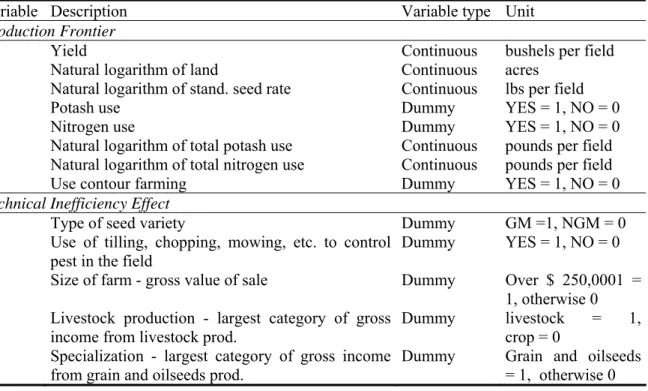
Before interpreting these estimates in more detail, it is important to note the characteristics of the data as well as results for specification tests. Table 1 clarifies the properties of the data. In many cases, discrete or polychotomous variables were involved as noted.
Table 1. Variable Definitions
Variable Description Variable type Unit
Production Frontier
y Yield Continuous bushels per field
x1 Natural logarithm of land Continuous acres
x2 Natural logarithm of stand. seed rate Continuous lbs per field
r1 Potash use Dummy YES = 1, NO = 0
r2 Nitrogen use Dummy YES = 1, NO = 0
z1 Natural logarithm of total potash use Continuous pounds per field
z2 Natural logarithm of total nitrogen use Continuous pounds per field
p Use contour farming Dummy YES = 1, NO = 0
Technical Inefficiency Effect
s1 Type of seed variety Dummy GM =1, NGM = 0
s2 Use of tilling, chopping, mowing, etc. to control
pest in the field
Dummy YES = 1, NO = 0
s3 Size of farm - gross value of sale Dummy Over $ 250,0001 =
1, otherwise 0
s4 Livestock production - largest category of gross
income from livestock prod.
Dummy livestock = 1,
crop = 0
s5 Specialization - largest category of gross income
from grain and oilseeds prod. Dummy Grain and oilseeds = 1, otherwise 0
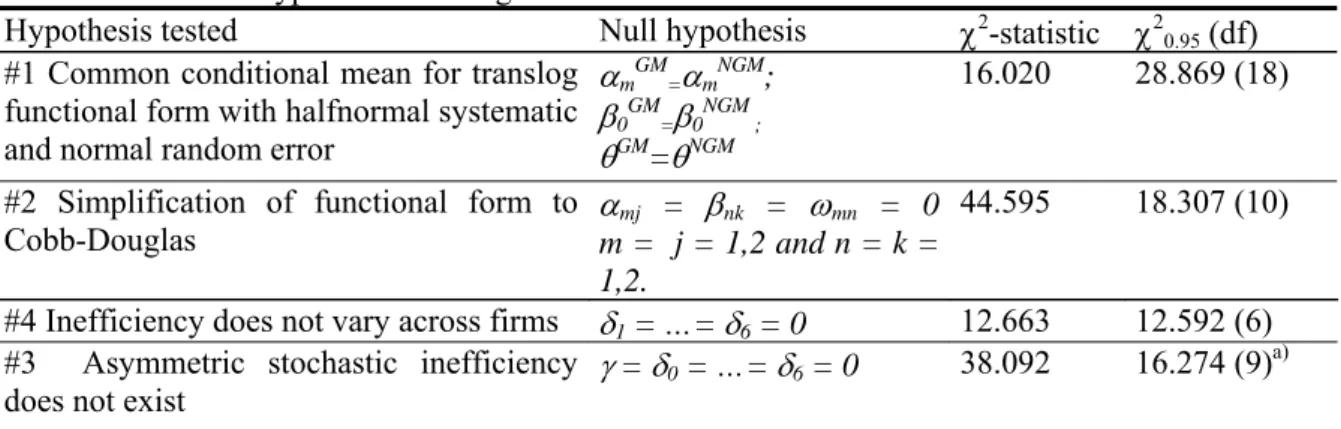
Table 2 presents results of a set of independent specification tests. To examine the nature of differences between the two technologies, we examine differences in the estimated conditional mean as well as in our estimated parameterization of the error structure. First, we examine evidence that would support a common conditional mean across GM and non-GM sub-samples. We test this pooling hypothesis using the translog production frontier model with a half-normal systematic and normal random error, thus without the technology and firm specific effects in the error term. Results indicate the restriction of a common conditional mean across a pooled sample could not be rejected (see Test #1 in Table 2). This result suggests that a gain in the efficiency of estimates can be attained by restricting the parameterization of the conditional mean to a common form across the GM and non-GM sub-samples. In the second test, we examine evidence that supports simplification of the
7
functional form of the pooled model to a Cobb-Douglas. Our data supports rejection of this hypothesis, implying that production elasticities vary over the surface of the production possibilities set. Conditional on a pooled model, we also examine evidence of the structure of the technical inefficiency. First, in test #3 in Table 2, we find that the hypothesis that the stochastic error is symmetric and invariant across firms can be strongly rejected. Next, in test #4 in Table 2, we examine and reject the hypothesis that technical inefficiency does not vary across firms. Based on these specification tests, we choose to proceed with the translog parameterization of the production function allowing for an unrestricted conditional mean and error structure.
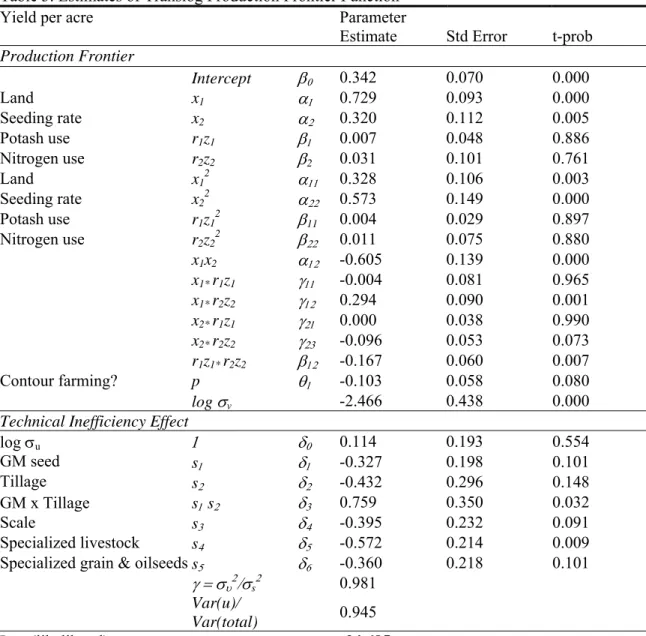
Estimates based on a pooled sample GM and non-GM data are reported in Table 3. In Table 3, we see that the first-order effects are statistically significant, except for potash use. Also, numerous second-order effects are statistically significant, which underlines the tested significance of the group of parameters for nitrogen and potash use. We further examine the shift of intercept due to the use of contour farming as it can proxy the terrain slope and thus the differences in production conditions. The negative parameter sign for contour farming suggests lesser production potential likely due to inferior production conditions on terrains where contour farming is necessary. Testing the frontier shift due to drastic technological changes by adopting GM technology was motivated, however, including the GM dummy variable in the production frontier did not prove to improve the model specification. GM technology thus does not significantly increase the maximum attainable yields.
Table 2. Results of Hypotheses Testing
Hypothesis tested Null hypothesis χ2-statistic χ2
0.95 (df)
#1 Common conditional mean for translog functional form with halfnormal systematic and normal random error
αmGM=αmNGM;
β0GM=β0NGM ;
θGM=θNGM
16.020 28.869 (18)
#2 Simplification of functional form to
Cobb-Douglas αm = j = 1,2 and n = k = mj = βnk = ωmn = 0
1,2.
44.595 18.307 (10)
#4 Inefficiency does not vary across firms δ1 = …= δ6 = 0 12.663 12.592 (6)
#3 Asymmetric stochastic inefficiency
does not exist γ = δ0 = …= δ6 = 0
38.092 16.274 (9)a)
*, **, and *** indicate the significance of the effect at the 10%, 5% and 1% significance level, respectively.
a) This statistic has a mixed χ2 distribution. This test involves one inequality restriction on γ and seven
equality restrictions on δ0 =δ1 …= δ6 = 0. The upper bounds for the mixed χ2 distribution are
employed from Table I in Kodde and Palm (1986, p. 1246).
However, as results with respect to the variance of the error structure of the model reported in the bottom portion of Table 3 show, GM technology is technically significantly more feasible. Recall the parameters in the error model indicate variation of the technical inefficiency with respect to particular characteristics of the firm. We find that use of GM seed is estimated to reduce technical inefficiency though this effect is statistically significant, the hypothesis of zero effect could be rejected at the 10% significance level. We conjecture that as 84 of the 88 GM technology users were using this technology for the first year, their management of the technology may not fully reflect intrinsic potential impacts on efficiency; still the feasibility of this technology seems already to play a role.
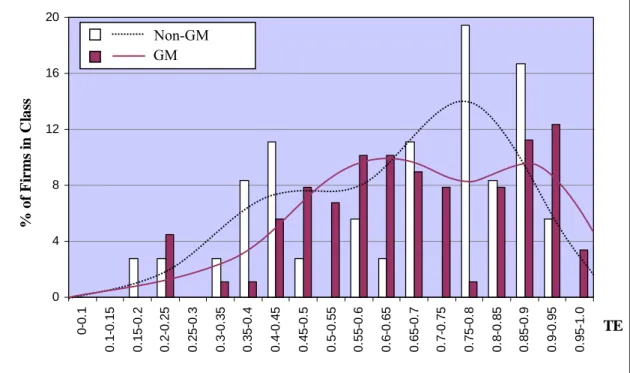
To quantify the magnitude of the effect, average technical efficiency scores in total and separately for the two technologies are reported in Table 4 and the distributions of estimated scores are graphically presented in Figures 1 and 2. On average, firms are achieving around 67 % of their production potential. The firms which adopted GM technology utilize slightly higher share, while non-GM seed users only 65 %. The difference between the producers is better demonstrated in Figure 1. Despite the fact that GM technology does not significantly shift the frontier, it is the firms using GM technology which determine the production potential.
Further results of the inefficiency effect model disclosed that tilling, chopping, moving to other discrete practices used to control pests in the field have in general a negative effect of technical inefficiency, thus positive effect on technical efficiency. However, the opposite is true for the GM technology. Tilling is a practice which decreases the performance of this technology. This finding is consistent with other above cited studies which found that performance of GM technologies is conditioned on the change of production practices, e.g. no-till planting. Next, the impacts of scale and
scope of operation on the variance of technical inefficiency are considered. Estimates of d4, d5, d6
indicate that scale and scope (gross income over 250,000 and specialization in livestock or grain and oilseed production) are highly significant. Estimates indicate that larger scale of production is related to higher technical efficiency. Furthermore, farms specializing in grain and oilseed production are in general better performing. Also specialization in livestock production, which could provide labor and allow better timing of field work, is found to have a positive effect on technically efficiency, actually higher than specialization in grain and oilseeds does.
Table 3. Estimates of Translog Production Frontier Function
Yield per acre Parameter
Estimate Std Error t-prob
Production Frontier Intercept β0 0.342 0.070 0.000 Land x1 α1 0.729 0.093 0.000 Seeding rate x2 α2 0.320 0.112 0.005 Potash use r1z1 β1 0.007 0.048 0.886 Nitrogen use r2z2 β2 0.031 0.101 0.761 Land x12 α11 0.328 0.106 0.003 Seeding rate x22 α22 0.573 0.149 0.000 Potash use r1z12 β11 0.004 0.029 0.897 Nitrogen use r2z22 β22 0.011 0.075 0.880 x1x2 α12 -0.605 0.139 0.000 x1* r1z1 γ11 -0.004 0.081 0.965 x1* r2z2 γ12 0.294 0.090 0.001 x2* r1z1 γ21 0.000 0.038 0.990 x2* r2z2 γ23 -0.096 0.053 0.073 r1z1* r2z2 β12 -0.167 0.060 0.007 Contour farming? p θ1 -0.103 0.058 0.080 log σv -2.466 0.438 0.000
Technical Inefficiency Effect
log σu 1 δ0 0.114 0.193 0.554 GM seed s1 δ1 -0.327 0.198 0.101 Tillage s2 δ2 -0.432 0.296 0.148 GM x Tillage s1 s2 δ3 0.759 0.350 0.032 Scale s3 δ4 -0.395 0.232 0.091 Specialized livestock s4 δ5 -0.572 0.214 0.009
Specialized grain & oilseeds s5 δ6 -0.360 0.218 0.101
γ = συ2/σs2 0.981
Var(u)/
Var(total) 0.945
Log (likelihood) -34.685
Table 4. Average Technical Efficiency (TE) for Firm Groups
Total GM Non-GM
9
0 4 8 12 16 20 0-0 .1 0. 1-0. 15 0. 15-0. 2 0. 2-0. 25 0. 25-0. 3 0. 3-0. 35 0. 35-0. 4 0. 4-0. 45 0. 45-0. 5 0. 5-0. 55 0. 55-0. 6 0. 6-0. 65 0. 65-0. 7 0. 7-0. 75 0. 75-0. 8 0. 8-0. 85 0. 85-0. 9 0. 9-0. 95 0. 95-1. 0 TE % of F ir m s i n C las s Non-GM GM GM Non-GM
Figure 1. Sample Distribution of Estimated Technical Efficiency Scores
Table 5 presents the partial production elasticities with respect to each input variable and also presents estimated scale elasticities. We present results for elasticities based on approximation around the geometric mean. The scale elasticity is computed as the sum of the partial output elasticity with respect to each input. In the mean of the sample, the estimated partial output elasticity is non-negative with respect to each input, but significantly only for land and standardized seed rate. For the group of fertilizer users, the partial production elasticity with respect to potash and nitrogen are negative. This is consistent with a violation of monotonicity as is expected for this type of input at particular ranges of use. The results are consistent with the interpretation that firms in the sample are on average within a range where further increase in potash and nitrogen would reduce output. The mean of estimated
scale elasticities are very close to one, consistent with constant returns-to-scale.
Table 5. Mean Production and Scale Elasticities
Approximation to mean
Mean elasticity Stand. dev.
Land 0.729 0.093
Standardized seed rate 0.320 0.112
Total potash use 0.007 0.048
- For users of potash -0.069 0.071
Total nitrogen use 0.031 0.101
- For users of nitrogen -0.253 0.112
Scale 1.087 0.071
Conclusions
Results presented a case to illustrate that in addition to a shift in the conditional mean of output, or yield, a change in technology may result in a change in technical efficiency. In this case, GM technology is found to reduce technical inefficiency. Given that many of the inputs involved in soybean production contribute to negative environmental impacts, these results suggest one aspect of
the environmental impacts of GM technologies may follow from the indirect effect associated with a change in technical efficiency.
The implications of a shift to GM technology for technical efficiency have been considered from a number of perspectives. Result s presented here suggest that technical efficiency may play a role in providing an incentive for adoption of GM technologies. While it is often the case that new technologies offer a strong incentive for adoption through increased productivity and private net benefit flow, it is also the case that the advantages offered by some new technologies are primarily reduction in inefficiency. Further, it is most often that new technologies involve a change in complexity of operations that requires management to invest in learning, new equipment, or new materials use. In this paper, we consider an example of such a technology. While data limitations restricted our ability to consider the full range of differences across GM and conventional technology, our results provide new insight into the role that technical efficiency can play in producer adoption of new technologies. Further, results suggest that the implications of such a change in technical efficiency may extend to include environmental and other public effects.
References
Aigner, D. J., Lovell, C. A. K. and Schmidt, P. (1977). Formulation and Estimation of Stochastic Frontier Production Function Models. Journal of Econometrics 6: 21-37.
Ajibefun, I.A., Battese, G.E. and Daramola. A.G. (1996). Investigation of Factors Influencing the Technical Efficiencies of Smallholder Croppers in Nigeria. Centre for Efficiency and Productivity Analysis (CEPA) Working Papers, No. 10/96, Department of Econometrics, University of New England, Armidale.
Alexander, C., J. Fernandez-Cornejo, and Goodhue R.E. (2002). Determinants of GMO use: a survey of Iowa maize-soybean farmers’ acreage allocation. In Santaniello, V., Evenson, R.E. and Zilberman, D. (eds), Market Development for Genetically Modified Foods. CABI
publishing, New York, NY.
Battese, G. E. and Coelli, T. J. (1992). Frontier Production Functions, Technical Efficiency and Panel Data: With Application to Paddy Farmers in India. Journal of Productivity Analysis 3:1/2: 153-69.
Battese, G. and Coelli, T. J. (1995). A Model for Technical Inefficiency Effects in a Stochastic Frontier Production Function and Panel Data. Empirical Economics 20: 325-332. Benbrook, C.M. (2001). Do GM crops mean less pesticide use? Pesticide Outlook: 204-207. Bresnahan, T. and Trajtenberg, M. (1995). General Purpose Technologies: Engines of Growth?
Journal of Econometrics 65: 83-108.
Brümmer, B. and Loy J.-P. (2000). The Technical Efficieny Impact of Farm Credit Programs: A Case Study of Northern Germany. Journal of Agricultural Economics 51 (3): 405–418.
Bullock, D. S., and Nitsi., E. I. (2001). Roundup Ready soybean technology and farm production costs: measuring the incentive to adopt. American Behavioral Scientist 44: 1283-1301. Cameron, L.A. (1999). The importance of learning in the adoption of high-yielding variety seeds.
American Journal of Agricultural Economics 81: 83-94.
Carpenter J. and Gianessi L. (1999). Herbicide tolerant soybeans: Why growers are adopting Roundup Ready varieties. AgBioForum, 2(2): 65-72; http://www.agbioforum.org
11
Caudill, S.B., Ford, J.M. and Gropper D. M. (1995). Frontier Estimation and Firm-Specific Inefficiency Measures in the Presence of Heteroskedasticity. Journal of Business and Economic Statistics 13 (1): 105–111.
Clark, E.A. (1999). Ten reasons why farmers should think twice before growing GE crops”, Plant Agriculture, University of Guelph;
http://www.plant.uoguelph.ca/faculty/eclark/10reasons.html.
Coelli, T., Sanzidur, R. and Colin, T. (2003). U Queensland; U Manchester; Imperial College London. Journal-of-International-Development 15(3): 321-33.
Coelli, T. and Battese. G. E. (1996). Identification of Factors Which Influence the Technical Inefficiency of Indian Farmers. Australian Journal of Agricultural Economics 40(2): 103-128.
Conservation Tillage Information Center. (1999). Conservation tillage survey data. Retrieved June 4, 1999 from the World Wide Web: http://www.ctic.purdue.edu/Core4/ConsTillage.html. Desli, E., Ray, S. and Kumbhakar. S. (2002). A Dynamic Stochastic Frontier Production Model with
Time-Varying Efficiency. Working Paper 2003-15.
Dosi, G. (1988). Sources, Procedures, and Microeconomic Effects of Innovation. Journal of Economic Literature 26: 1120-1171.
Ervin, D., Batie, S., Welsh, R. Carpentier, C., Fern, J., Richman, N. and Schulz, M. (2000). Transgenic Crops - An Environmental Assessment. Policy Studies Report. Wallace Center for
Agricultural and Environmental Policy. Winrock International.
Fane, G. (1975). Education and the Managerial Efficiency of Farmers. The Review of Economics and Statistics 57(4): 452-461.
Fernandez-Cornejo, J., Klotz-Ingram, C. and Jans, S. (2000). Farm-level effects of adopting
genetically engineered crops in the U.S.A. Proceeding of NE-165 Conference, June 24-25, 1999, Washington DC: 57-74.
Fernandez-Cornejo, J. and McBride (2000). Adoption of Bioengineered Crops. AER-810. Economic Research Service. U.S.D.A.
Fine, C. and Freund, R. (1990). Optimal Investment in Product-Flexible Manufacturing Capacity. Management Science 36(4): 449-466.
Kapusta, G. and Krausz, R.F. (1993). Weed control and yield are equal in conventional, reduced-, and no-tillage soybean (Glycine max) after 11 years. Weed Technology 7(2): 443-451.
Kodde, D.A. and Palm, F.C. (1986). Wald Criteria for Jointly Testing Equality and Inequality Restrictions. Econometrica 54: 1243-1248.
Kong, X., Marks, R. E. and Wan, G. H. (1999). Technical Efficiency, Technological Change and Total Factor Productivity Growth in Chinese State-Owned Enterprises in the Early 1990s. Asian Economic Journal 13 (3): 267-282.
Lansink, A., Pietola, K. and Bäckman, S. (2002). Efficiency and productivity of conventional and organic farms in Finland 1994–1997. European Review of Agricultural Economics 29: 51-65.
Lehr, W. and Lichtenberg, F. (1998). Computer Use and Productivity Growth in US Federal Government Agencies, 1987-92. The Journal of Industrial Economics 46 (2): 257-279. Meeusen, W., and van den Broeck, J. (1977). Efficiency Estimation from Cobb-DouglasProduction
Functions with Composed Error. International Economic Review 18 (2): 435-444.
Padgette, S.R., Re, D.B., Barry, G.F., Eichholtz, D.E., Delannay, X., Fuchs, R.L., Kishore, G.M. and Fraley, R.T. (1996). New weed control opportunities: Development of soybeans with a Roundup Ready gene. In Duke, S.O. (eds), Herbicide-Resistant Crops. Boca Raton: CRC Press, 53-84.
Pike, D.R., McGlamery, M.D., and Knake E.L. (1991). A case study of herbicide use. Weed Technology 5(3): 639-646.
Rawlinson, J. and Martin, A. (1998). Weed management strategies in soybeans. Unpublished manuscript, University of Nebraska at Lincoln.
Sarris, A.H., Doucha, T. and Mathijs, E. (1999). Agricultural restructuring in central and eastern Europe: implications for competitiveness and rural development. European Review of Agricultural Economics 26: 305-329.
Siegel, D. (1997). The Impact of Computers on Manufacturing Productivity Growth: A Multiple-indicators Multiple-causes Approach. Review of Economics and Statistics 79: 68-78. Siegel, D. and Griliches, Z. (1992). Purchased Services, Outsourcing, Computers, and Productivity in
Manufacturing”, in Griliches, Z. (eds), Output Measurement in the Service Sectors. Chicago: Chicago University Press, 429-458.
Stefanou, S. and Ueda, T. (2002). From Whom Do Farmers Learn? An Analysis of Technical Efficiency Determinants for the Indian Green Revolution. Presented at Asia Conference on Efficiency and Productivity Growth. July 19-20, 2002 Academic Activity Center,
Academia Sinica http://www.sinica.edu.tw/~teps/A3-2.pdf.
Wang, H.-J. and Schmidt P. (2002). One-Step and Two-Step Estimation of the Effects of Exogenous Variables on Technical Efficiency Levels. Journal of Productivity Analysis 18: 129-144.