Mohammed A. Saleh1*, Habibah Hashim1, Nur Nabila Mohamed1, Ali Abd Almisreb2, Benjamin Durakovic2
1
Faculty of Electrical Engineering, Universiti Teknology MARA (UiTM),40450 Shah Alam, Selangor, Malaysia
2
Faculty of Engineering and Natural Science, International University of Sarajevo, Sarajevo, Bosnia, and Herzegovina
ABSTRACT
In accordance with the advancement in robotics and the scholarly literature, the extents of utilizing robots for autistic children are widened and could be a promising method for individual with Autism Spectrum Disorder (ASD) treatments, where the different form of robot (humanoid, non-humanoid, animal-like, toy, and kits) can be employed effectively as a support tool to augment the learning skills and rehabilitate of the individual with Autism Spectrum Disorder (ASD). Thus, the robots were exploited for ASD children in different aspects namely; modelling, teaching, and skills practicing; testing, highlighting and evaluating; providing feedback or encouragement; join Attention; eliciting social behaviours; emotion recognition and expression; imitation; vocalization; turn-taking; and diagnostic. The related literature published recently in journals and conferences is taken into account. In this paper, we review the use of robots that help in the therapy of individuals with Autism Spectrum Disorder (ASD). The articles on using robots for autistic children rehabilitation and education which reported results of experiments on a number of participants were implicated. After looking in digital libraries under this criteria, and excluding non-related, and duplicated studies, 39 studies have been found. The findings were focused mainly on the social communication skills of autistic children and how the extent of the robots mitigate their stereotyped behaviours. Deeper research is required in this area to cover all applications of robotic on autistic children in order to design feasible and low-cost robots that ensure provide high validity.
Keywords: ASD rehabilitation, Autistic children, Autism therapy, Robotic treatment, Social robot
Corresponding Author: Mohammed A. Saleh
Faculty of Electrical Engineering, Universiti Teknology MARA (UiTM) 40450 Shah Alam, Selangor, Malaysia
E-mail: [email protected]
1. Introduction
The widespread of robots’ utilization, especially in the diagnosis and treatment area, open a huge gate for the invention to mitigate the effects of those who are afflicted with serious disabilities. Autism Spectrum Disorders (ASD) considered one of the serious disabilities, where is a neurological disorder that causes difficulties in social communication, social interaction, abnormal behavior, and interests [1][2]. ADS affects about 1 in 68 children, with varies in the disability levels from very mild to severe [3], [4]. Recently, the robots are exploited numerously in different assistive scenarios such as to fulfill various needs of humans and to aid in the rehabilitation of individuals with ASD as well. Robots have been developed in several different aspects and forms to peer-reviewed in autistic children therapy, some of them are dedicated to rehabilitation while the others for treatment and diagnostic.
There is a considerable amount of literature on this area, in the study of Pennisi et al. [5], the authors carried out a systematic review on the optimizing social robots for autism therapy in the period from March 2005 to March 2015. The study tried to provide a clinical perspective by evaluating the feasibility of an optimized robot mediated therapeutic approach in ASD.
Cabibihan et al. [6] conducted a review of the literature on using social robots to assist in the therapy of children with ASD. The study extracted and analyzed the most important experimental data from the previous research in the same area by focusing on particular behaviors and examine the usage of robots individually during the therapy session to achieve these behaviours. Provoost et al. in [7], provide a technological overview base for Embodied Conversational Agents (ECA) applications. In their work, the overview of the technological and clinical possibilities have been embraced base for ECA applications in clinical psychology, by providing information about the activity in this area [7][8].
In this review, we aim to review the use of robots as a social mediator to help individuals with ASD in therapy and education and assess to improve the existing proposed approaches in the same area. This paper is organized as follows: In section 2, the method of screening for the existing literature of “using robots in children with ASD therapy” under the predefined criteria is demonstrated. In section 3, the results of studies that meet the review criteria are presented and discussed in detail. Finally, the conclusion of this study is driven in section 4.
2. Materials and method
This review was concentrated on articles published recently on using robots for autism therapy those include peer reviewed journals, published conferences, which reported clear findings, a certain number of participants, and published in the English language. In the electronic database, we looked up in the Tobic (titles, keywords, and abstracts) of the articles for the keywords autism and robot. From the databases Web of Science (webofknowledge.com), Scopus (scopus.com), and IEEE Xplore (ieeexplore.ieee.org/Xplore) search engines around 100 studies were found. The inclusion criteria that has been applied to that studies collection were as follow:
a) If the study objective/s were on the therapy of children with ASD. b) If the study were conducted using one or more robots.
c) If the study achieved an experiment or evaluated model on one or more participants.
From the collected studies, all duplicated studies that have been retrieved from more than one library have been excluded. After classification for the studies according to the including criteria and years of publication, a deeply filtering has been performed to exclude non-related studies. The filtering started from the title, the abstract, then the contents of all studies. Eventually, by applying all of the inclusion, exclusion criteria and the contents screening, only 39 studies met all of that.
3. Results and discussion
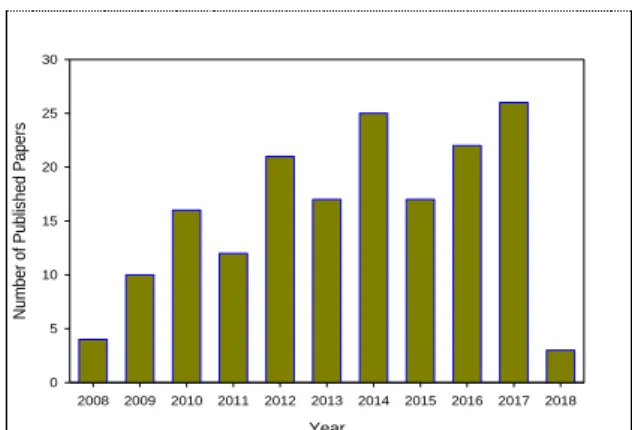
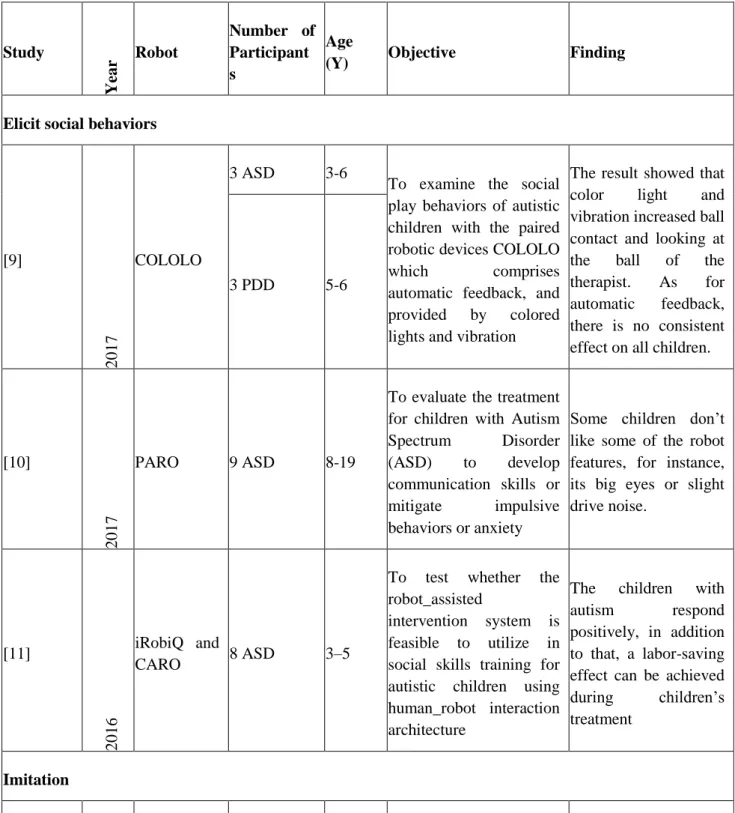
The screening based on the inclusion and exclusion criteria, and the duplicate’s removal, the remained studies N =39. Thus, only these articles were selected to be fully reviewed. The studies date started from 2008 to 2017, Figure 1 depicts the accelerated increase in the number of published articles on using robots to help children with ASD. Table I presents a classification of the identified studies in this paper according to the reference number, year of publication, the used robot/s in every study, the participant's number, the participants’ ages, the objective of the study, and the findings.
Year 2008 2009 2010 2011 2012 2013 2014 2015 2016 2017 2018 N u m b e r o f P u b lis h 0 5 10 15
Figure 1. Number of published papers per year
All studies collected in Table I are analyzed according to the targeting objectives, whereas each of which has dedicated to performing a particular task. Therefore, in all studies, the robots are categorized into three main groups:
3.1. Elicit Autistic Children Behaviors
In many studies, the robots are used in rehabilitation and therapy treatment for children with special needs. Humanoid robots are most widely used while the non-humanoid robots (animal-like and toy robots), and robotics kits are used in some other studies.
1) Social Behaviors Elicitation (3 Studies): One of the common uses of robots among treatments for autistic children is eliciting their social behaviors. Three studies were dedicated to eliciting social behaviors using three different robots. In [9], COLOLO robot comprised of automatic feedback and colored lights and vibration was used, therefore the robot increases the eye contact for the children. Another study [10] showed some children don’t like some of the robot features. In the last study [11], the children showed a positive response.
2) Imitation (3 Studies): Three studies tested the effect of the two robots (NAO and Darwin-OP) on imitation behaviours. In [12], the positive results have been generated for movement imitation and synchronous speech instruction. The other two studies [13], [14] showed failure in robot imitation test, however, in [13], the positive effects are generated on the social behaviors of children toward a human partner.
3) Joint Attention (6 Studies): Six studies tested the robots on eliciting the join attention. In four studies the results showed that the robots can improve joint attention and engagement time for autistic children. In [15], the robot produces a difference in eye contact and facial expression behaviors. While the results in [16], highlighted that, the robot generated a perturbing effect on children with ASD attention.
4) Turn-taking (3 Studies): Three studies were conducted to test the robot effect, in turn, taking in children with ASD. There are no clear results in the two studies from those three. The third study (Kose-Bagci et al., 2008) reported that the Kaspar Robot enabled more interaction and natural turn talking.
5) Emotion Recognition and Expression (5 studies): Five studies used robots on individuals with ASD to elicit their emotion recognition and expression. In four studies, the findings presented that, the used robots can improve the children's social skills including emotion recognition. Another study (Bonarini et al., 2016) was conducted on NDD children, where the results reported that in all participants, there are no positive effects were presented.
6) Spoken Ability (4 Studies): There are four studies that used five different robots for language improvement. All those studies reported that the robot helps improving children’s spoken ability.
Table 1. Classification of identified studies
Study Y ear Robot Number of Participant s Age
(Y) Objective Finding
Elicit social behaviors
[9]
2017
COLOLO
3 ASD 3-6
To examine the social play behaviors of autistic children with the paired robotic devices COLOLO which comprises automatic feedback, and provided by colored lights and vibration
The result showed that color light and vibration increased ball contact and looking at the ball of the therapist. As for automatic feedback, there is no consistent effect on all children.
3 PDD 5-6
[10]
2017
PARO 9 ASD 8-19
To evaluate the treatment for children with Autism Spectrum Disorder (ASD) to develop communication skills or mitigate impulsive behaviors or anxiety
Some children don’t like some of the robot features, for instance, its big eyes or slight drive noise.
[11]
2016
iRobiQ and
CARO 8 ASD 3–5
To test whether the robot_assisted
intervention system is feasible to utilize in social skills training for autistic children using human_robot interaction architecture
The children with autism respond positively, in addition to that, a labor-saving effect can be achieved during children’s treatment Imitation [13] 2017 NAO 12 ASD 11.7±2. 6
To test influence the robot on autistic children for imitation capability or initiated gestures.
The children with an over-reliance on proprioceptive cues and hypo-reactivity to visual cure shown difficulty for robot
Y
imitation more than the other children, where the repeated sessions generate positive effects on social behaviors in all children toward a human partner. [12] 2016 NAO 5 ASD >=8 To evaluate the effectiveness of NAO on children with ASD using movement imitation and synchronous speech instruction.
The results showed that the movement imitation and synchronous speech instruction are flexible and convenient for assisting intervention in children (with and without ASD)
[14]
2014
Darwin-OP 2 ASD 8
To develop social skills including interpersonal
synchrony and
concentration in the autistic children, the robot was used to play music while the children with ASD imitate it.
The children showed failure in imitating the robot. Joint Attention [17] 2016 NAO 12 3-4 To increase engagement time in the institutes
ASD children’s concentration time and efficiency in the classroom for long term usage for specific exercises can be increased using these robots. Zeno 6 6-7 Romibo 29 5-7 [18] 2017 NAO 5 Healthy 3-7 To examine children level response to a robotic-avatar therapeutic
1- the interaction time and response can be increased, which lead
Study Y ear Robot Number of Participant s Age
(Y) Objective Finding
system that was designed for ASD children's therapy service to increase the attention time. 2- the progress of interaction can be automated and measured easily. [15] 2016 Zeno R25 3 ASD 8-13 To improve joint attention, eye contact, and emotion recognition.
Using the robot, differences in eye contact and facial expression behaviors are perceived.
[16]
2017
NAO 1 ASD 17
To reinforce the mental skills of autistic children using EEG and robot to induce joint attention.
The results highlighted that the robot generated a perturbing effect on autistic children’s attention. [19] 2015 CuDDler (A*STAR Singapore) 7 ASD 4 - 5
Using a training protocol comprises CuDDler robot to train children with autism on joint attention skills.
There is an
improvement in joint attention skills post-training relative to a pre-training test. [20] 2009 multi-modal interface include Zino R25 6 ASD 6-13 To improve joint attention, eye contact, and imitation by involving Zino R25 in the multimodal interface based on a multilevel treatment protocol.
The results achieved in autistic children were better than in traditional therapy. Turn-taking [21] 2015 COLOLO 1 6:11
Use the robot to assist the therapist in elicit the child’s behavior by engaging the child in the turn_taking activity.
By this robot, the therapist can collect useful information that allows to understand and adapt the activities according to the child's
Y
progress.
[22]
2016
COLOLO 4 4-6
Propose a model using paired devices as a mediator to facilitate turn_taking behaviors between children with ASD and therapists.
The proposed method used to engage children and to measure the social performance of autistic children. [23] 2008 Kaspar 12 23-32 To facilitate social interaction between the human and humanoid by reinforcement
turn_taking and role switching.
By these models, more interaction and natural turn talking are enabled
Emotion recognition and expression
[24]
2012
AdMoVeo
3 6-7 Using a robot to account the symptoms of ASD utilizing empathic interactions of concern and empathic accuracy in different personalities.
The used robot showed the ability to develop various social skills and complex cognitive.
4 7-8 5 8-9 [25] 2014 Minimalist InterActor 20 NT and 20 ASD 6-7 Use Minimalist InterActor robot to observe verbal and emotional expressions of autistic and neurotypical children.
The robot that equipped with predictable reactions is able to facilitate autistic children in an expression better than a human [26] 2017 Monkey 13 ASD 5-11 To elicit social interaction using developed humanoid robotic monkey (Socially Animated Machine (SAM))
SAM can be used as an intervention tool for autistic children to improve their social skills including emotion recognition.
[27]
2016
Study Y ear Robot Number of Participant s Age
(Y) Objective Finding
positive emotions, and self-expression skills in children with ASD
causality relationships. The isolation for all potentially
confounding variables that may influence the improvement process is almost impossible to be isolated. In all participated children there are no Some positive effects were presented. [28] 2017 RoboKind Zeno R50 robot (ZECA) 6 ASD 8-9
To use RoboKind Zeno R50 robot (ZECA) as a mediator with autistic children to promote imitation and recognition of facial expressions
By this system, the robot showed the ability to interact with children with ASD naturally and comfortably especially in emotion recognition and imitation skills
Vocalization
[29]
2008
AIBO and
Kasha 11 ASD 5-8
To examine whether the dog robot can help to
promote social
interaction skills for autistic children.
Using AIBO robot, the children spoke more words and being more engaged in 1) verbal engagement, 2) reciprocal and authentic interaction behaviors. [30] 2017 Sphero robot 4 ASD 5.5
Using Sphero robot to develop social and communication skills in children with ASD
Produced an
interesting interaction where the children were encouraged to, 1) speak and utter more words, 2) practice friendship with the robot, 3) share feelings and develop more
Y interaction with parents/therapists. [31] 2018 NAO 6 ASD 11-15
Using robots to improve social skills by linking voice to gestures.
The autistic children showed fast change
effects in communication behavior. [32] 2016 Minimalistic toy 20 ASD 7-9
Use Minimalistic toy as a tool for children with ASD to analyzing their scenery of speaker/ listener condition
This robot was considered as a neuronal organizer and reorganizer with the potential to improve brain activity
Modeling, teaching, and skill’s practicing
[33]
2017
Ifbot 3 ASD 8-11
Examined the feasibility of collaborative learning between ASD children and a robot.
ASD child
communicated with the robot as a human friend and corrected the robot’s mistake.
[34]
2017
Puffy 2 ASD 7-9
Designing Puffy to be used as a learning and play tool for children with different forms of NDD.
The subjected children showing education behaviors during the experiment which does not happen very often before.
[35]
2017
ACTROID-F (female) 1 18
To use the robot as an intervenor in therapy and education using taking note system
The result showed stress was decreased effectively
[36]
2016
NAO 6 ASD 12
To teach ASD children gestural comprehension and production using video modeling.
Video modeling by a robot animation is an effective way to teach ASD children the recognize and generate
Study Y ear Robot Number of Participant s Age
(Y) Objective Finding
gestures
[37]
2010
Iromec 5 ASD 6-11
Using Iromec robot to empower the children with ASD to learn a wide range of play styles to improve their social interaction.
All the children were interested in all playing scenarios.
[38]
2006
Ifbot 3 GZ -
Examine the effects of
the robot for
collaborative learning in gray zone children.
It found that using the robot in collaborative learning increased the time span for the learning session. In addition, it stimulates the gray zone children to learn efficiently for a longer time.
[39]
2017
NAO 8 ASD 4-10
To use NAO to improve the social skills of autistic children by dance therapy.
The children showed more engagement and motivation [40] 2016 Lego NXT 3 ASD 12 Uses Lego NXT as Socially Assistive Robotics (SAR), to teach the children with ASD social behavior.
SAR can have a significant impact on breaking stereotypic behavior, avoidance, and rejection pattern
[41]
2017
NAO 1 ASD 8
Design a program to control the NAO robot remotely through a tablet
The program gave the ability to direct therapy sessions with a tablet.
[42]
2015
NAO 6 ASD 8-12
Using a humanoid robot to create and co-design LEGO in autistic children treatment to improve their social skills
Using a robot to create and co-design LEGO gives possibilities for intervention with children for a long time which lead to increase the social
Y
interaction
Provide feedback or encouragement
[43]
2017
ZECA 15 ASD 1-5
Use ZECA robot as a promoter for ASD children to interact in
some education
scenarios.
ASD children are able to interact in a comfortable and natural way, thus this system can be used as a promoter in academic and social learning. [44] 2012 Lego Mindstorms NXT 14 ASD 6-16 To assess the
effectiveness of the robot on children with autism disorder, check where the children with ASD can be stimulated to interact and gained learning skills using the robot as a promoter.
There is no pattern can predict either the robot will be used as an interaction promoter or it will not give significant changes to children with ASD.
[45]
2016
NAO 3 ASD 5,6,14
Utilizing NAO as an agent to assist autistic children during therapy sessions using a Tangram puzzle game
The robot assisted the children during the playing time and stimulate their attention towards the game [46] 2018 - 47 Normal 5-14
Using a robot as assistive for psychological and therapeutic intervention in the integrative ecosystem
Both children and specialists showed high levels of acceptance. 36 ASD 5 CIMA [47] [46] 2016 TWC soft wearable – social 5 ASD 3-10 Use TWC (embedded social robot) for therapy support and developing social skills in autistic
From the results, the TWC responses are used to increase the engagement time of
Study Y ear Robot Number of Participant s Age
(Y) Objective Finding
children. the children. Aside from that, the wearable companion is allowed to communicate with children or caregivers and therapists.
3.2. Modeling, Teaching, and Skill's Practicing (10 Studies)
Ten studies were dedicated to improving the social skills in children with ASD by learning and practicing some interaction skills. Six robots were used (NAO, Ifbot, Puffy, ACTRO ID-F, Iromec, and Lego NXT). All studies reported that the robots improve the communication skills of the children in dealing with the robot as a friend, decrease the stress during the playing sessions, improve the educational experiences for autistic children by increasing the engagement and social interaction time span in all playing and education scenarios.
3.3. Promoter (5 studies)
Five studies examined the utilization of robots as a promoter to improve interaction and communication skills in an individual with ASD. The outcome of four studies showed that the robot can assist in practicing specific skills, unlike one study [44] reported that there is no pattern can predict either the robot will be used as promoter or it will not give significant changes to children with ASD.
4. Conclusion
Yet robotic therapy has brought positive outcomes for individuals with ASD. Different robots’ models have been utilized, human-like (humanoid), animal-like, and toy robots. All of those robots were used according to their features either as promoter, mediator, analyzer or monitor tool. NAO robot was used in most studies. From this work, we concluded that more studies and efforts in this field are required. It is required to conduct other researches to determine the feasibility and validity of the robots used in autism treatment and therapy.
Acknowledgment
This research is fully supported by FRGS/1/2018/TK04/UITM/01/1. Therefore, the authors fully acknowledged Universiti Teknologi MARA and Ministry of Higher Education (MOHE), Malaysia for providing the fund which makes this research fulfilled effectively.
References
[1] J.-J. Cabibihan, H. Javed, M. Aldosari, T. Frazier, and H. Elbashir, “Sensing Technologies for Autism Spectrum Disorder Screening and Intervention,” Sensors, vol. 17, no. 1, p. 46, 2016, doi: 10.3390/s17010046.
[2] Y. Feng, L. Vladareanu, Z. Chen, D. Jin, I. Mimouni, and H. Wang, “Research on mechanical design of a multi-function finger rehabilitation robot,” Period. Eng. Nat. Sci., vol. 7, no. 1, pp. 356–360, Apr. 2019, doi: 10.21533/pen.v7i1.370.
[3] B. Scassellati, Henny Admoni, and M. Matarić, “Robots for Use in Autism Research,” Annu. Rev. Biomed. Eng., vol. 14, no. 1, pp. 275–294, 2012, doi: 10.1146/annurev-bioeng-071811-150036.
[6] J. J. Cabibihan, H. Javed, M. Ang, and S. M. Aljunied, “Why Robots? A Survey on the Roles and Benefits of Social Robots in the Therapy of Children with Autism,” Int. J. Soc. Robot., vol. 5, no. 4, pp. 593–618, 2013, doi: 10.1007/s12369-013-0202-2.
[7] S. Provoost, H. M. Lau, J. Ruwaard, and H. Riper, “Embodied conversational agents in clinical psychology: A scoping review,” J. Med. Internet Res., vol. 19, no. 5, 2017, doi: 10.2196/jmir.6553. [8] S. Burak, E. Begic, N. Begic, and F. Kadic, “Sedentary behavior as a public health issue:
Ergonomics as a useful tool,” Sustain. Eng. Innov. ISSN 2712-0562, vol. 1, no. 2, pp. 112–120, 2019. [9] S. Matsuda, E. Nunez, M. Hirokawa, J. Yamamoto, and K. Suzuki, “Facilitating social play for children with PDDs: Effects of paired robotic devices,” Front. Psychol., vol. 8, no. JUN, pp. 1–9, 2017, doi: 10.3389/fpsyg.2017.01029.
[10] Y. Nakadoi, “Usefulness of Animal Type Robot Assisted Therapy for Autism Spectrum Disorder in the Child and Adolescent Psychiatric Ward,” in New Frontiers in Artificial Intelligence, 2017, vol. 10247, pp. 478–482, doi: 10.1007/978-3-319-61572-1.
[11] S.-S. Yun, H. Kim, J. Choi, and S.-K. Park, “A robot-assisted behavioral intervention system for children with autism spectrum disorders,” Rob. Auton. Syst., vol. 76, pp. 58–67, 2016, doi: 10.1016/j.robot.2015.11.004.
[12] X. Liu et al., “An interactive training system of motor learning by imitation and speech instructions
for children with autism,” Proc. - 2016 9th Int. Conf. Hum. Syst. Interact. HSI 2016, pp. 56–61, 2016, doi: 10.1109/HSI.2016.7529609.
[13] P. Chevalier, G. Raiola, J. Martin, B. Isableu, C. Bazile, and A. Tapus, “Do sensory preferences of children with autism impact an imitation task with a robot?,” Proc. 2017 ACM/IEEE Int. Conf.
Human-Robot Interact. - HRI ’17, pp. 177–186, 2017, doi: 10.1145/2909824.3020234.
[14] Y. H. Peng, C. W. Lin, N. M. Mayer, and M. L. Wang, “Using a humanoid robot for music therapy with autistic children,” CACS 2014 - 2014 Int. Autom. Control Conf. Conf. Dig., no. April, pp. 156– 160, 2014, doi: 10.1109/CACS.2014.7097180.
[15] G. Palestra, G. Varni, M. Chetouani, and F. Esposito, “A multimodal and multilevel system for robotics treatment of autism in children,” Proc. Int. Work. Soc. Learn. Multimodal Interact. Des. Artif. Agents - DAA ’16, pp. 1–6, 2016, doi: 10.1145/3005338.3005341.
[16] S. M. Anzalone, A. Tanet, O. Pallanca, D. Cohen, and M. Chetouani, “A humanoid robot controlled by neurofeedback to reinforce attention in autism spectrum disorder,” CEUR Workshop Proc., vol. 1834, pp. 61–67, 2017.
[17] F. Kirstein and R. V. Risager, “Social robots in educational institutions they came to stay: Introducing, evaluating, and securing social robots in daily education,” in 11th ACM/IEEE International Conference on Human-Robot Interaction (HRI), 2016, pp. 453–454.
[18] M. Alahbabi et al., “Avatar Based Interaction Therapy: A Potential Therapeutic Approach for
[19] J. Kajopoulos, A. H. Y. Wong, A. W. C. Yuen, T. A. Dung, T. Y. Kee, and A. Wykowska, “Robot-Assisted Training of Joint Attention Skills in Children Diagnosed with Autism,” in International Conference on Social Robotics, 2015, pp. 296–305, doi: 10.1007/978-3-642-34103-8.
[20] M. B. Colton, D. J. Ricks, M. A. Goodrich, B. Dariush, K. Fujimura, and M. Fujiki, “Toward Therapist-in-the-Loop Assistive Robotics for Children with Autism and Specific Language Impairment,” AISB New Front. Human-Robot Interact. Symp., no. April, p. 25, 2009.
[21] E. Nunez, S. Matsuda, M. Hirokawa, J. Yamamoto, and K. Suzuki, “Paired robotic devices to mediate and represent social behaviors,” in Proceedings of the 24th IEEE International Workshop on
Robot and Human Interactive Communication, 2015, pp. 722–727, doi:
10.1109/ROMAN.2015.7333669.
[22] E. Nunez, S. Matsuda, M. Hirokawa, J. Yamamoto, and K. Suzuki, “An approach to facilitate turn-taking behavior with paired devices for children with Autism Spectrum Disorder,” in 25th IEEE International Symposium on Robot and Human Interactive Communication, RO-MAN, 2016, pp. 837–842, doi: 10.1109/ROMAN.2016.7745216.
[23] H. Kose-Bagci, K. Dautenhahn, and C. L. Nehaniv, “Emergent dynamics of turn-taking interaction in drumming games with a humanoid robot,” Proc. 17th IEEE Int. Symp. Robot Hum. Interact.
Commun. RO-MAN, pp. 346–353, 2008, doi: 10.1109/ROMAN.2008.4600690.
[24] M. Dimitrova, N. Vegt, and E. Barakova, “Designing a system of interactive robots for training collaborative skills to autistic children,” in 15th International Conference on Interactive Collaborative Learning, ICL, 2012, pp. 1–8, doi: 10.1109/ICL.2012.6402179.
[25] I. Giannopulu, V. Montreynaud, and T. Watanabe, “Neurotypical and autistic children aged 6 to 7 years in a speaker-listener situation with a human or a minimalist InterActor robot,” in The 23rd
IEEE International Workshop on Robot and Human Interactive Communication, 2014, pp. 942–948,
doi: 10.1109/ROMAN.2014.6926374.
[26] S. A. Koch et al., “A Feasibility Study Evaluating the Emotionally Expressive Robot SAM,” Int. J. Soc. Robot., vol. 9, no. 4, pp. 601–613, 2017, doi: 10.1007/s12369-017-0419-6.
[27] A. Bonarini, F. Clasadonte, F. Garzotto, M. Gelsomini, and M. Romero, “Playful interaction with Teo, a Mobile Robot for Children with Neurodevelopmental Disorders,” Proc. 7th Int. Conf. Softw. Dev. Technol. Enhancing Access. Fight. Info-exclusion - DSAI 2016, pp. 223–231, 2016, doi: 10.1145/3019943.3019976.
[28] V. Silva, F. Soares, and J. S. Esteves, “Mirroring and recognizing emotions through facial expressions for a RoboKind platform,” in IEEE 5th Portuguese Meeting on Bioengineering
(ENBENG), 2017, pp. 3–6, doi: 10.1109/ENBENG.2017.7889480.
[29] C. M. Stanton, P. H. Kahn Jr, R. L. Severson, J. H. Ruckert, and B. T. Gill, “Robotic animals might aid in the social development of children with autism,” in HRI ’08: Proceedings of the 3rd ACM/IEEE international conference on Human robot interaction, 2008, pp. 271–278, doi: 10.1145/1349822.1349858.
[30] S. Golestan, P. Soleiman, and H. Moradi, “Feasibility of using sphero in rehabilitation of children with autism in social and communication skills,” 2017 Int. Conf. Rehabil. Robot., vol. 2017, pp. 989–994, 2017, doi: 10.1109/ICORR.2017.8009378.
[31] S. Sakka et al., “Rob’autism: How to change autistic social skills in 20 weeks,” Mech. Mach. Sci., vol. 48, pp. 261–274, 2018, doi: 10.1007/978-3-319-59972-4_19.
robots and children with autism spectrum disorders,” vol. 10247, pp. 454–461, 2017, doi: 10.1007/978-3-319-61572-1.
[34] F. Garzotto, M. Gelsomini, and Y. Kinoe, “Puffy: A Mobile Inflatable Interactive Companion for Children with Neurodevelopmental Disorder,” vol. 10516, pp. 467–492, 2017, doi: 10.1007/978-3-319-68059-0.
[35] H. Kumazaki et al., “An intervention for children with social anxiety and autism spectrum disorders
using an android robot,” vol. 10247, pp. 470–477, 2017, doi: 10.1007/978-3-319-61572-1.
[36] W. C. So, M. K. Y. Wong, J. J. Cabibihan, C. K. Y. Lam, R. Y. Y. Chan, and H. H. Qian, “Using robot animation to promote gestural skills in children with autism spectrum disorders,” J. Comput. Assist. Learn., vol. 32, no. 6, pp. 632–646, 2016, doi: 10.1111/jcal.12159.
[37] P. Marti and L. Giusti, “A Robot Companion for Inclusive Games: a user-centred design perspective,” in IEEE International Conference on Robotics and Automation Anchorage Convention District May 3-8, 2010, Anchorage, Alaska, USA, 2010, pp. 4348–4353.
[38] B. Andrea and A. Bennedeto, “Effects of Collaborative Learning between Educational-Support Robots and Children who Potential Symptoms of a Development Disability,” in 8th International Conference on Soft Computing and Intelligent Systems and 17th International Symposium on Advanced Intelligent Systems, 2016, vol. 57, no. 25-28 Aug, pp. 101–131, doi: 10.1109/SCIS. [39] R. Suzuki, J. Lee, and O. Rudovic, “NAO-Dance Therapy for Children with ASD,” Proc.
Companion 2017 ACM/IEEE Int. Conf. Human-Robot Interact. - HRI ’17, pp. 295–296, 2017, doi:
10.1145/3029798.3038354.
[40] M. F. Tennyson, D. A. Kuester, J. Casteel, and C. Nikolopoulos, “Accessible Robots for Improving Social Skills of Individuals with Autism as an Intervention for Individuals,” vol. 6, no. 4, pp. 267– 277, 2016.
[41] J. Leaf, A. S. Preston, D. C. R. P.E., and R. E. Gerlick, “An Undergraduate Service Learning Research Project using a Humanoid Robot to Enhance Treatment for Children with Autism Spectrum Disorder,” in SEE Annual Conference & Exposition, 2017.
[42] E. I. Barakova, P. Bajracharya, M. Willemsen, T. Lourens, and B. Huskens, “Long-term LEGO therapy with humanoid robot for children with ASD,” Expert Syst., vol. 32, no. 6, pp. 698–709, 2015, doi: 10.1111/exsy.12098.
[43] H. Freitas, P. Costa, V. Silva, P. Pereira, F. Soares, and J. S. Esteves, “Using a Humanoid Robot as the Promoter of the Interaction with Children in the Context of Educational Games,” Int. J. Mechatronics Appl. Mech., no. 1, 2017.
[44] S. Silva, F. Soares, S. Costa, A. P. Pereira, and F. Moreira, “Development of skills in children with ASD using a robotic platform,” IEEE 2nd Port. Meet. Bioeng. ENBENG, pp. 1–4, 2012, doi: 10.1109/ENBENG.2012.6331347.
[45] B. Bernardo, P. Alves-Oliveira, M. G. Santos, F. S. Melo, and A. Paiva, “An Interactive Tangram Game For Children With Autism,” in International Conference on Intelligent Virtual Agents, 2016, pp. 1–10.
[46] V. Robles-Bykbaev et al., “A Hybrid Approach Based on Multi-sensory Stimulation Rooms,
Robotic Assistants and Ontologies to Provide Support in the Intervention of Children with Autism,” in International Conference on Applied Human Factors and Ergonomics, 2018, vol. 477–487, pp. 477–487, doi: 10.1007/978-3-319-60597-5.
[47] B. Özcan, D. Caligiore, V. Sperati, T. Moretta, and G. Baldassarre, “Transitional Wearable Companions: A Novel Concept of Soft Interactive Social Robots to Improve Social Skills in Children with Autism Spectrum Disorder,” Int. J. Soc. Robot., vol. 8, no. 4, pp. 471–481, 2016, doi: 10.1007/s12369-016-0373-8.