Risk
Aware
Data
Processing
in
Hybrid
Clouds
Technical
Report
UTDCS
31
11
The
University
of
Texas
at
Dallas
Department
of
Computer
Science
November
2011
Vaibhav
Khadilkar,
Kerim
Yasin
Oktay,
Bijit
Hore,
Murat
Kantarcioglu,
Sharad
Mehrotra,
Bhavani
Thuraisingham
Report Documentation Page
OMB No. 0704-0188Form ApprovedPublic reporting burden for the collection of information is estimated to average 1 hour per response, including the time for reviewing instructions, searching existing data sources, gathering and maintaining the data needed, and completing and reviewing the collection of information. Send comments regarding this burden estimate or any other aspect of this collection of information, including suggestions for reducing this burden, to Washington Headquarters Services, Directorate for Information Operations and Reports, 1215 Jefferson Davis Highway, Suite 1204, Arlington VA 22202-4302. Respondents should be aware that notwithstanding any other provision of law, no person shall be subject to a penalty for failing to comply with a collection of information if it does not display a currently valid OMB control number.
1. REPORT DATE
NOV 2011
2. REPORT TYPE3. DATES COVERED
00-00-2011 to 00-00-2011
4. TITLE AND SUBTITLE
Risk-Aware Data Processing in Hybrid Clouds
5a. CONTRACT NUMBER
5b. GRANT NUMBER
5c. PROGRAM ELEMENT NUMBER
6. AUTHOR(S) 5d. PROJECT NUMBER
5e. TASK NUMBER
5f. WORK UNIT NUMBER
7. PERFORMING ORGANIZATION NAME(S) AND ADDRESS(ES)
The University of Texas at Dallas,Department of Computer
Science,Richardson,TX,75080-3021
8. PERFORMING ORGANIZATION REPORT NUMBER
9. SPONSORING/MONITORING AGENCY NAME(S) AND ADDRESS(ES) 10. SPONSOR/MONITOR’S ACRONYM(S)
11. SPONSOR/MONITOR’S REPORT NUMBER(S)
12. DISTRIBUTION/AVAILABILITY STATEMENT
Approved for public release; distribution unlimited
13. SUPPLEMENTARY NOTES
14. ABSTRACT
This paper explores query processing in a hybrid cloud model where a user?s local computing capability is
exploited alongside public cloud services to deliver an efficient and secure data management solution.
Hybrid clouds offer numerous economic advantages including the ability to better manage data privacy
and confidentiality, as well as exerting control on monetary expenses of consuming cloud services by
exploiting local resources. Nonetheless, query processing in hybrid clouds introduces numerous challenges,
the foremost of which is, how to partition data and computation between the public and private
components of the cloud. The solution must account for the characteristics of the workload that will be
executed, the monetary costs associated with acquiring/operating cloud services as well as the risks
affiliated with storing sensitive data on a public cloud. This paper proposes a principled framework for
distributing data and processing in a hybrid cloud that meets the conflicting goals of performance,
disclosure risk and resource allocation cost. The proposed solution is implemented as an add-on tool for a
Hadoop and Hive based cloud computing infrastructure.
15. SUBJECT TERMS
16. SECURITY CLASSIFICATION OF: 17. LIMITATION OF ABSTRACT
Same as
Report (SAR)
18. NUMBER OF PAGES21
19a. NAME OF RESPONSIBLE PERSON a. REPORTunclassified
b. ABSTRACTunclassified
c. THIS PAGEunclassified
Standard Form 298 (Rev. 8-98) Prescribed by ANSI Std Z39-18
Risk-Aware Data Processing in Hybrid Clouds
Vaibhav Khadilkar
#1, Kerim Yasin Oktay
∗1, Bijit Hore
∗2,
Murat Kantarcioglu
#2, Sharad Mehrotra
∗3, Bhavani Thuraisingham
#3#The University of Texas at Dallas
1[email protected], 2[email protected], 3[email protected]
∗University of California, Irvine
1[email protected], 2[email protected], 3[email protected]
Abstract
This paper explores query processing in ahybrid cloudmodel where a user’s local computing capa-bility is exploited alongside public cloud services to deliver an efficient and secure data management solution. Hybrid clouds offer numerous economic advantages including the ability to better manage data privacy and confidentiality, as well as exerting control on monetary expenses of consuming cloud services by exploiting local resources. Nonetheless, query processing in hybrid clouds introduces nu-merous challenges, the foremost of which is, how to partition data and computation between the public and private components of the cloud. The solution must account for the characteristics of the workload that will be executed, the monetary costs associated with acquiring/operating cloud services as well as the risks affiliated with storing sensitive data on a public cloud. This paper pro-poses a principled framework for distributing data and processing in a hybrid cloud that meets the conflicting goals of performance, disclosure risk and resource allocation cost. The proposed solution is implemented as an add-on tool for a Hadoop and Hive based cloud computing infrastructure.
1
Introduction
The rise of cloud computing has created a revolution in the computing industry by giving end-users access to sophisticated computational infrastructures, platforms, and services using a pay-as-you-use model. Several new systems like HadoopDB and Hive that support database query processing on the cloud have emerged. Such systems investigate the potential benefits of using cloud-based systems instead
of traditional relational databases. An emerging trend in cloud computing is that ofhybrid cloud. Unlike
traditional outsourcing where organizations push their data and data processing to the cloud, in hybrid clouds in-house capabilities/resources at the end-user site are seamlessly integrated with cloud services to create a powerful, yet cost-effective data processing solution. Hybrid cloud solutions offer similar benefits as traditional cloud solutions. Yet, they provide advantages in terms of disclosure control and minimizing cloud resources given that most organizations already have an infrastructure they can use. Exploiting such benefits, however, opens numerous questions such as how should one partition data and computation between the public and private side of the infrastructure? What are the implications of the different designs – from the perspectives of data disclosure? computational performance? overall costs/savings?
Let us illustrate some of the design choices and their implications using an example. Consider a scenario in which a university IT department is considering a cloud-based solution as a cost-effective ap-proach to supporting increased data analyses needs. We consider a simplistic database schema consisting of the following tables:
Student(name, student_id, ssn, year_join, year_left, dept) Catalog(c_id, title, descr, dept, units)
Instructors(i_id, i_name, ssn, i_dept, join_date) Offering(instructor_id, course_id, quarter) Enrollment(s_id, c_id, term, grade)
In the above student database, while data such as catalog information is not sensitive, information about students & instructors (e.g., ssn), student course enrollments, and their grades is deemed sensitive. In particular, information such as ssn and grades, if leaked could lead to misuse of data and/or loss of privacy and hence must be protected. In addition to supporting typical workload such as queries to prepare end-of-term grade reports, identify policy violations (e.g., low/high course enrollments, students with too low a GPA, too low term credits, etc.), the university administrators, now require the database to support significantly more complex analyses such as degree of reciprocity amongst different departments in terms of student enrollments in courses offered by the departments, longitudinal (e.g., over the past 10 years) study of students’ relative performance (viz. grades) in courses offered by different departments grouped based on students’ home department, etc.
On one extreme, the university may choose to outsource its entire data and workload to the public cloud (as is typical to outsourcing solutions). While simple to implement, such a solution, incurs the most monetary cost in terms of cloud service (both storage & computing), and is most vulnerable to
data leakage1. In addition, the outsourcing strategy may not even be optimal in terms of performance
since it wastes local resources which are now unused. An alternate strategy might be to replicate data at both private and public sides and to split the workload between the two. For instance, policy checks and student reports may be prepared locally, while periodic complex analyses queries may be computed on the cloud side. The above strategy exploits local resources, and thereby reduces cost of cloud services required.
Another possibility might be to partition data in a way that allows multiple workload queries to be
evaluated partially on both sides. For instance,StudentandEnrollmenttables might be split horizontally
on both sides whereasCatalog may be replicated completely on the public side (since it is expected to
be a small table). Such an approach will allow for end-of-term grade report generation, policy violation checks, as well as analyses queries to be parallelized, thus gaining performance. In addition, this plan (like the previous) may also reduce the storage and potentially processing needs at the public cloud since now only part of the data processing is done on the public side while the remainder is done at the local
side. The fourth possibility might be to only store the projection of the Enrollmenttable without the
“grade” attribute on the public side. This will reduce the risk of disclosure (to the public cloud) of data
that is potentially sensitive (viz., grades). Likewise, “ssn”, “s id”, and “name” from theStudentrelation
might only be exposed in encrypted form to the public side to curb disclosure.
The possibilities described above are just four of the multitude of design choices, each of which represents different tradeoffs in terms of performance, costs, and disclosure.
In this paper, we develop a principled framework that provides mechanisms/opportunities to end users to tune storage and workload execution over private and public clouds in a way that the resulting query processing strikes the right balance of performance, risks, and costs from the users’ perspective. The key challenge in designing such a framework is deciding what should be stored at the public and local sites. The data partitioning and representation dictates not only the cloud storage requirement and level of disclosure of sensitive data, but also the query processing strategies used to process the workload. Query processing, in turn dictates the level of load generated on the public and private sides, the risks incurred, and the monetary cost of cloud infrastructures. We postulate data partitioning as a minimization problem where the goal is minimizing the performance cost while adhering to bounds on
risks and monetary costs2. By controlling the degree of risks and monetary costs, an end user can ensure
appropriate tradeoffs of the three factors in supporting query processing in hybrid clouds.
For a given data partitioning, the level of data exposure, as well as, workload distribution across public and private clouds depends upon the underlying data representation used. For instance, us-ing non-deterministic encryption to store data on the public cloud will minimize disclosure risks, but will also limit query processing capabilities on the public cloud. Alternatively, storing data using full-homomorphic encryption [3] will allow processing any class of queries while minimizing the risks of sensitive data exposure. However, it increases computational overheads (and hence monetary costs)
since it is practically infeasible as the data size increases. Adisclosure-limited indexingtechnique such as
bucketization[4] allows processing a large class of queries at reasonable monetary costs and performance, albeit with potentially higher data exposure risk compared to full-homomorphic encryption. A plain-text representation, of course, minimizes overheads but incurs the highest risks of disclosure. The framework
1Services such as S3 allow encrypted storage at no additional costs [1] ensuring protection for data at rest, however, the
data will be in cleartext form when in memory and hence susceptible to memory attacks [2].
we develop in this paper to explore tradeoffs between costs, performance, and disclosure control is largely agnostic to the specificity of the underlying data representation. Of course, the specific cost models used to compute performance, costs, and risks depend upon the representation and need to be modeled and input into the framework appropriately. While our framework is general, we use bucketization to store sensitive data on the public side for concreteness. Bucketization is a powerful framework that allows a range of possibilities from clear text representation (when buckets are very granular, with each value corresponding to a bucket) to a completely secure representation (when all values are mapped to a sin-gle bucket). We note that encryption-based approaches (such as homomorphic techniques) can also be supported in our framework, if and when they become practical.
We note that the data partitioning problem is very well studied in the database literature in both the parallel and distributed context [5, 6, 7, 8]. We compare and contrast the partitioning problem that results in the context of hybrid clouds with the previously developed state-of-the-art approaches in the related work section. Like prior partitioning problems, our problem is also NP-Hard. The paper explores greedy heuristics that are extensively evaluated over standard TPC-H benchmark datasets under various parameter settings and cloud side data representations.
Our primary technical contributions are listed below:
• We formalize the optimal risk-aware data partitioning problem as a mechanism for query cost
min-imization. Our formalization allows us to plug in different disclosure risk models for various use cases. We provide an algorithm to derive good partitions for both, vertical as well as the horizontal cases. Specifically, we develop an algorithm that searches for an optimal horizontal/vertical par-titioning scheme given a query workload and monetary cost constraints (resource allocation and sensitive data disclosure).
• We present a formal model for estimating the cost of SQL queries in a hybrid cloud setting and
develop techniques for their execution.
• We conduct extensive evaluation on realistic datasets and experimentally validate the benefits of
our algorithm.
The rest of the paper is organized as follows: Section 2 presents an overview of our Hadoop HDFS and Hive based architecture for creating a hybrid cloud. In section 3, we present details on the formalization of the data partitioning problem while in section 4 we present an iterative solution to the problem that covers the horizontal and vertical partitioning approaches. Section 4 also provides a summary of our query execution and estimation model that is used in solving the data partitioning problem. In section 5, we present results of our experimental evaluation of the horizontal and vertical partitioning strategies using the TPC-H benchmark. Section 6 reviews related work in the area of secure distributed data processing. Finally, we present our conclusions and future work in section 7.
2
System Architecture
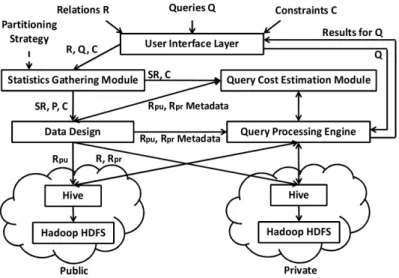
We begin by presenting an overview of our proposed system architecture in Figure 1. The system consists
mainly of two components: data design component responsible for optimal partitioning in the hybrid
cloud, andquery processing engine that, given a partitioning, decides on the query execution strategy.
Our focus in this paper is on the data design component of the system, though, as will become clear, cost estimation required to determine optimal partitioning depends upon the query processing strategies implemented by the query processing engine.
For the data design component, a user begins by submitting a set of relations,R={R1, R2,· · ·, Rm},
a query workload, Q={Q1, Q2, . . . , Qk}, and a set of resource allocation and sensitive data disclosure
constraints, C. The system initially performs the task of statistics collection over R and Q using the
statistics gathering module. This module also generates a set of predicates, P, based on R, Q and a
user-specified partitioning strategy (horizontal or vertical). The statisticsSR are created as equi-width
histograms and sent to thedata design layer. Thedata design layer receives the setP and the statistics
SRas well as the constraintsC, and then systematically solves the data partitioning problem,DPP. In
solvingDPP, thequery cost estimation,QCEstcomponent of the system is used to estimate the execution
costs of queriesQi∈Q. TheQCEst, in turn, estimates the execution costs of queries by determining the
Figure 1: The Hybrid Cloud Architecture
partial replicas ofR,Rpr={R1pr, R2pr,· · · , Rmpr} andRpu ={R1pu, R2pu,· · ·, Rmpu}that correspond
to the private and public replicas ofR.
The private cloud stores R as well as its private side replicaRpr, while the public cloud stores only
the public replica,Rpu. Rpr andRpu are constructed by partitioning setP into private (Ppr) and public
(Ppu) partitions respectively. Therefore, throughout the paper, a reference to “partitioning” denotes
a partitioning of set P, while “replication” denotes the replication achieved by storing Rpr and R on
the private side and movingRpu to the public side. Finally, the data design layer also mandates how
sensitive data inRpu will be stored on the public cloud.
After the data design layer has determined the replicas (RprandRpu) and the representation
(cleart-ext or bucketization), the sensitive data inRpuis stored on the public cloud in the decided representation.
On the other hand, the non-sensitive data inRpu andRpr is stored in the cleartext format on the public
and private clouds respectively.3 The metadata about replicas R
pr and Rpu is also sent to the query
processing engine. The details of constructingP as well as solving DPPwill be described in Section 3,
whereas information on howSR is created will be given in Section 5.
Once the system has stored the data based on the output of the data design component, the system
can support query processing. This is achieved by thequery processing engine, QPEwhich is responsible
for executing queries based on the way data is stored in the hybrid clouds. Given a queryQ, theQPE
transforms Q into a execution plan using rewrite rules and estimates costs of different strategies for
executingQ4.
3
Data Partitioning Problem
In this section, we formalize the data partitioning problem in a hybrid cloud setting. The problem aims to minimize the execution cost of a query workload and is bounded by two separate constraints, the first of which limits the resources that can be rented on a public cloud, while the second captures the disclosure risk that a user is willing to accept when sensitive data on the public side is exposed. The solution to the problem results in a partitioning of data between the public and private sides. We model such partitioning using predicates as is discussed next.
3We use a Hadoop HDFS based infrastructure for implementing the storage schemas. Hadoop HDFS is a distributed
file system designed to run on commodity hardware.
4We use a Hive based infrastructure for query processing. Hive is a data warehouse built on Hadoop that allows a user
3.1
Predicate Partitioning Model
In this paper, we use simple predicates as a foundation on which we can implement the horizontal and vertical partitioning strategies that form the basis of our solutions to the data partitioning problem. The use of predicates allows us to represent different data partitioning options (between the public and private clouds) within the same common framework. Predicates offer a general way to represent various
partitioning strategies viz., horizontal or vertical, using a common mechanism instead of developing
separate notations for them. Additionally, in contrast to fixed strategies such as round-robin or hash partitioning, predicates offer us a fine-grained and adaptive strategy for controlling what sensitive data gets replicated on the public cloud. Previous techniques to policy specification for access control and privacy have also considered a similar approach, e.g., [9] used a predicate based approach for specifying access control policies in relational databases, [10] used predicated queries to specify confidentiality
policies for structured data. In our data partitioning problem, the set of simple predicatesP is extracted
from relationsRand workloadQ. A simple predicate,Pi, is defined in one of the following three forms:
1. Pi←Attribute
2. Pi←Attribute op V alue 3. Pi←(Pi∧Pi)|(Pi∨Pi)|(¬Pi)
where opincludes {=, <, >,≤,≥}. Predicates of type 1 above can be used to specify vertical
par-titioning, while predicates of types 2 and 3 can be used for horizontal partitioning. We illustrate how simple predicates can be extracted to specify horizontal and vertical partitionings using examples below.
Consider the relationsStudent (R1),Catalog(R2),Instructors (R3)Offering(R4) andEnrollment (R5)
discussed in the introduction and the following query (Q1) that retrieves names of all students who received at least one ‘A’ grade in Winter 2011:
Q1: SELECT DISTINCT name FROM Student JOIN Enrollment ON student_id = s_id
WHERE term = "Winter 2011" AND grade = "A"
Vertical Partitioning: To specify a vertical partitioning policy, a simple predicatePi is created for
each attribute of relations R1-R5 using predicates of type 1. The setP will consist of predicates such as
P1←name, P2←title,etc. that have been extracted from relations R1 and R2 respectively.
Horizontal Partitioning: In this case, the set P is extracted from queries (viz., Q1) instead of relation schemas (i.e., R1-R5). We first identify predicates that appear in the where clause of queries
that are of types 2 or 3 and belong to the same relation. Then, we insert them into P. Additionally,
if a predicate Pi is of type 2, then a predicate ¬Pi is also inserted into P. On the other hand, for a
predicatePi of type 3, ifPi is either Pi1∧Pi2 orPi1∨Pi2, then predicatesPi1,¬Pi1,Pi2 and¬Pi2 will
also be added toP. Our strategy recursively performs the same operations for Pi1 and Pi2, until both
the predicates are simple (that is, of type 2). The set P for Q1 would consist of predicates such as:
P1←term= ”W inter 2011”,P2←term6= ”W inter 2011”,P3←grade = ”A”,P4 ←grade6= ”A”,
P5←term= ”W inter2011” AN D grade= ”A” andP6←term6= ”W inter 2011” OR grade6= ”A”.
Above, we have specified how predicates can be used to represent both horizontal and vertical parti-tioning strategies. We note that a predicate based specification can capture a much larger set of hybrid strategies as well, that combine both horizontal and vertical partitionings. However, we restrict our solutions to only consider either horizontal or vertical partitioning leaving more complex policies (which significantly increase the complexity of the problem) to future work.
3.2
Data Partitioning Problem Formalization
Given the predicate based representation of partitioning, we can model the data partitioning
prob-lem (DP P) as an optimization problem whose aim is to partition a set of simple predicates, P =
{P1, P2, . . . , Pl}, over a hybrid cloud such that the total execution cost of workloadQis minimized.
DPP Problem Definition: The data partitioning problem (DP P) is constructed as an optimization
minimize P0 n ∑ i=1 f req(Qi)×QP CQi(P 0) subject to store(P0) + n ∑ i=1
f req(Qi)×(commQi(P0) +procQi(P0)) ≤P RA COST
sens(∪ p∈P0
)×dis cost≤DIS COST
wheref req(Qi) denotes the access frequency of a queryQiwhileQP CQi(P0) denotes the query processing
cost ofQi given that setP0 is stored on a public cloud,P RA COST represents the maximum allowable
public resource allocation cost, andDIS COST represents the maximum allowable disclosure cost. The
use of a predicate partitioning model in conjunction with constraints (public side monetary cost and sensitive data disclosure risk) allows us to capture several realistic scenarios within the same framework. A few examples of such scenarios are as follows: (i) Users that are extremely averse to storing sensitive data on a public cloud possibly due to laws/regulations. (ii) Users that want to achieve a speed-up in performance and are willing to pay a price for the risk of storing sensitive data on the public side. Furthermore, such a general framework also enables us to study different tradeoff’s that exist within the problem domain in a systematic fashion.
Special Cases: The horizontal and vertical partitioning problems are specific cases of the general
problem defined above. The set of predicatesP is constructed differently for each of these cases as was
presented previously.
Complexity of DP P: TheDP P problem in general is NP-Hard as the 0-1 Knapsack Problem can
be reduced to theDP P problem. A proof sketch is given in Appendix A.
3.3
Cost Metrics
The formalization of the DPP problem above refers to three different performance metrics – query processing cost (i.e., performance), monetary costs and disclosure risk. We now discuss these metrics in some detail:
Performance (QP C): Query performance depends upon the strategy used for query execution. Given a particular query plan, we can estimate the performance overheads using standard cost estimation techniques for distributed query processing. The cost comprises of the cost of total computation at both the public and private clouds as well as the network cost of data exchange between the private and public clouds. We discuss the query cost estimation technique in Section 4.3.
Monetary costs: All cloud providers typically support competitive pricing models and provide different service level agreements (SLA’s) for data storage and processing services. For example, Amazon
Web Services (AWS)5 provides a tiered pricing model where, the amortized prices become cheaper as
more data and processing services are used. AWS also provides SLA’s for Elastic Compute Cloud (EC2) or Simple Storage Service (S3) that return a user between 10-25% of their monthly fee if Amazon fails to meet their commitment of at least 99% up time. Monetary costs can be controlled by limiting the data and processing outsourced to the public side, and therefore, we use this metric as a constraint in our problem, since public cloud services will usually be limited by an operational expenditure (OpEx).
We compute the cost associated with a public side predicate setP0 as a function of the following three
components: a) commQi(P0): The communication cost for data items d satisfying some predicate
p∈P0 wheredis required to answer queryQi. b)store(P0): Thestorage costfor data items satisfying
any predicatep∈P0. c) procQi(P0): The processing costfor data items dsatisfying some predicate
p∈P0 wheredis required to answer queryQi. Furthermore, we ensure that the total monetary cost for
P0 is limited by a maximum public resource allocation cost,P RA COST.
Disclosure risk: Disclosure risk is an important issue for organizations that deal with sensitive data, since in the event that they lose such sensitive information, they will be required to pay compliance
fines as well as possible litigation expenses [11]6. One way to measure disclosure risk is in monetary
5http://aws.amazon.com
terms. According to separate reports, organizations may need to spend between 90-1000$ per lost record to cover various fines and expenses [12, 13]. An organization would necessarily want to limit these expenses, therefore, we model the risk as a constraint in the data partitioning problem. For our
problem, we estimate the total disclosure cost over the set of predicates (P0) in a public side partition
as a product of the number of sensitive tuples over the predicate setP0 (computed assens(∪p∈P0) since
there may be overlapping predicates) times the per-tuple unit disclosure cost (dis cost). Additionally,
the disclosure risk depends on the data representation used to store sensitive data, which is fixed in our data partitioning problem. Also, our problem ensures that the computed disclosure cost is bounded by
a user-defined value,DIS COST7.
We observe that the above two constraints can be merged in a principled fashion into a single con-straint, since both are modeled as monetary costs. This will, however, require us to normalize the two monetary costs into a single metric. We leave such an undertaking for the future. We would also like to stress that our model can incorporate other risk assessment techniques by modifying the disclosure cost
for a predicatepj.
4
Solution to the Data Partitioning Problem
Our solution approach to the data partitioning problem first partitions the set of predicates into initial public and private side partitions. Then, we iteratively create different partitions and estimate the execution cost of the query workload for each of these partitions and check whether any monetary and disclosure risk constraints are violated or not. The execution cost estimation process makes use of the query processing model discussed in subsequent subsections. Finally, we choose the best partition as the one that minimizes the execution cost without violating the given constraints.
4.1
Greedy Approach to Finding the Best Partition
Given the exponential number of possible partitions (both for vertical and horizontal partitioning), we use a hill climbing approach to finding the best partition. We present the iterative algorithm that solves
DP P for horizontal and vertical partitioning next.
Algorithm 1 builds an initial solution (seed) in which the public side predicate set is empty (line 1), ensuring that we start with a feasible solution. This solution corresponds to storing the entire data and
computing all queries on the private side. Then, an initial estimate of execution cost for workload Q
is computed (line 2). Next, we iterate until we do not get any performance gain by moving predicates
to the public side or a maxnumber of iterations (equal to P.size) is reached. In each iteration, a loop
determines the predicate that brings the most gain from amongst all the remaining private side predicates (bestP redicate). In this loop, a predicate (p∈P) is copied one at a time to the public side (line 8). If
the transition ofpto the public side does not violate the disclosure risk constraint, then we estimate the
execution cost ofQ(queryCostin line 10) as well as the monetary cost associated with movingpto the
public side (totalM oneyCostin line 11). If the estimated query execution cost is lower than the current
minimum execution cost (curM inCost) and the monetary cost constraint is also not violated, then we
updatecurM inCostwithqueryCost(line 13) and we setbestP redicatetop(line 14). Finally, after the
loop terminates, if we have found a newbestP redicate then we move that predicate to the public side
(line 20) and proceed to the next iteration. On the other hand, if no suchbestP redicate is found, the
algorithm exits and returns the set of predicates on the public side (Ppu).
Note that the above algorithm is general in the sense that it applies to both horizontal and vertical
partitioning; the only difference being the construction of predicate setP during the statistics collection
process. In vertical partitioning, P contains one predicate for each attribute of the relations, while in
7In this paper, we have restricted our attention to a framework that selects optimal data partitioning given a fixed
approach for representing the data. Different choices of representation offer different levels of information disclosure -e.g., a cleartext representation reveals the sensitive data completely, while bucketization, based on an information hiding technique, offers a higher level of protection and encrypted representation offers the most protection. Furthermore, these different representations have implications on both, monetary costs and performance of queries. An extension of our framework that jointly optimizes the partitioning and selects the right representation for different data items is an interesting, and a non-trivial, direction of future work. One of the main complexities is the lack of concrete comparisons of different information hiding approaches in terms of the security they offer.
Algorithm 1Iterative()
Input:P,Q,P RA COST, DIS COST,dis cost
Output:Ppu
1: Ppu=∅ {Initial solution}
2: curM inCost←QWC-EST(Q,SR,Ppu){Initial cost} 3: isGain←true;ctr←1
4: while isGainANDctr+ +< P.sizedo
5: isGain←f alse{Checks if there is a gain at each pass} 6: bestP redicate← ∅ {Keeps the predicate brings the most gain} 7: forP redicate p∈P do
8: Ppu←Ppu∪p
9: if sens(∪p∈Ppu)×dis cost < DIS COST then
10: queryCost←QWC-EST(Q,SR, Ppu) 11: totalM oneyCost←store(Ppu) +∑n
i f req(Qi)×(commQi(P
pu) +proc Qi(P
pu)) 12: if queryCost < curM inCostANDtotalM oneyCost < P RA COST then
13: curM inCost←queryCost
14: bestP redicate← {p} 15: isGain←true 16: end if 17: end if 18: Ppu←Ppu−p 19: end for 20: Ppu←Ppu∪bestP redicate 21: P ←P−bestP redicate 22: end while 23: return Ppu
horizontal partitioning,P contains predicates derived from the queries in the query workload using the
rules specified in Section 3.1.
The algorithm above requires us to determine various costs (viz., disclosure, monetary, and query
execution) for a given workload of queriesQfor a given partitioningPi. We note that disclosure costs,
in our model, depend entirely on the partitioningPi and are independent of the query workload.
Disclo-sure cost can simply be computed as sens(∪p∈Ppu)×dis cost. Determining query execution costs and
monetary costs, however, depends upon the query workload. They can both be estimated as the sum of
costs of individual queries8.
Thus, to fully specify our approach, we need to further describe the query costs (both performance,
and monetary) for a given query Qj over partitionPi. Such a cost estimation depends upon the query
execution strategy, which, in turn, depends upon the underlying data representation. Therefore, we next discuss the query processing strategies over a hybrid cloud, followed by our mechanism to estimate costs.
4.2
Query Processing
In this subsection we briefly outline how query execution proceeds in our hybrid cloud setting. Before a
given queryQp is executed, we will already have a fixed partitioning of predicate setP (based on
Algo-rithm 1 in Section 4.1). Then, using the methodology of our query cost estimation module (Section 4.3),
we first generate private-only and public-most strategies forQp. Then, we select the best strategy out of
them in terms of execution cost, and use this strategy to executeQp. We note that our query execution
strategy is simplistic, however, the goal of this paper is data partitioning in a hybrid cloud setting, rather than building a complete query execution and optimization engine for a hybrid cloud. In addition, we note that the problem of query optimization has been addressed in the context of single-cluster systems
[15], but not in the context of hybrid clouds. The query processing strategy for a given queryQp in our
framework depends on the underlying data representation used.
8Recent work has explored techniques such as shared scans in the context of executing queries over MapReduce
frame-works [14] which can reduce costs of query workloads. We, however, do not consider such optimizations in developing our partitioning framework in this paper.
For concreteness, we use bucketization as a flexible security mechanism while allowing approximate query answering to be performed by a public cloud. This representation is therefore appropriate for users that want to limit their disclosure cost while performing some amount of query processing on a public cloud. In addition, varying the number of buckets for a predicate provides a tradeoff between
performancevs. disclosure cost.
Note that, Encrypted and Cleartext representations can be simulated using bucketization in which the buckets for each attribute are set to 1 and number of unique values, respectively.
We illustrate our query processing strategy for a hybrid cloud through the following example. Consider the following relational schema and query q:
S(A string, B int, C string) T(A date, B int, C int, D int) Query q: SELECT S.A, T.A, T.C
FROM S, T
WHERE S.B = T.C AND T.A < 1995-03-15 AND S.C = "FRANCE"
S.B andT.C are primary keys inS andT, whileT.D is a foreign key inT. We assume thatS and
T are horizontally partitioned intoSpr, Spu, Tpr and Tpu. Note that Spr andTpr are the private cloud
replicas, while Spu and Tpu are the public cloud replicas of S and T. The details on creation of Spr,
Spu, Tpr and Tpu have already been discussed in Section 3. Also, both S and T are stored along with
the replicas in the private cloud in case q is executed entirely on that side. Furthermore, we assume
that attribute A of relation T is sensitive and is stored in a bucketized representation on the public
side. Therefore, conditions involving T.A need to be mapped according to the bucketization schema
after which they can be applied onto the data. We now describe each of the three stages used in query execution:
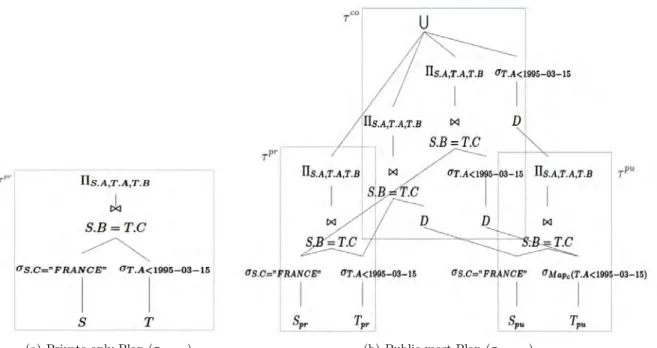
a) Private-only Plan Generation: At this step, an initial query plan (Private-only Plan,τpr on) which could completely run on the private side and doesn’t involve any public side processing will be
created. Figure 2(a) shows the private-only plan forqwhich is always a valid plan since the private cloud
always contains the original datasetR.
b)Public-most Plan Generation: The plan (Public-most Plan,τpu mo), that migrates the largest amount of processing to the public side amongst the candidate query plans, without allowing multi-round data transfer between the two sides (i.e. base data or generated intermediate data can only be transferred
from public to private clouds) will be produced. τpu mois created by successively applying query rewrite
rules to the initial Private-only Plan (Appendix B provides some details on query rewrite rules).
Fig-ure 2(b) shows the public-most plan for qproduced through the private-only plan from Figure 2(a). In
the case of bucketization, when results of the public query are transferred to the private side, additional decryption and filtering of false positives may be required before executing the combination query. The
operatorD in the figure denotes the combination of these tasks.
c) Best Strategy Selection: We now select the cheaper of the Private-only Plan and Public-most
Plan to be used as our strategy for executing queryqover the hybrid cloud. While these two plans might
not be optimal, they represent two extremes in terms of monetary cost and disclosure risk. Namely, the private-only plan has the least monetary cost and disclosure risk, whereas the public-most plan is the one that has the largest monetary cost and disclosure risk. Therefore, they provide a reasonable estimation of execution costs for queries over a hybrid cloud, and moreover, they give acceptable solutions to the
data partitioning problem9.
4.3
Query Workload Cost Estimation
Estimating costs for a query workload requires us to estimate the cost of each individual queryQi. Having
discussed query processing in the previous section, we next discuss mechanisms to estimate query costs.
The execution cost of a query plan over a hybrid cloud can be measured in terms of the total running time required to execute that plan. However, in this paper we will use the I/O size of a query plan as a substitute for the running time in the estimation process. Previous approaches to query cost
estimation in a cloud environment have also used a similar approach, e.g., Afratiet al. [16] use an I/O
(a) Private-only Plan (τpr on) (b) Public-most Plan (τpu mo)
Figure 2: A join query execution
based data-volume cost model to evaluate different algorithms for executing query plans on a cluster. In
another paper, Wuet al. [15] propose an I/O based cost model that is used to evaluate the performance
of query plans in the MapReduce framework. In addition, they also observe that the cost model based on query response time does not improve the accuracy of estimation by much over a model that uses
I/O size. The I/O size of a query planτ in a hybrid cloud can be estimated as:
cτ = (max(Spu+w2×Str, w1×Spr) +w1×Sco), (1)
where Spu and Spr are the estimated I/O sizes on the public and private cloud respectively, Str is
the estimated transfer size of the intermediate results from public to private cloud, andSco is the I/O
size required to combine intermediate results at the private side. The weights w1 and w2 account for
differences in computational resources between a public and private cluster (details are given in Section 5).
In order to accurately calculate Spu, Spr, Str and Sco for any given plan τ, τ will be split into 3
subplans: public cloud subplan (τpu), private cloud subplan (τpr) andcombination subplan (τco). The
subplan τpu is that part of the plan τ that is executed over data in the public cloud, whereas τpr is
executed directly over data in the private cloud. Also,τpu is executed in parallel withτpr. Further,τco
is used to combine the intermediate results generated byτpu andτprinto the final result. Additionally,
onlyτpu is executed within the public side whileτpr andτco are executed at the private side. We also
observe thatτprandτpuneed to be executed before being able to processτco. Splitting the private-only
planτpr onis quite simple; since the entire plan is only a private cloud subplan. (i.e. τpr onpr =q, whereas
τpu
pr on=τpr onco =∅). On the other hand, dividing the public-most plan may be challenging. To overcome
this challenge, we use the partitioning of set P as well as query rewrite rules to divide the public-most
plan into its constituent elements. Figure 2(a) and Figure 2(b) illustrate how the private-only and
public-most plans for queryqare divided into a public cloud, private cloud and combination subplans.
The I/O sizes for the various components of the planτare computed using statisticsSRand the
par-titioning ofP. Unfortunately, Hive does not maintain attribute level statistics for a relation. Therefore,
we implemented a statistics gathering module that analyzes the data for a relation once, and maintains statistics for that relation and its attributes using separate histograms for unencrypted (using partitions) and encrypted (using buckets) versions of attributes. Then, at run-time the I/O size for a query is es-timated using histograms over partitions for non-sensitive attributes and histograms over buckets for sensitive attributes.
Algorithm 2 performs the strategies proposed earlier to compute the cost of each queryQiby applying
Algorithm 2QWC-Est()
Input:Q, SR,Ppu
Output:Query Workload Cost,c
1: c←0
2: fori←1toQ.length do
3: ci← ∞
4: plan list← ∅
5: Generateτpr onandτpu mo forQi
6: plan list.add(τpr on);plan list.add(τpu mo)
7: foreach candidate planτ ∈plan list do
8: resSize←0 {Output Size of planτ}
9: Spu←0{I/O Size of public cloud subplan}
10: Str ←0{I/O Size of Transferred Results}
11: Spr←0 {I/O Size of private cloud subplan}
12: Soppr←0 {Output Size of private cloud subplan}
13: Divideτ intoτpr,τpu andτco
14: Estimate Spu,Str,Spr,Soppr andresSizeusingSRandPpu
15: Sco← |Str+Soppr+resSize|
16: ctau←max(Spu+w2×Str, w1×Spr) +w1×Sco {Total execution cost for planτ}
17: if ctau< ci thenci=ctau end if 18: end for
19: c←c+f req(Qi) ×ci 20: end for
21: return c
query costs to return the overall execution cost ofQ. We begin by creating candidate plans (private-only
or public-most plan) for Qi, and then we estimate the cost of each of these plans (lines 5-17). The
algorithm first initializes various I/O cost variables for a planτ to 0 (lines 8-12). Next, we divide the
planτ intoτpr,τpuandτco (line 13) after which values for the variables are estimated usingSR as well
as the given partitioningPpu (lines 14-15). Note that, for a private-only planSpu=Sco=Str= 0. The
execution cost ofτ is computed using Equation 1 (line 16) and is compared with the current minimum
cost plan value forQi. Finally, the overall cost of Qis computed as a sum of each Qi’s minimum cost
multiplied withf req(Qi) and is returned as the output (lines 19-21). Our current work supports simple
SPJ queries while we leave the support of nested queries as future work.
Additionally, as we said earlier our architecture should be able to compute the monetary cost of
the query workload for a fixed partitioningP0. Our system calculates this monetary cost as the
sum-mation of the monetary cost associated with storing P0 on the public side (i.e. store(P0)) and the
total processing monetary cost (T P M C) for the workload over the partition P0 (i.e. Monetary Cost
of Q for P0 = store(P0) +T P M C). T P M C is computed by adding the monetary cost for
pro-cessing each individual query Qi. The monetary cost for processing Qi is equal to the sum of the
monetary cost related to transferring results from a public to a private cloud during Qi’s execution,
commQi(P0), and the actual monetary cost of processing Qi over the public cloud, procQi(P0). As
a result, T P M C = ∑ni=1commQi(P0) +procQi(P0) and so monetary cost ofQ for P0 = store(P0) +
∑n
i=1commQi(P0) +procQi(P0).
5
Experimental Results
This section presents results of experiments that we conducted to compare the performance of our partitioning algorithm for horizontal and vertical partitioning. We first present details of our setup followed by the experiments.
Experimental Setup: We conducted experiments on two local clusters setup on different sub-networks of the same intranet. The first cluster consists of 9 nodes (used as private cloud) while the second consists of 14 nodes (used as public cloud). Each node consists of a Pentium IV processor with 290GB-320GB disk space and 4GB of main memory. Both clusters are setup using Hadoop v0.20.2 and
Hive v0.6.0.
Statistics collection: The statistics gathering module analyzed the 100GB TPC-H dataset and generated equi-width histograms for every attribute of TPC-H relations. We used the datatypes, int, double and string in Hive to represent TPC-H data. We also created a datatype ‘date’ that allows us to represent various dates from the TPC-H schema. The number of partitions used in a histogram is dependent on the datatype; this number is fixed for a given datatype: (i) For integers and doubles,
the number of partitions =log2(max−min), whereminand maxrepresent the min and max domain
values mandated by TPC-H. (ii) For dates, since TPC-H only allows dates between ‘1992-01-01’ and ‘1998-12-31’, we created one partition for each year from 1992 through 1998. (iii) For strings, we created
95 partitions that cover alphabets (a−z andA−Z), digits (0−9) and all special characters (!, @, #,
etc.).
Bucketization parameters: In our experiments, the number of buckets, B, is a user-configurable parameter that can be varied from 1 to the number of unique values in the domain of an attribute. We also used AES in CTR mode to encrypt subsets of attributes in our experiments.
Query Workload: We have used the TPC-H benchmark with a scale factor 100 in our experiments. We used a query workload of 60 queries containing modified versions of TPC-H queries Q1, Q3, Q6 and Q11. In particular, we do not perform grouping and aggregate operations in any query. Further, we assumed that each query was equally likely in the workload. The predicates in each of the queries are randomly modified to vary the range (as mandated by TPC-H) of the data that is accessed.
Estimation of weights w1 and w2: The weight w1 is calculated as a ratio between the relative
processing time of a private cloud to that of a public cloud. We estimated the relative processing times of our public and private clusters by running all 22 TPC-H queries for a 300GB dataset on them. Then,
w1is computed as the average ratio of the running times of queries on the private cluster to that on the
public cluster. In this way,w1 was estimated to be 1.624. Another interesting observation to be made
here is that the value 1.624 is very close to the ratio of number of nodes used in our public cloud to that
in our private cloud (14/9≈1.556). A value greater than 1 indicates that our private cloud is slower than
our public cloud. Additionally,w1 is used for the private cloud as well as the combination components
of a query since they both run on the same private cluster. The estimation of w2 is done in a similar
way. However, sinceStr is the estimated transfer size, we need to account for the network bandwidth
when computingw2. Therefore,w2is computed as a ratio of the inverse of the network bandwidth to the
processing time on a public cloud. The previously computed processing time was reused. The network
bandwidth was taken to be≈672KB/sec since this is the bandwidth available on our clusters. In this
way,w2 was estimated to be 61.481. This clearly suggests that in the time a unit of data is transferred
from our public to private cloud (a unit is 1 byte, 1MB and so on), the public cloud processes≈61 times
more data. This confirms the intuition that we should move processing to the public side rather than transferring relations and computation from public to private clouds.
Computation of resource allocation cost: The resource allocation cost was computed using unit prices from Amazon Web Services. We specifically used Amazon S3 pricing to determine storage ($0.140/GB + PUT) and communication ($0.120/GB + GET) costs, where the price for PUT and GET operations is $0.01/1000 requests and $0.01/10000 requests respectively. Also, we used Amazon EC2 and EMR pricing to calculate the processing cost ($0.085 + $0.015 = $0.1/hour). Finally, the total public
cloud resource allocation cost was computed as,P RApu≈77K, using the previously given values.
Computation of disclosure cost: The sensitive data disclosure cost can be computed as:
DIS COSTP0=sens(∪ p∈P0
)×dis cost
dis cost=U N IT COST×P r(data is disclosed|data repr.)
where sens(∪p∈P0) is the number of sensitive tuples released for a public side predicate set, which
is approximated by our query estimation module. In addition, dis cost represents the per-tuple unit
disclosure cost which depends on the following factors: (i) A unit price per-tuple,U N IT COST, which
we assume to be $100. (ii) The probability that sensitive data is disclosed given that a particular data representation is used for that data. In our experiments, we considered four different data representations
by bounding the buckets (B) used to store sensitive data such as names, phone numbers and addresses
from TPC-H on the public side. Note that, we assume the values used are supplied to us by an oracle, since the task of determining them is beyond the scope of the current paper. We present each case along
40000 60000 80000 100000 120000 0 20 40 60 80 100 Time (sec) Disclosure Cost (%) No. of Buckets = 1 Private Public Horizontal Vertical 40000 60000 80000 100000 120000 0 20 40 60 80 100 Time (sec) Disclosure Cost (%) No. of Buckets = 10 Private Public Horizontal Vertical 40000 60000 80000 100000 120000 0 20 40 60 80 100 Time (sec) Disclosure Cost (%) No. of Buckets = 100 Private Public Horizontal Vertical 40000 60000 80000 100000 120000 0 20 40 60 80 100 Time (sec) Disclosure Cost (%) No. of Buckets = |No. of unique values|
Private Public Horizontal Vertical
Figure 3: Comparison of partitioning strategies for a variable disclosure cost
with their probabilities (P r): (a) Cleartext -B is set to the number of unique values for each sensitive
attribute; Pr = 10e−5; (b) Bucketized - For our experiments, this case was further divided into the
following sub-cases: (1)B = 100 for each sensitive attribute;Pr = 10e−6; (2)B= 10 for each sensitive
attribute;Pr = 10e−7; (c) Encrypted -B is set to 1 for each sensitive attribute;Pr = 10e−8. Also, the
choices ofB= 10 andB= 100 were randomly made for the bucketized case. Finally, using the previously
defined values, we calculated the various maximum possible public cloud disclosure costs (DISpu) as:
(a) Cleartext - $1.18M; (b) Bucketized - (1)B= 100: $118K; (2)B= 10: $12K; (c) Encrypted - $1.2K.
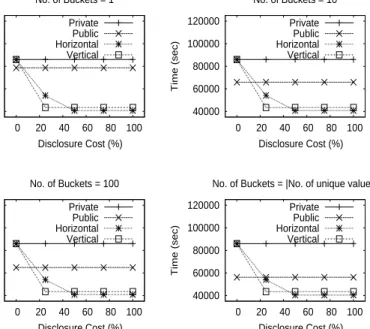
Preliminary Experiments: For all our experiments, we first computed the running time of the query workload for the following cases: (i) All computation is performed on our private cloud (Private). (ii) All computation is performed over public cloud data using one of the four strategies presented earlier (Public). Figures 3 and 5 clearly show that the time taken to run the query workload on the public cloud is much faster than the private cloud. Moreover, there is an additional overhead involved for all cases due to decryption and filtering. This overhead increases as the number of buckets is reduced from
B= number of unique values to B= 1.
Experiments with a variable disclosure cost: The goal of these experiments is to compare for both, the horizontal and vertical partitioning strategies, the query workload performance as well as the monetary expenditure on public side resources when the acceptable disclosure cost increases (from 25%
to 100% of DISpu costs) while the resource allocation cost is fixed randomly (at 50% of the P RApu
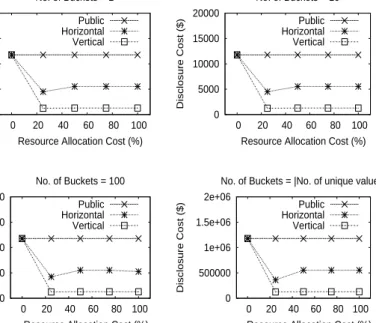
cost). Figure 3 clearly shows that when a user is willing to take additional risks by storing more sensitive data on the public side, they can gain a considerable speed-up in overall execution time (almost 50% for both strategies). On the other hand, Figure 4 shows that the monetary expenditure on public side resources is substantially low even when a user takes additional risks by storing increasing amounts of sensitive data on the public cloud. Finally, from Figures 3 and 4, we also observe that for a relatively
low resource allocation cost (≈28K on average over both cases) we can gain a considerable amount of
speed-up in performance (≈50%).
Experiments with a variable resource allocation cost: These experiments measure the time to run the query workload as well as the monetary expenditure on sensitive data exposure when the
acceptable resource allocation cost is increased (from 25% to 100% ofP RApu) while the disclosure cost
is fixed randomly (at 50% of theDISpu costs). As seen from Figure 5, when a user invests more capital
towards resource allocation, a considerable gain in overall workload performance (almost 50% for both strategies) can be achieved. This is expected since when more resources are allocated on the public side,
25000 50000 75000 100000 125000 0 20 40 60 80 100
Resource Allocation Cost ($)
Disclosure Cost (%) No. of Buckets = 1 Public Horizontal Vertical 25000 50000 75000 100000 125000 0 20 40 60 80 100
Resource Allocation Cost ($)
Disclosure Cost (%) No. of Buckets = 10 Public Horizontal Vertical 25000 50000 75000 100000 125000 0 20 40 60 80 100
Resource Allocation Cost ($)
Disclosure Cost (%) No. of Buckets = 100 Public Horizontal Vertical 25000 50000 75000 100000 125000 0 20 40 60 80 100
Resource Allocation Cost ($)
Disclosure Cost (%) No. of Buckets = |No. of unique values|
Public Horizontal Vertical
Figure 4: Comparison of partitioning strategies for a variable disclosure cost
40000 60000 80000 100000 120000 0 20 40 60 80 100 Time (sec)
Resource Allocation Cost (%) No. of Buckets = 1 Private Public Horizontal Vertical 40000 60000 80000 100000 120000 0 20 40 60 80 100 Time (sec)
Resource Allocation Cost (%) No. of Buckets = 10 Private Public Horizontal Vertical 40000 60000 80000 100000 120000 0 20 40 60 80 100 Time (sec)
Resource Allocation Cost (%) No. of Buckets = 100 Private Public Horizontal Vertical 40000 60000 80000 100000 120000 0 20 40 60 80 100 Time (sec)
Resource Allocation Cost (%) No. of Buckets = |No. of unique values|
Private Public Horizontal Vertical
0 500 1000 1500 2000 0 20 40 60 80 100 Disclosure Cost ($)
Resource Allocation Cost (%) No. of Buckets = 1 Public Horizontal Vertical 0 5000 10000 15000 20000 0 20 40 60 80 100 Disclosure Cost ($)
Resource Allocation Cost (%) No. of Buckets = 10 Public Horizontal Vertical 0 50000 100000 150000 200000 0 20 40 60 80 100 Disclosure Cost ($)
Resource Allocation Cost (%) No. of Buckets = 100 Public Horizontal Vertical 0 500000 1e+06 1.5e+06 2e+06 0 20 40 60 80 100 Disclosure Cost ($)
Resource Allocation Cost (%) No. of Buckets = |No. of unique values|
Public Horizontal Vertical
Figure 6: Comparison of partitioning strategies for a variable resource allocation cost
we are better able to exploit the parallelism that is afforded by a hybrid cloud. Thus, the intuition that a hybrid cloud improves performance due to greater use of inherent parallelism is justified. Additionally, Figure 6 shows that a hybrid cloud approach can considerably downgrade sensitive data exposure risks when compared with the outsourcing approach of moving everything to a cloud provider. Moreover, the sensitive data exposure risks continue to remain low even when a user rents more public side resources. Finally, from Figures 5 and 6, we also notice that irrespective of the data representation used, we can
achieve a considerable improvement in query performance (≈50%) for a relatively low risk (≈30%).
Experiments with dynamic workloads: These experiments measure the robustness of our par-titioning algorithm to variations in query workload characteristics. For these experiments, we initially
constructed multiple query workloads (Workload-1 to Workload-5) by randomly changing the
predi-cates of all queries from the original workload. For example, a selection condition such asl shipdate=
1992−03−01 was randomly changed to l shipdate = 1998−10−31. The experiments were then
conducted in the following two phases: (i) We first fixed the public and private clouds to the partitions
obtained for the case,B = 100,DISpu= 50% andP RApu= 50%. Then, the running times of the
mod-ified workloads were computed for this original partitioning (Original-Partitions). (ii) We next ran the partitioning algorithm using the modified workloads in place of the original workload to create partitions specific to these changed workloads. Next, we computed the running time of the modified workloads on these newly created partitions (Modified-Partitions). Figure 7 clearly shows that for both, horizontal and vertical partitioning, the running times for (i) and (ii) are nearly identical. This assures us of the robustness of our algorithm and further implies that partitions do not need to be changed each time a query workload is modified.
General Observations: We observe from Figures 3 and 5 that for both, horizontal and vertical
partitioning, changing the number of buckets (B) has little effect on the performance time. This is
because our partitioning algorithm leaves most of the sensitive data that is part of the query workload on the private side. Therefore, very little additional overhead (associated with decrypting and filtering
false positives) is incurred even when B is reduced from number of unique values to 1, leading to a
negligible change in query performance. Consequently, both approaches are suitable for users who place a higher weight on executing mission-critical tasks (operating on sensitive data) locally. On the other hand, Figures 4 and 6 show that for both, horizontal and vertical partitioning, there are significant monetary savings to be made even when the risks of data exposure as well as resource allocation costs increase. Therefore, both approaches are appropriate for users who want to balance the risks of sensitive
20000 40000 60000
Workload-1Workload-2Workload-3Workload-4Workload-5
Time (sec) Horizontal Partitioning Original-Partitions Modified-Partitions 20000 40000 60000
Workload-1Workload-2Workload-3Workload-4Workload-5
Time (sec)
Vertical Partitioning Original-Partitions Modified-Partitions
Figure 7: Comparison of partitioning strategies for dynamic workloads
data exposure and a reduced operational budget with optimal query performance.
6
Related Work
Our work builds upon a significant body of prior work on data partitioning (e.g., [7, 8, 5, 6]), distributed query processing (e.g., evolution from systems such as SDD-1 [17] to DISCO [18] that operates on heterogeneous data sources, to Internet-scale systems such as Astrolabe [19], and cloud systems [20]), and data privacy [21, 4, 22]. However, to our knowledge, this is the first paper that takes a risk-based approach to data security in the hybrid model. Also, the modeling of monetary constraints into the optimization problem at hand is a novel exploration in this domain. We summarize a few of the most relevant previous works below.
Data partitioning has been studied fairly extensively in distributed and parallel databases from a variety of perspectives, ranging from load balancing [5], efficient transaction processing [6] to physical database design [7, 8]. In [8], the authors consider the problem of workload driven horizontal data partitioning for parallel databases. They propose a two step approach wherein the first step involves candidate partition generation and the second step is partition evaluation which selects the best partition for each table with respect to the given workload. They generate partitioning “keys”, which are basically sets of attributes to be considered together as keys to hash functions that a partitioner will use. They
use columns that appear in join and grouping statements to generate candidate keys. In contrast,
we use the predicates appearing in query statements (or predicates derived from them) as criteria for partitioning the tables across the private and public clouds which gives us greater control over deciding which particular records get replicated on the public side since disclosure risk is also a concern in our framework. Furthermore, having a predicate based partitioning makes our statistics more accurate and more efficient to compute than in [8] where they have to resort to sampling after the partitioning function is applied.
A more recent related paper [6] looks at the data partitioning and replication problem in distributed databases for supporting OLTP queries efficiently. The objective is to improve the throughput by reduc-ing the time it takes to commit a transaction that needs to access multiple records distributed across multiple nodes of a cluster with a shared nothing architecture. The time taken to complete a transaction is dependent upon whether it accesses data on a single node or multiple nodes and therefore, reducing the number of such multi-node transactions can significantly increase the throughput. They propose a graph based data partitioning (including limited replication) approach based on a well known class of graph partitioning algorithms called METIS [23] which are known to generate balanced partitions in practice. The idea is to store all nodes within each partition at a single node and minimize the number of edge crossings between different partitions which in turn minimizes multi-node transactions. Previous approaches have used round-robin, range partitioning and hash partitioning based techniques [24] for distributed and parallel databases. However, a graph partitioning based approach proposed in [6] may not be very suitable for our setting, most importantly because of the poor scalability of graph partition-ing algorithms with size of the graph. Since the graph size is proportional to the number of records in tables, such an approach is not amenable (as yet) for even medium sized databases. Also, since we are not considering typical OLTP workloads, the execution time of a query is not so dependent on it being