Contents
Acknowledgements ... 5
English summary ... 7
Background ... 7
Aim of the PhD-project ... 8
Summary of methods ... 9
Analyses ... 10
Summary of results ... 11
Discussion and conclusions ... 12
Strengths and limitations ... 13
Conclusion and perspectives ... 15
Dansk sammenfatning ... 17
Baggrund ... 17
Formålet med PhD-projektet ... 19
Sammenfatning af de anvendte metoder ... 20
Analyser ... 21
Sammenfatning af resultater... 21
Diskussion og konklusion ... 23
Styrker og svagheder ... 24
Endelig konklusion og perspektiver ... 26
1. Foreword ... 29
2. Psychological aspects of learning ... 31
2.1. The behaviorist perspective ... 31
2.2. The cognitive perspective ... 33
2.3. Development of approaches to learning ... 34
2.4. Levels of Processing in student learning ... 35
2.4.1. Craik and Lockhart ... 35
2.5. Conceptions of deep and surface learning ... 37
2.5.1. The Gothenburg group ... 37
2.5.2. Pask ... 39
2.5.3. Biggs ... 40
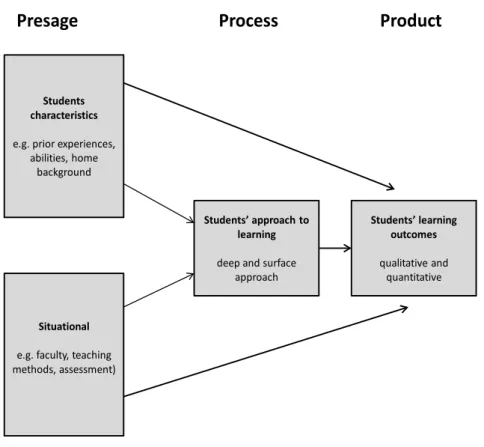
2.6. The 3-P model - A model of learning ... 43
2.7. Measurement of Approaches to Learning ... 48
2.8. Summary ... 49
3. Predictors of SAL - Empirical findings ... 51
3.1. Student background characteristics ... 51
3.2. Student motivational factors ... 53
3.3. Institutional and teaching context ... 56
3.4. Student perception of context ... 60
3.5. Student learning outcomes ... 61
3.6. Summary of the evidence ... 62
4. Aims and hypotheses ... 65
5. A summary of methods ... 67 5.1. Phase 1... 68 5.2. Phase 2... 68 Phase 3 ... 70 Phase 4 ... 72 Phase 5 ... 73 6. Summary of results ... 76 6.1. Paper 1 ... 76 6.2. Paper 2 ... 78 6.3. Paper 3 ... 82 6.4. Additional results ... 84 6.4.1. Expected grade ... 85
6.4.2. The role of personality? ... 88
6.4.3. Social desirability ... 92
7. Discussion ... 97
7.1. Reliability and validity of a Danish adaptation of the Study Process Questionnaire ... 97
7.2. Predictors of SAL in Danish university students ... 100
7.2.1. Student background characteristics ... 100
7.2.2. Student motivational factors ... 103
7.2.3. Institutional and contextual factors ... 105
7.2.4. Student perception of context ... 108
8. Strengths and limitations ... 112
8.1. Strengths ... 112
8.1.1. Addition to the 3-P model ... 112
8.1.2. Sample ... 112
8.1.3. Methods ... 113
8.2. Possible limitations ... 114
8.2.1. Representativity ... 114
8.2.2. Quantitative versus qualitative methodology ... 115
8.2.3. Reliability and validity of the Danish version of the SPQ ... 115
8.2.4. Between groups vs. within groups ... 117
8.2.5. Cross-sectional design ... 118
8.2.6. Outcomes of learning ... 119
8.2.7. The influence of personality ... 120
8.2.8. Social desirability ... 121
9. Conclusions and perspectives... 124
References ... 129
Appendix
• Lassesen B. Learning Strategies in a Danish university context - Testing the reliability and validity of the Revised Two-Factor Study Process Questionnaire. (PAPER 1)
• Lassesen B. & Jensen T.K. Demographic and Contextual predictors of student approaches to learn and in a large sample of Danish university students. (PAPER 2)
• Lassesen B. & Jensen T.K. Motivational factors as predictors of student approach to learning (PAPER 3)
Acknowledgements
I am indebted to my former supervisor, the late Professor Steinar Kvale, Department of Psychology, Aarhus University, for believing in me and this project. He is deeply missed.
My deepest thanks goes to my secondary supervisor and mentor, Torben K. Jensen, PhD, director, Centre for Teaching and Learning, Aarhus University, for planting the idea of pursuing a PhD degree and making sure that I persisted, and for the unlimited support and all the discussions, guidance, and constructive feedback throughout the project.
I am also deeply grateful to Professor, MDSci, Robert Zachariae, Department of Psychology, Aarhus University, and Aarhus University Hospital, for being such an inspiration in the pursue of academic skills, and for his willingness to discuss and share both my triumphs and my failures with me; for teaching methodological skills in a situated way, and for the invaluable help in conducting the statistical analyses and the interpretation of these.
I thank my supervisor professor Klaus Nielsen, PhD, Department of Psychology, Business and Social Sciences, Aarhus University for taking over the role as a supervisor during difficult times in my time as a PhD fellow at the Department of Psychology and Behavioural Sciences. I am grateful for his support and valuable feedback on my work.
I also wish to thank:
- Professor Keith Trigwell and the staff at the Institute for Teaching and Learning, University of Sydney, Australia for supervision, collaboration, teaching, discussions, and friendship during my appointment as a visiting scholar.
- Professor John Biggs for allowing me to use both the original and the revised version of SPQ, Professor Wilbert (Bill) McKeachie for allowing me to use scales from MSLQ, and Professor Kirsti Lonka for allowing me to use scales from the MED NORD study.
- My research assistants Lisbeth Grønborg and Merete Poulsen
- My wonderful colleagues and friends at Department of Psychology and Behavioural Sciences and Centre for Teaching and Learning for making me feel welcome, and for reminding me of that there may be different ways of seeing things.
- The administrative staff at Department of Psychology and Behavioural Sciences at Aarhus University for helping me with all the practicalities during my employment.
- All the teachers and students at Aarhus University, who so generously gave their time and participated in this study - without you this was not possible.
- And last but not least, my family and friends, for travelling with me all the way and surrounding me with love and support - reminding me that there is more to life than work, and yet
understanding the times where it had to be prioritized.
English summary
Background
Knowledge of how students go about their studies can be valuable for teachers, study counselors, and researchers, and with an increasing societal demand towards effectiveness and competence in higher education, there has been an increased interest in investigating and assessing student learning and study strategies.
Historically, several theoretical positions have dominated the landscape of learning theories: The behaviourist position, cognitive approaches, the information processing position (IP), and the Student Approach to Learning (SAL). SAL, the most recent approach, was developed in attempts to amend various limitations of the previous positions, e.g. the low ecological validity of stimulus-response- and memory-focused cognitive laboratory research, and focuses on academic learning research as the study of the student’s construction of meaning carried out in the natural educational settings.
The SAL perspective on students draws upon the Presage, Process, and Product (3P) model suggested by Dunkin and Biddle (1974) and the pioneering studies by Marton and colleagues (Marton and Säljö, 1976a; b). This model focuses on the interrelationship between personal characteristics of the students, the situational constraints in which they find themselves, their approach to learning, and the outcome of learning. Students’ perceptions of teaching and learning context are seen as a result of the interaction between their previous experiences of teaching and learning and the context itself.
Marton & Säljö (1976a; b) identified two basic levels of processing: a surface and a deep level, and subsequent research in the area has consistently confirmed these two broad approaches to learning.
working conceptually rather than with unrelated detail” (Biggs, 2003), and is likely to be promoted by teaching methods promoting critical thinking and meaningful interaction, where students are given the opportunity to challenge and question, and when the learning task is perceived to be relevant to student’s interests. In contrast, surface level processing seems more determined by non-academic priorities, insufficient time, high anxiety levels of the students, by an instructional environment unable to bring out the intrinsic structure of the learning material, and by assessment methods rewarding reproduction of information.
Studies of learning approaches and learning outcomes have found Deep Approach to be most consistent with the goals of higher education and to be related to higher quality learning outcomes, while a Surface Approach is usually found associated with lower quality outcomes. Given that learning approaches appear to be highly susceptible to outside influences, especially the learning environment, knowledge about the factors influencing learning approach can assist teachers in developing and implementing teaching strategies that encourage appropriate learning strategies.
Aim of the PhD-project
Factors, which can explain the variance in learning approach of students in Higher Education, have been extensively studied in the international context. The available studies, however, have often been based on relatively small samples and have generally focused on few selected variables. Furthermore, only very little is known about student learning in the Danish University context. The aims of the present PhD-project were therefore: 1) to translate into Danish one of the most widely used instrument assessing students’ approach to learn, the Study Process Questionnaire (SPQ) (Biggs 1987; 2001), and to provide a preliminary test of its reliability and validity in a sample of Danish university students, and 2) to use the instrument to explore the learning approaches of
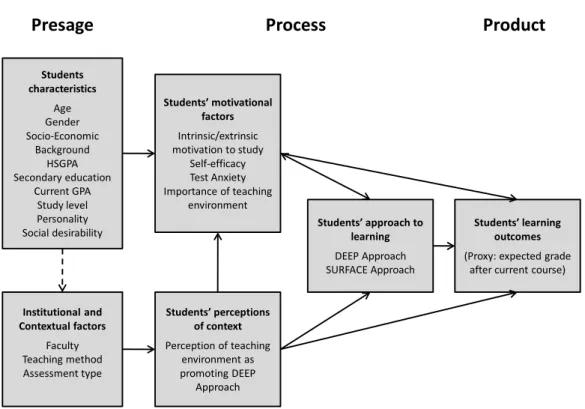
Danish university students and – following the 3-P model – to identify the major a) presage factors, i.e. student background characteristics and institutional and teaching context variables, and b) motivational factors, i.e. perception of the teaching environment, self-efficacy, and test-anxiety, which could explain the variance in Deep and Surface learning approach of Danish university students. Based on a review of the existing, international SAL research, a number of specific hypotheses concerning the associations between various presage and process factors and Deep and Surface Approach were stated and tested.
The methods and results have been described in the three papers included in the present thesis:
• Lassesen B. Learning Strategies in a Danish university context - Testing the reliability and
validity of the Revised Two-Factor Study Process Questionnaire. (PAPER 1)
• Lassesen B, Jensen T.K. Demographic and Contextual predictors of student approaches to
learn and in a large sample of Danish university students. (PAPER 2)
• Lassesen B, Jensen T.K. Motivational factors as predictors of student approach to learning
(PAPER 3)
Summary of methods
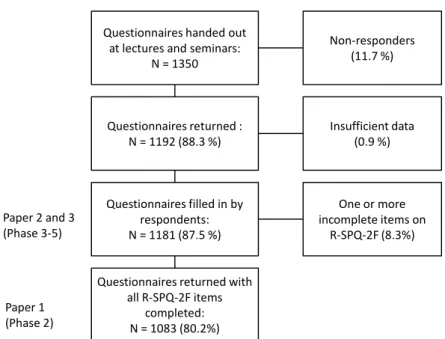
A total of 1350 questionnaires were handed out at lectures and seminars to undergraduate (3rd semester) and graduate students (7th and 9th semester) recruited from four major faculties at Aarhus University: Arts, Social Science, Health Science, and Science. A total of 1192 questionnaires were returned (response rate: 88.3%). The 1083 students who had completed all items of the Revised Two-Factor Study Process Questionnaire (R-SPQ-2F) (80.2%) were included in the validation study of the questionnaire (PAPER 1). The 1181 students who had responded to all questionnaires in the questionnaire package (response rate: 87.5 %), but had not necessarily completed all items of
the R-SPQ-2F, were included in the subsequent analyses of the potential presage- and process predictors of Deep and Surface approaches to learn (PAPER 2 and 3).
The dependent variables were Deep and Surface levels of approach to learn (R-SPQ-2F). The
independent variables explored were student background characteristics and institutional and teaching context variables. The background variables included age, gender, socio-economic
background measured through parental educational background, High School GPA, their secondary education, current study level, and current GPA. The context variables were faculty, the teaching method used in the course they were taking and the assessment methods to be used at the end of the course. In addition, the following motivational factors were assessed: Intrinsic and extrinsic
motivation to study, academic self-efficacy, test-anxiety, the perception of the current learning environment, and the importance they placed on the learning environment characteristics.
Analyses
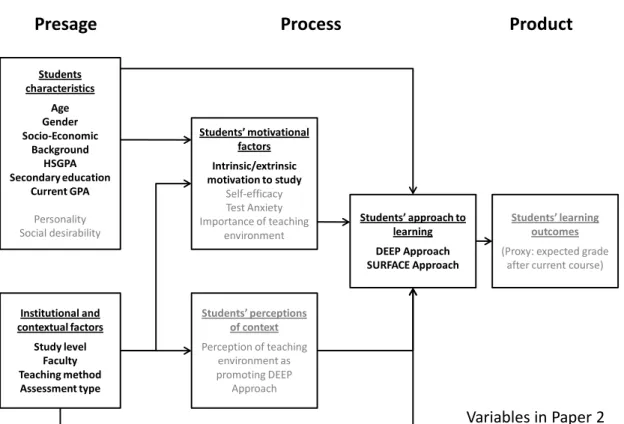
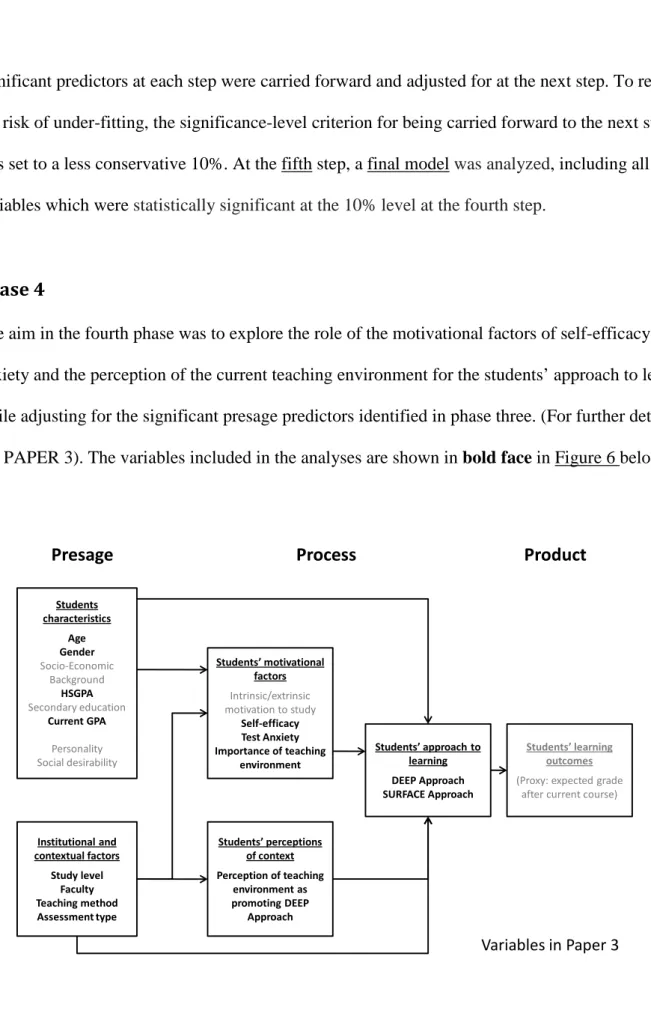
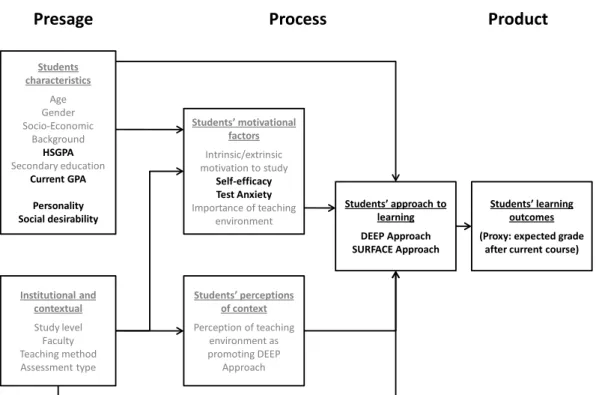
The preliminary reliability and validity of the R-SPQ-2F-DA was analyzed with descriptive and reliability statistics (internal consistencies; Cronbach’s alpha) and confirmatory factor analyses (CFA), following the analytical steps described by Biggs et al. (2001) for the English-language version of the R-SPQ-2F (PAPER 1). In subsequent studies (PAPER 2 and 3), the predictors of learning approach were analyzed with both unadjusted bivariate and multiple regression analyses with Deep and Surface Approach as dependent variables, adjusting for the other independent variables investigated. In each analysis, the selection of predictor variables and the order in which they were entered in the multiple regression models were based on theoretical grounds, i.e. the 3P model (Biggs, 1987).
Summary of results
PAPER 1: Internal consistencies of the subscales of the Danish R-SPQ-2F were higher or comparable to those reported for the English-language original. CFA suggested moderately acceptable fit at the item-level (CFI= 0.815; SRMR= 0.07; GFI= 0.874) with further analyses indicating the lesser fit to be primarily related to one the subscales: Surface Strategy (SS). A model treating the subscales as indicators of the two latent factors, Deep (DA) and Surface Approach (SA), showed better fit (CFI= 0.927; SRMR=0.05; GFI= 0.952). The results indicated that a 19-item Danish version of the R-SPQ-2F could be used for further analyses with the aim of providing preliminary data for Danish university students.
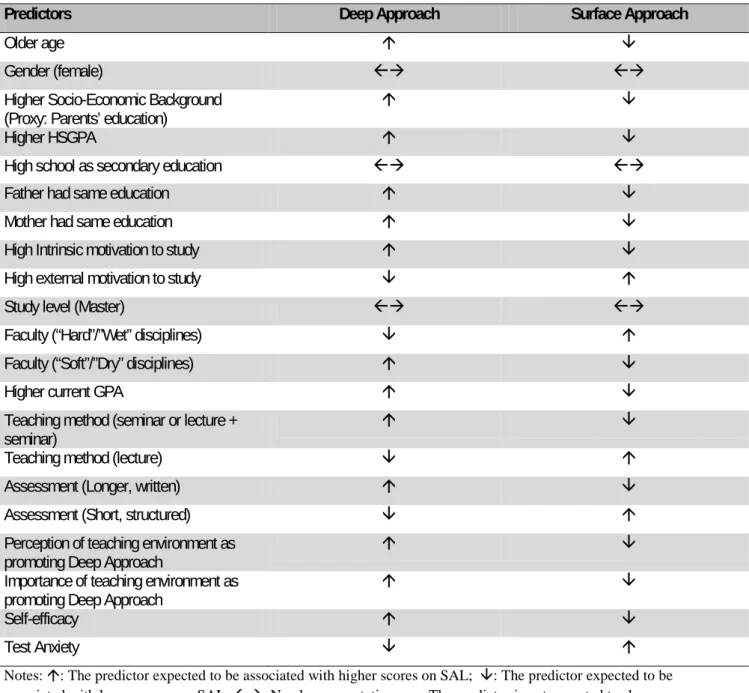
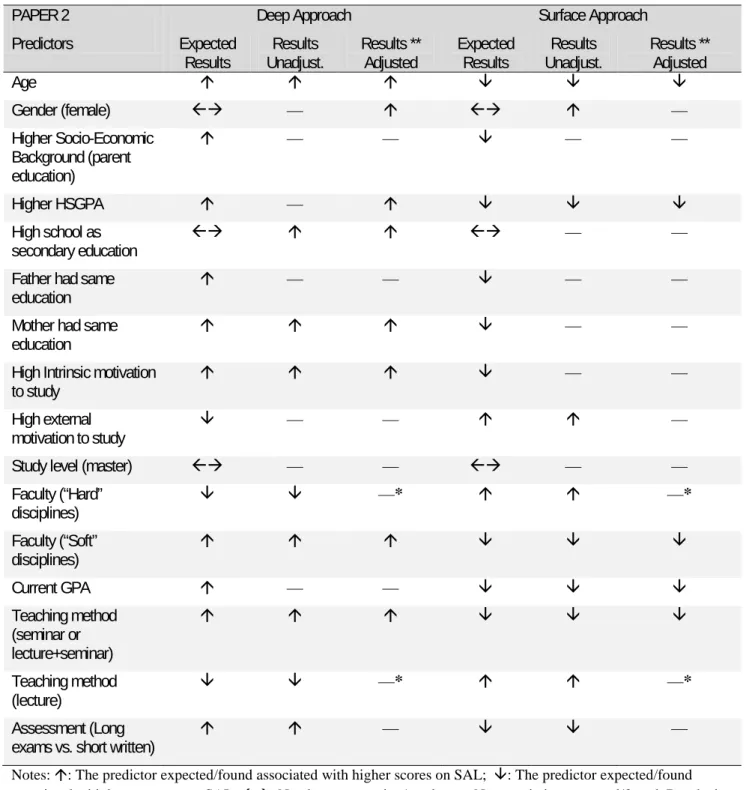
PAPER 2: Further analyses showed that the main independent presage (background and contextual) predictors of higher scores on Deep Approach to learn were: older age, female gender, higher High School Grades, intrinsic motivation to study, studying at the faculties of Arts and Social Sciences, and small-group seminar as the teaching method. Among the independent predictors of higher Surface Approach scores were: younger age, lower high school grades, studying at the faculties of Health Sciences and Science, lower current GPA, and lectures as teaching method. The final models, however, explained no more than 7% of the variance of Deep Approach and 10% of the variance in Surface Approach.
PAPER 3: In the third study the associations of psychological motivational factors of academic self-efficacy, test-anxiety, and the perception of the teaching environment and the perceived importance of the teaching environment with Deep and Surface Approach were explored while controlling for the previously investigated were examined, where the results showed that each of the student motivational factors of self-efficacy, test-anxiety, and perception and importance of the teaching
environment were strong independent predictors of students approach to learning, even when taking other motivational, background, and institutional factors into consideration. When adding the motivational factors to the models, the explanatory power was increased considerably to 28% of the variance in Deep and 21% of Surface Approach.
Discussion and conclusions
First, the results indicated that the Danish version of the R-SPQ-2F could be used for further analyses, and the results of the subsequent analyses supported the validity of the instrument in a Danish context. However, the results also suggested that further adjustments, primarily of the Surface Strategy (SS) subscale, are needed to establish a suitable version of the SPQ for Danish university students.
Second, several of the results were consistent with reported findings in the international literature on SAL; mainly that Deep Approach was associated with older age, higher HSGAP, current GPA, intrinsic motivation to study, and studying subjects associated with “soft” sciences such as the Arts. Furthermore, the results confirmed that the contextual factor of small-group teaching methods, e.g. seminars or lectures in combination with seminars, was associated with greater tendencies to use Deep approaches to learning. Somewhat surprisingly, assessment methods did not emerge as an independent significant predictor when adjusting for the remaining factors, which could be due to shared variance or interactions with some of the other factors, e.g. faculty and teaching method. Likewise, results previously found for Surface Approach were also generally confirmed. Taken together, the results indicated that the background and contextual factors only explained a relatively modest proportion of the variance in students approach to learn, suggesting that other factors, e.g. more direct motivational factors, could be relevant to explore.
Third, that motivational factors could add to our understanding of SAL was confirmed by the findings that academic self-efficacy, test anxiety, and the perception and importance of the learning environment were important predictors of approach to learn, adding considerably to the explanatory power of the models. Although successful learning largely depends on knowledge and skills,
motivational factors such as self efficacy and test anxiety also play an important role as predictors of students’ learning approaches, and subsequent learning outcomes. The results also indicated that perceiving the learning environment as stimulating problem solving, scientific thinking, and exam preparation in concordance with a Deep Approach to learning was an equally important predictor as self-efficacy.
Strengths and limitations
To this author’s knowledge, SAL has not previously been explored in the Danish university context, and the results thus add to the cross-cultural validation of both SAL as a model of learning and the SPQ as an instrument to assess SAL. The present study has several strengths. First, the majority of previous studies have used relatively small samples of convenience and have frequently only included relatively few predictors in each study, which means that the associations between the predictors and SAL have rarely been adjusted for other - potentially confounding - factors. In the present study it was attempted to amend these weaknesses by including one of the largest samples in this area of research with students at different study levels from several faculties representing both “soft” and “hard” disciplines, thereby increasing the representativity of the sample. Second, the large sample allowed for statistical adjustment for several relevant factors using a multivariate approach, enabling comparison of unadjusted bivariate associations with results adjusting for the remaining factors investigated. Our results thus support several previous findings, which mainly
have been explored in studies based on relatively small samples and focusing on a few selected variables. Third, the empirical evidence concerning the influence of expectancy and affective motivational components on study behavior is so far very limited, and the model of learning was therefore expanded in the present study to include these motivational variables while adjusting for other factors known to influence student approaches to learning. Finally
In spite of the strengths described above, a number of potential challenges and limitations of the present study should also be noted.
, attempts were made to ascertain that the main instrument to measure the dependent variable, the R-SPQ-2F, was translated following the general recommendations for cross-cultural adaptation, tested in a pilot study, and its psychometric properties explored with the appropriate methods, e.g. confirmatory factor analysis prior to the analyses of the final dataset.
First, while the number of participants is large, we cannot be certain that the sample is sufficiently representative, as all students were from Aarhus University. Second, while the overall response rate of 88.3% can indeed be considered highly satisfactory, the total number of students at the master level included was somewhat smaller than originally
intended, which could affect the statistical power to detect differences associated with study level. Third, a potential limitation of the present study is the quantitative questionnaire-based
methodology used. Quantitative methods imply reductionism, and the explanatory power could of course be challenged if the suggested model, as it is operationalized in the SPQ, does not
sufficiently capture the fundamental nature of the factors related to SAL. Finally, while the SPQ has been used in a large number of international studies, it had not previously been used in a Danish context, and evidence for the reliability and validity of the Danish adaptation is still not fully
available, as indicated by the less than satisfactory results for the Surface subscales, in particular the SS-subscale.
Conclusion and perspectives
Students’ approaches to learning (SAL) vary. Deep Approach, i.e. studying to develop personal understanding, has been found to correspond more to the requirements in higher education than Surface Approach, i.e. studying with the purpose of reproducing knowledge at a later time. Similar teaching and learning environments are not experienced in a similar way by the students attending, and teachers as well as administrators in higher education should be aware of factors that may either promote or hinder students in actively engagement and development of their own individual
understanding of what is being learned.
While being significant independent predictors, factors that can be influenced through recruitment, e.g. age, gender, HSGPA, study choice motivation, and previous educational experience, were only relatively weak predictors of SAL. The results indicate that although there seems to be good reason to continue the current admission requirements, it is also important that students have a genuine interest for the subject they have chosen.
Among the more salient predictors were teaching methods and – most prominently – motivational factors such as academic self-efficacy, test anxiety, and perception of the teaching environment as promoting deep approaches to learn. The results thus indicate that the learning environment and learning objectives, the student’s perception of these, and the perceived capacity to succeed at the task in question are potential important variables through their effects on student motivation and learning, regardless of the remaining demographic, institutional, and contextual variables. Therefore it is essential to facilitate active student collaborating, problem solving learning activities in which students are given the opportunity to regulate their own learning activities and form their own
opinion of what is being learned. Learning practices should as far as possible go beyond trivia and simple memorizing for examinations.
Although it could benefit from adjustments, the availability of an instrument such as a Danish version of the R-SPQ-2F creates opportunity for 1) further examination of the quality of the
learning activities in the university context, 2) raising students’ awareness of their own approach to learning and 3) investigating the impact of training and of changes in the teaching-learning system.
Dansk sammenfatning
Baggrund
Universiteterne står aktuelt overfor en pædagogisk udfordring. De studerende på de videregående uddannelser udgør en stadig mere uensartet gruppe. Heterogeniteten skyldes flere forhold. Dels har de studerende meget forskelligartede sociale baggrunde, og dels møder de op med meget forskellige faglige forudsætninger på grund af den brede vifte af adgangskriterier. Udviklingen medfører store krav til institutionerne og de universitetspædagogiske udviklingsenheder i form af at kunne bidrage med evalueringer af undervisningens kvalitet og årsager til frafald. Ligeledes vil viden om hvilke forhold der har betydning for og stimulerer og motiverer de studerende til hensigtsmæssig
læringsadfærd, herunder forventninger til uddannelse, undervisning og undervisere på
universiteterne, således være værdifuld for såvel undervisere, som studievejledere og forskere.
Det læringsteoretiske landskab været domineret af flere positioner: Fra behavioristiske over kognitionspsykologiske tilgange til konstruktivisme hvoraf den seneste udvikling - den såkaldte Student Approach to Learn (SAL) tilgang udspringer. På baggrund af begrænsninger ved de tidligere positioner, fx den begrænsede økologiske validitet som karakteriserer stimulus-respons-teorier og hukommelses-fokuserede kognitive laboratorieundersøgelser fokuserer SAL i
modsætning til de førnævnte tilgange på akademisk læring og kompleksiteten i de kognitive læringsprocesser og de studerendes konstruktion af mening, således som den foregår i de faktiske undervisningsmiljøer. SAL bygger på de banebrydende undersøgelser af Marton og kolleger (Marton og Säljö, 1976a, b; Svensson, 1977; Fransson, 1977) og den såkaldte 3-P-model (Presage, Process and Product) (Biggs, 1985; 1987; 1989; 1999), foreslået af Dunkin og Biddle (1974). Modellen fokuserer på sammenhængene mellem de studerendes personlige karakteristika og
tidligere erfaringer med undervisning og læring, de situationsbestemte forhold som karakteriserer læringssituationen (f.eks. undervisnings- og eksamensform), de studerendes valg af læringsstrategi i relation til oplevede læringskrav og resultatet af læringsprocessen.
Marton & Säljö (1976a; b) identificerede to grundlæggende processerings-niveauer for læring: et overflade- og et dybdelæringsniveau, og den efterfølgende forskning på området har gennemgående bekræftet disse to tilgange til læring. Dybdelæring er generelt karakteriseret ved en "en ægte
præference for, og evne til, at arbejde konceptuelt snarere end med isoleret detail-viden" (Biggs, 2003), og antages at fremmes af undervisningsmetoder, der fokuserer på involverende undervisning, der opfordrer til - og stimulerer kritisk tænkning, hvor de studerende får mulighed for at udfordre den præsenterede viden og stille spørgsmål, og af læringsopgaver der opleves som relevante og vedkommende for de studerende. I modsætning hertil synes overfladelæring i højere grad at være bestemt af ikke-akademiske prioriteringer, et undervisningsmiljø der er ude af stand til at fremstille den indre struktur i det anvendte undervisningsmateriale, tidspres i undervisningen og
eksamensformer, der belønner reproduktion og fremmer et højt angstniveau hos den studerende. Forskning i sammenhængen mellem læringsstrategier og læringsudbyttet i de videregående uddannelser viser, at resultatet af de studerendes læring hænger sammen med hvordan de lærer. Dybdelærings-strategier er forbundet med læringsresultater af højere kvalitet, mens
overfladelærings-strategier ofte er forbundet med læringsresultater af lavere kvalitet.
Læringsstrategier er reaktioner på det undervisningsmiljø, de studerende lærer i; dette ligger i begrebets relationelle natur (Ramsden, 1992). For at kunne støtte undervisere i at udvikle og
gennemføre undervisningsformer, der tilskynder og stimulerer de ønskede lærings aktiviteter, er det nødvendigt at opnå viden om de faktorer, der påvirker de studerendes læringsstrategier.
Formålet med PhD-projektet
Faktorer, som kan forklare variationen i læringsstrategier blandt studerende på de videregående uddannelser, er velundersøgt i international sammenhæng. De foreliggende undersøgelser har dog ofte været baseret på relativt små stikprøver og har generelt fokuseret på nogle få udvalgte variable. I den danske universitetskontekst har man derimod relativt begrænset viden om hvilke faktorer, der har betydning for de studerendes læring. Formålet med herværende PhD-projekt var derfor: 1) at oversætte et af de mest udbredte instrumenter til vurdering af de studerendes læringsstrategi, the Study Process Questionnaire (SPQ) (Biggs 1987; 2001), til dansk og at gennemføre en foreløbig vurdering af instrumentets pålidelighed og validitet i en større gruppe af danske
universitetsstuderende, og 2) at anvende dette instrument til at udforske læringsstrategier blandt danske universitetsstuderende og i denne forbindelse, med udgangspunkt i 3-P-modellen, at identificere de væsentligste prædiktorer for de studerendes valg af læringsstrategi, herunder: a) de studerendes baggrundskarakteristika samt de institutionelle og undervisningskontekstuelle
baggrundsvariable, og b) centrale motivationelle faktorer, herunder de studerendes oplevelse af undervisningsmiljøet, akademisk self-efficacy, og eksamens-angst (test anxiety). Baseret på en gennemgang af resultater fra den eksisterende internationale SAL-forskning opstilledes en række specifikke hypoteser vedrørende sammenhænge mellem forskellige faktorer i 3-P-modellen og de studerendes tendens til hhv. dybde- og overfladelæring.
De anvendte metoder og opnåede resultater er beskrevet i de tre artikler, som indgår i nærværende afhandling:
• Lassesen B. Learning Strategies in a Danish university context - Testing the reliability and
validity of the Revised Two-Factor Study Process Questionnaire. (PAPER 1)
• Lassesen B, Jensen T.K. Demographic and Contextual predictors of student approaches to
learn and in a large sample of Danish university students. (PAPER 2)
• Lassesen B, Jensen T.K. Motivational factors as predictors of student approach to learning
(PAPER 3)
Sammenfatning af de anvendte metoder
I alt 1350 spørgeskemaer blev uddelt ved forelæsninger og seminarer til bachelorstuderende (3. semester) og kandidatstuderende (7. og 9. semester) rekrutteret fra fire fakulteter ved Aarhus Universitet: Humaniora (Arts), Samfundsvidenskab (Business and Social Sciences),
Sundhedsvidenskab (Health) og Naturvidenskab (Science and Technology). I alt 1192
spørgeskemaer blev returneret (svarprocent: 88,3 %). De 1083 studerende, der havde besvaret alle spørgsmål i den oversatte reviderede SPQ (R-SPQ-2F) (80,2 %), blev inkluderet i
valideringsundersøgelsen af spørgeskemaet (PAPER 1). I alt 1181 studerende, som havde besvaret alle spørgeskemaer i spørgeskemapakken (svarprocent: 87,5 %), men som ikke nødvendigvis havde besvaret alle spørgsmål i de enkelte spørgeskemaer, herunder R-SPQ-2F, blev inkluderet i den efterfølgende analyse af de potentielle prædiktorer af dybde- og overfladelæringsstrategier (PAPER 2 og 3).
De afhængige variable var hhv. dybde- og overfladelæring (R-SPQ-2F). De uafhængige variable var de studerendes baggrundsfaktorer samt institutionelle og undervisningsrelaterede kontekstvariable. De undersøgte baggrundsvariable omfattede bl.a.: 1) alder, 2) køn, 3) social baggrund (målt ved forældrenes uddannelsesmæssige baggrund), 4) den selvrapporterede adgangsgivende
studentereksamenskarakter, 5) deres adgangsgivende uddannelse (f.eks. gymnasium, HF, HTX etc.), 6) deres aktuelle studietrin (Bachelor vs. Kandidat) og 7) selvrapporterede nuværende karaktergennemsnit på studiet. De undersøgte kontekstvariable var: 1) fakultet, 2) studietrin 3) undervisningsmetode (seminar, forelæsning m.v.) der blev anvendt på det fag, de blev anmodet om at udfylde R-SPQ-2F på baggrund af og 4) den eksamensform, som ville blive anvendt ved
afslutningen af det pågældende fag (f.eks. kort skriftlig eksamen (f.eks. 3, 6, 27 timer), skriftlig hjemmeopgave, mundtlig eksamen etc.). Derudover blev følgende motivationsfaktorer undersøgt: Indre og ydre motivation for deres studievalg, akademisk self-efficacy, eksamens-angst, oplevelsen af de aktuelle undervisningsaktiviteter på det pågældende fag var for dem og betydningen af dette.
Analyser
Den foreløbige reliabilitet og validitet af den danske oversættelse af R-SPQ-2F blev undersøgt med deskriptiv statistik, reliabilitetsanalyser (intern reliabilitet: Cronbach’s Alpha) og konfirmatorisk faktor-analyse (CFA) under anvendelse af de analytiske trin, som er beskrevet af Biggs et al. (2001) for den oprindelige engelsksprogede version af R-SPQ-2F (PAPER 1). I de efterfølgende
undersøgelser (PAPER 2 og 3), blev prædiktorer for dybde- og overfladelæring analyseret med ikke-korrigerede bivariate regressionsanalyser samt multiple hierarkiske regressionsanalyser med dybde- og overfladelæring som afhængige variable - justeret for de øvrige uafhængige undersøgte variable. I hver analyse blev udvælgelsen af prædiktorvariable og den rækkefølge hvori de blev optaget i de multiple hierarkiske regressionsmodeller foretaget på baggrund af teorien, dvs. 3P-modellen (Biggs, 1987).
PAPER 1: Den interne reliabilitet for den danske version af R-SPQ-2F var højere eller
sammenligneligelig med resultaterne for den engelsksprogede originalversion. Den konfirmatoriske faktoranalyse (CFA) indikerede et moderat acceptabelt fit på item-niveau (Fit-indices: CFI = 0,815; SRMR = 0,07; GFI = 0,874). Efterfølgende analyser pegede på, at det mindre tilfredsstillende fit var primært relateret til den ene af to subskalaer for overfladelæring: Surface Strategy (SS). En model, der anvendte de enkelte subskalaer som indikatorer for de to latente faktorer (Deep og Surface Approach), viste et bedre fit (CFI = 0,927; SRMR = 0,05; GFI = 0,952). Samlet pegede resultaterne på, at en modificeret 19-item dansk version af R-SPQ-2F kunne anvendes til yderligere
undersøgelse af validiteten og mhp. at frembringe præliminære data vedrørende de to overordnede læringsstrategier (dybde- og overfladelæring) for danske universitetsstuderende.
PAPER 2: De efterfølgende analyser viste, at de vigtigste uafhængige baggrunds- og kontekstuelle prædiktorer for højere grad af dybdelæring var følgende: 1) at den studerende var ældre, 2) var kvinde, 3) havde højere studentereksamenskarakter, 4) havde indre-styret motivation for valg af studium, 5) studerede på det humanistiske (Arts) eller det samfundsvidenskabelige (Business and Social Science) fakultet, og 6) at undervisningsformen foregik i mindre grupper
(seminarundervisning). Blandt de uafhængige prædiktorer for højere grad af overfladelæring var: 1) yngre alder, 2) lavere studentereksamenskarakter, 3) at studere på den sundhedsvidenskabelige (Health) eller naturvidenskabelige (Science) fakultet, 4) at have lavere selvrapporteret
gennemsnitskarakter på studiet, og 5) forelæsning som undervisningsmetode. De samlede statistiske modeller forklarede dog ikke mere end ca. 7 % af variationen af dybdelæring og 10 % af
PAPER 3: I det tredje sæt analyser undersøgtes betydningen for dybde- og overfladelæring af en række psykologiske motivationsfaktorer: akademisk self-efficacy, eksamens-angst, og oplevelsen og betydning af undervisningsmiljøet. Der blev samtidig taget højde for de baggrunds- og
kontekstfaktorer, som de tidligere analyser havde vist som potentielle prædiktorer for
læringsstrategi. Resultaterne viste, at hver af de motivationelle faktorer (self-efficacy, eksamens-angst, og oplevelse og betydning af undervisningsmiljøet) var stærke uafhængige prædiktorer af de studerendes læringsstrategi, selv når der blev taget højde for andre motivationelle, baggrunds- og institutionelle faktorer. Når de motivationelle faktorer blev inddraget i de statistiske modeller, øgedes forklaringsgraden til hhv. 28 % af variationen i dybdelæring og 21 % af variationen i overfladelæring.
Diskussion og konklusion
For det første
For det
pegede resultaterne på, at den foreløbige reliabilitet og validitet af den danske version af R-SPQ-2F var acceptabel således, at instrumentet kunne anvendes til yderligere undersøgelser af læringsstrategi blandt danske universitetsstuderende, og resultaterne af de efterfølgende analyser understøttede yderligere validiteten af instrumentet i en dansk kontekst. Dog antydede resultaterne også, at yderligere justeringer, primært af Surface-Strategy (SS) underskalaen, er ønskelige for at etablere en endelig dansk version af SPQ.
andet viste flere af resultaterne sig at være i overensstemmelse med en række tidligere rapporterede resultater i den internationale litteratur om SAL, herunder at dybdelæring var forbundet med højere alder, højere adgangskvotient, deres nuværende karaktergennemsnit på studiet, indre- motiveret studievalg, og at være indskrevet på fakulteter, der er forbundet med de
såkaldt ”tørre” områder, f.eks. humaniora. Desuden bekræftede resultaterne, at en række
kontekstuelle faktorer, herunder undervisning i mindre grupper, f.eks. seminarer eller forelæsninger kombineret med holdundervisning, var forbundet med øget tendens til at anvende dybdelærings-strategier. Noget overraskende fremstod eksamensformer ikke som en selvstændig signifikant prædiktor af læringsstrategi, når der tages højde for de øvrige faktorer i modellen. Dette kan tænkes at skyldes delt varians eller interaktioner med nogle af de øvrige faktorer, f.eks. fakultet og
undervisningsmetode. Tilsvarende blev tidligere fund vedrørende brugen af overfladelærings-strategier generelt bekræftet. Sammenfattet viste resultaterne, at baggrunds- og kontekstuelle faktorer forklarede en forholdsvis beskeden andel af variationen i de studerendes valg af
læringsstrategi, hvilket kunne tyde på, at andre faktorer, fx mere direkte motivationelle faktorer, er af betydning.
For det tredje bekræftede resultaterne denne antagelse. Inddragelse af motivationelle faktorer bidrog væsentlig til modellernes evne til at forklare variationen i SAL, idet akademisk self-efficacy,
eksamensangst og oplevelsen af, og betydningen af undervisningsmiljøet var vigtige prædiktorer for de studerendes læringsstrategier. Selvom resultatet af læring i høj grad afhænger af viden og evnen til at anvende denne, spiller motivationsfaktorer som self-efficacy og eksamensangst en vigtig rolle som prædiktorer for de studerendes læringsstrategier. Resultaterne pegede endvidere på, at
oplevelsen af et læringsmiljø, som stimulerer til problemløsning, videnskabelig tænkning, og eksamensforberedelse i overensstemmelse med en dybdelærings-baseret tilgang til læring, var en selvstændig prædiktor på lige fod med self-efficacy.
Så vidt vides er SAL ikke tidligere blevet udforsket i en dansk universitetskontekst, og de fundne resultater i herværende PhD-projekt bidrager således til en tværkulturel validering af SAL som læringsmodel og til SPQ som et pålideligt og validt instrument til at undersøge SAL. Nærværende undersøgelse har flere styrker. For det første har størstedelen af de tidligere studier af SAL anvendt relativt små stikprøver af studerende og har i mange tilfælde inkluderet relativt få prædiktorer i det enkelte studie, hvilket betyder, at de fundne sammenhænge mellem de undersøgte prædiktorer og SAL sjældent er korrigeret for andre, potentielt konfunderende, faktorer. I den nærværende undersøgelse blev der taget højde for disse metodiske svagheder ved at inddrage et stort antal
studerende på forskellige studietrin fra flere fakulteter, der repræsenterer både "tørre" og "våde" fag, for derved at øge repræsentativiteten af stikprøven. For det andet muliggjorde den store stikprøve, at der kunne justeres for betydningen af en række relevante faktorer ved hjælp af multivariate
statistiske modeller, der muliggjorde sammenligning af ikke-justerede bivariate sammenhænge med resultater justeret for de øvrige undersøgte faktorer. Vores resultater støtter således flere tidligere fund, som primært er blevet udforsket i undersøgelser baseret på relativt små stikprøver med fokus på få udvalgte variable. For det tredje foreligger der hidtil kun få empiriske undersøgelser af sammenhængen mellem motivationelle faktorer, som self-efficacy og test anxiety og valg af læringsstrategi. I herværende projekt blev modellen udvidet ved at inddrage disse motiverende variable, idet der samtidig blev justeret for andre faktorer, der vides at påvirke studerendes læringsstrategi. Endelig blev det tilstræbt at R-SPQ-2F, som er et af de hyppigst anvendte i international forskning til at måle den afhængige variabel, forud for analyserne af det endelige datasæt blev oversat under hensyn til de generelle anbefalinger for tværkulturel oversættelse, vurderet i en pilotundersøgelse og udforsket mht. dets psykometriske egenskaber ved hjælp af relevante metoder, herunder konfirmatorisk faktoranalyse.
På trods af de ovenfor beskrevne styrker bør en række potentielle udfordringer og begrænsninger i nærværende undersøgelse også bemærkes. For det første: til trods for at antallet af
undersøgelsesdeltagere er stort, kan vi ikke være sikre på, at stikprøven er tilstrækkeligt
repræsentativ, da alle studerende blev rekrutteret fra Aarhus Universitet. For det andet: selvom den samlede svarprocent på 88,3 % kan betragtes som særdeles tilfredsstillende, var det samlede antal studerende på kandidatniveau noget mindre end oprindeligt planlagt, hvilket kan tænkes at påvirke den statistiske mulighed for at finde eventuelle forskelle relateret til studietrin. For det tredje: en potentiel begrænsning ved den herværende undersøgelse er den anvendte kvantitative spørgeskema-baserede metode. Kvantitative metoder indebærer uundgåeligt en vis reduktionisme, og
forklaringsværdien kan blive svækket, hvis den foreslåede model, således som den er
operationaliseret i SPQ, ikke i tilstrækkelig grad indfanger de grundlæggende karakteristika ved SAL. Endelig, mens SPQ har været anvendt i en lang række internationale undersøgelser, har det ikke tidligere været brugt i dansk sammenhæng, og der mangler endnu tilstrækkelig dokumentation for reliabilitet og validitet af den danske version.
Endelig konklusion og perspektiver
De studerendes tilgange til læring (SAL) varierer. Dybdelæring, dvs. at studere for at udvikle personlige indsigt og forståelse, har vist sig i højere grad at svare til de krav, der stilles til
studerende på de videregående uddannelser, end overfladelæring, dvs. at studere med henblik på reproduktion på et senere tidspunkt. Undervisnings- og læringsmiljøer opleves ikke ens af de studerende, og undervisere såvel som administratorer på de videregående uddannelser bør være opmærksom på faktorer, der enten fremmer eller hindrer de studerende i aktivt at engagere sig og i at udvikle deres forståelse af, hvad der undervises i.
Faktorer, der kan påvirkes gennem rekrutteringen, f.eks. de studerendes alder, køn, adgangskvotienter, motivation for valg af studie, og øvrige tidligere uddannelsesmæssige kvalifikationer, var - til trods for at de viste sig at være statistisk signifikante uafhængige
prædiktorer - kun relativt svage prædiktorer for SAL. Resultaterne peger på, at selvom der synes at være grund til at fastholde eksamenskarakterer som et adgangskrav, er det også vigtigt, at de studerende har en ægte interesse for faget, de har valgt.
Blandt de mere fremtrædende, men fortsat moderate, prædiktorer for læringsstrategi var de anvendte undervisningsmetoder, først og fremmest undervisning i mindre grupper. De mest fremtrædende prædiktive faktorer var motivationelle: akademisk self-efficacy, eksamensangst og oplevelsen af et undervisningsmiljø som stimulerer dybdelæring. Resultaterne peger således på, at læringsmiljø, læringsmål og den studerendes opfattelse af disse, samt den studerendes oplevede evne til at kunne håndtere den pågældende læringsopgave på en succesfuld måde er potentielle vigtige faktorer via deres betydning for de studerendes motivation og læring, uafhængig af de øvrige undersøgte sociodemografiske, institutionelle og kontekstuelle faktorer. Det fremstår derfor som en vigtig opgave at fremme de studerendes aktive samarbejde og at udvikle
problemløsningsorienterede læringsaktiviteter, hvor de studerende får mulighed for at regulere deres egen læringsaktiviteter og danne deres egne opfattelser af, hvad der bliver undervist i. Den universitære læringspraksis bør i videst muligt omfang gå videre end blot at skulle indlære fakta og afprøve disse til eksamen.
An empirical investigation of factors associated with student approach to learning
Berit Lassesen, 2011
1. Foreword
Universities put great effort into helping their students develop their knowledge, skills and competencies. However, the associations between teaching and learning are complex, and
understanding the nature of and influencing the process of academic learning present considerable challenges.
The fundamental question of “how do students learn?” has been the subject of considerable research. The key processes are different forms of thinking, e.g. searching for understanding, problem solving, creativity, and evaluative learning, and various forms of remembering, including rote learning, identifying patterns, and learning through understanding. Teaching is essentially about helping students to become competent learners in their chosen field of interest. However, because students are not always internally motivated, they sometimes need the situated motivation
provided by the environmental conditions that the institution represents. Although successful learning largely depends on knowledge and skills, it is obvious that motivational factors such as intrinsic/extrinsic motivation, perception of the learning environment, and the feeling of
competence are important factors in determining what is learned and how it is learned. Some wish to pursue an interest while for others the main concern is to progress towards a desired career – others are affected by outside pressures from, for example, family. By improving our
understanding of the role of these factors in relation to specific learning tasks, we may improve our ability to create learning environments that provide opportunities for students to experience
progress in their learning.
As in many other countries, Danish higher education is currently undergoing many changes, including changes in recruitment, institutional organization, and – even more importantly – in
teaching and assessment methods, with the politically explicit aim of improving standards of
university teaching and outcomes. Demands on students are high in relation to their study efficiency and their competencies in showing a good grasp of study requirements. To help students meet these demands, many higher educational institutions in Denmark have in recent years established
resources to help departments to develop curricula, course designs, teaching, and assessment methods and to provide teacher training in student learning theory with the aim of improving students’ personal involvement in the learning task.
To ensure the success of such interventions, there is a need for evidence-based approaches. While a large number of potential predictors of learning approaches among university students have been extensively studied in the international context, only very little is yet known about student learning in the Danish University context. It is therefore of acute interest to explore factors influencing learning of Danish university students. This was the aim of the research project described in the present thesis.
2. Psychological aspects of learning
The concern about developing “the one grand theory of learning” has been the subject of research by psychologists in the larger part of the last century. While, prior to the 1970’s, remarkably little of this endeavor had spread to university teaching activities (Biggs & Tang, 2007), from the 1970’s and on, the complexity of the interrelationships affecting student learning became more clear (Biggs & Tang, 2007). Several theories and concepts have since been proposed in attempts to explain the process of learning and the ways people acquire skills, and over the years, models of learning have changed radically, with a progression from functionalism and behaviorism, through cognitive theories, to different variations of constructivism (Phillips, 2000 cited by Entwistle & Smith, 2002), situated cognition (Brown, Collins, & Duguid, 1989 cited by Entwistle &Smith, 2002), and
cognitive apprenticeship (Lave & Wenger, 1991 cited by Entwistle & Smith, 2002). The early attempts to explain learning were primarily based on laboratory studies, while later ideas to a larger degree depended on empirical data collected in varying natural learning contexts. As it will be argued below, the aims of these concepts were to establish assumptions with high levels of
generalizability, and many theories have been developed with the aim to suggest ways of improving the effectiveness of learning within education. They are thus, to some extent, products of their time and influenced both by social and political conditions (Entwistle & Smith, 2002). The following description is by no means exhaustive. First, a brief outline of the development in some central theoretical perspectives of learning will be presented, followed by an overview of the Student Approach to Learn (SAL) theory, which is the focus of the present thesis.
2.1. The behaviorist perspective
The empirical research on learning dates back to 1885 with Ebbinghaus’ pioneering research on memory (Kvale, 1975), and to Wundt and James (Berliner, 2009). Their work had an enormous
impact, because until then, the “mind” had primarily been the domain of philosophy, and their influence inspired the use of sceintific research methods in the study of learning, teaching, and curriculum (Berliner, 2009).
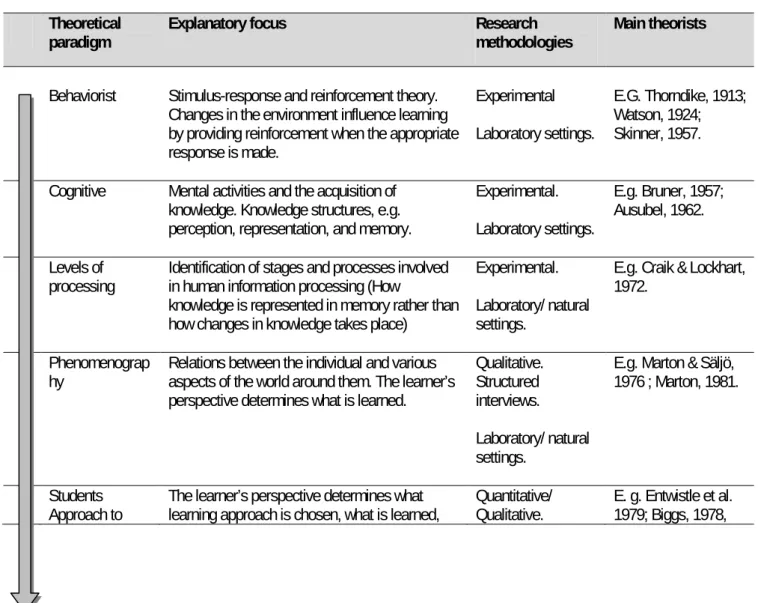
In the 20th Century, two paradigms dominated the field of educational psychology: The behaviorist and the cognitive. The behaviorist paradigm originated from the work of Pavlov and Thorndike and is perhaps best represented by scientists such as Watson and Skinner. Behaviorism focuses on designing the environment in order to influence behavior, in casu learning (Shuell, 1986). The theoretical goal was the prediction and control of the behavior, and it was attempted to describe ‘learning’ in purely environmental terms without attempting to understand the structure of the organism (Entwistle & Smith, 2002). Learning is seen as promoted through various stimuli and the responses to these stimuli - a conditioning process in which feedback (reinforcement) is used to modify behavior in the desired direction (Ertmer & Newby, 1993). Until the 1960’s, almost all research on learning was conducted within a behaviorist framework involving a relatively simple form of understanding learning as embedded in stimuli-response patterns. Most of the research was carried out with animals in the laboratory, and as a result, comprehension was rarely studied, even when examining human learning (Shuell, 1986). Behaviorist theories imply that teachers must organize the instructive framework with the purpose of making students respond properly to
presented stimuli, and this approach has generally been shown reliable in certain learning situations, e.g. those involving recalling of facts, applying explanations, and performance of specified
procedures (Ertmer & Newby, 1993). As a consequence of the behavioral research, learning was viewed as “programmed learning”, which emphasizes the importance of reinforcement (through knowledge of results) and increasing knowledge in small sequential steps. Today, however, it is generally agreed that behaviorist principles are insufficient when it comes to explaining the
acquisition of higher level skills or learning processes that require a greater depth of processing, e.g. language development, problem solving, and critical thinking (Ertmer & Newby, 1993).
2.2. The cognitive perspective
Later decades have therefore been dominated by the cognitive paradigm, which encompasses several scenarios ranging from computer-based information-processing to the later
socio-constructivist models (Calfee, 2009). The move from behaviorist to cognitive theories indicates a shift from the study of the individual’s behavioral responses to environmental stimuli - to the study of the individual’s cognitive processes (memory, perception, and problem solving) (Berliner, 2009). Although cognitive psychology was present in the 1930’s, the impact of conceptions of learning was limited until the 1960’s, when educational psychology began to show an interest for the internal, non-directly observable mental processes such as perception, reasoning, problem solving, conceptualization, planning, and applications (Shuell, 1986) The cognitive conceptions of learning differed from the traditional behaviorist conception of learning in ways that enriched the
understanding of how humans acquire new knowledge and how they differ in their ways of doing this. However, the cognitive perspective is comprehensive and the focus in this introduction will be on information processing theory and constructivist approaches to learning, as they have both played an important role in the attempts to explain complexity of learning in the academic setting.
From a constructivist perspective, the individual is no longer viewed as a passive information storage system, but as a self-determining agent who actively selects information from the perceived environment, and who constructs new knowledge in the light of what the learner already knows
(Biggs, 1989, p. 8). Learning is perceived as an active, constructive, and self-directed process in which learners build up internal knowledge representations that are personal interpretations of their
learning experiences. The cognitive orientation emphasized the effects of the structure of the organism and has been evident in research on topics such as meaningful verbal learning (Ausubel, 1962, 1963, cited in Shuell, 1986) and discovery learning (e.g., Bruner, 1957, 1961, cited in Shuell, 1986). Cognitive approaches were considered more appropriate than behaviorist learning theories, especially when it came to explain complex forms of learning, e.g. problem solving or information-processing. Research in human memory attempts to describe how information is processed, coded, and stored, and while these aspects remain important aspects of problem solving, the information processing approach was insufficient to understand a central aspect of problem solving, that is, how
people understand and represent problems. Although researchers studying cognition recognized that people learn in different ways, relatively little research had attempted to describe what students understand (Gibbs, Morgan & Taylor, 1982). As a result, the discipline of educational psychology developed a much wider range of cognitive perspectives, where the pre-dominate focus was upon answering the questions: ‘how individuals learn?’ and ‘what are the implications of this?’ (Haggis, 2009).
2.3. Development of approaches to learning
A number of the concepts developed by cognitive psychology had implications for the evolution of the Student Approach to Learn perspective. Research on student learning was for many years primarily carried out by experimental psychologists making use of university students as research participants. Although the research was often advanced in its experimental designs, it was often trivial in content, e.g. by the use of “nonsense syllables or simple prose passages” (Entwistle & Hounsell, 1979 p. 359). The experimenter’s concern was mainly with such aspects as verbatim recall and evidence of memory decay over time (Entwistle, 1979). The outcome of learning was generally observed in quantitative terms, e.g. measured by the numbers of units remembered when
required. The research presented in the following represents not only a change in research methods, but also in the underlying theoretical assumptions.
2.4. Levels of Processing in student learning
In the field of complex learning, e.g. at university level, educational researchers have generally referred to two fundamentally different ways in how learning may be approached. The distinction reflects the difference suggested by Ausubel (1968)between meaningful and rote learning, and despite the many differences in theoretical as well as methodological frameworks used by different researchers, the concepts are often described in quite similar terms, for example the concept of deep
and shallow levels of learning suggested by Craik & Lockhart (1972), the terms serialistic and
holistic learning coined by Pask and Scott (1976), the deep and surface level suggested by Marton and Säljö (1976a), internalizing and utilizing dimensions conceived by Biggs (1978a; 1984), and the understanding and reproductive learning suggested by Entwistle, Hanley & Hounsell (1979).
2.4.1. Craik and Lockhart
From an information processing perspective, Craik and Lockhart (1972) proposed the concept of
deep level processing, which requires access to semantic attributes and is hypothesized to generate a more efficient memory trace, and – in comparison - shallow level processing involving analysis of physical attributes of stimuli to explain memory retention (Tickle, 2001). The information
processing approach focused on the mechanism of the problem solving process, e.g. the procedures people adopt when handling a task (Laurillard, 1984), and the theory was largely developed on the basis of research of humans in artificial laboratory settings. Newell and Simon (1972, cited in Mayer, 1997) thus developed a characterization of the information processing model based on their
analysis of human problem solving in a study in which they asked people to think out loud while solving specified problems. Four assumptions underlie the levels of processing model (Dyne, Taylor and Boulton-Lewis, 1994 p. 360):
1. Qualitative different memory traces result from different types of processing – that is, memory is determined by the way which we perceive and process the stimulus
2. Increased levels of processing involves longer processing times
3. Deeper perceptual processing produces more accessible memory traces. Superficial or sensory processing of stimulus results in a fragile trace with rapid decay rate, whereas deeper, semantic processing results in a more robust memory trace with a slower decay rate.
4. Type 1 and Type 2 rehearsal characterize differences in the depth of encoding processes
Two well-documented findings emerged from this Levels of Processing model. First, rote rehearsal is not an effective learning strategy when recall is required. Second, memory may be facilitated by changing the nature of the encoding process (Dyne et al., 1994). Deeper processing requires access to more semantic aspects, whereas superficial processing involves more physical (e.g. phonetic) aspects of stimuli (Dyne et al., 1994; Tickle, 2001). By showing that encoding was not a simple, straightforward process, the levels of processing model changed the direction of memory research. It explains why some individuals memorize things in a more appropriate manner than others. However, according to McCleod (2007), the model failed to provide a sufficiently detailed account of why deep processing is so effective.
Research methodology as well as the underlying theoretical assumptions regarding student learning changed significantly in the 1970’s, and research in learning in higher education evolved with focus
on: a) building a knowledge base about individual student learning (cognitive psychology), and b) development of a particular extension of this approach (approaches to learning) (Haggis, 2009). As pointed out by Tickle (2001), the development of student learning as a distinct research area was a reaction to the finding that the general concepts of learning appeared insufficient to explain learning behavior within an academic environment. In contrast to the previous laboratory-based research, learning research now became a study of the individual construction of meaning in the students themselves carried out in natural settings.
2.5. Conceptions of deep and surface learning
2.5.1. The Gothenburg group
With an acknowledged link to Craik and Lockhart, a similar dichotomy was developed by a group of researchers from Gothenburg (Säljö, 1975; Marton & Säljö, 1976a; b; Svensson, 1977; Fransson, 1977), who applied Craik and Lockhart’s (1972) levels of processing theory to a specific learning situation (Duff & McKinstry, 2007). Their focal point was on students’ experiences and semantic processing of information in a natural setting at the university level. The development of this “phenomenographic” approach took place some years after the initial work on the epistemological level, but has had an even stronger influence on thinking about student learning, and research from the Gothenburg group signifies not only a shift in research methods but also a change in the
assumptions about the nature of learning (Entwistle & Hounsell, 1979). The aim was not merely to describe qualitative differences among individual students in terms of different levels of learning outcome, but also to derive a commensurable description of the levels of processing utilized in student learning (Richardson, 1999). As in Pask and Scott’s research (see below), students were involved in active learning by paraphrasing a text, but instead of anticipating the dimensions of
study processes from experimental work in cognitive psychology, qualitative levels of learning were derived from qualitative analysis of students’ reports of their own study processes (Biggs, 1979; Entwistle & Waterston, 1988). In a laboratory-type environment, students were instructed to read academic texts and, subsequently, asked to reflect about their experience of handling the task. Two different levels of processing were identified: a surface and a deep level. What (we) found was that the students who did not get “the point” failed to do so simply because they were not looking for it (Marton and Säljö, 2005, p. 41). In the case of surface level processing, the students directed their attention towards learning the text in itself, i.e. a reproductive type of learning, which forced them to use a rote-learning strategy. In the case of deep-level processing, the student was focused on the intentional content of the learning material. By looking for associations between the text and phenomena in the real world or by looking for relations between the text and its underlying structure, the students tried to understand the meaning. The latter type of learners seemed capable of using their capabilities to make critical judgments, logical conclusions and come up with their own ideas (Marton & Säljö, 1976a; Entwistle, 2005).
As anticipated, a clear association was found between the students’ levels of processing and the levels of outcome evident in their recall of the text. Svensson (1976 cited by Marton & Säljö, 2005) combined these two sources of information in making an independent and simultaneous analysis of the same set of data with the same intention: to explain the differences in outcome (Marton & Säljö, 2005). Those exhibiting deep levels of processing achieved the highest levels of outcome, while those demonstrating lower levels of processing reached lower levels of outcome (Richardson, 1999). Marton points out that the student’s intention is essential, i.e. what the student intends to accomplish from the task determines the student’s approach (deep or surface), which in return affects the level of outcome (Biggs & Rihn, 1984). Furthermore, the distinction between the levels
of processing seemed to be correlated with different conceptions of learning itself. Those who adopted deep level processing indicated that learning “is something they do”, whereas those
adopting surface level processing indicated that learning “is something that happens to them” (Ibid., p. 55).
What distinguished the work of the Gothenburg group was not the subject matter of their research, but the research perspective from which they viewed the topic. By embedding their research in practical activities, the theoretical principles that were developed had a greater ecological validity than those developed primarily in laboratory studies. The research helped clarifying the distinction between the different forms of learning, and as a consequence of this they were able to describe learning in ways, which gave new insights into what learning consists of (Gibbs, Morgan & Taylor, 1982. p. 126). The nature of this relationship was investigated more fully in other research
programs, albeit by the use of a different research methodology. Despite the differences in methods and aims, they all had in common the dichotomy between a deep and a surface level of processing (Prosser & Trigwell, 1999).
2.5.2. Pask
At the same time, Pask (1976) also identified a distinction between style and strategy. Using a selection and questioning technique, students were asked to work out the taxonomies of imaginary characters and required to explain the reasons for their inquiring progress. In order to achieve a more detailed understanding of what they have learned, subjects were asked to teach back to the researcher. Errors were pointed out and the subjects were asked to repeat the procedure until a faultless performance was carried out (Tickle, 2001). Using these methods, two general categories of learning strategies were identified: a) a serialistic “working-one-step-at-the-time” strategy, that
is, learning, remembering, and recapitulating information in terms of string-like cognitive
structures, where items are related by simple data links, and b) a holistic strategy, which is driven by an intention to put together a broad picture of understanding. During the teach-back exercise, the “serialists” showed a tendency to test simple predictions in their attempts to identify the categories, while the “holists” demonstrated a capability to test complex hypotheses. In this study, all students were required to reach a form of conceptual understanding, but they still went about it in very different ways. The attempt to obtain both ecological validity by the use of naturalistic learning condition - and high internal validity through scientific control - made this contribution unique. The relevance of the findings of a serialist/holist distinction between student learning strategies was demonstrated by the results showing that academic performance was improved when students were taught in manners that reflected their own chosen approach (Tickle, 2001).
2.5.3. Biggs
Working from a cognitive psychology perspective, Biggs criticized the information processing framework for being too narrow and for ignoring the role of contextual factors and student
characteristics. The work of Biggs was primarily concerned with the development of an inventory to identify and measure the most important dimensions underlying study behavior and attitudes (Entwistle et al. 1979b p. 369). Despite the differences in methods used, Biggs (1970a; 1976), on the basis of a detailed research of the literature available, identified similar categories of learning. Initially, he characterized these as internalizing and utilizing approaches to learning, but in the development of these constructs, and in the light of their very close relationship with the concepts proposed by the Swedish group, Biggs (1987) suggested a similar terminology of processing distinguishing between a surface level involving ‘repetition of analyses already carried’ out, and a
according to Biggs, approaches to learning consisted not only of a learning strategy, but also of a learning motive, with the two in combination constituting the learning approach. Motive signifies the reasons why students undertake the study, while strategy refers to the methods employed by the students to obtain their goal or fulfill their motivation for studying. Each motive-and-strategy-combination characterizes a distinct approach to learning (ibid). In addition, Biggs (1987) also identified a third approach, which was characterized by the desire to “publicly manifest one´s excellence” (Ibid. p. 12), as some students appeared to be particularly motivated by achieving high grades and therefore organized their work in a way they believe to best accommodate the
assessment criteria. The surface strategy is expected to “lead to accurate but un -integrated recall of details”; the deep strategy to the “greatest structural complexity”, while the use of flexible strategy is expected to “lead to whatever goals the student sees as most pertinent to high grades” (Ibid. p. 12). It is important to notice that the achieving approach differs in a significant way from Deep and Surface Approach in that it refers to the way students organize their work, while the two other approaches describe ways in which the student engage the context of the task itself (Biggs, 1987).
2.5.4. Entwistle
Another important contribution came from the Lancaster group in UK. Also drawing upon the work of Marton and Säljö and the psychology of individual student differences, Entwistle and colleagues (E.g. 1988; 1991; 1997; Entwistle & Entwistle1991; Entwistle, Hanley & Hounsell, 1979; Entwistle & Waterstone, 1988; Entwistle & Tait, 1990 cited by Jones 2001) by the use of interviews
developed a questionnaire and found corresponding levels of processing. Like Biggs (Jones, 2002), they considered the intention of learning (motive) and the process of learning (strategy) as central factors (Jones, 2001). However, according to Entwistle and colleagues (1979 b), Marton’s term “processing” lead to some confusion, as it covered differences in the learning related both to the