Performance Evaluation of QOS Routing in Computer
Network
Abhishek Singh
1, Anjali Kataria
2Information Technology Department, Dronacharya College of Engineering, Gurgoan, Haryana
Abstract: This paper evaluates “Optimized Link State Routing Protocol” (OLSR) routing measurement performance analysis based on different simulation parameters. We have used NS-2 simulator tools for the performance of OLSR routing protocol simulation, we develop the simulation environment of small network and observed the complexity of the mobile ad-hoc network. The various performance parameters like average end-to-end delay, packets sent and received, throughput, consumed bandwidth has been analysed. The paper describes all the stimulator parameters taken and then compares the effect of complexity of stimulation environment in performance of OLSR routing protocol. Our goal is to carry out a systematic comparative measurement study OLSR protocol in consideration of QoS parameters based on different stimulation parameters. Using NS-2 stimulator tools for the performance of OLSR routing protocol stimulation, we created a small network, medium sized network and measured statistically the complexity of the mobile ad-hoc network.
Keywords: Ad hoc networks, Mobile ad hoc networks, Multipoint Relay, Optimized Link State Routing Protocol, Quality of service, Quality of Service Routing, Routing protocol.
I. INTRODUCTION
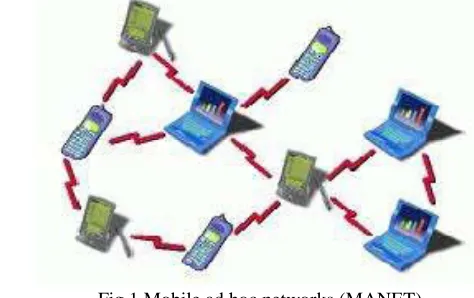
[image:2.612.176.413.504.653.2]An ad hoc network is a (possibly mobile) collection of communications devices (nodes) that wish to communicate, but have no fixed infrastructure available, and have no pre-determined organization of available links. An ad hoc network is a local area network or some other small network especially one with wireless or temporary plug in connections, in which some of the network devices are the part of the network only for the duration of a communication session. Each node acts as a router as well as a communication end-point. Ad hoc is Latin and means "for this purpose". A mobile ad hoc network (MANET) is a collection of mobile nodes where each node is free to move about arbitrarily. A MANET is a self-configuring infrastructure less network of mobile device connected by wireless links. MANET is shown in fig (1). It has the characteristics that the network topology changes very rapidly and unpredictably in which many mobile nodes moves to and from a wireless network without any fixed access point where routers and hosts move, that’s why the topology is dynamic. MANET can have multiple hops over wireless links. It has to support multi hop paths for mobile nodes to communicate with each other. If mobile nodes are within the communication range of each other, then source node can send message to the destination node otherwise it can send through intermediate node. There are two types of MANETs. One is Vehicular Ad Hoc Network (VANET) and another is Intelligent Vehicular Ad Hoc Network (In VANET).
Fig 1 Mobile ad hoc networks (MANET)
performance to a data flow. For example, a required bit rate, delay, jitter, packet dropping probability and bit error rate may be guaranteed. Routing is the process of selecting paths in a network along which to send network traffic.
QoS routing is part of the network layer and searches for a path with enough resources but does not reserve resources. The goal of Quality of Service (QoS) routing protocols is to obtain feasible paths that satisfy end-system performance requirements. Most QoS routing algorithms are mainly extension of existing classis best effort routing algorithms.
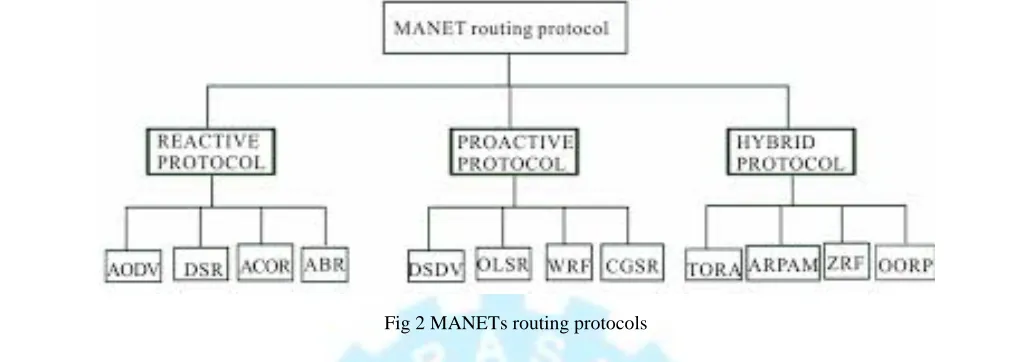
[image:3.612.48.562.156.337.2]The routing protocols of Mobile ad hoc network are characteristically subdivided into three main categories. These are proactive routing protocols, reactive routing protocols and hybrid routing protocols. These are shown in figure (2).
Fig 2 MANETs routing protocols
In which each has further more protocols. When there is a change in network topology the proactive routing protocol maintains the whole routing information about each node in the network by spreading route updation at fixed time intervals throughout the whole network. The routing information is usually maintained in tables, so these protocols are also called table-driven protocols. It includes the routing protocols i.e. Destination Sequenced Distance Vector (DSDV), Optimized Link State Routing (OLSR), Wireless Routing Protocol (WRP) and Cluster head Gateway Switch Routing (CGSR).
Reactive routing protocols establish the route to a destination only when there is a demand for it, so these protocols are also called on demand protocols. It includes the reactive routing protocols i.e. Ad hoc On Demand distance Vector protocol (AODV), Dynamic Source Routing (DSR); Admission Control enabled On-demand Routing (ACOR) and Associativity Based Routing (ABR).
It uses the route discovery mechanisms to find the path to the destinations, when a source wants to send to a destination. Hybrid routing protocols is the combination of both proactive and reactive routing protocols. It includes the routing protocols i.e. Temporary Ordered Routing Algorithm (TORA), Zone Routing Protocol (ZRP), Hazy Sighted Link State (HSLS) and Order one Routing Protocol (OOPR).The most routing protocols for mobile Ad hoc networks (MANETs) are OLSR, AODV, DSR, which are designed without explicitly considering the QoS of the routes they find. QoS routing requires not only to find a route from a source to a destination, but a route that satisfies the end-to-end QoS requirement, which are often given in terms of bandwidth, delay or loss probability. Quality of service is more difficult to achieve in ad hoc networks than in their wired counterparts, because the nodes in ad hoc network are not static and therefore the network topology changes unpredictably.
II. OPTIMIZED LINK STATE ROUTING (OLSR) PROTOCOL
A. Overview
The IETF MANET Working Group introduces the Optimized Link State Routing (OLSR) protocol for mobile Ad-Hoc networks. The protocol is an optimization of the pure link state algorithm. The key concept used in the protocol is that of Multipoint Relays (MPRs). Optimized link state routing is a proactive routing protocol. In which each node periodically broadcasts its routing table. The large amount of overhead is reduced by limiting the number of mobile nodes that can forward network wide traffic and for this purpose it uses multi point relays (MPRs) which is responsible for forwarding routing messages and optimization for controlled flooding and operations.
B. Multipoint Relay (MPR)
of the control message. Each node in the network selects a set of nodes in its neighbour nodes is called the multipoint relays of that node periodically announces the information about who has selected it as an MPR. The neighbours of any node which retransmit the broadcast packet received from node for this purpose, each node maintains a set of its neighbours which are called the MPR Selectors of the node. Every broadcast message coming from these MPR Selectors of a node is assumed to be retransmitted by that node. OLSR protocol relies on the selection of MPRs, and calculates its routes to all known destinations through these nodes, i.e. MPR nodes are selected as intermediate nodes in the path. To implement this scheme, each node in the network periodically broadcast the information about its one-hop neighbours which have selected it as a multipoint relay. Upon receipt of this MPR Selectors information, each node calculates and updates its routes to each known destination. Therefore, the route is a sequence of hops through the multipoint relays from source to destination.
Fig 3 Multipoint relays
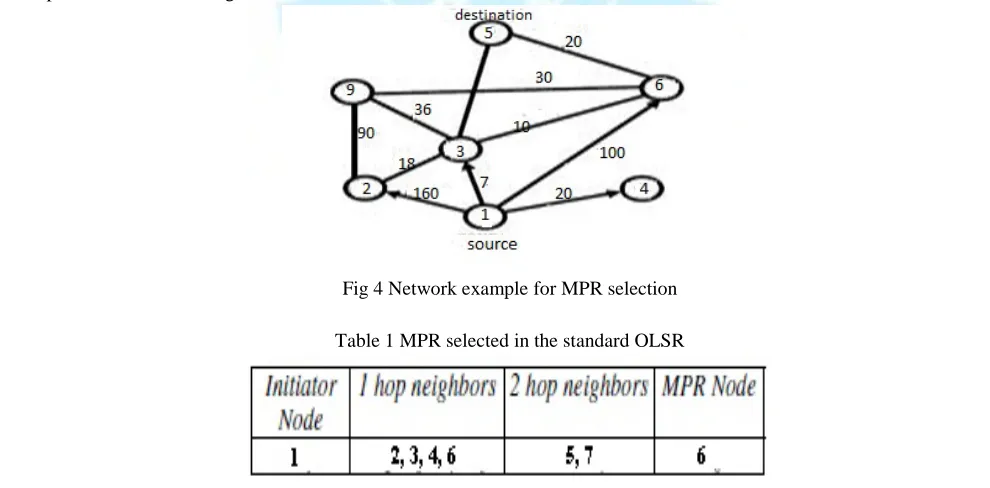
[image:4.612.51.546.407.651.2]In our research work bandwidth is the parameter which is used for performance evaluation of quality of service in computer networks. The heuristic for the selection of multipoint relays in the standard OLSR does not take into account the bandwidth information. It computes a multipoint relay set of minimal cardinality. So, the links with high bandwidth can be omitted. After, the path calculated between two nodes using the maximum path algorithm has no guarantee that it is the optimal path. For example it is shown from Figure 4 and Table 1:
Fig 4 Network example for MPR selection
Table 1 MPR selected in the standard OLSR
In this the MPR is selected with maximum bandwidth. Here node 3 and node 6 has same degree, so the node 6 of maximum bandwidth 100 is chosen the MPR. The decision of how each node selects its MPRs is essential to determinate the optimal bandwidth route in the network. In the MPR selection, the links with high bandwidth should not be omitted.
C. MPR Algorithm
In this protocol, Multipoint Relay selection is almost the same as that of the standard OLSR. However, when there is more than 1- hop neighbour covering the same number of uncovered of 2-hop neighbours.
1. Select a source node and start with an empty multipoint relay set.
2. Select the 1-hop nodes of the current node means calculate degree of all nodes in the network.
3. Select those 1-hop neighbour nodes as multipoint relays (MPRs), which provide the only path to 2-hop nodes and add these 1-hop neighbour nodes to the multipoint relay set.
4. While there still exist some nodes in 2-hop that are not covered by the multipoint relay set.
Select that node of 1-hop as a MPR which reaches the maximum number of uncovered nodes in 2-hop. If there is a tie in the above step, select that node with higher bandwidth as MPR.
5 To optimize, remove each node in MPR set, one at a time, and check if MPR set still covers all nodes in 2-hop. The third step permits to select some 1-hop neighbour nodes as MPRs which must be in the MPR set, otherwise the MP set will not cover all the 2-hop neighbours. So these nodes will be selected as MPRs in the process, sooner or later. In step, an optimization is performed by reducing the number of MPRs, if possible. The heuristics were based on considering only the bandwidth as a QoS routing parameter. A maximizable routing metric theory has been used to find a metric that selects, during the routing process, routes that are more stable, that offer a maximum throughput and that live for a long time.
III. PROPOSED APPROACH
In our research work we will be evaluating the performance of QoS routing in computer networks. We will optimize the path and flood the information to all the nodes in the network. In a pure link state routing protocol, all the links with neighbour nodes are declared and are flooded in the entire network. The OLSR protocol is an optimization of a pure link state protocol for mobile ad hoc networks. First, it reduces the size of control packet: instead of all links, it declares only a subset of links with its neighbours who are its multipoint relay selectors. Secondly, it minimizes flooding of this control traffic by using only the selected nodes, called multipoint relays, to diffuse its messages in the network. Only the multipoint relays of a node retransmit its broadcast messages. This technique significantly reduces the number of retransmissions in a flooding or broadcast procedure and then the routing table is determined of all nodes and the MPRs are used to find an optimal path in which MPRs are intermediate nodes.
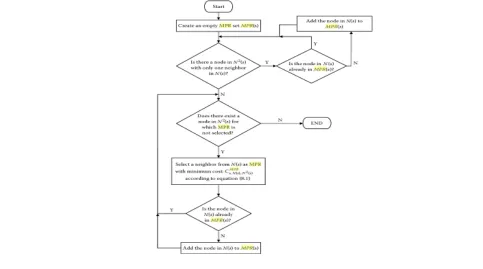
The algorithm is based on the following flow chart. The following definitions are given first:
N: represents the subset of neighbours of the current node.
N2: represents the set of two-hop neighbours of the current node.
[image:5.612.57.540.464.733.2]So we will use a general research methodology for finding multipoint relay set of all nodes and broadcast its MPR information in the periodic update packets, we use the heuristic algorithm proposed for OLSR to compute the MPR with slight adaptation. The following flow chart given in Fig.5 summarizes the essence of adapted version of the heuristic algorithm:
Select all the 1 hop neighbours that could provide only reachability to some 2 hop neighbours as MPRs. Then, if there are still some 2 hop neighbours are not covered by MPRs, select the 1 hop neighbours who could cover the most uncovered 2 hop neighbours as MPRs. Repeat this step until all the 2 hop neighbours are covered by MPRs.
IV. PERFORMANCE METRIC
We evaluate performance of the quality of service according to the given parameters as: throughput sent and received, to-end delay: frequency distribution, to-to-to-end delay: cumulative distribution, jitter sent and received on all nodes, average to- end-to-end delay, packet sent and received. These parameters are shown as follows:
A. Throughput is the total number of packets received by the destination.
B. End to End Delay is the time taken for an entire message to completely arrive at the destination from the source. Evaluation of end-to-end delay mostly depends on the following components i.e. propagation time (PT), transmission time (TT), queuing time (QT) and processing delay (PD). Therefore, EED is evaluated as:
EED=PT+TT+QT+PD
C. Average End to End Delay is averaged over all surviving data packets from the source to the destinations.
D. Packet Sent and Received is the total number of packets sent and received during the complete simulation time frame, packet size is 512 bytes.
V. SIMULATION AND RESULTS
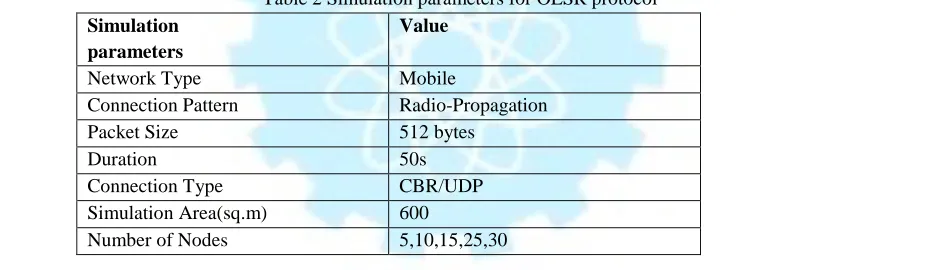
[image:6.612.76.539.386.521.2]Simulation parameters for OLSR protocol: Following table signifies the simulation parameters taken for simulation environment. Various parameters have been measured by simulating the OLSR routing protocol using NS2 simulator. Here, column 1 signify the simulation parameters like packet size, time duration etc and column 2 depicts the corresponding values of them like packet size is 512 bytes, duration of simulation is 50 sec., etc.
Table 2 Simulation parameters for OLSR protocol
Simulation parameters
Value
Network Type Mobile
Connection Pattern Radio-Propagation
Packet Size 512 bytes
Duration 50s
Connection Type CBR/UDP Simulation Area(sq.m) 600
Number of Nodes 5,10,15,25,30
As we increase the number of nodes for performing the simulation of OLSR protocol, number of sent packets and delivered packets changes, which in turn changes the average end-to-end delay. Average end-to-end delay is the average time a packet takes to reach its destination. The table shows the difference between sent packets, received packets and average end-to-end delay as the number of nodes is increased.
Table 3 Comparison of various parameters vs. no. of nodes
No. of Nodes 5 10 15 25 30
Packets Sent 226 365 552 926 1105
Avg End-to-end delay 0.254 0.272 0.363 0.454 0.5
VI. CONCLUSION
is when there are a large number of hosts. OLSR requires that it continuously has some bandwidth in order to receive the topology update messages.
REFERENCES
[1] T. Clausen, P. Jacquet, “The Optimized Link State Routing Protocol (OLSR)”, RFC 3626, October 2003.
[2] N. Enneya, K. Oudidi, and M. El Koutbi, "Enhancing Delay in MANET Using OLSR Protocol" International Journal of Communications, Network and System Sciences, pp 392-399, 5, 2009.
[3] H. Badis, A. Munareto, K. A1 Agba "QoS for Ad Hoc Networking Based on Multiple Metrics: Bandwidth and Delay" The Fifth IEEE International Conference on Mobile and Wireless Communications Networks (MWCN 2008) Singapore - October, 2008.
[4] S. Yilmaz, I. Matta, "Unicast Routing: Cost- Performance Tradeoffs" Technical Report BUCSTR- 2002.
[5] Q. Ma and P. Steenkist, “On Path Selection for Traffic with Bandwidth Guarantees”, Fifth IEEE International Conference on Network Protocols, Atlanta, GA, pages 191-202, October 1997.
[6] Perkins, E. M. Royer and S. R. Das, “Ad Hoc On-Demand Distance Vector (AODV) routing” RFC 3561, July 2003.
[7] Johnson and Al, “The Dynamic Source Routing Protocol for Mobile Ad hoc Networks (DSR)” In IETF Internet Draft, draft-ietfmanet- dsr-09.txt, April 2003.