Munich Personal RePEc Archive
The transfer space
Friedrich, T.
Humboldt-Universitaet zu Berlin
1 July 2010
Online at https://mpra.ub.uni-muenchen.de/30593/
The Transfer Space
Abstract
The coordinates of the transfer space are loss of the source, gain of the
sink and cost to both sides and compares the coupled gain and loss of
two single parties to gain or loss of the ensemble of both, the invisible
third party. Whenever two not identically equipped parties meet with the
potential to exchange substrates one party will become a source and the
other a sink. The outcome depends on the relation between fix cost,
variable cost, productivity and affinity. The selfishly transferred substrate
will optimize productivity of one or both sides and will lead under certain
conditions to a productivity increase of the ensemble. This increase roots
in the transfer of substrates from saturated to unsaturated production
conditions. Brute force and educational conditioning take advantage of
emotions to hide the real size of the cost to the exploited party. In case
the transfer of substrates leads to increased productivity parts of the
productivity might be reinvested to keep the exploited party. The lasting
relationship is called wise exploitation. Wise exploitation may last for one
or many generations depending on the use of brute force, education or
breeding. To maintain a stable system the benefit must always exceed
the cost. The transfer space views group (ensemble) selection as egoism
based exploitation from catalytic networks to societies and interprets the
decision process under external influence in a single economic entity.
Introduction
Cooperation and prisoners´ dilemma
What is cooperation? Many definitions exist in different fields of research.
They all speak of joint interactions and working together of two parties for
mutual benefits. But this kind of behaviour is hardly - if at all - observed.
The reason is prisoners´ dilemma.
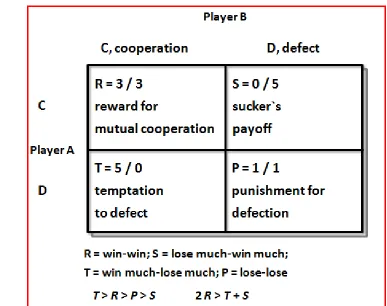
Axelrod and Hamilton (Axelrod, R. and Hamilton, W. D., 1981) use the
following and generally accepted matrix to explain prisoners´ dilemma
[image:3.595.91.478.379.685.2](Figure 1).
Figure 1
Figure 1. Prisoners´ dilemma, an example.
From arbitrary values they learn that successful exploitation (D) of a
productivity or fitness has the ensemble (Player A+B) if both parties
cooperate (C+C>C+D>D+D). This is the prisoners´ dilemma – it would
be better to cooperate, but the temptation to exploit someone or the
danger of being exploited prevents cooperation (P>S though
2R>T+S>P+P). As defect is stable (D+D; a Nash equilibrium) it is
puzzling to many authors why help between two organisms is
observable. One reason is genetic relation – kin selection (Hamilton,
W.D., 1964).
An unanswered question in this example is where does the productivity
come from and why should the productivity in cooperation (C+C) be
higher than in exploitation (C+D)? This view has evolved a little (Nowak,
M. A., 2006). This author writes: “a cooperator is someone who pays a
cost, c for another individual to receive a benefit, b. A defector has no
cost and does not deal out benefits.” To assume that something (a
benefit) can only come from something else (a cost) is a step forward.
However such behaviour (giving) is difficult to understand. Giving is
regarded as an altruistic action – it pays in terms of evolution only for
offspring and other genetic relation. Complex evolutionary epicycles are
invented to transfer the genetically founded behaviour altruism and kin
selection to group selection with no genetic foundation (“A group of
cooperators might be more successful than a group of defectors”, same
author). The question is not answered where this additional fitness
(productivity) has its source. The answer to this question is important as
we live under the law of mass and energy conservation – a very
important empirical law and philosophic meaningful concept.
As the values are arbitrary other outcomes are possible and would be
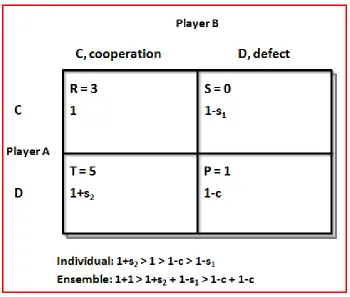
Chao (Turner, P. E. and Chao, L., 1999) use an interesting general form
to explain prisoners´ dilemma (Figure 2). They introduce a further
[image:5.595.123.473.189.486.2]simplification: one side gives and one side takes, a transfer is realized.
Figure 2
Figure 2. Prisoners´ dilemma, one side gives (–s1) and one side takes (+s2).
Using the same values as Axelrod and Hamilton we obtain the same
result. Prisoners´ dilemma is P>S though 2R>T+S>P+P. In this new
general form prisoners´ dilemma equals 1-s1<1-c. Cooperation (1=1) is
doing better than exploitation (1-s1<1+s2). We could say: 1+1>1- s1+1+s2.
The transfer space
What does the generalization (prisoners´ dilemma: c<s1; cooperation is
better than exploitation: 0>s2-s1≙s2<s1) teach?
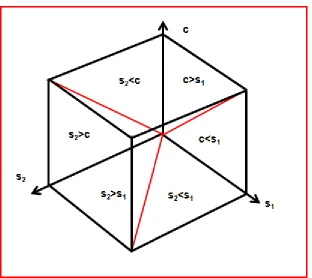
It seems there are three variables: s1, s2 and c and they are considered
variables may be best arranged in a three dimensional space, the
transfer space (Figure 3). The size comparison of these variables may
teach something like in prisoners´ dilemma (not giving, c<s1). The pair
wise combinations of three variables (c<s1, c>s1, s2<s1, s2>s1, s2>c, s2<c)
[image:6.595.144.456.234.512.2]form the surface of the transfer space.
Figure 3
Figure 3. The transfer is space formed by the variables c, s1 and s2. The origin of the transfer space is where the red lines meet; c=s1=s2=0. The red lines are s2=s1, c=s1 and s2=c.
What do the variables mean?
• The variable c is the loss if a transfer does not take place. This variable seems to be some kind of fix cost – always present. It is a fix
cost for both sides. This fix cost is not necessarily of the same size for
player A and player B but will be connected by a factor or an equation. • Although one substrate is transferred the loss to one party is not
necessarily identical with the gain to the other party (s2>s1, s2<s1)! The
• The variable s1 contains the loss of one party (source). It consists of
the fix cost (c, the essence of a fix cost is the ubiquity), the variable
cost that is connected to the lost substrate (S) and the loss in
productivity (p) with this lost substrate.
• The variable s2 contains the gain of the other party (sink). It consists of
the fix cost (c), the variable cost that is connected to the gained
substrate (S) and the gain in productivity (p) with this substrate.
• Productivity (p) is a saturation function. At high saturation the gain in productivity is small compared to low saturation for the same amount
of substrate (S). At high saturation the productivity with this substrate
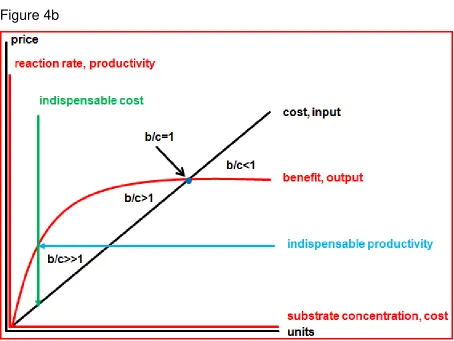
may be less earning than the variable cost for this substrate (Fig. 4b). • Due to the general limitedness of resources biological and economic
systems are usually not equally saturated – they are not Pareto
efficient!
• The substrate (S) is a variable cost with a linear dependence (Fig. 4b). • s1=c+S+p and s2=c+S+p. This helps to understand why there is
“giving”, “not giving”, “taking” and “not taking” without genetically
founded altruism involved.
giving: c>s1 ≙ c>c+S+p ≙ 0>S+p
not giving: c<s1 ≙ c<c+S+p ≙ 0<S+p
taking: s2>c ≙ c+S+p>c ≙ S+p>0
not taking: s2<c ≙ c+S+p<c ≙ S+p<0
Not giving, 0<S+p: The source would lose a highly productive (+p)
substrate (S). As long as the source is uninfluenced and reasonable it
Taking, S+p>0: The sink will take the substrate (S) because it will
make a positive productivity (+p) contribution (Figure 4b, b/c>1).
As S is always a positive value, p must be a large negative value (-p)
in the case of “giving” (0>S+p) and “not taking” (S+p<0).
Giving, 0>S+p: A negative productivity loss is a relative productivity
gain. Giving will increase the productivity! Giving will reduce variable
cost that does not pay (Figure 4b, b/c<1). Giving is a selfish act and
will increase the productivity via reducing the amount of substrate not
earning the variable cost at high saturation. This idea is important for
two reasons. Giving is reasonable, selfish and economically founded.
Giving is not a sacrifice. It is now independent of genetic relation.
Not taking, S+p<0: A negative productivity gain is a productivity loss.
The second party will not take because a loss in productivity would be
realized. Increasing the substrate (increase variable cost) at high
saturation will decrease the relative productivity (Figure 4b, b/c<1).
This idea is important for two reasons. Not taking is not generous, it is
reasonable. Not taking can prevent a decline of the productivity. It is
independent now of genetic relation.
Giving, giving not, taking and taking not: These 4 types of behaviour
meet in the three dimensional complex transfer space. The outcome of
interactions depends on the physiological, emotional, informational
and genetic condition of the parties.
(s2<s1). The effect is that the ensemble will be more or less productive
than the sum of the single entities.
• The variables c, S and p will be of typical size for a species/population and vary slightly between individuals.
• The value of the fix cost is considered absolute indispensable by sink or source. The value of the variable cost depends on the contribution
to the basic productivity (positive b/c>1 or negative b/c<1, Figure 4b). • The indispensable fix cost (c) is connected to an indispensable amount
of substrate and an indispensable productivity with this amount of
substrate. This productivity may or may not be saturated. But the
degree of this saturation will determine the value of the additional or
lost productivity with the variable cost (S) in source and sink (Fig. 4b). • Source and sink are the projection of the transfer space on one side
(c-s1 and c-s2). The outcome for the system (s2-s1) is a projection of
the transfer space on the ground. The ensemble manifests within the
transfer space and depends on source and sink (Figure 3).
• Giving and taking, brute force or informational influence on source and sink will change the perception of c, s1 (c+S+p) and s2 (c+S+p). This
can be interpreted either as a deformation of the transfer space or a
movement of source and sink along the sides of the transfer space. • Now we can give names to the different situations (Figure 3):
c<s1: prisoners´ dilemma; avoided exploitation, giving will decrease
source productivity
c>s1: tolerated exploitation, giving improves source productivity
s2<s1: consumptive exploitation, the ensemble looses productivity
s2>s1: productive exploitation, the ensemble gains productivity
s2>c: cost efficient exploitation, taking will increase sink productivity
s2<c: costing exploitation, taking will decrease sink productivity
Discussion
I suggest a new perspective to look at two parties capable to exchange
substrates. This idea explains exchange related behaviour on different
levels of complexity like enzymes, cells (many enzymes), organisms
(many cells) and societies (many organisms) and suggests a source of
productivity to fuel group selection without gene or moral founded
altruism. Here a purely selfish founded explanation is introduced. The
ensemble within the space is a complex entity. Therefore, it is better to
look at first at the surface of the transfer space and its origin.
• Cooperation, the entry point into the transfer space:
Now cooperation formally is the entry point into the transfer space. In
cooperation nothing is transferred (s1=s2=0) at no cost (c=0) but the two
parties are able to exchange. What is usually implied using the word
cooperation is a point of the coordinates s2>>s1, s1≈0, c≈0. In this point
productivity is generated from a small loss (transfer) at negligible cost
and part of the gain is shared. This will be explained later and is called
wise exploitation.
• Productive and consumptive exploitation; the surface s2-s1:
Giving and taking create or destroy productivity within the ensemble. The
productivity gain s2>s1 is the intrinsic power source for the ensemble and
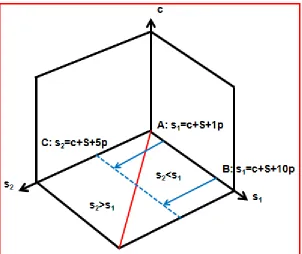
is called productive exploitation. The transfer of one substrate from a
saturated condition to an unsaturated condition is the reason for the
increase in productivity (Figure 4a). The increased productivity is realized
in the sink. The sink controls the gain and this is the maximal reward.
The ensemble of sink and source together has a better productivity then
cost of the source. The productivity of the source will decrease and
finally the source will be lost. The advantage to the sink and the group is
gone. The sink will need new exploitable source from anywhere else.
The transfer from an unsaturated condition to a saturated condition will
lead to a decrease in ensemble productivity (s2<s1) and is called
consumptive exploitation (Figure 4a). The smaller productivity is realized
and controlled by the sink. A reward is still obtained but the catch to the
sink is smaller than the loss to the source. But it is still an advantage to
the sink. The ensemble of sink and source together has a smaller
productivity than the sum of both parties alone. This is a disadvantage to
the group and in addition on cost of the source. The productivity of the
source and the group will decrease very fast and finally the source will be
[image:11.595.148.450.430.684.2]lost. The sink will need new exploitable source from anywhere else.
Figure 4a
ensemble AC will have a fivefold increased productivity. The productivity of the ensemble BC however is cut by half. AC is a productive transfer (s2>s1), BC is a consumptive transfer (s2<s1).
Whenever the relation of the fix cost c, the variable cost S and the
productivity p between the two parties is different, the transfer of a
substrate will always lead to a change in productivity. The productivity
gain s2>s1 and the productivity loss s2<s1 in biochemistry as well as
economy is usually the result of substrate transfer between different
states of saturation in saturating production functions. Therefore,
zero-sum games and Pareto efficiency are misleading concepts to understand
[image:12.595.71.525.347.688.2]the real world (Figure 4b).
Figure 4b
beyond b/c=1 additional substrate will be costing. The same will happen if the variable cost will become much steeper or the productivity will decrease.
The productivity gain s2>s1 reminds of the superadditivity in coalition
games, subadditivity corresponds to s2<s1. The difference between the
transfer space and a coalition game is that we simultaneously observe a
competition between two single players for a substrate and as a result of
their interaction (the transfer of a substrate) their coalition. The coalition
does not need any form of coordination or good will on both sides.
“Giving” and “taking not” are usually regarded as a generous and
altruistic behavior but they are selfish and reasonable for costing
substrates (b/c<1).
In case there is no saturation (substrate is valuable for both sides), brute
force and education can induce “giving” and “taking not” as I will discuss
now. Brute force and education will avoid the Nash equilibrium, breeding
will avoid extinction. The difference to classic game theory and
prisoners´ dilemma is that the equilibrium will not be reached. The
system is continuously driven by input of exploitable source either from
the outside or through internal breeding. The primary energy source is
the sun. The food chain and the energy pyramid continue into economy
and human civilization.
• Brute force, the surface c-s1:
In prisoners´ dilemma nothing is transferred because not giving is
cheaper (c<s1). Only the anyway spent fix cost (c) but no additional
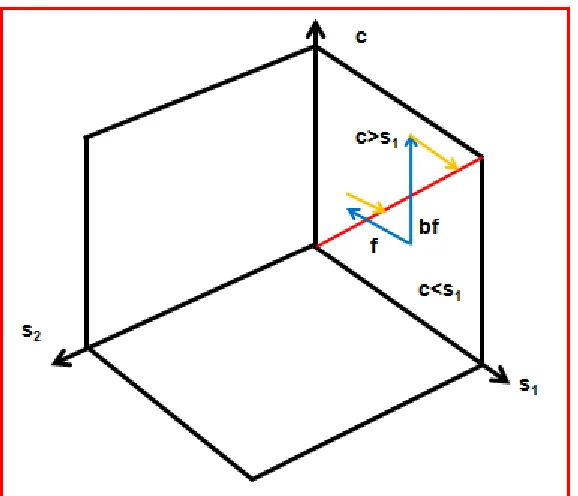
highly productive substrate is lost. Brute force (bf) will increase the cost
of “not giving”. To withstand the force the amount of indispensable cost
(c) must be increased (Figure 4b). The size relation will therefore
change. Starting at c<s1 the increase will finally exceed c=s1 (c+bf>s1)
now variable cost is given to optimize own productivity. Both sides may
cheap threatening will make the subdominant party give. Threatening
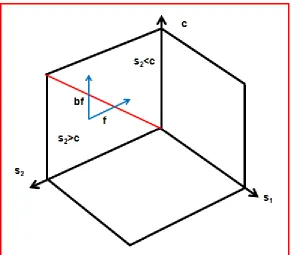
evokes the emotion fear (f) in complex organisms and will hide the true
[image:14.595.155.444.188.436.2]cost of giving (s1) (Figure 5).
Figure 5
Figure 5. At first brute force (bf, blue arrow) will increase the fix cost (c) for the subdominant party. Giving (orange arrow) is induced as variable cost no longer pay at that relationship between fix cost, variable cost and productivity. Later fear is sufficient. Fear (blue arrow, f) hides the true cost s1 and induces giving (orange arrow) at lower fix cost. The red line separates c>s1 and c<s1.
The intensity of brute force and fear correlate directly to the amount
given (bf=S+p). The productivity with the present variable cost and fix
cost does not pay the defence. Costing variable cost is given to increase
productivity. Even a new assessment of the fix cost may take place and
a part of the fix cost is transformed to a variable cost and given, too.
• Education, the surface c-s1:
Education is used in intelligent species. It is difficult to determine the true
degree of saturation in a complex organism. Manifold, different and
processing can be manipulated through appropriate additional
information. Education is an investment by one party to influence the
behaviour of a second party. Education as external information is
capable to change the perception of size and relation between fix cost
(c), variable cost (S) and productivity (p). The size relation will change
from c<s1 to c+e>s1. It appears to the source as if the amount of fix cost
and degree of saturation has increased. This changes the behaviour of
the source from “not giving” to “giving”.
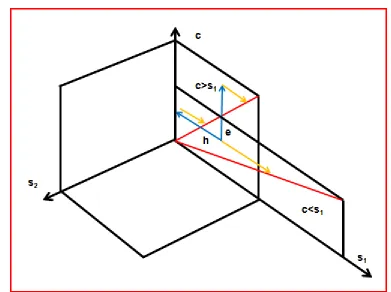
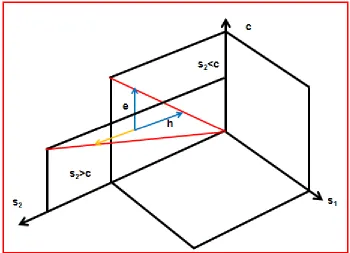
Emotions (hope, h) hide the true size of the loss (s1). The role of
emotions in cooperation related behaviour has been addressed (Fessler
and Haley, 2002). An alternative interpretation is that the whole space is
deformed and the source differently judges the own position and the
border between c<s1 and c>s1 and will give (Figure 6a). Giving will stop
[image:15.595.99.490.449.741.2]at c=s1.
Figure 6a
endogenous reward systems) is induced and hides the true cost (s1) and giving is induced (short orange arrow). Education can also change the perception of the whole transfer space and induce giving (long orange arrow) directly. The red lines separate c>s1 and c<s1.
The size of the difference (c minus s1) determines how intensive
education and hope have to be. Positive emotions conditioned through
education and induced by the sink will trigger the interpretation that fix
cost is high and productivity is saturated. Variable cost is costing and
therefore given. Even the fix cost could be reassessed and parts
transformed into variable cost and given to the sink. The given variable
cost is characterized by e=S+p. An objective loss is happily realized!
Negative emotions:
Hate is an example for negative emotions. Hate may involve two or three
parties, one or two competing ensembles.
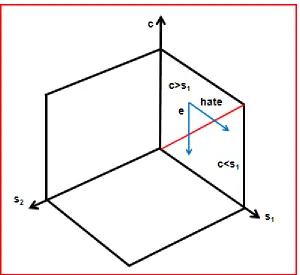
Two parties: The action (e) of a sink may induce hate of a source. The
source is moved from giving (c>s1) to not giving (c-e<s1) (Figure 6b). It
appears to the source as if a part of the indispensable fix cost has been
lost. This must be replaced by variable cost. The residual variable cost
seems to be much more productive and has now an increased value. A
highly productive substrate is not given away. The emotion hate makes
the source evaluate the relationship between c, S and p differently. Also
the transfer space could be deformed. Hate makes the source
overestimate the size of the loss s1.
Three parties: Hate is educational (through information; either true or
false) induced by a third party in a source to avoid giving to a sink so that
there will be more residual reserves for the third party or that the
productive interaction between source and sink is disrupted. Less
productivity will be an advantage to the competing ensemble the third
Figure 6b
Figure 6b. Education (blue arrow, e) manipulates the perception of the fix cost (amount or saturation) and giving ends. Hate makes the source overestimate the size of the loss s1. An interpretation is an increased value of the variable cost because lost fix cost had to be replaced with parts of the variable cost increasing the value of the residual variable cost. Or: Lost fix cost decreases saturation and increases productivity and value of the variable cost. The intensity of hate is direct proportional to the resulting size of the difference c minus s1. The red line separates c>s1 and c<s1.
• Brute force, the surface c-s2:
In cost efficient exploitation (s2>c) taking is cheap and effective for the
dominant party (sink) but the subdominant party (source) may not be
willing to give because the status there is not saturated anymore. Brute
(counter) force will increase the cost of taking. The size relation will
therefore change from s2>c to s2≤c+bf. Now the dominant party will no
longer take because the border to costing exploitation is exceeded. Also
here bf is a risky investment. Both sides may be hurt seriously. But once
bf is effective cheap threatening will make the dominant party recoil from
taking. Threatening evokes an emotion called fear to hide the true gain of
Figure 7
Figure 7. At first brute force (bf, blue arrow) will increase the fix cost (c) for the dominant party. Not taking is induced at that relationship between cost and productivity (costing exploitation). Later fear (f, blue arrow) is sufficient. Fear hides the true gain s2. The red line separates s2>c and s2<c. In the described case giving back could be a result as the border s2=c is exceeded. A sink is turned into a source.
A fight could be interpreted as a test which party is nearer to the border
of giving/not giving – taking/not taking. Or: Who is more and who is less
saturated? The minimal intensity of the counterforce is determined by the
distance to the border s2=c. But it should be clear that in every
production function the most left point is zero. At high saturation there
may be low additional or costing productivity of additional substrate but
there is also endurance. s1 or s2=c+S+p could also be interpreted as a
space with many different positions.
• Education, the surface c-s2:
Usually the exploiting party (sink) will educate the exploited party
(source) to tolerate exploitation in hope (h) for a better ending. This may
lead to exhaustion of the exploited party and a decrease of productivity
by ensembles with high productivity. The highest productivity will be
reached at optimal distribution of material and energy (substrates)
between both parties so that both are combined maximal productive.
Therefore, it could be in the interest of the exploiting party to restrain
from complete exploitation of the exploited party. The birth of moral.
Education as investment could originate in the dominant party but also
within the subdominant party to change the behaviour of the dominant
party. The size relation will change from s2>c to s2≤c+e. The dominant
party is changed from “taking” to “not taking”. The perception of size and
saturation within the fix cost (c) is changed by education (e). Emotions
(hope, h) hide here the size of s2, the possible gain and reward. A
different idea is that the transfer space is deformed and the addressed
party judges the position of the border between s2>c and s2<c differently
and will not take (Figure 8a). Not taking will start at c=s2. The size of the
difference (s2 minus c) determines how intensive education and hope
[image:19.595.122.472.504.757.2](emotions) have to be to avoid taking.
Figure 8a
system) is induced and hides the true gain. Education can also change the whole judgment of the transfer space and the perception of the own position within that space (from s2>c to s2<c). In this case giving back (orange arrow) would be induced in the sink. The sink becomes a source. This change of perception may also be a natural result of aging and increased saturation beyond the period of growth.
Positive emotions conditioned through education and induced by source
or sink will make the sink differently interpret the degree of saturation in
the fix cost. Variable cost is no longer taken from the source because
this would decrease sink productivity due to erroneously assumed high
saturation in the sink. In addition, the value of the fix cost could be
reassessed and partially transformed into a variable cost and given. A
loss of profit is proudly realized.
Negative emotions:
Hate is a negative emotion. Again hate may involve two or three parties,
one or two competing ensembles.
Two parties: The action (e) of a source may induce hate of a sink. The
sink is moved from not taking (s2<c) to taking (s2>c-e) (Figure 8b). Now it
appears to the sink as if parts of the fix cost have been taken away. The
indispensable fix cost must be replaced with variable cost. New variable
cost will increase productivity. This new variable cost is taken from the
source in hate. Alternatively the transfer space could be deformed.
Three parties: Hate is educational induced in the sink by a third party to
induce taking from a source to harm the source. This may have the effect
that the source is overstressed and the productivity of the ensemble will
Figure 8b
Figure 8b. Taking away or education (e, blue arrow) to hate manipulates the perception of the fix cost in the sink. Hate (blue arrow) is induced and overrates the true gain. Taking is induced (orange arrows). The red line separates s2>c and s2<c.
• Harmful exploitation; the surface s2-s1 and the effect of brute force,
education and breeding.
As long as the source is in c>s1 the source will selfishly give to increase
own productivity – in case a sink will take. This is an advantage through
increased productivity to all sides: source, sink and the ensemble. No
party is harmed or suffers.
If taking by the sink is larger than the additional productivity through
giving the source will approach c=s1. As soon as the source arrives at
c=s1 further taking would decrease productivity of the source and
therefore giving by the source will selfish end. The exploited party is at
first lost to prisoners´ dilemma. A source also may be right from the very
beginning of the contact in prisoners´ dilemma. If the sink wants to take
Exploitation with brute force, (s2-s1-bf>0) or (s2-s1-bf<0):
Brute force (bf) is an investment of the exploiting party (sink) to induce
giving by the source in prisoners´ dilemma. Fear (f) hides the true size of
s1 but is imaginary (exists only in c-s1; c-s2) and is not added (Figure 9).
Exploitation with education, (s2-s1-e>0) or (s2-s1-e<0):
Education (e) is an investment of the exploiting party (sink) to induce
giving by the source in prisoners´ dilemma. Hope (h, conditioned positive
emotions. The reward exists only in the brain. c-s1; c-s2) is virtual and
[image:22.595.152.444.334.579.2]therefore not added (Figure 9). Hope hides the true size of s1.
Figure 9
Figure 9. The investments brute force (bf) and education (e) always contain a reward for the exploiting party. The red line separates now the area where the investment (bf, e) is overcompensated (>0, wise) and where the investment (bf, e) is not overcompensated (<0) by the gain through the transfer. The red triangle (c<s1) is prisoners´ dilemma (not giving) but giving is induced through brute force and educational conditioning. In the region s2-s1-bf<0 or s2-s1-e<0 quantity may be traded for quality even though the investment is not paid.
The use of brute force and education changes the behaviour of the
exploited party in prisoners´ dilemma from not giving to giving. But this
will further decrease and then the source will be lost completely
(physically) through extinction or consumption.
In rare cases the source may be saturated and wants to give to optimize
own productivity but the saturated sink does not want to take. Brute force
or education (e.g. subvention, corruption) may also be used here to
make the sink take although this is not reasonable. This will be harmful
to the productivity of the sink and the ensemble.
Why can it be evolutionary stable to take in prisoners´ dilemma?
How can the loss of the exploited party be avoided?
• Productive wise exploitation with brute force (s2-s1-bf>0):
Brute force between different species:
The transfer of the substrate between two different species may lead to a
higher productivity of the ensemble so that the investment (bf) is
overcompensated. This is productive wise exploitation with brute force
and fear (s2-s1-bf>0). Wise refers to the fact that the gain will pay the
investment including a reward. Brute force in enzymes is a higher affinity.
In primitive organisms fear will be absent. The ensemble with such
behaviour will succeed against other not so productive ensembles of
different species or single competing species. However, the source will
suffer a decrease in fitness and therefore vanish. The ensemble may
succeed against a competing party on the short run but it will only
survive on the long run if parts of the gain are also used to breed the
source. An example would be the leafcutter ant with the fungus grown in
their garden. Parts of the living fungus are consumed (bf) but also bred
(br). Leafcutter ants form the largest colonies of all ants. Grazing and
hunting use brute force to exploit the source but usually no breeding of
(Lotka, A.J. 1920, Volterra, V. 1926, Prigogine, I. 1977). If the transfer is
consumptive (s2-s1-bf<0) the dominant party needs continuous influx of
exploitable individuals also but the ensemble-productivity is far below the
sum of the single parties. The small reward to the sink may be enough to
push through against a single competitor without an additional resource.
Brute force within the same species:
Naturally emerging asymmetries (male/female; young/old, strong/weak)
may serve the same purpose as breeding. With every new generation
the consumed sources are replaced resulting in a higher productivity of
the ensemble of e.g. strong and weak. The increased productivity (s2-s1
-bf>0) comes from the species internal transfer. This could be called
self-exploitation. Every species produces surplus offspring. This surplus is
partly consumed by disasters, diseases, predators and starvation. In self
exploitation part of the surplus is transformed into e.g. more muscles or
larger fat reserves or more offspring of the dominant animal. This may
lead to a better survival or better competitiveness of the whole group
against other groups but on cost of the source.
• Productive wise exploitation with education (s2-s1-e>0):
The transfer of the substrate to the exploiting party (sink) may lead to a
higher productivity of the ensemble so that the investment education (e)
is overcompensated. This leads to productive wise exploitation with
education to hope (s2-s1-e>0). In this case the ensemble with such a
behaviour will succeed against other not so productive ensembles or
single parties. However, the educated party will suffer a decrease in
fitness in c<s1 (prisoners´ dilemma). The ensemble may succeed against
competitors on the short run but it will only survive on the long run if parts
consumptive (s2-s1-e<0) the dominant party needs continuous influx of
exploitable individuals also. This behaviour is not sustainable and will
only continue as long as no better competitors arise and the influx is
constant. The long term physical loss of the exploited party in prisoners´
dilemma using brute force or education can be only counteracted
through breeding.
• Productive wise exploitation with breeding (s2-s1-br>0):
All animals and man depend on an energy and substrate source. If the
source is consumed completely the sink can no longer survive. Taking
from a source will decrease the productivity of the source and finally
consume the source. The source must be replaced if the sink will use the
source further. Two possibilities exist.
First: New sources must be found. This will only be the case when the
source is produced somewhere else unhindered and unconsumed and a
surplus leaks to the place where it will be consumed. Or the energy
reserves are big enough to carry the sink there. This situation reminds of
a predator-prey relationship in biology. This is the case (consumptive or
productive exploitation) as long as breeding is absent.
Second: The sink uses parts of the gain to replace the consumed source
through breeding. Though the source is consumed, new source will
replace the loss. This is called wise exploitation with breeding: s2-s1
-br>0, the essence of farming. The productivity gain (s2-s1>0, productive
exploitation) is so big that besides a reward a reinvestment (br) into the
stability of the source can be made. Due to the reinvestment breeding is
• Several forms of productive wise exploitation, a comparison:
When s2>>s1 there will be so much productivity generated that besides a
reward for the exploiting party parts of the gain may be reinvested to
stabilize the source. This is called productive wise exploitation (a special
[image:26.595.150.448.237.493.2]case of productive exploitation, Figure 10).
Figure 10
Figure 10. At small fix and variable cost and high productivity (low saturation) in the sink and low productivity (high saturation) in the source the region of wise exploitation is in reach (blue arrow, 1). This region is also in reach by inventions to increase the leverage (2). At higher cost or higher productivity in the source or lower productivity in the sink only the region of productive exploitation (3) can be reached. But a reward will always be gained and the ensemble is more productive than the single parties. The size of the reward and the size of the necessary investment determine when wise exploitation will be reached. Productive exploitation is also in reach adding several smaller contributions from several sources (4). Finally at very high cost (or low cost and high productivity; s1=c+S+p) only consumptive exploitation is reached. A reward is still earned but here the productivity of the ensemble is below the productivity of both parties. In example 3, 4 and 5 the source must come from anywhere else to maintain the system. The red line separates s2>s1 from s2<s1.
Due to the reinvestment (productive) wise exploitation is earning less
than productive exploitation in the same spot but it will last longer. The
energy conservation. The gain is a result of the transfer of a substrate
from a flat part of a production function (saturated, source) to the steep
part of another production function (not saturated, sink).
Breeding, brute force and education are different forms of wise
exploitation. Breeding (s2-s1-br>0) is a long lasting investment of the
exploiting party into the exploited party. This is driven by the gain from
the transfer of the substrate to a better production function. Breeding will
last many generations although wise exploitation is less earning than
productive exploitation in the same spot. Pure productive exploitation will
consume the source push trough against direct competitors and
disappear when there is no source anymore. If both strategies are not in
permanent contact and only in indirect competition reinvesting strategies
win. In intelligent species exploitation will be detected very fast. Here - on
the short run within one lifetime - brute force and education prevent the
loss of the exploited party, too. The loss here is to be understood as
entering prisoners´ dilemma (not giving). As long as the source exists it
can be exploited repeatedly in hope and fear. This will harm the source
and lead to suffering (decreased own productivity). This middle term
strategy of exploitation may be also part of pure productive or
consumptive exploitation.
As long as there is influx of exploitable entities or self sustaining
breeding, harmful exploitation starting in prisoners´ dilemma is
evolutionary stable.
Wise exploitation seems to be similar to reciprocity known from evolution
of cooperation - but it is completely different. Wise exploitation is no
mutual exchange of goods or services between equal or altruistic parties
for the benefit of both parties and in addition for the group. Wise
unidirectional transfer. In wise exploitation the sink takes as much as
possible without harming the basic survival of the source. This usually
includes suffering of the source. In case the sink will bring active service
into this exploitation the input of the sink is aimed at the smallest cost
and the largest benefit to the sink to avoid the loss of the exploited
source. This form of reciprocity is not based on just distribution between
two parties but on maximal profit of the sink without physical loss
(consumption, extinction) or loss of willingness of the source. Wise
exploitation needs neither moral nor intelligent nor genetic foundation.
If the saturating production functions and the variable cost and fix cost in
source and sink (Figure 16) are in a certain relationship, wise exploitation
may be a stable and harmonic point in the absence of brute force or
education and even breeding (steady state equilibrium). In this case
taking in the sink will be saturated simultaneously while productivity in
the source will leave saturation. Both parties are maximal productive and
“cooperate” with high efficiency and superadditivity.
• Productive wise exploitation within the complete transfer space: The three variables s1, s2 and c shape the transfer space. They are
coupled. Within this space we observe self-organization. If c>s1 giving
will be no problem as giving will improve the productivity of the source.
To give in avoided exploitation (prisoners´ dilemma, c<s1) would
decrease the productivity of the source and is therefore not reasonable
and will lead to exhaustion if induced by brute force or education. On the
other side taking will only be observed if s2>c (cost efficient exploitation).
Costing exploitation (s2<c) would lead to a decrease in productivity of the
1. Taking not (s2<c) and giving deliberately (c>s1) are observed with
high fix cost and high saturation. Conflicts on the basis of this
problem will be rare. If the source will use force or education to
make the sink take we observe wise exploitation type II. The
productivity of the sink suffers but the ensemble has an increased
productivity (11.1) through the much stronger increase of
productivity in the source. The sink will vanish due to the forced
unreasonable behaviour. In case the productivity in the sink (11.1)
would be a little bit better, the region of taking (s2>c) would be
reached by the blue arrow 1.
2. Once giving deliberately (c>s1) and taking (s2>c) are combined the
productivity of source, sink and the ensemble will increase very
much (11,2). But taking will not end if saturation (s2<c) is not
reached for the sink. The source will cross the border (c=s1) first at
low fix cost and then move on to prisoners´ dilemma (c<s1) (Figure
11,3).
3. Taking from prisoners´ dilemma (giving not, c<s1, Figure 11,3) is
only possible using brute force and education (wise exploitation
type I). The productivity of the ensemble will end when the source
is consumed without breeding. But until then the ensemble is more
productive.
4. The zone s2-s1>>0 (s2-s1-br>0 or s2-s1-br-bf-e>0) is producing the
Figure 11
Figure 11. In this example the transfer s1 to s2 is very effective (highly productive in s2), the blue arrows are very long. High fix cost and saturation will lead to the behaviour of giving deliberately and taking not (arrow 1). Wise exploitation type II may take over here. Giving in saturation and taking follow then (arrow 2). At small fix and variable cost wise exploitation type I is in reach (arrow 3: s2-s1-br-bf>0, s2 -s1-br-e>0). Giving will be deliberately in 1 and 2 and not harming only in 2. Education and brute force have to be used to induce taking in 1 and giving in 3 and 4. At higher cost or higher productivity in the source only the region of productive exploitation (arrow 4: s2-s1>0) will be in reach. The investment (bf, e, br) is no longer paid if it is still used (s2-s1-br-bf<0, s2-s1-br-e<0) but quantity may be traded for quality. An example for consumptive exploitation is not shown.
5. There are two tetrahedral spaces (wise exploitation type I and II).
They are either under control of the source (II) or the sink (I). The
volume in between is indifferent (dotted lines). The ensemble may
exist there as long as production and consumption are in a balance
(steady state equilibrium). This indifferent situation could be
stabilized if the source would have the control. Then we observe
c=s1 and the sink is no longer able to take. The sink on the other
side will stop taking at s2=c (Figure 11, arrow 2). Wise exploitation
type I is under the control of the sink, true symbiosis and wise
exploitation type II is under control of the source.
6. Wise exploitation type I: The limits of the subspace of wise
exploitation type I with brute force are: s2-s1-bf>0 and c<s1.
Therefore, if s2-bf-c>0 we are in the subspace of wise exploitation
of the source. Wise exploitation type I is observed when source
and sink are both not saturated (the sink will take, the source will
not give). Due to the limitedness of resources in economy and
biology this will be a standard situation.
Wise exploitation type II: The limits of the subspace of wise
exploitation type II with brute force are: s2-s1-bf>0 and s2<c. If we
observe c-s1-bf>0 we observe wise exploitation of the sink. A rare
event as saturation in source and sink is a prerequisite.
In other cases bf may be replaced with education e or breeding br
and all together.
7. Matrix and vector calculations would be an appropriate treatment
(Figure 12) to understand the complete ensemble. The vector
represents a single feature – a single interaction of an ensemble of
Figure 12
Figure 12. In this graphical interpretation “giving” (-s1), “taking” (+s2) and fix cost (c) are the coordinates. Two vectors begin at the origin and point either onto the negative side of the transfer space (right side of the blue surface, consumptive exploitation, s2<Is1I) or the positive portion of the transfer space (left side of the blue surface, productive exploitation, s2>Is1I). The endpoint of the vector is determined by the size of s2, s1 and c (green lines). Superposition of all transfer spaces of all sources and sinks related to such single features forms the complete ensemble; a complex entity. This entity is easily recognizable as a body build by many cells but difficult to understand as a group formed by many individuals.
• The decision process within a single economic entity:
Individual economic activity is based on a double transfer, an
exchange in a personal transfer space. For example money is
exchanged for a good or a service. The central question to the subject
is always: Does it pay (s2>s1)? The judgment is not easy and secure
as different objects on different baselines are to be compared and the
value depends on time, changing emotions, additional information and
many other factors. The productivity within the personal transfer
space is not easy determined. Figure 13 compares different
situations. To make it easy the fix cost c is identical in source and
Figure 13
Figure 13. In this picture an economic subject gives (e.g. money – the same amount but at different productivity, A and B) to take a good or service of different values (C, D). The best exchange is AC. This is obvious as A as well as C are in the region “giving” and “taking”. But also the exchanges AD and BC seem to be productive (earning) although this is not obvious as D “not taking” and B “not giving” usually are to be avoided. BD is a consumptive (loosing) exchange. The easy observation of one or two sides of the transfer space is not sufficient.
The exchange AC seems to be a reasonable exchange. The exchange
BD will for sure not be realized in a reasonable subject. But external
influence is able to deform the personal transfer space in a way that
economic harm and unreasonable behaviour is the result, a consumptive
transfer (Figure 14). It may appear that the surface s2-s1 is an objective
criterion to judge the real value of the exchange to the observed subject
or the observed parties. However this plane will also be deformed
through information and emotion and in addition, this surface does not
consider the cost (the already achieved saturation, the potential
additional productivity with the variable cost) as c is zero. Moving e.g. D
Figure 14
Figure 14. In this picture the transfer space is deformed so that the subject will judge the side s1 “giving” and s2 “taking” as reasonable. Also the system view s2 -s1 looks now good (productive). Here the transfer BD will be realized.
This surface (s2-s1) however has a big attraction as an argument. Many
ideologies argue that certain individually harmful behaviours will be
productive to the group, the country or the whole world. The interior of
the transfer space must be understood. The simple observation of the
surface is not enough. The transfer space is much more complex and
has areas where unexpected outcomes appear, especially when the
space is not linear. In addition there are many different transfer spaces
within every economic entity. Sometimes unrelated transfer spaces are
mixed, reasonable and coherent decisions are not to be expected in
such cases. In general the final benefit (b) to cost (c) ratio for organisms
and societies (ensembles) must be larger than one (b/c>1) to lead to
• Arms race
In an escalating arms race increasing amounts of productivity are
invested into the ability to withstand brute force. These adaptations are
costly (Dawkins R. and Krebs J. R., 1979). The amount of indispensable
fix cost (c) is increased for both sides. The source prevents “to give” and
the sink prevents “not be able to take”. Both adaptations make the
transfer space grow in direction of the c axis. More and more variable
cost is transformed to fix cost. (The size of s2 and s1 may stay the same if
there is an identical size relation in a symmetric arms race.) Increasing
the amount of fix cost makes the degree of saturation larger there. High
saturation is connected to low productivity of additional variable cost. The
arms race will end when the value (productivity, benefit) of an additional
substrate is smaller than the variable cost for this substrate (b/c≤)1. The
arms race ends sooner or later in exhaustion or defeat. In a symmetric
arms race the transfer space and saturating production functions may be
for both sides very similar. A symmetric arms race should end when
arming confers the same amount of advantage and disadvantage.
We do not generally observe this. Between different species/populations
the race may persist because the space looks different for both sides
(asymmetric) and changes over the millennia.
If the arms race between two parties does not involve a fertility race,
fertility itself can be regarded as a variable cost paying the price of
arming. Fertility under starvation is very often considered a variable cost
in life forms with more than one broad season and care for the broad.
After a missed breeding season there will be another chance. Sitting
starved to death on eggs does neither help the eggs nor the breeder.
Therefore, a reduction of fertility harming basic biological productivity
may be a successful behaviour as long as the loss is compensated
• The external energy source
All actions of life depend on the external energy from the sun (a few
exceptions exist). The suns energy is collected by plants and handed
over from consumers of different levels to man in the food chain. The
loss of energy in each step is about 90%. The empirical law of mass and
energy conservation is strictly obeyed on all levels! On each level of the
food chain the residual 10% are handed over via consumption of
generated surplus in form of offspring or offspring related products. Only
two offspring per parents will survive statistically under stable conditions.
The rest is consumed and transformed into productivity and activity of
the next trophic level. Man is the final stage of the food chain (usually). If
man invests all collected energy and substrates into offspring, density
dependent problems will arise (aggression, disease, starvation). Man can
also transform the substrates and energy into other activities
(manufacture, construction, art, science, etc). But energy and material
can be spent only once for physical activity or reproduction and related
activities. Productivity will result either in offspring or in economic
productivity or a mixture with less offspring and suboptimal economic
productivity. The transformation process leads to a decrease in fertility as
recently published (Myrskylä, M., Kohler, H.-P., Billari, F.C., 2009). The
transformation process comes to saturation at an offspring amount
between three and two as expected. A speed limit is reached when all
substrate and energy determined to produce offspring is converted to
economic activity. If all activity is transformed into economic productivity
the productivity (s2=max; no reinvestment into the stability of the source)
will be maximal for a short while and then the ensemble will break down
• The time course of interactions in the transfer space
In the exploration of the transfer space I have mainly concentrated on the
surface: the source, the sink, and the outcome for the system. To
understand the dynamics of this space it is necessary to look at the
inside and the time course of interactions.
Economy and biology share similarities (Witt, 2006). The fact that
economy is created by a living organism (man) may be a reason.
Biochemistry and economy share similarities, too. In both areas
[image:37.595.97.497.331.645.2]saturating production functions are usually observed (Figure 15).
Figure 15
When I discussed the surface of the transfer space I looked at the
productivity of the additional substrate (variable cost) dependent on the
saturation (fix cost) already reached in source or sink (the two sides of
the space). The ground of the space showed the outcome for the
system. To discuss the inside of the space one must understand that all
three variables have to be taken simultaneously into account and that
they are connected. The ensemble as entity is characterized by a
continuous gain of productivity in the sink coupled to a continuous
productivity loss in the source (Figure 16) at a certain cost and changing
[image:38.595.70.525.345.626.2]saturation in both in the course of time.
Figure 16
The simple saturating (Michaelis-Menten) type of behaviour is very ideal.
In some enzymes we do observe the maximal reaction velocity near zero
substrate concentration (s2>>s1). In the real world we observe a different
behaviour especially near the start. Besides simple saturation curves
sigmoid behaviour is observed in economy and biochemistry (Figure 17).
[image:39.595.71.526.255.591.2]This type of behaviour seems to be more realistic.
Figure 17
Figure 17. The saturating productivity (benefit b) here has a sigmoid shape. The variable cost (vc) is a linear function. Both functions have two crossing points with b/vc=1. On the left side between zero and b/vc=1 we find consumptive exploitation (b/vc<1). This region is followed by productive exploitation (b/vc>1). Finally, after the second crossing we again find consumptive exploitation where the b/vc ratio is smaller than 1. The variable cost is taken from the source and invested in the sink. The benefit is realized in the sink.
In this sigmoid behaviour there are two points where the ensemble
productivity changes between consumption and production forth and
Figure 18
Figure 18. In the beginning of the temporal development the loss in productivity of the source is not compensated through the gain in productivity in the sink (1). The ensemble shows a consumptive behaviour. Later the loss in the source is much smaller. Maybe reserves are being activated. A very productive phase of the ensemble starts here (2, 3). Then the productivity in the source decreases again and the sink does no longer overcompensate that (4). The reserves may be exhausted. Finally the ensemble enters a phase of consumptive exploitation again (5). This transfer may be induced by brute force or education. The fix cost and the variable cost is not considered here.
A sigmoid productivity has important consequences for the dynamic
behaviour of the ensemble within the transfer space. To observe this and
the fate of a single ensemble-feature, let us travel through the transfer
space (Figure 19). We follow the ensemble productivity within the
transfer space during the course of time when e.g. brute force or
education transfers increasing amounts of substrate from a source in
c<s1 (loosing productivity and becoming more unsaturated) to an
unsaturated sink in s2>c (gaining productivity and becoming more
Figure 19
Figure 19. The blue path of ensemble productivity (a single feature) starts at the origin, s1=s2=c=0. The complex behaviour is the result of sigmoid production functions in source and sink, a single interaction in the course of time. The ongoing decrease of saturation (productivity) in the source is connected to continually rising saturation (productivity) in the sink and rising fix cost in both. In this example the fix cost (c) seems to be all the time smaller than s1 (c<s1). Brute force and education is necessary to realize the transfer. The sink will take all the time as s2>c. The same path would be obtained if we would observe the tip of the vector in figure 12 wander through the transfer space while more and more substrate is transferred and the fix cost rise.
We start in a consumptive ensemble with a small, not earning transfer
from source to sink (18,1; 19,1) – a case of consumptive exploitation with
a promising future. Valid hope for improvement may guide the hungry
sink and the source, also hungry but convinced of a necessary sacrifice.
Increasing the transfer will decrease the loss and finally become earning
(18,2; 19,2). The region of productive exploitation is entered. Always on
Increasing the transfer further may lead to the subspace of wise
exploitation where long term stability through reinvestment is possible
(18,3; 19,3). Here the sink earns a stable reward and the source has a
stable payback. This payback is the result of a transformation process
(e.g. offspring is converted to consume; quantity is converted to quality)
and a productivity increase. The ensemble (the invisible third party) is
maximal productive with regard to this feature and stable. Now no further
transfer should be made. This could happen even in the absence of
reason when the size relation in the sink changes from s2>c to s2=c.
Although the ensemble has arrived at its maximal productivity with
respect to the considered feature, the sink may be involved in a direct
arms race with another party (not an indirect arms race with a second
ensemble!). The sink has to increase its own productivity.
The journey goes on. The sink tries to improve further as an increase in
sink productivity is still possible. The ensemble moves back to productive
exploitation. The ability or the will to reinvest has ended. The productivity
of the ensemble decreases (18,4; 19,4). This may go undetected as the
abolished costing reinvestment into the source under the regime of wise
exploitation may compensate for that. Desperately and with the best
intentions the sink tries to improve (verschlimmbessern, kill the patient
with the cure) the transfer from source to sink. Force and counter force
as well as increased educational efforts may increase the indispensable
fix cost (c) on both sides. Though the productivity in the sink is still
increasing, the ensemble reaches the area of consumptive exploitation
again at much higher fix cost (18,5; 19,5). Increasing the transfer further
is hopeless but will be done with all efforts and hope – maybe even with
the excited consent of a well educated source. Finally the source is
then s1=0, s2=0) when the source collapses. The size of the fix cost in
source and sink will determine whether the ensemble path is above or
below the border c=s1 and s2=c. This is important as it decides whether
brute force and education have to be used in the source to induce giving
in c<s1 or the sink to induce taking in s2<c.
What surprise may wait on a travel through an “ensemble space” with
many features, complex saturation functions different in many sources
and many sinks at different fix costs in sources and sinks with additional
variables influencing c, S and p? When we look at interdependent
ensembles and sub-ensembles in direct and indirect competition and
their development over time? It may look like evolution or human history.
• Master and servant strategy (Southampton strategy)
In 2004 a team from Southampton University (Rogers, A., 2007) won the
20th-anniversary Iterated Prisoners´ Dilemma competition based on a
competition run in 1984 by Robert Axelrod (USA, University of Michigan).
The programs of Southampton executed a series of up to 10 moves to
recognize each other. Once they recognized each other, they used a
"master and servant" strategy. The servant would sacrifice itself so the
master could win repeatedly. If the program detected other players it
would immediately defect to act as a spoiler for the non-Southampton
player. Contrary to 1984 not “tit for tat” won the competition but “master
and servant”. This clearly indicates that an exploiting strategy is superior
to a cooperating strategy. In reality the servant will finally become
unwillingly or consumed (Turner, P. E. and Chao, L. 1999). But he may
be regenerated through natural processes. In a relationship similar to
predator and prey the master (sink) is regulated through the availability
of the servant (source). This means after a phase of increasing source
source has recovered again. The other possibility is that the sink
permanently looks for new ignorant source to abuse once in an endless
and constantly renewing world (Jeden Morgen steht ein Dummer auf,
man muss ihn nur finden). The driving force is basically the suns´ energy
input. In wise exploitation the servant is not lost due to brute force or
education on the short run and breeding on the long run. The driving
force here is selfishness and the transfer of substrates from low
productivity to high productivity (high quality) resulting in a gain
(superadditivity) and leading to long term success. Master and servant
prevail due to their combined productivity – they are an ensemble, a new
entity. The servant suffers and the master develops moral standards to
not overdue exploitation. Ensemble internal fights would decrease
ensemble productivity. The moral standards will obscure the masters´
and servants´ view why the servant is suffering and that the servant is a
servant. The moral standards and traditions may become so dominant
that even the master will become a servant for the sake of the ensemble
productivity. His reward will decrease a little. The integration of the
ensemble has moved a step forward. The success will be a model for
others. New, hungry masters with new servants convinced by different
hopes and other fear will appear and challenge the old ensemble. The
new servants with high endurance and determination will surprise the old
masters. The old masters will invent new motivation and moral standards
for the old servants. Exploitation will be called cooperation. This may
succeed and the old ensembles´ productivity will increase again, it may
also lead to a break down. New and old ensembles may fight. Fix cost,
variable cost, productivity, reserves, brute force, motivation, hope and
fear will decide the winner, a super-ensemble consisting of source and
sink may form. But this was not part of the game and is unscientific
Interpretation
Enzymes
Enzymes are biological catalysts. Their production function is a
saturation curve. The behaviour is predictable by thermodynamics and
reaction kinetics. In a test tube their activity and productivity depends on
external physical and chemical parameters (pH, temperature, substrate
concentration, product concentration etc) and intrinsic features (substrate
affinity, specificity, etc). Source and sink in the test tube depends purely
on reaction kinetics. If a system of identical enzymes is not well mixed
there may be local substrate concentration differences and therefore
productivity differences. This system is not Pareto efficient. The
combination of local substrate depletion (S+p>0) with high productivity
potential and local substrate surplus (S+p<0) with low productivity
potential will lead to a higher overall activity after mixing. After mixing,
differences in productivity would be due to differences in intrinsic
features. Now the system is Pareto efficient. Enzymes never give beyond
the border to prisoners´ dilemma (c=s1; 0=S+p) in a well mixed solution.
A thermodynamic view of economy has already been developed. (Eric
Smith and Duncan K. Foley, 2005) Enzymes are important active
building blocks of organisms.
Organisms
Cells and organisms are partially closed and not identically equipped.
The enzymes in their bodies are in different states of saturation. This
different degree of saturation leads to different behaviour. Only hungry
animals graze or hunt. Many enzymes in their bodies are not saturated.
Saturated animals will not graze or hunt because their enzymes are