http://www.scirp.org/journal/ce ISSN Online: 2151-4771
ISSN Print: 2151-4755
Social Representations of the Body among
Students of ISSEP Gafsa
Hamdi Tesnime1, Chokri Imed1, Ben Jannet Zouhaier1, Elloumi Ali2
1ISSEP Gafsa, Gafsa, Tunisia
2Faculté des Lettres et Sciences Humaines de Sfax, Sfax, Tunisia
Abstract
Our study is based on a quantitative approach in order to gather relevant data. We chose to proceed by means of a pre-established questionnaire with students of the Higher Institute of Sports and Physical Education in Gafsa. We tried to highlight the social representations of the body through the bodily experience, the link of the body to the environment, the social interactions and the notional and normative acquisi-tions according to gender and the level of study.
Keywords
Body-Social Representations of the Body-Students-Gender-Level of Study
1. Introduction
The body is at the centre of numerous research fields and its study is multi-disciplinary. Biology presents a machine body, organised into many levels of integration together with digestion, respiration and locomotion. It is the question of nervous commands, programmes, reflexes, techniques, mastery, and an organic body. But, what about the subject body, that of emotions, desires, sensations, pleasure?
Christine Detrez (2002) evokes that the body is a gift (more or less gracious) of na-ture, whether these are thought on the mode of divinity or biology. The common evi-dence is anyway there to strengthen: the individual is incarnated throughout his life, from the first cry till the latest breath, in a particular body. Whatever were the eventual modifications we bring to it, from make-up to the colour of the hair, grafts to change the gender, the material of departure is given at birth. It is also by nature that features and social positions, and the relation cause-effect justify the established, legitimate or-der in some sort of social oror-der, suggesting, as unor-derlined by David le Breton “that the
How to cite this paper: Tesnime, H., Imed, C., Zouhaier, B. J., & Ali, E. (2016). Social Representations of the Body among Stu-dents of ISSEP Gafsa. Creative Education, 7, 2876-2884.
http://dx.doi.org/10.4236/ce.2016.718266
Received: September 24, 2016 Accepted: December 26, 2016 Published: December 29, 2016
Copyright © 2016 by authors and Scientific Research Publishing Inc. This work is licensed under the Creative Commons Attribution International License (CC BY 4.0).
biological features of the man make only his position on the whole which comes back to him by rights. Instead of making corporality an effect of the social condition of the man, this thought makes of the social condition the direct product of his body (...). The destiny of the man is subscribed immediately in the morphological conformation”. He concludes: “finally, the order of the world responds to a biological order to which it is enough to search proofs in the manifestations of the body” (Le Breton, 1993: p. 16).
Talking about the social construction of the body also breaks with the anthological experience both individual and common which contributes to suggesting the body as natural expression of the individual. The body would deliver the individual in their nudity, in this state of “nature” which is sometimes decried to the name of supremacy of the soul, reason, culture, which would distinguish each in their turn the man from the animal, or sometimes lauded, researched through Rousseau’s myths of the noble savage or more contemporary exhortations to find their sensations and listen to their body. In a case as in the other, the body and the barrier constituted by the skin would also be the concrete demarcation between the innate and the acquired, nature and cul-ture, the individual and the society. Against this evidence, the hypothesis of the body as a social construction implies to think of the body as an object, the stake and the product of socialization, which would also make the body as well a place of representation and reproduction not only of individuals but also of gendered and social identities. The body also involves polymorph socialization; it is all more difficult to understand that it is often diffuse, winning with “the evidence of the natural and the natural of the evi-dence” (Blöss, 2001).
The social representation of the body allows the subject to give a meaning to his practice, to analyse the reality of the body dimensions of the user. There is a direct link between the social representation and the practice followed, an inter-relation between the two aspects. Jean-Claude Abric (2001: p. 18) considers that “by those functions of elaboration of a common sense, construction of the social identity, by the expectations and the anticipations it generates, representation is responsible for the social practices”.
Denise Jodelet defines the social representation as “a knowledge form socially elabo-rated and shared, having a practical target and contributing to the construction of a re-ality common to a social group”. The representations are “organised under the species of knowledge saying something about the state of reality” (Jodelet, 2003: p. 53).
They constitute “modalities of practical thinking oriented towards communication, comprehension and the mastery of the social environment, both material and ideation-al” (Jodelet, 2003: p. 365).
From those elements of definition, we will study what constitutes the social repre-sentations of the body among the Tunisian population, particularly in the South (Gaf-sa), and how they are generally built, then, specifically applied on our object, the social representations of the body among the students of the Higher Institute of Sports and Physical Education of Gafsa, Tunisia.
we can weave between social representations of the body, gender, and the level of study? How do the diverse notions of the social representations articulate to apprehend the body as a social construct? A body of education? A body health? A body fun? A body performance? Or let us say what are the social representations of the body among students of ISSEP Gafsa?
2. Materials and Methods
Our intention is to study the link of the body which can make the object of the social representations of the body of the students of ISSEP Gafsa with taking into considera-tion of both genders and the level of study.
1) The lived body of the students of ISSEP Gafsa depends on gender and the level of study.
2) The link of the body to the social environment depends on the gender of the sub-jects studied and the level of study.
3) The social interactions take into consideration the presence of men and women, and the level of study.
4) Students forge of the social representations of the body through the notional and normative acquisitions that are influenced by gender and the level of study.
2.1. Study Population
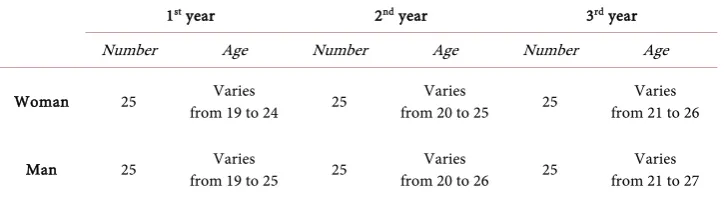
We arbitrarily chose students (their characteristics are mentioned in Table 1) of the Higher Institute of Sports and Physical Education in terms of gender and level of study. Most of them belong to South Tunisia.
2.2. Investigation Tool
From an elaborated questionnaire, we opted for the analysis of reliability (Cronbach Alpha which is equal to 70%). We also tried to study the social representations of the body of the students of ISSEP Gafsa (south Tunisia) through items (65 items) in the form of a scale from 1 to 4 (1: absolutely; 2: yes; 3: more or less; 4: no).
The questionnaire consists of different parts: i) General characteristics.
[image:3.595.194.557.600.701.2]ii) The social representations of the body. a) The bodily experience.
Table 1. Characteristics of the study population.
1st year 2nd year 3rd year
Number Age Number Age Number Age
Woman 25 from 19 to 24 Varies 25 from 20 to 25 Varies 25 from 21 to 26 Varies
b) The link of the body to the environment. c) The social interactions.
d) Notional and normative acquisitions.
2.3. Statistical Analysis
Through the statistical analysis of KHI two of Pearson, we could raise the asymptotic significations and we elaborated cross tabulations in terms of items, level of study and gender.
3. Results
[image:4.595.194.554.466.620.2]3.1. Verification of Hypothesis No. 1: The Bodily Experience
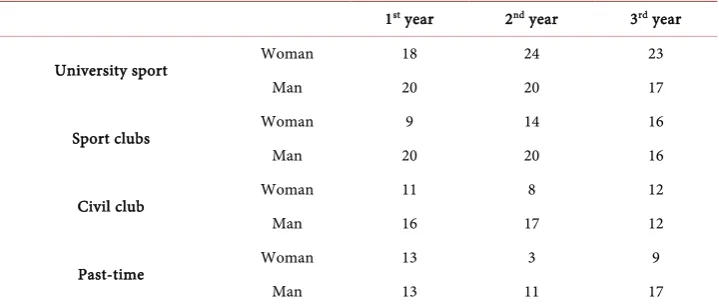
Table 2 shows the influence of the sporting experience of the students and the access to sporting practice in terms of gender and the level of study allows us to deduce that sports is a purely masculine field. Since masculine students are more invested in sport clubs and civil clubs. This can be confirmed by the sporting practice of the family members of the masculine gender (fathers, brothers) in spite of women. Whereas the level of study has no effect on the sporting practice of the students of ISSEP Gafsa.
Through Table 3, statistical analysis of Khitwo reveals a significant difference to p = 0.01 in favour of men (68%). They consider body as a machine to perform.
3.2. Verification of Hypothesis No. 2: The Link of the Body to the Social Environment
a) According to gender
Table 4 shows that masculinity of the sporting domain can explain the significant
Table 2. Sporting practice according to gender and the level of study.
1st year 2nd year 3rd year
University sport Woman 18 24 23
Man 20 20 17
Sport clubs Woman 9 14 16
Man 20 20 16
Civil club Woman 11 8 12
Man 16 17 12
Past-time Woman 13 3 9
Man 13 11 17
Table 3. According to gender; body machine to perform.
The body is machine to perform
Woman 58.66% p = 0.01
and quite significant differences (p varies between p = 0.02 and p = 0.005) in favour of men. In the sporting practice, men try to prove their masculinity and their virility through the engagement and the overrun of physical limits in diverse intense physical activities. Whereas women consider that the investment of the body in the sporting practice is marked by the endurance to pain and easing discomfort.
The image of the body allows the individual to give a meaning to his practice, and to seize their conducts and attitude well against his body and the bodies of others and in terms of social context. Abric considers that “by its functions of elaboration of a com-mon sense, the construction of a social identity, by the expectations and the anticipa-tions it generates, the representation is behind the social practices”.
b) According to the level of study
The statistical analysis of the questions related to the investment of the body in the sporting practice reveals through Table 5 quite significant differences (p = 0.001 & p = 0.01) and significant differences (p = 0.02 & p = 0.04). Indeed, first year students give more importance for performative efficacy in high-intensity activities. They consider the bodily existence as a performing body, this is explained by the study regime which gives more importance to the sporting practice.
Whereas most of the second year students (84%) preview that the investment of the body in the sporting field is endurance to pain and easing to discomfort due to the study regime which is loaded of physical activities.
Final year students choose the biological body as the body is related to everything that is teaching and pedagogical attitude (preparation of the body for the activity and everything pedagogical).
3.3. Verification of Hypothesis No. 3: Social Interactions
a) According to gender
Concerning the bodily appearance in the social loo in terms of gender, the statistical analysis shows in Table 6 a significant difference (p = 0.04) concerning women who feel good in their body and prefer the company of the opposite sex (p = 0.007).
The report to the body is not only limited to the social representations of the bodily practices but also to the report between both genders and the social status of each one.
Indeed, the link to the body is different among both genders due to the beliefs and perceptions of the body. Men conceive their body as object of belonging to the other and want to change their body to a muscular body, object of masculinity and virility.
The use of bodily appearance depends on the social context where the individual evolves. The mastery of this socio-bodily knowledge constitutes an issue of belonging to the social group. The bodily appearance is a social construct in which the practices of the actors are in action.
b) According to the level of study
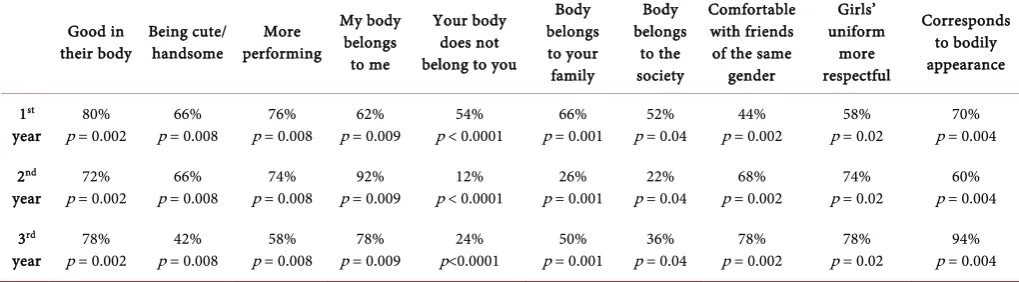
The notion of the social representation of the body differs according to the level of study through Table 7.
being for 80% (p = 0.002) of performative efficacy for 76% (p = 0.008) and belonging to the self, family and society.
[image:6.595.40.561.147.240.2]-Second year students consider their body as object of belonging to others (92%, p =
Table 4. Investment of the body in the sporting practice according to gender.
Exceed the
sporting limits Performative efficacy and identity rugbymen Body of Slender bodies of swimmers Endurance to pain discomfort Easing
Woman p24%
= 0.01
48% p = 0.005
25.33% p = 0.02
54.66% p = 0.01
78.66% p = 0.02
86.66% p = 0.01
[image:6.595.43.558.274.396.2]Man p = 0.01 40% p73.33% = 0.005 p = 0.02 44% p73.33% = 0.01 p = 0.02 72% p66.66% = 0.01
Table 5. Investment of the body in the sporting practice according to the level of study.
Performative efficacy and identity Bodies of rugbymen Bodies of runners Bodies of boxers Endurance to pain Easing discomfort Biological body Performing body Masculine bodily habits
1st year 72% p = 0.01
48% p = 0.001
72% p = 0.02
60% p = 0.02
70% p = 0.04
78% p = 0.008
74% p = 0.01
80% p = 0.02
74% p = 0.02
2nd year 56% p = 0.01
26% p = 0.001
42% p = 0.02
32% p = 0.02
84% p = 0.04
84% p = 0.008
54% p = 0.01
58% p = 0.02
52% p = 0.02
3rd year 54%
p = 0.01 p = 0.001 30% p = 0.02 52% p = 0.02 48% p = 0.04 72% p = 0.008 68% p = 0.01 76% p = 0.02 56% p = 0.02 60%
Table 6. Bodily appearance in the social look in terms of gender.
Good in their body
Change of the bodily appearance
Change towards a muscular body The body belongs to me The body does not belong to me
The body limits the personal
liberty
Comfortable with the other sex
Sport uniform in front of
others
Woman p = 0.04 80% p33.33% = 0.002 p = 0.001 36% p = 0.001 84% p18.66% = 0.02 p42.66% = 0.001 p = 0.007 64% p21.33% = 0.001
Man p73.33% = 0.04 p53.33% = 0.002 p66.66% = 0.001 p = 0.001 70% p41.33% = 0.02 p57.33% = 0.001 p58.66% = 0.007 p42.66% = 0.001
Table 7. Bodily appearance in the social respect in terms of the level of study.
Good in their body Being cute/ handsome More performing My body belongs to me Your body does not belong to you
Body belongs to your family Body belongs to the society Comfortable with friends of the same
gender Girls’ uniform more respectful Corresponds to bodily appearance 1st year 80% p = 0.002
66% p = 0.008
76% p = 0.008
62% p = 0.009
54% p < 0.0001
66% p = 0.001
52% p = 0.04
44% p = 0.002
58% p = 0.02
70% p = 0.004
2nd
year p = 0.002 72% p = 0.008 66% p = 0.008 74% p = 0.009 92% p < 0.0001 12% p = 0.001 26% p = 0.04 22% p = 0.002 68% p = 0.02 74% p = 0.004 60%
3rd
[image:6.595.41.567.429.527.2] [image:6.595.42.552.562.703.2]0.009) and feel comfortable with friends of the same gender with 78% (p = 0.002). -Final year students postulate that the sport uniform for girls must be respectful (78%, p = 0.02) which correspond to bodily appearance (94%, p = 0.004).
3.4. Verification of the Hypothesis No. 4: Notional and Normative Acquisitions
a) According to gender
We did not raise a significant difference in Table 8 for the influence of gender on the notional and normative acquisitions for the representations of the body of men only, which is distinguished by power and muscle structure in favour of women for p = 0.01 which is a very significant difference.
[image:7.595.195.555.622.706.2]b) According to the level of study
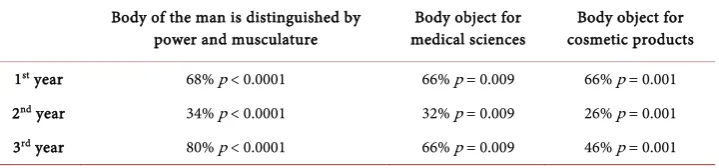
Table 9 shows notional and normative acquisitions according to the level of study: -80% of the 3rd year students assume that the body of the man stands for power and
muscle structure.
-66% of the 1st year students and 66% of the 3rd year students consider the body as
object of medical sciences.
-66% of the 1st year students conceive the body as object of cosmetic products.
4. Discussion
The sports experience of students in terms of gender and level of study allows to deduce that sports is a purely masculine domain. Men consider the body as a machine to per-form.
For the link between the body and the social environment, men prove their mascu-linity and virility through overtaking the physical limits. Women consider that the in-vestment of the body in the physical activity is guaranteed with endurance and easing discomfort.
Feminity and masculinity, depicted through corporeity, are expressed with specific bodily forms, postures and attitudes, style and gestures, as well as differentiated usages
Table 8. Bodily practices in term of gender.
The body of the man is distinct by power and musculature
Woman 73.33% p = 0.01
Man 48% p = 0.01
Table 9. Bodily practices in terms of the level of study.
Body of the man is distinguished by
power and musculature medical sciences Body object for cosmetic products Body object for
of the body. By integrating the body itself, its gender properties the enclose the indi-vidual and their body appearance in such behavioural models and prototypes of self- presentation stereotyped according to the group of gender of belonging.
Thereby, feminity and masculinity are expressed by the distinguished criteria that found it and define the boundaries of the models of feminine and masculine body. They are socially constructed and this construction “pushes us to believe in its neces-sity and naturality” (Butler, 2006: p. 264), but also in its aspect of unchangeable ap-pearance.
Concerning the level of study, first year students give more importance to the so-called performative efficacy. Although most the second-year students preview that the bodily investment in the activity is an endurance to pain and easing discomfort, fi- nal-year students choose the biological body.
For the social interactions, women feel better with their body and prefer the compa-ny of the opposite gender. Men conceive their body as object of belonging to others and want to change their body to a musculated one.
First-year students conceive their body as a source of physical well being. For the second-year students, they consider their body as an object of belonging to others. Third-year students assume that the sports uniform of girls must be more respectful.
The model of the sporting body returns obviously to the strong, musculated efficient competitive body in which the appreciation depends on the masculine norms. Mascu-linity constitutes, indeed, the framework in the sporting, considering the completely physical aspect of this practice (Bryson, 1990).
The representation of men’s body, according to the notional and normative acquisi-tions is distinguished by force and musculature. For the level of study, the third-year students assume that men’s body is distinguished by force and musculature. Second-year students consider the body as an object of medical sciences and cosmetic products.
Usages of the body for both genders are codified and legitimated with reference to a body model, sporting body, which is distinguished with prescriptive values and specific body norms (Lachheb, 2007).
5. Conclusion
Concerning the bodily experience, male students are invested in the sporting field and consider body as a machine to perform. For the link of the body to the social environ-ment, we have significant and even quite significant differences in favour of men since they try to prove their masculinity in diverse activities. The level of study relieves quite significant and significant differences for 1st year students. However, the bodily
References
Abric, J. C. (2001). Social Practices and Representations (p. 18). Paris: PUF.
Blöss, T. (2001). The Dialectic of Relationships between Men and Women. Paris: PUF.
Bryson, L. (1990). Challenges to Male Hegemony in Sport. In M. Messner, & D. Sabo (Dir.), Sport, Men and the Gender Order: Critical Feminist Perspectives (pp. 173-184). Illinois: Hu-man Kinetics.
Butler, J. (2006). Gender Troubles. Feminism and the Subversion of Identity. Paris: The Discov-ery.
Detrez, C. (2002).The Social Construction of the Body. Paris: Threshold Editions. Jodelet, D. (2003). Social Representations (p. 53, 365). Paris: PUF.
Lachheb, M. (2007). Models of the Body and Pedagogical Models through Contemporary Tuni-sian Physical Education. Doctoral Thesis in Sociology. Montpellier: University of Montpellier III.
Le Breton, D. (1993). The Living Flesh, Medical and Social Uses of the Human Body. Paris: Métailié.
Submit or recommend next manuscript to SCIRP and we will provide best service for you:
Accepting pre-submission inquiries through Email, Facebook, LinkedIn, Twitter, etc. A wide selection of journals (inclusive of 9 subjects, more than 200 journals)
Providing 24-hour high-quality service User-friendly online submission system Fair and swift peer-review system
Efficient typesetting and proofreading procedure
Display of the result of downloads and visits, as well as the number of cited articles Maximum dissemination of your research work
Submit your manuscript at: http://papersubmission.scirp.org/