http://www.scirp.org/journal/psych ISSN Online: 2152-7199 ISSN Print: 2152-7180
Effect of Poverty on Intertemporal Choice and
Psychological Explanations
Shaoli Yang
School of Management, Jinan University, Guangzhou, China
Abstract
In recent years, with global sustainable economic development, poverty is still one of the most pressing issues facing in the world. Many poor families have to face in their daily lives the complex and difficult economic decisions, and often the poor and the rich in these intertemporal preferences are different. Studies show that poverty will impact intertemporal choice through two intermediary paths: cognition and emo-tion. The poor prefer smaller and sooner choice other than larger and later choice. Future studies may pay attention to: absolute poverty and relative poverty, different effects on intertemporal choice; cognition and emotion, the two psychological me-chanisms of interaction and intercultural studies.
Keywords
Poverty, Intertemporal Choice, Cognitive Capacity, Emotion
1. Introduction
Poverty is still one of the most pressing issues facing in the world (Haushofer & Fehr, 2014). Poverty is a multidimensional concept, and by its very nature, which can be seen as a lack of sufficient wealth and income (Ravallion & Bidani, 1994). Currently there are 14.5% people worldwide (about 1.015 billion) living on less than 1.25 dollars a day, with more than 150 million people living on less than 1 dollar a day (WHO, 2013). Although in recent years, with global sustainable economic development, the population of po-verty has decreased, popo-verty has still not been effectively resolved. The purpose of de-velopment is to benefit all members of society, so we should pay special attention to the poor, and to improve the lives of the poor must become a priority in our agenda (Kan-bur & Squire, 1999).
Decision-making behaviors take places throughout our human life every day. Inter-temporal choice is one of the highlights in behavioral decision and related fields nearly How to cite this paper: Yang, S. L. (2016).
Effect of Poverty on Intertemporal Choice and Psychological Explanations. Psycholo-gy, 7, 1296-1306.
http://dx.doi.org/10.4236/psych.2016.710131
Received: August 22, 2016 Accepted: September 16, 2016 Published: September 19, 2016
Copyright © 2016 by author and Scientific Research Publishing Inc. This work is licensed under the Creative Commons Attribution International License (CC BY 4.0).
twenty years (Liang & Liu, 2011). Intertemporal choices are decisions involving tradeoffs among costs and benefits occurring at different times (Frederick, Loewenstein, & O’donoghue, 2002). In the study of intertemporal choice, in order to compare results at different times viewed by a psychological perspective, researchers introduced the con-cept of time discounting (Samuelson, 1937), that is, delay rewards are discounted at a rate over time. Generally researchers use the discounting rate to measure the degree to which people discount future events. Studying time discounting is helpful to explore the psychological process of intertemporal choice. Time discounting rate increases indicate that individual prefers more immediate rewards, and the value of delay reward declines more rapidly over time. Time discounting is the core concept to understand intertem-poral choice. Intertemintertem-poral choices are decisions with consequences that play out over time which are important and ubiquitous. Decisions about spending, investments, diet, relationships, fertility, crime and education all contain intertemporal tradeoffs (Berns, Laibson, & Loewenstein, 2007). Intertemporal choice not only affects personal health, wealth and happiness, but also the nation’s economic prosperity as first suggested by Adam Smith (Frederick, Loewenstein, & O’Donoghue, 2002). People in daily life often make various economic decisions. Many low-income families have to face complex and difficult intertemporal economic choices (Collins, Morduch, Rutherford, & Ruthven, 2009), concerning to savings and education investment. Some studies showed that poor and rich people in these intertemporal choices had different select tendencies. Poor people are unwilling to invest in the program which can obtain long-term benefits, for example education and medical health. Consequently, the short-sighted decisions will further reduce poor people long-term gains for the future (Haushofer & Fehr, 2014).
The cause of poverty has many reasons. Previous studies on poverty are always tak-ing the macro perspective (Badrudin & Warokka, 2012; Lu & Lu, 2013). However, psy-chological processes of poverty gradually come into discussions in recent years. Psy-chologists unite scholars from other fields arrange a series of laboratory experiments and field experiments around the relationship between poverty and intertemporal choice. There comes to different conclusions due to experimental paradigms adopted to understand poverty-related psychological decision from micro perspective. This paper aims at summarizing these studies and exploring the psychological mechanism of po-verty related with intertemporal choice. Studies show that popo-verty will impact inter-temporal choice through two intermediary paths: cognition and emotion. The poor prefer smaller and sooner choice other than larger and later choice.
2. The Relationship between Poverty and Intertemporal Choice
long-term benefit for the instant gratification. If people’s discounting rate is high, they are often reluctant to send their children to accept years of education. Because they think education is an investment for future earnings that they cannot wait (Tanaka, Camerer, & Nguyen, 2016). Studies also show that compared to rich countries, poor countries tend to saving less, eating less healthy food and exercising less (Fehr & Falk, 2002). Economic theories and empirical evidences both indicate that poor families are less likely to give up the present gains for future bigger and longer benefits. Whether poverty makes people “shortsighted” and prefer smaller and shorter gains in the inter-temporal choice? What is the relationship between poverty and interinter-temporal choice?
As early as 1930 Fisher made a point that “in the same condition, people with low- income tend to have a higher time discounting rate. Partly because they consider that necessities are necessary both for the present and the future, and partly because of the lack of foresight and self-control”. Later studies provide evidences for this view. There are many studies about the relationship between discounting rate and income in de-veloped and developing countries (Tanaka, Camerer, & Nguyen, 2016). There are many studies have found that people who live in poverty, especially in developing countries, tend to discount future benefits more than the rich. For example, in America the time discounting rate of poor family is higher than rich family (Lawrance, 1991). Similarly, researchers found that farm families in Ethiopia (Yesuf & Bluffstone, 2008) and the re-search samples in the South India (Pender, 1996) both show that lower levels of wealth predict quite high time discounting rate (by measure). Researcher used the family data of purchasing and using air-conditions to estimate the time discounting rate of con-sumer, and study showed that the relationship between time discounting rate and in-come is reverse (Hausman, 1979). There are studies showing that the relationship be-tween discounting rate and wealth is negative correlation in the United States and Denmark, that is to say, the wealthier people are more patience (Lawrance, 1991; Har-rison, Lau, & Williams, 2002). Researcher also found negative correlation between wealth and discounting rate in Madagascar (Nielsen, 2001). And researchers found that the discounting rate of subjects with high-income participants is lower than the low-income participants’ (Green et al., 1996).
In addition to the study of the correlation between income and time discounting, there is also evidence that poverty has causal effect on time discounting. Researchers used experimental method to measure the negative correlation between time discount-ing rate and income in Vietnam (Tanaka, Camerer, & Nguyen, 2016). That is to say, poor households prefer choosing smaller and shorter reward (SS) to choosing larger and later reward (LL). In the study, through the use of rainfall as a tool variable of in-come to predict and confirm the negative relationship between discounting rate and income, this finding suggests that poverty has causal effect on time discounting.
cues implicitly, three is that manipulating the change of status between poor and rich temporarily. And the findings suggest that individual in the poor status is more impulsive to some extent, thus they pursue instant gratification in intertemporal choice.
But there are also some studies do not support this view. For example, researchers had not found significant correlation between time discounting and wealth in Bolivia and Vietnam (Kirby et al., 2002; Anderson, Dietz, Gordon, & Klawitter, 2004). Howev-er, they only used two villages with similar characteristics in their research, so that the income changes between samples are too small. Therefore, researchers may not have enough income changes to explore the relationship between income and time dis-counting (Anderson, Dietz, Gordon, & Klawitter, 2004). If using villages that have larg-er income changes as samples, researchlarg-ers are likely to find possible relationship be-tween income and time discounting.
In summary, although a small number of studies suggest that there is no relationship between income and time discounting rate. Most studies suggest that income has a negative relationship with discounting rate, that is to say, poverty will produce higher discounting rate, and the poor tend to choose smaller and sooner rewards in intertem-poral choices. This paper supports the idea that poverty has effect on intertemintertem-poral choice through reviewing relevant literatures. Some researches focus on poor environ-mental conditions (such as restricted in the credit market) to explain the poor series of bad behavior, which in turn lead to further deepening of poverty (Banerjee & Duflo, 2008). While some researches focus on the characteristics of the poor themselves, such as rarely received good education, less parental attention and vulnerable to negative shocks (Haushofer, Schunk, & Fehr, 2013), this paper focuses primarily on the poor’s psychological process to explore the impact of poverty on intertemporal choice. Why is this happening? Numerous studies show that may exist some psychological variables to regulate the relationship between poverty and intertemporal choice. Next, we discuss the psychological mechanisms between them.
3. Psychological Mechanisms of Poverty Impact Intertemporal
Choice
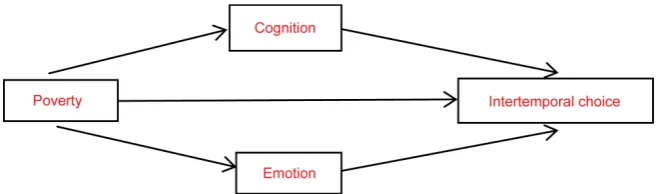
[image:4.595.209.542.590.687.2]By reviewing related literature, this paper suggests that poverty will impact intertem-poral choice through two intermediary paths: cognition and emotion, which will make people prefer smaller and sooner choice other than larger and later choice in intertem-poral choice (see Figure 1).
3.1. Through Cognitive Path
Human cognitive system only has limited capacity (Baddeley & Hitch, 1974; Luck & Vogel, 1997; Neisser, 1976). Urgent budgetary concerns dominate the mind, so there are fewer available cognitive resources to guide people’s decisions and actions. When the poor worry about money problems, they will lose the ability to make full considera-tion for the other issues (Mani, Mullainathan, Shafir, & Zhao, 2013). For the poor, the same economic decision for them means to make difficult tradeoffs among less mis-takes and more valuable alternatives (Spears, 2010). There are experimental evidences showing that these difficult decisions will consume cognitive resources (Vohs et al., 2014; Tversky & Shafir, 1992). Researchers used two different but complementary study designs to test the causal relationship between poverty and cognitive function (Butter-worth, Cherbuin, Sachdev, & Anstey, 2012). In the laboratory study, researchers con-ducted a series of experiments towards consumers in a New Jersey shopping mall. Par-ticipants were asked to imagine themselves encounter some specific economic events (for example, spend money to fix the car), and these economic events are divided into “easy” or “difficult” two grades based on expenditures (such as car repair will cost $150 or $1500), then participants need to think about coping approach. Subsequently, par-ticipants will receive the Raven’s standard progressive testing (RPM) and spatial coor-dination testing. The former tests logical thinking and the ability of solving new prob-lems, and the latter tests cognitive control. Results showed that when participants en-counter “easy” event, the performance of high-income people and low-income people are the same. But when participants encounter “difficult” event, cognitive ability of low-income people is declined significantly, however, high-income people maintain the original performance. In the field study, researchers tested cognitive ability changes among sugarcane growers before and after the harvest in India. Sugarcane growers ex-perienced the cycle of poverty before the harvest and rich after the harvest. Therefore, this allows us to compare the same farmers’ cognitive abilities in poor (prior to harvest) and rich (post harvest) condition. Performance of cognitive test of sugarcane growers before the harvest is not good. But after the harvest their cognitive abilities are signifi-cantly improved.
value of delayed reward is dropping, and discounting rate is increasing.
Therefore, poverty through impeding cognitive ability thus impacting intertemporal choice, making people prefer smaller and sooner options.
3.2. Through Emotional Path
Many studies show that poverty often leads to negative emotions, and poverty reduc-tion has the opposite effect (Haushofer & Fehr, 2014). Anxiety and depression are common negative emotions, and they are two typical negative emotions that are most closely related to physical and mental health (Fan, 2007; Tu & Guo, 2011). Studies show that level of negative emotion of impoverished college students is significantly higher than the non-poor student’s (Fan, 2007). And the poor college students’ level of depres-sion is significantly higher than non-poor students’ (Xue, Lu, & Liang, 2010). Numer-ous studies show that income is negative related to depression (Fiscella & Franks, 1997), and there is a negative linear relationship between income and anxiety (Witt-chen, Zhao, Kessler, & Eaton, 1994). Researches from psychology and biology show that poverty leads to anxiety and unhappiness (Sheehy-Skeffington & Haushofer, 2014).
Studies have shown that different emotional states affect individual’s intertemporal choice (Peng & Feng, 2014). Emotions are important factors affecting the intertemporal choice, and under different emotion priming state the future result’s value is different. Recently, many studies suggest that negative emotions increase time discounting (Lerner, Li, & Weber, 2012; Ifcher & Zarghamee, 2011; DeSteno et al., 2014).
Researchers through showing participants the short films which cause sadness emo-tion, and then let participants make money intertemporal choice between smaller and sooner rewards and lager and later rewards (Lerner, Li, & Weber, 2012). Study results show that compare to control group participants, participants watch short films that trigger sadness prefer to choose smaller and sooner rewards. That is to say, sadness re-duces people’s patience. To the contrary, in another recent study show that participants watch short films which trigger positive emotion tend to be more patience in the same task (Ifcher & Zarghamee, 2011). Studies have shown that in the presence of negative expected emotions, participants are more likely to choose immediate and smaller re-wards.
Therefore, poverty through triggering negative emotions thus impacting intertem-poral choice, making people prefer smaller and sooner options.
4. Prospects
4.1. Whether Absolute Poverty or Relative Poverty Has Impact on
Intertemporal Choice Needs to Be Further Studied
In traditional economic, there are arguments about absolute poverty and relative pover-ty. Absolute poverty means that poverty is absolute existence in essence. That is to say, the core meaning of absolute poverty is that individual lacking of capacity of acquiring basic material opportunity and the measurement standard is also absolute (Sen, 1983). Relative poverty means that poverty is compared with others and poverty can change with social norms and customs (Townsend, 1962). However, most of the existing re-search has avoided discussing whether to use absolute poverty or relative poverty as term (Banerjee, Deaton, & Duflo, 2004). We cannot compare the absolute level of discounting rate between America, Israel and Vietnam, because specific question is different in dif-ferent studies and difdif-ferent dollar terms. Therefore, the study of poverty should integrate the argument of absolute poverty and relative poverty in future research.
4.2. Single Psychological Mechanism Cannot Always Explain the Impact
of Poverty on Intertemporal Choice
There might be interactions between a variety of psychological variables, for example, cognition and emotion. These two aspects are inseparable. People’s decision is affected by emotions. Researchers induce participants’ positive emotion through pictures and words (Pyone & Isen, 2011). And the results show that people with positive emotion are more far-sighted and more concerned about the future, so they have better self-control ability. In the light of construction theory, people with positive emotion have high level of construction, so they are more likely to choose future higher income option.
4.3. Any Research Topic in Psychology Needs to Take Account of the
Cultural Background
References
Anderson, C. L., Dietz, M., Gordon, A., & Klawitter, M. (2004). Discount Rates in Vietnam.
Economic Development and Cultural Change, 52, 873-887. http://dx.doi.org/10.1086/381111
Baddeley, A. D., & Hitch, G. (1974). Working Memory. Psychology of Learning and Motivation, 8, 47-89. http://dx.doi.org/10.1016/S0079-7421(08)60452-1
Badrudin, R., & Warokka, A. (2012). Poverty Measurement and Choice of Poverty Reduction Strategy: The Importance of Poverty Measurement in Determining the Right Strategy. Journal of Economics and Behavioral Studies, 4, 595-602.
Banerjee, A. V., & Duflo, E. (2008). What Is Middle Class about the Middle Classes around the World? The Journal of Economic Perspectives, 22, 3-41. http://dx.doi.org/10.1257/jep.22.2.3
Banerjee, A., Deaton, A., & Duflo, E. (2004). Health, Health Care, and Economic Development: Wealth, Health, and Health Services in Rural Rajasthan. The American Economic Review, 94,
326-330. http://dx.doi.org/10.1257/0002828041301902
Benjamin, D. J., Brown, S. A., & Shapiro, J. M. (2013). Who Is “Behavioral”? Cognitive Ability and Anomalous Preferences. Journal of the European Economic Association, 11, 1231-1255.
http://dx.doi.org/10.1111/jeea.12055
Berns, G. S., Laibson, D., & Loewenstein, G. (2007). Intertemporal Choice toward an Integrative Framework. Trends in Cognitive Sciences, 11, 482-488.
http://dx.doi.org/10.1016/j.tics.2007.08.011
Burks, S. V., Carpenter, J., Götte, L., Monaco, K., Porter, K., & Rustichini, A. (2008). Using Beha-vioral Economic Field Experiments at a Firm: The Context and Design of the Truckers and Turnover Project. In S. Bender, J. Lane, & K. L. Shaw (Eds.), The Analysis of Firms and Em-ployees: Quantitative and Qualitative Approaches (pp. 45-106). Chicago, IL: University of Chicago Press. http://dx.doi.org/10.7208/chicago/9780226042893.003.0003
Butterworth, P., Cherbuin, N., Sachdev, P., & Anstey, K. J. (2012). The Association between Fi-nancial Hardship and Amygdala and Hippocampal Volumes: Results from the PATH through Life Project. Social Cognitive and Affective Neuroscience, 7, 548-556.
http://dx.doi.org/10.1093/scan/nsr027
Cohen, A. K., & Hodges, H. M. (1963). Characteristics of the Lower-Blue-Collar-Class. Social Problems, 10, 303-334. http://dx.doi.org/10.2307/799204
Collins, D., Morduch, J., Rutherford, S., & Ruthven, O. (2009). Portfolios of the Poor: How the World’s Poor Live on $2 a Day. Princeton, NJ: Princeton University Press.
Colom, R., & Shih, P. C. (2004). Is Working Memory Fractionated onto Different Components of Intelligence? A Reply to Mackintosh and Bennett (2003). Intelligence, 32, 431-444.
http://dx.doi.org/10.1016/j.intell.2004.06.011
DeSteno, D., Li, Y., Dickens, L., & Lerner, J. S. (2014). Gratitude: A Tool for Reducing Economic Impatience. Psychological Science, 25, 1262-1267.
http://dx.doi.org/10.1177/0956797614529979
Fan, R. F. (2007). The Study on Impoverished University Student’s Negative Emotions and the Effecting Factors. Master Dissertation, Nanjing: Hohai University.
Fehr, E., & Falk, A. (2002). Psychological Foundations of Incentives. European Economic Review, 46, 687-724. http://dx.doi.org/10.1016/S0014-2921(01)00208-2
Fiscella, K., & Franks, P. (1997). Poverty or Income Inequality as Predictor of Mortality: Longitu-dinal Cohort Study. BMJ, 314, 1724-1727. http://dx.doi.org/10.1136/bmj.314.7096.1724
http://dx.doi.org/10.1257/jel.40.2.351
Gray, J. R., & Thompson, P. M. (2004). Neurobiology of Intelligence: Science and Ethics. Nature Reviews Neuroscience, 5, 471-482. http://dx.doi.org/10.1038/nrn1405
Green, L., Myerson, J., Lichtman, D., Rosen, S., & Fry, A. (1996). Temporal Discounting in Choice between Delayed Rewards: The Role of Age and Income. Psychology and Aging, 11, 79-
84. http://dx.doi.org/10.1037/0882-7974.11.1.79
Harrison, G. W., Lau, M. I., & Williams, M. B. (2002). Estimating Individual Discount Rates in Denmark: A Field Experiment. The American Economic Review, 92, 1606-1617.
http://dx.doi.org/10.1257/000282802762024674
Haushofer, J., & Fehr, E. (2014). On the Psychology of Poverty. Science, 344, 862-867.
http://dx.doi.org/10.1126/science.1232491
Haushofer, J., Schunk, D., & Fehr, E. (2013). Negative Income Shocks Increase Discount Rates. Zurich: University of Zurich Working Paper.
Hausman, J. A. (1979). Individual Discount Rates and the Purchase and Utilization of Energy- Using Durables. The Bell Journal of Economics, 10, 33-54.
http://dx.doi.org/10.2307/3003318
Hinson, J. M., Jameson, T. L., & Whitney, P. (2003). Impulsive Decision Making and Working Memory. Journal of Experimental Psychology: Learning, Memory, and Cognition, 29, 298-306.
http://dx.doi.org/10.1037/0278-7393.29.2.298
Ifcher, J., & Zarghamee, H. (2011). Happiness and Time Preference: The Effect of Positive Affect in a Random-Assignment Experiment. The American Economic Review, 101, 3109-3129.
http://dx.doi.org/10.1257/aer.101.7.3109
Kanbur, R., & Squire, L. (1999). The Evolution of Thinking about Poverty: Exploring the Interac-tions Mimeographed Document. Washington DC: World Development Report Office, Wash-ington DC World Bank.
Kirby, K. N., Godoy, R., Reyes-Garcıa, V., Byron, E., Apaza, L., Leonard, W., Wilkie, D. et al. (2002). Correlates of Delay-Discount Rates: Evidence from Tsimane’ Amerindians of the Boli-vian Rain Forest. Journal of Economic Psychology, 23, 291-316.
http://dx.doi.org/10.1016/S0167-4870(02)00078-8
Lawrance, E. C. (1991). Poverty and the Rate of Time Preference: Evidence from Panel Data.
Journal of Political Economy, 99, 54-77. http://dx.doi.org/10.1086/261740
Lerner, J. S., Li, Y., & Weber, E. U. (2012). The Financial Costs of Sadness. Psychological Science, 24, 72-79. http://dx.doi.org/10.1177/0956797612450302
Liang, Z. Y., & Liu, H. (2011). Exploring the Nature of Intertemporal Choice. Advances in Psy-chological Science, 19, 959-966.
Liu, L., Feng, T., Suo, T., Lee, K., & Li, H. (2012). Adapting to the Destitute Situations: Poverty cues Lead to Short-Term Choice. PLoS ONE, 7, e33950.
http://dx.doi.org/10.1371/journal.pone.0033950
Lu, S. F., & Lu, H. Y. (2013). Could Government Assistance Help the Poor to Alleviate Poverty? Empirical Study Based on the Data of CHNS from 1989 to 2009. Journal of Finance and Eco-nomics, 39, 4-16.
Luck, S. J., & Vogel, E. K. (1997). The Capacity of Visual Working Memory for Features and Conjunctions. Nature, 390, 279-281. http://dx.doi.org/10.1038/36846
Mani, A., Mullainathan, S., Shafir, E., & Zhao, J. (2013). Poverty Impedes Cognitive Function.
Science, 341, 976-980. http://dx.doi.org/10.1126/science.1238041
New York: WH Freeman and Company.
Nielsen, U. (2001). Poverty and Attitudes towards Time and Risk: Experimental Evidence from Madagascar. Copenhagen: Royal Veterinary and Agricultural University.
O’Rand, A., & Ellis, R. A. (1974). Social Class and Social Time Perspective. Social Forces, 53, 53-
62. http://dx.doi.org/10.1093/sf/53.1.53
Pender, J. L. (1996). Discount Rates and Credit Markets: Theory and Evidence from Rural India.
Journal of Development Economics, 50, 257-296.
http://dx.doi.org/10.1016/S0304-3878(96)00400-2
Peng, J., & Feng T. Y. (2014). Intervention Program and Neural Mechanisms for Intertemporal Choice in Addicts. Advances in Psychological Science, 5, 810-821.
Pyone, J. S., & Isen, A. M. (2011). Positive Affect, Intertemporal Choice, and Levels of Thinking: Increasing Consumers’ Willingness to Wait. Journal of Marketing Research, 48, 532-543.
http://dx.doi.org/10.1509/jmkr.48.3.532
Ravallion, M., & Bidani, B. (1994). How Robust Is a Poverty Profile? The World Bank Economic Review, 8, 75-102. http://dx.doi.org/10.1093/wber/8.1.75
Samuelson, P. A. (1937). A Note on Measurement of Utility. The Review of Economic Studies, 4,
155-161. http://dx.doi.org/10.2307/2967612
Sen, A. (1983). Poor, Relatively Speaking. Oxford Economic Papers, 35, 153-169.
Shamosh, N. A., DeYoung, C. G., Green, A. E., Reis, D. L., Johnson, M. R., Conway, A. R., Gray, J. R. et al. (2008). Individual Differences in Delay Discounting Relation to Intelligence, Work-ing Memory, and Anterior Prefrontal Cortex. Psychological Science, 19, 904-911.
http://dx.doi.org/10.1111/j.1467-9280.2008.02175.x
Sheehy-Skeffington, J., & Haushofer, J. (2014). The Behavioural Economics of Poverty. In Bar-riers to and Opportunities for Poverty Reduction (pp. 96-112). UNDP.
Spears, D. E. (2010). Economic Decision-Making in Poverty Depletes Behavioral Control. Prin-ceton, NJ: Center for Economic Policy Studies, Princeton University.
Tanaka, T., Camerer, C. F., & Nguyen, Q. (2016). Risk and Time Preferences: Linking Experi-mental and Household Survey Data from Vietnam. In S. Ikeda, H. K. Kato, F. Ohtake, & Y. Tsutsui (Eds.), Behavioral Economics of Preferences, Choices, and Happiness (pp. 3-25). Ber-lin: Springer.
Townsend, P. (1962). The Meaning of Poverty. The British Journal of Sociology, 13, 210-227.
http://dx.doi.org/10.2307/587266
Tu, Y. J., & Guo, Y. Y. (2011). The Influence of Life-Events on Negative Emotions: Social Support as a Moderator and Coping Style as a Mediator. Chinese Journal of Clinical Psychology, 5, 652- 655.
Tversky, A., & Shafir, E. (1992). Choice under conflict: The Dynamics of Deferred Decision.
Psychological Science, 3, 358-361.
Vohs, K. D., Baumeister, R. F., Schmeichel, B. J., Twenge, J. M., Nelson, N. M., & Tice, D. M. (2014). Making Choices Impairs Subsequent Self-Control: A Limited-Resource Account of De-cision Making, Self-Regulation, and Active Initiative. Journal of Personality and Social Psy-chology, 94, 883-898. http://dx.doi.org/10.1037/2333-8113.1.s.19
WHO (2013). World Health Statistics 2013. Geneva.
Wittchen, H. U., Zhao, S., Kessler, R. C., & Eaton, W. W. (1994). DSM-III-R Generalized Anxiety Disorder in the National Comorbidity Survey. Archives of General Psychiatry, 51, 355-364.
Xue, C. X., Lu, L., & Liang, Z. Q. (2010). Investigation about the Depression of Poor College Stu-dents. China Journal of Health Psychology, 7, 853-854.
Yesuf, M., & Bluffstone, R. (2008). Wealth and Time Preference in Rural Ethiopia (No. dp-08-16-efd).
Submit or recommend next manuscript to SCIRP and we will provide best service for you:
Accepting pre-submission inquiries through Email, Facebook, LinkedIn, Twitter, etc. A wide selection of journals (inclusive of 9 subjects, more than 200 journals)
Providing 24-hour high-quality service User-friendly online submission system Fair and swift peer-review system
Efficient typesetting and proofreading procedure
Display of the result of downloads and visits, as well as the number of cited articles Maximum dissemination of your research work