Universal Forgery Attack against GCM-RUP
Yanbin Li1,2, Ga¨etan Leurent3, Meiqin Wang1,2, Wei Wang1,2, Guoyan Zhang1,2, Yu Liu1,2
1
School of Cyber Science and Technology, Shandong University, Jinan, China 2 Key Laboratory of Cryptologic Technology and Information Security(Shandong
University), Ministry of Education, Jinan, China 3
Inria, Paris, France
Abstract. Authenticated encryption (AE) schemes are widely used to secure communications because they can guarantee both confidentiality and authenticity of a message. In addition to the standard AE security notion, some recent schemes offer extra robustness, i.e. they maintain security in some misuse scenarios. In particular, Ashur, Dunkelman and Luykx proposed a generic AE construction at CRYPTO’17 that is secure even when releasing unverified plaintext (the RUP setting), and a con-crete instantiation, GCM-RUP. The designers proved that GCM-RUP is secure up to the birthday bound in the nonce-respecting model. In this paper, we perform a birthday-bound universal forgery attack against GCM-RUP, matching the bound of the proof. While there are simple distinguishing attacks with birthday complexity on GCM-RUP, our attack is much stronger: we have a partialkey recovery leading to universal forgeries. For reference, the best known universal forgery attack against GCM requires 22n/3 operations, and many schemes do not have any known universal forgery attacks faster than 2n. This suggests that GCM-RUP offers a different security trade-off than GCM: stronger pro-tection in the RUP setting, but more fragile when the data complexity reaches the birthday bound. In order to avoid this attack, we suggest a minor modification of GCM-RUP that seems to offer better robustness at the birthday bound.
Keywords:GCM-RUP, partial key recovery, universal forgery, birthday bound.
1
Introduction
composition at a high level. Their analysis shows that only the Encrypt-then-MAC composition is generically secure.
Later, new AE modes have been proposed [11, 18, 30] to provide confidential-ity and authentication in a single scheme, which is more efficient than the generic composition of conventional mechanisms. AE schemes are now widely used in In-ternet protocols, and there is an ongoing effort to design and standardize new AE schemes with the recent CAESAR competition [35], and the NIST lightweight standardisation effort [38] currently running. The design and cryptanalysis of AE schemes is a very active topic in the cryptographic community today.
One of the most widely used AE schemes today is the Galois/Counter mode (GCM) [8, 23], an AE scheme following the Encrypt-then-MAC paradigm. GCM has been widely deployed thanks to its excellent software performance and hard-ware support, and because there are no intellectual property restrictions to its use. It has been standardized in TLS [7], ISO/IEC [37], NSA Suite B [39] and IEEE 802.1 [36]. GCM encrypts data using a variation of the counter mode of operation (CTR) which requires a single block cipher encryption per message block, and does not need to perform block cipher decryption, even when decrypt-ing the message. The ciphertext and associated data are authenticated with a Wegman-Carter-Shoup authenticator, where the keyed universal hash function is a polynomial evaluation over a binary Galois field. However, GCM is not ro-bust against implementation errors or misuse. In particular, if a nonce is used just two times, the confidentiality and authentication for GCM are compromised with Joux’s “forbidden attack” [17]. GCM also loses its security if a device re-leases the plaintext corresponding to invalid ciphertext before verifying the tag. Therefore, variants of GCM have been proposed to achieve some more robust security notions.
In 2015, Gueronet al.presented GCM-SIV [12] combining GCM’s underlying components with the SIV paradigm designed by Rogaway and Shrimpton [31], to provide nonce-misuse resistance. Later, at CRYPTO’17, Ashuret al.introduced a generic construction of AE scheme using a tweakable block cipher (TBC), which resists attacks in the RUP setting [2] (with Release of Unverified Plain-text). Based on the generic AE scheme, an instantiation GCM-RUP with high-efficiency is put forward using AES-GCM’s components. The designers proved that GCM-RUP is secure up to the birthday bound in the nonce-respecting model and RUP setting. On the other hand, no attacks are known so far against the authentication part of GCM-RUP. Therefore we do not know whether the proof is tight, and we do not know what kind of security degradation to expect after the birthday bound.
1.1 Contributions
of GCM-RUP breaks when the bound is reached: a universal forgery attack is much stronger than a distinguishing attack.
This is significant because no similar attack is known against GCM: on the one hand there are attacks with roughly√n×2n/2queries and time 2n[20,22,26], and on the other hand attacks with√n×22n/3 queries and timen×22n/3[20]. Our results show that universal forgery attacks against GCM-RUP are easier than against GCM, even though the security bounds from the proofs are similar, and both proofs are known to be tight (with simple distinguishing attacks).
Our attack is based on the following techniques:
– We show that inner collisions in the authentication part of GCM-RUP can be detected efficiently, and give out the output difference of the universal hash functionGHASHK2;
– Due to the structure ofGHASH, we build a polynomial equation inK2, which can be solved efficiently;
– Finally, when K2 is known, we can sign arbitrary messages. This defines a universal forgery attack with complexity 2n/2 (time and data).
Since our attack points out a weakness in the structure of GCM-RUP, we also suggest a minor modification to GCM-RUP to prevent the leakage of the output of GHASHK2 by using an extra block cipher call EK4 to encrypt the output of
GHASHK2. The objective of our variant is to achieve better security in the RUP
setting and in the classical setting.
Many designs use GHASH because of its high performances. However, the output of GHASH may leak information about the key, as exploited in our attack. Therefore, the stronger GHASH variant we proposed could be applied to not only GCM like scheme but also future GHASH-based designs.
1.2 Related Works
Modes of operation are usually studied with security proofs, but there is a grow-ing interest in generic attacks, showgrow-ing how the security degrades when the proof doesn’t hold. In particular, many attacks focus on (partial) key-recovery: most modes of operations have distinguishing attacks with birthday complexity 2n/2, but key-recovery and universal forgery attacks with the same complexity show that some schemes are more fragile than others when approaching the birthday bound.
that the security of AEZ [14] collapses at the birthday bound, with a full key recovery [10]. The scheme was modified to avoid the attack, but a variant is still applicable [6].
Besides MAC algorithms, there has also been work on message-recovery at-tacks on encryption modes, with a stronger impact than distinguishers. The well-known collision attack against CBC has been shown to be usable in prac-tice with 64-bit block ciphers [4], and message-recovery attacks have also been shown against the CTR mode [20], even though the well-known distinguisher is much weaker.
All these results clearly show the importance of cryptanalysis work against modes of operation, even when the attacks do not contradict the proofs. In addition, this type of work sometimes detects mistakes in the proofs, as shown with GCM [16] and OCB2 [15].
1.3 Organization
The remainder of this paper is organized as follows. Section 2 gives the prelimi-naries. Section 3 briefly describes the generic construction and its instantiation GCM-RUP. We recover the authentication key in Section 4, and a universal forgery is provided in Section 5. Section 6 recommends a minor modification to GCM-RUP to resist our forgery attack. Finally, Section 7 concludes this paper.
2
Preliminaries
This section will show notations, operations, some cryptographic schemes and security definitions used in this paper.
2.1 Notations and Operations
– n: The block size of the block cipher (for GCM-RUP,n= 128). – {0,1}≤x: The set of strings with length no greater thanxbits. – {0,1}∗: The set of strings with arbitrary length.
– |X|: Length ofX, ifX∈ {0,1}∗.
– X⊕Y: Bit-wise exclusive OR ofX andY, ifX, Y ∈ {0,1}∗.
– X·Y: Galois field multiplication ofX andY, ifX, Y ∈ {0,1}n. – XkY orXY: Concatenation ofX andY, ifX, Y ∈ {0,1}∗.
– ε: The empty string.
– 0n:n-bit string consisting of only zeros.
– lenn(X): Length ofX modulo 2n as ann-bit string.
– X0∗n:X padded on the right with 0-bits to get a string of length a multiple ofn.
– |X|n:X’s length inn-bit blocks|X|n=d|X|/ne.
– int(Y): Map thejbits stringY =aj−1. . . a1a0to the integeri=aj−12j−1+
· · ·+a12 +a0.
– strj(i): Map the integeri=aj−12j−1+· · ·+a12 +a0<2j to thej-bit string aj−1. . . a1a0.
– incm(X): The function which adds one modulo 2mtoX when viewed as an integer:incm(X) :=strm(int(X) + 1mod2m).
– msbj(X):j most significant bits ofX: msbj(ai−1. . . a1a0) :=ai−1. . . aa−j. – lsbj(X):jleast significant bits of X: lsbj(ai−1. . . a1a0) :=aj−1. . . a0. – F←E(Ck·): DefineF(X) =E(CkX) whereC is fixed as constant. – a=? b: Evaluate to>ifaequals b, and⊥otherwise.
2.2 AE, Separated AE and TBC
An authenticated encryption scheme is a symmetric key algorithm that provides both confidentiality and authenticity. Bellare and Namprempre [3] defined the formal notion of authenticated encryption as follows:
Definition 1 (AE [3]). An AE scheme consists of a pair of functions, the encryption function Enc and the decryption function Dec,
Enc:K × N × A × M → C, Dec:K × N × A × C → M ∪ {⊥},
with K the key space, N the nonce space, A the associated data space,M the message space, C the ciphertext space, and ⊥ an error symbol not contained in
M, which represents verification failure. It must be the case that for all K∈ K,
N ∈ N,A∈ AandM ∈ M,
DecNK(A,EncNK(A, M)) =M.
The decryption process typically has two phases: plaintext computation and verification; the plaintext obtained from decryption is only given out after suc-cessful verification. However, keeping the full plaintext in memory can be an issue for constrained devices, and side-channel attacks can potentially recover infor-mation about the plaintext while it is decrypted. Therefore, new models have been introduced to take into account the effect of releasing unverified plaintext. In particular, Andreevaet al.[1] definedseparated AE schemes where the plain-text computation is disconnected from verification; in this model the decryption function always releases the plaintext, without verifying it. Formally, a separated AE scheme is defined as:
Definition 2 (separated AE [1]).A separated AE scheme consists of a triplet of functions, the encryption function SEnc, the decryption function SDec, and the verification function SVer, where
SEnc:K × N × A × M → C, SDec:K × N × A × C → M,
with K the key space, N the nonce space, A the associated data space,M the message space,C the ciphertext space. The special symbols>and⊥indicate the success and failure of the verification, respectively. It must be the case that for all K∈ K,N ∈ N,A∈ AandM ∈ M,
SDecNK(A,SEncNK(A, M)) =M and SVerNK(A,SEncNK(A, M)) =>.
Finally, we need to introduce the notion of tweakable block cipher (TBC), which is used in GCM-RUP. A tweakable block cipher is a generalization of a block cipher with an additional tweak input, generating a family of independent block ciphers [21]:
Definition 3 (TBC [21]). A TBC could be regarded as a pair of functions
(E,D), with
E:K × T × X → X, D:K × T × X → X,
where K is the key space, T is the tweak space, and X is the domain. For all
K∈ K,T ∈ T andX ∈ X,ETK is a permutation of X with DTK as inverse and
DTK(ETK(X)) =X.
3
Brief Description of GCM-RUP [2]
Ashur, Dunkelman and Luykx proposed a generic construction of an efficient separated AE scheme at CRYPTO’17 [2]. Their construction uses an encryption scheme and a TBC, and achieves security in the RUP setting, assuming that the encryption scheme is strongly indistinguishable-from-random-bits (SRND) [13, 32], and the TBC is a strong pseudorandom permutation (SPRP) [32]. Based on the generic construction, a dedicated instantiation GCM-RUP is built using AES-GCM’s primitives. This section will describe this construction and GCM-RUP.
3.1 Generic Construction with RUP Security [2]
Let(Enc,Dec)be an encryption scheme (without authentication), withKthe key space,N the nonce space,Mthe message space, andCthe ciphertext space. Let (E,D)denote a TBC with key spaceL, tweak spaceT =C, and domainX =N. Then define the separated AE scheme(SEnc,SDec,SVer)as follows,
SEncNK,L(A, M) := S=EA,CL (N), C=EncNK(αkM) ,
SDecK,L(A, S, C) := lsb|C|−τ(Dec
DA,CL (S)
K (C)),
SVerK,L(A, S, C) := msbτ(Dec
DA,CL (S)
K (C))
where (K, L)∈ K × Lis the key,N is the nonce space,Ais the associated data space,Mis the message space,N × Cis the ciphertext space, andα∈ {0,1}τ is some pre-defined constant. The construction is depicted in Fig. 1. The procedures of encryption, decryption and verification are illustrated in Fig. 1 (a), (b) and (c), respectively.
The novelty of the generic construction is that the nonce is encrypted using the ciphertext as a tweak. This provides security in the RUP setting, because if an attacker modifies the ciphertext or the encrypted nonce, the decryption oracle will output a random plaintext. The authentication security comes from the redundancy in the plaintext, with the pre-defined constant α (known by both sides); the length of αdetermines the security level. In order to maintain security up to the birthday bound on the block size, the size ofαand the nonce size are fixed to be the same as the block sizen.
3.2 GCM-RUP [2]
GCM-RUP is an instantiation of the generic construction using the counter mode (CTR) for encryption and the XTX construction [24] withGHASHfor the tweak-able block cipher. It reuses the component of GCM in order to benefit from the efficient implementations available, while offering more robustness with security in the RUP setting. Before describing GCM-RUP itself, we first define the prim-itives borrowed from GCM. Letndenote the block length of the available block cipher, in this casen= 128.
The first one is the universal hash functionGHASH, which takes a keyH and two stringsM andM0as input (in GCM,GHASHis used in the Wegman-Carter construction to build a MAC [34]). The core of GHASH is defined with a single stringM constituted of full blocks, and evaluates a polynomial defined from M atH as follows,
GHASHcoreH(M) =
|M|n−1 M
i=0
M[i]·H|M|n−i. (1)
The symbol “·” represents multiplication in the Galois field GF(2n). All the computations are performed by the rule of operations defined in finite field. GHASH is defined from GHASHcore; it takes two strings M and M0 as input, zero-pads and concatenates them, and adds the binary representation of the lengths ofM andM0 before processing the result throughGHASHcore,
GHASHH(M, M0) =GHASHcoreH(M0∗nkM00∗nkstrn/2(|M|)kstrn/2(|M0|)), where the functionstrj(i) maps the integeri=aj−12j−1+· · ·+a12 +a0<2j to the j-bit string aj−1. . . a1a0. Algorithm 1 describes the procedure of the function.
N M
S C
α
(a) Encryption
S C
EL
EncK
DL
DecK
M
lsb|C|-τ
(b) Decryption
S C
DL
DecK
msbτ
(c) Verification
α
A
A A
Fig. 1.Generic Construction with RUP Security
N
GHL
ε
inc32 inc32 inc32 inc32
0
τM
C
GH
A
S
msb
τ+|M| K1E
E
K1E
K1E
K1K3
E
K296
32
EncK1
EK2,K3
G
In
Out
Algorithm 1GHASHH(M, M0)
Input: H ∈ {0,1}n,M ∈ {0,1}≤n(2n/2−1),M0∈ {0
,1}≤n(2n/2−1) Output: Y ∈ {0,1}n
1: X←M0∗nkM0
0∗nkstrn/2(|M|)kstrn/2(|M0|)
2: X[1]X[2]. . . X[x]←−n X
3: Y ←0n
4: for1≤j≤xdo 5: Y ←H·(Y ⊕X[j]) 6: end for
7: return Y
computed byS[i] =F(inci
x(X)),whereincxrepresents counter incrementation, adding one modulo 2xtoX, with the convention thatinci
xrepresentsisuccessive implementations. The CTR mode is defined in Algorithm 2.
Algorithm 2CTR[F](X, m) Input: F :{0,1}x→ {0
,1}n
,X∈ {0,1}x
,m∈N
Output: S∈ {0,1}mn
1: I←X
2: for1≤j≤mdo 3: S[j]←F(I) 4: I←incx(I) 5: end for
6: S←S[1]S[2]. . . S[m] 7: return S
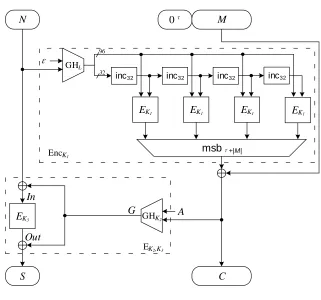
Finally, GCM-RUP uses three keys:K1is used for the CTR encryption, and K2 and K3 are used for the TBC following the XTX construction (K2 is used for GHASH, and K3 is used for the underlying block cipher call). GCM-RUP encrypts a messageM together with its associated dataAand a nonceN, into a ciphertextCand an encrypted nonceS. The associated data, the message and the ciphertext are all seen as sequences of blocks of lengthn. GCM-RUP follows the generic construction given above, and is described in Fig. 2, with pseudocode in Algorithm 3 (with ε an empty string). In the figure, EncK1 corresponds to
CTR mode encryption, and EK2,K3 to the TBC.
Algorithm 3GCM-RUPK1,K2,K3(N, A, M)
Input: K1K2K3∈ {0,1}3n,A∈ {0,1}n2
32
,M∈ {0,1}n232
Output: (S, C)∈ {0,1}n× {0,1}τ+|M|
1: M←0τkM
2: L←EK1(0n)
3: I←GHASHL(ε, N)
4: m← |M|n
5: F←EK1(msb96(I)k·)
6: S←CTR[F](inc32(lsb32(I)), m) 7: C←M⊕msb|M|(S)
8: G←GHASHK2(A, C)
9: S←EK3(N⊕G)⊕G
10: return (S, C)
4
Partial Authentication Key Recovery for GCM-RUP
Our analysis focuses on theGHASHK2 function, which can be written as a
poly-nomial inK2. In this section, we analyze properties ofGHASHK2which are then
used to recoverK2. After recoveringK2, it is possible to perform a forgery attack for GCM-RUP.
The main property used in our attacks is thatG, the output ofGHASHK2 as
defined in Fig. 2, is linearly dependent on the input (A, C) for fixedK2. There-fore, the output difference ∆G of values G emerging in encryption operations of two input tuples (N1, A, M) and (N2, A, M) is independent of the value of (A, M), and is only a function ofN1and N2.
Based on this property, we retrieveK2 with the following two steps. – For a fixed associated data and message, we search for a pair of nonces
(N1, N2) which produce a collision for the input of EK3 using a birthday
attack. For such pair of nonces (N1, N2),∆G=N1⊕N2=S1⊕S2.
– With a known∆G, a polynomial equation inK2is derived from theGHASHK2
definition. ThenK2 can be retrieved by solving this equation.
In this section, we will give the detailed description of the recovery ofK2.
4.1 Properties of GHASH
Let Π = (SEnc,SDec,SVer) denote the scheme GCM-RUP. We focus on the component GHASHK2 with inputs the associated dataAand the ciphertext C.
In order to clearly describe the attack, we rewriteGHASHK2 as
G=GHASHK2(A, C) =GHASHcoreK2(AkCkstrn/2(|A|)kstrn/2(|C|)).
Property 1 When processing a fixed associated data A and message M un-der two distinct nonces (N1, N2)with GCM-RUP, the output difference∆G of GHASHK2 is only dependent onN1 andN2, but independent onAandM. This
also holds for the input difference of EK3.
Proof. For two tuples (N1, A, M) and (N2, A, M), querySEncand get (S1, C1)←GCM-RUP(N1, A, M),
(S2, C2)←GCM-RUP(N2, A, M).
Let G1 andG2 represent the corresponding outputs of the functionGHASHK2
in the encryptions under noncesN1 andN2, respectively, G1=GHASHK2(A, C1),
G2=GHASHK2(A, C2),
where
C1= (0τkM)⊕EncK1(N1),
C2= (0τkM)⊕EncK1(N2),
the functionEncK1 is defined in the upper dotted box in Fig. 2. Hence,
∆G=G1⊕G2
=GHASHK2(A, C1)⊕GHASHK2(A, C2).
(2)
From the definition of GHASH, we have ∆G=GHASHcoreK2 A⊕AkC1⊕C2k
(strn/2(|A|)kstrn/2(|C1|))⊕(strn/2(|A|)kstrn/2(|C2|))
=GHASHcoreK2(0
|A|k∆Ck0n) =GHASHcoreK2(0
|A|kEnc
K1(N1)⊕EncK1(N2)k0
n),
(3)
which shows that the output difference of the function GHASHK2 depend only
on N1 and N2 for two tuples (N1, A, M) and (N2, A, M). The input difference ofEK3 can be computed as
∆In=N1⊕N2⊕∆G
=N1⊕N2⊕GHASHcoreK2(0
|A|k∆Ck0n), (4)
so it is also independent ofAandM. 2
In particular, if we can recover a value ∆G, we can then extract K2 by solving a polynomial equation, given the ciphertext difference∆Cand the output difference∆G:
∆G=GHASHcoreK2(0
For simplicity, we assume that|M|=nandτ=n, this implies|C1|=|C2|= 2n:
∆G=∆C[0]·K23⊕∆C[1]·K22.
This a polynomial equation inK2in the Galois field with 2128elements. Luckily, there are efficient algorithm to factor polynomials over finite fields. For instance, the Cantor-Zassenhaus algorithm [5] requires O(n2(log(r) log(q) +n)) field op-erations to factor a degree-n polynomial with r irreducible factors over a field withqelements. In practice, with the parameters used here, this takes negligible time using the implementation of SageMath [40].
4.2 Recovering K2 from Inner Collisions
As explained earlier, the first step of the attack is to identify collisions in the input of EK3, defined as In = N⊕G. Following the analysis above, we start
with a fixed associated dataA and messageM, and querySEncforq different nonces, to receive the corresponding encrypted noncesS and ciphertextsC.
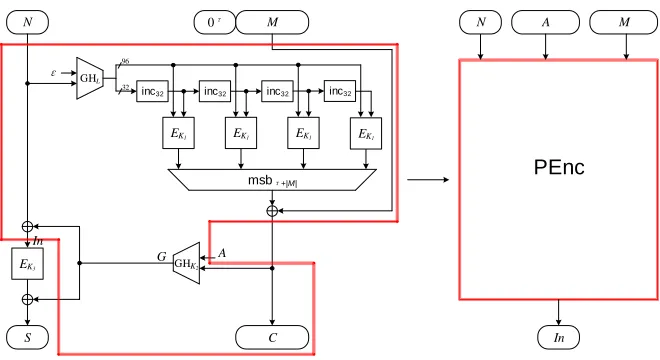
In order to simplify the description, we focus on the valueIn, and we consider the function mappingN, A, MtoIn, denoted asPEnc, and represented by Fig. 3. The output values of PEnccan not be accessed by the attacker, but collisions in PEnccan be detected. As forInand the outputOutofEK3,
In=N⊕G, Out=S⊕G.
When the collisions happen, ∆In=∆Out= 0,which means N1⊕N2⊕G1⊕G2= 0,
S1⊕S2⊕G1⊕G2= 0.
Thus, N1⊕N2 =S1⊕S2 =∆G. If the collisions ∆N =∆S can be detected, the collisions inPEnccan be detected. Meanwhile, this type of collisions give out the value of∆G, which can be used to recoverK2. Moreover, the corresponding pairs can be identified efficiently. We just build a list of all nonces indexed by Ni⊕Si, sort the list and look for collisions: each collision corresponds to a pair withN1⊕S1=N2⊕S2i.e.N1⊕N2=S1⊕S2. We now consider the converse, and evaluate the probability of a collision inPEncwhenN1⊕N2=S1⊕S2.
We formally define the two events asX andY:
– X (N1⊕N2=S1⊕S2): the event identifying pairs of nonces (N1, N2) with the input difference equal to the output difference of EK3, which is called
outer collision(equivalently, it can be defined as ∆In=∆Out).
– Y (∆In = 0): the event identifying pairs of nonces with collision in PEnc, i.e. zero input difference forEK3, which is called inner collision.
First, we observe that Y ⊆ X, because if ∆In = 0, then ∆Out = 0 and N1⊕N2=S1⊕S2=∆G. Therefore, we have
N
GHL ε
inc32 inc32 inc32 inc32
0τ M
C GH A
S
msbτ+|M|
K1
E EK1 EK1 EK1
K3
E K2
96
32
G In
PEnc
N A M
In
Fig. 3.Representation of the FunctionPEnc
Moreover, we have Pr[Y] = 2−n because the output of PEnc with a fresh nonce is random, assuming that E is a PRF. In order to compute Pr[X], we consider two cases, depending on eventY:
1. ∆In= 0. Then we have necessarily∆Out= 0, i.e.P r[X|∆In= 0] = 1. 2. ∆In6= 0. A pair with non-zero input difference must produce a non-zero
output difference. Assuming thatE is a PRF, we have P r[X|∆In 6= 0] = 1
2n−1.
Therefore,
P r(X) =P r[∆In=∆Out]
=P r[∆In=∆Out|∆In= 0]×P r[∆In= 0]+ P r[∆In=∆Out|∆In6= 0]×P r[∆In6= 0] =1× 1
2n + 1 2n−1×
2n−1 2n
= 1
2n−1.
(5)
Finally, we can conclude
Pr[∆In= 0|N1⊕N2=S1⊕S2] = 2−n 2−n+1 =
1
2. (6)
Attack Procedure. We can now give the detailed procedure to recoverK2: 1. Choose an arbitrary associated data Aand a single-block messageM, then
noncesS and ciphertextsC; save them in a table indexed byN ⊕S. With a suitable value of q (in the order of 2n/2), there are two pairs of nonces (N1, N2) satisfyingN1⊕N2=S1⊕S2, one of which is expected to further satisfy∆In= 0.
2. For each pair with N1⊕N2 =S1⊕S2, assuming that∆In = 0, we have ∆G=∆Sand we obtain a cubic polynomial equation with unknown variable K2, which can be solved with factoring tools:
∆S=GHASHcoreK2(0
|A|k∆Ck0n) =∆C[0]·K3
2 ⊕∆C[1]·K 2 2. 3. Identify the correct candidate for K2 with forgery attempts.
Using two pairs of nonces, this attack suggests a small set of six key candi-dates. The correct key can be identified with forgery attempts, or by using more pairs and looking for a repeated key candidate.
More precisely, we will describe how to construct a forgery with known can-didate ofK2for GCM-RUP in Section 5 for a given message, which can be used to filter the correctK2. There would be two cases:
– If the forgery is constructed under the correct candidate forK2, it can pass the verification algorithm of GCM-RUP.
– If the forgery is constructed under the wrong candidate forK2, it will receive a failure of the verification of GCM-RUP.
We only need to query the verification oracle SVer six times to identify the correctK2. The cost for this step is negligible.
Complexity Estimation. As already mentioned, the probability of two ran-dom nonces N1 and N2 satisfying∆In = 0 is 2−128. Starting from a set of q queries, we can evaluate the probabilitypof finding an inner collision following the analysis of the birthday paradox:
p'1−e−q2/(2×2128). Thus,
q' r
2×2128ln 1 1−p.
Table 1 shows number of nonces needed to achieve the given probability of success.
4.3 Experimental Verification with Mini-GCM-RUP
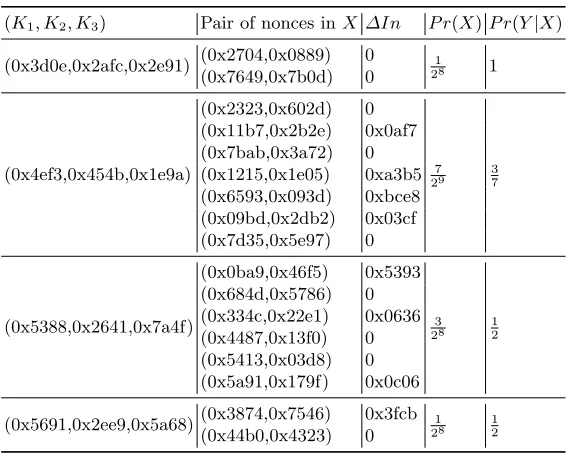
In order to verify our attack theory, we use a mini version of GCM-RUP con-structed with the 16-bit block cipher 4-round Mini-AES [28] to experimentally recover K2. This experiment identifies pairs of nonces in eventX and Y from 29random nonces, and recoverK
2with SageMath. We execute this experiment several times to give some results to show the validity of probabilities of event X andY in our paper, the detail is listed in Table 2.
Table 1.Number of Nonces Needed to Achieve the Given Success Probability
Number of nonces to identify inner collision Probability of finding inner collision
263 11%
264 39%
265 86%
266 99.9%
Table 2. Experimental Verification with Mini-GCM-RUP
(K1, K2, K3) Pair of nonces inX ∆In P r(X) P r(Y|X)
(0x3d0e,0x2afc,0x2e91) (0x2704,0x0889) 0 1 28 1
(0x7649,0x7b0d) 0
(0x4ef3,0x454b,0x1e9a)
(0x2323,0x602d) 0
7 29
3 7 (0x11b7,0x2b2e) 0x0af7
(0x7bab,0x3a72) 0 (0x1215,0x1e05) 0xa3b5 (0x6593,0x093d) 0xbce8 (0x09bd,0x2db2) 0x03cf (0x7d35,0x5e97) 0
(0x5388,0x2641,0x7a4f)
(0x0ba9,0x46f5) 0x5393
3 28 12
(0x684d,0x5786) 0 (0x334c,0x22e1) 0x0636 (0x4487,0x13f0) 0 (0x5413,0x03d8) 0 (0x5a91,0x179f) 0x0c06
(0x5691,0x2ee9,0x5a68)(0x3874,0x7546) 0x3fcb 1 28
5
Universal Forgery Attack of GCM-RUP
In this section, we will construct forgeries for GCM-RUP given a candidate for K2. We consider a challenge message M∗ (and possibly a challenge associated dataA∗), and our goal is to construct a valid ciphertext forM∗.
5.1 Almost Universal Forgery Attack
The first forgery attack makes only one query to the encryption oracleSEncand then constructs a forgery by solving an equation overGF(2128).
For an arbitrary nonceN, associated data A and message M (with|M|=
|M∗|), query (N, A, M), and receive the corresponding ciphertext (S, C). Let G=GHASHK2(A, C),and the keystream used to XOR message is computed by
EncK1(N) =C⊕(0
τkM).
We create a valid encryption ofM∗by reusing the same nonceN and the values
GandS.
First, we computeC∗corresponding to M∗:
C∗= 0τkM∗⊕EncK1(N)
= 0τkM∗⊕(C⊕0τkM). (7)
Then we constructA0 such that
GHASHK2(A
0, C∗) =GHASH
K2(A, C),
whereA,C,C∗ andK2are known. This gives a linear equation over GF(2128) which can easily be solved assuming that|A0| ≥128 andK26= 0.
To summarize, for any chosen messageM∗, we can give a successful forgery (A0, M∗, S0, C0) satisfying (S0 =S, C0= 0τkM∗⊕(C⊕0τkM)).This is an almost universal forgery, because we can chooseM∗ freely but notA0.
5.2 Universal Forgery Attack
Alternatively, we can design an attack where we choose bothA∗ andM∗, using 2n/2 queries. First, we make 2n/2 queries (N
i, A, M), for fixed A and M with
|M|=|M∗|, and receive the corresponding (Si, Ci). SinceK2is known, we can computeGi =GHASH(A, Ci), and recover the corresponding inputs and outputs toEK3:EK3(Ni⊕Gi) =Si⊕Gi.
Then, we can use the same nonces Ni to build a forgery. For each Ni, we build the corresponding Ci0 from M∗ and Ci as above, and we check whether Ni⊕GHASH(A∗, Ci0) is in the set of known inputs toEK3. With high probability,
N
GHL
ε
inc32 inc32 inc32 inc32
0
τM
C
GH
A
S
msb
τ+|M| K1E
E
K1E
K1E
K1K3
E
K296
32
K4
E
6
Variant of GCM-RUP
Our forgery attack against GCM-RUP highlights a potential weakness on the structure of GCM-RUP: the output difference of the function GHASHK2 can
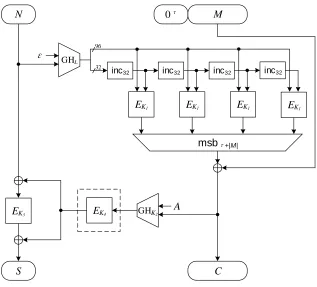
be recovered with birthday complexity and this leads to a recovery of K2. In order to prevent this attack, we suggest to add a block cipher call in the TBC construction used in GCM-RUP, as shown in Fig. 4, to avoid leakage of the output difference of the functionGHASHK2.
This modified TBC still follows the XTX construction of Iwata and Mine-matsu [24], using universal hash functionEK4(GHASHK2(A, C)) instead of the
originalGHASHK2(A, C). The new universal hash function has the same security
bounds, but does not leak the key from an output difference. Thus, the security proof of GCM-RUP is still applicable to this variant. But we do not provide a formal security proof. The extra block cipher has a limited impact on efficiency, and might offer better security by avoiding our attack.
More generally, the modified GHASH could replace GHASH in other designs. In particular, the corresponding modification of GCM would prevent the uni-versal forgery attack with complexity 22n/3 given in [20]. We believe that this construction is worth further study. Further work will be needed to determine whether this modification actually provides extra security and how much.
7
Conclusion
This paper shows a birthday-bound attack against GCM-RUP [2] using inner collisions to recover the output difference of the functionGHASHK2. Hence,K2
can be retrieved by solving a polynomial equation, and this directly leads to a universal forgery attack against GCM-RUP. This forgery attack shows that the construction of GCM-RUP breaks drastically when the security bound is reached. This is surprising because no such attack is known on GCM: the best known universal forgery attack requires 22n/3 operations.
Finally, a minor modification of GCM-RUP is suggested to prevent this kind of attack, using an additional block cipher to protect the output of GHASH. With little performance loss, this design focusing on GHASH can be applied to all GHASH-based designs.
In a more general setting, our attack technique can be applied to the LRW construction [21] with a polynomial universal hash function, as used in OCB, for instance. Actually, the corresponding attack on OCB would match the previous attack by Ferguson [9].
8
Acknowledgement
No. 2017CXGC0704, Natural Science Foundation of Shandong Province, China under Grant No. ZR2016FM22.
References
1. Andreeva E., Bogdanov A., Luykx A., Mennink B., Mouha N., Yasuda K.: How to Securely Release Unverified Plaintext in Authenticated Encryption. In: Sarkar P., Iwata T. (Eds.) ASIACRYPT 2014, PART I, LNCS 8873, pp. 105–125. Springer. 2. Ashur T., Dunkelman O., Luykx A.: Boosting Authenticated Encryption
Robust-ness with Minimal Modifications. In: Katz J., Shacham H. (Eds.) CRYPTO 2017, Part III, LNCS 10403, pp. 3-33. Springer.
3. Bellare M., Namprempre C.: Authenticated Encryption: Relations among Notions and Analysis of the Generic Composition Paradigm. In: Okamoto T. (Eds.) ASI-ACRYPT 2000, LNCS 1976, pp. 531–545. Springer.
4. Bhargavan, K., Leurent, G.: On the practical (in-)security of 64-bit block ciphers: Collision attacks on HTTP over TLS and OpenVPN. In: Weippl, E.R., Katzen-beisser, S., Kruegel, C., Myers, A.C., Halevi, S. (eds.) ACM CCS 2016. pp. 456–467. ACM Press (Oct 2016)
5. Cantor, D.G., Zassenhaus, H.: A new algorithm for factoring polynomials over finite fields. Mathematics of Computation pp. 587–592 (1981)
6. Chaigneau, C., Gilbert, H.: Is AEZ v4.1 sufficiently resilient against key-recovery attacks? IACR Trans. Symm. Cryptol. 2016(1), 114–133 (2016), http://tosc. iacr.org/index.php/ToSC/article/view/538
7. Dierks, T., Allen, C.: RFC 2246 - The TLS Protocol Version 1.0. Internet Activities Board (Jan 1999)
8. Dworkin M.: Recommendation for Block Cipher Modes of Operation: Ga-lois/Counter Mode (GCM) and GMAC. National Institute of Standards and Tech-nology. SP 800-38D, November 2007.
9. Ferguson, N.: Collision attacks on OCB. Comment to NIST (Feb 2002).
10. Fuhr, T., Leurent, G., Suder, V.: Collision attacks against CAESAR candidates -forgery and key-recovery against AEZ and Marble. In: Iwata, T., Cheon, J.H. (eds.) ASIACRYPT 2015, Part II. LNCS, vol. 9453, pp. 510–532. Springer, Heidelberg (Nov / Dec 2015)
11. Gligor V., Donescu P.: Fast Encryption and Authentication: XCBC Encryption and XECB Authentication Modes. In: Matsui M. (Eds.) FSE 2001, LNCS 2355, pp. 92-108. Springer.
12. Gueron S., Lindell Y.: GCM-SIV: Full Nonce Misuse-Resistant Authenticated En-cryption at Under One Cycle per Byte. In: Ray I., Li N., Kruegel C. (Eds.) Pro-ceedings of the 22nd ACM SIGSAC Conference on Computer and Communications Security, Denver, CO, USA, 12–16 October 2015, pp. 109-119. ACM (2015). 13. Halevi S., Rogaway P.: A Parallelizable Enciphering Mode. In: Okamoto T. (Eds.)
CT-RSA 2004. LNCS 2964, pp. 292–304. Springer.
14. Hoang V.T., Krovetz T., Rogaway P.: Robust Authenticated-Encryption AEZ and the Problem That It Solves. In: Oswald E., Fischlin M. (eds) EUROCRYPT 2015. LNCS, vol 9056, pp 15-44. Springer, Berlin, Heidelberg
16. Iwata, T., Ohashi, K., Minematsu, K.: Breaking and repairing GCM security proofs. In: Safavi-Naini, R., Canetti, R. (eds.) CRYPTO 2012. LNCS, vol. 7417, pp. 31–49. Springer, Heidelberg (Aug 2012)
17. Joux A.: Comments on the Draft GCM Specification - Authentication Fail-ures in NIST Version of GCM.http://csrc.nist.gov/groups/ST/toolkit/BCM/ documents/comments/800-38Series-Drafts/GCM/Jouxcomments.pdf.
18. Jutla C.: Encryption Modes with Almost Free Message Integrity. In: Pfitzmann B. (Eds.) EUROCRYPT 2001, LNCS 2045, pp. 529-544. Springer.
19. Leurent, G., Peyrin, T., Wang, L.: New generic attacks against hash-based MACs. In: Sako, K., Sarkar, P. (eds.) ASIACRYPT 2013, Part II. LNCS, vol. 8270, pp. 1–20. Springer, Heidelberg (Dec 2013)
20. Leurent, G., Sibleyras, F.: The missing difference problem, and its applications to counter mode encryption. In: Nielsen, J.B., Rijmen, V. (eds.) EUROCRYPT 2018, Part II. LNCS, vol. 10821, pp. 745–770. Springer, Heidelberg (Apr / May 2018) 21. Liskov M., Rivest R.L., Wagner D.: Tweakable Block Ciphers. In: Yung M. (Eds.)
CRYPTO 2002, LNCS 2442, pp. 31-46. Springer.
22. Luykx A., Preneel B.: Optimal forgeries against polynomial-based MACs and GCM. In: Nielsen J.B., Rijmen V. (eds.) EUROCRYPT 2018, Part I. LNCS, vol. 10820, pp. 445–467. Springer, Heidelberg (Apr / May 2018)
23. McGrew D., Viega J.: The Security and Performance of the Galois/Counter Mode (GCM) of Operation. In: Canteaut A., Viswanathan K. (eds) INDOCRYPT 2004. LNCS, vol 3348, pp 343-355. Springer, Berlin, Heidelberg
24. Minematsu, K., Iwata, T.: Tweak-length extension for tweakable blockciphers. In: Groth, J. (ed.) 15th IMA International Conference on Cryptography and Coding. LNCS, vol. 9496, pp. 77–93. Springer, Heidelberg (Dec 2015)
25. Mitchell C.J.: On the security of XCBC, TMAC and OMAC. Technical Re-port RHUL-MA-2003-4, 19 August, 2003. Available at http://www.rhul.ac. uk/mathematics/techreports. Also available from NIST’s web page at http: //csrc.nist.gov/CryptoToolkit/modes/comments/
26. Nandi, M.: Bernstein bound on WCS is tight - repairing Luykx-Preneel optimal forgeries. In: Shacham, H., Boldyreva, A. (eds.) CRYPTO 2018, Part II. LNCS, vol. 10992, pp. 213–238. Springer, Heidelberg (Aug 2018)
27. Peyrin, T., Wang, L.: Generic universal forgery attack on iterative hash-based MACs. In: Nguyen, P.Q., Oswald, E. (eds.) EUROCRYPT 2014. LNCS, vol. 8441, pp. 147–164. Springer, Heidelberg (May 2014)
28. Phan R. C.W.: Mini Advanced Encryption Standard (Mini-AES): A Testbed for Cryptanalysis Students. In Cryptologia, XXVI (4), 2002.https://staff.guilan. ac.ir/staff/users/rebrahimi/fckeditor_repo/file/mini-aes-spec.pdf.
29. Preneel, B., van Oorschot, P.C.: On the security of two MAC algorithms. In: Mau-rer, U.M. (ed.) EUROCRYPT’96. LNCS, vol. 1070, pp. 19–32. Springer, Heidelberg (May 1996)
30. Rogaway P., Bellare M., Black J.: OCB: A Block-Cipher Mode of Operation for Efficient Authenticated Encryption. Transactions on Information and System Se-curity, Vol. 6, No. 3, August 2003, pp. 365-403.
31. Rogaway P., Shrimpton T.: A Provable-Security Treatment of the Key-Wrap Problem. In: Vaudenay S. (Eds.): EUROCRYPT 2006, LNCS 4004, pp. 373-390. Springer.
33. Sung, J., Hong, D., Lee, S.: Key recovery attacks on the RMAC, TMAC, and IACBC. In: Safavi-Naini, R., Seberry, J. (eds.) ACISP 03. LNCS, vol. 2727, pp. 265–273. Springer, Heidelberg (Jul 2003)
34. Wegman M.N., Carter L.: New Hash Functions and Their Use in Authentication and Set Equality. Journal of Computer and System Sciences 22, 265-279 (1981) 35. The CAESAR committee: CAESAR: Competition for Authenticated Encryption:
Security, Applicability, and Robustness.http://competitions.cr.yp.to/caesar. html
36. IEEE Standard for Local and Metropolitan Area Networks Media Access Control (MAC) Security. IEEE Std 802.1AE-2006 (2006).
37. Information Technology - Security Techniques - Authenticated Encryption, ISO/IEC 19772:2009. International Standard ISO/IEC 19772 (2009).
38. NIST: Lightweight Cryptography. https://csrc.nist.gov/Projects/ Lightweight-Cryptography
39. National Security Agency, Internet Protocol Security (IPsec) Minimum Essential Interoperability Requirements, IPMEIR Version 1.0.0 Core (2010), http://www. nsa.gov/ia/programs/suitebcryptography/index.shtml.