Munich Personal RePEc Archive
Forecasting national recessions using
state-level data
Owyang, Michael T. and Piger, Jeremy and Wall, Howard J.
Federal Reserve Bank of St. Louis, University of Oregon, CEE,
Lindenwood University
10 April 2012
Online at
https://mpra.ub.uni-muenchen.de/57716/
Forecasting National Recessions Using State Level Data
∗
Michael T. Owyang
†Jeremy Piger
‡Howard J. Wall
§This draft: July 23, 2014
Abstract: A large literature studies the information contained in national-level economic indicators, such as financial and aggregate economic activity variables, for forecasting and nowcasting U.S. business cycle phases (expansions and recessions.) In this paper, we in-vestigate whether there is additional information useful for identifying business cycle phases contained in subnational measures of economic activity. Using a probit model to forecast the NBER expansion and recession classification, we assess the incremental information content of state-level employment growth over a commonly used set of national-level predictors. As state-level data adds a large number of predictors to the model, we employ a Bayesian model averaging procedure to construct forecasts. Based on a variety of forecast evaluation metrics, we find that including state-level employment growth substantially improves nowcasts and very short-horizon forecasts of the business cycle phase. The gains in forecast accuracy are concentrated during months of national recession.
Keywords: turning points, probit, Bayesian model averaging, nowcasting
JEL Classification Numbers: C52, C53, E32, E37
∗We thank the editor, two anonymous referees, and seminar participants at the University of Houston,
Federal Reserve Bank of St. Louis, and University of Texas, El Paso for helpful comments. This paper also benefited from conversations with Graham Elliott and Oscar Jord´a. Kristie M. Engemann and Kate Vermann provided research assistance. The views expressed herein do not reflect the official positions of the Federal Reserve Bank of St. Louis or the Federal Reserve System.
†Research Division, Federal Reserve Bank of St. Louis, ([email protected]) ‡Department of Economics, University of Oregon, ([email protected])
1
Introduction
A traditional view of the U.S. business cycle is that of alternating phases of expansion
and recession, where expansions correspond to widespread, persistent growth in economic
activity, and recessions consist of widespread, relatively rapid, decline in economic activity.1
A large literature investigates different aspects of these business cycle phases and documents
asymmetries across them. Such work experienced a resurgence following Hamilton (1989),
who built a modern statistical model of the alternating phases characterization of the business
cycle by describing the latent business cycle phase as following a first-order Markov process
that influences the mean growth rate of output.
Timely identification of business cycle phases, and the associated turning points between
them, is of particular interest to academics, policymakers, and practitioners. A substantial
literature has investigated the extent to which the business cycle phase can be predicted
using a variety of economic and financial time series.2 Here, the forecasting problem is to
use data available at time period t to predict whether period t+h will be an expansion or recession period. The most ambitious task is of course to predict the future business cycle
phase at long horizons, and the literature has had some limited success predicting recessions
one-year ahead by using information on the slope of the yield curve. For forecasting the
business cycle phase at short horizons, predictors measuring aggregate real activity, such as
employment or output growth, are found to be valuable. Not surprisingly, this is especially
true for h= 0 predictions, which are typically referred to as “nowcasts.”3
Although they have received less attention in the literature, short-horizon forecasts and
nowcasts of business cycle turning points are of considerable interest. While long horizon
forecasts of the business cycle phase would give economic agents the most advance warning
1See Mitchell (1927) and Burns and Mitchell (1946).
2See e.g., Estrella (1997), Estrella and Mishkin (1998), Kauppi and Saikkonen (2008), Rudebusch and
Williams (1991) and Berge (2013). For a recent summary of this literature, see Katayama (2008).
3Here, the prefix “now” in nowcast refers to the use of data available in periodtto evaluate whether period tis a recession or expansion period. Note that because of data reporting lags, most of the data available in
of a new business cycle turning point, it has historically been the case that new business
cycle phases have not been forecasted accurately. Indeed, in most cases new phases have
only been identified in real time after many months have passed following the turning point.4
As a recent example of this, Hamilton (2011) surveys a wide range of statistical models that
were in place to nowcast business cycle turning points using aggregate data, and finds that
such models did not send a definitive signal regarding the December 2007 NBER peak until
late 2008. Improved short-horizon forecasts and nowcasts thus hold the promise of giving a
quicker signal that a new recession or expansion is imminent or has already begun. These
could improve the speed of both policy and private sector adjustments to this new business
cycle phase.
The existing literature has focused on the use of predictors measured at the national
level. However, there is reason to believe that variables measured at the subnational level
would be useful for identifying the national business cycle phase. Owyang et al. (2005) and
Hamilton and Owyang (2011) provide evidence that the business cycles of individual U.S.
states are often out of phase with that of the nation. If these phase shifts are systematic, then
incorporating data from leading regions may be useful for predicting the national business
cycle phase. Also, even if subnational regions are coincident with the aggregate business cycle
phase, there may be regions that experience recession and expansion phases more severely
than the nation as a whole. In these cases, incorporating data from these regions will provide
a stronger signal regarding the business cycle phase that is currently in operation, and will
thus improve nowcasts and short-horizon forecasts of the business cycle phase.5
In this paper, we assess whether state-level economic indicators contain incremental
in-formation useful for forecasting and nowcasting U.S. business cycle phases. Following the
4Since the inception of the NBER’s business cycle dating committee in 1978, the NBER has announced new
business cycle peaks with a lag of 7.5 months and troughs with a lag of 15 months. Chauvet and Piger (2008) show that statistical models estimated using aggregate data improve on the NBERs timeliness for troughs, but not for peaks.
5Short-horizon forecasts will be improved because of the persistence of business cycle phases. If subnational
bulk of the literature, we take the NBER’s chronology of the dates of U.S. business cycle
phases as given. We then construct a monthly probit model to attach probabilities of
ex-pansion and recession to current and future periods, which incorporates both national- and
state-level variables as predictors. The national variables we use are those found to be good
predictors of the national business cycle phase at various horizons by the existing literature.
In particular, we focus on interest rates, asset prices, aggregate employment, and
aggre-gate industrial production. To these, we add state-level employment growth to capture the
predictive ability of subnational economic activity measures.
By using state-level employment growth, we measure subnational economic activity with
a coincident indicator, rather than a leading indicator. This raises the question of what
hope such data would have for helping predict the aggregate business cycle phase? While
state employment growth is a coincident indicator, it is likely an indicator that is coincident
with that state’s business cycle phase. Thus, as discussed above, if a state’s business cycle
leads the national business cycle phase, then state employment growth could be a leading
indicator for the national business cycle phase. As evidence of this, Hernandez-Murillo
and Owyang (2006) show that adding regional employment data can assist in predicting
aggregate employment growth in the United States. Also, even if state employment growth
is coincident with the national level business cycle phase, state employment growth may
provide improved nowcasts and short-horizon forecasts of the aggregate business cycle phase
if the employment response to the business cycle phase in operation is relatively strong for
certain states.6
Despite the potential promise of state-level data for improving nowcasts and forecasts of
6Our choice to focus on state-level employment growth is also driven by the lack of suitable leading
business cycle phases, simply adding this data into the information set used in a forecasting
model is problematic. It is likely that many states will not be informative about future
national business cycle phases at all, or perhaps any, forecast horizons. Further, there is
significant collinearity in employment growth across U.S. states. Put together, the naive
use of all state-level data will likely lead to an overparameterized model with a high level
of estimation uncertainty, which will not bode well for improved forecasting performance.
One may reduce, though not eliminate, these problems by aggregating across states to the
regional level. However, this aggregation would potentially average states that contain very
different forecasting information.
In this paper, we take a Bayesian model averaging (BMA) approach to incorporate
state-level predictors in a forecasting model. In particular, we explicitly incorporate the selection of
predictors into the estimation of the model, and average forecasts across models with different
sets of predictors by constructing the posterior predictive distribution for the future business
cycle phase. This approach allows individual states with predictive content for the business
cycle phase at a particular horizon to be highlighted in producing forecasts, while pushing
out those states that are not informative. Notably, the Bayesian approach to constructing
forecasts also incorporates uncertainty regarding model parameters.
Based on a variety of forecast evaluation metrics, we find that including state-level
em-ployment growth significantly improves nowcasts and very short-horizon forecasts of the
NBER business cycle phase over those produced by a model using only national-level data.
We document the incremental information content of the state-level data based on the
model’s out-of-sample forecast performance over the past 30 years. We also show that the
forecasting improvement comes primarily from improved classification of recession months.
As an example, for one-month ahead forecasts, nearly a quarter of all recession months are
correctly classified using the model that includes state-level data, but not by the model based
on national-level data only. Also, again based on one-month ahead forecasts, the December
state and national-level data, as opposed to late July 2008 when using only national-level
data.
The balance of the paper is as follows: Section 2 outlines the empirical model used for
forecasting recessions and describes the Bayesian approach to estimation and construction of
forecasts. Section 3 describes the national- and state-level data used to estimate the model
and construct forecasts. Section 4 presents the evaluation of the out-of-sample forecasts.
Section 5 summarizes and concludes.
2
Empirical Approach
2.1
Model
Define St ∈ {0,1} as a binary random variable that indicates whether month t belongs to an expansion (0) or recession (1) phase. Our objective is to forecast St+h based on
information available to a forecaster at the end of month t. This information may include national-, state-, or regional-level variables and is collected in the n×1 vector Xt.
Following the bulk of the existing literature, we use a probit model to link St+h toXt:
Pr [St+h = 1|ρ] =Φ(α+Xt0β), (1)
where the link function, Φ(.), is the standard normal cumulative density function, β is an
n × 1 vector of coefficients, and ρ = [α,β0]0 is an (n+ 1) ×1 vector holding the model
parameters.
The number of potentially relevant forecasting variables available in Xt may be large.
This is especially true with the inclusion of subnational data, as variables are measured
repeatedly across regions or states. This is problematic from a forecasting perspective, as
it is well established that highly parameterized models tend to have poor out-of-sample
the predicitve probabilities are functions of the values of all the included variables. This
means that including irrelevant variables could bias the forecasts. Here, we focus on a
modified version of (1), in which not all variables in Xt need be included in the model. In
particular, define γ as an n ×1 vector of zeros and ones, with a one indicating that the corresponding variable inXtshould be included in the model. We rewrite (1) to incorporate
this variable selection as follows:
Pr [St+h = 1|ργ,γ] =Φ α+X 0
γ,tβγ , (2)
whereXγ,t,ργ, andβγ contain the elements ofXt,ρ, andβrelevant for the variables selected
byγ. As is described in the next subsection, we treat γ as unknown, and estimate its value
along with the parameters of the model using Bayesian techniques.
2.2
Estimation
To estimate the model in (2) we take a Bayesian approach, which has some key advantages
for our purposes. For one, uncertainty about which variables should be included in the model
– that is uncertainty about γ – can be formally incorporated into Bayesian estimation in
a straightforward manner. Related to this, the Bayesian framework provides a mechanism,
through the posterior predictive density, to obtain forecasts that average over different choices
for variable inclusion and the values of unknown parameters.
Bayesian estimation requires priors be placed on the model parameters, ργ, as well as
the covariate selection vector, γ. We specify diffuse, i.i.d., mean-zero normal distributions
for the individual parameters collected in ργ:
p(ργ) =N 0kγ+1,σ
2I
kγ+1 ; σ
2 = 10, (3)
where kγ =γ0γ is the number of covariates selected by γ, 0
kγ+1 is a (kγ+ 1)×1 vector of
distribution defined across the 2n different possible choices ofγ. LetN
i = ni be the number
of choices of γ for which kγ =i. The prior probability over γ is then:
Pr (γ)∝ 1
Nkγ
. (4)
This distribution is flat in two dimensions. First, it assigns equal probability to all choices
of γ that have the same kγ. In other words, versions of (2) with the same number of covariates will receive equal prior probability. Second, the prior assigns equal cumulative
probability to groups of choices for γ that imply different numbers of covariates. That is,
Pr (kγ =i) = Pr (kγ=j), i, j = 0,1,· · ·, n.
7
To implement Bayesian estimation, we employ the Gibbs sampler to obtain draws from
the joint posterior distribution, π(ργ,γ|S
t), where St = [S
h+1,· · ·, St]
0
represents the
ob-served data.8 The Gibbs sampler is facilitated by augmenting the system with a continuous
variable yt that is deterministically related to the observed state variable St (Tanner and
Wong (1987)). Defineyt as:
yt=α+Xγ0,t hβγ+ut, (5)
where ut∼i.i.d.N(0,1). Given (2), the relationship between yt and St is:
St= 1 if yt≥0.
The Gibbs sampler is then implemented in two blocks. In the first, ργ and γ are sampled
conditional onStand the augmented datayt= [yh+1,· · ·, yt]0, as a draw from the conditional posterior distribution π(ργ,γ|y
t,St). As St is fully determined by yt, this distribution
7Note that this prior does not assign equal probability to all possible choices of
γ. While seemingly attractive
as a “flat” prior, an equal weights prior would give substantially different prior weight to the number of variables included. For example, if there are 50 possible variables, the cumulative prior probability of all models with 3 variables would be 16 times the cumulative prior probability of all models with 2 variables.
8See, for example, Albert and Chib (1993), Gelfand and Smith (1990), Casella and George (1992), and Carter
simplifies toπ(ργ,γ|y
t). In the second, the augmented dataytis sampled conditional onρ
γ,
γ, and St, from the conditional posterior distribution π(yt|ρ
γ,γ,S
t). We now describe each
of these blocks in detail:
Sampling π(ργ,γ|y
t)
As suggested by Holmes and Held (2006), we jointly sample ργ and γ from:
π ργ,γ|y
t
=πρ ργ|γ,y
t
Pr γ|yt ,
by employing a Metropolis step. Given a previous draw of ργ and γ, denoted h
ρ[γg],γ[g] i
, we
obtain a candidate for the covariate selection vector, denoted γ⇤, by sampling a proposal
distribution q γ⇤|γ[g] . Conditional on γ⇤, we then obtain a candidate for ρ
γ, denoted ρ ⇤ γ,
by sampling from the full conditional posterior density πρ(ργ|γ ⇤,yt).
The proposal distribution q γ⇤|γ[g] is set as follows. Conditional on γ[g], the candidate
covariate selection vector γ⇤ is drawn with equal probability from the set of vectors that
includes γ[g] and all other vectors that alter a single element of γ[g] (either from 0 to 1 or
1 to 0.) In other words, the candidate covariate selection vector will either select the same
covariates asγ[g], take away one covariate fromγ[g], or add one covariate toγ[g]. One notable
property of this proposal distribution is that q(γ⇤|γ[g]) will equal q(γ[g]|γ⇤).
The full conditional distribution for ρ, πρ(ργ|γ
⇤,yt), is as follows. Define X
γ,t h = ⇥
1, X0 γ,t h
⇤
, t =h+ 1,· · ·, t and let Xγt h represent the (t−h)×(kγ+ 1) matrix of stacked
Xγ,t h. Then, given the prior distribution in (3), the conditional posterior forργ is:
πρ ργ|γ ⇤,yt
∼N(mγ∗,Mγ∗),
Mγ∗ = ✓
1
σ2Ikγ+1+ (X
t h
γ )
0
Xt hγ
◆ 1
,
mγ∗ =Mγ∗ (Xt h γ )
0
yt h .
The candidate, ρ⇤
γ is then sampled fromN(mγ∗,Mγ∗).
The Metropolis step assigns an acceptance probabilityAto determine whether or not the candidate will be accepted. Given the gth drawhρ[g]
γ ,γ[g] i
, the (g+ 1)th draw is determined by:
⇥
ρ[γg+1],γ[g+1]⇤=
8 > < > : ⇥ ρ⇤ γ,γ
⇤⇤ with probability A h
ρ[γg],γ[
g]i with probability 1−A ,
where:
A= min
⇢
1, Pr(γ
⇤ |yt)
Pr(γ[g]|yt) .
From Bayes’ Rule:
Pr(γ|yt)∝f(yt|γ) Pr(γ),
where f(yt|γ) is the marginal likelihood for the augmented data, yt, conditional on the
choice of variables γ, and Pr(γ) is the prior distribution over γ. We can then rewrite the
acceptance probability as:
A= min
⇢
1, f(y
t|γ⇤
) Pr (γ⇤
)
f(yt|γ[g]) Pr (γ[g]) .
To computeA, we must computef(yt|γ). Given the prior distribution in (3), this is available
f(yt|γ)∼N(0,Σγ)
where Σγ =It h+σ
2Xt h
γ (X
t h
γ )
0. Using the equation for the multivariate normal we then
have:
A= min
8 < :1,
Σγ[g]
0.5
exp −0.5 (yt)0
(Σγ∗)
1
yt Pr (γ⇤)
|Σγ∗|
0.5
exp⇣−0.5⇣(yt)0
Σγ[g]
1
yt⌘⌘Pr γ[g]
9 =
;. (6)
Sampling π(yt|ργ,γ,S
t)
Conditional on ργ and γ, yt is normally distributed with mean δγ,t and unit variance,
where:
δγ,t =α+X 0
γ,t hβγ.
However, the target distribution also conditions on St, which adds the requirement that the
sign of yt must match the realization of St. In this case, yt has a truncated normal density:
yt ∼
8 > > < > > :
N(δγ,t,1)I[yt 0] if St = 1
N(δγ,t,1)I[yt<0] if St = 0
,
where the indicator I[.] reflects the direction of the truncation. A draw from yt is then obtained by drawingytfrom the appropriate truncated normal distribution,t=h+ 1,· · ·, T.
Given arbitrary starting values for ργ and γ, the above two sampling steps are iterated
to obtain drawshρ[γg],γ[g] i
, forg = 1,· · ·, G. Following a suitably large initialization period, these draws will be from the joint posterior distribution, π(ργ,γ|S
t). In all estimations
reported below, we sample 20,000 initialization draws to achieve convergence. Results are
initialization period by ensuring that results from two different runs of the Gibbs Sampler
with dispersed sets of starting values were similar.
2.3
Construction of Forecasts and Forecast Evaluation
To forecast the business cycle phase in period t+h, we use the posterior predictive
dis-tribution:
Pr⇥St+h = 1|St
⇤
. (7)
Although the posterior predictive distribution is not available analytically, we can simulate
from (7) as follows. The posterior predictive distribution is factored as:
Pr⇥St+h = 1|St
⇤ = Z ργ Z γ
Pr⇥St+h = 1|ργ,γ,S
t⇤π ρ
γ,γ|S
t d
γdργ. (8)
Equation (8) suggests a Monte Carlo integration approach to calculate the posterior
predic-tive distribution. Specifically, given a draw hρ[γg],γ[g] i
from π(ργ,γ|S
t) we simulate a value
of St+h, denoted St+h[g], from:
Pr⇥St+h = 1|ρ[γg],γ
[g],St⇤
= Pr⇥St+h = 1|ρ[γg],γ
[g]⇤ =
Φ⇣α[g]+X0 γ[g],tβ
[g]
γ ⌘
,
where the validity of the first equality sign comes from the fact that, given the model in
(2) and the model parameters, the observed data St are not informative for the distribution
of St+h. The simulated value S[ g]
t+h is a draw from the posterior predictive distribution,
Pr [St+h|St], and it follows that:
lim G!1 1 G G X g=1 ⇣
St+h[g]
⌘
= Pr[St+h = 1|St] (9)
as our (point) forecast of St+h. In the following, we refer to this forecast as Sbt+h. It is
worth emphasizing that Sbt+h is not conditional on model parameters or the choice of which
variables to include in the model. These sources of uncertainty have been integrated, over
their respective posterior distributions, out of the prediction. Note that the integration over
the posterior distribution for γ gives Sbt+h the interpretation of a BMA prediction.
To evaluateSbt+h, we consider a variety of forecast evaluation metrics. The first is the Brier (1950) quadratic probability score (QP S), which is a probability analog of mean squared error:
QP S = 2
τ2−τ1
τ2 X
t+h=τ1+1 ⇣
b
St+h−St+h
⌘2 ,
whereτ1 andτ2 are chosen to cover the period over whichSbt+h is being evaluated. TheQP S
ranges from 0 to 2, with 0 indicating perfect forecast accuracy.
While the QP S is a standard metric for the evaluation of forecasts of binary variables, it does not directly evaluate Sbt+h as a classifier of St+h. Specifically, the QP S is focused
on the distance between Sbt+h and St+h, rather than on the ability of Sbt+h to classify St+h
accurately. This distinction is meaningful, as it is simple to construct examples where a
forecasting model with perfect classification ability has an inferiorQP S to a model with less than perfect classification ability.9 Thus, we also consider two forecast evaluation metrics
that directly assess classification ability. The first is the correspondence, defined as the
proportion of months for which Sbt+h correctly indicates the NBER business cycle phase.
The correspondence (CSP) is given by:
CSP = 1
τ2−τ1
τ2 X
t+h=τ1+1 ⇣
I[Sb
t+h c]St+h+
⇣
1−I[Sb
t+h c]
⌘
(1−St+h)
⌘
,
wherecis a threshold point such that whenSbt+hexceedscwe classify a month as a recession,
and I[Sb
t+h c] ∈ {0,1} is an indicator function denoting the predicted business cycle phase.
In the results presented below, we set c = 0.5. Also, rather than focus directly on the correspondence, we present a measure of “excess correspondence” (XCSP) that shows the
increase in the CSP above the correspondence produced by a simple classifier that sets
b
St+h = 1 with probability equal to the sample mean of St, and sets Sbt+h = 0 otherwise.
The correspondence requires that we set a value of c, and while c = 0.5 is a natural threshold for a probability in terms of likelihood, it could easily distort the performance of
a classifier for which an alternative threshold was appropriate. Thus, for our final forecast
evaluation metric we follow Berge and Jord´a (2011) and consider the area under the receiver
operating characteristic, or ROC, curve. The ROC curve summarizes the classification
per-formance of a continuous index, such asSbt+h, by plotting the the proportion of true positives
against the proportion of false positives, where each is calculated for the range of possible
thresholds as c is varied from 1 to 0 (moving from left to right in the plot.) The area un-der this curve, or AU C, is a summary statistic describing classification performance, with a perfect classifier having an AU C = 1 and a coin-flip classifier having AU C = 0.5. Unlike the CSP statistic, the AU C is not dependent on a particular value of c. An estimate of the
AU C is given by:
[
AU C= 1
n0n1
n0 X
j=1
n1 X
i=1
⇣
I[Sb1
i>Sbj0]
⌘
,
where Sbi1, i = 1,· · · , n1 are the values of Sbt+h for the n1 out-of-sample periods for which St+h = 1 and Sb0
j, j = 1,· · ·, n0 are the values of Sbt+h for the n0 out-of-sample periods for
which St+h = 0.
3
Data Used in Forecast Evaluation
For the dependent variable in our estimation, St, we use the monthly chronology of
Our predictor variables consist of both national- and state-level variables, all of which are
sampled at the monthly frequency. For the national-level variables, we include a measure of
the term spread, the federal funds rate, and the return on the S&P 500 stock market index.
Each of these variables have been shown to help predict recessions at various horizons in
the existing literature.10 We also include two direct measure of aggregate economic activity,
namely payroll employment growth and industrial production growth. Such variables are of
obvious interest for nowcasting, and have also been found helpful for short-horizon business
cycle phase forecasting (Estrella and Mishkin (1998).)
In addition to this standard set of national-level variables, we also include a measure
of state-level economic activity, namely state-level payroll employment growth. We choose
payroll employment growth as the measure of state-level economic activity for two reasons.
First, we are interested in relatively high frequency monitoring of business cycle phases.
Payroll employment is the broadest measure of state-level economic activity that is sampled
at a monthly frequency.11 Second, as compared to other monthly measures of state-level
activity, such as retail sales, payroll employment is released quickly, roughly three weeks
following the end of the month. This timeliness makes payroll employment attractive for
nowcasting and forecasting.
The specific transformations applied to each variable are as follows. The term spread
is measured as the difference between the monthly averages of the 10-year Treasury bond
and the 3-month Treasury bill, while the Federal Funds rate is measured as its monthly
average value. The S&P 500 return is the three month growth rate of the S&P 500 index.
Industrial production and national- and state-level payroll employment growth are the three
month growth rates of the underlying levels of these variables.12 We focus on three month
growth rates in order to smooth month-to-month variability in these series that is unrelated
to shifts in business cycle phases. We have also generated results using one month growth
10See e.g., Estrella and Mishkin (1998), Wright (2006), King et al. (2007), and Berge (2013).
11The most comprehensive measure of state-level economic activity, Gross State Product, is only released
annually.
rates, and these were uniformly inferior for models using only national-level data as well as
models using national and state-level data. However, the relative forecasting advantage of
using state-level data remained when using one month growth rates.
In our forecast experiment we assume that the predictor matrixXtconsists of information
available at the end of month t. For the financial variables in our data set, this includes the values of these variables measured for month t. For each of the real-activity measures in the data set, both at the national- and state-level, this includes the values of these variables
measured for month t−1. As an example, a “nowcast” refers to the case of h= 0, and is a prediction ofStformed using financial variables measured for monthtand economic activity
variables measured for month t−1.
We collect all data series from January 1960 to August 2013. After computing growth
rates and adjusting for the longest forecast horizon considered, our initial in-sample
estima-tion is conducted for a sample ofSt+h spanning from August 1960 through December 1978, with the corresponding data period for Xt dependent on the value of h. We then produce
sample forecasts from early 1979 through August 2013, where, after each
out-of-sample forecast is produced, the in-out-of-sample estimation period is extended by one month and
the model re-estimated.13 The out-of-sample period includes 5 NBER-defined recessions,
accounting for approximately 14% of the months over this period.
In our primary analysis, we use variables collected as of the September 2013 vintage.
Thus, for variables that are revised, which is the case for the economic activity measures in
our sample, we use ex-post revised data in our out-of-sample forecasting experiments rather
than the vintage of data that would have been available to a forecaster in real time. We make
this choice due to difficulties with obtaining long histories for state-level payroll employment
at a substantial number of vintages over our out-of-sample forecasting period. However, as a
robustness check, we additionally report results of an out-of-sample forecasting experiment
13The exact month of the first out-of-sample forecast depends on the forecast horizon. When h = 0 the
first forecast is produced for January 1979. Whenh >0 the first forecast is produced for the month that
over a shorter time period for which we were able to obtain real-time data.
4
Results of Forecast Evaluation
This section presents results to assess the out-of-sample forecast performance of the probit
model augmented with state-level data. We focus on four short forecast horizons, consisting
of h = 0,1,2,3 months ahead, as the results suggest that forecast improvements coming from use of state-level data exist only at very short horizons. This suggests that the primary
benefit of the state-level data comes from exploitable short leads of state-level business cycles
over the national business cycle, or information provided by certain states that a recession
has already begun. Again, improved short-horizon forecasts are of substantial interest, since
definitive classification of new business cycle phases has historically only been available with
a substantial lag.
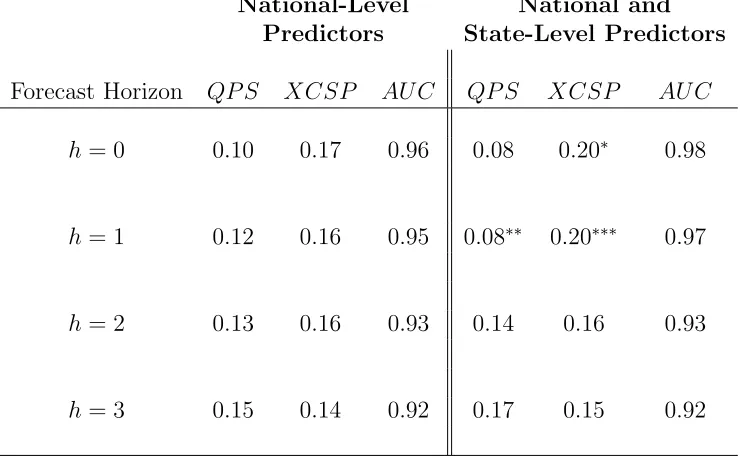
Table 1 presents the forecast evaluation metrics for two alternative models. The first uses
only national-level predictors. This model will serve as our baseline with which to compare
the second model, which includes both national- and state-level predictors. These metrics
tell a consistent story: the model that includes state-level data produces better forecasts than
the baseline model for very short horizon forecasts, namely nowcasts (h = 0) and one-step ahead forecasts (h = 1.) At these horizons, the QP S is lower, while the XCSP and AU C
are higher, for the model including state-level data. For the QP S and XCSP, we further test the null hypothesis of equal forecast accuracy using the Diebold-Mariano-West (DMW)
test, and find that this can be rejected for XCSP when h = 0 and for both metrics when
h= 1.14 The forecast improvements as measured by several metrics are quantitatively large.
As one example, the XCSP is 3 percentage points higher for the model including state-level
data when h = 1, meaning that approximately 12 more months were correctly classified by the model that includes state-level data. For longer horizons, the inclusion of state-level data
appears less helpful. For h= 2 and h= 3, the forecast metrics are very similar for both the
baseline model and the model that includes state-level data.
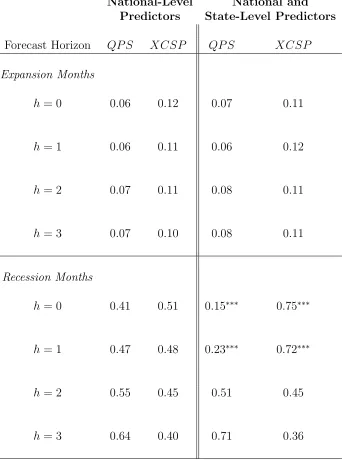
We next investigate whether the improvements generated by the inclusion of state-level
data are symmetric across business cycle phases. Table 2 presents the forecast evaluation
metrics computed separately for expansion vs. recession months in the out-of-sample
pe-riod.15 These results demonstrate that the forecast improvements generated by the inclusion
of state-level data in the out-of-sample period are concentrated in recession months. In
par-ticular, the forecast evaluation metrics computed for expansions are similar for the baseline
model and the model that includes state-level data. However, when we focus on recession
months, there is a clear benefit from incorporating state-level data for short-horizon
fore-casts. For h = 0 and h = 1, the QPS is reduced by 50% to 60% during recession months. The XCSP improvements are approximately 25 percentage points at these horizons, meaning
that a quarter of the recession months over the sample period are correctly classified by the
model that includes state-level data, but not by the model that includes only national-level
data. The QP S and XCSP improvements are highly statistically significant based on the DMW test. There are again no clear improvements from the addition of state-level data at
longer horizons.
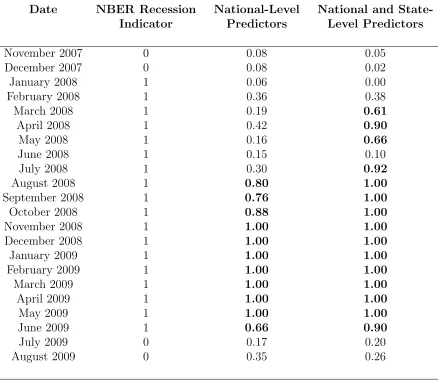
To provide an example from a specific recession, Table 3 presents the out-of-sample
forecasts, Sbt+h, for the h = 1 case around the 2008-2009 recession. Beginning with the
model that includes only national-level variables, Sbt+1 does not cross 50% probability of
recession until August 2008, eight months following the beginning of the NBER-defined
recession. For the h = 1 horizon, this forecast would have been available at the end of July 2008. This is consistent with the considerable uncertainty that persisted well into 2008
about whether the economy had entered a recession phase. For example, the NBER did not
announce the December 2007 peak until December 1, 2008. Also, as discussed in Hamilton
(2011), statistical models designed to track business cycle turning points using national-level
15Specifically, the forecast evaluation metrics discussed in Section 2.3 are computed separately for the
sub-sample of months for whichSt+h= 0 and the subsample of months for whichSt+h= 1. We do not report
data did not send a definitive signal that the recession had begun until mid-to-late 2008.
However, Table 3 also reveals that incorporating state-level data would have provided a
much quicker signal of the beginning of this recession. Specifically, Sbt moved above 50%
probability of recession for March 2008, where this forecast would have been available as of
the end of February 2008, an impressive five month improvement over the model using only
national-level data. Notably, both models produce accurate one-month ahead forecasts of
the end of the 2008-2009 recession.16
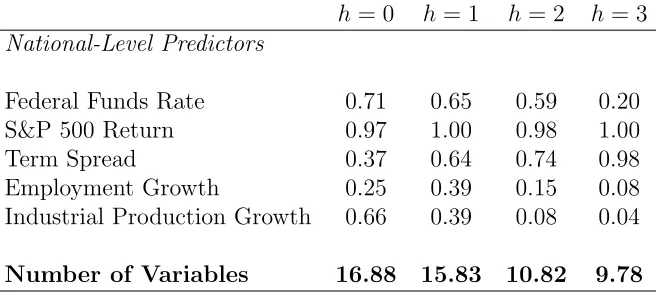
We next evaluate which variables are deemed as important predictors in the BMA
pro-cedure. Table 4 reports the posterior inclusion probabilities for the model that includes
both national- and state-level data, averaged over the recursive estimations conducted to
construct the out-of-sample forecasts. The table provides these inclusion probabilities for all
of the national-level variables. The state-level variables will be discussed separately below.
Of the national-level variables, the S&P 500 return is a robust predictor across all forecast
horizons, with average inclusion probabilities close to 100%. The Federal Funds rate also has
average inclusion probabilities above 50% for several forecast horizons. The term spread
be-comes a more robust predictor as the forecast horizon lengthens, consistent with the finding
of the existing literature that this variable is useful for longer-horizon business cycle phase
predictions. Interestingly, neither aggregate employment or aggregate industrial production
growth have average inclusion probabilities above 50% for most forecast horizons, the single
exception being industrial production growth when h = 0. These variables have very high average inclusion probabilities when state-level data is not included (not reported), implying
the importance of these aggregate level variables is substantially diminished by the inclusion
of state-level data.
The final row of 4 shows the posterior median for the number of variables in the model,
16When we extend this analysis to each of the five NBER peaks in the out-of-sample evaluation period, we
averaged across the recursive estimations. For the h = 0 and h = 1 horizon these values are large, at greater than 15 variables. This suggests that there are a substantial number
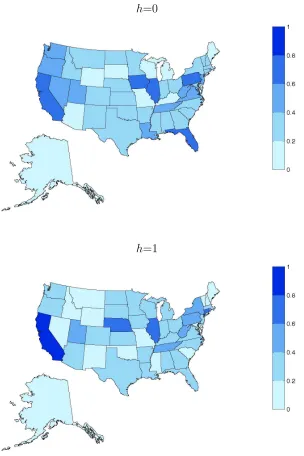
of state-level variables that influence the forecast. To investigate which state level variables
these are, Figure 1 maps the states with ranges of inclusion probability. We focus on the
h = 0 and h = 1 forecast horizons, where the forecast improvements from the addition of state level data are concentrated. These maps show that while there are few states with very
high average inclusion probabilities (darker shading), there are many states with average
inclusion probabilities in the 20%-60% range, meaning a large number of states influence
the BMA forecast. These probabilities also indicate significant model uncertainty regarding
which state-level variables should be included in the model. One likely reason for this
uncertainty is significant correlation between the state-level employment growth variables.
This uncertainty again highlights the potential importance of the BMA approach we take to
select predictors and incorporate uncertainty about this selection.
Given this potential importance, we next present results meant to evaluate whether the
BMA predictor selection algorithm is a significant factor for the out-of-sample forecast
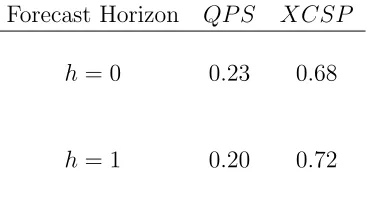
im-provements generated with the addition of state-level data. Specifically, Table 5 reports the
forecast evaluation metrics for out-of-sample forecasts produced from a model in which all
national- and state-level variables are always included. As the forecasting improvements from
adding state-level data were concentrated in short-horizon forecasts of recession months, we
focus on the forecast evaluation metrics computed for nowcasts (h= 0) and one-month-ahead forecasts (h= 1) of recession months over the out-of-sample period. By comparing Table 5 to the bottom panel of Table 2, we can gauge the value added of using the BMA predictor
selection algorithm to construct forecasts, vs. simply including all possible variables.
In-deed, this comparison shows a deterioration in the out-of-sample forecast performance from
conditioning on a model that includes all possible variables rather than using BMA. Notably
however, the model with all variables included is still preferred to the model that doesn’t
Finally, as was discussed in Section 3 above, our out-of-sample forecasts are constructed
using ex-post revised data for the predictors taken from the September 2013 vintage for each
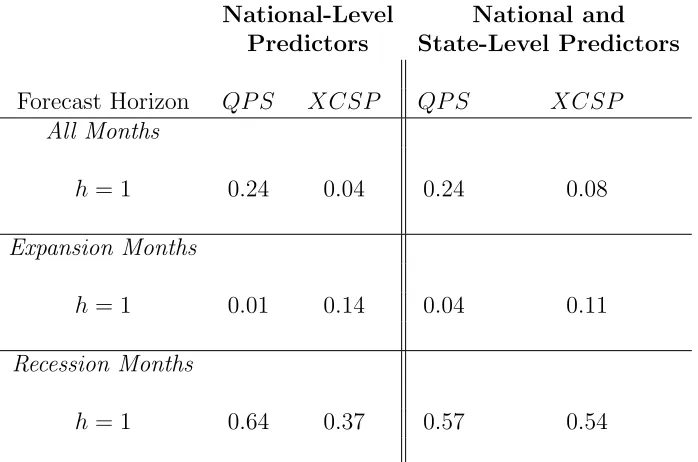
series. In Table 6 we evaluate the robustness of the out-of-sample forecasting results when
we instead use only vintages of data that would have been available to a forecaster in real
time. Due to difficulties with obtaining long histories for state-level payroll employment at
a substantial number of vintages, we focus on a shorter out-of-sample period running from
July 2007 to June 2011, which includes the most recent NBER-defined recession. As forecast
improvements from the addition of state-level data were primarily at short horizons, we focus
on one month ahead forecasts.
Table 6 demonstrates that our primary conclusions from the longer out-of-sample period
using ex-post data are confirmed for the shorter out-of-sample period using real-time data.
In particular, there is a general improvement in the forecast evaluation metrics computed
for recession months from the addition of state-level data. As an example, the XCSP is 17
percentage points higher when state-level data is included, which corresponds to roughly
3 more recession months during the 2008-2009 recession being correctly classified. Also, as
before, there is no apparent improvement from the addition of state-level data for one-month
ahead predictions of expansion phases.
5
Conclusion
A large literature has investigated the predictive content of variables measured at the
na-tional level, such as aggregate employment and output growth, for forecasting U.S. business
cycle phases (expansions and recessions.) Motivated by recent studies showing differences in
the timing of business cycle phases in nationally aggregated data from those for
geographi-cally disaggregated data, we investigate the information contained in state-level employment
growth for forecasting national business cycle phases. We use as a baseline a probit model
con-sists of national-level economic activity and financial variables. We then add to this model
state-level employment growth. To avoid issues associated with overparameterization of
forecasting models, we use a Bayesian model averaging procedure to construct forecasts.
Using a variety of forecast evaluation metrics, we find that adding state-level employment
growth improves nowcasts and short-horizon forecasts of the NBER business cycle phase over
a model that uses data measured at the national-level only. The gains in forecasting accuracy
are concentrated during months of recession, and are large and statistically significant.
Pos-terior inclusion probabilities indicate substantial uncertainty regarding which states belong
References
Albert, J. H. and S. Chib (1993). Bayesian analysis of binary and polychotomous response
data. Journal of the American Statistical Association 88(422), 669–679.
Berge, T. (2013). Predicting recessions with leading indicators: Model averaging and
selec-tion over the business cycle. Federal Reserve Bank of Kansas City Working Paper No.
13-05.
Berge, T. and O. Jord´a (2011). The classification of economic activity into expansions and
recessions. American Economic Journal: Macroeconomics 3(2), 246–277.
Brier, G. W. (1950). Verification of forecasts expressed in terms of probability. Monthly
Weather Review 75(January), 1–3.
Burns, A. F. and W. C. Mitchell (1946). Measuring business cycles. New York: National
Bureau of Economic Research. ID: 169122.
Carter, C. K. and R. Kohn (1994). On gibbs sampling for state space models.
Biometrika 81(3), 541–553. ID: 476895942.
Casella, G. and E. I. George (1992). Explaining the gibbs sampler. American
Statisti-cian 46(3), 167–174. ID: 481283991.
Chauvet, M. and J. Piger (2008). A comparison of the real-time performance of business
cycle dating methods. Journal of Business and Economic Statistics 26(1), 42–49.
Diebold, F. X. and R. S. Mariano (1995). Comparing predictive accuracy.Journal of Business
and Economic Statistics 13, 253–265.
Diebold, F. X. and G. D. Rudebusch (1991). Forecasting output with the composite leading
Estrella, A. (1997). A new measure of fit for equations with dichotomous dependent variables.
Journal of Business and Economic Statistics 16(2), 198–205.
Estrella, A. and F. S. Mishkin (1998). Predicting u.s. recessions: Financial variables as
leading indicators. The Review of Economics and Statistics 80(1), 45–61.
Gelfand, A. E. and A. F. M. Smith (1990). Sampling-based approaches to calculating
marginal densities. Journal of the American Statistical Association 85(410), 398–409.
Hamilton, J. D. (1989). A new approach to the economic analysis of nonstationary time
series and the business cycle. Econometrica 57(2), 357–384. ID: 480697643.
Hamilton, J. D. (2011). Calling recessions in real time. International Journal of
Forecast-ing 27(4), 1006–1026.
Hamilton, J. D. and M. T. Owyang (2011). The propagation of regional recessions. NBER
working paper no. 16657.
Hand, D. J. and V. Vinciotti (2003). Local versus global models for classification problems:
Fitting models where it matters. The American Statistician 57, 124–131.
Hernandez-Murillo, R. and M. T. Owyang (2006). The information content of regional
employment data for forecasting aggregate conditions. Economic Letters 90(3), 335–339.
Holmes, C. C. and L. Held (2006). Bayesian auxiliary variable models for binary and
multi-nomial regression. Bayesian Analysis 1(1), 145–168.
Katayama, M. (2008). Improving recession probability forecasts in the u.s. economy. Working
Paper.
Kauppi, H. and P. Saikkonen (2008). Predicting u.s. recessions with dynamic binary response
King, T. B., A. T. Levin, and R. Perli (2007). Financial market perceptions of recession
risk. Federal Reserve Board Finance and Economics Discussion Series working paper no.
2007-57.
Mitchell, W. C. (1927). Business Cycles: The Problem and its Setting. New York: National
Bureau of Economic Research.
Owyang, M. T., J. Piger, and H. J. Wall (2005). Business cycle phases in u.s. states. Review
of Economics and Statistics 87(4), 604–616.
Rudebusch, G. D. and J. C. Williams (1991). Forecasting recessions: The puzzle of the
enduring power of the yield curve. Journal of Business and Economic Statistics 27(4),
492–503.
Tanner, M. A. and W. H. Wong (1987). The calculation of posterior distributions by data
augmentation. Journal of the American Statistical Association 82(398), 528–540.
West, K. D. (1996). Asymptotic inference about predictive ability. Econometrica 64, 1067–
1084.
Wright, J. H. (2006). The yield curve and predicting recessions. Federal Reserve Board
Figure 1
Average Predictor Inclusion Probabilities for Recursive Estimations
h=0
h=1
Table 1
Forecast Evaluation Metrics
National-Level National and
Predictors State-Level Predictors
Forecast Horizon QP S XCSP AU C QP S XCSP AU C
h= 0 0.10 0.17 0.96 0.08 0.20⇤ 0.98
h= 1 0.12 0.16 0.95 0.08⇤⇤ 0.20⇤⇤⇤ 0.97
h= 2 0.13 0.16 0.93 0.14 0.16 0.93
h= 3 0.15 0.14 0.92 0.17 0.15 0.92
Table 2
Forecast Evaluation Metrics - Expansion vs. Recession Months
National-Level National and
Predictors State-Level Predictors
Forecast Horizon QP S XCSP QP S XCSP
Expansion Months
h= 0 0.06 0.12 0.07 0.11
h= 1 0.06 0.11 0.06 0.12
h= 2 0.07 0.11 0.08 0.11
h= 3 0.07 0.10 0.08 0.11
Recession Months
h= 0 0.41 0.51 0.15⇤⇤⇤ 0.75⇤⇤⇤
h= 1 0.47 0.48 0.23⇤⇤⇤ 0.72⇤⇤⇤
h= 2 0.55 0.45 0.51 0.45
h= 3 0.64 0.40 0.71 0.36
Table 3
One-Month Ahead Forecasts: 2008-2009 Recession
Date NBER Recession National-Level National and
State-Indicator Predictors Level Predictors
November 2007 0 0.08 0.05
December 2007 0 0.08 0.02
January 2008 1 0.06 0.00
February 2008 1 0.36 0.38
March 2008 1 0.19 0.61
April 2008 1 0.42 0.90
May 2008 1 0.16 0.66
June 2008 1 0.15 0.10
July 2008 1 0.30 0.92
August 2008 1 0.80 1.00
September 2008 1 0.76 1.00
October 2008 1 0.88 1.00
November 2008 1 1.00 1.00
December 2008 1 1.00 1.00
January 2009 1 1.00 1.00
February 2009 1 1.00 1.00
March 2009 1 1.00 1.00
April 2009 1 1.00 1.00
May 2009 1 1.00 1.00
June 2009 1 0.66 0.90
July 2009 0 0.17 0.20
August 2009 0 0.35 0.26
Table 4
Average Predictor Inclusion Probabilities for Recursive Estimations
h= 0 h= 1 h = 2 h= 3
National-Level Predictors
Federal Funds Rate 0.71 0.65 0.59 0.20 S&P 500 Return 0.97 1.00 0.98 1.00
Term Spread 0.37 0.64 0.74 0.98
Employment Growth 0.25 0.39 0.15 0.08 Industrial Production Growth 0.66 0.39 0.08 0.04
Number of Variables 16.88 15.83 10.82 9.78
Table 5
Forecast Evaluation Metrics - Recession Months All National- and State-Level Predictors Included
Forecast Horizon QP S XCSP
h= 0 0.23 0.68
h= 1 0.20 0.72
Table 6
Forecast Evaluation Metrics with “Real-Time” Data
National-Level National and
Predictors State-Level Predictors
Forecast Horizon QP S XCSP QP S XCSP
All Months
h= 1 0.24 0.04 0.24 0.08
Expansion Months
h= 1 0.01 0.14 0.04 0.11
Recession Months
h= 1 0.64 0.37 0.57 0.54