International Journal of Emerging Technology and Advanced Engineering
Website: www.ijetae.com (ISSN 2250-2459, ISO 9001:2008 Certified Journal, Volume 7, Issue 10, October 2017)
299
Load Balancing in Underwater Wireless Sensor Network using
Clustering Approach
Gulista khan
1, Dr. R. K. Dwivedi
2, Rahul Rathore
31,2,3Department of Computer Science, Teerthanker Mahaveer University, Moradabad, India
Abstract: Wireless Sensor Networks (UWSN) is the collection sensor nodes use to sense the environment to detect the things of interest. Dues to the higher usage of UWSNs, it has gained the high attention of the researchers. Wireless sensor network (UWSN) became the topic of interest in past decades. Wireless sensor network is used to get the information of surroundings. UWSN’s are used mainly in the areas where human intervention is not possible. It can be used in forests to detect fire, underwater to detect seismic activities, in defence to detect activities of enemies etc. As it is clear that UWSN is used to detect activities in unreachable areas, so it becomes essential to efficiently utilise the power by using some approach (like clustering) for prolonging the lifetime of the network. Clustering is grouping of similar sensor nodes in nearby area via different technique. One sensor node acts as cluster head (CH) in every cluster to send data to the base station. Cluster heads gather the data from respective clusters and aggregated data is sent to the base station for end user queries. The main challenge is to select the appropriate clustering technique as well as CH election. In this paper, a technique (based on probability) for selection of the cluster head is proposed, probability again depends on the residual energy and number of neighbours nodes. The simulation results show that this approach is more effective in prolonging the network lifetime.
Keywords: Wireless sensor network, Clustering, network
lifetime, propagation delay, Routing.
I. INTRODUCTION
Underwater Wireless Sensor Network (UWSN) is a network consists of a large number of Nodes. These sensor nodes (SN) are distributed in some geographical area. UWSN’s are used where person cannot interfere in the area of interest. Nodes are deployed in hazardous places, flood effective regions, underwater environments [1]. So, in such unreachable area [2] it is also very difficult to deploy the nodes. The UWSN is having many applications including disaster management, habitat monitoring, military surveillance, agriculture, detecting the intrusion and health monitoring. Routing is the main concern which can increase the lifetime of the network [3]. Various techniques have been developed since last decades to find out the ways to increase the lifetime of the network.
Among all these techniques clustering is found to be the most effective technique to increase lifetime along with lowering the propagation delay. Clustering technique works by forming the cluster of nodes then identify a cluster head. All sensor nodes needs to send data to the respective CH, which further aggregates [4,5] the data and send it to the base station or the sink node. In this fashion, all nodes can save their energy by sending data to a lower distance. Cluster head selection is based on either the probability factor or on remaining energy of the node. In case of probabilistic election, role of CH is to be rotated after each round otherwise node with highest residual energy is elected as CH. In last two decades, many clustering approaches have been proposed for wireless sensor networks. In these techniques, lowering the energy consumption is the major task to tackle. Generally clustering algorithms are divided into rounds. First round is to select the appropriate cluster head. Next is creating cluster under each CH. Then through predefined clustering data transmission is performed after aggregation. By this approach network will stay active for longer time.
In this paper, an algorithm is proposed and evaluated. This algorithm is divided into three steps cluster head selection, Cluster formation and routing. Cluster formation is again divided into two phases; firstly base station selects some temporary cluster head. Equal partitioned regions in proposed case. Then based on probability and highest residual energy, final cluster head is selected for the routing purpose. In second phase of algorithm clusters are formed. Then data transmission is done. The other sections of paper are divided as follows; the next section is the literature survey. The section following the second one is the problem formulation that how a sensing field is divided. The fourth section is the implementation and result. The fifth section concludes the paper.
II. LITERATURE REVIEW
International Journal of Emerging Technology and Advanced Engineering
Website: www.ijetae.com (ISSN 2250-2459, ISO 9001:2008 Certified Journal, Volume 7, Issue 10, October 2017)
300 Among that major criterion are cluster head selections, cluster head properties, clustering process [6, 7, 8]. Many research articles based on clustering are studied in literature [9-14]. Proposed algorithm is also considering cluster head selection, cluster formation and data transmission process. Prime objective is to increase the network lifetime by decreasing the energy consumption.
LEACH (“Low Energy Adaptive Clustering Hierarchy”) [4] [15] is the first and basic clustering approach in wireless sensor network. In LEACH, every sensor node is having equal energy distribution. They are equipped with the random probabilistic model for the election of a node as CH where 5% of the nodes are elected as CH. Role of the CH is rotated after each round and each node has to become CH cyclically irrespective of their remaining energy.
A hybrid energy efficient protocol known as HEED was proposed [16]. HEED selects the Cluster Head as the remaining energy is taken as main parameter. Second parameter was the node degrees i.e. number of nodes coming and out of the node. Also this technique was able to handle the heterogeneous battery data.
Few more techniques were proposed in [17] and [18] for heterogeneous nodes. Means nodes were having different energy levels. These algorithms were using two categories of nodes: as per the initial energy levels, simple nodes or the super nodes. However it doesn’t consider the residual energy levels.
As opposed to SEP [7], DEEC [18] improves the process of selection of CH based on the residual energy. Due to improvement in CH selection criteria [18] have better results. It considered the probability of electing as CH by considering the starting and left over energy of nodes. But again DEEC [18] was not able to perform well when Base station is outside at some distance from sensor nodes. It considers Base station is at the centre of the network area only.
Some protocols in [19] and [20] explains the concept of selecting cluster head by firstly selecting a candidate node of a cluster then selects final cluster head. After some time interval, cluster head selection was based on some other matrices. Also, if any node is found to be with more energy than the other nodes within that specific range, then it quits the competition and node with high energy will elected as Cluster head.
Proposed work is showing improvement over existing algorithms and also considers the base station at far distance from the Network area.
III. CHALLENGES
Clustering is considered as one of the best idea to reduce the energy consumption. As in direct communication all nodes had to transmit data directly to base station by which they exhaust their energy very quickly. By clustering one node is elected as cluster head collects the data from the nodes under its region and forward this aggregated data to the base station. One disadvantage of transferring all data through cluster heads is faster energy drainage of CH as well as nodes which are near to the base station.
So nodes frequently used in routing path will exhaust very soon. Another disadvantage is energy wastage in finding the appropriate route [7].
IV. PROPOSED ALGORITHM
A. Network Model Assumption
In this paper, a Wireless Sensor Network (UWSN) formed by deploying n number of sensor nodes SNi where (i = 1, 2, . . . , n) is considered. These nodes are distributed over the network area having size A*A.UWSNs is used in the hazardous areas, where it is hard to reach manually to monitor. So practically nodes can be deployed in random deployment fashion to form network topology for simulation. Also, the SNs are assumed to be fixed after random deployment. It is also assumed that sensor nodes have data every time and they used to send it to Cluster Head or Base Station, as per their routing strategy.
I. Assumption about Node Energy
Proposed scenario considers heterogeneous node deployment; means all nodes have different energy levels. So initially that initial energy of sensor is distributed between E0 to (1 + Emax )E0. Node will have initial energy varying from E0 to the maximum of (1 + Emax)E0. The maximum value of the power is determined by Emax. All nodes are assigned their initial energy as (1+Ei) E0. In addition, a node can investigate the total energy of network by broadcasting a message to Base station. The total energy is calculated by the following formula:
n n
ETotal = ∑ (1 + Ei) E0 = E0 (n+∑ Ei) = E0(n + A)
i=1 i=1
International Journal of Emerging Technology and Advanced Engineering
Website: www.ijetae.com (ISSN 2250-2459, ISO 9001:2008 Certified Journal, Volume 7, Issue 10, October 2017)
301 Aggregates clustered data by discarding the similar data. Chances of receiving duplicate data at CH are higher because nodes are correlated and covering nearby region, so they sense similar data. This aggregated data is contained within a fixed-length packet to transfer this to base station.
It is assumed that every sensor node senses and sends n bits of sensed data to the CH in one round. CH then collects that sensed data and aggregates this data. Energy consumption for data aggregation is (EA) 5nJ/bit/signal. Along with this, a broadcast message contains some control information. Also for the purpose of data transmission, there is a routing path between sensor node to CH and CH to base station so called one-hop network [21]. The required energy for transferring n- bit data packet over a distance of d meter is:
Etx = nEe + nEf d2
When distance d<= dth
Etx = nEe+nEmd4
When distance d> dth
Etx is transmission energy. Ee, Ef, and Em are parameters of the transmission or reception, dth is the threshold distance. The receiving energy can be calculated by following formula:
Erx= nEe
Total energy consumption of a sensor node is sum of transmission energy for transferring data and control messages and is given as
EConsumption= nd(2NEe+NEd+kemd4n2b+kefd2m2h)
Where distance between CH and Base station denoted by dn2b. Distance between clusters nodes and CH can be calculated by dm2h. The above equation is used to calculate the energy consumption of a single round in the condition when all the clusters are of same size. Also by the same way, lifetime of a network can be calculated. Based on total energy of the network and total consumption energy per round, dm2h can be calculated from the following equation:
dm2h =W/ √2pik
Where number of clusters is denoted by k, pi=3.14.
B. Proposed Scheme
Proposed algorithm is divided into two parts.
1. Random Deployment 2. Cluster head Selection 3. Cluster formation
I. Random Deployment
[image:3.612.331.562.192.368.2]Deployment process is done before the proposed algorithm. Proposed scheme uses Random Deployment in the field of interest.
Fig. 1 Random Deployment of the nodes
4.2.2 Cluster Head Selection
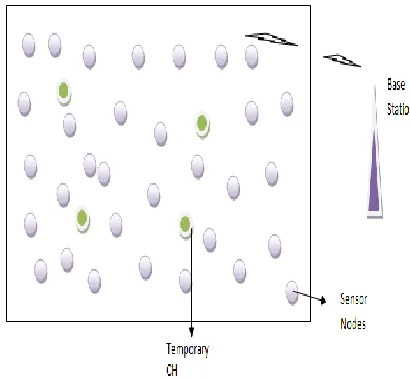
Cluster head selection is done in three steps. After the random deployment, base station decides any sensor node to be elected as cluster head. It is a temporary cluster head. After the selection of temporary head node, the residual energy of every node is calculated. The node that is having highest residual energy in the area is elected as new CH and replacing the temporary cluster head position.
[image:3.612.338.543.488.677.2]International Journal of Emerging Technology and Advanced Engineering
Website: www.ijetae.com (ISSN 2250-2459, ISO 9001:2008 Certified Journal, Volume 7, Issue 10, October 2017)
302 II. Calculation of residual energy
Each sensor nodes calculates its probability (pi) to elect as cluster head. pi could be calculated by considering the initial energy and the residual energy. The formula for finding the probability is given as:
pi= poptimal
Here Ei(rn) is the residual energy of sensor node (SNi) at round rn, E(rn) is the average energy of the network at some round rn. Pi can be fluctuated due to residual energy of the network. As soon as network balance this fluctuation, probability (pi) decides the next cluster head. The node which is having highest pi will participate in the cluster head selection process.
In the temporary Cluster head selection phase of each round, base station partition the area into equal portions and randomly selecting the nodes as cluster head from each partition. Then residual energy and the probability are calculated for selection of CH.
Probability threshold is also defined to determine the node that is eligible to take participation in the election process.
Th(SNi)=
Where S is the set of the sensor nodes that are consider as eligible to participate in election of cluster head at round r. S contains the nodes who have not been selected as cluster head from last five round.
III. Selection of Head Node
After the calculation of the probability piof nodes, it is
checked with the threshold Th(SNi) of probability. If the value of pi is within the range ofthreshold value, then it can
participate in the process of cluster head selection. Nodes from this set start the election process. Nodes compare their residual energy with the tentative cluster head. If its residual energy is greater than the energy of current cluster head then it broadcasts a message to the network to be elect as new and the final cluster head by replacing the temporary cluster head. In this way all the nodes who are eligible to be electing as cluster head node broadcast a small message to announce its membership within a bounded period of time.
In this election process, nodes who successfully broadcasted in first phase becomes CH. Rest of the nodes in set S give up the competition and wait for the next session of cluster head selection.
Fig.3 Final selection of CH
C. Cluster Formation
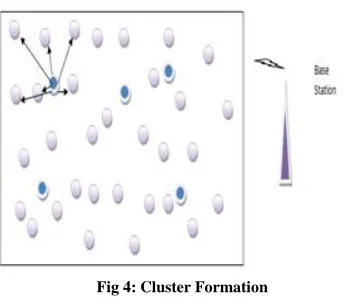
New cluster head now broadcast a message < IDCH, ECH, TrCH>, to form its cluster with its maximum transmission range.
This is known as Cluster_Registration message [1], act as an invitation to all nodes to become a member of its Cluster. The nodes dispersed in the network area try to listen this registration message and based on received signal strength nodes who can respond to CH by send joining message (Cluster_Join) to the corresponding CH. This join message would be containing < IDn, IDCH, ETxn>, where IDn is the ID of joining node, ETx residual energy of node at time Tx. When node joined to any cluster it discards the successive messages from the same Cluster. Where IDCH denotes IDs of a CH.
ECH is the residual energy of the CH. TrCH is the transmission energy of the CH.
International Journal of Emerging Technology and Advanced Engineering
Website: www.ijetae.com (ISSN 2250-2459, ISO 9001:2008 Certified Journal, Volume 7, Issue 10, October 2017)
[image:5.612.322.567.127.380.2]303 Fig 4: Cluster Formation
V. RESULTS AND CONCLUSION
[image:5.612.77.249.147.297.2]Author proposed a scheme energy efficient decision making strategy for selecting CH in wireless sensor network areas [11]. This scheme was using three criteria which include balance energy, calculation of distance from base station and number of nodes in neighborhood. In this paper a clustering scheme is proposed which is complete in three steps (from random deployment to cluster head selection and then clustering approach). Proposed work is considering one more factor than [11] is probability calculation of being the cluster head. Simulations of proposal work are done in MATLAB. Table 1 is represents simulation parameters. Result shown in fig. 5 illustrates considerable energy reduction and increase network lifetime compared to protocol discussed in DHAC [11].
Table 1.
Table captions should be placed above the table
Fig. 5 Network Lifetime Comparison
REFERENCES
[1] Cerulli, R.; De Donato, R.; Raiconi, A. Exact and heuristic methods to maximize network lifetime in Wireless sensor networks with adjustable sensing ranges. Eur. J. Oper. Res. 2012, 220, 58–66.
[2] Han, R.; Yang, W.; You, K. MB-OFDM-UWB Based Wireless
Multimedia Sensor Networks for Underground Coalmine: A Survey. Sensors 2016, 16, 2158.
[3] Huang, J.; Duan, Q.; Xing, C.C.;Wang, H.G. Topology Control for
Building a Large-Scale and Energy-Efficient Internet of Things. IEEE Wirel. Commun. 2017, 24, 67–73.
[4] Heinzelman,W.B.; Chandrakasan, A.P.; Balakrishnan, H. An
application-specific protocol architecture for wireless microsensor networks. IEEE Trans. Wirel. Commun. 2002, 1, 660–670. [5] Afsar, M.M.; Tayarani-N, M.H. Clustering in sensor networks: A
literature survey. J. Netw. Comput. Appl. 2014, 46, 198–226. [6] Abbasi, A.A.; Younis, M. A survey on clustering algorithms for
wireless sensor networks. Comput. Commun. 2007, 30, 2826–2841. [7] Tyagi, S.; Kumar, N. A systematic review on clustering and routing techniques based upon LEACH protocol for wireless sensor networks. J. Netw. Comput. Appl. 2013, 36, 623–645.
[8] Sucasas, V.; Radwan, A.; Marques, H.; Rodriguez, J. A survey on clustering techniques for cooperative wireless networks. Ad Hoc Netw. 2016, 47, 53–81.
[9] Manjeshwar, A.; Agrawal, D.P. TEEN: A Routing Protocol for Enhanced Efficiency in Wireless Sensor Networks. Proc. IPDPS
2001, 1, 189.
[10] Lindsey, S.; Raghavendra, C.S. PEGASIS: Power-efficient
gathering in sensor information systems. In Proceedings of the 2002 IEEE Aerospace Conference, Big Sky, MT, USA, 9–16 March 2002; pp. 1125–1130.
Description Value
“Total number of nodes ” 100
“Initialize energy of node” 1 J
“Packet Size” 500 bytes
“BS location” (50,50)
“Registration message/ Join message size”
25 bytes
“Eamp node energy used for amplification over a short distance
10 pj/bit/m2
“Eamp Energy consumed to transmit data at a longer distance”
0.0013 pJ/bit/m4
“Circuit to be transmitted or receive the Signal” 𝐸elec
[image:5.612.63.276.519.715.2]International Journal of Emerging Technology and Advanced Engineering
Website: www.ijetae.com (ISSN 2250-2459, ISO 9001:2008 Certified Journal, Volume 7, Issue 10, October 2017)
304
[11] Liu, Z.; Zheng, Q.; Xue, L.; Guan, X. A distributed energy-efficient clustering algorithm with improved coverage in wireless sensor networks. Future Gener. Comput. Syst. 2012, 28, 780–790. [12] Hu, Y.; Niu, Y.; Lam, J.; Shu, Z. An Energy-Efficient Adaptive
Overlapping Clustering Method for Dynamic Continuous
Monitoring in UWSNs. IEEE Sens. J. 2016, 17, 834–847.
[13] Wang, N.; Zhou, Y.; Xiang, W. An Energy Efficient Clustering Protocol for Lifetime Maximization in Wireless Sensor Networks. In Proceedings of the 2016 IEEE Global Communications Conference (GLOBECOM), Washington, DC, USA, 4–8 December 2016. [14] Ahmed, G.; Zou, J.; Zhao, X.; Sadiq Fareed, M.M. Markov Chain
Model-Based Optimal Cluster Heads Selection for Wireless Sensor Networks. Sensors 2017, 17, 440.
[15] Heinzelman,W.R.; Chandrakasan, A.; Balakrishnan, H.
Energy-efficient communication protocol for wireless microsensor networks. In Proceedings of the 33rd Annual Hawaii International Conference on System Sciences, 2000, Maui, HI, USA, 4–7 January 2000; IEEE: Piscataway Township, NJ, USA, 2000.
[16] Younis, O.; Fahmy, S. HEED: A hybrid, energy-efficient, distributed clustering approach for ad hoc sensor networks. IEEE Trans. Mob. Comput. 2004, 3, 366–379.
[17] Smaragdakis, G.; Matta, I.; Bestavros, A. SEP: A Stable Election Protocol for Clustered Heterogeneous Wireless Sensor Networks; Technical Report BUCS-2004-022; Computer Science Department, Boston University: Boston, MA, USA, 2004;
[18] Qing, L.; Zhu, Q.; Wang, M. Design of a distributed energy-efficient clustering algorithm for heterogeneous wireless sensor networks.
Comput. Commun. 2006, 29, 2230–2237.
[19] Ye, M.; Li, C.; Chen, G.;Wu, J. EECS: An energy efficient clustering scheme in wireless sensor networks. In Proceedings of the 24th IEEE International Conference on Performance, Computing, and Communications, Phoenix, AZ, USA, 7–9 April 2005; pp. 535– 540.
[20] Tarhani, M.; Kavian, Y.S.; Siavoshi, S. SEECH: Scalable energy efficient clustering hierarchy protocol in wireless sensor networks. IEEE Sens. J. 2014, 14, 3944–3954.
[21] Rappaport, T.S. Wireless Communications: principles and Practice, 2nd ed.; Prentice Hall: Upper Saddle River, NJ, USA, 2002. [22] Pahlavan, K.; Levesque, A.H. Wireless Information Networks; John