A SURVEY ON VIDEO STREAMING OVER MULTIMEDIA
NETWORKS USING TCP
U.RAHAMATHUNNISA1, DR.R.SARAVANAN2,
1Assistant Professor, SITE, VIT university, Vellore. 2Sr. Professor, SITE, VIT university, Vellore
E-mail : [email protected], [email protected]
ABSTRACT
Video Streaming has been used recently for various interactive services. Video Streaming is playing the content of the video in real time. Today’s research is focused on video streaming through TCP. Regardless of the retransmission procedures, researchers focus on TCP Streaming due to its reliable service. This paper focuses more towards TCP Video Streaming and various congestion control algorithms used for video streaming.
Keywords: TCP, Video Streaming, Congestion Control
1. INTRODUCTION
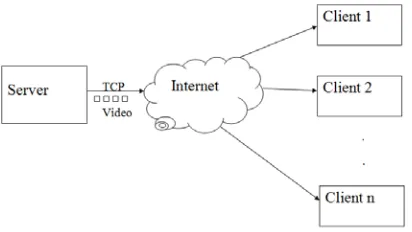
[image:1.612.92.298.493.609.2]Figure 1. describes an architecture of TCP Video Streaming. The Video server splits the video into streams. The Video Streams are then transmitted through TCP to the clients. There are ‘n’ clients connected to the internet. The clients are connected with varying bandwidth limits. The challenge is towards efficient video streaming with minimal loss and delay.
Figure 1. TCP Video Streaming Architecture
2. FEATURES OF TCP AND UDP IN VIDEO STREAMING IN WIRELESS NETWORKS
Chi-Fai Wong et al [1] discussed the comparisons of TCP and UDP video streaming over
wireless networks. The Advantages and
Disadvantages of TCP/UDP for streaming videos over wireless networks are given below.
2.1 Disadvantages of Using UDP in Wireless Video Streaming
a. UDP is an unreliable and non congestion control protocol. Packet loss occur during video streaming in UDP because of its unreliable service and UDP are in need of the error correction and retransmission mechanisms to avoid packet loss. However, the above mechanisms have certain draw backs. It is very difficult to implement efficient retransmission mechanisms and it increases overhead at the client side .Forward Error Correction schemes increases delay in the encoder part at the server end and error concealment schemes are not suitable for burst error in the case of wireless channel.
b. High packet loss occurs with varying bandwidth in the case of wireless networks .
c. In video streaming, some frames like I frames and synchronization bits have to be protected. Due to wireless errors, there is a chance for data loss in UDP. Such data loss may reduce the quality of the video.
2.2 Advantages of Using TCP in Wireless Video Streaming
a. TCP is a reliable congestion control protocol. Error recovery and error concealment mechanisms are not required .
b. TCP provides Selective frame transmission and the proxy can be designed in such a way that it provides flexibility in selecting the frames to be transmitted.
c. Frame overhead may occur in RTCP and RTP protocols and TCP avoids frame overhead .
d. TCP is friendly and bandwidth adaptable in nature. Even if congestion occurs TCP utilizes the resources using that bandwidth
e. TCP can be implemented in applications because it penetrates the firewall with the use of HTTP.
To our knowledge we have inferred, though there are some drawbacks in TCP such as retransmission which can be avoided by buffering mechanisms, TCP would give better Quality of service due to its fairness. Since UDP is a non congestion control protocol, they are in need of adaptive control mechanisms. The disadvantage of UDP and the Advantages of TCP in wireless video streaming have been given in Table 1.
Table 1. Summary of Features of TCP and UDP in Wireless Video Streaming
Features TCP UDP
Reliability Reliable. Uses Sequence number and Ack. Avoids Packet loss
Unreliable. No sequence number and Ack so Packet loss occurs
Error
Recovery and Error
Concealment
TCP is a Congestion
control protocol. No need of error recovery and error
concealment mechanisms
UDP is a non congestion control protocol. FEC, Retransmission mechanisms are needed
Firewall penetration
TCP penetrates with the firewall by means of HTTP
UDP does not penetrate firewall
Selective Frame transmission
TCP provides selective frame transmission
UDP do not
provide selective frame transmission
3. ADVANCED TCP FOR WIRELESS
ENVIRONMENT
Danny De Vleeschauwer and David Robinson [2] have proposed the HTTP adaptive video streaming mechanisms and the authors have suggested the researchers to follow the following features to make TCP more robust. H. Inamura et al [3] states the additional features of TCP.
1. Client Side Buffer: The size of the buffer at the client end has to be chosen such that no delay occurs while streaming video
2. Early Congestion Notification (ECN): ECN signals are used to notify whether packet loss occur due to error or congestion
3. Selective Acknowledgement (SACK): Instead of sending the entire packets for retransmission, the lost packets alone are retransmitted.
Multimedia streaming via TCP-analytical performance study have been discussed in Bing Wang et al [4] .The best results are obtained in this paper, if its throughput is two times the bit rate. Kim and Ammar [5] worked on stored media streaming using TCP based on receiver buffer size. TCP streaming model and quality of experience has been assessed by Jinyao Yan et al [6].
4. CONGESTION CONTROL ALGORITHMS IN THE INTERNET
To achieve TCP Fairness and friendliness, the congestion control methods should have the following capabilities
i. It should maintain Network Stability ii. Effective Bandwidth utilization is needed iii. Smooth playback is to be followed
5. CLASSIFICATION OF TCP FRIENDLY CONGESTION CONTROL ALGORITHMS
Figure 2. Classification of TCP Congestion Control Algorithms
5.1 AIMD Congestion Control Scheme
According to Qian Wang et al [7], AIMD Congestion Control Algorithm is given by AIMD(A,B)
(or)
E: Wt+s ← Wt+A, A>0 (1)
F: W t+δt ← (1-B) Wt , 0<B<1,
Where
E-Window size increase F-Window size decrease
Wt –Window Size at time t
S-Round Trip A=1 packet B=1/2
Disadvantage of TCP AIMD
Oscillations in the sending rate
Sending rate is halved for a single packet
drop
5.2 Window Based Approach
D. Bansal, H. Balakrishnan [8] presents a TCP Friendly congestion control schemes by modifying the Equation1.The parameters m and n are used in equation 2.
E: Wt+s ← Wt + AnWtm; A>0 (2) F : W t+δs ←W t- B Wt n ; 0< B<1
where,
m and n are the parameter space.
The Equation 2 becomes TCP Friendly if it satisfies the following
m+n=1 and n<=1
It is difficult to configure the parameters
(m,n) space according to the required application.
5.3.Rate Based Approach
Reza Rejaie et al [9] has discussed the Rate Adaptation protocol for real time streams. The rate based scheme are not acknowledgement based when compared with window based scheme. Packet sending is not based on acknowledgements but it is based on the sending rate timer. Rate Adaptation Protocol(RAP) and LDA are the examples of this scheme. RAP is used in unicast playback of real time systems. RAP uses Inter Packet Gap(IPG).IPG doubles multiplicatively if congestion occurs or it decrease additively if congestion does not occur.
Advantage
Adaptation of the sending rate reduces
oscillations
Reduces traffic in real time application
Disadvantage
Sending rate is reduced due to single
packet loss, so performance is reduced in the case of real time applications
5.4. Modeling Based Approach
J. Padhye et al [10] proposed the Modeling schemes to solve the above drawbacks. The Response Function of this scheme is given in Equation 3.
TR=Q/(S√2/3p+tn(3√3p/8).p(1+32p2)) (3)
Where,
TR - Maximum sending rate
Q - Size of the packet
S - Round Trip
tn - Time out value
5.5 Equation Based schemes
These schemes are developed for Unicast traffic .The transmission rate depends upon rate of loss and round trip time. These parameters are adjusted to achieve a reasonable transmission rate. According to this technique, the client has to send the feedback . TFRC is an example for this scheme
Advantage
Sending rate is reduced to half for
successive loss events 5.5.1 Design goals of TFRC
design goals. Transmission rate is reduced to half on successive loss events and if the feedback is not received from the client end, again the transmission rate is reduced to half. So, the transmission rate purely depends upon the successive loss rate and the feedback. The parameters are calculated based on the Response Function as stated in Equation 3.
Advantages
TFRC reduces its sending rate more
smoothly thereby reducing the oscillations in the sending rate .
5.6 Model Based
This scheme is based on the the formulation
Throughput=f(Wmax ,R,p,B), Where,
Wmax-Receiver Declared window size R-Transmission Rate
p-Loss Rate Probability B-Round trip time
TFRCP is an example for this scheme
Advantage
Reduces oscillations in the sending rate
Suitable for real time multimedia
applications
6. DYNAMIC TCP FRIENDLY AIMD ALGORITHM (DTAIMD)
Lin Cai et al [12] proposed the DTAIMD
algorithm which is based on AIMD(α,β)
Step 1 If(cwnd≥1/1- β) //congestion window is large
Step 2 α=3(1- β)/1+ β
Step 3 else if(cwnd= =1) //congestion window is minimal
Step 4 α=1
Step 5 else //if 1<cwnd≤1/1- β Step 6 α=3/2cwnd-1
The results in this paper showed that the above algorithm is suitable for multi rate multimedia applications. The scenario has been tested with different (α,β) pairs and the proposed DTAIMD algorithm yield better throughput when compared with TCP.
7. DESIGN OF MEDIA TCP FRIENDLY
CONGESTION CONTROL (MTCC)
APPROACH
Hsien-Po Shiang and Mihaela van der Schaar [13] proposed a new Congestion Control approach for Wired IP Networks. The authors have proposed an algorithm for independent and interdependent packets. Window size is modified without altering the design of the receiver side. The design of this approach are given below.
1. The RTP packets are classified into M classes
2. MTCC uses the retransmission mechanism of TCP but the expired packet in the buffer is not retransmitted
3. MTCC adjust the congestion window based on the Transmission Scheduler and Network Estimator
4. Transmission Scheduler selects the number of packets to be sent in k time slots
5. The Network Estimator updates the packet Loss rate
8. CONCLUSION AND FUTURE WORK
The paper has discussed about the TCP Video Streaming and the congestion control algorithms used in the internet. Though TCP has certain limitations with video streaming, the buffer management schemes and congestion control methods involved in it improves the video streaming which is still a challenging problem to be solved. Past researchers have focused on the window size and retransmission procedures and our future direction of research will be towards improving quality of service in video streaming through TCP.
REFERENCES
[2] Danny De Vleeschauwer and David Robinson,”TCP:From data to streaming video”, March 22-2011. http://www2.alcatel- lucent.com/techzine/tcp-from-data-to-streaming-video/
[3] H. Inamura, G. Montenegro, R. Ludwig, A. Gurtov, F. Khafizov, “TCP over Second (2.5G) and Third (3G) Generation Wireless Networks,” IETF RFC 3481, February 2003. [4] Bing Wang, Jim Kurose, Prashant Shenoy, and
Don Towsley,”Multimedia Streaming via TCP: An Analytic Performance Study, ACM Transactions on Multimedia Computing, Communications and Applications”, Vol. 4, No. 2, Article 16, May 2008.
[5]Kim, T. and Ammar, M. 2006. Receiver buffer requirements for video streaming over TCP. In Proceedings of Visual Communications and Image Processing Conference. San Jose, CA.
[6] Jinyao Yan, Wolfgang Mühlbauer and
Bernhard Plattner”, Analytical Framework for Improving the Quality of Streaming Over TCP”,IEEE Transactions on Multimedia, Vol. 14, No. 6, December 2012
[7] Qian Wang Keping Long Shiduan Cheng Runtong Zhang,”TCP-Friendly Congestion Control Schemes in the Internet”,IEEE,2001 [8] Deepak Bansal and Hari Balakrishnan
“TCP-friendly Congestion Control for Real-time
Streaming Applications”,
MIT-LCS-TR-806,May 2000
[9] Reza Rejaie, Mark Handley, Deborah Estrin “RAP: An End-to-end Rate-based Congestion Control Mechanism for Real time Streams in the Internet” IEEE.1999
[10] Padhye, J., Firoiu, V., Towsley, D., and Krusoe, J. “Modeling TCP throughput: A simple model and its empirical validation.” In Proceedings of the ACM SIGCOMM. Vancouver, CA, 303–314.1998.
[11] Sally Floyd, Mark, Jitendra Padhye,J¨org Widmer “Equation Based Congestion Control for Unicast Applications” SIGCOMM 2000 [12] Lin Cai, Xuemin Shen, Jianping Pan and Jon
W. Mark,” Performance Analysis of TCP-Friendly AIMD Algorithms for Multimedia
Applications” IEEE Transactions on
Multimedia, Vol. 7, No. 2, April 2005 [13] Hsien-Po Shiang and Mihaela van der Schaar,
Fellow, IEEE “A Quality-Centric TCP-Friendly Congestion Control for Multimedia
Transmission” IEEE Transactions on