International Journal of Emerging Technology and Advanced Engineering
Website: www.ijetae.com (ISSN 2250-2459, ISO 9001:2008 Certified Journal, Volume 5, Issue 1, January 2015)
368
Virtualized Cloud Based IPTV System within Compressed
Format.
Jyoti P. Hase
1, Prof. Rahul. L. Paikrao
21
ME student, Computer Engineering, AVCOE, Sangamner, India. 2
Assistant Prof, Computer Engineering Dept, AVCOE, Sangamner, India
Abstract—Internet protocol Television (IPTV) delivers the television content over an internet Protocol Infrastructure. The Virtualized cloud-based service will make the most
of applied stastical multiplexing across applications to
produce important cost savings to the operator IPTV services through a virtualized IPTV design and thru intelligent time shifting of service delivery. We tend to make the most of the variations in the deadlines related to the Live TV versus Video-on-Demand (VoD) to effectively multiplex these services. In this Paper The problem of server loading, We proposed a technique of Group Of Picture algorithm which provides the functionality of compression in video file and hiding the text document into the video file.
The time shifting method and GOP method reduces the server load up to 15 to 20 %.The traditional instant channel change (ICC) reduces the latency by having different unicast channel for every user changing channel, the user does a multicast join to new stream & experiences smaller display latency due to that it required lower bandwidth in IPTV environment.
Keywords-IPTV, instant channel change, Bandwidth.
I. INTRODUCTION
AS IP-based video delivery becomes lots of famous, the demands places upon the service provider’s resources dramatically increased. Service suppliers sometimes provision for the peak demands of each service across the supplier population. However, provisioning for peak demand leaves resources beneath utilized in any respect different periods. Usually this can be often considerably evident with Instant Channel change (ICC) requests in IPTV [1]. In IPTV, Live TV is commonly multicast from server’s exploitation informatics Multicast, with one cluster per television channel. Video-on-Demand (VoD) is supported by the service suppliers with every request being serve by a server serving a unicast stream[1] When users change channels whereas observation live TV, therefore the channel amendment takes impact quickly.
For each channel change, the user must be a part of the multicast cluster associated with the channel, and expect enough data to be buffered before the video is displayed;. As a result, there measure several makes a trial to support instant channel change by mitigating the user perceived channel shift latency [2],[3]. With the everyday Instant Channel change enforced on IPTV systems, the contents is delivered at happen additional quickly rate employing a unicast stream from the server. The play out buffer is stuffed quickly, so keeps shift latency very little. Once the play out buffer is stuffed up to the play out reason, The set top box activity back to receiving the multicast stream. Our Aim is during this paper is to require advantage of the distinct workloads of the varied IPTV services to higher utilize the deployed servers. It gives opportunities for the service providers to deliver the VoD content in anticipation and probably out of order, taking advantage of the buffering out there at the receivers [1]. Virtualization offers flexibility to share the server resources across these services. we uses a cloud computing infrastructure with virtualization is shifting the resources dynamically in real time to handle the moment channel change activities workloads, b) to be able to anticipate the modification inside the work before time and preload VoD content on Set Top Boxes, thereby facilitate the shifting of resources from Video on Demand to Instant Channel amendment throughout the bursts. c) To unravel a general cost problem
of optimization formulation while not having to
International Journal of Emerging Technology and Advanced Engineering
Website: www.ijetae.com (ISSN 2250-2459, ISO 9001:2008 Certified Journal, Volume 5, Issue 1, January 2015)
369
Fig 1. Live TV ICC and VoD packet buffering timeline [1]We will shift servers (VMs) from Video On Demand to handle the Instant Channel Change demand in a matter of some seconds[6] Note that by having the ability to predict the Instant channel Change bursts channel modification behavior are often foretold from historic logs as a results of Live Television show timings. The channel changes some times happen each time. In anticipation of the Instant Channel Change load, to get to accelerate delivery of VoD content (for example, for a little variety of minutes of play out time) to the users’ STBs and shift the VoD demand far away from the ICC burst interval (see Fig 1). this may conjointly make sure that VoD users won't notice any impairment in their delivered quality of service (e.g. frozen frames etc.) because the play out will be from the native STB cache For we using cost function for computing the number of servers in, the maximum and piecewise linear convex cost value functions. We discovered a series of numerical simulations to envision the impact of varied firstly, the ICC durations and secondly, the Video on Demand delay tolerance on the entire variety of servers required to accommodate the combined workload. Our findings indicate that potential server information measure savings 30 to 35% is accomplished by anticipating the ICC load and thereby shifting the VoD load previous the ICC burst. Ultimately our approach entirely wants a server advanced that is sized to satisfy the necessities of the Instant Channel Change workload , which has no flexibility, and that we will virtually utterly mask the need for any extra servers for managing the VoD load.
II. LITERATURE SURVEY
There are primarily three threads of connected work, namely Cloud computing, optimization, Scheduling with deadline constraints. Cloud computing has recently changed the landscape of web based computing, whereby a shared pool of configurable computing resources like networks,servers, storage will be a space provisioned and discharged to support multiple services at intervals a similar infrastructure [6]. Due to its nature of serving computationallyintensive applications, cloud infrastructure is especially appropriate for content delivery applications Usually Live TV, and VoD services are operated using dedicated servers [4], where as this paper considers the option of in operation multiple services by careful rebalancing of resources in real time at intervals a similar cloud infrastructure. Arrival of requests that ought to be served by an explicit deadline are wide studied [7], [8]. For a given set of processors and incoming jobs characterized by point and demand to end by bound point in time, EDF (Earliest Deadline First) schedules the jobs specified every job finishes by the point in time [9].
In this paper, there are multiple sets of services providing jobs. Each of those services send request for chunks with totally different deadlines, EDF is optimal schedule. during this paper, we discover the region shaped by server tuples in order that all the chunks are serviceable specified no chunk misses point in time Optimization theory could be a mathematical technique for crucial the most profitable or least disadvantageous selection out of a collection of alternatives. Dynamic improvement could be a sub branch of improvement theory that deals with optimizing the required management variables of a separate time dynamic system. In this paper, we tend to contemplate finite-horizon improvement wherever the optimum management parameters with finite look-ahead are to be found [10] [11]. we all know the arrival pattern of the IPTV and VoD requests with their deadlines in the future. we tend to want to seek out the quantity of servers to use at each time thus on minimize the price operate. During this paper, we consider totally different sorts of price functions. We tend to derive closed form solutions wherever doable for numerous cost functions.
[image:2.612.61.277.146.298.2]International Journal of Emerging Technology and Advanced Engineering
Website: www.ijetae.com (ISSN 2250-2459, ISO 9001:2008 Certified Journal, Volume 5, Issue 1, January 2015)
370
Appropriate container video file must be selected such that it would be feasible to transmit over internet. The software must hide large amount of data. the GOP must encrypt the data before hiding it into container media file .Message hiding should be such that hidden message must encrypt able.In Virtualized cloud Based system there is more workload so reducing workload we are designing the Group Of Picture is to secure the transmission of huge amount of data over the unreliable channel e.g. internet, wireless channels etc .Software will hide text document in to video file. Appropriate container video file must be selected such that it would be feasible to transmit over internet as such video file requires large bandwidth The software must hide large amount of data The software must encrypt the data before hiding it into container media file Message hiding should be such that hidden message must intercept table so the system gives following Advantages -
1. Live TV Controller-
Pause, play, rewind while watching television broadcast due to that it is called triple play.
2. Security-
Security is implemented by using the GOP algorithm to hide inside message.
3. Compress Video Files-
The GOP algorithm compress video due to that size of video is decreases as well as the decrees the load of Sever.
4. Video-On-Demand-
IPTV technology is bringing video-on-demand (VoD) to television, which permits a customer to browse an online program or film catalog, to watch trailers and to then select a selected recording.
5. Interactivity-
An IP-based platform is permits vital opportunities to form the TV viewing expertise a lot of interactive and customized, The provider program guides that enables viewers to go looking for content by title or actors name, or a picture-in-picture practicality that enables them to channel surf without departure the program observation.
6. Economics-
However,The video streams need a high bit rate for much longer periods of your time, the expenditures to support high amounts of video traffic are abundant bigger.
7. IPTV primarily based Converged Service-
Another advantage of an IP-based network is that the chance for integration and convergence. This changes amplified once exploitation IMS-based solutions. con- verged existing services in an exceedingly seamless manner to form new worth side services. Example is on-screen display, obtaining display on a TV and also the ability to handle it (send it to voice mail, etc.). IP-based services can help to updates efforts to supply customers anytime-anywhere access to content over their televisions, cell phones and personal computers, and to integrated services and content to them along at intervals businesses and establishments, IPTV optimizes the requirement to run a parallel infrastructure to deliver live and hold on video services.
8. Ease of installation and operation.
9. Competitive pricing.
III. PROPOSED SYSTEM
A. System Architecture-
Fig 2 shows the IPTV Architecture and system
elements for IPTV systems. a cloud-based design for providing on-demand services. each service encompasses a dynamic pool of resources, network, and storage that area unit allotted from cloud suppliers. The key set up of our style is to host all the IPTV services wherever as minimizing the resource needed by manipulating individual services to adapt to the period of time employment. For every service, we have a tendency is tend to as certain a employment model, that predicts the degree of incoming requests over time and (thus the resource needed at a given purpose in time to satisfy these requirements). This might be supported historical data analysis, external event hints, etc. inside the context of IPTV, with the exception of the regular diurnal pattern sort that exists for all services;
Live TV Instant Channel Change encompasses a
International Journal of Emerging Technology and Advanced Engineering
Website: www.ijetae.com (ISSN 2250-2459, ISO 9001:2008 Certified Journal, Volume 5, Issue 1, January 2015)
[image:4.612.341.535.576.643.2]371
Example, once dashing up VOD content delivery area unit ready to just pause the VOD related VMs, and alter allocation VMs [7] is to handle the Live TV Instant channel change (ICC) workload.Fig 2.Cloud IPTV Architecture [5]
The core Architecture could be a service orchestrator that takes the individual workloads models of all the services as input. Effectively, the orchestrator acts as associate supervisor that
1) understands the resource needs of every services 2)Decides on the variation strategies of the overall resource consumption. We arrange to address this as associate optimization downside. Especially, the service orchestrator divides the continual time domain into bins that begin on (T0, T1, .... At) the start of a time bin Ti, the orchestrator first executes regular operations for that bin, specified the allocated resources for every service are updated. Supported the most recent workload model prediction, the orchestrator adds or modifies regular operations on Tj (j > i).
There are several attention-grabbing trade-offs that are price exploring We plan to address them in our future work. The First is each time bin represents a period throughout that every service operates on fixed set of resources, as a result of resource modification happens at the start of every bin. A short bin period permits a lot of adaptiveness to the dynamic workload, however introduces higher system instability and higher optimization workloads on the orchestrator.
Second, the service manipulation call created at the beginning of every time bin could be a complicated optimization method. It would become impractical (due to modeling complexity) and unnecessary (due to declaration inaccuracy) for the service orchestrator to appear too way ahead. A simple design, for example, is that at Ti the service adapter solely decides on what to try to to at Ti+1.
Third, every service should be able to express policies specified it will get a good share of resources. For example, the VOD service will limit the proportion of sessions to be sped-up. We will associate every service manipulation mechanism with a penalty metric, specified the service longer bins scale back optimization workload, however inescapably result in sub-optimal service delivery owing to slow response to workload change.
There are two threads of related work, particularly cloud computing and scheduling policies. Cloud computing has recently modified the landscape of web primarily based
computing, because of its nature of serving
computationally intensive applications, cloud infrastructure is especially appropriate for content delivery applications. Generally Live TV and VoD services area unit operated exploitation dedicated servers [3].
B. Group Of
Picture(GOP)-Which performs compression of video as well as secure transmission of huge amount of data over the unreliable channel? Software will hide text document in container video file. Appropriate container video file must be selected such that it would be feasible to transmit over internet as such video file requires large bandwidth. The software must hide large amount of data and compression of video,
The GOP Algorithm works see in Fig 3 ,on the server side we are implementing GOP Algorithm the cloud server will store all the Video files so we store all the video file in compressed Format by using GOP Algorithm as well as ,This algorithm accept the Input from one user1 embed into original media then apply the hidden algorithm process the user1 input message hide the message by using GOP algorithm send these message to user2. These applications compress the video so the video file size is decreases reduces the server load. This application use in Secure data transmission Between two or more people
Fig3 GOP Algorithm GOP
International Journal of Emerging Technology and Advanced Engineering
Website: www.ijetae.com (ISSN 2250-2459, ISO 9001:2008 Certified Journal, Volume 5, Issue 1, January 2015)
372
C. Algorithm-Hiding the message inside video or image
Input: message bit stream m, GOP(d, E),k,Tmax,Tmin Output: Data embedded in Encoded ( )
1 P and B-frame in the GOP do 2. Initialize Tkey=Tmax;
3. Simulate the decoder: decompress E to obtain e 4. Repeat
5. =d
6. Obtain the candidate motion vector
Dij(x)={dij(x):10log10( Tkey
7. While(k K)&For all (I,j)€di,j(x) do
8. replaces the least significant bit LSB( I,j)=m(k),
LSB( ( I,j)=m(k+1)
9 .k=k+2
10. if B frame then 11.k=k+2 12. end 13. ( I,j)=đi,j
14. End.
15. Compute associated Eh(x) by suitable compensation using (x+dh(x));
16. [if key Found,Tkey] validate(Eh,Tkey,đ); 17. until key found of Tkey=Tmin
19. if not key found then 20. Tkey=-1
21. End
22. Hide Tkey in I frame or send on a separate channel 23. end
For Video Compression- Input: Eh,Tkey,đ Output: KeyFound,Tkey
1. Compress Eh using Video compression to produce Êh; 2. Decompress Êh to obtain lossy Ehr;
3. Set Key Found=True
4. While Key Found &(I,j) €đi,j (x)do
5. if 10log10(b2/∑βi,j Erh(x))> Tkey then
6 Key Found=False; 7. Decrement Tkey; 8. End.
9. End
D. Results-
Our results show that even our straightforward mechanism is ready to relinquish important reductions in load up to 15 to 20% by using GOP Algorithm.
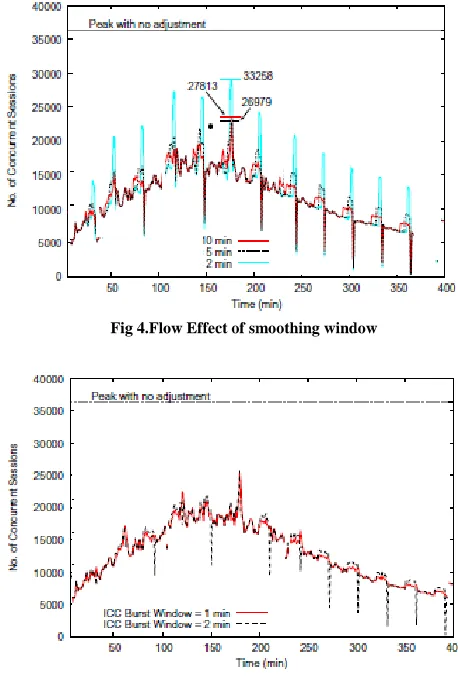
[image:5.612.322.551.334.676.2]However, there's still area for improved. We showed that the load reduction relies on the period of the adjustment (burst window), the quantity of jobs emotional and also the period over that they're averaged (the smoothing window). Our results show that a specific price for every of those parameters isn't the simplest across the board; instead the worth chosen depends on the relative load of every of the services being adjusted.fig 6 we show that rescheduling jobs to associate degree earlier point is so possible which it may result in an exceedingly significant reduction within the mixture load. we tend to assume associate degree Instant Channel Change burst window of one minute and a smoothing window of ten minutes. we tend to conjointly assume that each one the VoD jobs before the burst window are affected to the start of the smoothing window. we tend to plot the lead to Figure 6.
Fig 4.Flow Effect of smoothing window
International Journal of Emerging Technology and Advanced Engineering
Website: www.ijetae.com (ISSN 2250-2459, ISO 9001:2008 Certified Journal, Volume 5, Issue 1, January 2015)
373
Fig.6. Probability of moving jobs vs. load.The smoothing window size & Burst Window Size determines how the VoD load from the burst window and smoothing window is distributed. Fig 5 and fig 6 shows The effect of smoothing window .shows burst window it shows the reduce load of Server Fig 6 shows the Speedup of operations due to GOP Algorithm.
IV. CONCLUSION
We studied however IPTV service suppliers will leverage a virtualized cloud infrastructure and intelligent time-shifting of load to higher utilize deployed resources. Using GOP Algorithm which helps the reduces the workload as well Instant Channel Change and VoD delivery as examples. We show that we will benefit of the distinction in workloads of IPTV services to schedule them befittingly on virtualized infrastructure. We consider multiple forms for the value operate (e.g. min-max, concave and concave) and solved for the best variety of servers that are needed to support these services while not missing any deadlines. We are reducing the load of video on demand by using GOP Algorithm.
V. FUTURE SCOPE
In future we are implementing Live television compression so IPTV decreasing the load of server & user will enjoying the better experience of videos with very few delay.
REFERENCES
[1] “Optimizing Cloud Resources for Delivering IPTV Services through Virtualization”, Vaneet Aggarwal, Vijay Gopalakrishnan, Rittwik Jana, K. K. Ramakrishnan, Vinay A. Vaishampayan AT&T Labs – Research, 180 Park Ave, Florham Park, NJ, 07932
[2] D. Banodkar, K. K. Ramakrishnan, S. Kalyanaraman, A. Gerber, and O. Spatscheck, “Multicast instant channel change in IPTV system,” in Proceedings of IEEE COMSWARE, January 2008.
[3] “Microsoft tv: Iptv edition,” http:// www. microsoft. com/tv/IPTVEdition .mspx.
[4] H. A. Lagar-Cavilla, J. A. Whitney, A. Scannell, R. B. P. Patchin, S.M.Rumble, E. de Lara, M. Brudno, and M. Satyanarayanan, “SnowFlock:Virtual Machine Cloning as a First Class Cloud Primitive,” ACM Transactions on Computer Systems (TOCS), 2011. [5] V. Aggarwal, V. Gopalakrishnan, R. Jana, K. K. Ramakrishnan, and V. Vaishampayan, “Exploiting Virtualization for Delivering Cloud-based IPTV Services,” in Proc. of IEEE INFOCOM (mini-conference), Shanghai, April 2011.
[6] R. Urgaonkar, U. Kozat, K. Igarashi, and M. J. Neely, “Dynamic resource allocation and power management in virtualized data centers,” in Proceedings of IEEE IFIP NOMS, March 2010. [7] C. L.Liu and J. W. Layland, “Scheduling Algorithms for
Multiprogramming in a Hard Real Time Environment,” Journal of the ACM, vol. 20, no. 1, pp. 46–61, 1973.
[8] A. Dan, D. Sitaram, and P. Shahabuddin, “Scheduling Policies for an On-Demand Video Server with Batching,” in Proc. of ACM Multimedia, San Francisco, CA, October 1994, pp. 15–23.
[9] A. J. Stankovic, M.Spuri, K.Ramamritham, and G. Buttazzo, “Deadline Scheduling for Real-Time Systems EDF and Related Algorithms,” 1998, the Springer International Series in Engineering and Computer Science.
[10] L. I. Sennott, Stochastic Dynamic Programming and the Control of Queueing Systems. Wiley-Interscience, 1998.
![Fig 1. Live TV ICC and VoD packet buffering timeline [1]](https://thumb-us.123doks.com/thumbv2/123dok_us/8704985.880475/2.612.61.277.146.298/fig-live-tv-icc-vod-packet-buffering-timeline.webp)
![Fig 2.Cloud IPTV Architecture [5]](https://thumb-us.123doks.com/thumbv2/123dok_us/8704985.880475/4.612.341.535.576.643/fig-cloud-iptv-architecture.webp)