International Journal of Emerging Technology and Advanced Engineering
Website: www.ijetae.com (ISSN 2250-2459,ISO 9001:2008 Certified Journal, Volume 3, Issue 11, November 2013)
438
A Comparative Study of Image Fusion Technique Based on
Feature Using Transforms Function
Mr. Vipin Wani
1, Prof. Mukesh Baghe
2, Prof. Hitesh Gupta
31,2,3
PIES, Ratibad, Bhopal, India.
Abstract—Image fusion is powerful technique for quality improvement of image processing. The improvement of degraded image various methods and technique are used some method based on transform function and others are based on pixel operation. The processes of image fusion technique are changed in current decade. The current process of image fusion focus on feature based image fusion. The feature based image fusion technique imparts various methods such as wavelets transform function, neural network and meta-heuristic function. Heuristic is artificial searching technique used for optimal feature selection such as genetic algorithm, ant colony optimization and particle of swarm optimization. Here we also discuss some standard method result for image fusion. Our empirical result shows the continuous improvement is required for image fusion process.
Keywords— Image fusion techniques, transform function.
I. INTRODUCTION
The need for data fusion in current image processing systems is increasing mainly due to the increase of image acquisition techniques Current technology in imaging sensors offers a wide variety of different information that can be extracted from an observed scene. This information is jointly combined to provide an enhanced representation in many cases of experimental sciences. Any piece of information makes sense only if it conveys the actual content, clarity and quality. The term "image fusion" usually implies the integration of images acquired by multiple sensors with the intention of providing a better perspective of a scene that contains more content. For merging remotely sensed images, particularly one multispectral (MS) image and one panchromatic (PAN) image (also known as pan sharpening), fusion algorithms should aim to integrate information from images of different spectral and spatial resolution, leading to obtain a single image that includes the best features of each one. Image fusion is concerned with the integration or collection of multiple different images, derived from different sensors, into a single image which is more suitable for visual perception or computer processing tasks.
With the rapid proliferation of digital imaging and communication technologies, image quality assessment (IQA) has been becoming an important issue in numerous applications, such as image acquisition, transmission,
compression, restoration, and enhancement. The
International Journal of Emerging Technology and Advanced Engineering
Website: www.ijetae.com (ISSN 2250-2459,ISO 9001:2008 Certified Journal, Volume 3, Issue 11, November 2013)
439 A standalone executable has been developed for the targeted image fusion application using Mat lab Compiler Runtime library. Feature-level fusion is intermediate level, it is to carry out feature extraction for the original
information of the various images, and then
comprehensively analyze and process the feature information. In general, the extracted feature information should be a sufficient statistic of the pixel information, and then multi-image data will be classified, collected and integrated according to the feature information. If the data the multimedia obtained is image data, then the feature is abstractly extracted from the image pixel information, and the typical feature information has cable type, edge, texture, spectrum, similar brightness area, similar depth of field areas, etc. heuristic function is well know method for feature optimization in image processing. Various authors used genetic and neural network method for feature optimization process [8, 9].The genetic algorithm is similar to the natural evolution; it finds good chromosomes for solving problem through acting on genes in the chromosome. It need only evaluate each chromosome which the algorithm generates, and choose chromosomes based on adaptive value, and the better adaptive values of chromosomes are, the more reproduction opportunities are. The above section discuss introduction of image fusion and feature selection method. In section II we describe related work of image fusion. In section III image fusion methods. In section IV discuss some experimental result of image fusion and finally conclude in section V.
II. RELATED WORK
In this section describe some related work to image fusion based on feature selection method using wavelets transform function and heuristic function. The feature selection method for image fusion is intermediate steps along with fused process.
[1] Authors used the high frequency coefficients of transform function; the regional edge intensities of each sub-image are calculated to realize automated fusion. The low occurrence value choosing is based on boundary of images, so that the fused image can protect all useful information and appear visibly. The edge and contour of the image target region is important, in the image, different edge represent boundaries of different component of image. The proposed fusion algorithm of multi-modality image based on DWT. This method prevents the average in fused proceeding, extract abundant information, important features and boundary information from source images.
[2] Authors describe noised image fusion using Dual-tree Complex Wavelets Transform (DT-CWT). Complex wavelets transform is complex valued extension of the standard wavelets. The real 2-D dual-tree DWT of an image x is implemented using two critically sampled separable 2-D DWTs in parallel. Then for each pair of sub bands we take the sum and difference. The complex 2-D
DT-DWT also gives rise to wavelets in six distinct
directions. The complex 2-D dual-tree is implemented as four critically sampled separable 2-D DWTs operating in parallel as structure needs four trees for analysis and for synthesis.
[3] Authors used rule based technique for image fusion using Pixel level rules may reduce the contrast in some images and does not always succeed in effectively removing ringing and noise in source images. The inadequacies of these types of fusion rules point to the importance of developing a Hybrid algorithm to improve the visual quality by combining the advantages of four pixel based methods. The proposed Hybrid Image Fusion method is based on Pixel level image Fusion methods. These methods are basically based on various standards Pixel level fusion rules. Combination of various fusion rules is done to get better quality final fused image. Here the image fusion techniques used are based on wavelets transformation. First level and second level decomposition of original image is based on Discrete Wavelets Transformation
International Journal of Emerging Technology and Advanced Engineering
Website: www.ijetae.com (ISSN 2250-2459,ISO 9001:2008 Certified Journal, Volume 3, Issue 11, November 2013)
440 For the purpose of assigning the fusion weights of multi-feature similarity scores reasonably, the genetic algorithm is applied. They are image retrieval based on color feature, texture feature and fusion of color-texture feature similarity score with equal weights.
III. FEATURE EXTRACTION METHOD
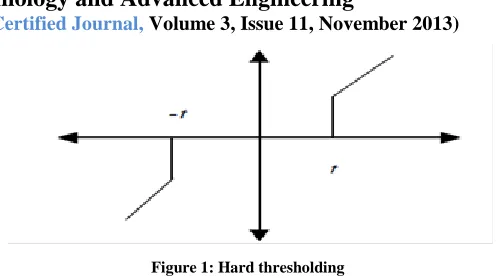
[image:3.612.320.568.113.252.2]Wavelets play a major role in image compression and image fusion. Wavelets coefficients calculated by a wavelets transform represent change in the time series at a particular resolution. By considering the time series at various resolutions, it is then possible to filter out feature and process actual feature of image. The term wavelets thresholding is explained as decomposition of the data or the image into wavelets coefficients, comparing the detail coefficients with a given threshold value, and shrinking these coefficients close to zero to take away the effect of feature in the data. The image is reconstructed from the modified coefficients [7]. This process is also known as the inverse discrete wavelets transform. During thresholding, a wavelets coefficient is compared with a given threshold and is set to zero if its magnitude is less than the threshold; otherwise, it is retained or modified depending on the threshold rule. Thresholding distinguishes between the coefficients due to feature and the ones consisting of important signal information. The choice of a threshold is an important point of interest. It plays a major role in the removal of feature in images because fusion most frequently produces smoothed images, reducing the sharpness of the image. Care should be taken so as to preserve the edges of the featured image. There exist various methods for wavelets thresholding, which rely on the choice of a threshold value. Some typically used methods for image feature removal include. Prior to the discussion of these methods, it is necessary to know about the two general categories of thresholding. They are hard- thresholding and soft-thresholding types. The hard-thresholding TH can be defined as [8]
Figure 1: Hard thresholding
Here tis the threshold value. A plot of TH is shown in Figure 1.
[image:3.612.337.579.389.578.2]Thus, all coefficients whose magnitude is greater than the selected threshold value t remain as they are and the others with magnitudes smaller than t are set to zero. It creates a region around zero where the coefficients are considered negligible. Soft thresholding is where the coefficients with greater than the threshold are shrunk towards zero after comparing them to a threshold value. It is defined as follows.
Figure 2: Soft thresholding
International Journal of Emerging Technology and Advanced Engineering
Website: www.ijetae.com (ISSN 2250-2459,ISO 9001:2008 Certified Journal, Volume 3, Issue 11, November 2013)
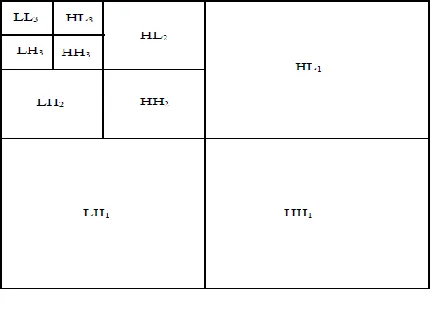
[image:4.612.64.282.137.293.2]441 Figure 3: DWT on 2-dimensional data
The sub-bands HHk, HLk, LHk, k = 1, 2…... j are called the details, where k is the scale and j denotes the largest or coarsest scale in decomposition. Note, LLkis the low-resolution component. Thresholding is now applied to the detail components of these sub bands to remove the unwanted coefficients, which contribute to feature. And as a final step in the fusion algorithm, the inverse discrete wavelets transform is applied to build back the modified image from its coefficients. Artificial neural networks (ANNs) proved to be capable of finding internal representations of interdependencies within raw data not explicitly given or even known by human system. Its special characteristic together with the simplicity of building and training ANNs and their very short response time encouraged their application to the task of image fusion. Because of their inherent nonlinearity, ANNs are able to deal with the complex interactions between variables that affect image pixels [1]. There is no need for complex functional models to describe the relationships between the input variables and the input image. Recently the ANNs technology has been proposed as a substitute for statistical approaches for classification and image fused method problems. The advantages of ANNs over statistical methods include robustness to probability distribution assumptions, the ability to classify in the presence of nonlinear relationships, and the ability to perform reasonably well using incomplete data bases [5]. Comparison results between ANNs and statistical techniques indicated that neural nets offer an accurate alternative to other classical methods such as histogram equalization or auto regressive models in thisdissertation cascaded ANNs are used for image fusion and bright contrast preserving.
The ANNs are trained with the back-propagation algorithm, which is a gradient-decent technique that is easily applied to networks whose neurons have smooth, monotonic differentiable transfer functions such as sigmoid and hyperbolic tangent.
IV. EXPERIMENTAL RESULT ANALYSIS
In this section some of experimental results of our work on wavelets based Image Fusion are discussed. Input image database is taken in different environment through a digital camera; the multi focused environment is generated using different light effects. In the proposed hybrid method, first wavelets decomposition of the input source images is performed up to level second level using discrete wavelets transform.
A.Evaluation criteria for image fusion
Objective image quality measures play an important role in various image processing applications. There are different types of object quality or distortion assessment approaches. The fused images are evaluated, taking the following parameters into consideration.
B.Root Mean Square error (RMSE)
The root mean square error (RMSE) between each unsharpened MS band and corresponding sharpened band can also be computed as a measure of spectral fidelity. It measures the amount of change per pixel due to the processing.
The RMSE between a reference image R and the fused image F is given by
International Journal of Emerging Technology and Advanced Engineering
Website: www.ijetae.com (ISSN 2250-2459,ISO 9001:2008 Certified Journal, Volume 3, Issue 11, November 2013)
442 Similarly E2 is computed as RMSE between source image B and fused image F.
Then the overall RMSE value is obtained by taking the average of E1 and E2.
Smaller RMSE value indicates good fusion quality. Peak Signal to Noise Ratio PSNR can be calculated by using the formula
Where MSE is the mean square error and L is the number of gray levels in the image.
Image Quality Index IQI measures the similarity between two images (I1 & I2) and its value ranges from -1 to 1. IQI is equal to 1 if both images are identical. IQI measure is given by
Where x and y denote the mean values of images I1 and I2, and denotes the variance of I1, I2 and covariance of I1 and I2.
Mutual Information Mutual Information (MI) measures the degree of dependence of two images. Its value is zero when I1 and I2 are independent of each other. MI between two source images I1 and I2 and fused image F is given by
[image:5.612.322.582.111.490.2]and PA(a) ,PB(b) and PF(f) are histograms of images A, B and F,PFA(f,a) and PFB(f,b) are the joint histograms of F and A, and F and B respectively. Higher MI value indicates good fusion results.
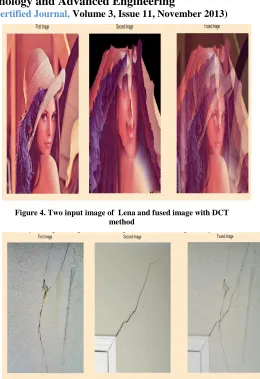
Figure 4. Two input image of Lena and fused image with DCT method
Figure 5. Two input image wall cracks and fused image with Wavelets transform method
C.Performance table
Table I
Comparative result analyses of transform function.
METHOD IQI MI RMSE PSNR
DCT
0.9851 1.1293 12.3288 26.3124WT
0.9468 1.0042 20.6849 21.8177International Journal of Emerging Technology and Advanced Engineering
Website: www.ijetae.com (ISSN 2250-2459,ISO 9001:2008 Certified Journal, Volume 3, Issue 11, November 2013)
443 V. CONCLUSION AND FUTURE WORK
There are various method of fusing images. We have compared the regular image fusion techniques with the integer wavelets transform based techniques. It can be seen from the above table and the image results that the IWT based techniques are having better results when compared with the conventional techniques. Two IWT based image fusion algorithms are introduced and their objective and subjective comparison with other classical techniques is carried out. It is concluded from experimental results that IWT based image fusion schemes perform better than existing schemes.
REFERENCES
[1] Ling Tao, Zhi-Yu Qian ―An Improved Medical Image Fusion Algorithm Based on Wavelets Transform‖ 978-1-4244-9953-3/11 2011 IEEE.
[2] Rajeswara Mahidar P, N.V.G.Prasad, V.L.N sastry ―A Novel Noisy Image Fusion Technique Using Dual-Tree Complex Wavelets Transform‖ Vol. 3 No. 6 June IJEST 2011.
[3] Paresh Rawat, Sapna Gangrade, ―Implementation of Hybrid Image Fusion Technique Using Wavelets Based Fusion Rules‖ IJCTEE 2011.
[4] Liang Hong Kun Yang Xianchun Pan ―Multispectral and panchromatic image fusion Based On Genetic Algorithm and Data Assimilation‖ 978-1-4577-0969-2/11/2011 IEEE.
[5] De-gan Zhang, Chao Li, Dong Wang, Xiao-li Zhang ―A New Method of Image Data Fusion Based on FNN‖ 978-1-4244-5961-2/10/ 2010 IEEE.
[6] Mianshu Chen, Ping Fu, Yuan Sun, Hui Zhang‖ Image Retrieval Based on Multi-Feature Similarity Score Fusion Using Genetic Algorithm‖ 978-1-4244-5586-7/10/ 2010 IEEE.
[7] Chaunté W. Lacewell, Mohamed Gebril, Ruben Buaba, and Abdollah Homaifar ―Optimization of Image Fusion Using Genetic Algorithms and Discrete Wavelets Transform‖ 978-1-4244-6578-1/10/ 2010 IEEE.
[8] Shivsubramani Krishnamoorthy, K P Soman ―Implementation and Comparative Study of Image Fusion Algorithms‖ Volume 9– No.2, November 2010 IJCA.
[9] Special Issue on Recent Advances in System Applications and Methods of Data Management 2010 ACADEMY PUBLISHER. [10] Dr. V. T. Ingole, Prof. C. N. Deshmukh, Mrs. Anjali Joshi, Mr.
Deepak Shete‖ Medical Image Registration Using Genetic Algorithm‖ 978-0-7695-3884-6/09 2009 IEEE.
[11] Aqeel Mumtaz, Abdul Majid, Adeel Mumtaz ‖ Genetic Algorithms and its Application to Image Fusion‖ 978-1-4244-2211-1/08/2008 IEEE.
[12] Zhang Yong, Tan Xiaobin, Xi Hongsheng‖ A Novel Approach to Network Security Situation Awareness Based on Multiperspective Analysis‖ 0-7695-3072-9/07 2007 IEEE.
[13] LU Xiaoqi, ZHANG Baohua, GU Yong‖ Medical Image Fusion Algorithm Based on clustering neural network‖ 1-4244-1120-3/07/2007 IEEE.
[14] M. Antonini, M. Barlaud, P. Mathieu, and I. Daubechies, Image coding using wavelets transform, IEEE Trans. Image Processing, vol. 1, pp.205-220, 1992.
[15] P.L. Dragotti, G. Poggi, and A.R.P. Ragozini, Compression of multispectral images by three-dimensional SPIHT algorithm, IEEE Trans. on Geoscience and remote sensing, vol. 38, No. 1, Jan 2000. [16] Image compression using Fast Fourier Transform by Parminder
Kaur, Thapar Institute of Engineering and Technology, Patiala. [17] J. M. Shapiro, Embedded image coding using zerotrees of wavelets
coef_cients, IEEE Trans. Signal Processing, vol. 41, pp.3445-3462, Dec. 1993.
[18] J. Chen, M. Yang, Y. Zhang, and X. Shi, Ecg compression by optimized quantization of wavelets coefficients, ICIC 2006, LNCIS, vol. 345, Springer-Verlag Berlin Heidelberg, 2006, p. 809814. [19] D. Karaboga, An idea based on honey bee swarm for numerical
optimization, Tech. Report TR06, Erciyes University, Engineering Faculty, Computer Engineering Department, 2005.
[20] D. Karaboga and B. Akay, A survey: Algorithms simulating bee swarm intelligence, Artificial Intelligence Review 31 2009, no. 1, 68–55.
[21] A modified artificial bee colony (abc) algorithm for constrained optimization problems, Applied Soft Computing (In Press). [22] Z. Ye and Ye Y. Mohamadian, H., Digital image wavelets