IJPSR (2017), Vol. 8, Issue 5 (Research Article)
Received on 20 October, 2016; received in revised form, 06 February, 2017; accepted, 20 April, 2016; published 01 May, 2017 A NOVEL STABILITY INDICATING RP-HPLC METHOD DEVELOPMENT AND VALIDATION FOR THE DETERMINATION OF TENOFOVIR DISOPROXIL FUMARATE AND EMTRICITABINE IN BULK AND PHARMACEUTICAL FORMULATIONS
B. Venkateswara Rao *, S. Vidyadhara, B. Nagaraju and SK Jhonbi
Department of Pharmaceutical Analysis, Chebrolu Hanumaiah Institute of Pharmaceutical Sciences, Chandramoulipuram, Chowdavaram, Guntur, Andhra Pradesh, India.
ABSTRACT: The prime aim and object of present investigation is to develop and validate a novel, precise, accurate, specific, rapid and economic stability- indicating isocratic reverse phase liquid chromatography method for the quantitative simultaneous estimation of Tenofovir disoproxil fumarate and Emtricitabine in bulk and marketed formulations. Estimation of drugs in this combination was achieved with a C18 column Agilent TC-C18 (2) column. 5m, 4.6250 mmkept at ambient temperature, using mobile phase of composition Methanol and phosphate buffer (30:70 v/v, pH 4).The flow rate was 1.0 ml/min and the effluents were monitored at 261 nm, using variable wavelength UV detector. The retention time of Tenofovir disoproxil fumarate and Emtricitabine were 2.81min and 4.72min respectively. Validation of the method was done according to the ICH guidelines for different analytical parameters. The method was found to be linear over a range of 40-80g/ml for Tenofovir disoproxil fumarate and Emtricitabine. The established method proved as reproducible one with a %RSD value of less than 2 and having the robustness and accuracy within the specified limits. Assay of marketed formulation was determined and find with 97.58% and 97.88% for Tenofovir disoproxil fumarate and Emtricitabine respectively. The stressed samples were analyzed and this proposed method was found to be specific and stability indicating as no interfering peaks of degradation compounds and excipients were noticed. Successfully employed in the estimation of commercial formulations. This liquid chromatographic method can be applied for the qualitative and quantitative determination of selected drugs by the modern chemist.
INTRODUCTION: Tenofovir disoproxil fumarate
is chemically designated as (9-[(R)-2-[[bis[[(iso propoxy carbonyl)oxy] methoxy] phosphinyl] methoxy] propyl] adenine fumarate 1:1 Tenofovir disoproxil fumarate) is an orally bioavailable ester prodrug of Tenofovir (also known as PMPA), an
acyclic nucleotide analog with activity in vitro
against retroviruses, including HIV-1, HIV-2, and hepatitis B virus (HBV).
QUICK RESPONSE CODE
DOI:
10.13040/IJPSR.0975-8232.8(5).2168-76
Article can be accessed online on:
www.ijpsr.com
DOI link: http://dx.doi.org/10.13040/IJPSR.0975-8232.8 (5).2168-76
Due to the presence of a phosphonate group, tenofovir is negatively charged at neutral pH, which limits its oral bioavailability.
It is official drug in Indian Pharmacopoeia 2007 and 2014. Emtricitabine is chemically designated as 5fluoro – 1 [(2R,5S) 2 (hydroxymethyl) -1,3-oxathiolan-5-yl] cytosine.
Emtricitabine is a nucleoside analogue and reverse transcriptase inhibitor used in combination with other agents for treatment and prevention of human immunodeficiency virus (HIV) infection and the acquired immunodeficiency syndrome (AIDS). It is official drug in Indian Pharmacopoeia 2007 and
2014 1-3.
Keywords:
Tenofovir disoproxil fumarate, Emtricitabine, RP-HPLC, Method
validation and Stability
Correspondence to Author: B. Venkateswara Rao
Associate Professor
Chebrolu Hanumaiah Institute of Pharmaceutical Sciences,
Chowdavaram, Chandramoulipuram, Guntur, Andhra Pradesh, India.
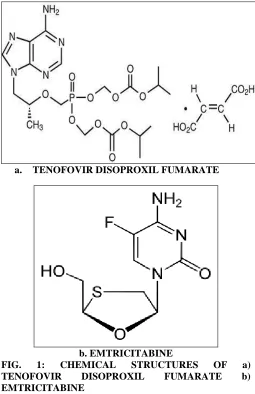
a. TENOFOVIR DISOPROXIL FUMARATE
b. EMTRICITABINE
FIG. 1: CHEMICAL STRUCTURES OF a)
TENOFOVIR DISOPROXIL FUMARATE b)
EMTRICITABINE
Extreme literature survey proved that very few methods were reported for the determination of Tenofovir disoproxil fumarate and Emtricitabine by
RP-HPLC 4-24. So in the present research we aimed
to develop a novel, precise, accurate, sensitive,
stable and economically viable liquid
chromatographic method for the simultaneous determination of selected drugs.
MATERIALS AND METHODS:
Equipment used: The chromatographic separation was performed on Agilent 1120 compact isocratic liquid chromatographic system integrated with a variable wavelength programmable UV detector
and a Rheodyne injector equipped with 20 l fixed
loop. A reverse phase C18Agilent ODS UG 5
column, 250 mm × 4.5 mmwas used. Elico SL-218
double beam UV visible spectrophotometer was used for wavelength detection Axis AGN204-PO electronic balances were used for weighing purpose.
Reagents and chemicals: HPLC grade Methanol and Water were procured from Merck specialties private limited, Mumbai. Pharmaceutical grade
pure Tenofovir disoproxil fumarate and
Emtricitabine gift samples were procured from
Mylan Laboratories, Hyderabad. Marketed
formulation Tablets with dose of 300 mg of Tenofovir disoproxil fumarate and 200 mg of Emtricitabine were procured from local market. (Mfd. by Emcure Pharmaceuticals Ltd).
Chromatographic conditions: Agilent ODS-C18
column 5m [250 mm x 4.6 mm] was used for the
chromatographic separation at a detection wave length of 261 nm, under ambient temperature. Mobile phase of composition Methanol and Phosphate buffer pH-4 in a ratio of 30:70 v/v which was degassed under ultra-sonication was selected for elution and same mixture was used in the preparation of standard and sample solutions. Flow rate was optimized to 1.0 ml/min and the injection
volume was 20 l.
Preparation of Mobile phase: Phosphate buffer pH 4 was prepared by dissolve 0.504 gm of disodium hydrogen phosphate and 0.301 gm of Potassium dihydrogen phosphate of HPLC grade water and adjusts the pH to 4.0 with glacial acetic acid and sufficient water was added to produce100
ml filtered through 0.45 membrane filter and
sonicated for 10 minutes.
Preparation of Standard solutions: 25 mg each of Tenofovir disoproxil fumarate and Emtricitabine were accurately weighed and transferred into two 25 ml volumetric flasks, dissolved using mobile phase and the volume was made up with the same solvent to obtain primary stock solutions A
(Tenofovir disoproxil fumarate) and B
(Emtricitabine) of concentration 1000g/ml of each
drug. From the primary stock solutions,0.8 ml of each was pipette out from A and B respectively, transferred to a 10 ml volumetric flask and the volume was made up with the mobile phase to obtain final concentrations of 80 µg/ml of each was Tenofovir disoproxil fumarate and Emtricitabine respectively and this solution is (working stock solution A).
[image:2.612.47.302.53.447.2]were weighed and crushed. Tablet powder equivalent to 300 mg of Tenofovir disoproxil fumarate and 200 mg of Emtricitabine was weighed accurately and transferred to a 25 ml volumetric flask. The content was dissolved with 10 ml of mobile phase and then sonicated for 15 min. The volume was made up with the mobile phase and
filtered with 0.45 membrane filter and sonicated
for 20 min. 0.1 ml of this solution was pipette out and transferred to a 10mlvolumetric flask and the volume was made up with the mobile phase to obtain a concentration of 150 µg/ml of Tenofovir disoproxil fumarate and 100 µg/ml of Emtricitabine (working stock solution B).
Optimization of RP-HPLC method: The HPLC method was optimized with an aim to develop a simultaneous estimation procedure for the assay of Tenofovir disoproxil fumarate and Emtricitabine. For the method optimization, different mobile phases were tried, but acceptable retention times, theoretical plates and good resolution were observed with Methanol, Phosphate buffer pH 4
(30:70 v/v) using Agilent TC-C18 (2) column 5m
[250mm x 4.6mm].
Validation of the RP-HPLC method: Validation of the optimized method was performed according to the ICH Q2 (B) guidelines.
System suitability: System suitability was carried out with five injections of solution of 100% concentration having 80 µg/ml of Tenofovir disoproxil fumarate and 80 µg/ml of Emtricitabine in to the chromatographic system. Number of theoretical plates (N) obtained and calculated
tailing factors (T) were reported in Table 1.
Linearity: For the determination of linearity, appropriate aliquots were pipette out from working stock solution A to a series of 10 ml volumetric flasks and volume was made up with the solvent to
obtain concentration ranging from 40-80 g/ml of
Tenofovir disoproxil fumarate and 40-80 g/ml of
Emtricitabine. Each solution was injected in triplicate. Calibration curves were plotted with observed peak areas against concentration followed by the determination of regression equations and calculation of the correlation coefficients. The
calibration curves for Tenofovir disoproxil
fumarate and Emtricitabine were shown in Fig. 3
and Fig. 4 their corresponding linearity parameters
were given in Table 2.
Limit of Detection (LOD) and Limit of Quantitation (LOQ): The LOD and LOQ were calculated from the slope(s) of the calibration plot and the standard deviation (SD) of the peak areas using the formulae LOD = 3.3 σ/s and LOQ = 10
σ/s. The results were given in Table 2.
Precision: The repeatability of the method was verified by calculating the %RSD of six replicate
injections of 100% concentration (80 g/ml of
Tenofovir disoproxil fumarate and 80 g/ml of
Emtricitabine) on the same day and for intermediate precision % RSD was calculated from repeated studies on different days. The results were
given in Table 3.
Accuracy: To ensure the reliability and accuracy of the method recovery studies were carried out by standard addition method. A known quantity of pure drug was added to pre-analyzed sample and contents were reanalyzed by the proposed method and the percent recovery was reported. The results
were given in Table 4.
Specificity: Specificity of a method was determined by testing standard substances against potential interferences. The method was found to be specific when the test solution was injected and no interferences were found because of the
presence of excipients. The optimized
chromatogram of Tenofovir disoproxil fumarate and Emtricitabine without any interference was
shown in Fig. 2.
Robustness: Robustness of the method was verified by altering the chromatographic conditions like mobile phase composition, wavelength detection, flow rate, etc. and the % RSD should be reported. Small changes in the operational conditions were allowed and the extent to which the method was robust was determined. A deviation of ±2 nm in the detection wave length and ±0.2ml/min in the flow rate, were tried individually. A solution of 100 % test concentration with the specified changes in the operational conditions was injected to the instrument in
Assay of Marketed Formulations: 20 l of
sample solution of concentration 150 g/ml of
Tenofovir disoproxil fumarate and 100 g/ml of
Emtricitabine was injected into chromatographic system and the peak responses were measured. The solution was injected three times in to the column.
The amount of drug present and percentage purity was calculated by comparing the peak areas of the standards with that of test samples. A typical chromatogram for assay of marketed formulation
was shown in Fig. 5 and the obtained values were
reported in the Table 6.
Stability Studies:
Acid degradation studies: Prepared each 1mg/ml stock solution of Tenofovir disoproxil fumarate and Emtricitabine by using mobile phase as solvent, and then filtered through 0.45 μm membrane filter paper. Stock solutions of 0.8 ml and 0.8 ml of Tenofovir disoproxil fumarate and Emtricitabine were transferred into 10 ml volumetric flask and added 1 ml of 0.1N HCL and diluted to volume with mobile phase. The resultant solution was injected into the system; there was no acid degradation products were found and the obtained
[image:4.612.111.505.241.415.2]chromatogram was shown in Fig. 6.
FIG. 6: CHROMATOGRAM OF ACID DEGRADATION
Alkaline degradation studies: 20 l of Tenofovir disoproxil fumarate and Emtricitabine was injected
having concentrations of 80 g/ml Premixed with
1ml of 0.1N NaOH solution then filtered through 0.45 mm membrane filter paper. The obtained non
interfered chromatogram was represented in Fig. 7.
FIG. 7: CHROMATOGRAM OF ALKALINE DEGRADATION
Oxide degradation studies: Tenofovir disoproxil fumarate and Emtricitabine were prepared by dissolving 25 mg/25 ml of mobile phase in two different 25 ml volumetric flask then filtered through 0.45 µm membrane filter paper. Stock solutions of 0.8 ml and 0.8 ml of Tenofovir
disoproxil fumarate and Emtricitabine was
transferred into 10 ml volumetric flask and added 1
ml of H2O2 and diluted to volume with mobile
phase. In this investigation no identifiable oxidative degradants were found and the chromatogram was
[image:4.612.115.503.485.655.2]FIG. 8: CHROMATOGRAM OF HYDROGEN PEROXIDE DEGRADATION
Thermal degradation studies: From the primary
stock solutions of 1mg/ml 80 g/ml Tenofovir
disoproxil fumarate and Emtricitabine was
prepared in 10ml volumetric flask and diluted to volume with mobile phase and kept for 60 min at
60 0C in hot air oven. 20 l of above solution was
injected in to system and from the obtained chromatogram it was proved that the selected samples were stable against thermal degradation.
[image:5.612.123.494.313.470.2]The obtained chromatogram was shown in Fig. 9.
FIG. 9: CHROMATOGRAM OF THERMAL DEGRADATION
RESULTS AND DISCUSSION: After a number
of trials with mobile phases of different composition, Methanol, Phosphate buffer pH 4.0 in the ratio 30:70 v/v was selected as mobile phase because of better resolution more no. of Theoretical plates and symmetric peaks. Tenofovir disoproxil fumarate and Emtricitabine were found to show
appreciable absorbance at 261 nm when determined spectrophotometrically and hence it was selected as
the detection wavelength. An optimized
chromatogram showing the separation of Tenofovir disoproxil fumarate and Emtricitabine at different
RTs was shown in Fig. 2.
System suitability was carried out by injecting 5 replicate injections of 100 % test concentration, number of theoretical plates, HETP and resolution were satisfactory. The chromatograms confirm the presence of Tenofovir disoproxil fumarate and Emtricitabine at 2.8 min and 4.7 min respectively without any interference. The parameters were
given in Table 1.
TABLE 1: SYSTEM SUITABILITY PARAMETERS (n=5)
Parameters Tenofovir
disoproxil fumarate
Emtricitabine
Retention time (min) Theoretical plates (N) Tailing factor (T)
2.8 8012
1.71
4.7 7854
1.63 Resolution (Rs) 2.1
Concentration range of 40-80 µg/ml for Tenofovir
disoproxil fumarate and 40-80 µg/ml of
Emtricitabine were found to be linear with correlation coefficients 0.999 and 0.999 for Tenofovir disoproxil fumarate and Emtricitabine
respectively. The results were given in Table 2.
FIG. 3: CALIBRATION PLOT OF TENOFOVIR DISOPROXIL FUMARATE
FIG. 4: CALIBRATION PLOT OF EMTRICITABINE
The limits of detection for Tenofovir disoproxil fumarate and Emtricitabine were found to be 1.9µg/ml and 3.5 µg/ml respectively and the limit of Quantitation were 6.2 µg/ml and 11.5 µg/ml
respectively. Values were represented in Table 2.
TABLE 2: RESULTS FOR LINEARITY (n=3)
Parameters Tenofovir
disoproxil fumarate
Emtricitabine
Slope 28995 45641
y intercept 13581 15870 Correlation coefficient r2 0.999 0.999
Regression Equation y = 28995x + 13581
y = 45641x + 15870 Linearity range 40-80g/ml 40-80g/ml
LOD 1.9g/ml 3.5g/ml LOQ 6.2g/ml 11.5g/ml
n= No. of determinants
The proposed method was found to be precise and reproducible with % RSD of 0.7 and 0.5 for Tenofovir disoproxil fumarate and Emtricitabine
respectively. % RSD was reported in Table 3.
TABLE 3: RESULTS OF PRECISION (n=6)
Drug Intraday
Precision (%RSD)
Interday Precision (%RSD)
Tenofovir disoproxil fumarate
Emtricitabine
0.7 0.5
0.8 0.7
n= No. of determinants
Accuracy of the method was verified by performing recovery studies by standard addition method. The percent recovery of the standard added to the pre-analysed sample was calculated and it was found to be 97.05 % to 98.5 % for Tenofovir disoproxil fumarate and 96.9 to 98.4 % for Emtricitabine. This indicates that the method
was accurate. Values obtained were given in Table
4.
The method was found to be robust after changing the conditions like detection wavelength (± 2nm) and flow rate (± 0.2 ml). % RSD was calculated for each variation and reported. Values obtained were
TABLE 4: RESULTS FOR ACCURACY (n=3)
n= No. of determinant
TABLE 5: RESULTS FOR ROBUSTNESS (n=3)
The method was found to be specific for the combination of interest after verifying the chromatograms showing no interference of the excipients present. Hence, the method was well suitable for the estimation of the commercial formulations of the selected combination with a
percentage purity of 97.58 % for Tenofovir disoproxil fumarate and 97.88 % for Emtricitabine. The typical chromatogram for assay of marketed
formulations was shown in Fig. 5 and Values
[image:7.612.128.492.396.539.2]obtained were given in Table 6.
FIG. 5: A TYPICAL CHROMATOGRAM FOR ASSAY OF MARKETED FORMULATION CONTAINING 150 g/ml OF TENOFOVIR DISOPROXIL FUMARATE AND 100 g/ml OF EMTRICITABINE
TABLE 6: RESULTS FOR ASSAY (n=3) OF MARKETED FORMULATION
n= No. of determinants
Forced Degradation Study: Degradation studies indicated the specificity of developed method in presence of degradation products. Degradation was carried out in combination of two drugs and purity of drug peaks was confirmed by purity angles. Their combination drug products were exposed to acid, alkali, oxidative and thermal stress conditions.
Then found to be no degradable substances presence and proved that the proposed method was stable towards acid, alkali, peroxide and thermal conditions. The obtained values were reported in
Table 7.
Recovery level
Tenofovir disoproxil fumarate Emtricitabine
Amount Added (µg/ml)
Amount Found (µg/ml)
% Recovery Amount
Added (µg/ml)
Amount Found (µg/ml)
% Recovery
std test Std Test
50% 100% 150%
10 40 70
20 20 20
29.31 58.23 88.69
97.7 97.05
98.5
10 40 70
20 20 20
29.52 58.15 88.15
98.4 96.9 97.9
Mean recovery 97.75% 97.7%
Parameters (n=3) %RSD
Tenofovir disoproxil fumarate Emtricitabine
Detection wavelength at 263nm Detection wavelength at 259nm
Flow rate 0.8ml/min Flow rate 1.2ml/min
0.29 0.69 0.52 0.82
0.53 0.59 0.93 0.72
Drug Label claim (mg/tab) Amount recovered % Amount found in drug
Tenofovir disoproxil fumarate Emtricitabine
300 200
292.76 195.77
97.58% 97.88%
TABLE 7: RESULTS FOR STABILITY STUDIES OF TENOFOVIR DISOPROXIL FUMARATE AND EMTRICITABINE COMBINED FORM (n=3)
Parameters Peak area % of degradation
Tenofovir disoproxil fumarate
Emtricitabine Tenofovir disoproxil fumarate Emtricitabine Acid degradation Alkali degradation Peroxide degradation Thermal degradation 22374140 21607157 20469720 21006831 36140977 35843472 34309910 34691847 0.125 0.112 0.268 0.262 0.196 0.156 0.341 0.192 *n= No. of determinants
CONCLUSION: The RP-HPLC method
developed and validated allows a simple and rapid quantitative determination of Tenofovir disoproxil
fumarate and Emtricitabine from their
formulations. All the validation parameters were found to be within the limits according to ICH guidelines. The proposed method was found to be specific for the drugs of interest irrespective of the excipients present and the short retention times allows the analyst to analyze large no. of samples in short period and method was found to be simple, accurate, precise, rugged, robust and stable under forced degradation stress conditions. So the established method can be successfully applied for the routine analysis of the marketed formulations. Hence the proposed method is a productive one.
ACKNOWLEDGMENTS: The authors are
thankful to the Mylan laboratories, Hyderabad. For providing the gift samples of Tenofovir disoproxil fumarate and Emtricitabine, and also to the management of Chebrolu Hanumaiah Institute of Pharmaceutical Sciences, Chowdavaram, Guntur for providing facilities and great support to carry out the research work.
REFERENCES:
1. Martindale (The complete drug reference) (2005) 34th
edition: 632 &655.
2. Merck Index (2006)14th edition: 9151 & 3568.
3. Indian Pharmacopeia (2014) 7th edition, Vol – 2 & 3: 1652
& 2834.
4. Sayyed Z M, Sheikh A, Shaikh Z A, Shinde S A, Chaware
V J and Biyani K R. Development and Validation of Analytical Method for Simultaneous Estimation of Tenofovir and Emtricitabine in Pharmaceutical Dosage Forms by HPLC, International Journal of Pharmaceutics &
Drug Analysis, 2016; 4: 24 –29.
5. Naresh C J, Pradeep Kumar and Rakesh Kumar.
Development and validation of RP-HPLC method for the estimation of antiretroviral drugs and their Pharmaceutical
Formulations, An International Research Journal, 2016; 7:
152-165.
6. Ajay D M and Uttam B. RP-HPLC Method for
Simultaneous estimation of Impurities from Emtricitabine and Tenofovir disoproxil fumarate Tablet, International
Journal of Pharmaceutical Sciences and Research, 2016; 7: 1662-1669.
7. Manasi A, Rohit Ch and Vaishali S. A Rapid Stability
Indicating RP-HPLC Method and the Degradation Kinetics Data for the Simultaneous Estimation of Tenofovir disoproxil fumarate and Emtricitabine, International Journal of Pharmacy and Pharmaceutical Research, 2015; 3: 145-159.
8. Abdelhay MH, Gazy AA, Shaalan RA, and Ashour HK.
Selective RP-HPLC DAD Method for Determination of Tenofovir fumarate and Emtricitabine in Bulk Powder and in Tablets, Acta Chromatographica, 2015; 27: 41–54.
9. Akbar B, Sireesha D, Anil D, Rajini T, Akifulhaque M,
Harshini S and Vasudha B. Method development and validation for simultaneous estimation of Tenofovir disoproxil fumarate and Emtricitabine in pharmaceutical dosage form by RP-HPLC method, International Journal of Innovative Pharmaceutical Sciences and Research, 2015; 3: 1537-1545.
10. Bala R R, Mutta Reddy Y S and Bala Sekhara R Ch.
Simultaneous Estimation of Emtricitabine and Tenofovir disoproxil fumarate in tablet dosage form by Reverse
Phase High-performance Liquid Chromatography,
Chromatographic Science, 2015; 1: 1-6.
11. Sujatha K, Sheela Rani T, AnandBabu K, Kavitha K and
Chitra K. RP-HPLC Method Development and Validation of Emtricitabine Synthetic Mixture, World Journal of Pharmaceutical Research, 2014; 3: 499-505.
12. Srinivasan R, Lurdhu Mary K, Lakshmana G Rajesh K D
and Rajini B. Method Development and Validation of Tenofovir disoproxil fumarate and Emtricitabine in combined tablet dosage form by UV-Spectrophotometry and RP-HPLC, International Journal of Pharmacy and Analytical Research, 2014; 3: 414-421.
13. Vanitha C, PradeepKumar P, Rajanisekhar V, Swarnalatha
G and Sekar V. Simultaneous Estimation of Emtricitabine and Tenofovir disoproxil fumarate in a tablet dosage form
by RP-HPLC Method, International Journal of
Pharmaceutical Development & Technology, 2014; 4: 279-283.
14. Venkatesh, Sumanth A L M N and Venkateswa Rao P.
Analytical Method development and validation of simultaneous estimation of Tenofovir and Emtricitabine in bulk and Pharmaceutical dosage forms By Using RP-HPLC, Asian Journal of Pharmaceutical Analysis and Medicinal Chemistry, 2013; 1: 60-69.
15. Sreenivasa Rao B, Nagaraju, Siva and Kiran BV.
Development, Validation and Stress Degradation Studies of Emtricitabine and Tenofovir disoproxil fumarate by High Performance Liquid Chromatography, Asian Journal of Research in Chemistry, 2013; 6: 936.
16. Viswanath V, Shanmuga Sundaram P and Ravichandiran.
[image:8.612.53.572.67.163.2]Combined tablet dosage form, International Journal of Pharm Tech Research, 2013; 5: 1186-1195.
17. Deepthin K, Nagarjuna Reddy G and Dhanalakshmi K.
Method Development and Validation for Simultaneous Estimation of Emtricitabine and Tenofovir disoproxil fumarate in Pure and Tablet Dosage Form by using
RP-HPLC, International Journal of Pharma Research &
Review, 2013; 2: 1-11.
18. Rui Tan, Bo Yan, Jingchuan Shang, Junqing Yang,
Wenxiang Huang, Xiaoni Zhong, Ailong Huang and Mingfeng Wang. New Solid Phase Extraction Reversed
Phase High Performance Liquid Chromatography
Ultraviolet (RP-HPLC-UV) Method for Simultaneous Determination of Tenofovir and Emtricitabine in Chinese
population, African Journal of Pharmacy and
Pharmacology, 2012; 6: 1890-1900.
19. Narendra D, Satyanarayana T and Ganga Rao B. HPLC
Method Development and Validation for Simultaneous Estimation of Tenofovir and Emtricitabine in Combined Pharmaceutical Dosage Form, International Journal of Research in Pharmaceutical and Biomedical Sciences, 2012; 3: 361-367.
20. Lavanya B, Hari prasad P, Allumellu Venkata Praveen A,
Prasanna Lakshmi D and Rami reddy M. Simultaneous
estimation of Emtricitabine and Tenofovir disoproxil
fumarate by HPLC Method, Der Pharmacia letter,2012; 4:
1855-1862.
21. Syam Sundar B and Subhashini E. RP – HPLC Method
Development and Validation for the Analysis of Tenofovir in Pharmaceutical Dosage Forms, Journal of Atoms and
Molecules,2011; 1: 32-40.
22. Prathiban C, Bhagavan Raju M and Sudhakar M.A Simple
RP-HPLC Method for Simultaneous Estimation of Tenofovir disoproxil fumarate and Emtricitabine in Tablet Dosage Form, International Research Journal of Pharmacy, 2011; 2S: 201-203.
23. Jayakar B, Kumudhavalli M V, Koteswara Rao V P V S,
Saravanan C, Margret Chandira R and Abhitej. Method Development and Validation for Simultaneous Estimation of Emtricitabine and Tenofovir disoproxil fumarate in Pharmaceutical Dosage Form, Annals of Pharmacy and Pharmaceutical Sciences, 2010; 1: 152-154.
24. Ananda Kumar K, Kannan K and Vetrichelvan T. A
Validated RP - HPLC Method for Simultaneous Estimation of Emtricitabine and Tenofovir disoproxil fumarate in Pure and in Tablet Dosage Form, Der Pharmacia Sinica, 2010; 1: 52-60.
All © 2013 are reserved by International Journal of Pharmaceutical Sciences and Research. This Journal licensed under a Creative Commons Attribution-NonCommercial-ShareAlike 3.0 Unported License.
This article can be downloaded to ANDROID OS based mobile. Scan QR Code using Code/Bar Scanner from your mobile. (Scanners are available on Google Playstore)
How to cite this article:
Rao BV, Vidyadhara S, Nagaraju B and Jhonbi SK: A novel stability indicating RP-HPLC method development and validation for the
determination of tenofovir disoproxil fumarate and emtricitabine in bulk and pharmaceutical formulations. Int J Pharm Sci Res2017; 8(5):