IJPSR (2017), Volume 8, Issue 8 (Research Article)
Received on 21 October, 2016; received in revised form, 19 July, 2017; accepted, 26 July, 2017; published 01August, 2017 PROTEIN INTERACTION NETWORK AND DRUG DISCOVERY
M. Suriyavathana* and M. Vidhya
Department of Biochemistry, Periyar University, Salem - 636011, Tamil Nadu, India.
ABSTRACT: Protein conformation and dynamics are influenced by various factors, including binding of ligands, their physico-chemical
properties, etc. Every conformational change is dictated by an array of
events, as making and breaking of bonds or change in interaction of protein residues. The three dimensional structure of protein molecules are widely investigated, based on small world network approaches, with an emphasis on different combinations of descriptors affecting the structure which have been tested on studies involving binding in protein ligand complexes and for protein-protein complexes. This application has revealed the benefits and success of the small world network approach which can change the focus from specific interactions in the local environment or to non-local phenomenon. Network analysis of interacting protein upon ligand binding is analysed. A similarity in interaction parameters among residues of the target protein, upon binding of particular ligands, is identified. This method differentiates ligands, on the basis of overall changes in interaction among residues of Target proteins in complex.
INTRODUCTION: Protein conformation and dynamics are imposed by physical, chemical and
thermodynamic components that constantly
undergo change during interaction. Small molecule binding is expected to bring about various
transformations based on physio-chemical
characteristics of interacting molecules, during and after binding. The dynamics in conformational
change involved, affects association and
dissociation of ligand and protein 1. Interactions
during and after complexation, are governed by many intermediate conformations with different ambiguous binding sites.
QUICK RESPONSE CODE
DOI:
10.13040/IJPSR.0975-8232.8(8).3582-90
Article can be accessed online on:
www.ijpsr.com
DOI link: http://dx.doi.org/10.13040/IJPSR.0975-8232.8 (8).3582-90
Intrinsic protein flexibility is an important criterion to be considered for drug design methods. Interactions are the primary area in focus, for discovery of medicinal compounds and their development. Studies focus on different aspects of interaction, the various methods used from chromatography to systems biology.
Without modifying or labelling either molecule, they help to find stability in interaction of protein-small molecule, based on size-exclusion of complex and individual components. The rate constants of association and dissociation are measured by attaching either molecule to a surface,
and monitoring the other partner's binding. Various
methods are used from different perspectives, to identify the interactions of macromolecules as proteins and small molecules. The analyses have enabled understanding and solving of important chemical and biological processes.
Keywords:
Interaction, Network, Conformation, Simulation, Clustering, Inflammation, Molecular
dynamics, Target
Correspondence to Author: M. Suriyavathana
Assistant Professor,
Department of Biochemistry, Periyar University, Salem - 636011, Tamil Nadu, India.
These include, integrating synthetic chemistry and analytical chemistry to understand the biological system better, study activity of small molecules and using them for analysis as affinity reagents, screening agents to identify bioactive molecules
etc.2 Probes as natural products or synthetic
compounds are in use, to identify protein targets, which are therapeutically applicable in chemistry. Biochemical methods include identification of endogenous metabolites, to target chosen proteins. This also involves extensive use of techniques in synthetic and analytical chemistry, to recognise protein small molecule and metabolite interactions 2
. Many chemical and biological specifications are taken into consideration, to develop effective strategies for identification of an appropriate ligand and target.
Different methods are employed in the
identification of small-molecule interactions, with biological targets. Analysis by quantification methods for the determination of small-molecule interaction, involve Fluorescence polarisation (FP), which measure the association of fluorescent ligand
with a larger molecule non-disruptively 3. Mass
spectrometry based proteomics approaches give an unbiased evaluation of small-molecule target
interactions 4, 5. Many perturbations are brought
about at biological level, as the target involved in small-molecule interactions take part in multiple biological functions, or cause off-target effects. This level of analysis is done at systems level, considering all the system biological concepts and methods.
Computational methods form an important tool in understanding the process, by relating the target spectra to global models including pathway and network of macromolecular interactions. They help with integration of interaction, with existing
functional annotations 6. Drug target interaction
analysis is continuously evolving field of research, and focus on novel approaches to find an appropriate ligand and biological target. Network analysis has focussed mostly on protein-protein interactions. However, interaction analyses for identification of an effective drug for a given target are also carried out. System-wide approaches are used for understanding different scales of action of drug with protein (molecular scale) and their side effects (phenotypic scale), to predict the side
effects of uncharacterised drugs or find the likely affected biological conditions. Study involving various drug combinations at the systems level, help to identify general and specific modes of action, and contribute to discovering novel
multi-component therapies 6, 7. Drug interactions are
compared based on the effects during target binding, at the structural level of macromolecule. Binding is found to effect the target conformation, and the changes are found to be discriminating in comparison, among target in various complexes chosen in the study.
MATERIALS AND METHODS: Inflammatory responses are mediated by enzymes, which are targeted, in drug discovery. Interleukin, the cytokines have significant role in inflammatory responses. It participates in metabolic, regenerative and neural processes. Interleukine is present as membrane bound interleukine-6 receptors, which take part in classical signalling whereas, the range of interleukine targets is increased with soluble form of interleukine. Anti-inflammatory pathways are mediated through classical signalling, while pro-inflammatory signalling is through
trans-signalling pathway 8.
Soluble Interleukine combines with its receptor sIL-6Ralpha, and this complex mediates the transition from acute to chronic inflammation. This is done, by changing the nature of leukocyte
infiltrate 9. The development of tocilizumab, a
humanised anti-human (interleukine) IL-6R
monoclonal antibody, help to block IL6 mediated signal transduction, through its inhibition from binding to the transmembrane and soluble IL-6 receptors. This molecule has very good efficacy,
for rheumatoid arthritis 10.
Many drugs which take part in reduction and elimination of the body’s inflammatory response, including irritation and injury and the affects as redness, warmth, swelling and pain, are used to treat inflammatory conditions. These drugs or non- steroidal anti-inflammatory drug (NSAID) molecules are used, in case of arthritis and tendinitis. They
include aspirin, diclofenac, esomeprazole,
ibuprofen, indomethacin, ketorolac, nabumetone, salsalate, celecoxib, etodolac, naproxen, piroxicam, which are used for their anti-inflammatory
Naproxen an NSAID reduces substances related to inflammation, pain and fever. Esomeprazole, is a proton pump inhibitor used in combination with naproxen. This compound is found to treat symptoms of osteoarthritis, rheumatoid arthritis and ankylosing spondylitis. It reduces the acid quantity, produced in stomach ulcers or through use of an
NSAID, and treats the symptoms 13. However,
esomeprazole is also found to control
Inflammation, by suppressing the expression of pro-inflammatory molecules and vascular cell molecule-1, inducible nitric oxide synthase, tumor necrosis factor-alpha (TNF-α) and interleukins (IL-1β and IL-6) in cell culture studies. This function was identified, based on strong induction of the
stress-inducible cytoprotective protein heme
oxygenase-1 (HO1), and the anti-fibrotic effect is associated with potent inhibition of fibroblast proliferation, as well as downregulation of
profibrotic proteins including receptors for
transforming growth factor β (TGFβ), fibronectin
and matrix metalloproteinases (MMPs) 14.
The compound effects of esomeprazole, is found to down regulate the expression of several key mediators of inflammation including VCAM-1, TNFα, IL-1β and NfκB. It exhibits, decreased adherence of inflammatory cells to vascular wall. The compound diminishes the devepment, of several pro-inflammatory cytokines, induced by bleomycin and ionizing radiaiton. Esomeprazole treatment also reduce lung injury from IL-1β in plasma of animals, which are subjected to bleomycin-induced lung injury and mitigated inflammatory and fibrotic responses, in a murine model of acute lung injury. This compound is
compared with phytoquinolines from Toddalia
aculeata, for understanding their inflammatory properties.
Structure of inflammatory target interleukine (IL) is
taken as 3D coordinates from PDB 15. Complexes
of structures are prepared, with phytoquinolines
identified from Toddalia aculeata (TA) 16. The
complexes are energy minimised. The interface formed with various ligands, are studied for their interactions with target. The presence of Glutamic acid interactions are identified with the target, at binding site and complexes were differentiated. Glutamic acid at position 173, participated in the interactions with compounds esomeprazole, and
both phytoquinolines from Toddalia aculeate17.
Interaction network of each target molecule (IL), docked with different compounds are taken, and their coordinate network generated based on the residue interaction. Variations are identified in comparison to coordinates from other ligand complexes. Protein structures are represented, as network of interacting residues. Residues, are represented as nodes and interactions. Covalent and non-covalent interactions are represented, as edges. The interacting components are represented in the form of a tree. Statistical analysis is done based on average clustering coefficient and neighbourhood connectivity.
The local clustering coefficient quantifies vertexes, based on closeness of neighbours to being a clique or a complete graph. The average of local clustering coefficients of all vertices as measured by Watts and Strogatz, represents an overall level of network clustering. This parameter is expected to be affected by the variation, in interaction of small molecules representing the nodes. The interactions among nodes were determined, based on changes affected by interacting ligands. Distribution of coordinates on the basis of variation effected by ligand interactions, are calculated, and neighbourhood connectivity distribution.
Analyses of the network distribution parameters are done using the software platform Cytoscape. Molecular interaction network is created with intramolecular interaction variations, in target protein residues. Results indicate variations, exhibited by interacting components when it binds
to different targets 18. Stability of interaction in
ligands is determined through the dynamic analysis with temperature and pressure constant (NPT dynamics). Steepest descent minimisation of the complex was done for 100 steps and 1000 steps of ABNR (adopted basis Newton-Raphson method (ABNR). Dynamics was run without any implicit solvent. Shake algorithm was used for restraining backbone atom during dynamic run. Dynamics run is carried out for 1femto sec time step, a maximum
of 10 pico seconds 19. Variation in residue
ligands, and compared with interaction of
phytoquinolines from Toddalia aculeata.
RESULTS AND DISCUSSION: Interleukin (IL6) complexes prepared with small molecules from ligand a dataset are found to be stable. The most stable conformation for each ligand complex, is identified based on free energy and full fitness score. Low free energy is scrutinised, and structures with higher binding affinity are identified. Intermolecular interaction analysis
show, both phytoquinolines from Toddalia
aculeata bind to Glutamic acid residue at position 173, at the same binding site as esomeprazole.
Complexes of IL6 is taken with both
phytoquinolines from Toddalia bound at the same site, as that of esomeprazole. Dataset of ligands formed from stable complexes are taken, which are further energy minimised. Residue interaction
network (RIN) of complexes, Fig. 1 are analysed
for each protein, bound to various targets. The
network interaction indicates variation in
interactions among the residues.
FIG. 1A: IL6 COMPLEX RIN WITH TACpd1 FIG. 1B: IL6 COMPLEX RIN WITH TACpd2
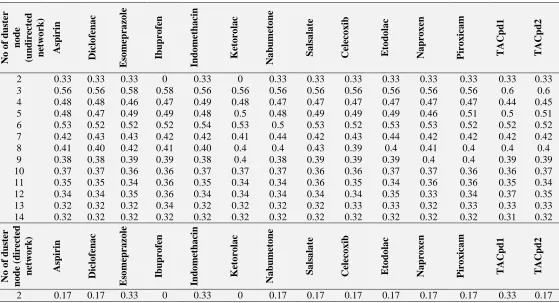
Residue interactions are taken as directed and undirected network interactions. Complex network of residues bound to various ligands, are analysed based on their properties. They show differences in clustering limits, for different complexes. Network cluster nodes studied, reveal varying number of neighbours in comparison to other complexes. The ligands bind to IL6 receptor at different binding sites. The distribution of residue interaction in network, is related to binding site of interaction, and protein residues involved in interaction.
Complexes of IL6 bound with Toddalia
compounds, show similar clustering distribution as
esomeprazole (Fig. 2, Table 1).
A. Aspirin complex
B. Toddalia aculeata quinoline compound 1(TAQCpd1) complex
D. Esomeprazole complex
E. Diclofenac complex
F. Ibuprofen complex
G. Indomethacin complex
H. Ketorolac complex
I. Nabumetone complex
J. Salsalate complex
L. Etodolac complex M. Naproxen complex
N. Piroxicam complex
[image:6.612.48.557.53.387.2]FIG. 2(A-N): AVERAGE CLUSTERING COEFFICIENT OF n (2-14) NODE CLUSTERS IN THE COMPLEXES OF INTERLEUKINE (IL6)
TABLE 1: AVERAGE CLUSTERING COEFFICIENT FOR VARYING NUMBER OF NODES (2-14) IN DIRECTED AND UNDIRECTED NETOWK IN IL6 COMPLEXES
No o f du st er no de (un direct ed net wo rk) Asp iri n Diclo fena c E so mepra zo le Ibu pro fen Ind o met ha cin K et o ro la c Na bu met o ne Sa ls a la te Cele co x ib E to do la c Na pro x en P iro x ica m T ACp d1 T ACp d2
2 0.33 0.33 0.33 0 0.33 0 0.33 0.33 0.33 0.33 0.33 0.33 0.33 0.33 3 0.56 0.56 0.58 0.58 0.56 0.56 0.56 0.56 0.56 0.56 0.56 0.56 0.6 0.6 4 0.48 0.48 0.46 0.47 0.49 0.48 0.47 0.47 0.47 0.47 0.47 0.47 0.44 0.45 5 0.48 0.47 0.49 0.49 0.48 0.5 0.48 0.49 0.49 0.49 0.46 0.51 0.5 0.51 6 0.53 0.52 0.52 0.52 0.54 0.53 0.5 0.53 0.52 0.53 0.53 0.52 0.52 0.52 7 0.42 0.43 0.43 0.42 0.42 0.41 0.44 0.42 0.43 0.44 0.42 0.42 0.42 0.42 8 0.41 0.40 0.42 0.41 0.40 0.4 0.4 0.43 0.39 0.4 0.41 0.4 0.4 0.4 9 0.38 0.38 0.39 0.39 0.38 0.4 0.38 0.39 0.39 0.39 0.4 0.4 0.39 0.39 10 0.37 0.37 0.36 0.36 0.37 0.37 0.37 0.36 0.36 0.37 0.37 0.36 0.36 0.37 11 0.35 0.35 0.34 0.36 0.35 0.34 0.34 0.36 0.35 0.34 0.36 0.36 0.35 0.34 12 0.34 0.34 0.35 0.36 0.34 0.34 0.34 0.34 0.34 0.35 0.33 0.34 0.37 0.35 13 0.32 0.32 0.32 0.34 0.32 0.32 0.32 0.32 0.33 0.33 0.32 0.33 0.33 0.33 14 0.32 0.32 0.32 0.32 0.32 0.32 0.32 0.32 0.32 0.32 0.32 0.32 0.31 0.32
No o f du st er no de (direct ed net wo rk) Asp iri n Diclo fena c E so mepra zo le Ibu pro fen Ind o met ha cin K et o ro la c Na bu met o ne Sa ls a la te Cele co x ib E to do la c Na pro x en P iro x ica m T ACp d1 T ACp d2
[image:6.612.29.588.453.756.2]3 0.28 0.28 0.58 0.29 0.51 0.28 0.28 0.28 0.28 0.28 0.28 0.27 0.6 0.3 4 0.24 0.24 0.46 0.24 0.43 0.24 0.24 0.24 0.24 0.24 0.24 0.24 0.44 0.23 5 0.24 0.24 0.47 0.25 0.41 0.25 0.24 0.24 0.25 0.24 0.23 0.25 0.49 0.25 6 0.27 0.26 0.51 0.26 0.48 0.27 0.25 0.27 0.26 0.26 0.27 0.26 0.5 0.26 7 0.21 0.21 0.42 0.21 0.38 0.21 0.22 0.21 0.22 0.22 0.21 0.21 0.42 0.21 8 0.21 0.2 0.4 0.2 0.36 0.2 0.2 0.21 0.2 0.2 0.2 0.2 0.39 0.2 9 0.19 0.19 0.37 0.19 0.34 0.2 0.19 0.19 0.2 0.19 0.2 0.2 0.38 0.2 10 0.18 0.18 0.34 0.18 0.31 0.19 0.18 0.18 0.18 0.19 0.18 0.18 0.33 0.18 11 0.17 0.17 0.33 0.17 0.3 0.17 0.17 0.17 0.17 0.17 0.17 0.18 0.33 0.17 12 0.17 0.17 0.32 0.17 0.28 0.17 0.17 0.17 0.17 0.18 0.17 0.17 0.33 0.18 13 0.16 0.16 0.29 0.17 0.25 0.17 0.16 0.16 0.17 0.17 0.16 0.17 0.29 0.17 14 0.16 0.16 0.29 0.16 0.27 0.16 0.16 0.16 0.16 0.16 0.16 0.16 0.26 0.16
The Standard Deviation (SD) of average clustering coefficient values indicate, there is a higher deviation in clustering, based on number of nodes forming clusters. The values are high in both
directed and undirected residue interaction
network, for esomeprazole and TA compound 1. There is no significant variation in SD among the directed and undirected clusters respectively in case of indomethacin. Ibuprofen and ketorolac also exhibit high SD among the average clustering coefficient in undirected cluster. In case of ibuprofen, the SD values are found to be high, also in case of directed network.
The phytocompounds exhibit higher SD values based on number of nodes forming a cluster in comparison to the high values exhibited by the standard ligands as esomeprazole, indomethacin, salsalate among the undirected networks and the highest deviations are exhibited by esomeprazole and TA Compound 1 in case of directed networks Table 2.
Results show, interaction of phytoquinoline
compounds from Toddalia aculeata provides a
relatively high the number of intracellular interactions in the target, in comparison to other compounds.
TABLE 2: SD OF VARIATION OF AVERAGE CLUSTERING COEFFICIENT ACROSS DIFFERENT CLUSTERS WITH VARYING NUMBER OF NODES IN DIRECTED AND UNDIRECTED RIN NETWORKS OF IL-6 COMPLEXED WITH VARIOUS LIGANDS
Directed Undirected
Aspirin 0.08179 0.04174 Diclofenac 0.08006 0.04045 Esomeprazole 0.09227 0.08385 Ibuprofen 0.07057 0.14099 Indomethacin 0.08095 0.08388 Ketorolac 0.07028 0.13984 Nabumetone 0.03961 0.0788
Salsalate 0.04174 0.08235 Celecoxib 0.04054 0.08037 Etodolac 0.03886 0.08129 Naproxen 0.0409 0.08017 Piroxicam 0.03821 0.08033 TACpd1 0.09616 0.08578 TACpd2 0.04253 0.08727
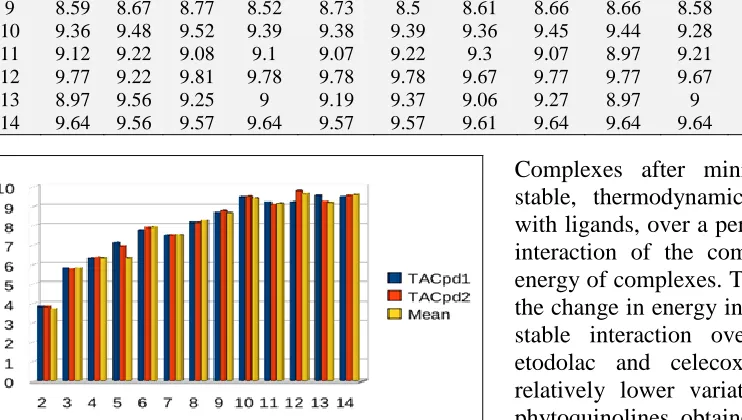
The values of neighbourhood connectivity, are calculated for network formed by the complexes. Table 3, Fig. 3 The results on neighborhood
connectivity indicate, compounds from Toddalia
[image:7.612.22.587.56.195.2]aculeata, interact with the interleukin protein target, providing target conformation where variations of interaction of neighbours of nodes is found to be similar to that present in complexes formed by other NSAIDs.
TABLE 3: NEIGHBORHOOD CONNECTIVITY IN UNDIRECTED RIN CLUSTERS OF IL6
N o de in du st er T ACp d1 T ACp d2 Asp iri n Diclo fena c E so mepra zo le Ibu pro fen Ind o met ha cin K et o ro la c Na bu met o ne Sa ls a la te Cele co x ib E to do la c Na pro x en P iro x ica m
[image:7.612.47.566.593.749.2]9 8.59 8.67 8.77 8.52 8.73 8.5 8.61 8.66 8.66 8.58 8.66 8.74 8.66 8.96 10 9.36 9.48 9.52 9.39 9.38 9.39 9.36 9.45 9.44 9.28 9.56 9.52 9.54 9.28 11 9.12 9.22 9.08 9.1 9.07 9.22 9.3 9.07 8.97 9.21 9.16 9.06 9.26 9.23 12 9.77 9.22 9.81 9.78 9.78 9.78 9.67 9.77 9.77 9.67 9.62 9.75 9.5 9.38 13 8.97 9.56 9.25 9 9.19 9.37 9.06 9.27 8.97 9 9.33 9.25 9.19 9.31 14 9.64 9.56 9.57 9.64 9.57 9.57 9.61 9.64 9.64 9.64 9.64 9.57 9.57 9.71
FIG. 3: NEIGHBORHOOD CONNECTIVITY OF PHYTOCOMPOUNDS (TACpd1 AND TACpd2) WITH MEAN ALL VALUES IN CLUSTER WITH VARYING NUMBER OF NODES
Complexes after minimisation are found very stable, thermodynamically. Interaction of target with ligands, over a period (1fs) is taken. Dynamic interaction of the complexes increased the total energy of complexes. The average energy based on the change in energy indicates the complexes show stable interaction over time. Two compounds etodolac and celecoxib are found to exhibit relatively lower variation in total energy. Both
phytoquinolines obtained from Toddalia aculeata
exhibit relatively lower variation in average total
[image:8.612.57.428.57.267.2]energy in comparison to other compounds Table 4.
TABLE 4: MD ANALYSIS OF COMPLEXES OF IL-6
Energy(kcal/mol)
Ligand Minimization MD (Avg Total) Variaiton
Aspirin -59024.49 -43879.14 -15145.35
Celecoxib -58838.5 -43992.92 -14845.59
Diclofenac -60783.22 -45646.15 -15137.06
Esomeprazole -62243.19 -47076.6 -15166.59
Etodolac -58981.38 -44083.42 -14897.96
Ibuprofen -60760.69 -45599.42 -15161.27
Indomethacin -62278.32 -47079.43 -15198.88
Ketorolac -59952.11 -44946.31 -15005.8
Nabumetone -56073.23 -40920.47 -15152.75
Naproxen -56556.99 -41497.56 -15059.44
Piroxicam -62085.36 -46992.4 -15092.96
Salsalate -62145.51 -47076.04 -15069.47
TACpd1 -57169.42 -42328.29 -14841.12
TACpd2 -56085.76 -41130.03 -14955.73
CONCLUSION: Phytocompounds from Toddalia aculeata analysed for their interacting properties
with protein Interleukine-6 displays, stable
interaction at the interacting sites of one of the standard drug molecules as esomeprazole. The changes brought about by interaction among the protein residues in complex, indicate stability in complex formed and their dynamical interaction. The dynamic interaction is found to show lower energy variation among the stable energy minimised complexes, and complexes after simulation. Difference in the connectivity of nodes
in clusters of complexes from the Toddalia
aculeata compounds is insignificant when compared to the mean values of neighbourhood connectivity with other NSAIDs.
There is greater variation in the number of clusters formed, with a change in number of nodes that form cluster, for the complex formed by phytoquinoline. This signifies the interaction of phytocompounds provide the required number of
clusters forming node with intramolecular
[image:8.612.48.574.338.527.2]The number of node forming clusters, there was a variation in standard deviation. This indicates that relatively more number of nodes participate in forming different clusters which suggests a better interaction of nodes or residues in complexes formed by them, The work signifies residue interaction based studies to find druggability of
compounds based on their bound target
interactions.
ACKNOWLEDGEMENT: The resources and
support provided for the study by Department of Science and Technology, India at Biomolecular Computation Laboratory, DCDS, IISc, Bangalore is gratefully acknowledged. The generous support for carrying out part of the study at Biomolecular Computation Laboratory, DCDS, IISc, Bangalore is acknowledged. The opportunity provided to undertake the research work by Department of
Biochemistry, Periyar University, Salem is
acknowledged with gratitude. CONFLICT OF INTEREST: Nil. REFERENCES:
1. Yang GX, Li X, Snyder M. Investigating metabolite– protein interactions: An overview of available techniques. Methods. 2012; 31; 57(4):459-66.
2. McFedries A, Schwaid A, Saghatelian A. Methods for the elucidation of protein-small molecule interactions. Chemistry & biology. 2013; 20(5):667-73.
3. Rossi AM, Taylor CW. Analysis of protein-ligand interactions by fluorescence polarization. Nature protocols. 2011; 6(3):365.
4. Zinn N, Hopf C, Drewes G, Bantscheff M. Mass
spectrometry approaches to monitor protein–drug
interactions. Methods. 2012; 57(4):430-40.
5. Marklein G, Josten M, Klanke U, Müller E, Horre R, Maier T, Wenzel T, Kostrzewa M, Bierbaum G, Hoerauf A, Sahl HG. Matrix-assisted laser desorption ionization-time of flight mass spectrometry for fast and reliable identification of clinical yeast isolates. Journal of clinical microbiology. 2009; 47(9):2912-7.
6. Colinge J, Rix U, Bennett KL, Superti‐Furga G. Systems biology analysis of protein‐drug interactions. Proteomics-Clinical Applications. 2012 Jan 1; 6(1‐2):102-16.
7. Li S, Zhang B, Zhang N. Network target for screening synergistic drug combinations with application to traditional Chinese medicine. BMC systems biology. 2011; 5(1): S10.
8. Jones SA, Scheller J, Rose-John S. Therapeutic strategies for the clinical blockade of IL-6/gp130 signaling. The Journal of clinical investigation. 2011 Sep 1; 121(9):3375. 9. Gabay C. Interleukin-6 and chronic inflammation. Arthritis
research & therapy. 2006 Jul 28; 8(2):S3.
10. Tanaka T, Kishimoto T. Targeting interleukin-6: all the way to treat autoimmune and inflammatory diseases. International journal of biological sciences. 2012; 8(9): 1227.
11. Peterson K, Dana T, Roberts MC, Chou R and Helfand M. Drug Class Review Nonsteroidal Anti-inflammatory Drugs (NSAIDs). Update 2006; 4.
12. Dhasmana D, Hathorn E, McGrath R, Tariq A, Ross JD. The effectiveness of nonsteroidal anti-inflammatory agents in the treatment of pelvic inflammatory disease: a systematic review. Systematic reviews. 2014; 3(1):79. 13. Crofford LJ. Use of NSAIDs in treating patients with
arthritis. Arthritis research & therapy. 2013; 15(3):S2. 14. Ghebremariam YT, Cooke JP, Gerhart W, Griego C,
Brower JB, Doyle-Eisele M, Moeller BC, Zhou Q, Ho L, de Andrade J, Raghu G. Pleiotropic effect of the proton pump inhibitor esomeprazole leading to suppression of lung inflammation and fibrosis. Journal of translational medicine. 2015; 13(1):249.
15. Berman HM, Burley SK, Kleywegt GJ, Markley JL, Nakamura H, Velankar S. The archiving and dissemination of biological structure data. Current opinion in structural biology. 2016; 40:17-22.
16. Grosdidier A, Zoete V, Michielin O. SwissDock, a protein-small molecule docking web service based on EADock DSS. Nucleic acids research. 2011; 39 (suppl_2): W270-7. 17. Yang Z, Lasker K, Schneidman-Duhovny D, Webb B,
Huang CC, Pettersen EF, Goddard TD, Meng EC, Sali A, Ferrin TE. UCSF Chimera, Modeller, and IMP: an integrated modeling system. Journal of structural biology. 2012; 179(3):269-78.
18. Su G, Morris JH, Demchak B, Bader GD. Biological network exploration with cytoscape 3. Current Protocols in Bioinformatics. 2014; 24:8-13.
19. iller BT, ingh , lauda B, odo ek , Brooks BR, Woodcock Iii HL. CHARMMing: a new, flexible web portal for CHARMM. Journal of chemical information and modelling 2008; 48(9): 1920-9.
All © 2013 are reserved by International Journal of Pharmaceutical Sciences and Research. This Journal licensed under a Creative Commons Attribution-NonCommercial-ShareAlike 3.0 Unported License.
This article can be downloaded to ANDROID OS based mobile. Scan QR Code using Code/Bar Scanner from your mobile. (Scanners are available on Google Playstore)
How to cite this article: