Available online on www.ijpsr.com 79
IJPSR (2011), Vol. 2, Issue 1 (Research Article)
Received on 14 August, 2010; received in revised form 12 November, 2010; accepted 23 December, 2010
IMPROVEMENT OF DISSOLUTION RATE OF POORLY SOLUBLE ALPRAZOLAM BY SOLID DISPERSION
Niranjan Kumar Manna* and Laxmikanta Roul
Department of Pharmaceutics, College of Pharmaceutical Sciences, Mahuda, Berhampur, Ganjam, Orissa, India
ABSTRACT
Dissolution rate enhancement of alprazolam, an anti-anxiety drug, was done by preparing solid dispersions by solvent evaporation method .Polyethylene glycol 6000 and Polyvinyl pyrrolidone k-30 were selected as carriers. Drug: Polymer ratios were taken as 1:1,1:2and1:4 for both the polymers for the preparation of solid dispersions. Tablets were prepared from solid dispersions and also from physical mixtures by direct compression. Dissolution rates and drug releases of solid dispersions or their tablets were found more than those of corresponding physical mixtures or their tablets.
Keywords:
Alprazolam,
Solid dispersion,
Carriers,
Polyethylene glycol 6000,
Polyvinyl pyrrolidone k-30
Correspondence to Author:
Prof. Niranjan Kumar Manna
Department of Pharmaceutics, College of Pharmaceutical Sciences, Mahuda, Berhampur -
Available online on www.ijpsr.com 80 INTRODUCTION: Alprazolam, a triazolobenzo-
diazepine with poor aqueous solubility and 70-80% bio-availability orally and 70-80% protein– binding, is used to treat panic and anxiety disorder 1, 2. It is a potent drug available in tablet form with a dose of 0.25, 0.5, 1 or 2 mg/day 3, 4. Dissolution is the rate limiting step for this poorly water soluble drug. For better absorption and quick onset of action, dissolution rate enhancement is required. The increased dissolution rates from solid dispersions are attributed to the reduction of particle size of the drug within the dispersions and increased wettability 5. The particle size reduction to the minimum level, i.e., the molecular state is desirable since when the carrier dissolves the drug must go into solution. Molecular dispersions are obtained in glass and solid solutions and probably are amorphous dispersions.
Therefore molecular dispersion of the drug are the prime motive force in increasing the dissolution rates. Dug release is dependent upon the position of the solid dispersion on the phase diagram and even in amorphous dispersions; the degree of crystallinity (and hence amorphous- ness) will control dissolution rates. Therefore any dispersion containing highly energetic forms of the drug should possess high dissolution .So in this study an attempt is made to enhance the dissolution rate by making solid dispersions of drug with carriers e.g., Polyethylene glycol 6000 and Polyvinyl pyrrolidone k-30 by solvent evaporation method. Tablets were prepared from both solid dispersions and physical mixtures. Dissolution rates and drug releases were studied
MATERIALS AND METHODS:
Materials: Alprozolam (I. P.) was a gift sample from Cipla pharmaceutical Pvt. Ltd (Baddi, H.P, India). Polyethylene glycol 6000 was procured
from Merck (Mumbai, India). Polyvinyl pyrrolidone k-30.was obtained from Rosayon laboratory (India). Others were of analytical reagent grade.
Preparation of Solid dispersion- Solvent evaporation Method 6: Solid dispersion of Alprazolam were prepared in the Drug: Polymer ratio 1:1, 1:2, 1:4 individually by Solvent evaporation method . Respective amount of water soluble carrier was dissolved in glass mortar containing methanol, and Alprazolam was added in parts with continuous stirring. Then the solvent was removed by evaporation at 40° under vacuum. The resulting solid dispersion was stored in a desiccator and the solidified mass was pulverized and passed through mesh no 80.The Carriers selected for Solvent evaporation technique are Polyethylene Glycol-6000, PolyVinyl Pyrrolidone-k30. The composition of the formulations are given in Table 1.
Composition of formulations (Solid Dispersion):
TABLE 1:COMPOSITION OF DIFFERENT FORMULATIONS
FORMULATION COMPOSITION
F1 (1:1) ALPZ:PEG-6000
F2 (1:2) ALPZ:PEG-6000
F3 (1:4) ALPZ:PEG-6000
F4 (1:1) ALPZ:PVPK30
F5 (1:2) ALPZ:PVPK30
F6 (1:4) ALPZ:PVPK30
PM1 (1:1) ALPZ:PEG-6000
PM2 (1:1) ALPZ:PVPK30
ALPZ= Alprazolam, PEG= Polyethylene Glycol, PVP= Polyvinyl Pyrrolidone, PM=Physical mixture
Available online on www.ijpsr.com 81 Evaluation and Characterization of the prepared
Solid dispersion:
Particle Size Analysis: Solid dispersion prepared by Solvent evaporation method was taken in a dry mortar and pestle and triturated. The triturated mass was passed through sieve Nos. 44,60,80,100. It passed through sieve no 80 and retained by sieve no 100.
[image:3.612.61.287.449.585.2] [image:3.612.317.566.475.650.2]Solubility Studies: Solubility studies of both pure Alprazolam, prepared solid dispersions and physical mixtures were carried out. Powder samples of solid dispersions equivalent to 10mg of pure Alprazolam were taken and added to 50 ml of distilled water. The solutions were shaken and kept aside for 24 hrs with continuous stirring. After 24 hrs, the sample solutions were filtered through Whatmann filter no. 1 and from the filtrate 1 ml of solution was taken and diluted to a suitable concentration with Phosphate buffer pH-6.8. The absorbance of the prepared dilutions were measured at 222nm using UV-Visible spectrophotometer. The results are shown in table 2.
TABLE 2: SOLUBILITYOF DIFFERENT FORMULATIONS
FORMULATION SOLUBILITY IN WATER (mg/ml)
Pure Drug 0.06449
F1 0.07447
F2 0.08113
F3 0.08398
F4 0.08297
F5 0.09016
F6 0.13724
PM1 0.06795
PM2 0.06956
In-vitro dissolution rate studies 7, 8: The in vitro
dissolution studies were carried out in USP XXI eight stage dissolution rate test apparatus using 900 ml of dissolution medium (Phosphate buffer pH-6.8). The temperature of the medium was maintained at 370C±0.5oC through out the
experiment. The samples containing 10 mg. of Alprazolam or its equivalent in solid dispersions or physical mixtures were placed in the dissolution medium. Paddle was used at a stirring rate of 50 rpm. A 5 ml aliquot was withdrawn at predetermined time intervals of 3, 5, 10, 15, 30, 45 and 60 minutes and then 5 ml of fresh dissolution medium was replaced to maintain the constant volume of dissolution medium. From the samples collected, 1 ml was taken and diluted to 10 ml with Phosphate buffer pH-6.8 and the absorbance of the diluted solutions were measured at 222nm using UV-visible spectrophotometer against Phosphate buffer pH-6.8 as blank. The amounts of Alprazolam released were calculated from the standard graph.
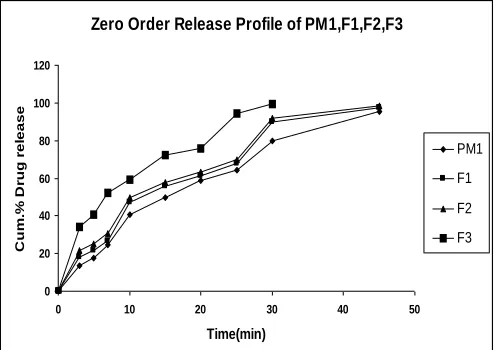
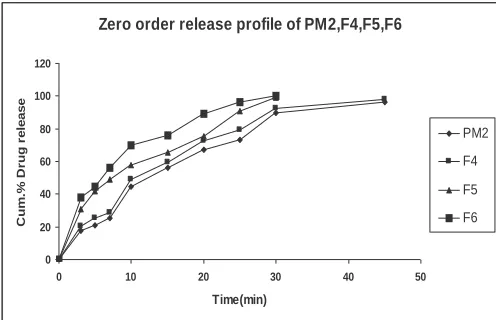
Dissolution of the drug in Solid dispersions is enhanced significantly compared to that of corresponding physical mixtures or drug alone. Among the three formulations of Alprazolam solid dispersions with PEG-6000 , F3 showed more solubility and dissolution rate; and with PVP K30, F6 showed more solubility & dissolution rate. But F6 showed highest solubility and dissolution rate than all other formulations. The results shown in Fig. 1 & 2.
Zero Order Release Profile of PM1,F1,F2,F3
0 20 40 60 80 100 120
0 10 20 30 40 50
Time(min)
C
u
m
.%
D
ru
g
r
e
le
a
s
e
PM1
F1
F2
F3
Available online on www.ijpsr.com 82 Zero order release profile of PM2,F4,F5,F6
0 20 40 60 80 100 120
0 10 20 30 40 50
Time(min)
C
u
m
.%
D
ru
g
r
e
le
a
s
e
PM2
F4
F5
F6
Fig. 2: DISSOLUTION PROFILE OF FORMULATIONS PM2, F4, F5 & F6
It indicates that the PVPK30 showing highest improvement in solubility and dissolution rate as
compared to the PEG-6000 . PVP K30 is the good carrier among the two carriers selected for Solvent evaporation method.
Preparation and Characterization of the tablets of Solid Dispersions and Physical Mixtures:
Preparation of the tablets: Direct compression method was preferred because of simplicity, rapidity, economic reasons and stability concerns. Tablets were prepared by mixing required amounts of solid dispersions or their physical mixtures with excipients and compressing directly. Composition of the tablets are given in table 3. Formulation F3 & F6 were selected for preparing tablets.
TABLE 3: COMPOSITION OF TABLETS
Tablet Formulations Alprazolam SD Mannitol MCC Sod. CMC Talc Mag. Stearate
PM1 2 116.4 32 6.4 1.6 1.6
PM2 2 116.4 32 6.4 1.6 1.6
F3 5 113.4 32 6.4 1.6 1.6
F6 5 113.4 32 6.4 1.6 1.6
Wt. of the Tablets= 160mg
Physical Characteristics 9: Physical properties e.g. Thickness of Tablets, Hardness ,Weight variation, Friability, Disintegration time were studied and found to be well within permissible limits.
In-vitro Dissolution Rate Studies: The in vitro
dissolution studies were carried out in USP XXIV eight stage dissolution rate test apparatus using 900 ml of dissolution medium (Phosphate buffer pH-6.8). The temperature of the medium was maintained at 370C±0.50C throughout the experiment. Tablets were placed in the dissolution medium. Paddle was used at a stirring rate of 50 rpm. A 5 ml aliquot was withdrawn at predetermined time intervals of 5, 10, 15, 30, 45, 60, 90 minutes and then 5 ml of fresh dissolution medium was replaced to maintain the constant volume of dissolution medium. The absorbance of the solutions were measured at 222 nm using UV- visible spectrophotometer against Phosphate
[image:4.612.55.303.73.233.2]buffer pH-6.8 as blank.. The results are shown in Fig. 3.
Zero Order Release of PM1,PM2.F3,F6
0 20 40 60 80 100 120
0 20 40 60 80
Time(min)
C
u
m
.
%
D
ru
g
R
e
le
a
s
e
PM1 PM2 F3 F6
FIG. 3: DISSOLUTION PROFILE OF TABLETS PREPARED FROM PM1, PM2, F3 & F6
[image:4.612.316.561.439.605.2]Available online on www.ijpsr.com 83 Drug Release Mechanism 10: The experimental
data were fitted to different kinetic models like Zero order, First order, Higuchi Model and Korsmeyer model to ascertain the mechanisms for drug release from different formulations. The correlation coefficient of the slope of these formulations showed an adequate fit to Korsmeyers kinetics. From calculation of “n” values obtained for different formulations after fitting into Korsmeyer and Peppas equation were within 0.5-0.75, which indicates diffusion of drug from the formulations are following anomalous transport.
Drug-Polymer Interactions Study: FTIR spectra were taken in the Perkin Elmer (spectrum RX -1) by scanning the sample in potassium bromide (KBr) discs. Before taking the spectrum of the sample, a blank spectrum of air back ground was taken. The sample of pure drug, pure polymers and the solid dispersions containing both the drug and polymer were scanned and plotted with the help of Bruker software. No interaction between the drug and polymers were found as evident from analysis of characteristics peaks. Stability Study: Solid dispersions F3, F6 were put on short term stability study at 300C and 400C/75 RH for a period of three months, there were no significant changes in drug content and dissolution profile at 300C but significant changes were observed at 400C. Hence, solid dispersions need storage in a dry place at a temperature not exceeding 300C.
CONCLUSION: PVP-K30 was most effective to enhance the dissolution rate of the drug. Drug release mostly followed anomalous transport. There was no interaction between drug and excipients. Solid dispersions were stable at 300C in dry atmosphere.
ACKNOWLEDGEMENT: Authors are thankful to the Principal, College of Pharmaceutical of Sciences, Berhampur for allowing laboratory facilities and Cipla Pharmaceuticals Pvt. Ltd. (Baddi, H. P., India), Merck (Mumbai, India), Rosayon Laboratory (India) for providing materials .
REFERENCES
1. K. D. Tripathy. “Essentials of Medical Pharmacology”, 5th, edition, 357, 400, 401.
2. Goodman & Gilman’s “the pharmacological basis of therapeutics”, 9th edition, (420-21).
3. U.S.P, vol-1, 24, (41-44) 4. I.P, vol-1, 1996, 34,35.
5. K. Ravi Sankar, K.E. V. Nagoji, “Formulation and evaluation of Roxithromycin solid dispersions and their tablets”, 2005, 21-25.
6. Bhanubhain. Suhagia, Haresh Patel, Shailesh a. Shah, ishwarsinh rathod, vijay k. Parmar “Preparation and characterization of etoricoxib-polyethylene glycol 4000 plus polyvinylpyrrolidone K30 solid dispersions” Acta Pharm. 56 (2006) 285–298. (4), 531-540.
7. Banakar, U. V., “Pharmaceutical Dissolution testing”, Vol.49, Marcel Dekker, Inc. New York, 1992, 347. 8. Tang, L., Khan, S. U., Muhammad, N. A., “Evaluation and
selection of bio-relevant dissolution media for a poorly water soluble new chemical entity”, Pharm Dev Technol., 2001, 6
9. L. Lachman, H. A. Lieberman, J.L. Kanig, “Theory and Practice of Industrial Pharmacy” 3rd Edition. 293-345. 10. Langer R. and Pappas N.-“Drug release mechanisms and