2518
THE RELATIONSHIP BETWEEN SELF-CONCEPTS AND
FLAMING BEHAVIOR:
POLARITY OF THE ONLINE
COMMENTS
JUNGYONG LEE1 , CHANGHYUN JIN2
1Department of Business Administration, Sungkyunkwan University, Korea
2Department of Business Administration, Kyonggi University, Korea
E-mail: 1[email protected], 2[email protected]
ABSTRACT
This study aims to explore how the sub-factors of self-concepts such as self-identity and self-monitoring are associated with flaming behavior, demonstrate whether polarity of online comments plays the moderating variable and show how flaming behavior affects corporate brands and product purchases. The study was conducted in groups of approximately 1060 subjects. Self-monitoring, identity and self-control had a strongly associated with flaming behavior. Therefore, when writing online comments on the internet, self-monitoring, self-identity and self-control seem to play an important role when explain internet users’ flaming behavior in cyberspace. Users with strong self-concepts tended to respond sensitively with comments when looking at online comments than did users with lower self-concepts. In spite of the fact that flaming behavior has been the chief obstacle to internet culture; however, it is true that there has still been a lack of academic interest in flaming. Therefore, this study is significant in arousing academic interest in flaming.
Keywords: Flaming Behavior, Online Comments, Self-Concepts, Purchase Intention
1. INTRODUCTION
The new internet medium has become an important communication tool in the digital media era as a foundation for free communication. There are various positive effects of the internet. However, the adverse effects of the polarity of online comments are becoming a social problem as malicious comments, including mockery, abuse, groundless and vicious slander, insults, personal attacks, threats and defamation, are a global problem [1] [2] [3]. The phenomena that occur in cyberspace are characterized by anonymity and invisibility [3] [4] [5]. Anyone can join a community anonymously without revealing their own identity, as it is defined in the physical world. Guaranteed anonymity encourages people to participate equally regardless of social status, gender and age.
The cyber phenomena and associations with psychological variables have garnered minimal focus in the relevant literature [6]. We lack an integrated model explaining the phenomena that
result from this growth in online behavior [6]. In addition to anonymity, individuals’ social environments and inclination factors have not been comprehensively considered [7]. It should be noted that individuals’ inclination factors are the factors that strengthen or weaken the effects of comments.
ISSN: 1992-8645 www.jatit.org E-ISSN: 1817-3195
2519 flaming behavior were examined. This process was also performed to suggest a model that explains the relationship between flaming behavior and brand attitude and purchase intention. This investigation will provide valuable data to support an effective online marketing communication strategy.
2. LITERATURE REVIEW
2.1 Online Comments and Flaming Behavior
Online commentaries are displayed to a wide audience, frequently for a long period; however, their authors may be insensitive to the harm potentially caused to the individual users targeted [8]. Although online comments are written by individual consumers, they tend to be perceived as opinions of generalized others. Thus, these comments can act as a type of norm, and, particularly if there are several consistent comments, they are often perceived as a majority view. This perception can be understood as a sympathetic phenomenon of following the opinions of the reference group. The effect of comments depends on their positivity or negativity. Generally, negative comments have a greater effect than positive comments [9]. From the perspective of social norms theory, comments can act as user norms, and the norms that are the internalized norm, from the perspective of the reasoned action theory, influence behavioral intention and eventually change the attitudes and consumer behavior [10]. Based on a relatively wide-ranging definition, online comments refer to writing as a means of expressing thoughts on specific issues in cyberspace as well as posting news stories as the context [9] [10].
Flaming refers to the outburst of rude or emotional behaviors by specific users in the computing environment [11]. Flaming is a concept that includes antisocial and negative behaviors that range from becoming angry to displaying strong emotions such as hostility [12]. In other words, flaming encompasses a wide range of online behaviors such as abuse, the use of coarse language, slander, the spread of false information, personal attacks, the plastering of message boards with malicious comments and sexual harassment. In addition, flaming principally refers to cyber verbal bullying. Flaming also refers to negative, antisocial behaviors that express hostility using violent and rude language to unspecified individuals or about uninterested subjects [7] [9] [12].
The causes of flaming in virtual space have been explained by theories of
computer-mediated communication (CMC). Computer-mediated communication (CMC) has since been found to have a correlation with uninhibited behaviors among users [13]. According to the CMC theorists, concepts of offline social norms and politeness are ignored online due to the nature of the medium, which is marked by a lack of social cues that can be exchanged in face-to-face contact; this leads to flaming [13] [14].
Flaming behavior in cyberspace will also have a negative impact on the sound growth and continued existence of cyberspace. Therefore, there have been calls to examine the cause of flaming and the inhibitors in the personal and social spheres [1] [7] [9] [15]. Nonetheless, the academic approach to understand flaming in various academic disciplines has thus far focused solely on circumstantial factors [16] [17] [18].
The foregoing review of the literature and the theoretical constructs that pertain to the self-concepts, the online comments and the flaming behavior provides the framework within which this study examines the relationship between the self-concepts and the flaming behavior. On this logical basis, the self-concepts were addressed in terms of flaming behavior on the internet. As discussed above, this study identified the self-concepts that are relevant in online comments by examining discussions on the self-concepts. The self-concepts in online comments were derived based on the concept of the individual in a virtual society as a digital self or virtual human.
3. HYPOTHESIS
3.1 Relationship between the self-concepts and
flaming behavior
Every person has a concept of who he or she is and what he or she likes. In addition to this subjective perspective, people define themselves from a social perspective by various means based on who they are at home, at school, in the workplace, or in the neighborhood; which cumulatively produce their self-concept of what type of person they are [19]. Generally, the self is an indigenous self as distinct from others, and a self-concept means one's opinions or beliefs about oneself or a general self-awareness about oneself [20] [21]. The self-concepts consist of three elements for flaming behavior in a cyber environment. Across the relevant literature, monitoring [22], identity [23], and self-controlling [24] have also been identified as elements of the self-concepts.
2520 self-monitoring can display an appropriate image that is fit for an audience; they can adjust their attitude, perspective and behavior to each circumstance, similar to a chameleon [25]. Self-mo nitoring refers to the extent to which an individual o bserves and controls self-expression and outward b ehavior in conformity with social cues [26]. In cont rast, people with low self-monitoring tend to behav e with minimal conformity with the prevailing socia l norms, as they have relatively low levels of ability and desire to control their self-expression [27]. In a ddition, some researcher reported that, as self-monit oring increases, the effects of image congruity beco me more significant for publicly consumed product s than for privately consumed ones [28]. Self-monitoring was observed to be one of users’ psychological factors and to be related to the propensity for opinion leadership, including in the comment context [29].
Mussen, Conger and Kagan defined self-identity as one's uniqueness, consistency or sameness as differentiated from others as well as that which enables the continuity of past, present and future to be maintained [30]. One’s self-structure is not considered a static concept but a dynamic one. That statement means that self-identity as a self-structure can be a process by which one's psychological functions to achieve a consistent self become systematized in a dynamic manner [31].
Self-control refers to the belief that one can control one’s feelings or actions while solving a problem or the ability to avoid and endure the behaviors that rely on temporary impulses to achieve one's goal or obtain instant gratification. Cyber verbal violence can be understood to be a result of low self-control. Self-control is a concept that contradicts impulsivity and means the ability to control one's emotions, cognition and behaviors.
According to the previous studies on self-monitoring, people with low self-monitoring are likely to be dependent on the conclusions that they deduce as they are strongly influenced by their internal clues, while people with high self-control are less dependent on the conclusions that they deduce because they are strongly influenced by external circumstantial clues [32]; in addition, they show less consistent purchase behavior than consumers with low self-monitoring due to their tendency to be affected by the circumstances around them. Because self-identity is the most crucial intrinsic disposition that determines one’s behaviors, one needs to build a self-identity to be a mature human being [33].
The past studies have found that high
self-monitoring people rate image-based ads preferably. Conversely, low self-monitoring people rate produc t-based ads preferably, and they are willing to spen d money on products that are advertised by quality-based messages; furthermore, they tend to trial-purc hase products that advertise their quality. Bearden, Shuptrine and Teel argued that low self-monitoring people, being less sensitive to their social environm ent, will particularly focus on the social interpretati ons that are offered by ads, whereas high self-monit oring people do not heed social appeals from ads bu t prefer to gain social recognition within the social c ontext [22]. Therefore, this study intends to explore how three personal traits influence flaming behavio r on the internet. It is expected that flaming behavio r will vary depending on the degree of these three p ersonal traits. Therefore, the following hypothesis was derived as follows:
H1-1. The sub-factors of concept such as self-monitoring is strongly associated with flaming behavior.
Self-identity is particularly significant in adolescence when self-identity begins to be built; however, it can also be viewed as a measure to reexamine oneself for adults who have established their self-identity because self-identity is not a definite or fixed concept. The movement of self-identity from individual self-identity to social self-identity means that self-awareness and individual behavior are de-individualized, which can be explained as the process of group conformity. This argument suggests a useful rationale in explaining the phenomenon in which specific groups such as hackers collectively exercise radical and rude language or behavior to assert their opinions to an indefinite majority [34]. Therefore, the following h ypothesis was derived as follows:
H1-2. The sub-factors of concept such as self-identity is strongly associated with flaming behavior.
ISSN: 1992-8645 www.jatit.org E-ISSN: 1817-3195
2521 physical work to mental work. Self-control can become an explanatory variable that predicts flaming in virtual space. Therefore, the following hypothesis was derived as follows:
H1-3. The sub-factors of concept such as self-controlling is strongly associated with flaming behavior.
3.2 Relationship between flaming behavior and
consumer attitude
In circumstances where anonymity is guaranteed, people tend to post comments impulsively, and they more easily show antisocial or uncivil behaviors such as engaging in personal attacks, abuse, slander and defamation [1] [2]. Antisocial behaviors that reveal hostility through the use of offensive, abusive, contemptuous, bitter and rude language in cyberspace are referred to as flaming or venting [1]. Flaming behavior (e.g., verbal attacks in online discussion) was strongly affected by other discussion members, organizations, and commenting behavior [16]. Since the introduction of the internet, consumers can exchange information about products or services online. One of the means to exchange product information online is in the context of online comments. The effects of online comments on consumer behavior can be understood within the framework of the persuasive effect of online word-of-mouth communication. Such comments, in which anonymity is guaranteed, can become a factor that can weaken the brand loyalty of products in a corporate brand community as well as become critical influenza to damage brand and business reputations [36] [37].
Based on the above discussion, it was expected that flaming behavior that is associated with th e self-co n cep ts would create different attitudes toward a brand and purchase intention, thus directly affecting the attitude toward the brand. Therefore, hypotheses were derived as follows.
H2. Flaming behavior has a significant influence on attitude toward a brand.
H3. Attitude toward a brand has a significant influence on purchase intention.
3.3 Moderating effect
The foregoing review of the literature and theoretical constructs that pertain to the self-concepts and polarity of online comments and flaming behavior provides the framework within which this study examines a moderating effect. According to the studies on the relationship between self-concepts and flaming behavior, it can be conceptualized that consumers purchase goods to communicate various aspects of their self-concepts in a symbolic manner. Based on the review of the previous studies, this study targets examining how consumers’ attitudes change according to the polarity of online comments, and it addresses whether the polarity of online comments has a controlling role between personal factors and flaming behavior. With regard to comment types, the division according to the directivity (positivity or negativity) of comment information was chosen as the most-used comment classification standard in the previous studies. The directivity of comment information refers to whether the content of a comment is positive or negative [38]. Several previous studies on online word of mouth show that negative word of mouth is more influential than positive word of mouth, and consumer reviews or the comments of others can form views in the negative direction [1] [2]. In other words, positive comments can generate a positive attitude, and negative comments can generate a negative attitude. Therefore, it is found that consumers' attitudes can vary depending on the comment type.
On this logical basis, the polarity of online comments on the internet are closely related to the relationship between self-concepts and flaming beh avior, and the polarity of online comments are believed to have a moderating effect on when the se lf-concepts will affect flaming behavior. Thus, the f ollowing hypothesis is proposed:
H4. The polarity of online comments will have a moderating effect when the sub-factors of concept such as monitoring (H4-1), self-identity (H4-2), and self-controlling (H4-3) affect flaming behavior.
3.4 Theoretical Model
2522
Figure 1: Conceptual Framework
4. METHOD
4.1 Pretest and Experimental Stimulus Selection
A pretest was administered to 25 undergraduate students in business school because these students have knowledge of and information regarding online comments (e.g., internet, SNSs) as well as a strong tendency to communicate with others through online media, which makes them suitable judges of the clarity of the questions. Following the pretest, a list of unfamiliar words that were used on the questionnaire form was compiled, and clearer directions about how to complete the survey were added. The measurement tools that were used in the study are based on the literature review and related to the participants’ self-concepts (self-monitoring, self-identity and self-controlling as exogenous variables). Flaming behavior, attitude toward the brand, and purchase intention were also measured as endogenous variables. The study conducted a pretest to check not only the experiment design but also the selected experimental stimulus.
First, an expert in the relevant field chose two different types of experimental stimuli deemed appropriate for this study. Considering that the majority of the research subjects who used this study are in their thirties, a consumer product (e.g., noodle food) was chosen as the experimental object because it is a very familiar food in this area as and it maximizes the exposure as well. The stimuli that were used in this study were equally controlled except for the different types of online replies. The advertisement was for the brand NONG SHIM ramen (instant noodles), and the internet format for the positive or negative replies was designed by the researchers.
Each online comments included taste, price, ingredients, and how the product was prepared. Each of the four components (e.g., taste, price, ingredients, and cuisine) received written negative comments (replies). For negative online
comments about a product, contents related to the product’s taste, price, ingredients, and cuisine were provided, such as the taste is not that good, the product really may not be all that, or I have heard a rumor that the product is made with or contains GMOs (genetically modified organisms) and industrial oil. For positive online comments about a product, contents related to the product’s taste, price, ingredients, and cuisine were provided, such as the taste is really good, the product has ingredients that are really reliable, and I believe that the product is attempting to develop the health of consumers and build a strong consumer relationship with the company.
In t-tests of the experimental stimulus, an operational test of the experimental stimulus showed a significant result. The mean of negative comments was 2.89 (S.D=.049), and the mean of positive information was 3.67 (S.D=.087), indicating statistical significance (t=8.86, p<.001).
Experimental Procedure
To examine the effect of online replies, a researcher requested the participants to connect to the online survey website. The sample for this study was identified through convenience samples of online media (internet and SNS) users from corporate panel members (n=1060). To prevent the leakage of information about the experimental stimulus, two different versions were provided for participants. There was no exposure to either experimental stimulus in advance. The participants were instructed when to begin and when to stop and obtain the URL by manipulating the proctors. The study was conducted in groups of approximately 1060 subjects. The subjects were divided into equal groups by randomly assigning two different websites to either the positive online comments or the negative online comments. Five hundred thirty subjects were provided the formatted positive online comments, and the others were provided the negative online comments. The test subjects read the experimental stimulus on the first web page. The subjects were instructed to write each online comment as if they have positive or negative opinions and experiences with the target product and then click on the answers to a questionnaire.
4.2.Manipulation Check
ISSN: 1992-8645 www.jatit.org E-ISSN: 1817-3195
2523 whether the mean of each group was significant. The mean for experimental participants in each group proved to be significant. An operational test of the negative (positive) online comments information type showed the following result: very negative information and not at all negative information (3.57/1.49, t=34.2, p<.001) and very positive online comment information and not at all positive online comment information (3.87/1.58, t=36.4, p<.001).
4.3.Instrument Construction
4.3.1 Exogenous Variables
The research used previously developed scales that were modified when necessary to measure the variables. The role of self-concepts was measured by self-monitoring, self-identity and self-controlling as exogenous variables.
The propensity of self-monitoring was composed of a total of 12 items that were based on the existing research [26] [27]. Self-identity is generated from one’s desires, abilities, beliefs, and private life, as an intrinsic and dynamic system, which is defined as a self-structure [31]. Five items for self-identity [31] were developed or adopted from the previous studies. Self-control can be defined as individuals’ effort to control themselves in behaving, and it is a stable personal propensity. The measure of self-control is composed of items that are associated with controlling the pursuit of long-term satisfaction and instant satisfaction. The questions about self-control that are used in this study consist of a total of three items that are based on reviews of the extant literature.
4.3.1 Endogenous Variables: Flaming
Behavior, Attitude toward Brand, and Purchase Intention
The measurement of flaming behavior that was used in this study consisted of a total of six items that were based on reviews of the extant literature. Thus, six items for flaming behavior wer e developed or adopted from the previous studies [11]. Although the statistical thresholds can be met with the measurement, flaming behavior was defined as online users’ outburst of rude or emotional behaviors. Thus, flaming behavior consists of flaming experience for three items and intention for three items. To justify the statistical issues, this study performs exploratory factor analys is (EFA). Three items for attitude toward brand wer e developed or adopted from the previous studies. Three items for purchase intention were developed or adopted from the previous studies. All the items t hat were used in this study were scored on 5-point
Likert scales with 1 indicating “strongly disagree” a nd 5 indicating “strongly agree.”
4.4 Demographic Analysis
As is shown in Table 1 below, over ninety-five percent ranged from 20 to 49 years of age, and over eighty-five percent of the participants had received college-level instruction. On average, the respondents explored online media including internet and SNS approximately over two hours per day to acquire or share information, present their opinions and engage in social issues.
Table 1: Demographic Profiles
n=1060 Frequency %
Sex Male 531 50.1
Female 529 49.9
Education
High School 124 11.7 College Student 405 38.2 Bachler Degree 460 43.4 M.A Degree 71 6.7
Ages
20-29 539 50.9
30-39 256 24.2
40-49 229 21.6
Over 50 year 36 3.4
Occupation
Office 352 33.2
Professional 67 6.3
Sales 201 19.0
Student 293 27.6 Homemaker 132 12.5
None 15 1.4
4.5 Assessment of Flaming Behavior
Measurement Model
To verify the hypotheses, the demographic data were analyzed using a statistical package, SPSS 15.0, and Covariance Structure Analysis was conducted using EQS6b and the Maximum Likelihood Method. After collecting and cleaning the data, verification tests were conducted to determine the measurement model’s validity. Principal components factor analysis with varimax rotation was conducted on the initial items, employing a factor weight of 0.50 as the minimum cutoff value. As is shown in Table 2 below, the author then examined the underlying factor structure to determine whether any new dimension within each factor was conceptually meaningful and to examine the psychometric properties of the scales. The result of a Bartlett’s test of sphericity was found to be significant ( = 6003.5(df=190),
2524 exploratory factor analysis (EFA) of all our scale items revealed three factors explaining 44.1% of the variance, with the first factor explaining 17.1%, and the last factor explaining 10.6% of the total variance. This analysis suggested that the data sample used in the study was unlikely to have been contaminated by common method bias [39].
Table 2: Results of Factor Analysis
Independent Variables
Construct Items F.L
Self-Monitoring
SM1 .758
SM2 .778
SM3 .764
SM4 .791
SM5 .794
SM6 .793
SM7 .802
SM8 .812
SM9 .789
SM10 .762 SM11 .734 SM12 .690 Self-Identity SI1 .725
SI2 .702
SI3 .723
SI4 .693
SI5 .723
Self-Control
SC1 .704
SC2 .791
SC3 .763
Factor Eigenvalues % of Variance Factor 1 4.490 17.093 Factor 2 2.541 16.392 Factor 3 1.784 10.589 % of total variance extracted 44.074
Dependent Variables Construct Items F.L
Flaming behavior
FB1 .845 FB2 .863 FB3 .846 FB4 .916 FB5 .938 FB6 .934
Brand
BR1 .837 BR1 .747 BR1 .840
Purchase Intention
PI1 .847 PI1 .830 PI1 .808 Factor Eigenvalues % of Variance Factor 1 4.302 33.468 Factor 2 3.074 22.576 Factor 3 1.659 19.243 % of total variance extracted 75.288 Note: F.L: Factor Loadings.
This study conducted the required procedures for building a structural equation model and assuring the model’s goodness of fit. The means of skewness and kurtosis should fall within the range of ±1.96; this study satisfied that
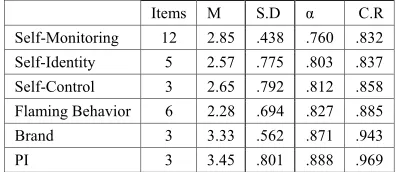
[image:7.612.311.509.196.282.2]condition. As is shown in Table 3, the Cronbach’s alpha means that all the concepts are above 0.7. The Cronbach’s alpha mean should be 0.6 or higher; thus, this study has sufficient reliability. The study’s AVE also satisfies the standard of 0.5, which means that the measurement indexes satisfy the requirement for convergent validity.
Table 3: Internal Consistency of the Constructs
Items M S.D α C.R Self-Monitoring 12 2.85 .438 .760 .832 Self-Identity 5 2.57 .775 .803 .837 Self-Control 3 2.65 .792 .812 .858 Flaming Behavior 6 2.28 .694 .827 .885 Brand 3 3.33 .562 .871 .943 PI 3 3.45 .801 .888 .969 Note: M: Mean, S.D; Standard Deviation, α: Cronbach’s alpha, C.R: Composite Reliability
To verify the discriminant validity, the AVE of each of the two potential factors was compared with the square of the correlation between the two potential factors. As is shown in Table 3, the means of the squares of the correlation coefficients (r²) are smaller than AVE. The extracted AVE is between .602 and .789, and the means of the squares of the correlation coefficients are between .001 and .437, which results in an AVE that is larger than the means of the squares of the correlation coefficients (r²); this also ensures that the data that were collected for verification have sufficient discriminant validity.
Table 4: Analysis of Discriminant Validity Using Average Variance Extracted
AVE SM SI SC FB BR PI 1 .602 1
2 .653 .160 1 3 .708 .020 .084 1 4 .749 .054 .168 .212 1 5 .784 .001 .006 .006 .021 1 6 .789 .005 .006 .001 .005 .437 1 Note: Sm: Self-Monitoring, SI: Self-Identity, SC: Self-Control, FB: Flaming Behavior, Brand: Attitude toward brand, PI: purchase Intention, * squared the correlation coefficients
4.6 Tests of Hypotheses
The goodness of fit of the model hypotheses yielded χ²=(408)=2175.8, CFI=.932, NFI=.905, NNFI=.911, GFI=.898, AGFI=.867, SRMR=.112, RMSEA=.052, which means that the model’s goodness of fit satisfies the advised base values. This result is an acceptable goodness of fit, which means that the measurement methodology of this study is sufficiently reliable.
ISSN: 1992-8645 www.jatit.org E-ISSN: 1817-3195
2525 Hypothesis S.E Standardized Coefficient
H1-1: Self-Monitoring
-> Flaming Behavior .091 .111***(.319)/z=2.855 H1-2: Self-Identity ->
Flaming Behavior .068 .366***(.661)/z=4.745 H1-3: Self-Control ->
Flaming Behavior .096 .225***(.459)/z=4.084 H2: Flaming Behavior
-> Brand .087 -.173***(-.178)/z=5.240 H3: Brand -> Purchase
Intention
.066 .789***(.895)/z=13.674
Notes: Brand: Attitude toward Brand, *** p<.05,
b(Unstandardized) Coefficient
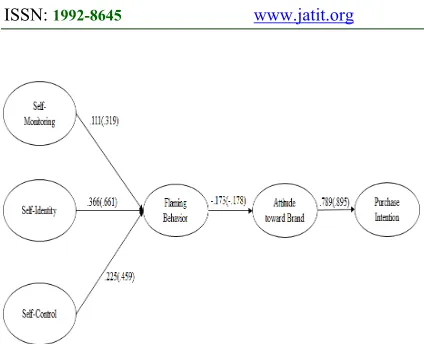
To test the structural relationships, the hypothesized casual paths were estimated. The results are shown in Table 5. The results indicate that self-monitoring is positively related to flaming behavior. The proposed paths were significant in the hypothesized direction (self-monitoring, with a standardized path coefficient for flaming behavior: γ= .111, p< .05 for H1-1). Thus, hypothesis H1-1 was supported. Self-identity is positively associated with flaming behavior. The proposed paths were significant in the hypothesized direction (self-identity, with a standardized path coefficient for flaming behavior: γ= .366, p< .05 for H1-2). Thus, hypothesis H1-2 was supported. Self-control is closely related to flaming behavior. The proposed paths were significant in the hypothesized direction (self-control, with a standardized path coefficient for flaming behavior: γ= .225, p< .05 for H1-3). Thus, hypothesis H1-3 was supported.
Flaming behavior is negatively related to attitude toward brand. The proposed paths were significant in the hypothesized direction (flaming behavior, with a standardized path coefficient for attitude toward brand: γ= -.173, p< .05 for H2). Thus, hypothesis H2 was supported. Attitude toward brand is positively related to purchase intention. The proposed paths were significant in the hypothesized direction (attitude toward brand, with a standardized path coefficient for purchase intention: γ= .789, p< .05 for H3). Thus, hypothesis H3 was supported.
4.7 Comparison of two different groups
As is shown in Table 6 and Figure 2, the hypothesized model was estimated for each of the two different groups, the polarity of online comments in the sample, individually. Regarding H4, the values that were generated by the suggested conceptual model for flaming behavior from two groups differ following the purchase intention. Multi-group CFA analysis with covariance structure analysis was conducted using EQS6b and MLE (the Maximum Likelihood Method). The objective of multi-group simultaneous path analysis
is to determine whether the path coefficients for the relationships between self-monitoring, identity, control, and flaming behavior were equal across the two groups. We first constrained one path to be invariant across the two groups and then freely estimated this path. The LM method in EQS was used to determine which paths were different. The tests show that the interaction between the influence of self-identity and control were not significant. However, the direction of the interaction was not completely opposite to the predicted effect (χ²=0.148, p>0.05 for self-identity, χ²=1.685, p>0.05 for self-control); therefore, H4-2 and H4-3 were not supported. However, the tests show that the interaction between self-monitoring and flaming behavior (χ²=8.259, p<0.05) for
self-monitoring were significant; however, in every case, the direction of interaction was completely opposite to the predicted effect. Therefore, H4-1 was supported.
The study performed additional analyses for other variables; the tests show that the interaction between flaming behavior and attitude toward brand (χ²=0.907, p>0.05) was not
significant, but only in cases in which the direction of the interaction was not completely opposite to the predicted effect. Therefore, the relationship was not supported. The tests show that the interaction between attitude toward brand and purchase intention (χ²=5.074, p<0.05) was not significant,
but only in the case in which the direction of the interaction was not completely opposite to the predicted effect; therefore, the relationship was not supported. It was hypothesized that the effects of self-monitoring would be stronger for the flaming behavior in positive online comments then in negative online comments. It was hypothesized that the effects of attitude toward brand would be stronger for the purchase intention in positive online comments then in negative online comments.
Table 6: Results of Multi-Group Analysis
Path
Path coefficients
Difference from t1 to
t2
Modification Index χ²
t1 t2
SM → Flaming .206 -.044ns 0.25 8.259**
SI → Flaming .398 .372 .026 0.148 SC → Flaming .131 .317 -0.186 1.685 Flaming →
Brand
-.214 -.186 -0.028 0.907
Brand → PI .795 .685 0.11 5.074** Note.t1: Sample in Positive comments, t2: Sample in Negative
2526
Figure 2: Results of Suggested Research Model with Path Coefficients
5 DISCUSSIONS ABD CONCLUIONS
In this study, we observed significant causal relationships along the hypothesized paths between self-concepts and flaming behavior. Self-monitoring, self-identity and self-control were closely associated with flaming behavior. Therefore, when writing online comments on the internet, self-monitoring, self-identity and self-control were related to flaming behavior. When examining online comments, users who have strong self-concepts (e.g., self-monitoring, self-identity and self-control) tended to respond sensitively with comments (e.g., replies) than did users with opposing personal traits.
The result of testing the hypothesis regarding the moderating effect is as follows. The test focused on whether positive and negative comment information plays a controlling role when personal traits are associated with flaming behavior. The results showed that the interactions between self-monitoring, self-identity, and self-control as the personal traits factors that were used in this study and the polarity of online comments have a significant effect on flaming behavior in cyberspace. The interaction between the association of self-identity and control were not significant; however, the interaction between self-monitoring and flaming behavior was significant.
Self-monitoring as a sub-factor of a personal trait is a critical influence that explains users’ flaming behavior in cyberspace. Self-monitoring has significant effects on users’ flaming behavior in cyberspace. The results indicated that online users’ self-monitoring is closely related with flaming behavior. Although certain scholars have studied the role of self-monitoring on attitude toward brand and brand choice, few studies have
been conducted on the relationship between personal traits and flaming behavior.
The personal trait of low self-monitoring has a decisive effect on consumer brand choice; however, personality is not an important factor for people with high self-monitoring. From this discussion, those with low personal traits (self-monitoring, identity, and control) frequently show brand choice because they tend to behave and judge based on individual internal propensities such as emotional state, attitude and value. In contrast, in this study, the results show that those with high personal traits (self-monitoring, identity, and control) are relatively willing to show flaming behavior because they tend to be self-conscious in behaving and judging, and they consider how they will present their image to others.
The hypothesis of the moderating effect focused on whether the polarity of online comments information plays a controlling role when personal trait factors are related to flaming behavior. The interaction between self-monitoring as a personal trait that was used in this study and the polarity of online comments has a significant effect on flaming behavior in cyberspace. It is indicated that self-monitoring as a personal trait would be better explained in positive online replies than in negative online replies when exploring the relationship between the self-concepts flaming behavior.
The uncivil comments could have been perceived as excessively innocent in comparison to more aggressive comments that can be found online. Previous research works noted that different online social environments elicit different behaviors. It should be understood that different social contexts in online environments matter. The results of this study augment certain clues to understand the ideas that self-concept is associated with internet behavior such as uncivil and flaming behaviors. The study’s objective was to attempt to provide a theoretical model that explains the relationship between individual Internet users’ self-concepts and flaming behavior or the moderating effects of polarity of online comments. The findings provide a framework for further research on a similar topic.
ISSN: 1992-8645 www.jatit.org E-ISSN: 1817-3195
2527 argued that people who have high self-monitoring have a tendency to adjust their self-expression to project a desirable public image. In contrast, people who have low self-monitoring tend to behave with minimal conformity with the prevailing social norms and have a desire to control their self-expression. As previously noted, self-identity is formed and developed through social interactions. Self-control is a stable personal propensity. From this perspective, users’ degree of self-concepts may predict their ensuing behavior in cyberspace.
6 IMPLICATIONS
This study has potential implications for research, practice, and marketing. The results indicated that online users’ personality traits (e.g., self-concept and aspects) lead to flaming, which, moderated by comment valence, leads ultimately to a product purchase decision. Thus, marketers should consider the relationship between self-concept and internet behavior such as uncivil or flaming behavior when they are building online marketing. While flaming behaviors, which are verbal violence or antisocial actions, in consumers who have strong self-monitoring, self-identity, and self-control vary depending on the polarity of online comments, positive and negative, flaming behavior in users who have strong self-monitoring are influenced by online comments. Based on the definition of monitoring, identity, and self-control propensities, it can be understood that this result is because consumers with strong self-control, self-identity and self-monitoring tend to recognize comments as useful information, and they are sensitive to them. Consumers with strong self-monitoring, self-identity, and self-control are indeed sensitive to the surrounding information that is regarded as socially desirable. Therefore, showing a sensitive attitude towards comments that act as surrounding information and social norms can be interpreted in the same context as provided in several of the previous studies that are related to the self-monitoring personal trait.
Consumers with strong self-monitoring, self-identity, and self-control are easily influenced, particularly by online word of mouth, because they are highly likely to be self-conscious about others and choose the brands or products that become positive through word of mouth. Thus, it is very important to provide these consumers with positive messages. Particularly in the social networking service (SNS) environment, the influence of comments can be stronger than the word of mouth that is formed in spaces such as existing portal blogs or cafes. Consumers with strong
self-monitoring, self-identity, and self-control are also highly likely to trust consumer opinions on SNS because they can be easily persuaded by other people’s opinions. Therefore, marketing communication practitioners should develop strategies that can closely form networks between brand and consumer and between consumer and consumer for future SNS marketing.
According to the results obtained in this research, it is true that online media (Internet, Blog, and SNS) are communication channels for marketers to reach their customers with product information and information related to customer service issues. Marketers should also develop tools that understand the relationship between online users’ personal traits and flaming behavior that is adapted to potential and profitable customers, thus allowing customers to market their products and services. An analysis of user behavior and an understanding of self-concepts in cyberspace could also provide early warnings regarding communication with consumers as well as guide responses to them. The results of this study provide valuable information to build or develop an effective online marketing communication strategy according to consumers’ valence of personal traits as well as provides an understanding of consumer information processing for academics. As the internet is a space that has social impact that is as large as that in the offline world, flaming behavior in cyberspace has a considerable mental effect on both victims and their perpetrators. Although flaming behavior has been the chief obstacle to internet culture, it is true that there remains a lack of academic interest in flaming. Therefore, this study is significant in arousing academic interest in flaming.
8. LIMITAIONS
2528
REFRENCES:
[1] L. Rösner, S. Winter, and N.C. Krämer, “Dangerous minds? Effects of uncivil online comments on aggressive cognitions, emotions, and behavior,” Comput. Hum. Behav., Vol.58,
pp. 461-470, 2016.
[2] I. Rowe, “Deliberation 2.0: Comparing the deliberative quality of online news user comments across platforms,” J. Broadcast.
Electron. Media, Vol.59, No.4, pp. 539-555,
2015.
[3] J. Suler, “The online disinhibition effects,”
Cyber. Behav. Soc. Net., Vol.7, No.3,
pp.321-326, 2004.
[4] A. Joinson, “Causes and implications of disinhibited behavior on the Internet,” In Gackenbach, J. (Ed.), Psychology and the Internet: Intrapersonal, interpersonal, and transpersonal implications. San Diego, CA: Academic Press Inc., pp 43–60, 2007.
[5] S.B. Nichollas, and R.E.Rice, “A dual-identity model of responses to deviance in online groups: integrating social identity theory and expectancy violations theory,” Communi.
Theor, Vol.27, pp.243–268, 2007.
[6] C.H. Jin, “Self-concepts in cyber censorship awareness and privacy risk perceptions: What do cyber asylum-seekers have?” Comput. Hum.
Behav. vol.80, no.4, pp.379-389, 2017.
[7] Santana, “Virtuous or vitriolic: The effects of anonymity on civility in online newspaper reader comment boards,” Journal. Pact. Vol.8,
No.1, pp.18-33, 2014.
[8] K. Weber, G.L. Bradley, and B. Sparks, “Stressor effects of negative online reviews on anger and burnout in the restaurant industry,”
Inte. J. Contemp. Hospital. Manag. Vol.29,
No.1, pp.2847-2866, 2017.
[9] G.M. Chen, and Y.M. Nargaret, “Nasty online comments anger you more than me, but nice ones make me as happy as you,” Comput. Hum.
Behav, Vol.71, No.1, pp.181-188, 2017.
[10] D. Godes, and D. Mayzlin, “Using online conversations to study word-of-mouth communication,” Mark. Sci. Vol.23, No.4,
pp.545-560, 2004.
[11] M. Spitzer, “Writing style in computer conferences,” IEEE Transact. Profess.Comm. PC, Vol.29, No.10, pp.19-22, 2014.
[11] A. Suh, and C. Wagner, C. “Factors Affecting Individual Flaming in Virtual Communities,”
Syst. Sci.(HCISS), pp.3282-3291, 2013.
[12] K.I. Wang, and J.F. Shih, “Factors Influencing University Students' Online Disinhibition Behavior – The Moderating Effects of Deterrence and Social Identity. World Academy of Science,” Engin. Technol.Inte. J. Economic.
Manag. Engin. Vol.8, No.5, pp.1486-1492,
2014.
[13] R.E. Kleine, S.S. Kleine, and J.B. Kernan, “Mundane consumption and the self: A social-identity perspective,” J. Consum. Psychol.
Vol.2, No.3, pp. 209–235, 1993.
[14] D.C. DeAndrea, S.T. Tong, and J.B.Walther, “Dark sides of computer-mediated communication,” In W. R. Cupach and B. H. Spitzberg (Ed.), The dark side of close
relationships II (pp. 95-118), New York: New
York: Routledge, 2011.
[15] D.E. Anderson, B.M. DePaulo, M.E. Ansfield, J.J.Tickle, and E. Green, E. (1999). Beliefs about cues to deception: mindless stereotypes or untapped wisdom?” J. Nonver. Behav. Vol.23,
No.1, pp.67-89, 1999.
[16] J. Brwon, A.J. Broderick, and N. Lee, “Word of mouth communication within online communities: Conceptualizing the online social network,” J. Interactive. Mark., Vol.27, No.3,
pp.2-20, 2007.
[17] M. Ma, and R. Agarwal, “Through a glass darkly: Information technology design, identity verification, and knowledge contribution in online communities,” Infor. Syst. Res. Vol.18,
No.1, pp.42-67,2007.
[18] P.M. Valkenburg, “Understanding self-effects in social media,” Hum. Commun. Res., Vol.43,
No.4, pp.477-490, 2017.
[19] C.H. Jin, “The role of facebook users’ self-systems in generating social relationships and social capital effects,” New Medi. Soc. Vol.17,
No.4, pp.501-519, 2015.
[20] S. Kiealer, J. Siegel, and T.W. McGuire, “Social psychological aspects of computer mediated communication,” Americ. Psychol.
Vol.39, No.10, pp.1123-1134, 1984.
[21] W. Bearden, F.Shuptrine, and J.Teel, “Self-monitoring and reactions to image appeals and claims about product quality,” Advanc. Consum.
Res. Vol.16, No.1, pp.703-710, 1989.
[22] A.S. Waterman, “Identity development from adolescence to adulthood: An extension of theory and review of research,” Develo.
Psychol. Vol.18, No.3, pp.341-358, 1982.
ISSN: 1992-8645 www.jatit.org E-ISSN: 1817-3195
2529 Comparing the effects of imprudent behavior and an attitudinal indicator of low self-control.
Western Criminol. Revi. Vol.7, No.1, pp.41-55,
2006.
[24] M. Kilduff, and D.V. Day, “Do chameleons get ahead? The effects of self-monitoring on managerial careers,” Acad. Manag. J., Vol.37,
pp.1047-1060. 1990.
[25] M. Snyner, “Self-monitoring processes,” In L Berkowitz (Ed), Advances in Experimental
Social Psychology, Vol.12, pp.85-128, 1975.
[26] M. Snyder, and S.Gangestad, “On the nature of self-monitoring: matters of assessment, matters of validity,” J. Person. Soc. Psychol. Vol.51,
pp.125-139, 1986.
[27] S.J. Gould, “Assessing self-concept discrepancy in consumer behavior: the joint effect of private self-consciousness and self-monitoring,”
Advanc. Consum. Res. Vol.l, No.20,
pp.419-424, 1993.
[28] P. Rose, and J. Kim, “Self-monitoring, opinion leadership and opinion seeking: A socio-motivational approach,” Cur. Psychol. Vol.30,
No.3, pp.203-221, 2011.
[29] P.H. Mussen, J.J.Conger, J. Kagan, and A.C. Huston, “Child development and personality,”
(7th.Ed.), New York: Harper & Row, 1990. [30] Marica. J. E. (1966). Development and
validation of ego-identity status. J. Personal.
Sociopsychol. Vol. 3, 51-558, 1966.
[31] S.W. Gangestad, and M. Snyder, “Self-monitoring: Appraisal and reappraisal.,
Psychol.Bullet., Vol.126, pp.530–555, 2001.
[32] G.W. Allport, “Pattern and growth in
personality,” New York: Holt, Rinehart, &
Winston, 1961.
[33] N. Kugihara, “Effects of aggressive behavior and group size on collective escape in an emergency: A test between a social identity model and deindividuation theory. Brit. J. Soc.
Psychol. Vol.40, pp.575-598, 2001.
[34] M. Gottfredson, and T. Hirschi, A General
Theory of Crime. California: Stanford
University Press, 1994.
[35] I.E. Vermeulen, and D. Seegers, “Tried and tested: the impact of online hotel reviews on consumer consideration,” Tour. Manag. Vol.30,
No.1, pp.123-127, 2009.
[36] K.L. Xie, Z. Zhang, and Z. Zhang, “The business value of online consumer reviews and management responses to hotel performance,”
Inter. J. Hospit. Manag. Vol.43, pp.1-12, 2014.
[37] J.M.Brister, “Word of mouth communication and their effects in consumer network,” Advan.