5685
DESIGN AND SIMULATION OF TRAFFIC CONTROLLER IN
COMMUNICATION NETWORKS USING MATLAB
MAJID S. NAGHMASH AND SAADI ALOBIDI
Iraqi Ministry Of Higher Education And Scientific Research/Dijlah University College
[email protected], [email protected]
ABSTRACT
In this paper, the efficient traffic control in communication networks is investigated and developed. The congestion delay control in the mobile network based fluid flow theory has been used to design the suggested model with efficient managements. The suggested approach is able to adapt manage with physical layer resource and time delay. The proposed controls techniques are established with mathematical consequent structure by use customized sliding controller technique. In this method, a high utilization with minimum delay is provided by adapt the state feedback with sliding mode controllers. The achievements in the requirements of quality of service (QoS) by mean of dynamic regulation and effectiveness of network resources for traditional structures. The limitation in the bandwidth and capacity as a network input restriction has been considered in this work. Results shows minimum delay by 0.9 msec. in the networks delay by this approach which is consider a novel developments compared with existing design. Keywords- Traffic control, Communication Network, QoS, MATLAB
1. INTRODUCTION
Many applications of commercial engineering and military become more importance nowadays which forces the researcher to find reliable communication networks. To achieve this task, the requirements of change a number of equipments distribution are necessary [1]. The technical improvements and communication network approach upcoming to these equipments to increase the processing ability. These kinds of equipments are representing intelligent agents as independent units to achieve the required goals. The amount of intelligent agents guide to ability of learns the knowledge access with engine interference for performance determining the agent sense in responsibility success grip [2]. The mobility of intelligent agents need o move from target points to carry the responsibility without restricted conditions. A certain degree of mobility is provided in this type of devices. In addition, the mobility environments benefit is to provide reconnect functions after invented position from disconnect [3]. In term of multi agent structures, the agent of intelligent is able to arrange all agents when distrusted exit happened by using many monitor. The challenge of this systems represent in the capability of agents to perceiving and evolving their conditions to collaborate with other nodes in order to realize more tasks [4]. The challenge of multi agents could be overcome by
single agents to provide numerous solutions in the main design.
ISSN: 1992-8645 www.jatit.org E-ISSN: 1817-3195
5686 congestion control in the implementation of suggested design.
2. MECHANISMS OF AQM
The internet engineering task force produce more approach to solve the failed of integrated services adoption with widespread uses that did not need any changes in internet infrastructure which provide differentiation of services. The two broad aggregate groups defined by Diff-Serv. working staff is [15]
a. Expedited forwarding (PHB) Behavior
b. Assured forwarding ( AF) Behavior
To build low loss and latency end –to-end services, EF-PHB could be used to provide some QoS. Thus, to safeguard the packet noticeable the EF receives from every router to assign sufficient advancing resource is necessary. Hence, the incoming EF packets rate is continuously less than the rate of the router could onward them in this case. Consequently, this could be completed via level services contract during the joining arrangement. This property is reservation on an end-to-end foundation with EF necessitates traffic determining in the network with reshape also [16]. The group of AF-PHB provides delivery IP packets in four separately forwarded AF periods in the networks field. In every AF class, many drops preferred levels are used to discriminate flows and the idea overdue AF is to specially drop top exertion package. Due to the quantity limitation of AF traffic in the network, the routers might confirm little harm performance to packets obvious [17]. The QAM mechanism has recently produce with the objectives to offer great link application and little harm in the delay and rate cases. This will respond rapidly to load deviations in the present networks.
The first QAM algorithms proposed by [18] using set nearly smallest and extreme design edges to offer congestion control in network of TCP/IP shapes. If the normal queues size goes above the smallest verge, the RED create arbitrarily marking packets created on likelihood dependent on the standard file distance. And if the size queue overdoes the minimum threshold each packet is go down. The Diff-Serv. group has provided approximately QoS using a Diff-Serv. aware congestion control algorithms with the maximum general implementation procedures as in [19]. The implementation of RED in Diff-Serv. named In/Out and defined as a different for every class of services in the structure of network. The configuration of RED with two different parameters sets represent (
In ) and (Out ) packets. The carefully choosing of minimum and maximum threshold levels is discriminating against out packets while the maximum mark probability. The most excellent effort in out marks packets has the lowest least and all-out thresholds. The spot likelihood for finest exertion traffic closed to one and hence provide accomplished a bounded in this case [20].
3. FRAME WORK OF QoS
In the satellite network communication, the vital factors which affect on the performance of this network are persons involving to bandwidth organization and traffic type with their action shape of this network. The management of bandwidth in contradiction of the procedures and parameters that affect services is assumed a specific collective in the network [21]. Practically, the number of drop priority and the level of kept traffic were recognized as the key factors as mentioned above. The method of selection packets to drop when the full buffers are present is related to buffer management. The usually approaches used called end drop and random early drop (RED) techniques. In case of multiple drop precedence occur, the RED become possible. The consideration here of two type of traffic is TCP and UDP aggregates networks. These two types were detached out outstanding to their dissimilar reply to losses of packets. If the same action were specified for both excess TCP and UDP, the flow of TCP will decrease their rate. From this analysis, one could give better treatment to excess TCP than UDP [22].
4. CLASSIFICATIONS
OF BUFFER MANAGEMENT
To select the packs must be released after the queue surpass a convinced threshold, a buffer management techniques become possible in this case. Depending on the color or flow type of queue, packets should be placed in one queue inside multiple queues. It's conceivable to save solitary verge on packs in completely lines. Hence, the accounting of queues should be single and multiple and thresholds also. The classes of buffer management's techniques are:
1. SAST
2. SAMT
3. MAST
4. MAMT
5687 shown better performance and offer improved justice than the end drop strategy. The drop likelihood of packet in RED depends on the length of queue during the interval of arrival packet. The probability of drop will increase in linear way from zero to maximum and queue length increased from minimum to maximum. The calculation of average queue length could be done in many methods with multiple set of drop thresholds with different color. The RED strategy could be realized as irregular of one of above four categories (SAST, SAMT, MAST and MAMT). The SAST with RED has a solitary regular line length and similar maximized and minimize threshold in all color packets. This strategy is not discriminate among packets of dissimilar insignia and could be named RED blind hue. Additionally, the SAMT category with RED techniques has regular queue length founded on entire number of packets in queue regardless color approaches. Therefore, dissimilar colors packets have dissimilar verges drops. Hence, the extreme queue magnitude is 60 packets; the threshold of drop for yellow and green with red color packets could be 40/60, 20/40, and 0/10 respectively. The average queue of a color could be planned by means of quantity of packets in the queue with improved color or same color. This scheme provides normal line distance for yellow, (green and red packets will be calculated using different mixing of colors). This case shown that the average queue length for green, yellow and red packets, can be calculated using in same sequence of color. In MAST category with RED, the same drop threshold for packets of all color is shown same behavioral. While, in MAMT with RED will have dissimilar drop verge for packets in dissimilar color arrangement.
5. IEEE 802. FRAMEWORK
The background of congestion management in IEEE 802 arrangement which is presented now days has composed of two parts. The congestion point and reaction point (CP and RP). The CP task is to distinguish congestion and produce response packets formerly refer them spinal to the basis opinion. The response opinion area is to correct the transmission speed rendering to the response data. The monitoring of queue length and income packets is done by CP part to generate the feedback packets with probability of periodical track. Additionally, the CPID flag involved in feedback packets to identify the congestion point. Since the Int-Serv. is failed, the Diff-Serv. is coming as new architecture to adopt for widespread uses and the internet
engineering duty proposed more evaluation approach. This suggestion not compulsory major change to the internet organization and providing difference of facilities ( Diff-Serv.). To realize the Diff-Serv. usages, the kind of facilities arena bits in the IP heading are retitled as discriminated services (DS) and the purposes connected with these bits is also redefined correctly. The major matter of Diff-Serv. development is to regulate easy set of mechanism for packets treatment with much precedence indicated by DS field in IP shot techniques. In Diff-Serv. advance packets classifications is performed only at edge of the network to reduce the complication in the core of network which make it better scalability. Additionally, there is no specific measures are taken to assure the priority related to the desired QoS when the packets depart the router border. Hence, the standard Diff-Serv. design offer only radium entry QoS without any enumerates assurance. The obtainability of inadequate amount of bits in the DS field a minor set of construction block named per-hop interactive set is added to work with Diff-Serv. group which are rummage-sale by the router to transport a disparity of facilities.
6. ACTIVE NETWORK DESIGN
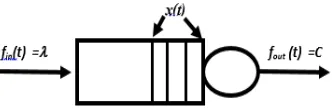
The equation of state space systems for M/M/1 line is present in this section. The delay in overcrowded contain indecisively in the model design could be expanded. Afterword, three collections of passing utilities is predictable in the network structure. The model of fluid flow showing in Figure 1 assume x(t) as changeable situation represent the typical numeral of the set in the system in match period with time. Additionally, let Fin(t) and Fout(t) are
[image:3.612.316.483.587.642.2]composed regular of income and leave flow in the system.
Figure 1: Virtually Block Of Model Line
The formulation of this design is:
X(t) = dx (t) / d(t)
ISSN: 1992-8645 www.jatit.org E-ISSN: 1817-3195
5688 Equation 1 used for queue systems and the parameters C and λ could be defined as the ability of expiration server and average coming rate in the network respectively. One could assume the capacity of queue is boundless and F(t) is independent to the arrival rate (λ). The output flow in the system Fout (t) is related to the queue ρ(t) by
Fout (t) = ρ(t)C………..(2)
The parameter of ρ that consumption can predictable by the estimated function G(X(t)) which have been signifies together with consumption link at time t as a state variable function. Hence, the queue model could be represented by the below non linear differential equation.
X(t) = - CG(x(t)) + λ……….….(3)
Then, the function G(x(t)) could be governed queuing association if data arithmetic is obtained. Hence, by this function one could empirically formulate. So far, it's more often than not situation function of G(x(t)) is classically resolute by corresponding of steady state queue resulting from equation 3. Then M/M/1 could realize in many traffics of communication system as:
X(t) = -C (x(t)/ x(t)+1) + λ………(4)
Many contributors were present the validity of equation 4 as in [23-24].
7. CONTROLLER DESIGN AND
STRUCTURE SYSTEM
Suppose a group of routers gave three differentiated traffic programs. The out port controller occupy many class of traffic flow entering via this port. Figure 2 shows a new sliding mode controller. This controller explain the effective of sliding controller on the output signals in case of the input node traffic consist of different node structure. While the input node disconnect from any identifier tags, head long packets to suitable queue to each class in the line with tags of identifier class. Therefore, maximum rate will explain the services in the transmit package as illustrated in the next section.
8. PROJECTED CONTROL DESIGN
The definite exacting to deliver in premium traffic flow is wanted. The package, delay and jitter descents must be possibly close up to certain values. A dynamic design of queue could be expressed as below:
Xp(t) = - Cp(t). (xp(t)/1+xp(t) ) + λp(t)….(5)
Then Cp (t) could be determined in the control system network as main objective for coming rate
λp (t) and every travel time with length queue xp(t)
is adjusted to reference rate x p ref (t) which is
quantified by system structure. From equation 5, the rate of system could be tracked and control
signal Cp(t) resolution by congestion controller
while a disturbance is λp(t). To increase an extra capacity allocate, least probability of ability for best traffic is the goal of this design.
Then, to provide a proper QoS for premium flow should limited as:
0 ≤ Cp (t) ≤ Cserver ………(6)
Due to essential capacity, the capacity of server is less than the maximum server capacity, then, the constraints in controller design is further toughly in this situation.
9. ORDINARY-CONTROLLER APPROACH
The delay of ordinary traffic flow without limitation is adjusted with capacity rate because a block controller has been specified suppose the sources are sending the ordinary packets via networks. Then, the dynamic design of queue could be expressed as follow:
Xo(t) = (xo (t) / 1+ xo(t) ) Co (t) + λo(t- τ)….(6)
1. By consider Co (t) is residual capacity
which is a disquiet to measure the premium queue and the modified sliding controller design forces the segregate the effect of Co(t) on the variable state xo(t),
then:
Co (t) = Cserver – Cp (t)………(7)
2. The maximum value of λo is limited to
5689 The lowest significant of traffic optimization and therefore could be used only port capacity none the less will not used best and normal traffic flow to highlight the results and this type of services could not controlled as well.
10. PROPOSED-CONGESTION CONTROL
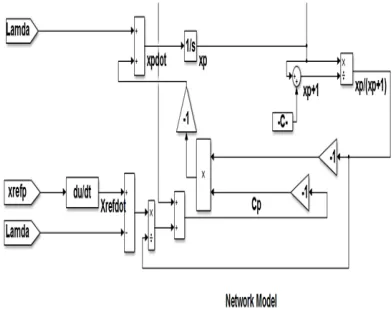
The design of DiffServ based on time delay strength of congestion control stay extremely badly. New algorithms have been introduced in this paper by using queue buffer length as feedback of information. Future controls in surrounding area by performing in server bandwidth. To allow maximum rate, all together send it back to ordinary source. Figure 2 shows the robustness network model which is suggested in this work.
[image:5.612.96.292.306.461.2]
Figure 2: suggested network model
The design of controller model for congestion control goal is completed as follow:
Cmax = 3.00000 packets / second
λmax = 15,0000 packets / second
where τ =0 there is no delay appear in the system. Best system could be got by use two controllers for types and sliding line of modified sliding mode suppose:
σ = x(t) – xref(t) ……….(8)
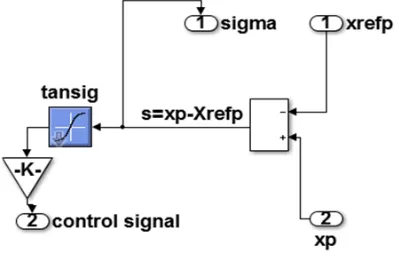
The proposed system illustrated in Figure 3 and Figure 4 with input and output (m, n) respectively. The following formula represents the sliding mode of congestion control which is designed in the state space error with known variables.
Error. ei = xi – xiref and Ei = Xi – Xiref
u(t) = - Kxi (t) ………(9)
where K is gain of state feedback
K = [0 0 ….1] P-1 α(A) ………..(10)
K = [k1 k2]………….………..(11)
Then, to combine the sliding mode criteria with state feedback gain, new formula of equation 9 become as:
u(t) = - Kxi (t) . sign (σ)………(12)
Substitute equation 11 in equation 12 yelled:
u(t) = [- K1 sign (σ) – K2 sign (σ)] xi (t)…..(13)
X(t) = [Ax(t) – Bkxi(t)] . sign (σ)
X(t) = [A-BK sign (σ) x(t) ……….(14)
Then substitute equation 13 in equation 14 yelled:
ISSN: 1992-8645 www.jatit.org E-ISSN: 1817-3195
[image:6.612.89.520.67.302.2]5690 Figure 3: Block Diagram of the MSMC simulation
Figure 4: Simulation of Sliding Mode Controller
11. RESULTS AND COMPARISON
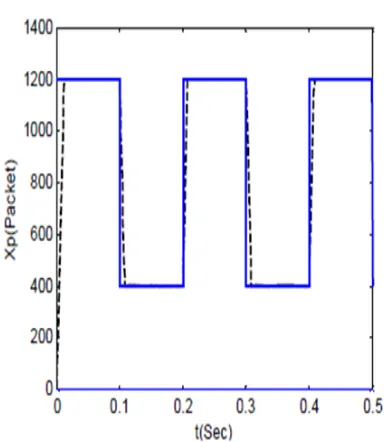
The simulation results of premium traffic showing new sliding mode controller approach. The input and output signals are illustrated in Figure 5 with reference data. Clearly, the new sliding mode controller minimizes the chattering effect significantly because of oscillation reducing. The best and proposed sliding mode signals are illustrated in Figure 6.
To achieve better rising and settling time behavior
[image:6.612.312.513.92.496.2]of x(t) , this system has been suggested.
Figure 5: input and output data
Figure 6: xpref(t) and xp(t) signal
[image:6.612.319.508.317.495.2] [image:6.612.94.292.370.497.2]5691 Figure 7 Output rate of Premium's buffer.
The tracking behavior set point of xp(t) and xp.ref(t)
with delay time respectively according to functional situation which applied is illustrated in Figure 8. The observation and distortion caused by overshoot because of high gain in PID controller dose not much with main data which send as clearly in this figure. While this distortion is appear in the received data. Thought, the data congruent causing data change in logical data. Table 1 show the clear comparison between conventional SMC, PID and proposed sliding mode controller. The appearance
of xp(t) in new approach and the achievements of
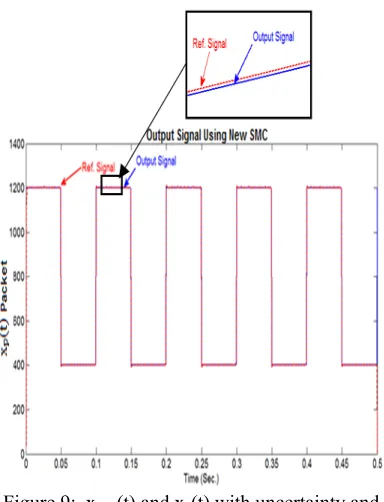
controller dose not differ changing and the received data effected as show in Figure 9 and Figure 10. As a result, the indication of the obtained results not affected on the close loop system in suggested
improvements. Therefore, the performance of xo(t)
[image:7.612.91.302.76.299.2]is a somewhat inferior than the case of deprived delay.
Figure 8 xpref(t) and xp(t) with uncertainty and delay
using PID controller
Figure 9: xpref(t) and xp(t) with uncertainty and
[image:7.612.315.513.87.324.2] [image:7.612.322.514.373.624.2]ISSN: 1992-8645 www.jatit.org E-ISSN: 1817-3195
[image:8.612.94.288.103.324.2]5692
Figure 10: xpref(t) and xp(t) with uncertainty and
delay Using Fuzzy with PID ref [24].
TABLE 1: Results Comparison Controlle
r (mse𝐓𝐬 c)
OVERSH OOT
DISTURAB NCE REJECTIO
N Proposed
SMC 1.1 Nil GOOD
Conventio nal SMC
[24]
2 Nil GOOD
PID [24]
2.5 Present POOR
12. CONCLUSIONS
Anew network congestion control by using modified sliding mode controller is produced in this paper and network systems is modeled and improved. The suggested control system was based on matching between state feedbacks controllers with sliding mode controllers. The derivation of mathematical formula is representing the theoretical model by combined equations. To generate the gain
Commensurate with amount of error, the model of controller of the system state is exploited. The DiffServ network is expected and the controller design was framed for three kinds of services such as premium services and ordinary. The examination and investigation of proposed results are shows a nature of currencies in the systems which lead to reduce the distortion and time delay as well.
REFERENCES
[1] Xinhao Yang,1 Sheng Xu,2,3 and Ze Li4, Consensus Congestion Control in Multirouter Networks Based on Multiagent System, Hindawi Complexity Volume 2017.
[2] Min Xiang and Qinqin Qu, A Congestion Control Strategy for Power Scale-Free Communication Network, Applied Sciences journal, October 2017
[3] Dr.Dike D.O et al., “Improving Congestion Control in Data Communication Network Using Queuing Theory Model”, Journal of Electrical and Electronics Engineering, Volume 11, Issue 2 Vol. I , PP 49-53, 2016.
[4] Weiqi Chen, et al., “Joint QoS provisioning and congestion control for multi-hop wireless networks”,EURASIP Journal on Wireless
Communications nd Networking DOI
10.1186/s13638-016-0519-2, 2016
[5] Sanyam Agarwal and TulikaKansal,
“Congestion Control Schemes in
ATMNetworks for ABR Services: An Overview”, I.J. of Electronics and Information Engineering, Vol.5, No.2, PP.57-67, Dec. 2016
[6] Akshay Mishra and Nirmala Sinha, “Congestion Control Issues & Trends”, International Journal of Advanced Research in Computer Science and Software Engineering, Volume 6, Issue 4, PP. 798-802,April 2016
[7] N. RamanjaneyaReddy ,P.Chenna Reddy, M.
Padmavathamma, Efficient Traffic
Engineering Strategies for Improving the Performance of TCP Friendly Rate Control Protoco, August 2017.
[8] Z. Ning, F. Xia, N. Ullah et al., “Vehicular social networks: enabling smart mobility,”
IEEE Communications Magazine, vol. 55, no.
[image:8.612.86.297.386.528.2]5693 [9] C.-Y. Chu, et al., “Congestion-aware single link
failure recovery in hybrid SDN networks,” in Proceedings of the 34th IEEE Annual Conference on Computer Communications and Networks, IEEE INFOCOM 2015, pp. 1086–1094, Hong Kong, May 2015
[10] Km. AvniYadavandSachin Kumar, "A review of congestion control mechanisms for wireless networks”, Communication and Electronics
Systems (ICCES), 2nd International
Conference on, IEEE Xplore: 22 March 2018
[11] Ali A Ahmed, RB Ahmad, A Yahya, H H Tahir, J Quinlan, Variable structure system with sliding mode controller Procedia Engineering 53, 441-452,2013.
[12] Ruchin Jain, "A Congestion Control System Based on VANET for Small Length Roads",
Annals of Emerging Technologies in Computing (AETiC) Vol. 2, No. 1, 2018
[13] A. A. ALRawi, S Alobaidi, S Graovac, Robust Adaptive Gain for Suppression of Chattering in Sliding Mode Controller, International Conference on Control Robotics Society, 2017.
[14] DaweiShen,et al, "Congestion Control and
Traffic Scheduling for Collaborative
Crowdsourcing in SDN Enabled Mobile
Wireless Networks",Hindawi Wireless
Communications and Mobile Computing Volume 2018
[15] Wanchun Jiang, et al., "Sliding Mode Congestion Control for Data Center Ethernet Networks", IEEE TRANSACTIONS ON
COMPUTERS, VOL. 64, NO. 9,
SEPTEMBER 2015
[16] IEEE 802.1Qau: End-to-end congestion
management, Working Draft [Online].
Available: http://www.ieee802.org/1/pages/
802.1au.html
[17] GHOBADI, M., YEGANEH, S., AND
GANJALI, Y. Rethinking end-to-end
congestion control in software-defined networks. Proc. of HotNets
(November 2012).
[18] Cardwell, n., et al., Congestion-based congestion control. Queue 14, 5 (2016) [19] Dong, m., et al., M. PCC: Re-architecting
Congestion Control for Consistent High Performance. Proc. of NSDI (March 2015). [20] Mittal, R., et al., Recursively cautious
congestion control. Proc. of NSDI (March 2014).
[21] ZAKI, Y., et al., Adaptive congestion control for unpredictable cellular networks. Proc. of ACM SIGCOMM (August 2015).
[22] M. Dong, T. Meng, D. Zarchy, E. Arslan, Y. Gilad, B. Godfrey, and M. Schapira. Pcc vivace: Online-learning congestion control. In 15th fUSENIXg Symposium on Networked Systems Design and Implementation (fNSDIg 18). USENIX Association, 2018.
[23] Weinan Zhang, et al, "The Study of Secure Congestion Control for TCP in Ad Hoc Networks", Journal of Information Security, 9, 25-32, 2018
[24] Hassan Ebrahimirad and M.J. Yazd anpanah," Sliding Mode Congestion Control in
Differentiated Service Communication