3448
AN INTELLIGENT AND REAL-TIME RANSOMWARE
DETECTION TOOL USING MACHINE LEARNING
ALGORITHM
1HIBA ZUHAIR, 2ALI SELAMAT
1Dr, Department of Systems Engineering, College of Information Engineering, Al-Nahrain University,
Baghdad, Iraq
2Prof. Dr, Malaysia Japan International Institute of Technology (MJIIT), Universiti Teknologi Malaysia
(UTM), Kuala Lumur, Malaysia
E-mail: 1[email protected] or [email protected] , 2[email protected]
ABSTRACT
Abstract Zero-day ransomware still threaten users’ and enterprises’ survival in the cyber-space by disturbing
electronic amenities, damaging information systems, and causing data and money losses. The publically used anti-ransomware software are trying to mitigate this security issue, however they are limited at identifying zero-day ransomware variants effectively in the real-time without performance overhead. Thus, this paper proposed intelligent, real-time, and three-tier model of ransomware detection tool to be performed well for protecting windows-based information systems. The proposed ransomware detection tool comprises a hybrid machine learning algorithm which hybridizes the decisive functions of two topmost machine learning algorithms (Naïve Bays and Decision Tree) to holistically characterize and accurately classify zero-day ransomware variants in real-time application. Empirical, comparative and realistic assessments demonstrate theadaptabilityand effectiveness of the proposed ransomware detection tool versuszero-day ransomwares. It achieves approximate accuracy rate of (96. 27%) and mistake rate of (1.32%) along with low misclassifications throughout real-time practice.
Keywords: Zero-day ransomwares, Signature-based detection, Anomaly-based detection, Hybrid-based
detection, Dynamic traits, Hybrid machine learning algorithms.
1. INTRODUCTION
With the recent breakthrough of cyber-space services, almost world-wide enterprises involved in connected information systems that are integrated together at an exponential rate over the last few ears [1]. Incessantly, such information systems have been targeted by the cyber-criminals who evolved new families of their ransomware attacksthat aiming at disrupting the electronic amenities, damaging the information systems, causing giant monetary losses to the related enterprises [1], [2]. Usually, ransomware attacks utilize systems’ vulnerabilities and intrude them via add-ons, cookies, email attachments, faux and hoaxing links, and software downloads [1], [3]. They infect install ransomware file payload into the system, configure system registry and boot-up, seek out any backups and directories to remove them, disable windows backup, and launch their own servers during the
3449
(a) Outmost Infected Smart Devices And Computer Systems By Ransomware Attacks
[image:2.612.97.521.58.338.2](b) Supremacy Of Ransomware Attacks Among Cyber-Attacks
Figure 1. Global Advancement Of Ransomware Attacks [1]-[3]
To protect users’ privacy and survive systems’ data in windows platforms, many anti-ransomware
tools are developed in industry and academia. Among them are the signature-based anti-ransomware tools like Kaspersky and Avast. Others
are the anomaly-based anti-ransomware tools like
McAfee [4], [5]. However, these tools suffer from
problems of frequent archive update, data loss and deterioration, obfuscation noise, false alarms, infirmity versus the scalable network traffic, and defeatism against zero-day ransomwares. Thus, they still need more improvements to work effectively against zero-day ransomwares and different ransomware families that have not been investigated before [4], [5].
To overcome the aforesaid problems, researchers develop hybrid-based anti-ransomware tools which are assisted by static and dynamic analyses of ransomware traits, and they are assembled by machine learning algorithms to detect zero-day ransomwares accurately with lower rate of false. For example, EldeRan, ShieldFS, and UNIVEIL etc. [4] - [20]. However, hybrid-based anti-ransomware tools are still obsolescent versus the adversary traits that the new ransomware usually evolve in real-time application. Deploying machine learning classifiers only while a ransomware’s action runs encounters variable detection outcomes according to their ensemble design, different induction boundaries, and various sets of traits that they leverage.
To detect zero-day variants of ransomware families effectively in the real-time mode, the
anti-ransomware tool requires an adaptive machine learning classifier that trains a big stream of data, adjusts its default functions, and regulates its induction parameters to make future predictions.
To do so, two supervised and unsupervised machine learning algorithms are hybridized to generate more decisive machine learning algorithm for ransomware detection, as it is presented in this paper. Furthermore, this hybrid machine learning algorithm is assisted by a set of the most distinctive ransomware traits for more holistic characterization of ransomware families. To be a well-suited ransomware detection tool for protecting windows-based information systems, the proposed hybrid machine learning algorithm is assembled into a three-tier ransomware detection model which involves analysis, learning, and testing tiers.
The analysis tier analyzes the dynamic actions and probable infections of different ransomware families in five-minute test routine which is implemented iteratively via a virtual testbed. Dynamic traits and infecting actions are characterized, synthesized, and archived for the next tier “learning tier”. The learning tier; learns the extracted sets of traits by using the proposed hybrid machine learning algorithm to generate the ransomware detection model that must be adjusted whenever necessary during the real-time application mode. Whilst, the testing tier; applies the generated detection model to identify any unknown action of a
1.8 2.2
1.3 1.5
3.5
4.2
1.3
4.2
2 0 1 5 2 0 1 8
S y s t e m s I n f e c t e d B y R a n s o m w a r e ( % )
Android iOS
Blackberry Windows
%58 %23
%10 %9
Cyber-Attacks Growth (2015-2018)
Ransomware
Malware
Banking Trojan
3450 new ransomware variant “zero-day ransomware” in real-time application.
As such, the key contributions of this paper can be itemized as follows:
A hybrid machine learning algorithm that analyzes the dynamic traits of zero-day ransomware variants,
A robust schema of an anti-ransomware tool for protecting windows-based information system against zero-day ransomwares without tackling the entire system and machine.
A Real-time model of anti-ransomware tool against daily evolving variants of different ransomware families.
Realistic and comparative performance assessment of the proposed work.
For more description, the rest of this paper is organized as follows: a background of the ransomware and the related works will be presented in Section 2. Whereas, Section 3 will present the design and workflow of the proposed approach. Implementation and experimental results will be discussed in Section 4. At last, conclusions and future outlooks will be presented in Section 5.
2. RELATED WORK
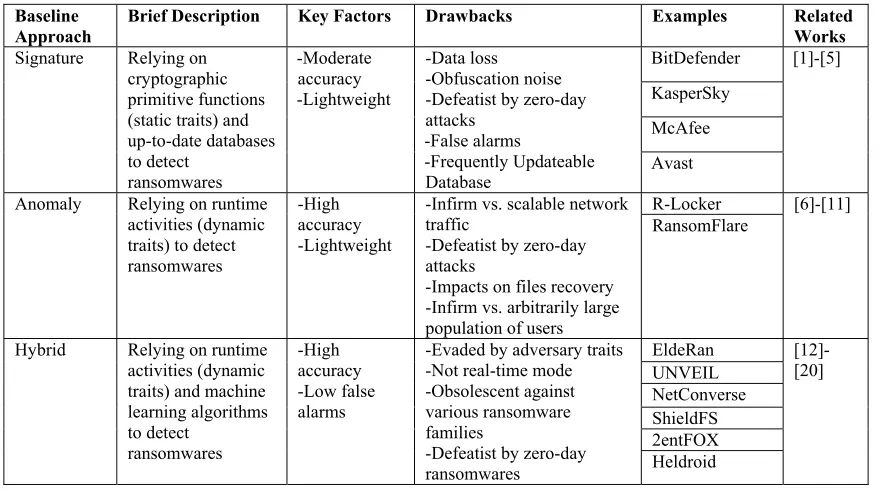
Recently, various anti-ransomware tools have been developed by researchers in both academia and industry to detect ransomware families and their own variants online. These tools have been grouped under three categories: signature, anomaly, and hybrid approaches [4]-[20]. The signature-based approaches have identified ransomware variants whose traits have been previously archived in their related repositories [4], [5]. However, they have needed to update their archives frequently that might need human labor and took long time. Furthermore, some signature-based approaches like BitDefender
have identified ransomware trait of particular ransomware families exclusively. Precisely, families of similar variants rather than families of different variants [4-20]. Whereas, anomaly-based approaches have recognized whether the system activities are benign or threat throughout data mining rules and/or machine learning classifiers [6]-[11]. However, they have encountered high fault alarms along with complex computations, time-consuming in implementation, and performance overhead on windows and other platforms [6]-[11]. To boost anti-ransomware, other achievements have adopted hybrid approaches for by assembling both signature and anomaly-based approaches simultaneously [12]-[20]. Even though, they have shown effective ransomware detection against zero-day variants; they have encountered performance overhead, maximal footprints, maximal misclassifications in online mode [12]-[20]. Inspiration of aforesaid categories have driven many related works published recently in the topic of anti-ransomware technology. Table 1 synthesizes the related works in
3451
Table 1. Synthesis of notable related works for anti-ransomware technology
Baseline Approach
Brief Description Key Factors Drawbacks Examples Related
Works
Signature Relying on cryptographic primitive functions (static traits) and up-to-date databases to detect
ransomwares
-Moderate accuracy -Lightweight
-Data loss -Obfuscation noise -Defeatist by zero-day attacks
-False alarms
-Frequently Updateable Database
BitDefender [1]-[5] KasperSky
McAfee Avast Anomaly Relying on runtime
activities (dynamic traits) to detect ransomwares
-High accuracy -Lightweight
-Infirm vs. scalable network traffic
-Defeatist by zero-day attacks
-Impacts on files recovery -Infirm vs. arbitrarily large population of users
R-Locker [6]-[11] RansomFlare
Hybrid Relying on runtime activities (dynamic traits) and machine learning algorithms to detect
ransomwares
-High accuracy -Low false alarms
-Evaded by adversary traits -Not real-time mode -Obsolescent against various ransomware families
-Defeatist by zero-day ransomwares
EldeRan [12]-[20] UNVEIL
NetConverse ShieldFS 2entFOX Heldroid
3. METHODOLOGY
This section describes the proposed hybrid machine learning algorithms, the design of the anti-ransomware tiers, and the behavioral traits as well as the ransomware families that have to be detected by the proposed tool, as follows:
3.1 Ransomware Traits and Families
Cyber-criminals utilize different ransomware families to attack users and their computer-based systems as presented in Table 2. Accordingly, ransomware families varied in their activities, traits, and impacts. They exhibit traits that may infect the settings of operating systems, or users’ data and files, or software applications, or control and command servers. To this end, 9 usually exploited traits by the topmost ransomware families are utilized to implement and testify the proposed tool.
3452
Table 2. The most risky ransomware families to windows-based information systems [1-5]
Type Place Year Method Impacts
AiDS USA 1989 It was delivered to
computer-based information systems via floppy disks
Encrypting root directories Damage system files
GpCode Russia 2005 It developed symmetric
encryption algorithm to encrypt users’ data files
Damage to management
information systems of banks and real estate agencies
Archiveus USA 2006 It applied RSA algorithm
to encrypt system files
Defeat the original version of computer system
Cause illegal and big money losses
WinLock Russia
2008-2012 It locked computer system and demanding ransom via sending SMS to victim’s phone number
Damage computer system Cause Data loss
Cause Money loss
Reveton Pakistan 2012 It impersonated law
enforcement agencies to deceive users with rumor claims
Abuse the prepaid electronic payment platforms of e-business
Crypto-Locker Europe 2013 It encrypts file's contents
by RSA algorithm with private and public keys
Lock computer systems Target industrial organizations Cause financial loss
Crypto-Wall USA 2014 It encrypted system files
and injected malicious code which freezed the systems firewalls.
Halt the computer system Require ransoms in Bitcoins
Ransom as Service (RaaS)
USA and Europe
2015 Impersonated a malicious website in the dark web
[image:5.612.91.522.431.638.2]Halt computer systems of victims who use are browsing the dark web
Table 3. The Topmost ransomware families and their traits [11]-[20]
Traits Ransomware Families CryptoWall WinLock Reventon CryptoLocker Archiveus, GpCode AiDS RaaS Windows API
calls
Registry key
actions
File system
actions
Various File
extensions
File names
Directory actions
Application
folders
Control panel
settings
Command and Control Server (C & C)
3.2 The Proposed Hybrid Machine Learning Algorithm
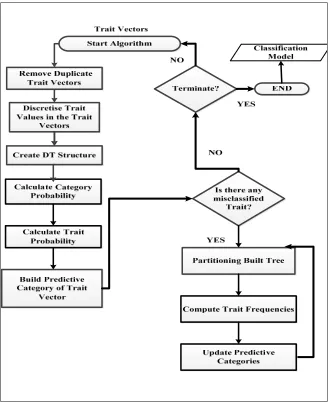
It can be observed from Figure 2 that the proposed hybrid machine-based learning algorithm assembles the decision functions of Decision Tree (DT) and Naïve Bays (NB) synchronously to
3453 examined trait to its corresponding category [9]. Whilst, NB predicts the actual category of the overlooked traits in the indecipherable nodes of DT. So far, any unclassified trait is categorized by using
the Bayes’ probabilistic theorem with the assumption of that all traits are independent of each other [9].
[image:6.612.142.472.151.553.2]Figure 2: Flowchart of the proposed hybrid machine learning algorithm
To do so, the proposed algorithm learns the fetching trait vectors by leveraging the cutting back decision tree of DT to split the training trait vectors
into sub-training vectors that would be pruned by
NB’s decision margins recursively. Thus, the
training trait matrix ( 𝑇 𝑇 , … , 𝑇 ) is given such that ( 𝑇 𝑇, ∈ , ∈
, ) with the prediction categories ( 𝑃 𝐶 , 𝐶 : 𝐶 1, 𝑎𝑛𝑑 𝐶 1 ). Each trait vector can be represented as (𝑇 𝐶 , 𝑇, ∈
, , ∈| |. Then, the prior probability 𝑃 𝐶 is computed as per Equation (1) to predict how often each category
occurs over ( 𝑇 ) relatively to the trait vector (𝑇 . Whilst, the conditional probability of (𝑇 is computed by Equation (2) to predict the relevance between the predicted category (𝐶 ) and its corresponding trait (𝑇,) as it was indicated by
(𝑃 𝑇,|𝐶 ). Consequently, frequencies of each
examined 𝑡 in the current trait vector 𝑇 would be checked-up across both the trait vectors and legitimate vectors to identify any redundant and/or misclassified trait such that 𝑁 → is the number
frequencies of 𝑡 in the trait vector, 𝑁 → is the
3454
P T ⌈C P C T,|C
→
(1)
C C → P T , C (2)
𝑃 𝑃 ∣ 𝑡 →
→ →
(3)
3.3 Three-Tier Architecture Of Ransomware Detection Tool
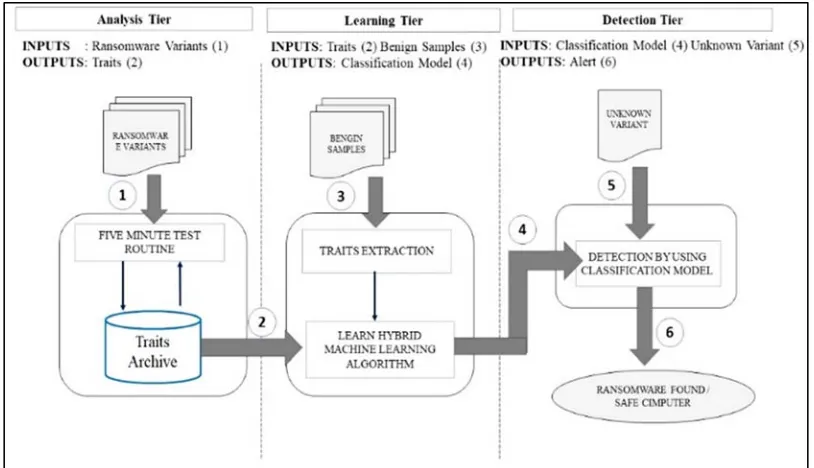
Figure 3 illustrates the multi-tier architecture of the proposed anti-ransomware tool that consists of analysis tier, learning tier, and detection tier. In the analysis tier, the ransomware samples are analyzed during the five-minute routine on a virtual testbed to extract their distinctive traits. Correspondingly, the extracted traits are characterized into their related ransomware families. A virtual testbed is utilized to avoid the severe damage and malfunctions of ransomwares on the platform system. To do so, trap files (s) are created and disseminated into three different locations of hard disk partition (C: /). Once a ransomware’s downloads on the targeting system,
[image:7.612.103.510.449.683.2]that ransomware runs and encrypts the trap file (s) before it halts the system. Then, all the traits that previously described in Table 3, are extracted the ransomware sample to be characterized and archived as a vector of traits belongs to the diagnosed sample. The learning tier retrieves all the archived trait vectors (both benign and ransomware trait vectors) from the data archive and learns them with the proposed hybrid machine learning algorithm to generate the classification model. Accordingly, the generated classification models will be used to check-up any suspicious sample in terms of its actions or traits in the detection tier to alert the system’s user that a ransomware is going to infect the system probably.
3455 4. IMPLEMENTATION AND EXPERIMENTS 4.1 Implementation
To implement the analysis tier, a collected set of ransomware and benign variants are analysed in terms of their actions and infections to the trap file (s) on the virtual testbed during the five-minute test routine. Consequently, the learning tier is implemented such that the hybrid machine learning algorithm learns the aggregated set of samples to
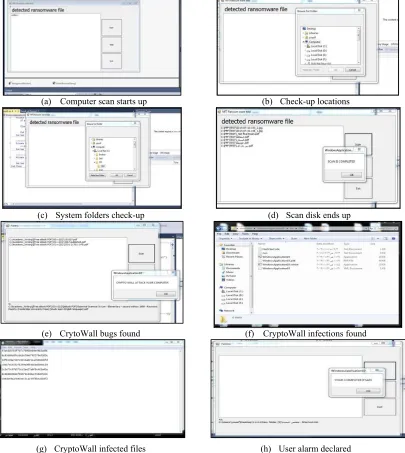
characterize the traits and to generate the classification models. Whilst, the detection tier pursues a computer scan to fix any new ransomware downloaded during the web browsing as it can be observed from Figure 4. If one or more of the downloaded file causing traits as those of the archive, then an alert will be popped up in user’s screen acquiring him/her to stop the ransomware attack. Otherwise, the user is notified that his/her computer system is safe of ransomwares.
(a) Computer scan starts up (b) Check-up locations
(c) System folders check-up (d) Scan disk ends up
(e) CrytoWall bugs found (f) CryptoWall infections found
[image:8.612.104.509.252.705.2](g) CryptoWall infected files (h) User alarm declared
3456 4.2 Experimental Design
To implement and assess the developed multi-tier anti-ransomware tool, a collection of ransomware variants has been aggregated from notable data sources like Virus Total and Malware Blacklist during (1/9/2018 – 30/1/2019). Such data
sources are usually adopted in the recently published studies for the same purpose [21]-[22]. Furthermore, the benign instances have been crawled from the web manually through the topmost software aggregators during the same period of time. By reducing the redundant variants, the malware variants besides excluding the suspicious samples that do not act as ransomwares, the benchmarking
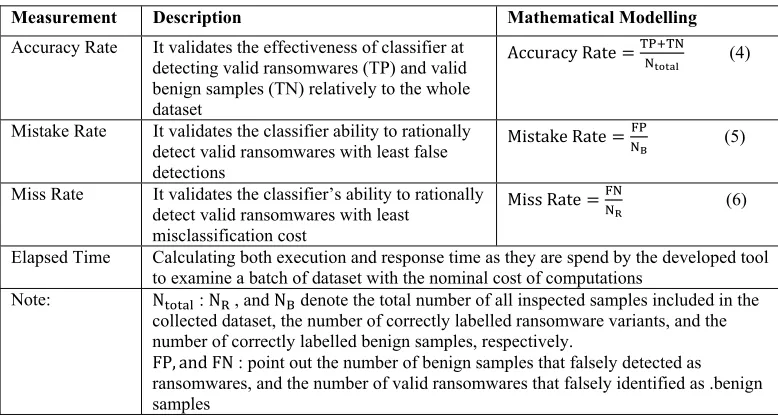
dataset contains 10000 valid and active ransomware variants of eight different ransomware families along with 500 benign instances as they are depicted in Table 4. Then, the benchmarking dataset has been formulated into a number of trait vectors that could be split up randomly into , and splits for analysis, learning and detection tiers respectively. To test and demonstrate whether the proposed tool could adapt the zero-day ransomware variants and their corresponding families, performance metrics including Detection Accuracy Rate, Mistake Rate, Miss Rate, and Elapsed Time along with plots of ROC curve have been utilized through experiments,
[image:9.612.111.500.488.697.2]see Table 5.
Table 4. Characteristics of benchmarking dataset
Characteristics Benchmarking Dataset
Number of Ransomware Samples 10000 Number of Benign Samples 500
Data Archive Malware Blacklist, Virus Total
Aggregation Time 1/9/2018-1/1/2019
Analysis Dataset 3500
Learning Dataset 3500
Detection Dataset 3500
Ransomware Families AiDS 400
GpCode 800
Archiveus 1500
WinLock 2620
Reveton 400
CryptoLocker 720 CryptoWall 3250
RaaS 310
Table 5. Performance evaluation metrics as they adopted in [9]-[12]
Measurement Description Mathematical Modelling
Accuracy Rate It validates the effectiveness of classifier at detecting valid ransomwares (TP) and valid benign samples (TN) relatively to the whole dataset
Accuracy Rate (4)
Mistake Rate It validates the classifier ability to rationally detect valid ransomwares with least false detections
Mistake Rate (5)
Miss Rate It validates the classifier’s ability to rationally detect valid ransomwares with least
misclassification cost
Miss Rate (6)
Elapsed Time Calculating both execution and response time as they are spend by the developed tool to examine a batch of dataset with the nominal cost of computations
Note: N : N , and N denote the total number of all inspected samples included in the collected dataset, the number of correctly labelled ransomware variants, and the number of correctly labelled benign samples, respectively.
3457 4.3 Experimental Results and Discussion
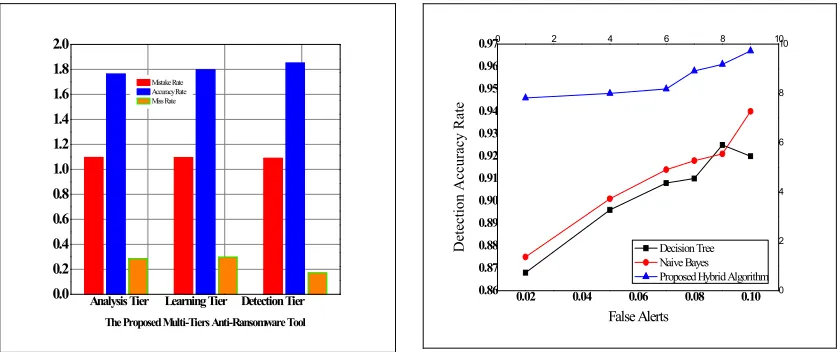
Overall performance outcomes of the proposed tool across its three-tiers were cataloged in terms of
Accuracy Rate, Mistake and Miss Rates, as shown
in Figure 5. In addition, two experiments were conducted for (i) comparing the proposed hybrid
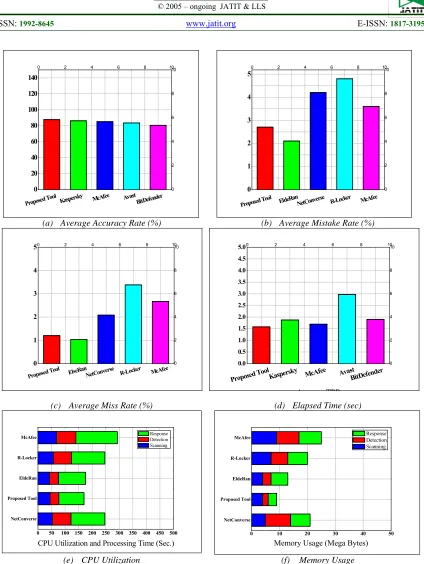
algorithm versus the baseline machine learning algorithms like DT and NB via ROCcurve plots, and (ii) appraising the proposed tool’s outcomes versus
those of its competitors like McAfee, EldeRan, NetConverse, and R-Locker, as shown in Figures 6
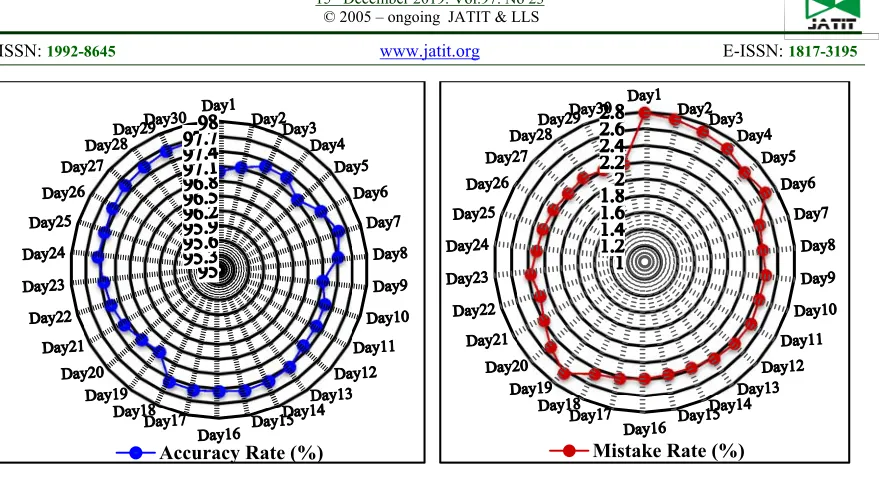
and 7. On the other hand, the plotted charts in
Figures 8 and 9 showed the progressive
effectiveness of the proposed toolon the daily basis assessment during one-month test. Plots of Accuracy Rate, Mistake Rate, Miss Rate and Elapsed Time
from the 1st day to the 30th day; inferred that the proposed tool could manifest its adaptive and effective classification against zero-day ransomwares. That was attributed to the proposed hybrid machine learning algorithm which hybridized and synchronized the classification margins of NB
and DT into an iterative assembly to update the
default margins on every batch of ransomware variants. Furthermore, the proposed tool deployed robust ransomware traits to characterize different ransomware families and identify their related variants. However, a radical escalating and/or de-escalating of performance trend line was reported at certain days. This was caused by the merits of ransomware families and their corresponding variants that might been varied in their traits, infections, crawling, analysis, and computations as well as elapsed time to thwart during the run of the
proposed tool’s multi-tiers. The aforesaid performance outcomes of the proposed tool as they were presented in Figures (5, 6, 7, 8 and 9) demonstrated the holistic analysis tier, the effective learning tier, and the progressive detection tier alongside the minimal performance overhead of the proposed tool during experimental, real-time and comparative assessments. Altogether, were caused by the following issues:
i. The comparable anti-ransomware tools fall short in characterizing all ransomware families and their exploitations;
ii. They varied in their detection approach (either signature, or anomaly, or hybrid based approaches) which assured different decisive rules at identifying ransomware variants;
iii. They varied in their adaptability to zero-day and/or new ransomware variants, therefore, they attained high to moderate
FNRs;
iv. Also, they were limited in adjusting their own initial decisive margins by hybridizing different machine learning or data mining algorithms;
v. Existing anti-ransomware tools fall short in tackling ransomware variants in real-time mode.
vi. The proposed tool tackled ransomware
variants during short elapsed time with a minimal computer system’s footprints including: CPU utilization during processing time, detection time, and response time as well as memory usage. Thus, it outperformed its competitors with minimal performance overhead.
Analysis Tier Learning Tier Detection Tier
0.0 0.2 0.4 0.6 0.8 1.0 1.2 1.4 1.6 1.8 2.0
The Proposed Multi-Tiers Anti-Ransomware Tool
Mistake Rate Accuracy Rate Miss Rate
0.02 0.04 0.06 0.08 0.10 0.86 0.87 0.88 0.89 0.90 0.91 0.92 0.93 0.94 0.95 0.96 0.97 Detection Ac cur ac y Ra te False Alerts Decision Tree Naive Bayes Proposed Hybrid Algorithm
0 2 4 6 8 10
0 2 4 6 8 10
Figure 5: Performance outcomes of the proposed tool
[image:10.612.98.518.529.705.2]on the benchmarking dataset
Figure 6: ROC plots of the proposed hybrid machine
3458
Proposed To
ol
Kaspersky McAfee AvastBitDefender
0 20 40 60 80 100 120 140
0 2 4 6 8 10
0 2 4 6 8 10
Proposed Too
l
EldeRanNetConverse R-Locker McAfee
0 1 2 3 4
50 2 4 6 8 10
0 2 4 6 8 10
(a) Average Accuracy Rate (%) (b) Average Mistake Rate (%)
Proposed To
ol ElseRan
NetConverse R-Locker McAfe
e
0 1 2 3 4
50 2 4 6 8 10
0 2 4 6 8 10
Proposed To ol
Kaspersky McAfee AvastBitDefender
0.0 0.5 1.0 1.5 2.0 2.5 3.0 3.5 4.0 4.5 5.0
A TPR
0 2 4 6 8 10
0 2 4 6 8 10
(c) Average Miss Rate (%) (d) Elapsed Time (sec)
NetConverse Proposed Tool EldeRan R-Locker McAfee
0 50 100 150 200 250 300 350 400 450 500 CPU Utilization and Processing Time (Sec.)
Response Detection Scanning
NetConverse Proposed Tool EldeRan R-Locker McAfee
0 10 20 30 40 50
Memory Usage (Mega Bytes) Response Detection Scanning
[image:11.612.95.519.55.619.2](e) CPU Utilization (f) Memory Usage
3459
[image:12.612.91.532.53.293.2](a) Daily basis average Accuracy Rate (b) Daily basis average Mistake Rates
Figure 8: Outcomes of real-time practice in terms of Accuracy and Mistake Rates
(a) Daily basis average Miss Rates (b) Daily basis average Elapsed Time
Figure 9: Outcomes of real-time practice in terms of Miss Rate and Elapsed Time
5. CONCLUSIONSANDFUTUREWORK
This paper addressed the importance of hybrid machine learning algorithm that assisted by dynamic traits at characterizing ransomware families accurately, detecting the zero-day ransomwares effectively, and boosting the real-time defenselessness of hybrid-based ransomware detection tools proficiently through a three-tier paradigm. Conceptually, the proposed three-tier ransomware detection tool could synthesize and extract the dynamic traits of ransomware families during a five-minute test routine that implemented in virtual tested throughout the analysis tier. Whereas, the learning tier could learn the extracted by the
proposed hybrid machine learning algorithm which hybridizes the induction functions of Naïve Bayes
and Decision Tree into an iterative adjustment
strategy to generate a decisive classification model. On the other hand, the detection tier could applied the generated decisive classification model adaptively at detecting zero-day ransomware variants on daily basis practice. Results of empirical, comparative, and realistic assessments showcased the effectiveness of the proposed hybrid machine learning algorithm individually and/or as it was designed in a three-tier ransomware detection tool. Precisely, both the proposed hybrid machine learning algorithm and the three-tier ransomware detection tool could achieve maximal detection
Accuracy Rate (%) Mistake Rate (%)
[image:12.612.93.519.334.513.2]3460 accuracy rates, minimal mistake rates, minimal misclassification rates, shorter elapsed time as well as minimal memory and CPU usage among their competitors. So far, the results approved that the designed ransomware detection tool can serve as real-time and publically used anti-ransomware software in the future versus the escalating number of ransomware families, their adversary traits, and their life-span variants on windows-based information systems. For future work, both static and dynamic traits of more ransomware families as well as the categorical selection of the best sets of those traits can be employed to learn the hybrid machine learning algorithm decisively.
REFERENCES:
[1] Bhardwaj, A., Avasthi, V., Sastry, H. and Subrahmanyam, G.V.B.: Ransomware digital extortion: a rising new age threat. Indian Journal of Science and Technology, 9(14), pp.1-5 (2016).
[2] Symantec. 2016 Internet Security Threat Report.
https://www.symantec.com/content/dam/syma ntec/docs/reports/istr-21-2016-en.pdf, 2016. [3] Tailor, J.P. and Patel, A.D.: A comprehensive
survey: ransomware attacks prevention, monitoring and damage control. International Journal of Research, Science and Innovation, 4, pp.2321-2705, 2017.
[4] Richardson, R. and North, M.: Ransomware: Evolution, mitigation and prevention. International Management Review, 13(1), pp.10-21, 2017.
[5] Genç, Z.A., Lenzini, G. and Ryan, P.Y.,
Security analysis of key acquiring strategies used by cryptographic ransomware. In Proceedings of the Central European Cybersecurity Conference 2018 (p. 7), ACM, November, 2018.
[6] Morato, D., Berrueta, E., Magaña, E. and Izal, M., Ransomware early detection by the analysis of file sharing traffic, Journal of Network and Computer Applications, 124, pp.14-32, 2018.
[7] Gómez-Hernández, J. A., Álvarez-González, L., & García-Teodoro, P., R-Locker: Thwarting ransomware action through a honeyfile-based approach. Computers & Security, 73, 389-398, 2018.
[8] Cabaj, K., Gregorczyk, M. and Mazurczyk, W., Software-defined networking-based crypto ransomware detection using HTTP traffic characteristics. Computers and Electrical Engineering, 66, pp.353-368, 2018.
[9] Hampton, N., Baig, Z. and Zeadally, S.: Ransomware behavioural analysis on windows platforms. Journal of Information Security and Applications, 40, pp.44-51, 2018.
[10]Sgandurra, D., Muñoz-González, L., Mohsen, R., and Lupu, E. C., Automated dynamic analysis of ransomware: benefits, limitations and use for detection, 2016.
[11]Zimba, A., Malware-free intrusion: a novel approach to Ransomware infection vectors, International Journal of Computer Science and Information Security, 15(2), p.317, 2017. [12]Kharaz, A., Arshad, S., Mulliner, C., Roberson,
W. K., and Krida, E., Unveil: a large scale, automated approach to detecting ransomware. In USINEX Security Symposium, pp. 757-772 (2016)
[13]Zavarsky, P. and Lindskog, D., Experimental analysis of ransomware on windows and android platforms: Evolution and characterization. Procedia Computer Science, 94, pp.465-472 (2016).
[14]Alhawi, O.M., Baldwin, J. and Dehghantanha, A., Leveraging machine learning techniques for windows ransomware network traffic detection, Cyber Threat Intelligence, pp.93-106, 2018.
[15]Nieuwenhuizen, D.: A behavioural-based approach to ransomware detection. Whitepaper. MWR Labs Whitepaper , 2017.
[16]Christensen, J.B. and Beuschau, N., Ransomware detection and mitigation tool. M.Sc. Thesis, Technical University of Denmark, 2017.
[17]Continella, A., Guagnelli, A., Zingaro, G., De Pasquale, G., Barenghi, A., Zanero, S. and Maggi, F., ShieldFS: a self-healing, ransomware-aware filesystem. In Proceedings of the 32nd Annual Conference on Computer Security Applications, pp. 336-347, ACM, December, 2016.
[18]Ahmadian, M.M. and Shahriari, H.R., 2entFOX: A framework for high survivable ransomwares detection. In 2016 13th International Iranian Society of Cryptology Conference on Information Security and Cryptology (ISCISC), pp. 79-84, IEEE, September, 2016.
[19]Andronio, N., Heldroid: fast and efficient linguistic-based ransomware detection, Doctoral Dissertation, University of Illinois, Chicago, USA, 2015.
3461 deception, In 38th IEEE Symposium on Security and Privacy, IEEE, 2017.
[21]MalwareBlackList - Online Repository of
Malicious URLs.
http://www.malwareblacklist.com.
![Figure 1. Global Advancement Of Ransomware Attacks [1]-[3]](https://thumb-us.123doks.com/thumbv2/123dok_us/8897695.953709/2.612.97.521.58.338/figure-global-advancement-ransomware-attacks.webp)
![Table 2. The most risky ransomware families to windows-based information systems [1-5]](https://thumb-us.123doks.com/thumbv2/123dok_us/8897695.953709/5.612.90.527.108.406/table-risky-ransomware-families-windows-based-information-systems.webp)