0095-1137/06/$08.00⫹0 doi:10.1128/JCM.44.3.777–782.2006
Copyright © 2006, American Society for Microbiology. All Rights Reserved.
Single-Nucleotide Repeat Analysis for Subtyping
Bacillus anthracis
Isolates
Chad W. Stratilo,
1* Christopher T. Lewis,
2Louis Bryden,
3Michael R. Mulvey,
3and Doug Bader
1Chemical and Biological Defence Section, Defence R&D Canada—Suffield, Medicine Hat, AB,1Department of Computer Science,
University of Saskatchewan, Saskatoon, SK,2and Public Health Agency of Canada, Winnipeg, MB,3Canada
Received 2 November 2005/Returned for modification 12 December 2005/Accepted 20 December 2005
Single-nucleotide repeats (SNRs) are variable-number tandem repeats that display very high mutation rates. In an outbreak situation, the use of a marker system that exploits regions with very high mutation rates, such as SNRs, allows the differentiation of isolates with extremely low levels of genetic diversity. This report
describes the identification and analysis of SNR loci ofBacillus anthracis. SNR loci were selected in silico, and
the loci with the highest diversity were used to design and test locus-specific primers against a number ofB.
anthracisstrains with the same multilocus variable-number tandem repeat analysis (MLVA) genotype. SNR markers that allowed strains with the same MLVA genotype to be differentiated from each other were identified. The resulting SNR marker system can be used as a molecular epidemiological tool in a natural outbreak or bioterrorism event, offering the best chance of distinguishing very closely related isolates.
Bacillus anthracis, the causative agent of anthrax, is a spore-forming bacterium endemic in soils throughout much of the world. Herbivores are the natural hosts, which become in-fected by contact with spore-containing soil. Humans are usu-ally infected by exposure to infected animals or their products. Virulent strains ofB. anthraciscontain two virulence plasmids, pXO1 and pXO2. These plasmids contain genes that confer toxin production and capsule synthesis activities, respectively, although there are chromosomally encoded factors that are important for the full virulence ofB. anthracis(10).
B. anthracis belongs to the B. cereus group and is most closely related to B. cereus and B. thuringiensis. Multilocus enzyme electrophoresis and fluorescent amplified fragment length polymorphism (AFLP) analysis of theB. cereusgroup revealed a high degree of genetic variability but failed to iden-tify distinct groups (5, 19). AlthoughB. cereusandB. thurin-giensis are broadly interspersed across all branches of the AFLP phylogenetic tree,B. anthracisshows very low genetic diversity and clusters to a subbranch of the phylogenetic tree that is distinct from branches where other members of theB. cereusgroup cluster (6).
Due to recent bioterrorism events, there has been an in-creased interest inB. anthracis, especially in its identification, detection, and molecular subtyping.B. anthracisis considered to be evolutionarily “young,” lacking character homoplasy and containing few single-nucleotide polymorphisms (SNPs) (15). This lack of homoplasy may be due to its life history, which includes long periods of time as dormant endospores. B. anthracisis among the most monomorphic pathogenic bacteria described. Molecular typing techniques commonly used to dif-ferentiate between strains of other species generally fail to discriminate betweenB. anthracisstrains, including AFLP (6,
7), multilocus sequence typing (14), and pulsed-field gel elec-trophoresis (4).
Several molecular typing methods, including SNP analysis and multilocus variable-number tandem repeat analysis (MLVA), have been more successful in discriminating betweenB. anthracis strains and have allowed the exploration of its phylogenetics. SNPs are rare inB. anthracis, but molecular typing by the use of these polymorphisms is possible due to the availability of multiple whole-genome sequences. SNP phylogenetic markers are evolu-tionarily stable, with mutation rates of approximately 10⫺10
changes per nucleotide per generation (21). A set of canonical SNPs that distinguish the major clades ofB. anthracishas been developed (9).
An MLVA method that exploits the copy number differ-ences of nucleotide repeat sequdiffer-ences at six chromosomal loci and one locus for each of the two plasmids has been developed (8). MLVA loci have an increased mutation rate and a greatly increased number of allelic states compared to SNPs. .
B. anthracisisolates obtained during a natural outbreak or a bioterrorism event would have an extremely low level of ge-netic diversity. During such an event, canonical SNP analysis and MLVA may not distinguish isolates or closely related strains. To identify polymorphisms in populations with ex-tremely low levels of genetic diversity, one could examine “hot spots,” which are areas within the genome that have very high mutation rates. Single-nucleotide repeats (SNRs), also re-ferred to as mononucleotide nucleotide repeats, are a type of variable-number tandem repeat (VNTR) that display very high mutation rates (as high as 6.0⫻10⫺4mutations per
genera-tion) (9). Unlike some VNTR loci that have complicated re-peat structures, SNRs are stretches of one kind of nucleotide that may vary in length between different bacterial isolates due to slip-strand mispairing (12). SNRs are more likely than other types of simple sequence repeats (SSRs) to undergo strand separation and base pair slippage, increasing the chance of slip-strand mispairing and causing a mutation at the SNR locus (1, 3). SSR analysis ofEscherichia colirevealed that 93% of all mononucleotide repeats were A or T (3). The lower melting * Corresponding author. Mailing address: Defence R&D Canada—
Suffield CBDS, P.O. Box 4000, Station Main, Medicine Hat, Alberta T1A 8K6, Canada. Phone: (403) 544-4390. Fax: (403) 544-3388. E-mail: [email protected].
777
on May 16, 2020 by guest
http://jcm.asm.org/
temperature, characteristic of A and T, increases the instability of the DNA helix, theoretically increasing the possibility of slip-strand mispairing, which may explain the A-T bias of SNRs (13, 20). SNRs have been identified in a number of bacterial species and have been used for multilocus sequence typing (2, 3, 16, 20). SNR markers have been suggested for use as part of a hierarchical typing scheme forB. anthracis; but their actual use, including target sequences or primer sequences, has not been described (9). This paper describes the discovery and analysis of SNR loci ofB. anthracis, the comparison of these loci betweenB. anthracis strains with sequenced genomes, and the use of the most polymorphic loci as a way to dif-ferentiate isolates that are indistinguishable when they are analyzed by MLVA.
MATERIALS AND METHODS
Bacterial strains and DNA isolation.B. anthracisstrains were from DRDC Suffield and the National Microbiology Laboratory, Public Health Agency of Canada (Table 1). The strains were grown overnight on sheep blood agar petri dishes at 37°C in 5% CO2. Strain DNA was isolated by using the MasterPure DNA & RNA
purification kit (Epicenter Biotechnologies, Madison, WI), Phase lock gels (Eppen-dorf, Westbury, NY), the GNOME DNA isolation kit (QBiogene, Irvine, CA), or the like.
MLVA.MLVA ofB. anthracisstrain DNA was performed for the loci de-scribed by Keim et al. (8). The PCR mixtures contained 1⫻AmpliTaq gold PCR buffer and 0.5 U of AmpliTaq gold DNA polymerase (Applied Biosystems Inc., Foster City, CA), 2 mM MgCl2(for amplification of thevrrA,vrrB1,vrrC1, and
vrrC2loci) or 4 mM MgCl2(for amplification of thevrrB2, CG3, pXO1-att, and
pXO2-at loci), deoxynucleoside triphosphates (dNTPs; 0.2 mM each), and for-ward and reverse primers (0.2M each). Approximately 2 ng of template DNA was used per 50-l reaction mixture. A phosphoramidite fluorescent dye (6-carboxyfluorescein [FAM] or hexachlorofluorescein [HEX]), covalently linked to the forward primer, was used to allow direct analysis of the amplicons. If the amplicons were to be sequenced, unlabeled forward and reverse primers were used. The thermocycling conditions were 95°C for 5 min; 35 cycles of 94°C for 30 s, 60°C for 30 s, and 65°C for 30 s; and finally, 65°C for 7 min. HiDi formamide (8l) (Applied Biosystems Inc.) and 1l of the diluted PCR products were combined with 1l of size standard Rhodamine-X Mapmaker 70 to 400 bp and CST ROX 420-800 (BioVentures Inc., Murfreesboro, TN). These products were analyzed on an ABI 3100 genetic analyzer and were sized by using GeneMapper (Applied Biosystems Inc.).
Some of the MLVA amplicons were sequenced to establish the size of the
amplicon and the VNTR. These MLVA PCR products were purified by using Montage PCR96 plates (Millipore, Nepean, Ontario, Canada) and were
se-quenced by using the MLVA primers as sequencing primers. All sequencing reactions were carried out in 20-l reaction mixtures with Big Dye 3.1 Termi-nator chemistry (Applied Biosystems Inc.), and the sequences were analyzed on an ABI 3100 automated sequencer (Applied Biosystems Inc.). Contig assembly of theB. anthracis MLVA locus sequences was performed with Sequencher (Gene Codes Corp., Ann Arbor, MI).
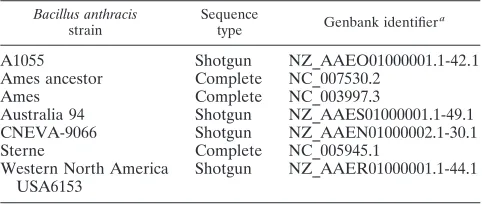
Bioinformatics and primer design.TheB. anthracissequences used in the in silico SNR analysis are summarized in Table 2. The fasta format sequences were processed by use of a perl script to identify all A-T polymorphisms with lengths of⬎6 nucleotides; the position of each polymorphism was then used to create a primer3 input file. The primer3 input file contained 250 bases of sequence flanking each side of the putative polymorphism, which was specified as the target for primer design (18). Polymorphisms with less than 250 bases of flanking sequence on either side were not considered in this analysis. Primer3 was run with the default options, producing five primer pairs (primer pairs 0 to 4) for each amplicon. The primer3 output was processed by use of a perl script to extract the amplicon sequences and write them to a fasta file. The fasta file was then used as input for tgicl (http://www.tigr.org/tdb/tgi/publications/TGICL.pdf) to cluster similar amplicons. The tgicl software generated a cluster file (which assigns each sequence to a unique cluster without assembling the sequences). Any cluster that did not contain at least one polymorphism longer than 9 bases was then removed from the analysis, as it allowed a manageable data set repre-senting the equivalent of three codons. Nei’s marker diversity index (D) was calculated as 1 ⫺ ⌺(allele frequency)2
for each cluster by using predicted amplicon sizes for the first primer set (primer set 0).
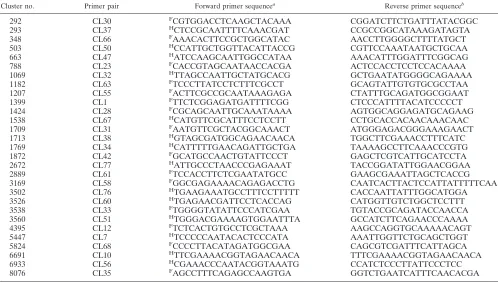
Single-nucleotide repeat analysis.Primers for clusters with at least six mem-bers for chromosomal clusters and four memmem-bers for plasmid clusters and a diversity index of⬎0.41 were synthesized with a phosphoramidite fluorescent dye (FAM or HEX) covalently linked to the forward primer (Table 3). The primers used to sequence these loci contained 5⬘M13 tails (forward primers) or T7 tails (reverse primers). The PCR mixtures contained 1⫻AmpliTaq gold PCR buffer and 0.5 U of AmpliTaq gold DNA polymerase (Applied Biosystems Inc.), 2 mM MgCl2, dNTPs (0.2 mM each), and forward and reverse primers (0.4M each).
Approximately 2 ng of template DNA was used per 25-l reaction mixture. The thermocycling conditions were 95°C for 5 min; 35 cycles of 94°C for 30 s, 60°C for 30 s, and 72°C for 30 s; and finally, 72°C for 7 min. Phusion high-fidelity DNA polymerase (New England Biolabs, Inc., Pickering, Ontario, Canada) was also used to reduce split peak fragments. The PCR mixtures contained 1⫻Phusion HF buffer (with MgCl2), 1 U of Phusion DNA polymerase (New England
[image:2.585.43.289.73.288.2]Bio-labs, Inc.), dNTPs (0.2 mM each), and forward and reverse primers (0.4M each). Approximately 2 ng of template DNA was used per 25-l reaction mix-ture. The thermocycling conditions were 98°C for 30 s; 35 cycles of 98°C for 10 s, 60°C for 30 s, and 72°C for 30 s; and finally, 72°C for 7 min. PCR products containing phosphoramidite fluorescent dyes were diluted 1/80. HiDi formamide (8l) and 1l of the diluted PCR products were combined with 1l of size standard Rhodamine-X Mapmaker 70 to 400 bp and CST ROX 420-800 (Bio-Ventures Inc.). These products were analyzed on an ABI 3100 genetic analyzer and sized by using GeneMapper (Applied Biosystems Inc.). When required, the amplicons were sequenced to confirm the polymorphisms, as described above. The PCR primers used to amplify the SNR regions ofB. anthraciscontained 5⬘ tails (T7 or M13 primers). The T7 and M13 primers were used to sequence the PCR products.
TABLE 1. B. anthracisstrains used
Strain name Source, yr of isolation
9604 ...Bovine, Oyen, Alberta, Canada, 1996
9807 ...Bison/deer, Winnipeg, Manitoba, Canada, 1998 9911 ...Bovine, Red Deer, Alberta, Canada 1999 9937 ...Bovine, Alhambra, Alberta, Canada, 1999 03-0139...Bovine spleen, Cadam provincial lab, Manitoba,
Canada, 2003
03-0191...Bovine blood culture, Manitoba Agriculture and Food, 2003
200077 ...Bovine, Zhoda, Manitoba, Canada, 2000 17T5 ...Kudu, South Africa, 1957
93-189c ...Bison, Hay River, NWT, Canada 1993 94-188c ...Bovine, Avonlea, Saskatchewan, Canada 1994 9609 ...Bovine, High Level, Alberta, Canada, 1996 9614 ...Bovine, High Level, Alberta, Canada, 1996 9946 ...Bovine, Alhambra, Alberta, Canada, 1999 Ames ...Bovine, Texas, 1981
Buffalo...Buffalo, Iowa, 1979
SK31...Wildebeest, South Africa, 1974 Sterne...Vaccine strain
[image:2.585.301.542.81.183.2]Vollum ...Cow, ca. 1944 Vollum1B ...Derived from Vollum
TABLE 2. B. anthracissequences used for in silico SNR analysis
Bacillus anthracis
strain
Sequence
type Genbank identifier
a
A1055 Shotgun NZ_AAEO01000001.1-42.1
Ames ancestor Complete NC_007530.2
Ames Complete NC_003997.3
Australia 94 Shotgun NZ_AAES01000001.1-49.1 CNEVA-9066 Shotgun NZ_AAEN01000002.1-30.1
Sterne Complete NC_005945.1
Western North America USA6153
Shotgun NZ_AAER01000001.1-44.1
ahttp.www.ncbi.nlm.nih.gov.
on May 16, 2020 by guest
http://jcm.asm.org/
RESULTS
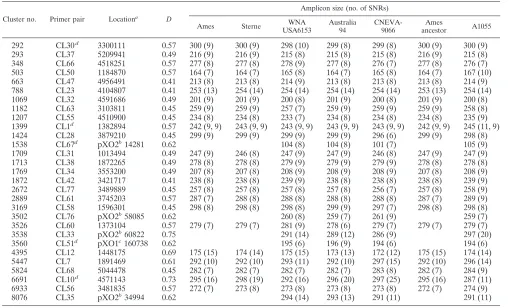
In silico analysis of the SNR loci ofB. anthracisrevealed 74 regions within theB. anthracisgenome that had A-T mononu-cleotide repeats that were greater than 9 bp for at least one strain used in the analysis. Sixty of these appeared to be poly-morphic and to have at least one member of the cluster with a repeat region greater than 9 bp in length. Initial PCR screening of 39 candidate loci from the in silico analysis withDvalues ranging from 0 to 0.75 was performed with sevenB. anthracis strains of various MLVA types. The level of polymorphism detected by sequencing and fragment analysis of the SNR loci correlated well with theDvalues determined by in silico anal-ysis, in that the higher theDvalue was, the greater the number of alleles present at a given SNR locus. Most of the SNR loci of interest were chromosomal; the exceptions were four loci present on the pXO2 plasmid and one locus present on the pXO1 plasmid. Most of the repeats do not appear to be in coding regions of identified proteins, although several were found in hypothetical protein-coding regions. Their presence outside of coding regions is interesting, as it reduces the selec-tive pressure to maintain the length of the repeats due to codon usage.
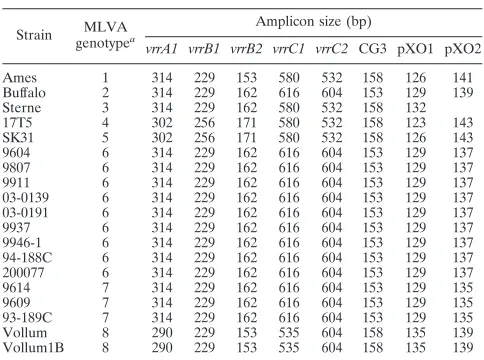
From this preliminary screen of 39 candidate loci, 29 loci exhibiting polymorphisms (Table 4) were screened against a larger panel of B. anthracis strains (Table 1). Seven SNR primer sets (for loci CL50, CL47, CL32, CL63, CL55, CL77, and CL35) inconsistently or poorly amplified the SNR loci and were not used further in this study. The remaining 22 SNR
[image:3.585.43.541.82.364.2]primer sets were able to reproducibly amplify the SNR loci and thus were used for the subsequent analysis of B. anthracis strains of established MLVA types (Table 5). Amplicon sizes were as expected by fragment size analysis and/or direct se-quencing, as were the differences in amplicon lengths between strains compared to the lengths determined by in silico analy-sis, with some minor differences (Table 6). There were small differences between the expected and the observed amplicon lengths of⫾1 to⫾3 bp. This small difference in amplicon size was consistent within amplicons produced from the same primer pairs and is likely due to the 5⬘ modification of the primer. Many SNR amplicons produced multiple split peaks when they were analyzed on the ABI 3100 genetic analyzer. This may be due in part to incomplete 3⬘adenylation of am-plicons byTaqpolymerase. Phusion polymerase was used with some success to reduce the occurrence of split peaks. Phusion polymerase produces blunt-end products and thus eliminates variation of the PCR products due to incomplete 3⬘ adenyla-tion. Analysis on the ABI 3100 genetic analyzer usually pro-duced a cluster of two or four peaks within 3 bp of each other. The first and fourth peaks, when they were present, had sub-stantially less fluorescence than the second and third peaks. The peak with the highest fluorescence in the cluster was used to size the amplicons. The polymorphic loci were sequenced directly to confirm the polymorphisms. Sequence analysis al-lowed the comparison of the nucleotide sequences of the loci; however, some loci (loci CL10, CL33, and CL12) were difficult to sequence directly, possibly due to the length of the repeat TABLE 3. SNR primer sequences used to screenB. anthracisstrains
Cluster no. Primer pair Forward primer sequencea Reverse primer sequenceb
292 CL30 FCGTGGACCTCAAGCTACAAA CGGATCTTCTGATTTATACGGC
293 CL37 HCTCCGCAATTTTCAAACGAT CCGCCGGCATAAAGATAGTA
348 CL66 FAAACACTTCCGCTGGCATAC AACCTTGGGGCTTTTATGCT
503 CL50 HCCATTGCTGGTTACATTACCG CGTTCCAAATAATGCTGCAA
663 CL47 HATCCAAGCAATTGGCCATAA AAACATTTGGATTTCGGCAG
788 CL23 FCACCGTAGCAATAACCACGA ACTCCACCTCCTCCACAAAA
1069 CL32 HTTAGCCAATTGCTATGCACG GCTGAATATGGGGCAGAAAA
1182 CL63 FTCCCTTATCCTCTTTCGCCT GCAGTATTGTGTGCGCCTAA
1207 CL55 FACTTCGCCGCAATAAAGAGA CTATTTGCAGATGGCGGAAT
1399 CL1 FTTCTCGGAGATGATTTTCGG CTCCCATTTTACATCCCCCT
1424 CL28 FCGCAGCAATTGCAAATAAAA AGTGGCAGGAGATGCAGAAG
1538 CL67 HCATGTTCGCATTTCCTCCTT CCTGCACCACAACAAACAAC
1709 CL31 FAATGTTCGCTACGGCAAACT ATGGGAGACGGGAAAGAACT
1713 CL38 HGTAGCGATGGCAGAACAACA TGGCTTCGAAACCTTTCATC
1769 CL34 HCATTTTTGAACAGATTGCTGA TAAAAGCCTTCAAACCCGTG
1872 CL42 FGCATGCCAACTGTATTCCCT GAGCTCGTCATTGCATCCTA
2672 CL77 HATTGCCCTAACCCGAGAAAT TACCGGATATTGGAACGGAA
2889 CL61 FTCCACCTTCTCGAATATGCC GAAGCGAAATTAGCTCACCG
3169 CL58 FGGCGAGAAAACAGAGACCTG CAATCACTTACTCCATTATTTTTCAA
3502 CL76 HTGAAGAAATGCCTTTCCTTTTT CACCAATTATTTGGCATGGA
3526 CL60 HTGAGAACGATTCCTCACCAG CATGGTTGTCTGGCTCCTTT
3538 CL33 FTGGGGTATATTCCCATCGAA TGTACCGCAGATACCAACCA
3560 CL51 HTGGGACGAAAAGTGGAATTTA GCCATCTTCAGAACCCAAAA
4395 CL12 FTCTCACTGTGCCTCGCTAAA AAGCCAGGTGCAAAAACAGT
5447 CL7 HTCCCCCAATACACTCCCATA AAATTGGTTCTGCAGCTGGT
5824 CL68 FCCCCTTACATAGATGGCGAA CAGCGTCGATTTCATTAGCA
6691 CL10 HTTCGAAAACGGTAGAACAACA TTTCGAAAACGGTAGAACAACA
6933 CL56 HCGAAACCCAATACGGTAAATG CCATCTCCCTTATTCCCTCC
8076 CL35 FAGCCTTTCAGAGCCAAGTGA GGTCTGAATCATTTCAACACGA
a
The M13 primer (5⬘-GTAAAACGACGGCCAGT-3⬘) was used as a 5⬘tail on the primers for sequencing. Superscript letters: F, primers that were labeled 5⬘with FAM when the amplicons were used for fragment analysis; H, primers that were labeled 5⬘with HEX when the amplicons were used for fragment analysis.
b
The T7 primer (5⬘-TAATACGACTCACTATAGGG-3⬘) was used as a 5⬘tail on the primers for sequencing.
on May 16, 2020 by guest
http://jcm.asm.org/
region. With these three loci, the data from in silico analysis and successful direct sequencing of several strains allowed the size of the SNR to be established to⫾2 bp. Sequence analysis was able to distinguish between alleles of amplicons that had multiple SNR regions that masked the polymorphisms present at each SNR region (CL1 locus), since fragment analysis at this locus was not informative. Many of the SNR loci showed lim-ited polymorphisms when they were used to screen the B. anthracisstrains selected (Table 6).
The B. anthracis strains that were indistinguishable from each other by standard MLVA analysis (Table 5) were often distinctive at one or several SNR loci (Table 6). Several SNR loci had unique alleles for isolates of a specific MLVA geno-type, although this may be due to the small sample sizes for these MLVA genotypes.
DISCUSSION
In an outbreak situation, the use of a marker system that exploits regions with very high mutation rates, such as SNRs, allows the differentiation of isolates with extremely low levels of genetic diversity. This paper describes the selection and the in silico analysis of SNR loci. Those loci with the highest diversity indices were selected and used to analyze a number of B. anthracisstrains that had the same MLVA genotype. These
SNR markers allowed most strains with the same MLVA type to be differentiated from each other.
Molecular typing ofB. anthracishas been possible due to the exploitation of VNTRs by MLVA. VNTR mutation rates are low enough to maintain their sizing through 100,000 genera-tions with only one change in allele size (8). MLVA mutation rates are locus dependent but have been reported to be be-tween 10⫺5and 10⫺4per generation inB. anthracisand greater
than 10⫺3mutations per generation in other bacterial species
(9). The use of additional MLVA markers beyond the eight markers used in this study may differentiate between the strains used in this experiment. However, some SNR markers have higher mutation rates and perhaps higher diversity index values than most MLVA markers and therefore offer the best chance of discriminating between isolates with low levels of genetic diversity. It may not be appropriate to use these mark-ers to establish phylogenetic relationships among divmark-erse iso-lates due to homoplasy because of the high mutation rates of these markers (9). These SNR markers are best used as a molecular epidemiological tool for examination of very closely related isolates that are indistinguishable by MLVA, thereby allowing one to distinguish closely related strains more accu-rately at the terminal branches of the phylogenetic tree.
[image:4.585.41.550.80.388.2]Alternative molecular typing methods that could provide isolate discrimination include whole-genome sequencing and TABLE 4. In silico analysis of SNR loci fromB. anthracissequenced genomes
Cluster no. Primer pair Locationa
D
Amplicon size (no. of SNRs)
Ames Sterne WNA
USA6153
Australia 94
CNEVA-9066
Ames
ancestor A1055
292 CL30d 3300111 0.57 300 (9) 300 (9) 298 (10) 299 (8) 299 (8) 300 (9) 300 (9)
293 CL37 5209941 0.49 216 (9) 216 (9) 215 (8) 215 (8) 215 (8) 216 (9) 215 (8) 348 CL66 4518251 0.57 277 (8) 277 (8) 278 (9) 277 (8) 276 (7) 277 (8) 276 (7) 503 CL50 1184870 0.57 164 (7) 164 (7) 165 (8) 164 (7) 165 (8) 164 (7) 167 (10) 663 CL47 4956491 0.41 213 (8) 213 (8) 214 (9) 213 (8) 213 (8) 213 (8) 214 (9) 788 CL23 4104807 0.41 253 (13) 254 (14) 254 (14) 254 (14) 254 (14) 253 (13) 254 (14) 1069 CL32 4591686 0.49 201 (9) 201 (9) 200 (8) 201 (9) 200 (8) 201 (9) 200 (8) 1182 CL63 3103811 0.45 259 (9) 259 (9) 257 (7) 259 (9) 259 (9) 259 (9) 258 (8) 1207 CL55 4510900 0.45 234 (8) 234 (8) 233 (7) 234 (8) 234 (8) 234 (8) 235 (9) 1399 CL1d 1382894 0.57 242 (9, 9) 243 (9, 9) 243 (9, 9) 243 (9, 9) 243 (9, 9) 242 (9, 9) 245 (11, 9)
1424 CL28 3879210 0.45 299 (9) 299 (9) 299 (9) 299 (9) 296 (6) 299 (9) 298 (8)
1538 CL67d pXO2b14281 0.62 104 (8) 104 (8) 101 (7) 105 (9)
1709 CL31 1013494 0.49 247 (9) 246 (8) 247 (9) 247 (9) 246 (8) 247 (9) 247 (9) 1713 CL38 1872265 0.49 278 (8) 278 (8) 279 (9) 279 (9) 279 (9) 278 (8) 278 (8) 1769 CL34 3553200 0.49 207 (8) 207 (8) 208 (9) 208 (9) 208 (9) 207 (8) 208 (9) 1872 CL42 3421717 0.41 238 (8) 238 (8) 239 (9) 238 (8) 238 (8) 238 (8) 239 (9) 2672 CL77 3489889 0.45 257 (8) 257 (8) 257 (8) 257 (8) 256 (7) 257 (8) 258 (9) 2889 CL61 3745203 0.57 287 (7) 288 (8) 288 (8) 288 (8) 288 (8) 287 (7) 289 (9) 3169 CL58 1596301 0.45 298 (8) 298 (8) 298 (8) 299 (9) 297 (7) 298 (8) 298 (8)
3502 CL76 pXO2b58085 0.62 260 (8) 259 (7) 261 (9) 259 (7)
3526 CL60 1373104 0.57 279 (7) 279 (7) 281 (9) 278 (6) 279 (7) 279 (7) 279 (7)
3538 CL33 pXO2b60822 0.75 291 (14) 289 (12) 286 (9) 297 (20)
3560 CL51d pXO1c160738 0.62 195 (6) 196 (9) 194 (6) 194 (6)
4395 CL12 1448175 0.69 175 (15) 174 (14) 175 (15) 173 (13) 172 (12) 175 (15) 174 (14) 5447 CL7 1891469 0.61 292 (10) 292 (10) 293 (11) 292 (10) 297 (15) 292 (10) 296 (14) 5824 CL68 5044478 0.45 282 (7) 282 (7) 282 (7) 282 (7) 283 (8) 282 (7) 284 (9) 6691 CL10d 4571143 0.73 295 (16) 298 (19) 292 (16) 296 (20) 297 (25) 295 (16) 287 (11)
6933 CL56 3481835 0.57 272 (7) 273 (8) 273 (8) 273 (8) 273 (8) 272 (7) 274 (9)
8076 CL35 pXO2b34994 0.62 294 (14) 293 (13) 291 (11) 291 (11)
aLocation established by using Sterne strain coordinates of the first possible repeat within the amplicon. bpXO2 plasmid sequence AF188935 coordinates of the first repeat region within the amplicon. cpXO1 plasmid sequence NC_001496 coordinates of the first repeat region within the amplicon.
dAmplicon length difference independent of repeat length difference due to complex or interrupted repeats.
on May 16, 2020 by guest
http://jcm.asm.org/
microarray-based resequencing. Whole-genome sequencing reveals polymorphisms for typing purposes by allowing com-parisons of entire genomes from isolates of interest; however, this technique remains cost prohibitive and is not feasible for large sample sizes (17). Microarray-based resequencing ofB. anthracishas been carried out with 56 strains ofB. anthracis (22). Resequencing allows one to survey large areas of the genome for strain-specific variations; however, the proper se-lection of the regions to be represented on the chip is crucial, since only a portion of the genome is examined. Although this technique is well suited to large sample sizes, it is cost prohib-itive and is dependent on which portions of the genome have been exploited.
As expected, there is a positive correlation between diversity (D) and the length of the repeat, since larger mononucleotide SSRs are more likely to undergo slip-strand mispairing, result-ing in greater variability in repeat length (1). A highly signifi-cant correlation between total repeat length and the number of alleles has been described forB. anthraciswith larger repeat units (11). In our study, some plasmid SNRs were among the most polymorphic markers evaluated. Unlike chromosomal loci, plasmid loci are present in multiple copies and the detec-tion of transient states of SNRs may be possible.
[image:5.585.306.523.84.723.2]Differences in the number of polymorphic SNR loci for strains with identical MLVA genotypes were observed. There were two locus differences for 9609/9614/93-189C; two locus differences between Vollum and Vollum 1B; and seven locus differences between 17T5 and SK31, although the pXO1 MLVA locus was polymorphic between the two strains. When nine otherB. anthracisstrains with the same MLVA genotype were compared (strain 9604, 9807, 9911, 03-0139, 03-0191, 9937, 9946, 94-188C, and 200077), 22 different alleles were identified at a combined seven loci. Seven of the nine strains were distinguished from each other by the use of four SNR loci (the CL10, CL12, CL33, and CL76 loci). While our study demonstrates that SNR analysis does allow strains with the same MLVA genotype to be further distinguished from each other, two sets of isolates were not readily distinguished from
TABLE 5. MLVA typing results at eight loci for
19B. anthracisstrains
Strain MLVA genotypea
Amplicon size (bp)
vrrA1 vrrB1 vrrB2 vrrC1 vrrC2 CG3 pXO1 pXO2
Ames 1 314 229 153 580 532 158 126 141
Buffalo 2 314 229 162 616 604 153 129 139 Sterne 3 314 229 162 580 532 158 132
17T5 4 302 256 171 580 532 158 123 143
SK31 5 302 256 171 580 532 158 126 143
9604 6 314 229 162 616 604 153 129 137
9807 6 314 229 162 616 604 153 129 137
9911 6 314 229 162 616 604 153 129 137
03-0139 6 314 229 162 616 604 153 129 137 03-0191 6 314 229 162 616 604 153 129 137
9937 6 314 229 162 616 604 153 129 137
9946-1 6 314 229 162 616 604 153 129 137 94-188C 6 314 229 162 616 604 153 129 137 200077 6 314 229 162 616 604 153 129 137
9614 7 314 229 162 616 604 153 129 135
9609 7 314 229 162 616 604 153 129 135
93-189C 7 314 229 162 616 604 153 129 135 Vollum 8 290 229 153 535 604 158 135 139 Vollum1B 8 290 229 153 535 604 158 135 139
aThe MLVA genotype is a number assigned to identify distinct MLVA
ge-notypes. TABLE 6. Lengths of repeats at polymorphic loci for 19 B. anthracis strains Strain MLVA genotype a Repeat length(s) (bp) CL10 b CL12 b CL7 CL33 b CL76 b CL60 CL56 CL61 CL1 d CL66 CL30 CL34 b CL31 CL68 CL37 CL38 CL58 b CL28 CL42 CL23 b CL67 Ames 1 16 15 10 35 13 7 7 7 9, 9 9 9 8 9798 1 4 98 1 3 8 Buf falo 2 16 15 11 14 14 8 8 8 9, 9 9 10 9 9789 1 4 99 1 4 8 Sterne 3 18 14 10 N c N 788 9 , 9 9 9 8 8798 1 4 98 1 4 N 17T5 4 19 13 17 8 15 7 7 7 8, 10 8 8 9 9889 1 3 78 1 3 7 SK31 5 21 15 17 8 12 7 8 8 8, 10 8 8 9 8889 1 3 99 1 3 7 9604 6 13 13 11 18 14 9 8 8 9, 10 9 10 9 9789 1 4 99 1 4 8 9807 6 12 14 11 13 14 9 8 8 9, 9 9 10 9 9789 1 4 99 1 4 8 9911 6 15 13 11 17 14 9 8 8 9, 9 9 10 9 9789 1 4 99 1 4 8 03-0139 6 16 12 11 13 14 8 8 8 9, 9 9 10 9 9789 1 4 99 1 4 8 03-0191 6 16 12 11 13 14 8 8 8 9, 9 9 10 9 9789 1 4 99 1 4 8 9937 6 15 13 11 18 15 9 8 8 9, 9 9 10 9 9789 1 4 99 1 4 8 9946-1 6 15 13 11 18 14 9 8 8 9, 9 9 10 9 9789 1 4 99 1 4 8 94-188C 6 16 13 11 13 14 8 8 8 9, 9 9 10 9 9788 1 4 98 1 4 8 200077 6 15 12 11 12 14 7 8 8 9, 9 9 10 9 9789 1 4 99 1 4 8 9614 7 15 13 11 15 14 9 8 8 9, 9 9 10 9 9789 1 4 99 1 4 8 9609 7 15 13 11 15 14 9 8 8 9, 9 9 10 9 9789 1 4 99 1 4 8 93-189C 7 15 12 11 15 14 9 8 8 9, 9 9 10 9 9789 1 4 99 1 4 8 Vollum 8 10 13 11 18 13 7 7 8 9, 9 8 10 9 9789 1 4 89 1 4 8 Vollum1B 8 10 13 12 19 13 7 7 8 9, 9 8 10 9 9789 1 4 89 1 4 8 a The MLVA genotype is a number assigned to identify distinct MLVA genotypes. b Imperfect repeats or ambiguous sequence. c N, not tested because pXO2 markers are absent from strain Sterne (pXO2 negative). d The pairs of numbers in the column represent two dif ferent SNR loci found in the same amplicon.
on May 16, 2020 by guest
http://jcm.asm.org/
[image:5.585.42.284.86.266.2]each other. One set included strains 9609 and 9614, which were from the same outbreak. It is interesting that strains 9937 and 9946 were isolated in the same year at the same location (Alhambra, Alberta, Canada) and had distinctive SNR geno-types. The other set of SNR identical isolates were 03-0191 and 03-0139, which were both isolated from bovines in Manitoba, Canada, in 2003; but the nature of their isolation is not clear (they may have been from the same outbreak or even the same animal). Although the use of the most polymorphic SNR mark-ers may be a prudent first step in attempting to distinguish between several isolates with identical MLVA genotypes (the CL10, CL12, CL33, CL76, and CL60 loci), any one of the SNR markers (Table 6) may prove to be discriminatory between isolates. This technique is laborious and may not be suited to high-throughput automation; it uses specialized molecular typ-ing equipment but can be easily adopted by laboratories that perform MLVA. This technique allows isolates ofB. anthracis to be distinguished from each other when other typing meth-ods fail to discriminate them; therefore, in epidemiological studies or in forensic investigations, this may be the only tech-nique that offers the discriminatory power required.
Screening of the SNR markers (Table 3) against a more genetically and geographically diverse group of B. anthracis isolates to determine the full breadth of the SNR polymor-phisms would be an important next step. Also, testing of these markers against a larger group of isolates with the same MLVA genotype is crucial in order to determine the utility of these markers for the differentiation of B. anthracis isolates and for epidemiological analysis ofB. anthracisoutbreaks.
ACKNOWLEDGMENTS
This work was supported by the Chemical, Biological, Radiological, Nuclear Research and Technology Initiative (CRTI project 02-0069RD). The excellent technical assistance of D. Johnstone, T. MacMillan, and M. Russell is noted with appreciation. Thanks go to Barry Ford and John Cherwonogrodzky for reviewing this work.
REFERENCES
1.Coenye, T., and P. Vandamme.2003. Simple sequence repeats and compo-sitional bias in bipartiteRalstonia solanacearumGMI1000 genome. BMC Microbiol.4:10. [Online.] http://www.biomedcentral.com/1471-2164/4/10. 2.Diamant, E., Y. Palti, R. Gur-Arie, H. Cohen, E. M. Haller, and Y. Kashi.
2004. Phylogeny and strain typing ofEscherichia coli, inferred from mono-nucleotide repeat loci. Appl. Environ. Microbiol.70:2464–2473.
3.Gur-Arie, R., C. J. Cohen, Y. Eitan, L. Shelef, E. M. Hallerman, and Y. Kashi.2000. Simple sequence repeats inEscherichia coli: abundance, distri-bution, composition and polymorphism. Genome Res.10:62–71. 4.Harrell, L. J., G. L. Andersen, and K. H. Wilson.1995. Genetic variability of
Bacillus anthracisand related species. J. Clin. Microbiol.33:1847–1850. 5.Helgason, E., D. A. Caugant, M. M. Lecadet, Y. H. Chen, J. Mahillon, A.
Lo¨vgren, I. Hegna, K. Kvaløy, and A.-B. Kolstø.1998. Genetic diversity of
Bacillus cereus/B. thuringiensisisolates from natural sources. Curr. Microbiol. 37:80–87.
6.Hill, K. K., L. O. Ticknor, R. T. Okinaka, M. Asay, H. Blair, K. A. Bliss, M. Laker, P. E. Pardington, A. P. Richardson, M. Tonks, D. J. Beecher, J. D. Kemp, A.-B. Kolstø, A. C. Lee Wong, P. Keim, and P. J. Jackson.2004. Fluorescent amplified fragment length polymorphism analysis ofBacillus
anthracis,Bacillus cereus, andBacillusisolates. Appl. Environ. Microbiol. 70:1068–1080.
7.Keim, P., A. Kalif, J. M. Schupp, K. K. Hill, S. E. Travis, K. Richmond, D. M. Adair, M. E. Hugh-Jones, C. R. Kuske, and P. Jackson.1997. Molecular evolution and diversity inBacillus anthracisas detected by amplified frag-ment length polymorphism markers. J. Bacteriol.179:818–824.
8.Keim, P., L. B. Price, A. M. Klevytska, K. L. Smith, J. M. Schupp, R. Okinaka, P. J. Jackson, and M. E. Hugh-Jones.2000. Multiple-locus vari-able-number tandem repeat analysis reveals genetic relationships within
Bacillus anthracis. J. Bacteriol.182:2928–2936.
9.Keim, P., M. N. Van Ert, T. Pearson, A. J. Vogler, L. Y. Huynh, and D. M. Wagner.2004. Anthrax molecular epidemiology and forensics: using the appropriate marker for different evolutionary scales. Infect. Genet. Evol. 4:205–213.
10.Koehler, T. M.2002.Bacillus anthracisgenetics and virulence gene regula-tion. Curr. Top. Microbiol. Immunol.71:143–164.
11.Le Fle`che, P., Y. Hauck, L. Onteniente, A. Prieur, F. Denoeud, V. Ramisse, P. Sylvestre, G. Benson, F. Ramisse, and G. Vergnaud.2001. A tandem repeats database for bacterial genomes: application to the genotyping of
Yersinia pestisandBacillus anthracis. BMC Microbiol.1:2. [Online.] http: //www.biomedcentral.com/1471-2180/1/2.
12.Levinson, G., and G. A. Gutman.1987. Slipped-strand mispairing: a major mechanism for DNA sequence evolution. Mol. Biol. Evol.4:203–221. 13.Moxon, E. R., and P. B. Rainey.1995. Pathogenic bacteria: the wisdom of
their genes, p. 255–268.InB. A. M. Van der Zeijst, L. Van Alphen, W. P. M. Hoekstra, and J. D. A. van Embden (ed.), Ecology of pathogenic bacteria. Royal Dutch Academy of Sciences, second series, no. 96. Royal Dutch Academy of Sciences, Amsterdam, The Netherlands.
14.Okinaka, R., K. Cloud, O. Hampton, A. Hoffmaster, K. Hill, P. Keim, T. M. Koehler, G. Lamke, S. Kumano, J. Mahillon, D. Manter, Y. Martinez, D. Ricke, R. Svensson, and P. J. Jackson.1999. Sequence and organization of pXO1, the large Bacillus anthracis plasmid harboring the anthrax toxin genes. J. Bacteriol.181:6509–6515.
15.Pearson, T., J. D. Busch, J. Ravel, T. D. Read, S. D. Rhoton, J. M. U’Ren, T. S. Simonson, S. M. Kachur, R. R. Leadem, M. L. Cardon, M. N. Van Ert, L. Y. Huynh, C. M. Fraser, and P. Keim.2004. Phylogenetic discovery bias inBacillus anthracis using single-nucleotide polymorphisms from whole-genome sequencing. Proc. Natl. Acad. Sci. USA101:13536–13541. 16.Read, T. D., S. L. Salzberg, M. Pop, M. Shumway, L. Umayam, L. Jiang, E.
Holtzapple, J. D. Busch, K. L. Smith, J. M. Schupp, D. Solomon, P. Keim, and C. M. Fraser.2002. Comparative genome sequencing for discovery of novel polymorphisms inBacillus anthracis. Science296:2028–2033. 17.Read, T. D., S. N. Peterson, N. Tourasse, L. W. Baillie, I. T. Paulsen, K. E.
Nelson, H. Tettelin, D. E. Fouts, J. A. Eisen, S. R. Gill, E. K. Holtzapple, O. A. Okstad, E. Helgason, J. Rilstone, M. Wu, J. F. Kolonay, M. J. Beanan, R. J. Dodson, L. M. Brinkac, M. Gwinn, R. T. Deboy, R. Madpu, S. C. Daugherty, A. S. Durkin, D. H. Haft, W. C. Nelson, J. D. Peterson, M. Pop, H. M. Khouri, D. Radune, J. L. Benton, Y. Mahamoud, L. Jiang, I. R. Hance, J. F. Weidman, K. J. Berry, R. D. Plaut, A. M. Wolf, K. L. Watkins, W. C. Nierman, A. Hazen, R. Cline, C. Redmond, J. E. Thwaite, O. White, S. L. Salzberg, B. Thomason, A. M. Friedlander, T. M. Koehler, P. C. Hanna, A. B. Kolsto, and C. M. Fraser.2003. The genome sequence of Bacillus anthracis Ames and comparison to closely related bacteria. Nature423: 81–86.
18.Rozen, S., and H. J. Skaletsky.2000. Primer3 on the WWW for general users and for biologist programmers, p. 365–386.InS. Krawetz and S. Misener (ed.), Bioinformatics methods and protocols: methods in molecular biology. Humana Press, Totowa, N.J.
19.Ticknor, L. O., A.-B. Kolstø, K. K. Hill, P. Keim, M. T. Laker, M. Tonks, and P. J. Jackson.2001. Fluorescent amplified fragment length polymorphism analysis of NorwegianBacillus cereusandBacillus thuringiensissoil isolates. Appl. Environ. Microbiol.67:4863–4873.
20.van Belkum, A., S. Scherer, L. van Alphen, and H. Verbrugh.1998. Short-sequence DNA repeats in prokaryotic genomes. Microbiol. Mol. Biol. Rev. 62:275–293.
21.Vogler, A. J., J. D. Busch, S. Percy-Fine, C. Tipton-Hunton, K. L. Smith, and P. Keim.2002. Molecular analysis of rifampin resistance inBacillus anthracis
andBacillus cereus. Antimicrob. Agents Chemother.46:511–513. 22.Zwick, M. E., F. Mcafee, D. J. Cutler, T. D. Read, J. Ravel, G. R. Bowman,
D. R. Galloway, and A. Mateczun.2004. Microarray-based resequencing of multipleBacillus anthracisisolates. Genome Biol.6:R10.