The London School of Economics and Political Science
The Influence of Total Domestic Outsourcing on the Role
of the IT Function: A Case Study of the BBC
Hemini Mehta
Declaration
I certify that the thesis I have presented for examination for the PhD degree of the London School of Economics and Political Science is solely my own work other than where I have clearly indicated that it is the work of others (in which case the extent of any work carried out jointly by me and any other person is clearly identified in it).
The copyright of this thesis rests with the author. Quotation from it is
permitted, provided that full acknowledgement is made. This thesis may not be reproduced without the prior written consent of the author.
Abstract
The prominent themes of the research are total domestic outsourcing and the role of the IT function. The latter has been an issue for researchers and practitioners since the early days of information systems. The role of IT has changed considerably over the years, from basic administrative data processing to the central focus of enabling strategic processes. The literature reveals the considerable changes that have taken place over the last 30 years in the role of the IT function. The IT department over the years has moved from a traditional manufacturing role, where the department would be involved in software development and maintenance, computer operations, and technical services, to a more services orientated role.
In addition, IT outsourcing has grown over the past thirty years to become a major industry. It usually involves some transfer of assets and staff to the vendor. The concept of IT outsourcing has changed over the years from a tactical option for the IT function to, in some cases, a significant part of a long-term strategy to structure and manage organisations. As such, it has often had a considerable influence on the role of the IT function.
Although much has been written about IT sourcing strategy, there is a gap in the literature regarding in-depth case studies of the impact of IT outsourcing on the IT function, seen within various levels of the organisation, from senior management down to operations, and everyday users. Similarly, there are few studies that consider IT outsourcing in the context of other competitive and industrial forces that are affecting the management and operation of large organisations. This research comprises a
detailed case study of the implementation of large-scale domestic IT outsourcing within the British Broadcasting Corporation (BBC). It utilises Activity Theory as a lens to examine the implementation from the perspective of various stakeholder groups at different levels within the organisation in order to address the research question: “What is the influence of total domestic IT outsourcing on the role of the IT function?”
Acknowledgements
First and foremost I would like to thank my wonderfully supportive family – Mum, Dad, Panna, Bijal, Bunty and Dylan. Thank you for being with me every step of this strange and amazing journey. With faith and my family I have finally reached this point.
Secondly, I must thank my supervisor Dr Steve Smithson for guiding me on this expedition. You have been on this rather long trip with me, and guided me through the various terrains. Your advice and laid back nature has helped me more than you realise.
My PhD friends, Dr Savita Bailur, Dr Harinder Mann, Patrizia Bertini and Huey Tan, your friendship has been a source of comfort. My gratitude to the PhD students and academics of the Information Systems group for their debates, discussions, advice and camaraderie throughout the PhD process.
The staff I interviewed and talked with at the BBC were great. Every single person I came across for input, were willing to talk openly and honestly, and went out of their way to make sure I had the information I required.
I would like to thank Harpreet Ghai and Pareena Khairdin for their amazing support when I needed it the most. There are so many friends and family that I cannot name them all, but would like to thank you for the support and kindness you have shown me.
Table of Contents
List of Abbreviations i
List of Figures and Tables ii
1. Introduction 1
1.1 Background of the Project 1
1.1.1 A Brief History: Role of the IT Function 2
1.2 Research Questions 4
1.3 Thesis Structure 6
1.4 Summary 9
2. Literature Review 11
2.1 Introduction 11
2.2 Role 12
2.3 Role of Information Technology 17
2.3.1 Recent Issues 19
2.4 Information Technology Function 20
2.4.1 The Centralisation vs. Decentralisation Debate 25 2.5 Changing Role of Information Technology Function 27
2.5.1 Overview 28
2.5.2 Timeline of End User Computing 34
2.6 Outsourcing 36
2.6.1 Contracts and Service Level Agreements 40
2.6.2 Risks 42
2.6.3 Relationships 43
2.6.4 Personnel 45
2.7 Summary 46
3. Theoretical Framework 48
3.1 Introduction 48
3.2 Actor Network Theory 49
3.3 New Institutionalism 52
3.4 Activity Theory 54
3.4.1 Origins of Activity Theory 55
3.4.2 Present 58
3.5 Limitations of Activity Theory 65
3.7 Summary 70
4. Methodology 71
4.1 Introduction 71
4.2 Epistemology and Ontology 71
4.2.1 Justification of Epistemology and Ontology Selection 76
4.3 Methodology Options 77
4.3.1 Action Research 78
4.3.2 Historical Studies 80
4.3.3 Longitudinal Studies 82
4.3.4 Case Studies 84
4.4 Justification of Methodology 85
4.5 Research Design 86
4.5.1 The Host Organisation 86
4.5.2 Empirical Research 92
4.5.3 Interviews 92
4.5.4 Observation 97
4.5.5 Documents 98
4.6 Analysis Method 99
4.7 Summary 100
5. Findings: Outsourcing 102
5.1 Introduction 102
5.2 BBC Technology 103
5.3 Outsourcing 104
5.3.1 Users’ Perspectives 110
5.3.2 Senior IT Managers’ Perspectives 114
5.3.3 BBC Account Manager’s Perspective 117
5.3.4 Siemens Account Manager’s Perspective 120
5.4 Summary 123
6. Findings: IT Centralisation and Organisation Restructure 125
6.1 Introduction 125
6.2 IT Centralisation and Organisation Restructure 126
6.2.1 Users’ Perspectives 126
6.2.2 Policy Knowledge Management Team’s Perspectives 135
6.2.3 Middle IT Managers’ Perspectives 143
6.3 Summary 161
7. Analysis 163
7.1 Introduction 163
7.2 Overview 165
7.3 Organisational Level Activity 167
7.3.1 Object 167
7.3.2 Subject 167
7.3.3 Community 167
7.3.4 Division of Labour 167
7.3.5 Rules 168
7.3.6 Mediating Artifacts 168
7.3.7 Outcomes 169
7.4 Outsourcing Activity 170
7.4.1 Object 170
7.4.2 Subject 171
7.4.3 Community 171
7.4.4 Division of Labour 171
7.4.5 Rules 171
7.4.6 Mediating Artifacts 172
7.4.7 Outcomes 172
7.5 Siemens Account Manager Level Activity 173
7.5.1 Object 173
7.5.2 Subject 174
7.5.3 Community 174
7.5.4 Division of Labour 176
7.5.5 Rules 177
7.5.6 Mediating Artifacts 177
7.5.7 Outcomes 179
7.6 BBC Account Manager Level Activity 180
7.6.1 Object 180
7.6.2 Subject 180
7.6.3 Community 181
7.6.4 Division of Labour 181
7.6.5 Rules 181
7.6.7 Outcomes 183
7.7 Senior IT Managers‟ Level Activity 184
7.7.1 Object 184
7.7.2 Subject 184
7.7.3 Community 184
7.7.4 Division of Labour 185
7.7.5 Rules 187
7.7.6 Mediating Artifacts 188
7.7.7 Outcomes 189
7.8 Middle IT Managers‟ Level Activity 190
7.8.1 Object 190
7.8.2 Subject 190
7.8.3 Community 190
7.8.4 Division of Labour 190
7.8.5 Rules 192
7.8.6 Mediating Artifacts 193
7.8.7 Outcomes 195
7.9 Policy Knowledge Management Team Level Activity 195
7.9.1 Object 195
7.9.2 Subject 196
7.9.3 Community 196
7.9.4 Division of Labour 196
7.9.5 Rules 198
7.9.6 Mediating Artifacts 200
7.9.7 Outcomes 201
7.10 Users‟ Level Activity 202
7.10.1 Object 202
7.10.2 Subject 203
7.10.3 Community 203
7.10.4 Division of Labour 203
7.10.5 Rules 204
7.10.6 Mediating Artifacts 204
7.10.7 Outcomes 205
7.11.2 Subject 208
7.11.3 Community 208
7.11.4 Division of Labour 209
7.11.5 Rules 209
7.11.6 Mediating Artifacts 210
7.11.7 Outcomes 210
7.12 Concepts of Emotions, Mood and Legitimacy 210
7.13 Activity Theory and its Limitations 213
7.14 Summary 219
8. Discussion 221
8.1 Introduction 221
8.2 Concept of Role and Activity 221
8.3 Roles within the IT Function 223
8.3.1 Account Managers 227
8.3.2 Senior IT Managers 230
8.3.3 Middle IT Managers 234
8.3.4 IT Teams 236
8.3.5 Users 237
8.4 Outsourcing 239
8.5 Summary 247
9.Conclusion 249
9.1 Thesis Synopsis 249
9.2 Research Contributions 251
9.2.1 Theoretical Contributions 252
9.2.2 Methodological Contributions 256
9.2.3 Practical Contributions 258
9.3 Research Limitations 263
9.3.1 Theoretical Limitations 263
9.3.2 Methodological Limitations 263
9.3.3 Practical Limitations 265
9.4 Further Research 265
9.4.1 Further Theoretical Research 265
9.4.2 Further Methodological Research 266
9.4.3 Further Practical Research 266
Appendix 1 268
Appendix 2 274
i
List of Abbreviations
ANT – Actor Network Theory
BBC – British Broadcasting Corporation BPR – Business Process Re-engineering CEO – Chief Executive Officer
CIO – Chief Information Officer
CORMS – Corporate Occupational Risk Management Systems CSCW - Computer Supported Cooperative Work
CTO – Chief Technology Officer DMI - Digital Media Initiative
DMS – Document Management System DVD – Digital Video Disc
E – Electronic
FM&T - Future Media and Technology HCI – Human Computer Interaction HQ – Headquarters
HR – Human Resources
HSS Net – Health, Safety and Security Intranet Site ICT – Information and Communications Technology IS – Information Systems
IT – Information Technology LAN – Local Area Network
MIS – Management Information Systems ORM - Occupational Risk Management PA – Personal Assistant
PAC - Public Accounts Committee PC – Personal computer
PDA – Personal Digital Assistant
PKMT - Policy Knowledge Management Team PMO – Programme Management Office
SLA – Service Level Agreement TD – Technology Direction TV – Television
List of Figures and Tables
Figure 2.1 – Role set (Handy, 1985).
Figure 2.2 – Technology push and competitive pull (Scott Morton, 1991). Figure 3.1 – Mediated relationship at individual level (cited in Kuutti, 1995). Figure 3.2 – Model of an activity system (Engestrom, 1999).
Figure 3.3 - Hierarchical levels of an activity (Kuutti, 1995).
Figure 3.4 - Hierarchical levels of human activity (Gonzalez et al, 2009). Figure 4.1 – Elements informing one another (Crotty, 1998).
Figure 4.2 – BBC‟s major milestones timeline. Figure 4.3 – ORM work structure.
Figure 4.4 – Hierarchy of IT function structure. Figure 4.5 – Timeline and number of interviews. Figure 5.1 – Timeline and number of interviews.
Figure 5.2 - Before Siemens outsourcing contract, pre-2004. Figure 5.3 - After Siemens outsourcing contract, post-2004. Figure 5.4 – Structure of interviewees.
Figure 6.1 – Timeline and number of interviews.
Figure 7.1 – Model of an activity system (Engestrom, 1999).
Figure 7.2 – BBC‟s high level IT story depicted as an activity system diagram. Figure 7.3 – BBC organisational level activity system.
Figure 7.4 – BBC IT outsourcing activity system.
Figure 7.5 – Siemens Account Manager‟s activity system. Figure 7.6 – BBC Account Manager‟s activity system. Figure 7.7 – Senior IT managers‟ activity system. Figure 7.8 – Middle IT managers‟ activity system. Figure 7.9 – PKMT‟s activity system.
Figure 7.10 – Users‟ activity system. Figure 7.11 – New altered activity system.
Table 2.1 - Timeline of the outsourcing trend (Lee et al, 2003). Table 4.1 – Checklist for case studies (Benbasat et al, 1987).
Table 5.1 – BBC outsourcing: the contract between the BBC and Siemens Business Service (House of Commons Committee of Public Accounts, 2007).
Table 7.2 - Mediating artifacts hierarchy (Collins et al, 2009).
1. Introduction
“A journey of a thousand miles must begin with a single step.” Lao Tzu
The quest of learning is a life long journey, and the thesis is that small single step towards attaining minute knowledge. The thesis focused on two main subject areas, total domestic outsourcing and the changing role of the IT function. These two subjects have oceans of knowledge and depth, and the thesis is a small drop in those oceans.
“The Influence of Total Domestic Outsourcing on the Role of the IT Function: A Case Study of the BBC.” In order to answer the questions of what, how and why total domestic outsourcing affects the role of the IT function, the introduction chapter provides some background on the study, and to answer why it is an important subject. It moves on to the research questions, answering how the questions arose and their significance. Finally a breakdown of the thesis is provided, chapter by chapter.
1.1 Background of the Project
One of the prominent themes of the research was outsourcing. Much has been written about outsourcing, from the type of outsourcing, domestic outsourcing or offshoring, to the management options, short term tactical steps or long term strategic decisions. IT outsourcing has grown over the past thirty years to become a major industry. It can be seen as “the commissioning of third-party management of IT assets, people and/or activities to required result” (Willcocks & Fitzgerald 1993, p.224) and it usually involves some transfer of assets and staff to the vendor. As such, it has probably had a considerable impact on the role of the IT function.
Outsourcing, and in particular the use of contractors is not a new concept. Many organisations in the 1970s would employ contractors as programmers, and system integrators to oversee projects. With outsourcing, organisations are used for similar reasons as the contractors in the 1970s - to review the IT function and offer advice on strategic planning, methodology consulting and restructuring (Gallivan, 1994). The timeline of the outsourcing trend was: 1960s, the focus was on hardware, and the
management. In the 1990s, the centre was on total solutions, and the approach taken was asset management. The 2000s saw the focus on total solutions to projects, and the approach was cost savings via offshoring. However, during the 2000s some
organisations brought the technology services back in-house or to the UK.
The other prominent theme was the changing role of the IT function. This has been an issue for researchers and practitioners since the early days of information systems. The role of IT has changed considerably over the years, from basic administrative data processing to the central focus of enabling strategic processes. “The growing importance of information, coupled with the increased distribution of technology to knowledgeable users, has both IT professionals and business managers re-examining the role of the IT unit. Some wonder whether there will even be a role for the IT function” (Rockart et al, 1996). The reading revealed the considerable changes that have taken place over the last 30 years in the role of the IT function. The IT department over the years has moved from a traditional manufacturing role, where the department would be involved in software development and maintenance, computer operations, and technical services, to a more services orientated role.
1.1.1 A Brief History: Role of the IT Function
Large organisations‟ IT functions have typically grown from the finance department and experienced end user computing, strategic information systems and outsourcing along the way. They have changed a great deal in terms of the people, technology, structure and processes employed, and it is reasonable to assume that this history has influenced their present role. This section provides an introductory sketch, based on the literature, of generally how the IT function has changed through history, although the dates shown here are approximates.
1960s/70s
By the late 1960s many large organisations had acquired large mainframe computers. The era was characterised by the notion „big was beautiful‟. The majority of
organisations had huge centralised installations operating remotely from the users and business (Somogyi & Galliers, 1987). The problems with the computerised systems were that although cost was saved on clerical/administration employees, this was offset by the cost of employing highly specialised IT personnel.
In the early 1970s the information management strategy (if it existed in organisations), would have manifested in the form of a management standards manual. Many
organisations in the 1970s were improving their management of data processing in a classical control manner. At the end of the 1970s minicomputers began to appear on the shop floor and databases were introduced. They were seen as flexible and cheaper than the mainframes (Somogyi & Galliers, 1987). The idea of a functional strategy for IT was gaining attention (Earl, 1989).
1980s
There was no field entitled „telecommunications and business policy (strategic management).‟ Discussions on the impact of communications technology usually focused on hardware, public policy and regulation, or on specific applications such as office automation, teleconferencing, and electronic banking (Keen 1981, cited in Scott Morton 1991, p.124). There was an emergence of the vital linkages between strategic management and IT, the notion of IT providing strategic competitive advantage.
The responsibility of efficiency shifted to the effectiveness of the individual user. The foremost facilitators in achieving this were PCs and packages. The PCs led to the phenomenon of end user computing, and then the emergence of LANs.
1990s
The business strategy moved towards gaining competitive advantage and transformation of organisations to become knowledge based. The buzzword of the time was
„knowledge‟. Organisations were knowledge firms, using knowledge management, through the use of knowledge sharing and knowledge systems.
networks. The role of the IT function during this period was strategic, infrastructural, consultant led and based on the coordination of systems. The development of high performance, high reliability, communication networks, both intraorganisationally and interorganisationally, occurred at a fast pace. Simultaneously, hardware and software technologies were evolving to the state where it was possible to maintain extensive amounts of information online and to be able to access it from almost any location (Scott Morton, 1991).
2000s
It seems as though everyone was looking towards the electronic („E‟), and this was driven through the use of the Internet. Initially the Internet implied an increased role for the IT function in promoting and applying an extremely pervasive new technology throughout the organisation.
It has also been argued that in the 2000s IT was beginning to be seen as a mature technology, it had become a commodity, and its strategic importance had diminished, similar to electricity. Initially with the Internet there was the possibility of competitive advantage, but soon all firms gained access to the Web (Carr, 2003). The role of the IT function in 2000s was said to have shifted to the efficient control of resources.
Overview
The rapid advance in technology and the growth in the range of applications had placed considerable demands on IT management. The role and structure of IT/IS departments had to adapt to realise the opportunities and control the risks. Most IT departments currently carry out business support, information resource management and
infrastructure work. The IT department, along with the organisation has experienced a culture change. The primary cause of the IT change is the changing business
environment. Over the past two decades, organisations have faced increased
competition, and dynamic markets. This has led to continuous change and uncertainty.
1.2 Research Questions
available on outsourcing from academia and industry papers, have practitioners adopted the advice provided? Have they stopped making the same mistakes as the previous generations of outsourcers?
Outsourcing has matured, in particular total domestic outsourcing, however there has been little follow up on cases. What has happened to the total domestic outsourcing almost a decade after all the academic interest? There is a gap in current literature with the topic. The domestic outsourcing subject has been taken over by offshoring,
however large domestic outsourcing ten year contracts continue to be signed, and therefore an in-depth case study is required to view what has changed, if anything has changed at all.
Little is known about what is happening currently in the IT functions, there is a gap in the literature. Furthermore, there is now an opportunity to find out how this somewhat „bumpy‟ history is represented in today‟s IT function. In recent years, many papers have been written around the topic but they tend to be fairly prescriptive; for example, dealing with the role of the CIO, and there have been few recent empirical studies. Significant changes in the organisational IT environment, such as outsourcing and end user computing, are necessarily reflected in the changing role of the IT function but little is known about what is currently happening in organisations.
A focus on the role of the IT function necessitates a precise treatment of the notion of „role‟ that goes beyond its normal everyday usage. The literature of social and
organisational psychology to strengthen our understanding of this concept is required. It is argued that a person‟s role has much to do with a person‟s behaviour, i.e. „what‟ they do and „why‟. A greater insight in to the current role of the IT function is important not only for a better understanding of the organisational application of information systems but also in terms of the current and future skill requirements for industry. Thus, this research will interest not only researchers in the field but also educators and
practitioners.
support (through end user computing) and outsourcing remain key issues for senior IT managers.
However, much of the literature concerning the role of the IT function in user
organisations is either old or highly prescriptive (with little empirical base) or focuses on a particular aspect, such as outsourcing. There are very few rich in-depth studies concerning this important issue. The overall research questions asked: “What is the influence of total domestic IT outsourcing on the role of the IT function?” “What is the current role of the IT function in a user organisation after outsourcing?” A user
organisation is one that is not a specialist technology provider.
This research question can be broken down in to various sub-questions:
How has the role of the IT function changed in recent years?
o What influenced this change?
o How was the change implemented?
What are the key policies, processes and activities?
o How have they changed in recent years?
What is the size and skill set of staff within the IT function? o How is the IT function structured?
o How have they changed in recent years?
o How are relationships with users and vendors managed?
How has history and institutionalisation affected the IT function?
Institutionalisation implying organisation culture, structure and processes.
1.3 Thesis Structure
A review of the literature concerning the role of the IT function in user organisations revealed a gap of recent in-depth studies, although there is widespread agreement the role has changed significantly over the years through trends such as end user computing and outsourcing, as well as changes in the overall business environment. In order to fill this important gap, the research proposed is to carry out a detailed study in a large user organisation.
IT has been debated, however IT is so dynamic, that by the time it is defined, it would be out of date. Next, the IT function was investigated, the centralisation vs.
decentralisation debate formed the foundation of what the optimal structure is for the function. The role of the IT function is constantly changing, and the ideal key roles for the function are prescribed by Rockart et al (1996) and Feeny and Willcocks (1998), in order to provide the optimum output from the function. Finally, a brief introduction to outsourcing is offered, specifically the management issues of the contracts and service level agreements, risks, types of relationships between organisations and personnel.
The next chapter is the theoretical framework selection. A number of theories are defined; Actor Network Theory, Activity Theory and New Institutionalism. It was proposed that the role of the IT function can be conceptualised as the agglomerate of the roles of the IT people and, furthermore, it can be investigated through the use of
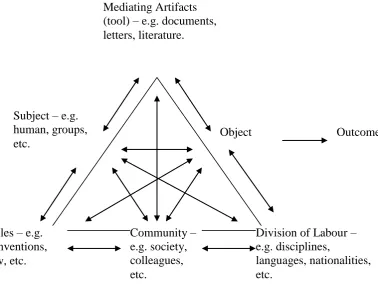
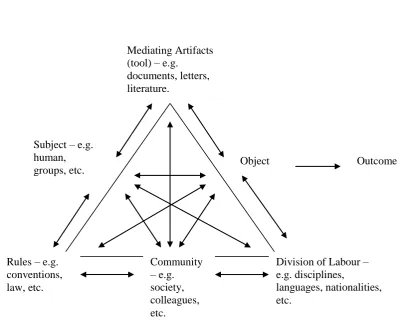
Activity Theory. The latter provides a comprehensive and systematic way of examining roles. Activity Theory was further justified by demonstrating the use of the theory with the research itself, and the concepts of role and history.
Next, is the methodology chapter. Various forms of epistemology and ontology are explored. The justification for opting for subjectivism as the epistemology and realism as the ontology are explained at length. The following section is the methodology options. There are a number of methodologies that seem to be a good fit for the research; action research, historical study, longitudinal study and case study. All the options are detailed and why they could fit the thesis. Case study was selected and its justification was presented. The proposal argues for the use of a single in-depth
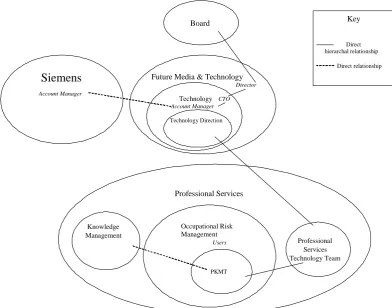
Following on from the methodology chapter are the findings chapters. The findings have been split in to two. Chapter five focuses on the findings based on the outsourcing subject. It provides some background on how the Siemens contract was attained. The BBC had looked in to outsourcing previously, but decided to keep technology function in-house. Historical data was used to compile the background story that led to the Siemens contract. It proceeds on to the views and beliefs of outsourcing, and its affects on the interviewee groups – users, senior IT managers, and both account managers. Chapter six focuses on the findings based on the influences of the outsourcing, IT centralisation and organisation restructure. The interviewee groups (users, department IT team, middle IT managers and senior IT managers) tell their stories of how the outsourcing has directly affected them. Every staff member was affected by the outsourcing in some form, from change of process for IT support to being made redundant.
Chapter seven is the analysis section. The data collated is made sense of through the Activity Theory lens. Initially, the reader is presented the organisational and
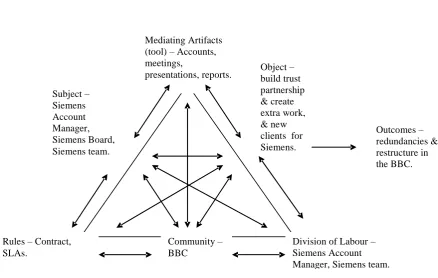
outsourcing information at a high level. This gives a broad picture of what was happening. The analysis then drills down the organisation structure through all the interviewee groups (users, department IT team, middle IT managers, senior IT managers and both account managers) to detail what was happening, why, and the interviewees‟ activities that were being carried out. The interviewees and their activities all led to the role of the IT function and what was happening within it. The chapter moves on to the Activity Theory‟s activity system constructs and how they worked with the interviewee groups, and through the analysis what new interesting features are presented. Finally, the Activity Theory and its limitations are given, and through it the theoretical
contributions.
on the outsourcing topic, and what was learned through the case study, but also if the academic advice continues to hold true.
The last chapter is the conclusion chapter. The aim of this chapter is to summarise the findings and contributions of the total thesis. The synopsis of each chapter is presented. It then proceeds on to the research contributions, divided by literature, theoretical, methodological and practical contributions. It moves on to the research limitations. All work has some issues, and it is important to recognise the problems and shortcomings. The limitations are partitioned by theoretical, methodological and practical limitations. The final section of the chapter looks ahead to further research that can be conducted. All research raises questions and it should be clarified that further research could enhance the current knowledge base. The researcher found further research areas in the theory, methodology and practice. The overall contributions of the study are:
Extend our knowledge of outsourcing and the changing role of the IT function. To fill the gap in the literature.
To view the long term affects of organisational IT strategy and decisions. To add to the body of literature of Activity Theory.
Provide further guidance (decisions, suitable structures, policies, etc.) on IT functions to practitioners.
1.4 Summary
The introduction chapter highlighted the significance of the research areas and question, “what is the influence of total domestic IT outsourcing on the role of the IT function?” It went in to detail on why it is important. There has been a gap in literature on total domestic outsourcing of some years, and whether industry has taken any notes on management practice prescribed by academic such as Willcocks, Fitzgerald, Lacity and Hirschheim. The other part of the question relies on the state of the role of the IT function. Much has occurred over the years, e.g. Internet and mobile technology, and how have all these issues played their part in influencing the role of the IT function. The final segment of the introduction provided a synopsis of the structure of the thesis.
2. Literature Review
"The more extensive a man's knowledge of what has been done, the greater will be his power of knowing what to do." Benjamin Disraeli
2.1 Introduction
The research seems straightforward, however it encapsulates a myriad of topics: How does outsourcing influence the role of the information technology (IT) function and it includes areas of role, role of information technology, information technology function and outsourcing. These topics are the foundations for basing the research upon. The chapter‟s aim is to give a broad understanding of the foundation of existing literature. The topics are themselves highly detailed, however the chapter only gives a flavour of them. It sets a benchmark for the research to add upon. Outsourcing is a huge topic in itself therefore in terms of the research only domestic total outsourcing literature is presented.
The first section opens with the definition of role. One would think that this is a simple task, however role is a complex concept. The history of role‟s definition is rich and goes back to ancient Rome. In the 20th century, sociologists added various angles to role; the idea of culture, perception, enactment and society. The second section discusses the role of IT. IT has many definitions and one of the reasons for this is that IT is dynamic and has changed so much through its short history that the term cannot be static. A brief history of IT is presented and then it moves to more recent academic work tackling „what is IT‟? As well as the definition, positive and negative perspectives on IT are presented. The third section examines the role of the IT function. This
section brings the two previous sections together, as it reviews the role of IT in
practices of the time are also highlighted. The section ends with well known academics providing prescriptions for organisations considering outsourcing.
This chapter is relevant to the thesis as it sets the tone on the concept of roles and the total domestic outsourcing phenomenon. Both areas are defined and detailed to provide the reader background to the study. The notion of role is important, many studies use the term in a generic manner, and no formal definition is provided, however this study wants to get in to the heart of the definition, and utilise it through the thesis. The concepts of role enactment, perception and behaviours will come in to play throughout the study. For this reason, the next section defines and discusses the concept of role.
2.2 Role
The standard definition of role is “1): a character assigned or assumed 2): a socially expected behaviour pattern usually determined by an individual's status in a particular society” or “a function or part performed especially in a particular operation or process” according to the Merriam Webster Dictionary (2004). The Oxford English Dictionary (2004) defines it as “a person‟s or thing‟s function.” The term „role‟ has an interesting history of usage, which Moreno has summarised:
Moreno presents the reasons for disagreement on the definition of role due to its historical usage. However, the universal common denominator seems to be the notion of behaviour, and in particular, behaviour of specific persons. Role can be defined as “those patterns of behaviour characteristic of certain persons” (Thomas & Biddle, 1966, p.31; Katz & Kahn, 1978). The idea of characteristic being the behaviours performed by the persons designated, e.g. it is characteristic for policemen to stand on corners and direct traffic. In 1945, Linton (cited in Banton 1965) stated “the term role will be used to designate the sum total of the culture patterns associated with a particular status. It thus includes the attitudes, values and behaviour ascribed by the society to any and all persons occupying the status. It can even be extended to include the legitimate
expectations of such persons with respect to the behaviour towards them of persons in other statuses within the same system”. This view was accepted by sociologists such as Banton who stood by role behaviour, and the way that people translated their roles in to action.
The concept of role has been split in to three categories by Moreno: 1) psychomatic roles as the sleeper, the eater, the walker; 2) psychodramatic roles as a mother, a teacher, a daughter, etc.; and 3) social roles, the mother, the teacher, the daughter, etc. The genesis of roles went through two stages, role perception and role enactment. Role enactment is considered to be experimental, a method of learning to perform a role. When an individual begins a new job or their existing role changes, they have some perception of what their new role will be. The perception is created by a number of factors, e.g. previous experience, knowledge and script. The role enactment is carried out once the person is in the role. The role perception may be different to the
performance of the role, and therefore the person will need to adjust, and learn to execute the new role.
Sociologists such as Goffman and Stryker proposed that roles are not completely
formed or scripted but required the active negotiation of the role occupant with the other participants in the social situation (Fincham & Rhodes, 1988; Reitzes & Mutran, 2002). Using the IT department scenario, if the senior management decided to end the use of Cobol legacy systems and move to new Oracle databases, the decision would affect the Cobol developers. The developers would be required to learn a new coding system. In organisations, roles are not completely independent, other roles and decisions affect the role occupant. There is the notion of “role acquisition”, a process of 1) role taking, learning the shared meanings of roles, and 2) role making, negotiating role boundaries to reflect personal and unique meanings (Turner 1956, cited in Reitzes & Mutran 2002). Role making includes self-motives, concerns, and interests.
The role itself and role behaviour are distinguishable units, argued Fincham and Rhodes (1988). The role itself is structured (similar to a script), and behaviour in a role can be altered by the expressive concerns of individuals (similar to how an actor interprets a part). For example, a new manager may want to be the most popular or the most innovative manager in an organisation. In this example, roles provide an arena for the interplay of the practical requirements that need to be met and the individuals own expressive concerns.
In the organisational form, roles are standardised patterns of behaviour required from all people playing a part in a functional relationship, regardless of the personal wishes or obligations. In terms of organisations and roles within an establishment, structural sociologists such as Perrow argued that in the design and analysis of organisations it made sense to concentrate on the “roles people play rather than the personalities in the roles” (Perrow 1970, cited in Robertson & Cooper 1983, p.8). Other sociologists, such as Arygris, argued that consideration should be given to individual personalities. The use of organisation charts suggests there may be some value in making a distinction between organisational roles and the individuals who fill them (Robertson & Cooper, 1983). During the analysis phase it may make sense to focus on the individual personality. This literature review presents cases where IT departments become effective or successful due to the CIO making a decision “out of the box”. A
Handy, looked at roles within groups, that roles are dependent on other people - what they think should be done, and how they think it should be carried out.
An individual‟s role is a combination of the role expectations that members of the role set have of the focal role (Handy, 1985). According to Handy (1985) the person‟s performance is influenced by the forces in the person (personality, attributes and skills) and the forces in the situation. The focal person‟s role set can be viewed as a spider‟s web, where the focal role is in the centre and interacting with others. The focal person performs differently in each relationship interaction, however each relationship has expectations of behaviour on the focal person.
Figure 2.1 – Role set (Handy, 1985).
A role was viewed as social, and interbehaviour was an important element according to Sarbin and Allen (1968), it followed Kantor‟s view that the occupant of one social role interbehaves with the occupants of complementary social positions. The total of the complementary roles related to a given role was known as a role set. The role expectations lead to the person‟s conduct whilst the role is enacted. By specifying “how”, “should”, and “is” ensures that the enactment is appropriate. Overall role expectations can be seen as specifications for adherence to group norms. The role behaviour should occur at the correct time and place. People find it difficult to escape from the role that cultural traditions have defined, e.g. doctors‟ role behaviour is constrained if people are in that role of a long period, it becomes part of them, part of their personality.
One of the main strengths of a formal organisation is its constancy under conditions of The
focal person parents
partner friends
physically, they must be connected psychologically. The organisation consists of patterned and motivated acts of humans, and they will continue to exist as long as the attitudes, beliefs, perceptions, habits and expectations of humans evoke the required motivation and behaviour. In other words, each behavioural element is to a greater extent caused and secured by the others (Katz & Kahn, 1978). This can be exhibited in the workplace, as people bend the rules or do not use official channels to complete tasks, e.g. IT users go directly to one person they know to fix a PC support issue, rather than going through the support helpline, and the support staff may be happy to fix small problems this way. This follows Handy‟s (1985) definition of role set, that others can impose role expectations on other people, and that the expected behaviours become part of the role set. The organisation can be divided in to offices. Associated with each office is a set of expected behaviours. The activities constitute the role to be performed by any person who occupies that office.
The efficiency and effectiveness of organisations rely on employees presenting dependable role behaviour. However, it is impossible for organisations to specify the complete prescriptions associated with a role. Instead, they rely on the socialisation of employees for jobs, including the learning of general scripts for work behaviour. Scripts are plans or structures that state the appropriate sequences of events in a specific context. An example of a script is a university professor‟s script for the delivery of a lecture. Scripts serve a number of important functions:
Enable an individual to organise previous knowledge and to know the behaviours appropriate in particular situations.
Allow individuals to “fill in gaps” that are not explicitly given in a particular situation.
In the office scenario, role ambiguity means uncertainty regarding what the occupant of the office is supposed to do. There maybe uncertainty over particular aspects of a role, including the membership of the role set (e.g. superiors, colleagues), the ends to be served by role enactment, and evaluation of present role behaviour (Katz & Kahn, 1978). The majority of roles in the IT industry are fairly ambiguous, the role of an IT consultant in one organisation may be completely different to an IT consultant in another establishment. The boundaries of work may not be very clear. For example in end user computing departments, the IT team within the department may support and maintain a particular system, but it is not their role to look after the organisation networks. A problem with end user computing can be that the IT team is bombarded with network problems, such as forgotten passwords, and the users expect the
department IT team to resolve the issues. The scripts in these situations are not strongly embedded in the organisations, and this leads to the role perception being incorrect.
The research will use Handy‟s concepts of role perception and role enactment in the workplace, the idea that other‟s perceptions can lead to role enactment on the focal person. Goffman‟s and Stryker‟s idea of roles not being completely formed or scripted as part of the role enactment will also enter the research.
2.3 Role of Information Technology
The term „information technology‟ has various definitions. Earl (1989) defined IT as comprising computers, telecommunications, and automation technologies. He went further to show other aspects of IT – as an activity, it consisted of the supply,
“Information technology will change the world more permanently and more profoundly than any technology so far seen in history and will bring about a transformation of civilisation to match” (Diebold 1984, cited in Scott Morton 1991, p.124). The theme of the quote is not unique. Nevertheless, it emphasised the impact of IT capabilities on the economy. Even if one does not agree entirely with this stance, it is clear managers should evaluate the emerging role and implications of IT for strategic management (Scott Morton, 1991; Currie, 1995). IT has moved beyond the administrative function towards a central role of business operations (Loh & Venkatraman, 1992). The main assumptions underlying the role of IT in knowledge firms is that it enables value
creation by assisting creation, transfer, integration and leverage of knowledge resources across the business units of an organisation (Tanriverdi, 2004). There are many
academics and practitioners that have a positive view of IT, such as Olson (1984), however there are others that have a negative view, such as Carr (2003). He believes that IT is losing its value in the strategic sense, that it cannot assist an organisation in gaining strong competitive advantages as the cost and availability of IT is decreasing. IT is a commodity, similar to electricity.
A frequently raised issue is whether information increases management‟s control over the work force, or empowers the work force to make improvements in their
responsibilities (Scott Morton, 1991). Scott Morton argues that the effective exploitation of IT can lead to significant changes in organisational strategy,
management structure, systems and processes. He states the emerging definition of the role for IT within organisations is the result of the convergence of two forces –
technology push and competitive pull. The diagram is shown:
Figure 2.2 – Technology push and competitive pull (Scott Morton, 1991).
2.3.1 Recent Issues
IT is seen as having many issues; software crashing, hardware breaking, network traffic, viruses bringing systems down, data becoming corrupt, and users using systems in the way designers never imagined. The daily operational work processes evolve,
communication links are restructured, and strategies change. IT is complex. Despite the complexities, individuals, organisations and societies increasingly depend on IT to provide services and capabilities (Butler & Gray, 2006). It is the dependency on IT that many view as negative. The increasing dependency on IT has fuelled much debate, not only in academia but also in society. The issues have led to many science fiction films showing Earth being powered by technology, and although the films are set far in to the future, people are seeing the seeds being sown at present.
Hirschheim et al (2003) feels in organisations the main problem with the role of IT has been corporate management‟s lack of understanding of IT. Executives are unaware of what can realistically be achieved by IT. Their perceptions of IT do not match reality.
Technology Push
Cost-performance trends
Connectivity capabilities
Competitive Pull
Innovative IT-enabled applications to obtain differential benefits in the marketplace to stay competitive IT as a
After almost five decades, IT continues to be considered an overhead. The executives grow weary of IT‟s incomplete promises to gain competitive advantage, enable business transformation, reduce costs, and improve customer service. News stories and research show negative cases of IT, and these have appeared to influence senior management. An example would be the 2008 London Stock Exchange computer crash that seized trading for 7 hours.
The negative perception of IT is not new. In the 1960s, Andrew Pettigrew wrote that a senior manager described the IT department as a “bunch of techies” that had to be separated from the rest of the organisation because they were too different. The
manager‟s solution was to “build a wall around the computer department,” to reduce the interaction between them and the rest of the organisation. He understood that an IT department was essential, but he felt that the people working in IT were so different from the rest of the people within the organisation that they needed to be left alone (Hirschheim et al, 2003). Forty years on, researchers continue to find this attitude.
According to several researchers, one way of highlighting the IT perception problem is to view it from a service quality issue (Pitt et al 1995, cited in Hirschheim et al 2003). Service quality is based on a comparison of what the customer feels should be offered and what is actually provided. Another view is that service quality is the gap between customers‟ perceptions and expectations. Rushinek and Rushinek (cited in Hirschheim et al 2003) conclude that fulfilled user expectations have a strong effect on overall satisfaction. The IT function suffers from the high expectations set upon them from top management (Ibid).
2.4 Information Technology Function
After twenty plus years of research, the question „how should contemporary firms organise their IT function?‟ remains unanswered. Throughout the 1970s and 1980s, organisations alternated between the centralised and decentralised models. During the 1990s, numerous organisations moved towards the federal model, in which control and authority for IT decisions were dispersed. The corporate IT groups were given authority for IT infrastructure, whilst the divisional units had the authority for the strategic
deployment of IT. A number of researchers conclude this model of distributed
divisional priorities for IT innovation in their products, services, or customer
relationships (Agarwal & Sambamurthy, 2002). Organisation designs are one of the key factors for building and sustaining IT function capabilities (Clark et al, 1997). The designs are the forms of organisation and IT department structures. There are many types of structures, and in practice the organisations tend to be hybrids.
According to Earl (1989), the term infrastructure encapsulated the processing power of technology, highways of telecommunications, the foundations of data, and the fabric of basic business systems. Whilst the technologists advised on and recommended
infrastructure plans and policies, it was the executive management that had the strategic responsibility to approve them, and be kept up to date on the technology matters.
In the 21st century, IT plays a greater prominent role in corporate agility. It acts as an enabler to rapid and continual business innovation in products, services, channels, and supply and demand chain management. Hence, the heavy investment in enterprise digital platforms (such as enterprise resource planning and customer relationship
management) to support innovations in the organisation‟s “ecosystems” – their business partnerships with customers, suppliers, and other firms. The accelerated rates of
technological change and obsolescence in the IT market require models to pay close attention to human capital and relationships with other key organisations (Agarwal & Sambamurthy, 2002).
infrastructure. IT managers liaise with business units. The model works where there are global businesses in multiple lines of business and there is a strong knowledge of IT among business managers; Scalable Model – IT provides flexible and scalable
resources for the business. The IT department is centralised for leveragability. There is a strong IT presence in the business units. The model works where there are global businesses in related lines of business, and in cyclical industries.
There is no single best IT organisational structure because IT needs to react to the unique environment in which it exists. The models are benchmarks for executives to consider when assessing the organisation design. The executives are required to view the nature of the business, understand the industry environment, and look at the IT sophistication and knowledge in the business units – all these should point to one of the three models as the appropriate. The IT function needs to continue to reassess and adapt its design to ensure relevance. Organisational designs should not be static (Agarwal & Sambamurthy, 2002).
Time also plays a part - how should the IT staff divide their time between maintenance and new system development? The motivation aspect enters in to the issue, Couger and Colter (cited in Swanson & Beath 1990) found that development work has higher motivating potential than maintenance work. This has led some organisations to separate the development and maintenance roles in to different departments. Many organisations have gone further to outsource the maintenance work, hoping for
productivity gains. Within the time aspect, there is also the issue of manager‟s attention across many diverse markets and activities, where each one has the potential to make a transformation (Feeny & Willcocks, 1998). Good organisation design makes a
difference in IT, but organisation design is more than organisation structure. The benefits of separating the IT unit is dependent on good management, particularly at the top, and it is important to recognise and reward its members (Swanson & Beath, 1990).
that individuals could have greater control of their career, and the organisation would also benefit from motivated staff. The transformation was not straightforward; staff had anxieties, processes needed to be modified, and structure and function of the IT
department required change.
Another term for the contemporary organisation is „boundary less‟. It focuses on the notion of diminishing organisational structures. The formal structures are fading in to the background. The informal structures (the ones that emerge rather than those mandated) are gaining greater importance. Previous studies have shown that organisations are a combination of „explicit and implicit values, beliefs and
assumptions‟. The informal structure cannot be separated from the formal structure because together they bring the organisation‟s socio-technical systems (including work, technology, people, processes, structures and information). The combination comprises of the various informal structures, connections, and procedures that are used to get work done, such as social networks, communities of practice, cross departmental
relationships, unofficial agreed on processes and flexible division of work (Chan, 2002).
The definition of IT alignment ranges from “the fit between an organisation and its strategy, structure, processes, technology and environment” (Kanellis et al, cited in Chan 2002, p.98) to a more a focused meaning such as “convergent intentions, shared understanding, and coordinated procedures” (Reich & Benbasat, cited in Chan 2002, p.98). A well received view is that IT alignment is “the degree to which the
information technology mission, objectives, and plans support and are supported by the business mission, objectives, and plans” (Keen, cited in Chan 2002, p.98). According to Chan, IT alignment is best described as a “superset of multiple, simultaneous
component alignments that bring together an organisation‟s structure, strategy, and culture at multiple (IT, business unit, and corporate) levels, with all their inherent demands” (Chan 2002, p.99). Organisations are more dynamic and networked, and they defy the old hierarchical models.
structures working together that allow good IT alignment performance. The two sides of the organisation bring together the organisation‟s socio-technical systems (work, technology, people, processes, structures and information). Overall, it is the informal structures, connections and procedures people use to get their tasks done, such as social networks, communities of practice and unofficial agreed on processes – these are the important factors for a successful IT alignment placement. Poor business IT alignment can manifest itself in a number of ways:
Business executives cannot communicate their IT needs. IT personnel have limited business knowledge.
IT investments are likely to be costly and the returns low. High potential IT applications may not be identified.
Business executives that have good ideas, but find it difficult to turn them in to reality.
In organisations that presented these traits, business executives placed IT personnel disguised as business analysts in to departments. However, to retain talented IT employees, the organisations need to challenge and appreciate them (Chan, 2002; Peppard & Ward, 2004). Organisations try to rectify the situation by throwing more money towards IT to compete effectively, but continue to experience sub-optimal performance. Investing heavily in IT also creates higher expectations for success (Currie, 1995; Chan, 2002).
A general consensus is that it is not always necessary to utilise extensive amounts of technology. Good results can be achieved with reasonable amounts of technology (industry average) if correct organisational arrangements are in place. The high tech approach requires customised organisational arrangements. If these are not in place, the overall the results are poorer than if less technology is used. Scott Morton‟s (1991) findings show that conditions favourable to effective IT utilisation are in place before the IT system is implemented. IT should be pulled in to place by the users rather than pushed by managers. The reasoning behind this is users that have substantial input are more likely to be lined up with organisational arrangements. In order for an IT-enabled strategy to succeed and change the organisation, the managers should have a vision of what the new organisation should be like with regard to its structure, style, and
2.4.1 The Centralisation vs. Decentralisation Debate
The role and structure of the IT function has to be considered against the backdrop of the old dichotomy of centralisation and decentralisation. A universal arrangement has not yet been found. It is evident that technological changes can affect the existing arrangements. A centralised solution is where the “IS responsibility is held totally within a centralised or corporate IS unit” (Brown & Magill 1994, p.373). A
decentralised solution is where “the IS responsibility is held totally within business units, resulting in multiple units with IS personnel dispersed throughout a firm” (Brown & Magill 1994, p.373). There are three aspects to the centralisation versus
decentralisation issue, according to King (1983):
Control concerns are at the centre of decision making activities in organisations. Centralisation implies the concentration of the decision making power within an individual or small group, whereas in decentralisation the decisions are made at various levels in the hierarchy.
Physical location concerns the location of facilities. Centralised physical location has all the facilities in one place, but in decentralised locations the facilities are dispersed.
There is also the issue of function, referring to the position of an activity or responsibility within the structure of an organisation. For example, a centralised accounting control would require all departments to report to a single unit, whereas in decentralisation, the organisation may establish a number of profit and cost centres with their own accounting activities, and require specific data to be passed to the corporate headquarters.
Centralisation of control preserves the senior management prerogatives in majority of the decisions, whilst decentralisation allows lower level managers discretion in choosing among options. The former strategy is believed to promote continuity in organisational operations, but separates decision making from its environment. If decisions are misguided due to the poor top level understanding of the problem, or are subverted due to poor enforcement at the lower levels, centralisation can be
disadvantageous. Decentralisation of control forces the lower level managers to take responsibility for their actions, possibly improving their performance. It also
Centralisation of physical location capitalises on economies of scale, arising from exploiting the full potential of technologies that allow output to increase faster than costs. The costs of duplicating overheads and facilities are avoided, and organisational protocols are simpler to enforce. The advantages can be outweighed by the costs for organisational communications (including travel costs), transportation of raw materials and finished goods, and maintaining close ties with the customers/clients (King, 1983; Angell & Smithson, 1991).
The centralisation of organisational functions keep performance in line with the organisational protocols and standards, it smoothes the work flow on highly discrete tasks, constrains the labour cost escalation by reducing the need for new employees, and allows close monitoring and modification of work activities to correspond with overall organisational operations. Decentralisation is beneficial when the functions performed require close cooperation with other units, when the tasks being conducted require great worker discretion and less central guidance, or when regular interaction with members require too much commuting (King, 1983).
The traditional models of hierarchy, standardised procedures, functions, responsibility centres and performance management have all been criticised. The basic argument is they serve organisations well in periods of environmental stability, and adjust to cope with occasional shocks, but the present is a continuously changing environment, more flexible and adaptive capabilities are needed and radical change is necessary.
Therefore, Cross et al (1997) state organisational transformation have been encouraged, and contemporary practices such as downsizing, outsourcing, delayering and
reengineering have emerged.
Robey (1977) observed that computing appeared to support an existing decentralised structure in organisations with uncertain environments. However, in simpler
environments, it seemed to strengthen a centralised authority structure. Robey (Markus & Robey, 1988) recommended that IT should be viewed as a moderating variable, affecting the strength of a causal relationship between environment uncertainty and organisational structure.
Excessive centralisation or decentralisation can create nightmares of frightening proportions, and a middle position seems inevitable, according to Angell & Smithson (1991). To find a balance is very difficult to achieve in practice, and there are no simple answers; the outcome of whether IT favours more centralised or decentralised
organisations depends upon the particular situation of the individual organisation (Ibid). It is sometimes believed the issue of centralisation or decentralisation is no longer relevant because it has been much discussed and the conclusion seems to be that organisations should find a balance that works for them (Niederman et al, 1990; Brown & Magill, 1994). IT is required to provide a suitable mix of line and staff functions whilst staying in tune with company strategy, organisational direction, and business cycles. The key is to unlock the value from technology, and this can only be done by business management. The change from IT decentralisation to centralisation continues to be significant, and management continue to debate the optimal balance of this, as will be seen in the case study.
2.5 Changing Role of Information Technology Function
The literature discussed so far demonstrates the changing role of IT as well as some ambiguity regarding the role of IT in today‟s organisations. For example, in some organisations the specialised IT department serves the organisation, but also provides solutions for external clients, organisations such as the British Broadcasting Corporation (BBC). In other organisations, the IT department has moved from development towards procurement, using off the shelf software, such as IT consultancies during difficult economic periods.
function as the agglomeration of the roles of the people within that function (developers, senior/middle management, etc).
The IT department can act as a powerful change agent. The department can affect transformation in the organisation by suggesting new business strategies and
information based products, and coordinating the development of technology and the planned alterations in the organisation. Changes in organisation also lead towards role change or reinvention pressure. The IT function should also keep a technology watch and observe opportunities or threats from developing technologies. IT departments tend to operate in a complex environment. The function has evolved from controlling
information resources to an era where they must account for the growing user influence in IT investment decisions (Gottschalk, 1999).
2.5.1 Overview
One characteristic of the IT era is that IT is viewed as a management function together with finance, marketing, and production. However, the function has many descriptors – information technology, information systems, information services, management
services, technology, management systems, and management information systems being common examples (Earl, 1989). The term encapsulates a great deal, and what is
considered IT in all organisations is fuzzy. The key is the IT function needs to be manageable. Ramakrishna and Lin (1999) state there are three distinct roles for the IT function: 1) IT function having a subordinate status compared to the user departments, 2) IT function having equal status to that of user functions, and 3) IT function having a leader (driver) status compared to the user functions. Ramakrishna and Lin (1999) view the IT function‟s role as providing the organisational information processing backbone to a business driver that changes the way organisations operate and compete. Taylor et al (2000) has a similar stance to Ramakrishna and Lin (1999), as they believe the function has evolved from providing automatic processing and record keeping, to not only contributing towards organisational success but its survival. This can be achieved by business professionals having an understanding of IT/IS concepts.
managers to control the excess spending of the expansion stage. Finally, the integration stage was where the systems started to operate in an economical way. The stages of Nolan‟s growth model was revised by Galliers and Sutherland (1991):
Ad hocracy – Uncontrolled, ad hoc approach to use of IT in organisations. Starting foundations – Attempt to find the users‟ needs and try to meet them.
The future is viewed as a linear expansion of the past.
Centralised dictatorship – The need for planning is recognised, and is typically conducted top down. IT is under central control. The IT development should be seen to link with the business/corporate plans.
Democratic dialectic & cooperation – Integrating and coordinating the central control and end user computing systems. The IT function moves out of the „ivory tower‟ in to the real world of turmoil of the business organisation.
Entrepreneurial opportunity – IT function moves from support services to being a strategic benefit.
Integrated harmonious relationships – New age of sophistication and use of IT. IT is deeply embedded in to the organisation. The organisation tries to maintain comparative strategic advantage. IT remains centrally coordinated, but not controlled in any strict sense.
According to Rockart and Short (1989), IT‟s purpose was to “manage organisational interdependence,” for example to solve coordination issues between departments and strategic business units. Within strategic management, the strategy concept was based on three-level categorisation. The levels are linked through the strategic planning processes and systems. The levels are 1) Corporate strategy – Develops the overview vision. It sets the agenda and guidelines for the business level strategies. 2) Business strategy – Sets the agenda and guidelines for functional strategies. 3) Functional strategy – IT is viewed as the supporting infrastructure for the implementation and administration of the higher level strategies. Therefore, the level of resources tends to be based on administrative expenses considerations rather than as business investments that could potentially modify the organisation‟s strategic thrusts.
management are knowledgeable of senior management‟s strategic and tactical thinking. IT staff need to be present when business strategies are discussed. IT executives should contribute positively to management thinking by identifying the business threats and opportunities that IT poses, due to the fact that technology influences strategy and vice versa; Develop effective relationships with the line managers – IT personnel should develop strong, ongoing partnerships with their main users, e.g. line managers. It is through the relationships that the communication can occur to ensure that both business and technology capabilities are integrated in to effective solutions; deliver and
implement new systems – the types of systems being built have changed over time from mainframe to desktop systems. As a result the approaches to building, designing, implementing and maintaining the systems have changed, IT executives need to respond to the challenges with a variety of strategies; Build and manage infrastructure – from the user‟s viewpoint the correct data needs to be available effortlessly. In order for this to occur the infrastructure requires to be seamless, although it may pass through several different systems; Reskill the IT organisation continuously – IT staff should be kept up to date with technical and business skills; Manage vendor partnerships – outsourcing particular IT responsibilities to vendors can compensate for skill shortages and relieve management from peripheral tasks to concentrate on core competencies. Outsourcing can be reliable, cost effective, and can lead to productivity gains through specialisation, efficiency of communication and management control1 (Swanson & Beath, 1990; Rockart et al, 1996); Build high performance systems – transfer of TQM and customer services programs in to the IT department. Systems development cannot constrain business development. The long wait for applications development is no longer acceptable in the fast changing markets; Redesign and manage the federal IT organisation – a well thought out IT vision, effective leadership and group wide IT strategy and architecture is required.
Feeny, Willcocks and Rockart amongst others have defined the roles within IT departments, mostly in a rather prescriptive fashion: IT Leadership (Feeny &
Willcocks, 1998)/Senior Management (Rockart et al, 1996) – Effective leaders design organisational arrangements (structures, process