INTERNATIONAL POLICY CENTER
Gerald R. Ford School of Public Policy University of Michigan
IPC Working Paper Series Number 120
Assessing Ukrainian Banking Performance Before and After the Crisis
Iryna Shkura
Barbara Peitsch
RESEARCH SEMINAR IN INTERNATIONAL ECONOMICS
Gerald R. Ford School of Public Policy The University of Michigan Ann Arbor, Michigan 48109-3091
Discussion Paper No. 623
Assessing Ukrainian Banking Performance
Before and After the Crisis
Iryna Shkura
Alfred Nobel University
Barbara Peitsch
University of Michigan
2011
Recent RSIE Discussion Papers are available on the World Wide Web at:
ASSESSING UKRAINIAN BANKING
PERFORMANCE BEFORE AND AFTER THE
CRISIS
Iryna Shkura
1, Barbara Peitsch
2Abstract
The main goal of this paper is to analyze the impact of the 2008 global financial crisis on the Ukrainian financial system, and on Ukrainian bank performance. Our analysis is based on key bank performance indicators from 2003-2011. Bank assets, liabilities and capital are analyzed, and changes in bank management are taken into consideration. Special attention is paid to changes in bank stock prices of two of the largest banks, following the crisis.
Key words: performance, problem loans, debt provision, banking system, financial crisis, bank stock prices.
Introduction
The strength and sustainability of a country’s banking system is the basis for its economic development, especially in countries with bank-based financial systems. The performance of the banking system is always an area of interest and concern to government regulators and academic researchers. After the global financial crises in the 1990s and early 2000s, bank performance has received even more attention. The Ukrainian banking system had been characterized by rapid growth in terms of the number of banks, the number of loans extended to companies and households, and the performance of the banks until 2009. This sector was one of the most attractive for foreign investors and as a result, bank capitalization grew rapidly. New approaches to bank management were introduced in the strongest banks and the quality of banking services improved. Such large inflows of foreign capital brought some additional risks to the system, however.
The main goal of this paper is to analyze the changes in Ukrainian bank performance before, during and after the financial crisis of 2008, with special attention paid to changes in bank stock prices, rates of return, and risk. Ukrainian bank capital, assets, liabilities, and financial results will be analyzed in the overview of the Ukrainian banking system. A SWOT-analysis of foreign investment in Ukrainian banks will also be conducted. The final section of this paper will present our assessment of the impact of the 2008 global financial crisis on Ukrainian bank stock prices.
Overview of the Ukrainian banking system
The Ukrainian financial system is similar to banking systems in the Euro-zone and Japan in that it is bank-based, as opposed to capital markets-based. Financial sector development, and therefore a financial system type in a country is often based on historical and economic development and on the financial sector development in neighboring countries. The main criteria for determining a country’s type of financial system is the source of capital for the enterprises and other entities. In bank-based systems, bank loans are the primary
source, while in capital markets-based systems, capital from bond issues and/or equity investments are the main source.
[image:4.595.66.536.220.417.2]Economic research on the Ukrainian banking system does not classify it consistently. Moreover, the process of globalization has caused the convergence of financial systems [Hölzl, 2003, Masciandaro, 2009, Reinhard, 2001]. In the Ukrainian financial system, the banking sector developed before capital markets, the volume of banking sector assets exceeds non-banking assets by nearly ten times (see Table 1). Loans issued by banks are 80 times more than corporate bonds issued (in the year 2010).
Table 1. Ukrainian financial system assets, 2003-2010*
Banks 2003 2004 2005 2006 2007 2008 2009 2010
Bank assets share of GDP,
%
30.01% 39.48% 41.00% 50.52% 65.67% 92.14% 109.66% 99.59%
Non-banking financial institutions Mutual fund
assets share of GDP, %
No
data 0.56% 1.56% 3.15% 5.66% 6.67% 9.04% 9.88%
Non-government pension fund assets share of GDP, %
No data
No
data 0.01% 0.03% 0.04% 6.67% 0.09% 0.10%
Insurance company Assets share in GDP, %
3.38% 5.08% 2.80% 3.21% No data 4.42% 4.60% 4.13%
Source: Own calculation based on the reports of State Commission of Financial Services Market Regulation, Ukrainian Investment Business Association, and State Statistics Comity of Ukraine
This situation is similar to the Japan where “prior the financial liberalization alternatives to bank finance were very limited. As equity and bond finance were restricted, most firms had to rely heavily on bank loans” (D. Weinstein, Y. Yafeh, 1998, p.635).
The development of the Ukrainian banking system commenced in March, 1991, after the adoption of the Law on the National Bank of Ukraine and the Law on Banks and Banking by the Ukrainian Parliament. Ukraine introduced a two-tiered banking system at that time, consisting of the National Bank of Ukraine and commercial banks of various types and forms of ownership including the state-owned Export-Import Bank and a specialized savings bank.
The National Bank of Ukraine serves as the country's central bank and is responsible for monetary policy and for ensuring the stability of the national currency, the Hryvnia. Commercial banks are formed primarily as joint-stock companies. Foreign ownership of Ukrainian banks is permitted. Some commercial banks are privately held, while others are publicly traded. The range of commercial banking activity includes deposit taking, lending, investing in securities, providing service products, foreign exchange operations and other services to natural persons and legal bodies.
Banks operate in accordance with the Constitution of Ukraine, the Laws of Ukraine "On the National Bank of Ukraine", "On Banks and Banking", Ukrainian legislation on joint-stock companies and other economic entities, as well as with the normative regulations of the National Bank of Ukraine and their Statutes.
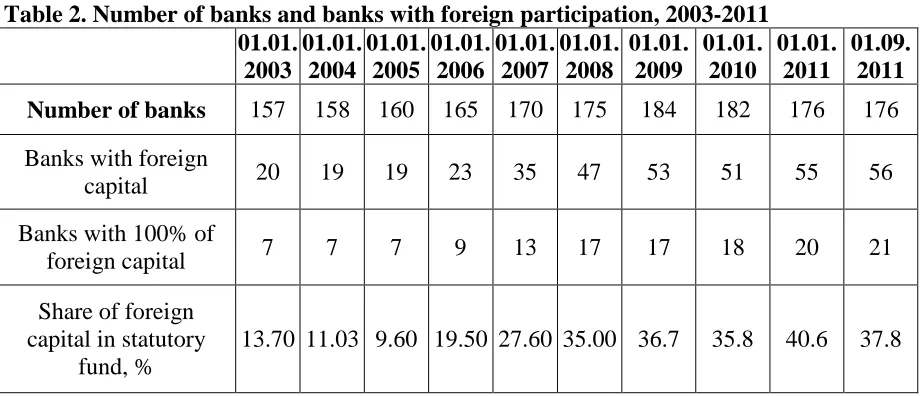
Table 2. Number of banks and banks with foreign participation, 2003-2011 01.01.
2003
01.01. 2004
01.01. 2005
01.01. 2006
01.01. 2007
01.01. 2008
01.01. 2009
01.01. 2010
01.01. 2011
01.09. 2011
Number of banks 157 158 160 165 170 175 184 182 176 176
Banks with foreign
capital 20 19 19 23 35 47 53 51 55 56
Banks with 100% of
foreign capital 7 7 7 9 13 17 17 18 20 21
Share of foreign capital in statutory
fund, %
13.70 11.03 9.60 19.50 27.60 35.00 36.7 35.8 40.6 37.8
Source: http//bank.gov.ua
In spite of the economic contraction in Ukraine since September 2008, the main indicators of banking activity had been improving in 2003-2008. For example, bank equity grew by 71.4%, liabilities by 52.3%, and assets by 57.2%, Profits increased by 7.3 billion UAH. However, in the 1st quarter of 2009, the banking sector began to decline. Profitability shrank for the first time in more than a decade.
Analyses of Ukrainian bank assets
The period of analysis is characterized by an increase in net assets by 16 times (see table 3).
Increasing credit volumes in 2003-2008 confirm that the economy has become more market oriented. Banking credits to enterprises create the financial basis for the GDP growth this period. Individual credit, or credit to private households, exploded from 2003 to 2008, growing from 7% of total credit at the beginning of 2003 to almost 34% by the end of 2008. During the same period, the share of credit to enterprises declined from 81.7% to 59.6%. The quality of banks’ credit portfolios improved markedly in the period 2003-2008, as the share of long-term loans expanded 47.5 times in the last six years. The share of long-term loans in bank portfolios was 64.1% at the beginning of 2009, compared to 22.9% at the beginning of 2003. The structure of long- term loans by borrower provides more evidence of liberal lending policies towards individuals – in 2003 only 10% of long- term loans were issued to individuals, while at the beginning of 2009, 47.6% were issued to private individuals. It should be noted that this trend is due primarily to the introduction of mortgage lending, which grew rapidly once people were allowed to own private property.
There were also positive changes in the quality of bank management in terms of credit policy, as evidenced by the sharp decline of problem credits, or bad loans, from 4.5% in 2003, to just 1.3% at the end of 2008. It should be noted, however, that the financial crisis of 2008 led to a 6% decrease in credit volume in 2009.
that bank lending to enterprises outpaced loans to individuals. Long-term loans were only available to enterprises after the crisis. The interesting fact is that the volume of long-term loans peaked in 2008 before dropping off dramatically.
Table 3. Assets of Ukrainian commercial banks, 2003-2011
№ Indicators 01.01. 2003 01.01. 2004 01.01. 2005 01.01. 2006 01.01. 2007 01.01. 2008 01.01. 2009 01.01. 2010 01.01. 2011 01.09. 2011
1. Assets, m UAH 67774 105539 141497 223024 353086 619004 973332 1001626 1090248 1189832
Net assets, m
UAH 63896 100234 134348 213878 340179 599396 926086 880302 942088 1026073
2. Credit issued 46736 73442 97197 156385 269688 485507 792384 747348 755030 807830
2.1.
including credit issued to enterprises, m
UAH.
38189 57957 72875 109020 167661 276184 472584 474991 508288 564720
share in total
volume, % 81.71 78.92 74.98 69.71 62.17 56.89 59.64 63.56 67.32 69.91
2.2. Credit issued to individuals, m
UAH
3255 8879 14599 33156 77755 153633 268857 222538 186540 182595
share in total
volume,% 6.96 12.09 15.02 21.20 28.83 31.64 33.93 29.78 24.71 22.60
3. credits, m UAH Long-term 10690 28136 45531 86227 157224 291963 507715 441778 420061 439896
share in total
volume,% 22.87 38.31 46.84 55.14 58.30 60.14 64.07 59.11 55.64 54.45
3.1.
including: long-term credits to enterprises, m
UAH
9698 23239 34693 58528 90576 156355 266204 244412 262199 298027
share in total volume of
long-term assets,%
90.72 82.60 76.20 67.88 57.61 53.55 52.43 55.32 62.42 67.75
4.
Problem credits (overdue and
doubtful), m UAH
2113 2500 3145 3379 4456 6357 18015 69935 84851 83147
share in total
volume,% 4.52 3.40 3.24 2.16 1.65 1.31 2.27 9.36 11.24 10.29
5. Investments in securities, m
UAH
4402 6534 8157 14338 14466 28693 40610 39335 83559 92011
6. Reserves (Provision) for active bank operations, m UAH
3905 5355 7250 9370 13289 20188 48409 122433 148839 164424
including: debt provision, m
UAH
3575 4631 6367 8328 12246 18477 44502 99238 112965 122916
Analyses of commercial bank liabilities
From the 2003 until 2009, the stability of the banking system improved. This is reflected in the growth of bank capitalization and the increase in individual and enterprise deposits in banks. The sources of bank capital are included in Table 4.
Table 4. Liabilities & equity of the Ukrainian commercial banks, 2003-2008, million UAH
№ Indicators 01.01. 2003 01.01. 2004 01.01. 2005 01.01. 2006 01.01. 2007 01.01. 2008 01.01. 2009 01.01. 2010 01.01. 2011 01.09. 2011
1. Liabilities & equity 63896 100234 134348 213878 340179 599396 926086 880302 942088 1026073
2. Equity 9983 12882 18421 25451 42566 69578 119263 115175 137725 149136
Including: paid-in
statutory fund 6003 8116 11648 16144 26266 42873 82454 119189 145857 163838
share of capital in liabilities &
equity, %
15.60 12.90 13.70 11.90 12.50 11.60 12.9 13.1% 14.6% 14.5%
3. Bank liabilities 53
913 87352 115927 188427 297613 529818 806823 765127 804363 876937 3.1. including: capital
of enterprises
19
703 27987 40128 61214 76898 111995 143928 115204 144038 169144
share in total volume of liabilities & equity,%
36.55 32.04 34.61 32.49 25.84 21.14 17.8 13.1% 15.3% 16.5%
including: fixed-term deposits of enterprises
6161 10391 15377 26807 37675 54189 73352 50511 55276 62816
part in total capital of
enterprises, %
31.27 37.13 38.32 43.79 48.99 48.39 50.7 43.8% 38.4% 37.1%
3.2
capital of
individuals 19092 32113 41207 72542 106078 163482 213219 210006 270733 303045
share in total volume of liabilities & equity, %
35.41 36.76 35.55 38.50 35.64 30.86 26.43 23.9% 28.7% 29.5%
Including: fixed-term deposits of
individuals
14128 24861 33204 55257 81850 125625 175142 155201 206630 227067
part in total capital of individuals, %
74.00 77.42 80.58 76.17 77.16 76.84 82.14 73.9% 76.3% 74.9% Source: Own calculation based on www.bank.gov.ua (15.10.2011)
During the period 2003-2008, bank equity had a growth rate of 1194.7%, liabilities increased roughly 15 times, and the growth rate of individual deposits exceeded the growth rate of enterprise deposits (1116% compared with 730%) over the six year period. The analyses of bank liabilities suggests a high level of public trust in the banking system at the beginning of 2009 – 82.14% of all individual capital was fixed term.
banking system liabilities) in 2010. Such large amounts allow banks to hedge country and currency risk. Liabilities fell in 2009 by 6% and then almost reached the level of 2008 in 2010. In the 3rd quarter of 2011 liabilities were the highest of the analyzed period.
According to the structure of the deposit portfolio, the share of capital of individuals exceeds share of enterprise capital in total volume of liabilities and equity from 2004 to the present time. However fixed term deposits, which are more desired by banks because they are a more stable source of funding, decreased from 2009, and only the data from the 3rd quartet of 2011 suggests that long-term loans funded by fixed term deposits are beginning to grow again.
Financial results of the banking system
[image:8.595.67.530.288.604.2]One of the most important measures of bank health is profitability and improved effectiveness of money lent [Caruntu, 2008, p.2]. Table 5 provides key financial results of commercial banks from 2003-2011.
Table 5. Financial results of commercial banks, 2003-2011
№ Indicator
01.01. 2003 01.01. 2004 01.01. 2005 01.01. 2006 01.01. 2007 01.01. 2008 01.01. 2009 01.01. 2010 01.01. 2011 01.09. 2011 1. Incomes, million
UAH. 10470 13949 20072 27537 41645 68185 122580 142995 136848 91842
2.
Expenditures,
million UAH 9785 13122 18809 25367 37501 61565 115276 181445 149875 96395
3.
Financial results, million UAH
685 827 1263 2170 4144 6620 7304 -38450 -13027 -4553
4.
Return on average assets (ROA), %
1.27 1.04 1.07 1.31 1.61 1.50 1.03 -4.38 -1.45 -0.69
5.
Return on average equity (ROE), %
7.97 7.61 8.43 10.39 13.52 12.67 8.51 -32.52 -10.19 -4.79
6.
Net interest
margin, % 6.00 5.78 4.90 4.90 5.30 5.03 5.30 6.21 5.79 5.36
7.
Net spread, %
7.20 6.97 5.72 5.78 5.76 5.31 5.18 5.29 4.84 4.57
8
Leverage multiplier, MC (ROE/ROA)
6.28 7.32 7.88 7.93 8.40 8.45 8.26 7.42 7.03 6.94
9
The profit rate,%
6.54 5.93 6.29 7.88 9.95 9.71 5.96 -26.89 -9.52 -4.96
10
The margin of assets
utilization,% 15.45 13.22 14.19 12.35 11.79 11.02 12.59 14.28 12.55 7.72
Source: Own calculation based on www.bank.gov.ua (15.10.2011)
The government regulation of the problems which banks had was conducted through the implementation of temporary administration, purchase of the commercial banks’ stocks by government (on the sum of nearly 25.8 billion UAH) and refinancing credits to the banks (more than 120 billion UAH). However, the effectiveness of the last two measures is not satisfactory. To the beginning of 2010 commercial banks debt to the National Bank was 86.3 bill UAH with the opportunity of extension and refinancing to support liquidity. Some Commercial banks (Ukrgazbank, Rodovid Bank, Bank “Kyiv”) purchased by the government now should be sold, but the way of their selling is a debatable issue because of their unattractiveness for the investors’ due to great amount of losses (904.7 billion UAH as a result of 6 months of 2011) [The alternatives...,2011].
Bank performance and the perceived health of the banking system have great influence on the investment activity of enterprises. The greater availability of credit provided more investment opportunities for market participants, which resulted in the enlargement of the loan portfolios of banks - long-term credits increased to 64% of the total portfolios, on average. It should also be noted that the stability of the banking system improved for the 2003-2008 period (see Table 6). And the opposite effect also takes place: since 2009 in conditions of the restriction monetary policy and interrupting or reducing of issued credits market participants suffer from the deficit of investment resources.
Thus, the first impact of the financial crisis on the banking system began from the 3rd quarter of 2008. Due to the deficit of liquidity and the National Bank disciplining requirements, a lot of banks were limited in increasing their credit portfolios, as a result reducing profitability and changing in the development plans of some banks.
Foreign capital in the Ukrainian banking system
During the period analyzed, growing Ukrainian bank resources were provided by both internal (individuals, enterprises) and external (foreign capital) sources. One distinctive feature of the Ukrainian banking system is undoubtedly the high level of foreign investment in the sector – the share of foreign capital in the statutory funds of banks was 40.6% on 01.01.2011, compared to only 13.7% on 01.01.2003 (see Table 2). Currently, foreign investment in Ukrainian banks comes from 26 countries. The largest portion comes from Russia (24.5%), Cyprus and France (11.1% each), Sweden (10.4%), Austria (10.0%), Germany (8.0%), and the Netherlands (5.9%).
Figure 1. SWOT-analyzes of foreign investments in banking system of Ukraine S – perspectives of Ukrainian banking
sector (advantages for foreign investors)
W – weak sides of financial system in Ukraine
Limited availability of banking products Lack of financial recourses with growing needs
Low concentration of banking capital Low amount of foreign investments per capita
Small share of foreign capital A lot of small captive banks, high level of corruption, necessity of income legalization O – opportunities for development
with the help of foreign capital
T – threats / risks for the Ukrainian economy
Enhancement of service (Improvement of service quality)
Loss of sovereignty in the sphere of monetary-credit policy
Improvement of using technology
Unexpected volatility of banks liquidity
Growth of financial resources Speculative changes in demand and supply on monetary-credit market
Development of security market (due to participation of banks in the Ukrainian and foreign security markets)
Possible runoff of financial resources
Increasing of international financial rating Strengthening of competition between banks
Source: Own elaboration
Government regulation of these processes is important in order to take full advantage of foreign investment in the banking system, and to protect against potential risks. It should be noted that after the crisis expert’s evaluation of the impact of foreign investment on the Ukrainian banking system became more negative. The main threats named are the following:
- Insecure concentration of speculative capital as short- and medium-term loans on real estate, land, automobile and consumer markets (growing basic assets prices on these markets and distortion of the country’s trade balance as a result);
- Dollarization of lending (and following problems with debt service because of the devaluation of the UAH).
- Rapid growth of bank external debt (39 bill USD on 01.01.2009) [Analytica…,2010]
Ukrainian banks stock market:
с
rises impact
The banking system is clearly more vulnerable due to the global financial crisis and this fact influences the value of bank stock prices and here we are attempting to estimate the strength of this impact.
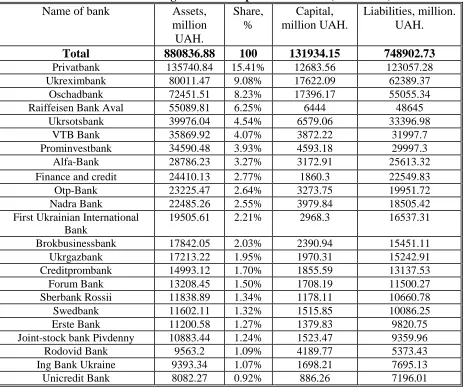
[image:11.595.68.532.207.595.2]First, it should be noted that of the 176 banks, stocks of only 5 are in the listing of PFTS Stock Exchange. The level of concentration of bank assets and capital is significant enough in only a few of the biggest traded banks, which are the ones that we have chosen to analyze. 80% of all assets belong to 24 banks, long-term trading conducts with only 2 banks stocks (see Table 6 )
Table 6 Concentration of banking assets and capital in Ukraine (01.07.2011) Name of bank Assets,
million UAH.
Share, %
Capital, million UAH.
Liabilities, million. UAH.
Total 880836.88 100 131934.15 748902.73
Privatbank 135740.84 15.41% 12683.56 123057.28
Ukreximbank 80011.47 9.08% 17622.09 62389.37
Oschadbank 72451.51 8.23% 17396.17 55055.34
Raiffeisen Bank Aval 55089.81 6.25% 6444 48645
Ukrsotsbank 39976.04 4.54% 6579.06 33396.98
VTB Bank 35869.92 4.07% 3872.22 31997.7
Prominvestbank 34590.48 3.93% 4593.18 29997.3
Alfa-Bank 28786.23 3.27% 3172.91 25613.32
Finance and credit 24410.13 2.77% 1860.3 22549.83
Otp-Bank 23225.47 2.64% 3273.75 19951.72
Nadra Bank 22485.26 2.55% 3979.84 18505.42
First Ukrainian International Bank
19505.61 2.21% 2968.3 16537.31
Brokbusinessbank 17842.05 2.03% 2390.94 15451.11
Ukrgazbank 17213.22 1.95% 1970.31 15242.91
Creditprombank 14993.12 1.70% 1855.59 13137.53
Forum Bank 13208.45 1.50% 1708.19 11500.27
Sberbank Rossii 11838.89 1.34% 1178.11 10660.78
Swedbank 11602.11 1.32% 1515.85 10086.25
Erste Bank 11200.58 1.27% 1379.83 9820.75
Joint-stock bank Pivdenny 10883.44 1.24% 1523.47 9359.96
Rodovid Bank 9563.2 1.09% 4189.77 5373.43
Ing Bank Ukraine 9393.34 1.07% 1698.21 7695.13
Unicredit Bank 8082.27 0.92% 886.26 7196.01
Source: Own calculations according the data from:
http://www.kinto.com/rus/research/marketupdate/transactions/equity/company/10/t_transactions/13/7/2008/13/7/2009.html\
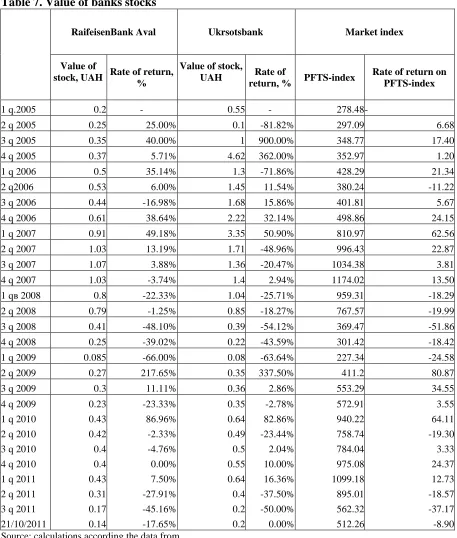
We have therefore chosen to further analyze the 2 biggest banks, based on asset volume with full data about market value of stocks in the period 2005-2011.
Table 7. Value of banks stocks
RaifeisenBank Aval Ukrsotsbank Market index
Value of
stock, UAH Rate of return, %
Value of stock,
UAH Rate of
return, % PFTS-index
Rate of return on PFTS-index
1 q.2005 0.2 - 0.55 - 278.48 -
2 q 2005 0.25 25.00% 0.1 -81.82% 297.09 6.68 3 q 2005 0.35 40.00% 1 900.00% 348.77 17.40 4 q 2005 0.37 5.71% 4.62 362.00% 352.97 1.20 1 q 2006 0.5 35.14% 1.3 -71.86% 428.29 21.34 2 q2006 0.53 6.00% 1.45 11.54% 380.24 -11.22 3 q 2006 0.44 -16.98% 1.68 15.86% 401.81 5.67 4 q 2006 0.61 38.64% 2.22 32.14% 498.86 24.15 1 q 2007 0.91 49.18% 3.35 50.90% 810.97 62.56 2 q 2007 1.03 13.19% 1.71 -48.96% 996.43 22.87 3 q 2007 1.07 3.88% 1.36 -20.47% 1034.38 3.81 4 q 2007 1.03 -3.74% 1.4 2.94% 1174.02 13.50 1 qв 2008 0.8 -22.33% 1.04 -25.71% 959.31 -18.29 2 q 2008 0.79 -1.25% 0.85 -18.27% 767.57 -19.99 3 q 2008 0.41 -48.10% 0.39 -54.12% 369.47 -51.86 4 q 2008 0.25 -39.02% 0.22 -43.59% 301.42 -18.42 1 q 2009 0.085 -66.00% 0.08 -63.64% 227.34 -24.58 2 q 2009 0.27 217.65% 0.35 337.50% 411.2 80.87 3 q 2009 0.3 11.11% 0.36 2.86% 553.29 34.55 4 q 2009 0.23 -23.33% 0.35 -2.78% 572.91 3.55 1 q 2010 0.43 86.96% 0.64 82.86% 940.22 64.11 2 q 2010 0.42 -2.33% 0.49 -23.44% 758.74 -19.30 3 q 2010 0.4 -4.76% 0.5 2.04% 784.04 3.33 4 q 2010 0.4 0.00% 0.55 10.00% 975.08 24.37 1 q 2011 0.43 7.50% 0.64 16.36% 1099.18 12.73 2 q 2011 0.31 -27.91% 0.4 -37.50% 895.01 -18.57 3 q 2011 0.17 -45.16% 0.2 -50.00% 562.32 -37.17 21/10/2011 0.14 -17.65% 0.2 0.00% 512.26 -8.90 Source: calculations according the data from
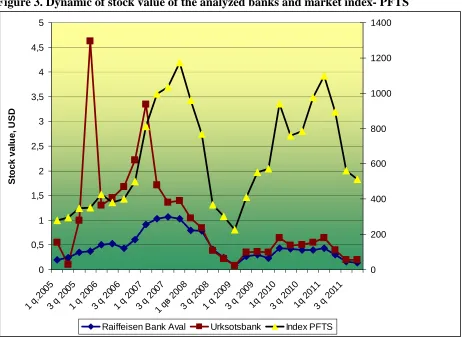
Figure 3. Dynamic of stock value of the analyzed banks and market index- PFTS
Source: Own elaboration
The dynamic of stock rate of return in comparison with the dynamic of stock exchange index (here PFTS – index) allows us to evaluate the level of exposure (dependence) of stock value on the market movements and also gives the opportunity of risk valuation.
[image:13.595.63.533.543.684.2]A valuation of risk (market beta) for these two publicly traded banks with foreign capital, which trade on a constant basis, was conducted, as was an estimation of the impact of the market on the bank stock prices. The results are presented in the Table 8.
Table 8. Risk valuation of bank stocks
Security name Beta Alpha R-Sqr Resid Std Std. Err Number of Observations Dev-n Beta Alpha
RaiffeisenBank Aval
(BAVL) 0.015 -0.012 0.71 0.29 0.002 0.056 28
Ukrsotsbank (USCB) 0.021 0.329 0.10 1.89 0.012 0.365 28
Source: Own calculations
Thus, we can draw some conclusions about these stocks: there is positive correlation between the Raiffeisen Bank Aval stocks rate of return and the rate of return of the market
0 0,5 1 1,5 2 2,5 3 3,5 4 4,5 5
1 q. 2005
3 q 2005
1 q 2006
3 q 2006
1 q 2007
3 q 2007
1 qв 200
8
3 q 2008
1 q 2009
3 q 2009
1q 2 010
3 q 2010
1q 2 011
3 q 2011 S to c k v a lu e , U S D 0 200 400 600 800 1000 1200 1400
with more than average range (correlation ratio equals 0.84 ). Volatility of rate of return of BAVL stocks depends on volatility of rate of return of the market index by 71%.
Regarding Ukrsotsbank, we should note that there is a positive correlation between the stock’s rate of return and the rate of return of the market with less than average range (correlation ratio equals 0,32 )
In contrast to the BAVL stocks, the volatility of the rate of return of USCB only depends on the rate of return of the market index by 10%.
Risk levels of both stocks are low and “betta” indicator confirms this statement.
Besides we can come to conclusion that during the analyzed period the BAVL stocks had less rate of return than market and USCB stocks had quite the opposite more rate of return. These statements are based on “alpha” indicators of the appropriate stocks.
Using the results of the above calculations we can build the market model for these two banks
For RaifeisenBank Aval it is:
r BAVL=-0,01158+0,01455*r i
For Ukrsotsbank it is:
r USCB=0,3290+0,0208*r i
In conducting a quality analysis of the impact of the crisis on stocks prices, we should note the following: analyzed banks are bank subsidiaries of European parent banks (Raifeisen Bank Aval of Reifeisen Bank Austria, and Ukrsotsbank of UniCredit Group) and changes in the stock prices depend on the situation of the parent banks. Prior to the crisis, foreign ownership strengthened the competitiveness of these banks, but the current debt crisis in Western Europe could hurt these banks. The parent banks could even leave the Ukrainian market if things get worse [Shulik, V. Analysis…, 2010].
Besides the investors’ expectations about the banks future and sustainability of financial system in Europe and Ukraine, legislative limits had significant impact on the stock price: prohibition for mutual fund to own banks stock. This restriction was adopted at the February 2011 and applied from the June, 16. As a result, mutual funds-owners of banks capital had to sell their shares.
Stock prices are very sensitive both to internal factors and international events.
The following groups of factors appear to have an impact on stock prices of Ukrainian commercial banks at present:
• investors expectations concerning the banks performance; • politic uncertainty;
• capitalization of the banking system; • stability of the financial system; • news about world financial markets; • sale of big bank shares.
• macroeconomic risk of devaluation
• financial soundness of parent banks and their further strategy.
Conclusion
more negative. S&P experts rate the Ukrainian banking system in the weakest group (group 10) because of the high level of country risk and because the recovery of most Ukrainian banks took 2-3 years. A number of factors delayed recovery, including a deficiency of currency derivatives, a lack of long-term resources, and volatile client deposits [Shulik, V. Survey…2011]. According the Global Competitiveness Index 2010-2011, the soundness of Ukrainian banks (as one element of the “financial market development” assessment) ranked poorly --138th among the 139 evaluated countries [The Global…,2010, p.335].
The post crisis period was extremely difficult for the Ukrainian banking system. Many internal and external factors influenced bank performance. Additional debt provisions (the sharp increase in required reserves) are the main reason for the longer than expected poor financial results of banks. The quality of banking assets is worsening because of unstable borrowers’ activity.
The volume of non-performing loans is falling at present, and there appears to be a chance for asset recovery. As a result, it is possible that bank performance will be significantly stronger in 2011. However, macroeconomic performance influences bank performance, and the macroeconomic situation is still vulnerable to the European and global economic.
References
D.E. Weinstein, Y. Yafeh. On the costs of bank-centered financial system: evidence from the changing main bank relations in Japan, The journal of Finance, vol LIII, No 2, 1998, p. 635-672
The Global Competitiveness Report 2010–2011. World Bank
http://www3.weforum.org/docs/WEF_GlobalCompetitivenessReport_2010-11.pdf Annual Report of National Bank of Ukraine 2010. National Bank of Ukraine.
http://www.bank.gov.ua/doccatalog/document?id=77872 Shulik, V. Ukrainian Banking System: challenge by the crisis
http://www.credit-rating.ua/en/analytics/analytical-articles/12570/ Shulik, V. Survey of Ukraine's Banking Sector for 1H2011
http://www.credit-rating.ua/en/analytics/analytical-articles/
Shulik, V. Analysis of the operating environment and general state of the banking system in 2010 http://www.credit-rating.ua/en/analytics/analytical-articles/12922/
Ukrainian Banking System – slow recovery and significant risks?
http://aub.org.ua/index.php?option=com_content&task=view&id=1331&menu=104 &Itemid=96
Analytical review lessons from banking crisis 2008-2009 and ways for the strategic transformation of banking branch of Ukraine. AUB experts group (September- November 2010) http://aub.org.ua/index.php?option=com_content&task=view&id=3921&menu=104&Itemid=96
Segura, En (2010). Ukraine After the Crisis: the Road to Recovery.
http://newtbf.sigmableyzer.com/wp-content/uploads/2011/02/Ukraine-after-the-Crisis-Ap-2010-v2.pdf
Masciandaro D, Nieto, M. J., Quintyn M. (2009) Measuring convergence in the new European system of financial supervisors http://voxeu.org/index.php?q=node/3859 Reinhard H. Schmidt, R.H, Hackethal A., Tyrell M. (2001) The Convergence of Financial
Systems in Europe. Working paper series: Finance & Accounting No.75: Weinstein COSTS
The alternatives of banks selling, Ukraine Banks Messenger, 12.09.2011 http://stolytsa.com.ua/varianty-prodazhi-problemnyx-bankov/
Indices of banking activity. Association of Ukrainian banks (AUB)
http://aub.org.ua/index.php?option=com_arhive_docs&show=1&menu=104&Itemid=112 Data from financial statements of Ukrainian banks
http://bank.gov.ua/control/uk/publish/article?art_id=36807&cat_id=36798 Main indicators of Ukrainian bank activities.
http://bank.gov.ua/control/uk/publish/category?cat_id=64097
Abstrakt