279 CNTFR = ciliary neurotrophic factor receptor; IFN = interferon; JCA = juvenile chronic arthritis; JDM = juvenile dermatomyositis; PBEF = pre-B-cell colony-enhancing factor; PBMC = peripheral blood mononuclear cells; PCR = polymerase chain reaction; RA = rheumatoid arthritis; SAM = signifi-cance analysis of microarrays; SLE = systemic lupus erythematosus.
Introduction: the dawning of the microarray
era
The concept that the identification of genes that are differ-entially expressed in a disease state will elucidate disease mechanisms has driven the development of new technol-ogy. Earlier approaches, including Northern blotting, poly-merase chain reaction (PCR), and RNase protection, have permitted analysis of small numbers of gene transcripts, but the value of characterizing a broad spectrum of gene products expressed in a cell population or in a disease state has stimulated the invention of more sophisticated tools. Subtractive hybridization and representational differ-ence analysis, comparing gene expression in two cell pop-ulations, are time-intensive approaches used in the late 1990s to assist in gene discovery and to identify molecu-lar pathways relevant to a disease. Microarray analysis, a system in which thousands of oligonucleotide sequences are spotted on a solid substrate, usually a glass slide, and
RNA-derived material from a cell population is hybridized to the gene array, is an innovative technology that has already changed our understanding of the mechanisms that underlie disease [1].
The utility of microarray analysis of gene expression was demonstrated impressively in 2000 when Alizadeh and colleagues used this technique to study the malignant cell population of patients with diffuse large B cell leukemia [2]. Although individual patient samples were not readily differentiated on the basis of traditional cell surface phe-notypic markers, microarray analysis discerned two dis-crete tumor groups: those with a gene expression profile similar to that of germinal center B cells from healthy indi-viduals and those with a profile similar to that of activated mature B cells. Significantly, these two groups were char-acterized by markedly different clinical courses: B cell lym-phomas of the germinal center type had a 5-year survival
Review
Microarray analysis of gene expression in lupus
Mary K Crow
1and Jay Wohlgemuth
21Mary Kirkland Center for Lupus Research, Hospital for Special Surgery, New York, NY, USA 2Expression Diagnostics, Inc, South San Francisco, CA, USA
Corresponding author: Mary K Crow (e-mail: [email protected])
Received: 26 Aug 2003 Revisions requested: 5 Sep 2003 Revisions received: 22 Sep 2003 Accepted: 1 Oct 2003 Published: 13 Oct 2003
Arthritis Res Ther2003, 5:279-287 (DOI 10.1186/ar1015)
© 2003 BioMed Central Ltd (Print ISSN 1478-6354; Online ISSN 1478-6362)
Abstract
Recent advances in the study of global patterns of gene expression with the use of microarray technology, coupled with data analysis using sophisticated statistical algorithms, have provided new insights into pathogenic mechanisms of disease. Complementary and reproducible data from multiple laboratories have documented the feasibility of analysis of heterogeneous populations of peripheral blood mononuclear cells from patients with rheumatic diseases through use of this powerful technology. Although some patterns of gene expression, including increased expression of immune system cell surface activation molecules, confirm previous data obtained with other techniques, some novel genes that are differentially expressed have been identified. Most interesting is the dominant pattern of interferon-induced gene expression detected among blood mononuclear cells from patients with systemic lupus erythematosus and juvenile dermatomyositis. These data are consistent with long-standing observations indicating increased circulating interferon-αin the blood of patients with active lupus, but draw attention to the dominance of the interferon pathway in the hierarchy of gene expression pathways implicated in systemic autoimmunity.
280
of 76%, whereas lymphomas of the activated B cell type were associated with a 16% 5-year survival. As striking as this study was, at that time confidence was not high that microarray analysis of gene expression could be success-fully applied to heterogeneous populations of cells, cells that were not monoclonal.
Numerous investigations over the past several years have demonstrated that significant and useful microarray data can be derived from more complex cell samples, including cell populations from peripheral blood. Although such studies face challenges in data interpretation, several lab-oratories have used microarray analysis to study mononu-clear cells from patients with autoimmune diseases. When studying mixed cell populations, gene expression profiling can successfully detect differential gene expression in specific cell types present in the samples under compari-son. However, it can also measure and reflect the cellular composition of the sample. The contribution of variable enrichment of a cell population in a sample can be sorted out by combining cell sorting or histology with expression profiling experiments. Cell sorting can also be used as an initial step in sample preparation to enrich for specific cell types in a cell mixture to overcome sensitivity and speci-ficity limitations of arrays.
The recent advances in the analysis of broad gene expres-sion patterns have rapidly led to new insights into patho-genic mechanisms of rheumatic diseases and are supporting new initiatives in therapeutic drug develop-ment. Most striking are microarray data that have refo-cused attention on the interferon (IFN) pathway in systemic lupus erythematosus (SLE) [3–6].
Analysis of microarray data
A statistical analysis of appropriately normalized micro-array data is as important as the cell preparation, initial hybridization, and data extraction in deriving valuable infor-mation from this technology. Arrays are useful because they allow large-scale screening for differential gene expression. However, the thousands of variables in the analyses represent a significant statistical problem. Theo-retically, when using an array with 1000 genes and a stan-dard t-test with a significance at the P< 0.05 level, one would expect to identify 50 genes that are ‘differentially expressed’ by chance alone. Corrections for multiple com-parisons, such as the Bonferroni method, can be used to address this problem but tend to lose efficacy with very large numbers of comparisons, and some differentially expressed genes might not appear as significant [7,8]. Significance analysis of microarrays (SAM) is an approach that uses an estimate of the false detection rate to make an estimate of significance under conditions in which thousands of data points are being compared [9]. We have learned that no one statistical algorithm is sufficient to derive an accurate view of the genes significantly
over-expressed or underover-expressed in one population compared with another.
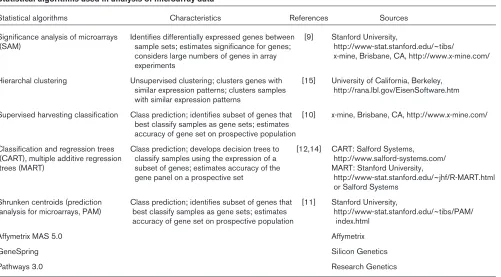
Although a comparative analysis of the current statistical approaches to microarray data is beyond the scope of this review, we will direct the reader to several of the most useful algorithms that we and others have used to derive a comprehensive data set that includes genes most signifi-cantly differentially expressed between cell populations (Table 1). When analyzing microarray data from two sets of patient-derived samples, we first use the SAM algorithm with parameters set to determine the genes significantly overexpressed or underexpressed in the patient group of interest compared with the control group [9]. The false detection rate is set at approximately 5% (indicating that in only 5 cases out of 100 will a gene be erroneously iden-tified as significantly differentially expressed). Additional algorithms, including supervised harvesting classification and a method termed ‘shrunken centroids’, are then applied to the data set [10–16]. Genes that either are identified in several of the algorithms or are most highly ranked in one of the algorithms are then used in a hierar-chical clustering approach to identify additional genes that are coexpressed with the most significantly differentially expressed genes.
Array data can be internally validated by, for example, car-rying multiple probes for the same gene. When data from all such probes in a particular experiment are identified as correlating in an array experiment, the probability of the finding being real is increased. Further, when data from multiple genes that are known to be coexpressed in a cluster or cellular pathway are correlated, the result has greater significance than data from a single gene. Micro-array analysis cannot be relied on to develop a definitive rank order of the most significant gene products associ-ated with a particular disease or cell state. Rather, the technology is most useful in drawing attention to path-ways, and sometimes individual genes, that are most rele-vant to the recent in vivoexperience of the cell population being studied.
As revealing as microarray data can be, confirmation of the data using more accurate, quantitative, and less variable approaches, such as real-time PCR, and validation in a second patient population are essential for drawing mean-ingful conclusions [17].
Early microarray data from the use of SLE
peripheral blood
281 receptors, and other immune-system cell surface
mole-cules, including adhesion molecules. Data analysis com-prised several approaches: selection of genes with mean expression in the SLE group that was more than 2.5-fold that observed in the healthy control group; genes that were significantly different between groups with the use of the Mann–Whitney U-test at a significance level of P< 0.05; and SAM analysis with a false detection rate of 8%. Fifty genes were identified as differing by more than 2.5-fold, and 20 genes differed between groups on the basis of the Mann–Whitney U-test, of which 15 differed by more than 2.5-fold between groups. The importance of confirming microarray data with an additional technique was clearly illustrated in this report. The gene that showed the greatest fold difference between SLE and control groups by microarray, that encoding ciliary neurotrophic factor receptorα (CNTFR), could not be confirmed by reverse transcriptase PCR (RT–PCR). Increased expres-sion of two other genes that were also studied by RT–PCR, CXCR2 and that encoding pre-B-cell colony-enhancing factor (PBEF), was confirmed, although the fold increase as assessed by RT–PCR was less than esti-mated by microarray. Of the genes significantly overex-pressed, the products of some, including MMP3,
TNFRSF1B (TNF receptor 2), IL1B, and FCGRIA, have
been documented to be increased in SLE. Among other genes with increased expression were TNFSF10 (encod-ing TRAIL), TNFRSF10Cand TNFRSF10D(TRAIL
recep-tors 3 and 4), IL1RAP (interleukin-1 receptor accessory protein), TGFBR3 (transforming growth factor-βreceptor type III), and CCR7(a T cell chemokine receptor important for the recruitment of CD4 T cells to the periarteriolar lym-phoid sheath). Although the Rus study did not provide an opportunity to detect the expression of genes that were not obviously directly related to immune system function, it drew attention to several genes that had not been studied previously in detail in SLE. Overall, the data presented in this study supported the value of the microarray approach for detecting genes differentially expressed among PBMC from lupus patients.
[image:3.612.60.561.112.389.2]A second early report came from Maas and colleagues, who showed PBMC microarray data from a small number of patients with SLE (n= 9), rheumatoid arthritis (RA; n= 9), type I diabetes mellitus (n= 5) or multiple sclerosis (n= 4), along with nine control subjects before and after immunization with influenza vaccine [19]. The array used (Research Genetics GF-211 membrane) included more than 4000 genes, and the statistical analysis was based on Eisen’s Cluster and Treeview software, as well as the Research Genetics Pathways 3.0 program used to locate differentially expressed genes in pathways related to the immune system [15]. As in the Rus study, microarray analysis of unfractionated PBMC provided data that seemed to be reproducible and statistically significant, and characterization of the cell composition of the PBMC
Table 1
Statistical algorithms used in analysis of microarray data
Statistical algorithms Characteristics References Sources
Significance analysis of microarrays Identifies differentially expressed genes between [9] Stanford University,
(SAM) sample sets; estimates significance for genes; http://www-stat.stanford.edu/~tibs/
considers large numbers of genes in array x-mine, Brisbane, CA, http://www.x-mine.com/ experiments
Hierarchal clustering Unsupervised clustering; clusters genes with [15] University of California, Berkeley, similar expression patterns; clusters samples http://rana.lbl.gov/EisenSoftware.htm with similar expression patterns
Supervised harvesting classification Class prediction; identifies subset of genes that [10] x-mine, Brisbane, CA, http://www.x-mine.com/ best classify samples as gene sets; estimates
accuracy of gene set on prospective population
Classification and regression trees Class prediction; develops decision trees to [12,14] CART: Salford Systems, (CART), multiple additive regression classify samples using the expression of a http://www.salford-systems.com/ trees (MART) subset of genes; estimates accuracy of the MART: Stanford University,
gene panel on a prospective set http://www-stat.stanford.edu/~jhf/R-MART.html or Salford Systems
Shrunken centroids (prediction Class prediction; identifies subset of genes that [11] Stanford University,
analysis for microarrays, PAM) best classify samples as gene sets; estimates http://www-stat.stanford.edu/~tibs/PAM/ accuracy of gene set on prospective population index.html
Affymetrix MAS 5.0 Affymetrix
GeneSpring Silicon Genetics
282
indicated that a variable presence of mononuclear cell populations could not account for differential gene expres-sion. However, the analysis was not able to distinguish a gene expression profile that was distinct for SLE as com-pared with RA or other autoimmune diseases. Ninety-five genes were identified that distinguished the samples from all four autoimmune diseases from healthy controls, includ-ing those encodinclud-ing the cell surface receptors TGFBR2, CSF3R, and BMPR2, which were overexpressed in the autoimmune patients, and several genes implicated in apoptosis (TRADD, TRAF2, CASP6, CASP8), which were underexpressed. It is of interest that ADAR, an IFN-induced gene encoding the RNA-specific adenosine deaminase, was highly overexpressed in most patients with autoimmune disease. Increased RNA editing, depen-dent on the ADAR protein, has been idepen-dentified in T cells in patients with SLE [20]. The patterns seen in the patients with autoimmune disease were distinct from those observed in samples from healthy subjects who had received influenza vaccination, suggesting that the path-ways involved in the immunopathogenesis of autoimmune disease do not simply reflect an active immune response to an antigen. This study relied mainly on clustering algo-rithms to identify genes that were differentially expressed among the study groups and also eliminated from analysis genes whose expression levels did not vary by more than 3SD from their means, supporting our view that multiple approaches, including algorithms such as SAM, are useful in discerning gene expression relevant to disease-specific molecular pathways.
Interferon-induced gene expression in
rheumatic diseases
A gene expression profile identified by microarray analysis and consistent with IFN-mediated gene transcription in a rheumatic disease was first reported by Tezak and col-leagues in a study of muscle biopsy tissue from four patients with juvenile dermatomyositis (JDM) [21]. Data from biopsies were compared with gene expression data from two healthy control peripheral blood samples as well as previously obtained microarray data from muscle biopsy samples from patients with Duchenne muscular dystrophy by using Affymetrix HuFL GeneChips. Genes showing at least a twofold difference in comparisons of JDM samples with each of two control samples were used to develop a list of differentially expressed genes. Ninety-one genes showed more than twofold increased expression, and 87 genes showed more than twofold lower expression. It should be noted that in studies using small numbers of patient samples, although genes might be identified that are truly differentially expressed between the samples, the variable expression patterns might be unrelated to the disease state. In this study, fold differences between patient samples and controls were highly variable (ranging from 3.8-fold to 96.4-fold higher in patients than in con-trols), but the list of differentially expressed genes was
striking for its enrichment in those that have been linked to IFN. MX1, MX2, G1P3, IRF7, and C1ORF29were among the IFN-induced genes overexpressed in the JDM muscle samples. Increased expression of several genes, including G1P3 (encoding IFN-induced 6-16) and CDKN1A (p21 cyclin kinase inhibitor), were confirmed by real-time PCR, and G1P3expression was also identified in JDM periph-eral blood. It is of interest that there was no significant increase in mRNA for either IFN-αor IFN-γ, although IFN-γ protein was seen in JDM muscle by using immunohisto-chemistry. The authors interpreted their data as consistent with effects of both IFN-α/βand IFN-γon gene expression. In addition to this set of IFN-induced genes, gene expres-sion profiles indicating ischemia and myofiber degenera-tion and regeneradegenera-tion were detected.
Data supporting a pathogenic role for type I IFN (predomi-nantly IFN-α) in SLE have been available for 25 years, with type II IFN (IFN-γ) also being implicated in murine models of lupus [22–31]. It has only been recently that microarray data from several laboratories have refocused attention on this important cytokine and its downstream targets. Studies from our laboratory and from others have used more extensive microarrays than those used in the two SLE studies described above to characterize the broad gene expression profile operative in the peripheral blood of patients with SLE [3–6]. Most striking is an ‘IFN signa-ture’, a prominent overexpression of mRNAs encoded by genes regulated by IFNs and similar to that detected in JDM muscle.
Detection of an interferon signature in SLE by
using microarray technology
283 IFN-γ. It should be noted that the patterns of gene
expres-sion induced in PBMC by type I and type II IFNs can vary with time after initial stimulation. The data from Baechler, then, provide only a partial assessment of IFN-regulated genes at a single point in time.
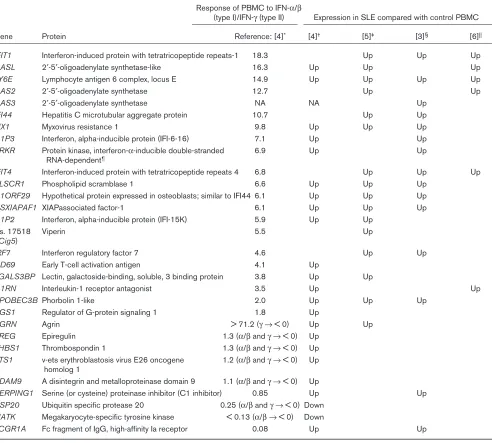
The pattern of expression of the IFN-regulated genes was complex (Table 2). Eleven of the IFN-regulated genes that were differentially expressed between SLE and control PBMC clustered together and were preferentially induced by a combination of IFN-αand IFN-β. However, two genes preferentially induced by IFN-γ (SERPING1 and
FCGR1A) were also significantly increased in the SLE
patients and clustered with the IFN-α/β-induced genes. Additional genes, preferentially induced by IFN-α/βbut not clustering with the major IFN-induced group (CD69,
RGS1, IL1RN, and AGRN), were also increased in the
SLE group, and two genes repressed by IFN-α/β were significantly underexpressed in the SLE patients. Three genes significantly overexpressed in SLE were decreased in expression by both IFN-γand IFN-α/β(EREG, THBS1, and ETS1). These are decreased somewhat more by IFN-γ than by IFN-α/β. Taken together, these SLE data, along with the very useful information about genes induced by type I and type II IFNs, support the type I IFNs as being particularly important in the gene expression pattern that distinguishes SLE PBMC from those of healthy controls. Confirmation of these data by a more quantitative tech-nique will be essential to determine more precisely the rel-ative expression of this gene set in patients with SLE, as well as those with other autoimmune diseases.
In addition to the IFN-regulated genes, the Baechler study documented an increased expression of genes encoding immune system activation antigens, including TNFR6 (encoding Fas), CD54 (ICAM-1), and CD69 in the SLE samples, along with FCGRIA (as observed in the Rus study) and FCGRIIA(Table 3) [4]. Other genes detected by Rus and colleagues were also identified (IL1B, IL1RB). Genes with decreased expression in the SLE samples included TCF3 (encoding transcription factor E2α), important in B cell development; TCF7 (transcription factor 7 [T-cell specific, HMG box]), a polymorphism of which has been associated with type I diabetes; and LCK (lymphocyte-specific tyrosine kinase), which mediates T cell activation.
A second extensive gene expression study by Bennett and colleagues also used Affymetrix U95AV2 microarrays to analyze PBMC from 30 pediatric lupus patients ranging in age from 6 to 18 years (mean age 13), 12 patients with juvenile chronic arthritis (JCA), and 9 healthy control chil-dren [5]. Of the 30 SLE patients, 18 were studied no more than 1 year after diagnosis, reflecting the gene expression profile at a point in time closer to the onset of symptoms than is usually possible to document in adult
SLE patients. Data were analyzed with a correction for multiple comparisons. With this approach, 15 genes were found differentially expressed between SLE patients and healthy controls, and 14 of those 15 were identified as targets of IFN. Several of the most significantly differen-tially expressed genes were among those identified in the Baechler study (C1ORF29, MX1, LY6E, PLSCR1, and
APOBEC3B) and others identified with less stringent
sta-tistical criteria were also found in the Baechler study (Table 2) or are closely related to genes identified by Baechler (OAS1, OAS2, MX2). In addition, Bennett identi-fied IFI44 (encoding hepatitis C-associated microtubular aggregate protein), IFIT4 (termed CIG49 by those authors), CIG5 (viperin), and C1ORF29as nearly univer-sally expressed in their SLE subjects. The JCA samples did not demonstrate overexpression of IFN-induced genes.
Although neither the Baechler study nor the Bennett study confirmed the IFN-regulated gene expression signature by using more quantitative techniques, the similarity of results derived from the two studies is remarkable, strongly sup-porting the significance of the IFN pathway in SLE and also demonstrating the power of microarray technology, even when applied to heterogeneous populations of peripheral blood cells.
Additional observations by Bennett and colleagues included the significant overexpression of DEFA3, encod-ing the neutrophil-specific α3 defensin that is predomi-nantly expressed in precursors of mature polymorphonuclear cells [5]. Sorting of granular cells iden-tified by flow cytometry confirmed a population of early granulocyte cells not present in mononuclear cell popula-tions from controls. DEFA3 and another neutrophil gene
FPRL1 (encoding formyl peptide receptor-like-1), along
with several of the IFN-induced genes, were highly corre-lated with disease activity as measured by the Systemic Lupus Erythematosus Disease Activity Index.
284
Table 2
Interferon-induced genes identified in large-scale microarray analyses of SLE PBMC
Response of PBMC to IFN-α/β
(type I)/IFN-γ(type II) Expression in SLE compared with control PBMC
Gene Protein Reference: [4]* [4]† [5]‡ [3]§ [6]||
IFIT1 Interferon-induced protein with tetratricopeptide repeats-1 18.3 Up Up Up
OASL 2′-5′-oligoadenylate synthetase-like 16.3 Up Up Up
LY6E Lymphocyte antigen 6 complex, locus E 14.9 Up Up Up Up
OAS2 2′-5′-oligoadenylate synthetase 12.7 Up Up
OAS3 2′-5′-oligoadenylate synthetase NA NA Up
IFI44 Hepatitis C microtubular aggregate protein 10.7 Up Up
MX1 Myxovirus resistance 1 9.8 Up Up Up
G1P3 Interferon, alpha-inducible protein (IFI-6-16) 7.1 Up Up
PRKR Protein kinase, interferon-α-inducible double-stranded 6.9 Up Up RNA-dependent¶
IFIT4 Interferon-induced protein with tetratricopeptide repeats 4 6.8 Up Up Up
PLSCR1 Phospholipid scramblase 1 6.6 Up Up Up
C1ORF29 Hypothetical protein expressed in osteoblasts; similar to IFI44 6.1 Up Up Up
HSXIAPAF1 XIAPassociated factor-1 6.1 Up Up Up
G1P2 Interferon, alpha-inducible protein (IFI-15K) 5.9 Up Up
Hs. 17518 Viperin 5.5 Up
(Cig5)
IRF7 Interferon regulatory factor 7 4.6 Up Up
CD69 Early T-cell activation antigen 4.1 Up
LGALS3BP Lectin, galactoside-binding, soluble, 3 binding protein 3.8 Up Up
IL1RN Interleukin-1 receptor antagonist 3.5 Up Up
APOBEC3B Phorbolin 1-like 2.0 Up Up Up
RGS1 Regulator of G-protein signaling 1 1.8 Up
AGRN Agrin > 71.2 (γ →< 0) Up Up
EREG Epiregulin 1.3 (α/βand γ →< 0) Up
THBS1 Thrombospondin 1 1.3 (α/βand γ →< 0) Up
ETS1 v-ets erythroblastosis virus E26 oncogene 1.2 (α/βand γ →< 0) Up homolog 1
ADAM9 A disintegrin and metalloproteinase domain 9 1.1 (α/βand γ →< 0) Up
SERPING1 Serine (or cysteine) proteinase inhibitor (C1 inhibitor) 0.85 Up Up
USP20 Ubiquitin specific protease 20 0.25 (α/βand γ →< 0) Down
MATK Megakaryocyte-specific tyrosine kinase < 0.13 (α/β →< 0) Down
FCGR1A Fc fragment of IgG, high-affinity Ia receptor 0.08 Up Up
The genes and corresponding proteins listed were identified as significantly differentially expressed in SLE and healthy control PBMC in the study by Baechler and colleagues [4], or were among the most commonly overexpressed transcripts among SLE PBMC in the study by Bennett and colleagues [5]. The significant overexpression of these genes in SLE compared with control PBMC in microarray data sets from Crow and colleagues [3] or Han and colleagues [6] is also noted. In addition, genes identified by Baechler and colleagues as both regulated by type I
285 identity of the stimulus for the IFN-induced gene expression
signature. It is noteworthy that none of the SLE or JDM studies identified significantly increased expression of type I or type II IFN mRNA, with the exception of a recent report by Han and colleagues [6] that detected IFN-ω, another type I IFN species, by using a distinct microarray system (Mergen ExpressChip DNA Microarray System
Human HO4) in a study of 10 SLE patients and 8 healthy controls. The Han study also detected an increased expression of several of the genes identified in the other three studies (Table 2). In contrast to the Baechler and Bennett reports, which note that type I and II IFNs are undetectable in serum from most SLE patients, we have measured plasma IFN-αprotein by ELISA and are currently analyzing those data in relation to the IFN target gene expression data, as well as measures of clinical disease activity. Importantly, our data provide direct support for IFN-α in the gene expression profile observed in SLE PBMC (KA Kirou, C Lee, S George, K Louca, M Peterson, MK Crow, unpublished observations). However, it should be noted that the IFN signature is complex, as described in detail for the Baechler study, and additional work will be required to determine the relative roles of type I and type II IFN in the gene expression profile observed in SLE periph-eral blood. Analysis of the age of study patients, time from diagnosis, organ system involvement, and current therapy, along with gene expression data, will be essential for an understanding of the place of IFN family members in disease pathogenesis.
Beyond the impressive IFN gene signature, each of the studies identified additional genes that were differentially expressed in SLE and control samples. In view of the bio-logical, patient, and assay variation encountered in gene profiling of SLE, a diagnostic gene signature might prove most useful clinically. An algorithm such as shrunken cen-troids can be used to develop a robust multigene classifier that can be tested in clinical studies as a measure of diag-nosis or clinical outcome [11].
Microarray analysis of gene expression at
sites of tissue damage
The next generation of reports describing global gene expression patterns based on microarray assays will
prob-Figure 1
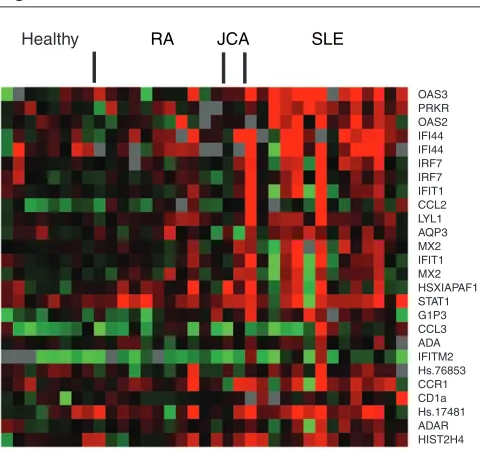
Exemplary gene sequences that cluster with PRKR and OAS3. Hierarchical clustering was performed on the total study population to determine genes that cluster with PRKR and OAS3. A visual demonstration of the expression of a selection from those genes, comprising a partial IFN signature, is shown. Data are shown from a subset of SLE samples tested (n= 14) and from rheumatoid arthritis (RA) (n= 11), juvenile chronic arthritis (JCA) (n= 2), and control samples (n= 8). Relative expression compared with an internal control ranged from approximately –0.5 (bright green) to 0.5 (bright red).
OAS3 PRKR OAS2 IFI44 IFI44 IRF7 IRF7 IFIT1 CCL2 LYL1 AQP3 MX2 IFIT1 MX2 HSXIAPAF1 STAT1 G1P3 CCL3 ADA IFITM2 Hs.76853 CCR1 CD1a Hs.17481 ADAR HIST2H4
[image:7.612.56.565.112.269.2]Healthy RA JCA SLE
Table 3
Selected gene families overexpressed or underexpressed in SLE PBMC
Gene families overexpressed Examples Gene families underexpressed Examples
IFN target genes See Table 2 Transcription factors TCF3, TCF7
TNF and TNF receptor families TNFSF10(TRAIL), TNFRSF10C(TRAIL receptor 3), Kinases LCK TNFR6(Fas)
Chemokines and chemokine
receptors CCR7, CXCR2 T cell receptors TCRB, TCRD
Cell surface activation antigens CD69 C-type lectins KLRB1
Fc receptors FCGR1A, FCGR2A
Metalloproteinases MMP3, MMP9
Defensins DEFA3, F2RPA
[image:7.612.57.297.319.544.2]286
ably derive from studies of tissue samples from sites of disease activity. Unpublished data presented at scientific meetings demonstrate the feasibility of microarray analysis of glomeruli from lupus nephritis kidneys and from skin lesions of lupus patients. As valuable as those data will be, we are encouraged that peripheral blood seems to provide a reasonable sampling of those gene pathways that are activated and relatively disease specific.
Conclusion
Since the dramatic illustration of the clinical utility of microarray technology in patients with malignant disease 3 years ago, efforts to study mixed mononuclear cell popu-lations in patients with autoimmune diseases have been remarkably successful. Not only are microarray-derived data interpretable and significant, but they have drawn our attention back to a key cytokine pathway. Increased expression of IFN in patients with active SLE was first reported in 1979, but relatively few investigators have pursued the role of IFN in SLE [22]. An important excep-tion is the group led by Ronnblom and Alm, who noted the induction of lupus autoantibodies and clinical lupus in patients receiving therapeutic IFN-α [26]. That group has gone on to characterize the IFN-producing cells as well as some of the properties of immune complexes that induce the production of IFN by plasmacytoid dendritic cells [32–37]. In addition, Bennett’s collaborators, led by Banchereau, have presented functional data showing the induction of efficient stimulators of allogeneic T cell responses by IFN-αin SLE sera [28]. Now, the repeated appearance of IFN-induced genes among the most signifi-cantly overexpressed genes in data derived from multiple laboratories using distinct microarrays raises the profile of IFN as a pathogenic mediator of the myriad alterations to the immune system seen in SLE.
In view of the important effects of IFN on immune system function, including activities that could contribute to the development of systemic autoimmunity, this cytokine system might represent an excellent target for therapeutic modulation [38–44]. At the same time, both type I and type II IFNs are important, if not essential, for effective host defense against pathogenic microbes. The weight of data are consistent with the action of type I IFNs as primary mediators of the observed gene expression signature in SLE, with significant consequences for the development of clinical disease. However, additional potential mediators of the IFN gene signature, including CpG DNA or double-stranded RNA, are candidates that should be explored.
Competing interests
MKC is a scientific advisor to Expression Diagnostics, Inc, and JW is Vice-President, Research and Development, Expression Diagnostics, Inc. Research conducted by MKC was supported through a contract between Expression Diagnostics, Inc. and Hospital for Special Surgery.
Acknowledgements
We thank our collaborators at the Hospital for Special Surgery and Expression Diagnostics, Inc, particularly Dr Kyriakos Kirou and Ms Christina Lee and Ms Sandhya George, for their contributions to the work described in this review. MKC is supported by a Target Identifica-tion in Lupus Grant from the Alliance for Lupus Research, by a Novel Research Grant from the Lupus Research Institute, and by the Mary Kirkland Center for Lupus Research.
References
1. Brown PO, Botstein D: Exploring the new world of the genome with DNA microarrays.Nat Genet1999, 21:33-37.
2. Alizadeh AA, Eisen MB, Davis RE, Ma C, Lossos IS, Rosenwald A, Boldrick JC, Sabet H, Tran T, Yu X, Powell JI, Yang L, Marti GE, Moore T, Hudson J Jr, Lu L, Lewis DB, Tibshirani R, Sherlock G, Chan WC, Greiner TC, Weisenburger DD, Armitage JO, Warnke R, Staudt LM: Distinct types of diffuse large B-cell lymphoma identified by gene expression profiling.Nature2000, 403: 503-511.
3. Crow MK, George S, Paget SA, Ly N, Woodward R, Fry K, Wohlgemuth J: Expression of an interferon-alpha gene program in SLE.Arthritis Rheum2002, 46:S281.
4. Baechler EC, Batliwalla FM, Karypis G, Gaffney PM, Ortmann WA, Espe KJ, Shark KB, Grande WJ, Hughes KM, Kapur V, Gregersen PK, Behrens TW: Interferon-inducible gene expres-sion signature in peripheral blood cells of patients with severe lupus.Proc Natl Acad Sci USA2003, 100:2610-2515. 5. Bennett L, Palucka AK, Arce E, Cantrell V, Borvak J, Banchereau
J, Pascual V: Interferon and granulopoiesis signatures in sys-temic lupus erythematosus blood.J Exp Med2003, 197: 711-723.
6. Han GM, Chen SL, Shen N, Ye S, Bao CD, Gu YY: Analysis of gene expression profiles in human systemic lupus erythe-matosus using oligonucleotide microarray. Genes Immun
2003, 4:177-186.
7. Benjamini Y, Hochberg Y: Controlling the false discovery rate: a practical and powerful approach to multiple testing.J R Statist Soc1995, 57:289–300.
8. Dudoit S, Gentleman RC, Quackenbush J: Open source soft-ware for the analysis of microarray data.Biotechniques2003, Mar Suppl:45-51.
9. Tusher VG, Tibshirani R, Chu G: Significance analysis of microarrays applied to the ionizing radiation response.Proc Natl Acad Sci USA2001, 98:5116-5121.
10. Hastie T, Tibshirani R, Botstein D, Brown P: Supervised harvest-ing of expression trees.Genome Biol 2001, 2: research0003.1-0003.12
11. Tibshirani R, Hastie T, Narasimhan B, Chu G: Diagnosis of multi-ple cancer types by shrunken centroids of gene expression.
Proc Natl Acad Sci USA2002, 99:6567-6572.
12. Friedman JH: Stochastic Gradient Boosting. Technical report.
Stanford, CA: Department of Statistics, Stanford University; 1999. 13. Golub TR, Slonim DK, Tamayo P, Huard C, Gaasenbeek M, Mesirov JP, Coller H, Loh ML, Downing JR, Caligiuri MA, Bloom-field CD, Lander ES: Molecular classification of cancer: class discovery and class prediction by gene expression monitor-ing.Science1999, 286:531-537.
14. Breiman L, Friedman JH, Olshen RA, Stone CJ: Classification and Regression Trees.Belmont, CA: Wadsworth; 1984.
15. Eisen MB, Spellman PT, Brown PO, Botstein D: Cluster analysis and display of genome-wide expression patterns. Proc Natl Acad Sci USA1998, 95:14863-14868.
16. Sherlock G: Analysis of large-scale gene expression data.Curr Opin Immunol2000, 12:201-205.
17 Kirou K, Lee C, Crow MK: Measurement of cytokines in autoim-mune disease.Methods Mol Med, in press.
18. Rus V, Atamas SP, Shustova V, Luzina IG, Selaru F, Magder LS, Via CS: Expression of cytokine- and chemokine-related genes in peripheral blood mononuclear cells from lupus patients by cDNA array.Clin Immunol2002, 102:283-290.
19. Maas K, Chan S, Parker J, Slater A, Moore J, Olsen N, Aune TM: Cutting edge: molecular portrait of human autoimmune disease.J Immunol2002, 169:5-9.
287 21. Tezak Z, Hoffman EP, Lutz JL, Fedczyna TO, Stephan D, Bremer
EG, Krasnoselska-Riz I, Kumar A, Pachman LM: Gene expression profiling in DQA1*0501+ children with untreated dermato-myositis: a novel model of pathogenesis. J Immunol 2002, 168:4154-4163.
22. Hooks JJ, Moutsopoulos HM, Geis SA, Stahl NI, Decker JL, Notkins AL: Immune interferon in the circulation of patients with autoimmune disease.N Engl J Med1979, 301:5-8. 23. Hooks JJ, Jordan GW, Cupps T, Moutsopoulos HM, Fauci AS,
Notkins AL: Multiple interferons in the circulation of patients with systemic lupus erythematosus and vasculitis. Arthritis Rheum1982, 25:396-400.
24. Preble OT, Black RJ, Friedman RM, Klippel JH, Vilcek J: Systemic lupus erythematosus: presence in human serum of an unusual acid-labile leukocyte interferon.Science1982, 216: 429-431.
25. Rich SA: Human lupus inclusions and interferon. Science
1981, 213:772-775.
26. Ronnblom LE, Alm GV, Oberg KE: Possible induction of sys-temic lupus erythematosus by interferon-alpha treatment in a patient with a malignant carcinoid tumour.J Intern Med1990, 227:207-210.
27. Wandl UB, Nagel-Hiemke M, May D, Kreuzfelder E, Kloke O, Kranzhoff M, Seeber S, Niederle N: Lupus-like autoimmune disease induced by interferon therapy for myeloproliferative disorders.Clin Immunol Immunopathol1992, 65:70-74. 28. Blanco P, Palucha AK, Gill M, Pascual V, Banchereau J: Induction
of dendritic cell differentiation by IFN-alpha in systemic lupus erythematosus.Science2001, 294:1540-1543.
29. Peng SL, Moslehi J, Craft J: Roles of interferon-gamma and interleukin-4 in murine lupus. J Clin Invest. 1997, 99: 1936-1946.
30. Lawson BR, Prud’homme GJ, Chang Y, Gardner HA, Kuan J, Kono DH, Theofilopoulos AN: Treatment of murine lupus with cDNA encoding IFN-γγR/Fc. J Clin Invest 2000, 106: 207-215.
31. Santiago-Raber ML, Baccala R, Haraldsson KM, Choubey D, Stewart TA, Kono DH, Theofilopoulos AN: Type-I interferon receptor deficiency reduces lupus-like disease in NZB mice.J Exp Med2003, 197:777-788.
32. Svensson H, Johannisson A, Nikkila T, Alm GV, Cederblad B: The cell surface phenotype of human natural interferon-αα produc-ing cells as determined by flow cytometry.Scand J Immunol
1996, 44:164-172.
33. Vallin H, Blomberg S, Alm GV, Cederblad B, Ronnblom L: Patients with systemic lupus erythematosus (SLE) have a cir-culating inducer of interferon-alpha (IFN-αα) production acting on leukocytes resembling immature dendritic cells.Clin Exp Immunol1999, 115:196-202.
34. Vallin H, Peters A, Alm GV, Ronnblom L: Anti-double-stranded DNA antibodies and immunostimulatory plasmid DNA in com-bination mimic the endogenous IFN-alpha inducer in systemic lupus erythematosus.J Immunol1999, 163:6306-6313. 35. Bave U, Alm GV, Ronnblom L: The combination of apoptotic
U937 cells and lupus IgG is a potent IFN-alpha inducer. J Immunol2000, 165:3519-3526.
36. Bave U, Vallin H, Alm GV, Ronnblom L: Activation of natural interferon-alpha producing cells by apoptotic U937 cells com-bined with lupus IgG and its regulation by cytokines.J Auto-immun2001, 17:71-80.
37. Magnusson M, Magnusson S, Vallin H, Ronnblom L, Alm GV: Importance of CpG dinucleotides in activation of natural IFN-alpha-producing cells by a lupus-related oligodeoxynu-cleotide.Scand J Immunol2001, 54:543-550.
38. Ronnblom L, Alm GV: A pivotal role for the natural interferon αα -producing cells (plasmacytoid dendritic cells) in the patho-genesis of lupus.J Exp Med2001, 194:59-63.
39. Aman MJ, Tretter T, Eisenbeis I, Bug G, Decker T, Aulitzky WE, Tilg H, Huber C, Peschel C: Interferon-alpha stimulates pro-duction of interleukin-10 in activated CD4+ T cells and mono-cytes.Blood1996, 87:4731-4736.
40. Brinkmann V, Geiger T, Alkan S, Heusser CH: Interferon alpha increases the frequency of interferon gamma-producing human CD4+ T cells.J Exp Med1993, 178:1655-1663. 41. Kirou KA, Vakkalanka RK, Butler MJ, Crow MK: Induction of Fas
ligand-mediated apoptosis by interferon-alpha.Clin Immunol
2000, 95:218-226.
42. Radvanyi LG, Banerjee A, Weir M, Messner H: Low levels of interferon-alpha induce CD86 (B7.2) expression and acceler-ates dendritic cell maturation from human peripheral blood mononuclear cells.Scand J Immunol1999, 50:499-509. 43. Luft T, Pang KC, Thomas E, Herzog P, Hart DN, Trapani J, Cebon
J: Type I IFNs enhance the terminal differentiation of dendritic cells.J Immunol1998, 161:1947-1953.
44. Crow MK: Interferon-alpha: a new target for therapy in SLE?
Arthritis Rheum2003, 48:2396-2401.