University of Windsor University of Windsor
Scholarship at UWindsor
Scholarship at UWindsor
Electronic Theses and Dissertations Theses, Dissertations, and Major Papers
1-1-2006
Application of immune algorithm in multiple sensor system.
Application of immune algorithm in multiple sensor system.
Zhengqiao Ji
University of Windsor
Follow this and additional works at: https://scholar.uwindsor.ca/etd
Recommended Citation Recommended Citation
Ji, Zhengqiao, "Application of immune algorithm in multiple sensor system." (2006). Electronic Theses and Dissertations. 6945.
https://scholar.uwindsor.ca/etd/6945
APPLICATION OF IMMUNE ALGORITHM IN MULTIPLE SENSOR SYSTEM
by
ZHENGQIAO JI
A Thesis
Submitted to the Faculty o f Graduate Studies and Research through Electrical Engineering
in Partial Fulfillment of the Requirements for the Degree of Master of Applied Science at the
University o f Windsor
Windsor, Ontario, Canada
2006
1*1
Library and Archives CanadaPublished Heritage Branch
Bibliotheque et Archives Canada
Direction du
Patrimoine de I'edition 395 W ellington Street
Ottawa ON K1A 0N4 Canada
395, rue W ellington Ottawa ON K1A 0N4 Canada
Your file Votre reference ISBN: 978-0-494-34908-3
Our file Notre reference
ISBN: 978-0-494-34908-3
NOTICE:
The author has granted a non exclusive license allowing Library and Archives Canada to reproduce, publish, archive, preserve, conserve, communicate to the public by
telecommunication or on the Internet, loan, distribute and sell theses
worldwide, for commercial or non commercial purposes, in microform, paper, electronic and/or any other formats.
AVIS:
L'auteur a accorde une licence non exclusive permettant a la Bibliotheque et Archives Canada de reproduire, publier, archiver,
sauvegarder, conserver, transmettre au public par telecommunication ou par I'lnternet, preter, distribuer et vendre des theses partout dans le monde, a des fins commerciales ou autres, sur support microforme, papier, electronique et/ou autres formats.
The author retains copyright ownership and moral rights in this thesis. Neither the thesis
nor substantial extracts from it may be printed or otherwise reproduced without the author's permission.
L'auteur conserve la propriete du droit d'auteur et des droits moraux qui protege cette these. Ni la these ni des extraits substantiels de celle-ci ne doivent etre imprimes ou autrement reproduits sans son autorisation.
In compliance with the Canadian Privacy Act some supporting forms may have been removed from this thesis.
While these forms may be included in the document page count,
Conformement a la loi canadienne sur la protection de la vie privee, quelques formulaires secondaires ont ete enleves de cette these.
ABSTRACT
Recently the human immune systems have aroused researcher’s interest due to it
useful mechanisms which can be used exploited for information processing in a complex
cognition system. The scope o f this research is not to reproduce any immune
phenomenon accurately, rather to show that immune concepts can be applied to develop
powerful computational tools for data processing. From this viewpoint, an improved
artificial immune algorithm is presented and applied in the problems associated with
image registration and configuration o f multiple sensor systems. The simulation results
show that the immune algorithm can successfully obtain the global optimum with lesser
computational cost compared to other traditional algorithms. Therefore this method has a
ACKNOWLEDGEMENT
I would like to thank Dr. Jonathan Wu, my research supervisor, for his sincere
support, contributions and professional insight. His enthusiasm for life and academic
accomplishments have been motivating and inspiring me in the past two years.
Many thanks are also given to my friendly colleagues for their kind help and
warming smiles during the writing of this thesis. They are Abdul Adeel, He Quan and
Rashid Minhas.
Finally, my deep acknowledgements and thanks must be directed to my patient
and understanding family and aunts. Their love has always encouraged me to move
TABLE OF CONTENTS
ABSTRACT... iii
ACKNOW LEDGEM ENT...iv
LIST OF TA BLES...vii
LIST OF FIG U R ES... viii
CHAPTER I. INTRODUCTION 1. Multiple sensor fu sio n ...1
2. Fusion application... 1
3. Sensor and sensor data... 4
4. Benefits o f sensor fu sio n ... 6
5. General approach... 8
6. Sensor network motivation and challenge...9
7. Summary... 11
II. MULTIPLE SENSOR FUSION 1. General fram ew ork... 13
2. Mathematical tools... 14
3. Summ ary... 21
III. FUNDAMENTAL OF IMMUNE SYSTEM 1. General id e a s... 22
2. B rief History and Perspectives on Immunology...22
3. Fundamentals and Main com ponents... 25
4. Basic Immune Recognition and Activation M echanisms... 27
5. The Clone Selection Principle... 28
6. Immune Learning and M em ory... 29
7. Affinity M aturation...31
8. Summary... 32
IV. ARTIFICIAL IMMUNE ALGORITHM 1. Background...34
2. Artificial Immune system ... 35
6. Algorithm and Processes... 41
7. Summary... 46
V. APPLICATION CASES IN MULTIPLE SENSOR NETWORK 1. Image registration...48
2. Configuration of sensor system...50
3. Multiple fault tolerance design... 51
VI. EXPERIMENTS AND RESULTS 1. Image registration...57
2. Minimizing cost...60
3. Multiple fault endurance tolerance design... 62
VII. DISCUSSIONS AND CONCLUSIONS 1. Comparison with genetic algorithm...67
2. Algorithm sensitivity...69
3. Conclusion... 72
REFERENCES...74
LIST OF TABLES
Ta b l e3 . 1 Pe r i o d so f Hi s t o r y o f Im m u n o l o g y... 2 5
Ta b l e 6.1: Two Se n s o r s' Lo c a t i o n (1-D )... 58
Ta b l e 6 .2 : Re s u l t o n On e Di m e n s i o n... 5 8
Ta b l e 6 .3 : Two Se n s o r's Lo c a t i o n ( 3 - D ) ...5 8
Ta b l e 6 .4 : Re s u l to n Th r e e Di m e n s i o n s... 5 9
Ta b l e 6 .5 : Re s u l t si n p r e s e n c eo f No is eb yA IS...6 0
Ta b l e 6 .6 : Re s u l t sb y Ge n e t ic Al g o r i t h m... 6 0
Ta b l e 6 .7 : Mi n i m u m Co s t u n d e r Re l i a b i l i t y Co n s t r a i n t...61
Ta b l e 6 .8 : Ma x i m a Re l i a b i l i t y u n d e r Bu d g e t... 6 2
Ta b l e 6 .9 : Pr io r Pr o b a b i l i t i e s(A )...63
Ta b l e 6 .1 0 : Se n s o r s Pr i o r Pr o b a b i l i t i e s (A )... 6 3
Ta b l e 6 .1 1 : De s i g n e d Co n f i g u r a t i o nf o r Sy s t e mA... 63
Ta b l e 6 .1 2 : Pr i o r Pr o b a b i l i t i e s(B)... 6 4
Ta b l e 6 .1 3 : Se n s o r s Pr i o r Pr o b a b i l i t i e s (B )... 6 5
Ta b l e 6 .1 4 : De s i g n e d Co n f i g u r a t i o nf o r Se n s o r s y s t e m B... 6 5
L I S T O F F I G U R E S
Fig u r e 1 .1 Mu l t i p l es e n s o rf u s i o n-Ra d a rt r a c k i n g...2
Fi g u r eI . 2 Mu l t ip l e s e n s o r s y s t e m v s. Si n g l e s e n s o r... 7
Fig u r e 1 . 3 Ba s i c Fu n c t i o n s o f Mu l t ip l e Se n s o r Fu s i o n... 9
Fig u r e2 . 1 Ge n e r a l Fr a m e w o r k... 13
Fig u r e2 . 2 A Co o l i n g Sc h e d u l e...17
Fig u r e2 . 3 A Cl a s s i c Ar t if ic ia l Ne u r a l Ne t w o r k... 19
Fi g u r e3 . 1 In n e r Im m u n e Sy s t e ma n d m e d i a t o r s...2 6 Fi g u r e3 . 2 Im m u n e Re c o g n i t i o na n d Ac t i v a t i o n Pr o c e s s... 2 8 Fig u r e3 . 3 Pr i m a r y a n d Se c o n d a r y Re s p o n s e s...31
Fig u r e 4 . 1 : An t i b o d i e s Af f i n i t y La n d s c a p e...3 9 Fig u r e 4 . 2 : Sc h e m a t i c Re p r e s e n t a t i o no ft h e Sh a p e Sp a c e f o ra n Af f i n i t y La n d s c a p e... 4 0 Fi g u r e 4 . 3 : Ma i n Bl o c k so ft h e Al g o r i t h m...4 5 Fi g u r e s. 1 T w o Se n s o rr e a d i n g s... 4 9 Fi g u r e s. 2 Tw o- La y e r Se n s o r Sy s t e m Mo d e l...53
Fi g u r e5 . 3 Se n s o r Sy s t e m De s i g n Pr o c e s s...55
Fi g u r e6 . 1 Ab’s Al l o c a t i o n p a t t e r n Du r i n g Se a r c h i n g Gl o b a l Op t i m a 5 9 Fi g u r e6 . 2 Pr o b a b i l i t y o f Co r r e c td i a g n o s t i cd e c i s i o na n d Fa u l t s 1 ...6 4 Fi g u r e6 . 3 Pr o b a b i l i t yo f Co r r e c td i a g n o s t i cd e c i s i o na n d Fa u l t s 2 ... 6 6 Fig u r e 7 . 1 : Ba s i c Ge n e t i c Al g o r it h m Fl o w c h a r t...6 8 Fig u r e 7 . 2 : It e r a t io n s Ef f e c t e d b y Nc ... 71
CHAPTER I
INTRODUCTION
1. Multiple sensor fusion
Multiple sensor fusion is an evolving technology concerned with the problem of
combining the information from multiple sensors in order to make an optimal system for
inferences about a physical event or environment. In recent years, multiple sensor data
fusion, as a new discipline, has been developed to solve a diverse set o f problems having
common characteristics in the sensor network.
The role of multiple sensor fusion can best be understood with reference to the
type o f information that the integrated multiple sensors can uniquely provide the system.
The potential advantages gained through the synergistic use o f this multiple sensor
information can be decomposed into a combination of four fundamental aspects: the
redundancy, complementarities, timeliness and the cost o f the information.
2. Fusion application
Possible applications of multiple sensor fusion include virtually all systems
involving signal processing. In modem industrial societies that rely heavily on
communications and information, reliable data collection and interpretation is o f utmost
importance. Data fusion is therefore becoming an essential part o f the modem decision
making processes.
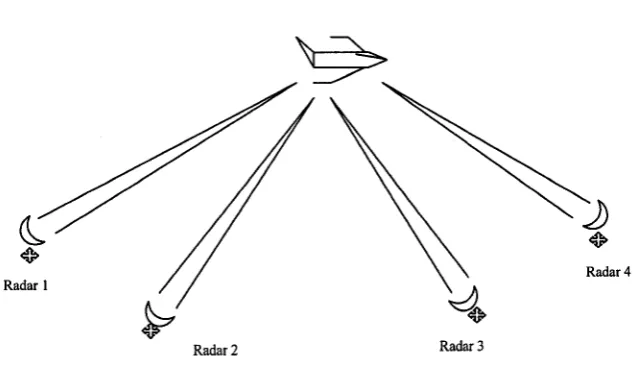
Figure 1.1 presents a radar tracking system requiring multiple sensor fusion. This
system consists o f several independent radar sites to track airplane. Each reading consists
expressed in three dimensions. The data in the system is therefore concerned with at least
four dimensions.
R adar 4 R adar 1
Radar 3 Radar 2
Figure 1.1: Multiple sensor fusion-Radar tracking
Other application areas include automation industries where accuracy and
reliability are of paramount importance. In short, all applications that require reliable data
processing to interact with a continuously changing environment can make good use of
this technology, which means multiple sensor fusion can be applied into several main
aspects as follows.
Aeronautics: As the number of airplanes in the air increases, air traffic control
becomes more and more difficult. In order to track large numbers o f aircraft over a large
area, using more than one radar antenna is necessary. In order to avoid system downtime,
Airliners also rely on input from many different sensors i.e. navigation beacons,
radar, altimeters and other equipment for accurately and reliably locating the position of
the aircraft. These gadgets must be used in combination by the pilot in order to properly
navigate large commercial airplanes. The same concerns exist for automatic navigation
systems, which are in common use. Spacecrafts have to consider all the above factors and
several others as well, such as resistance ability to noisy environments [1].
Manufacturing: Use of industrial robots in manufacturing has significantly
increased worker productivity and the quality of the end product. One of the main
problems that need to be resolved is that robot’s sensors are not reliable. Sensor fusion is
likely to help robots get reliable information about their environment.
Remote sensing: Remote sensing is one application area o f technology that has
seen tremendous growth within the last few decades. Satellites and airplanes use remote
sensing devices for activities that affect the day-to-day human life. Remote sensing is
used to provide accurate weather forecasting including charting the movement of
hurricanes. A network o f satellite is used to provide national intelligence service with
accurate information that would otherwise be impossible to obtain. Satellites use remote
sensing to determine how the environment is changing and study the effects pollution on
the eco-system. Sensor fusion will help these applications be more accurate and less
costly [2].
Work in hazardous environment: In order to avoid risking human life, many
autonomous and semi-autonomous devices are being developed and used for working in
hazardous areas. These devices must be particularly robust in order to function in special
applications. During the desert storm operation, unmanned flying vehicles were used to
provide intelligence about enemy troop positions on the battlefield. It is also meaningful
in scientific research, such as volcano exploration.
Medical applications: with the development of modem hospitals, new tools and
techniques for diagnosing illnesses are continuously emerging. It requires more
sophisticated information regarding the health of the patient and operations will require
technology that is extremely precise and beyond the manipulative abilities of unaided
human hands. Accurate and reliable sensors are the key to obtain precise information
needed for such diagnosis. Similarly the tools to perform surgical modifications at a
microscopic scale must be used in coordination with very precise, accurate and reliable
sensors. Sensor fusion is one o f the important areas of research needed for further
development in the field o f medical technology [4].
3. Sensor and sensor data
A simple sensor can be represented by a single thermometer that returns a single
reading with certain accuracy. It means sensor interacts with the environment and gives
us a reading that is within certain bounds of inaccuracy.
Mathematical model of a simple sensor is shown below. The mathematical
function has two arguments, the environment E and time t. The function, S maps the
environment to numeric values represented as variable V. V is a point in a D-dimensional
space. V is surrounded by an uncertainty s .
S(E,t) = {V{t),s{t)}
An analysis of sensor performance results concludes that there isn’t a perfect
targets in all circumstances (namely, for all ranges, sensing environments, etc.). Some
sensors are more accurate at locating and tracking objects, while others are good at
providing identity information.
The main characteristics o f sensors can be categorized into three aspects [5]:
Uncertainty and accuracy: sensors have varying accuracy. Rarely sensors provide
one single, absolutely accurate value for a physical variable. When a sensor delivers this
type o f reading, the physical values being measured generally vary over time. A sensor
reading that covers a finite time period would thus return a value range in order to
accurately represent the environment. As commonly known, all data processing has its
own limited accuracy i.e. all data representations have upper and lower bounds for the
values that can be represented and a maximum number of digits o f accuracy. If limits in
accuracy are not handled properly, the key information can be lost, thus resulting errors
in further calculation.
Probability and reliability: in addition to the limited accuracy o f each sensor, the
fact remains that a sensor might fail during the system’s lifetime, or may temporarily
return false readings for any possible reason. In other words, no matter how well a sensor
is maintained, it will inevitably cause problem in its lifetime, especially under some
hostile and noisy conditions. For these reasons, each sensor has an associated probability,
which depends on the sensor type, environment and actual sensor reading at any given
time.
Cost: each sensor also has its own cost. The cost o f sensor is important in
use. We regard cost as one of the attributes o f sensors and take cost constraints into
consideration during the design o f a sensor network.
4. Benefits o f sensor fusion
The purpose o f multiple senor fusion is to obtain more accurate and reliable
information o f the observed target, which provides higher fault tolerance and
dispensability than a system composed of one sensor. There are numerous examples
where sensor fusion is used in industrial and commercial applications. For improved
detection, effective integration of multiple sensor measurements o f the event/target
increases the chances o f its detection. Besides, a system employing different sensors to
measure various portions o f the electromagnetic spectrum is less vulnerable to disruption
by hostile action and natural phenomena. Therefore the benefits o f sensor fusion include
improved operational performance, extended spatial coverage, extended temporal
coverage, increased confidence, reduced ambiguity o f inferences, improved detection and
enhanced system reliability [6].
In addition to the qualitative benefits mentioned above, the quantitative
advantages o f multiple sensor fusion can also be illustrated through an example shown in
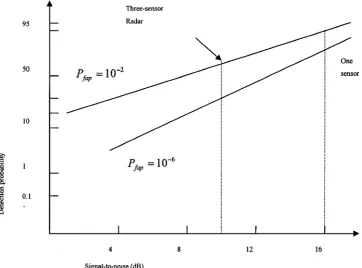
Figure 1.2 [7].
The lower curve gives the detection probability for a single radar sensor as a
function o f signal-to-noise ratio when the false alarm probability is 10"6. The detection
probability of 0.7 is acceptable while signal-to-noise locates on 16dB. But the detection
probability drops to 0.27 when signal-to-noise falls to lOdB. Now assuming that a three
unique signature-generation phenomena and does not generate false alarm on the same
events as others, then the false alarm rejection can be distributed among the three sensors.
The system false alarm probability is recovered through some fusion methods that
incorporate sensors operating in series and parallel combinations. When the false alarm
rejection can be divided equally among the sensors, the radar performance is given by the
upper curve marked with 10~2 false alarm probability. Now the nominal target signature
Three-sensor Radar 95
One 50
sensor
10
,-6 1
0.1
4 8 12 16
Signal-to-noise (dB)
Figure 1.2: Multiple sensor system vs. Single sensor
yields a detection probability 0.85. Besides, the reduced signature target on signal-to-
noise lOdB yields a detection probability 0.63, which is greater than before. The three
and signal processing capabilities o f all sensors and data combining capabilities o f the
fusion algorithm.
5. General approach
The synergistic use of multiple sensors by machines and systems is a major factor
in enabling some measure of intelligence to be incorporated into their overall operation
so that they can interact with and operate in an unstructured environment without
complete control o f a human operator. The sensors in an intelligent system provide
sufficient information o f outside world for next operation and allow a system to learn the
state of the world needed to continuously update its own model o f the world. Therefore, it
naturally leads people to a simple question: since a sensor can increase the capability o f a
system, how we can fuse more sensors to increase it even further? Over the past decade a
number of researchers have devoted themselves to exploring this question from both a
theoretical and practical perspective. Multiple sensor machines and systems have been
built for use in a variety o f areas o f application, such as target recognition, mobile robot
navigation and target tracking [8].
Although the process o f multiple sensor fusion can take different forms depending
on the particular needs and design o f the overall system, certain basic functions are
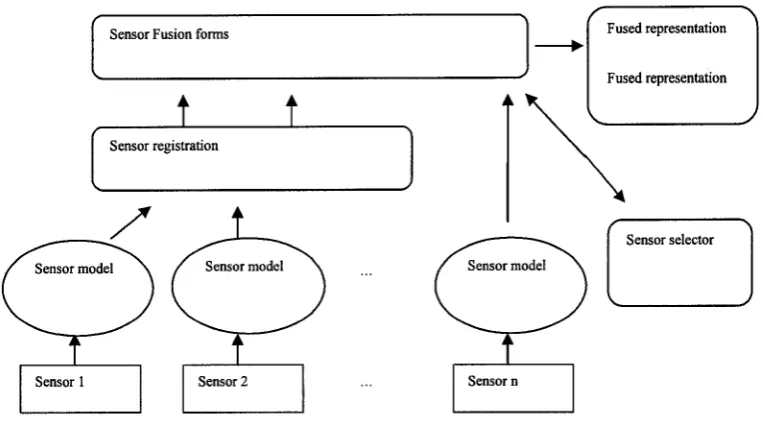
common to most implementations. Figure 1.3 illustrates these basic functions of multiple
sensor fusion.
A group of n sensors provide input to the fusion process. In order to make
readings from each sensor useful for fusion mechanism, the sensory data must be
Sensor model Sensor model
Sensor model
i k
Sensor n Sensor 2
Sensor 1
Sensor selector Fused representation
Fused representation
Sensor registration Sensor Fusion forms
Figure 1.3: Basic Functions o f Multiple Sensor Fusion
in the data from each sensor and provides a measure o f its quality that can be used by the
subsequent fusion functions. A common assumption is that the uncertainty in the sensor
data can be adequately modeled as a Gaussian distribution. After data modelling the data
is ready for further fusion processing. Sensor registration refers to the means used to
make data from each sensor commensurate in both its spatial and temporal dimensions i.e.
the data refers to the same location in environment over the same period o f time. Sensor
selector refers to the means adopted to select or allocate the particular group of sensors to
be used by the system. Fusion forms will be discussed in the next chapter.
6. Sensor network motivation and challenge
and capabilities one simple sensor is unable to achieve. These networks can have many
different construction levels and different network architectures which have respective
data communications and computational complexity requirements. They decide the ways
sensors can interact and the interaction among sensors in turn determines exactly how
fusion will be done on the readings from these sensors.
According to different network configurations, we can divide the sensor networks
into three categories: complementary, competitive and cooperative.
Complementary: In this sensor network, sensors are independent and can be
combined to provide a more complete image o f the phenomena being monitored. The
typical example is that every radar monitors one part o f a region and these radars together
provide complete information o f that region by merging their individual observations.
Complementary networks may give a representation of data over a large area, or
provide several aspects of the same phenomenon that can be used together for studying
one phenomenon. In general, to fuse complementary data is not difficult since the data
from independent sensors can be appended to each other providing a more complete
mapping o f the physical attributes being studied.
Cooperative: cooperative sensor networks combine data from independent sensors
to derive information that would be unavailable from individual sensors. The interaction
of sensors is sensitive to chrematistics o f all simple sensors components used. The
cooperative fusion causes accuracy and reliability o f whole system to decrease when
information from all simple sensor components is combined.
Competitive: in competitive sensor network, each sensor provides respective
focus on same target, the sensors are in competition as to which reading will be adopted
by the system in the case o f discrepancies. The reason to use competitive sensor network
is to provide greater reliability and fault-tolerance to a system.
In contrast to the example in a complementary network, if all radars monitor the
same area and return their readings, the question raised is which is the exact information
at the point measured and what is the accuracy o f the measurement.
To sum up, complementary and independent sensor network are the most easily
fused. Data from independent sensors can usually be inserted in to the same map
structure as extra fields without any ill effects. Cooperative sensor networks take data
from simple sensors and construct a new abstract sensor with data that does not resemble
the readings from any particular sensor. This setup is a special construction of new
information and is not limited to the reconciliation o f the existing sensor data, which
makes it more appropriate in the preprocessing stage.
The most difficult type o f sensor fusion is one that involves data from competitive
sensors, because this data is redundant and inconsistencies will arise between the sensor
readings. These characteristics help improve the overall system performance based on the
combination o f different sensor readings. However, utmost care must be taken to fuse
inconsistent data in a way that removes as much disturbances as possible in order to
increase the robustness of the system. Otherwise, competitive data fusion may have
potentially disastrous consequences.
7. Summary
This chapter provides an introduction to multiple sensor fusion problems and
with a summary o f its applications, characteristics and advantages. Note that multiple
sensor fusion is not a discipline in the same sense as a more well-defined study as signal
processing or numerical methods because it still has space to develop an eclectic set of
CHAPTER II
MULTIPLE SENSOR FUSION
1. General framework
The fusion of multiple sensor data or information from multiple sensors can take
place at different levels o f representation. A classic categorization is to consider multiple
sensor fusion taking place at signal, pixel, feature and symbol levels of representation
since most o f the sensors typically used in practice provide data that can be fused at one
or more o f these levels. Recently a generic framework covering a large set of these
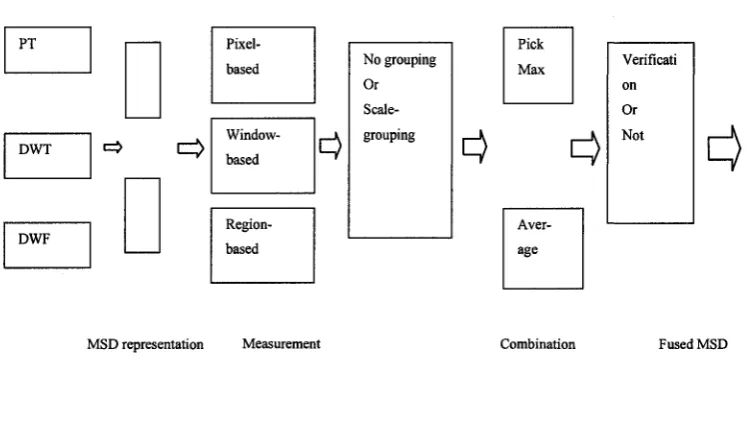
approaches has been given [9], [10]. A general framework is illustrated in Figure 2.1.
DW T
DWF
PT
Pixel-based
Window-based
Region-based
No grouping Or Scale-grouping
Pick M ax
A ver age
V enficati
M SD representation M easurement Combination Fused MSD
Figure 2.1: General Framework
In this figure, blocks in each column allow a choice o f several alternatives.
Selecting different choices will lead to the composition o f different algorithms. For
decomposition: pyramid transform (PT), discrete wavelet transform (DWT), and discrete
wavelet frame (DWF). O f course, these three are not mandatory before executing next
step so that the following steps are applied directly to the original signal as opposed to the
transform. Whether to use transform or not and the nature of transform to be used varies
from one case to another, sometimes using no transform does provide simplicity in many
applications.
The other blocks in Figure 2.1 describe how each coefficient o f the MSD
representations o f the source sensor information should be used to construct the MSD
representation o f the fused data. This process is influenced by a quantity we call the
activity level measurement which attempts to determine the quality o f each source data.
Grouping methods allow the fusion process to consider groups o f coefficients in each
source data rather than considering a single coefficient at a time. In addition, combination
methods describe exactly how the composite MSD representation o f the fused
information is obtained from the MSD representations o f the source data, which are based
on the previous steps. After a fused data is determined, further modifications can be made
by a consistency verification procedure which incorporates the idea that a composite
MSD coefficient is unlikely to be generated in a completely different manner from all its
neighbours.
2. Mathematical tools
The study o f computer science is primarily concerned with the study o f data
representations and their transformation by a software program. In the multiple sensor
system, programs are manipulated to provide an accurate and relevant description of
must be different with traditional methods and linear programming. A number of
methods have been proved to be practical algorithms for solving non-linear problems,
such as tabu search, genetic algorithms, simulated annealing and artificial neuron
network.
Tabu search: Tabu search is one of class of non-monotonic search methods that
have been proposed for solving optimization problems. The optimization here refers to
find globally optimal solutions in problems containing local minima. Optimization
problems containing local minima are more difficult than linear problems that can be
solved by linear programming.
The Tabu method was partly motivated by the observation that human behaviour
appears to operate with a random element that leads to inconsistent behaviour given
similar circumstances. In the tabu search category of meta-heuristics, the essential idea is
to 'forbid' search moves to points already visited in the (usually discrete) search space, at
least for the upcoming few steps. That is, one can temporarily accept new inferior
solutions, in order to avoid paths already investigated. This approach can lead to
exploring new regions with the goal o f finding a solution by 'globalized' search. Tabu
search has traditionally been applied to combinatorial optimization (e.g., scheduling,
routing and traveling salesman) problems. The technique can be made, at least in
principle, directly applicable to continuous global optimization problems by a discrete
approximation (encoding) o f the problem, but other extensions are also possible [11].
Simulated annealing: it is a simple Monte Carlo simulation that samples the
possible states o f a system by randomly choosing new parameters while attempting to
cooling solids. A material heated beyond a certain point will become fluid; if the fluid is
cooled gradually, the material will form crystals and revert to a minimal energy state. The
strategy o f this algorithm is based on a fitness function comparing the relative merit of
various points in the problem space. A Simulated Annealing optimization starts with a
Metropolis Monte Carlo simulation at a high temperature. This means that a relatively
large percentage of the random steps that result in an increase in the energy will be
accepted. After a sufficient number of Monte Carlo steps, or attempts, the temperature is
decreased. The Metropolis Monte Carlo simulation is then continued. This process is
repeated until the final temperature is reached.
A Simulated Annealing program consists of a pair o f nested loops. The outer
most loop sets the temperature and the inner-most loop runs a Metropolis Monte Carlo
simulation at that temperature. The way in which the temperature is decreased is known
as the cooling schedule. In practice, two different cooling schedules are predominantly
used; a linear cooling schedule {Tnew = Told - A T ) and a proportional cooling schedule
(Tnew = C x Told) where C<1.0. Actually, they are just the ones that appear the most in
literature; other cooling schedules are shown in Figure 2.2.
From a point in the search space, a neighbouring point is chosen at random. The
difference in the fitness function value between the new point and the current point is
calculated. This difference is used together with the current system temperature to
the distribution e = AC/I. The process continues with the same temperature t either for a
+ B
A (T0 - T n )(N + \)
Figure 2.2: A Cooling Schedule
given number o f iterations or until a given number o f positions have been occupied, at
which time the value t is decreased. The temperature decreases until no transitions are
possible, so the system remains frozen in one position. This freezing occurs only when
AC is positive for all neighboring points: therefore, the position must be a local
minimum and may be the global minimum, showing that simulated annealing has a
definite halting condition as opposed to tabu search and genetic algorithms. Although this
is advantageous for many applications but the result may be still the local optima.
Genetic algorithm: Genetic algorithm attempt to apply a Darwinian concept of
survival of the fittest to optimization problems, the idea being that biological systems
adapt themselves to fit into an ecological niche. The hypothesis is similar to evolutionary
process with a parametric description of an answer instead o f a deoxyribonucleic acid
(DNA) code would result in a series of increasingly fit answers. Possible solution to a
gene pool. The relative quality o f these answers are determined and used in production of
the next generation chromosomes. The contents of high quality solution are more likely
to survive to next generation. The next generation is generally formed via the processes
of crossover, combing elements of two chromosomes from the gene pool, mutation and
randomly altering elements o f a chromosome. Comparison between genetic algorithm
and proposed method will be discussed in the following chapter.
Artificial neural network: Artificial Neural Networks are relatively crude
electronic models based on the neural structure of the brain.
The most common type of artificial neural network consists o f three groups or
layers o f units: a layer of "input" units is connected to a layer o f "hidden" units, which is
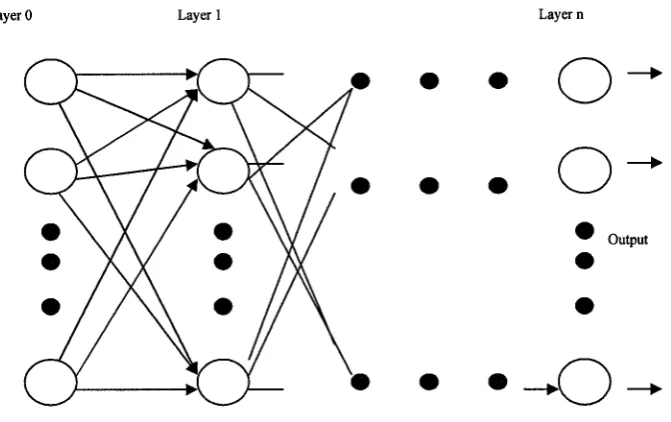
connected to a layer o f "output" units (See Figure 2.3). The activity o f the input units
represents the raw information that is fed into the network while the activity o f each
hidden unit is determined by the activities of the input units and the weights on the
connections between the input and the hidden units. The behavior o f the output units
depends on the activity of the hidden units and the weights between the hidden and
output units.
This simple type o f network is interesting because the hidden units are free to
construct their own representations o f the input. The weights between the input and
hidden units determine when each hidden unit is active and therefore by modifying these
weights, a hidden unit can choose what it represents.
We also distinguish single-layer and multi-layer architectures. The single-layer
organization, in which all units are connected to one another, constitutes the most general
multi-layer organizations. In multi-multi-layer networks, units are often numbered by multi-layer, instead of
following a global numbering.
Artificial neural networks or shortly neural networks have been quite promising in
offering solutions to problems, where traditional models have failed or are very difficult
to build. Due to the non-linear nature of the neural networks, they are able to express
much more complex phenomena than some linear modeling techniques.
Kohonen divides artificial neural networks into three categories [12]: 1) Signal
transfer networks; 2) State transition networks; 3) Competitive learning networks. In
signal transfer networks, the input signal is transformed into an output signal. The signal
traverses the network and undergoes a signal transformation o f some kind. The network
has usually a set o f pre-deflned basis functions, which are parameterized. The learning in
these networks corresponds to changing parameters o f these basis functions. Some
examples are the multi-layer perceptron (MLP) networks that are taught with error back
Layer 0 Layer 1 Layer n
propagation algorithm (BP) and radial basis function (RBF) networks. More about these
network models can be found in books [13], [14].
In state transition networks the dynamic behavior o f the network is essential.
Given an input, the network converges to a stable state, which, hopefully, is a solution to
a problem presented to it. Examples are Hopfield networks and Boltzmann machines.
In competitive learning networks, or self-organizing networks, all the neurons of
the network receive the same input. The cells have lateral competition and the one with
most activity "wins". Learning is based on the concept o f winner neurons. A
representative example o f a network based on competitive learning is the Self-Organizing
Map. The monograph by Kohonen is the most complete book about this particular
network model.
Learning in artificial neural networks is done in terms o f adaptation o f the
network parameters. Network parameters are changed according to pre-defmed equations
called the learning rules. The learning rules may be derived from pre-defined error
measures or may be inspired by biological systems. An example of an error measure in a
network based on supervised learning could be the squared error between the output of
the model and the desired output. This requires knowledge o f the desired value for a
given input. Learning rules are written so that the iterative learning process minimizes the
error measure. Minimization might be performed by gradient descent optimization
methods. In the course o f learning, the residual between the model output and the desired
output decreases and the model learns the relation between the input and the output.
The training must be stopped at the right time. If training continues for too long, it
information from the individual case and forgets the relevant information of the general
case.
3. Summary
In this chapter, we present the general process to deal with the problem of
multiple sensor fusion. Besides, we also give a brief introduction to a number o f tools and
constructs needed for multiple sensor processing. The intention here is to give the reader
a brief understanding o f the various tools and their basic principles.
The methods mentioned above are related to the non-linear problems. Their
applications for problems of multiple sensor fusion obtain satisfactory results in some
CHAPTER III
FUNDAMENTAL OF IMMUNE SYSTEM
1. General ideas
Individuals who do not succumb to a disease when infected are said to be immune
and the status of a specific resistance to a certain disease is called immunity. As the
immune system plays a major role in the survival o f humans/animals, it has to act
efficiently and effectively. Researchers have found a lot o f distinct components and
mechanisms working on the immune system. Some o f these elements are optimized to
defend against a specific invader, while others are directed against a great variety of
infecting agents. The circulation o f immune cells as well as their traffic through the
organisms is essential to immune surveillance and to an efficient immune response. In
addition, there is a great redundancy within the immune system, to allow for many
distinct defence mechanisms to be activated against a single agent.
From a biological and computational viewpoint, the presence o f adaptive and
memory mechanisms in the immune system is very important. The immune system owns
the capability o f extracting information from the infectious agents or environment and
makes it available for future recognition in cases of re-infection by a similar agent.
2. Brief History and Perspectives on Immunology
As a relatively new science, the origins o f immunology have been attributed to
Edward Jenner who, in 1796, discovered that by introducing small amounts of vaccine, or
cowpox, in an animal would induce protection against the often lethal disease smallpox.
When Jenner discovered the process o f vaccination, very little was known about
from the 19th century contributed to the development o f the science o f immunology,
which proved that pathogenic micro organisms caused infectious diseases; each of which
is responsible for a specific infection or pathology. In 1890, Emil von Behring and
Shibasaburo Kitasato demonstrated that protection induced by vaccination was not due to
the removal o f nutrients, but was associated with the appearance o f protecting elements in
the blood serum o f inoculated individuals. They discovered that people who had been
inoculated against diseases contained certain agents that could in some way bind to other
infectious agents. These agents were named antibodies.
From the beginning o f 20th century, several theories related to the immune system
had been proposed. Paul Ehrlich formulated a theory named side chain theory. The main
premise o f this theory was that the surfaces o f white blood cells, such as B-cells, are
covered with several side-chains, or receptors. The receptors on the surfaces o f B-cells
form chemical links with the antigens encountered. In a broad sense, any molecule that
can be recognized by the immune system is regarded as antigen.
Furthermore, the providential theory intrigued by Ehrlich stated that antibodies
might be constructed from the collection of genes, or genome, o f the animal. Therefore, it
was suggested that the content o f a receptor on a B-cell with a given antigen would be
responsible for selecting and stimulating the B-cell. This would give rise to large
production o f these receptors, which would then be secreted to the blood stream as
antibodies.
Niels K. Jeme revived the selective theories o f antibody formation in the early
1950. Jeme assumed that a diverse population o f natural antibodies would appear during
through the selection o f circulating antibodies containing structures complementary to
this antigen. The quality o f an immune response to a given antigen would depend on the
concentration of the circulating antibody of a specific type and could be enhanced by the
previous exposition to the antigen.
In 1959, Burnet formalized the clone selection theory which asserts that each cell
produces and creates on its surface a single type o f antibody molecule [15]. The selective
event is the stimulus given by the antigen, where those cells that produce antibodies
complementary to it will proliferate (clone expansion) and secrete antibodies.
More recently, Susumo Tonegawa (1983) formalized his research concerning the
structure and diversity o f the antibody molecules, He proposed that within the genome of
a germinal cell, a newly created cell, is contained (in multiple gene segments scattered
along a chromosome) the genetic information to code or an antibody molecule.
According to Zinkemael’s (2000) progress made in cell biology, genetics,
molecular biology and developmental biology will help scientists to better understand
general rules and exceptions of immunity. Also, among the many challenges for the
immunology to the 21st century, Abbas and Janeway made a further step in the
understanding o f the mechanisms that control the adaptive immune response [16].
Table 3.1 below summarizes the main concepts, periods and their respective
T ab le3.1 Periods of History of Immunology
Fields Period Pioneers Concepts
Application 1796-1870 E.Jenner
R.Koch Immunization Pathology 1870-1890 L.Pasteur E.Metchnikoff Immunization Phagocytosis
Description 1890-1910 E.von Behring
P.Ehrlich Antibodies Cell receptors 1910-1930 J.Bordet K.Landseiner Specificity/complement Haptens/Blood types
Mechanisms 1930-1950 A. Breinl
L.Pauling Antibody synthesis Instructionism 1950-1980 M.Bumet N.Jeme Clone selection
Network and cell co-op
Molecular 1980-1990 S.Tonegawa Structure and diversity
o f receptors
3. Fundamental s and Main components
The immune system is a natural, fast and effective defence entity against
infections. It is composed o f a two-tier line o f defence, these are known as the innate
immune system and the adaptive immune system. Both systems depend on the activity of
white blood cells, the leukocytes, where the innate immunity is mediated mainly by
granulocytes and macrophages, and the adaptive immunity is controlled by lymphocytes,
as presented in Figure 3.1.
However, these two immunities play different roles in the immune system. The
in the same way in all normal individuals. The adaptive immune system refers to the
production o f antibodies in response to a determined infectious agent. In other words,
antibodies are produced only corresponding to specific infections. The presence of
antibodies in an individual reflects the infections to which that individual has already
been exposed. Cells of the adaptive system are capable of developing an immune
memory. They are also able to recognize the same antigenic stimulus when it is presented
to the organism again. This capability avoids the re-establishment o f the disease in the
organism. Thus, the adaptive immune response allows the immune system to improve
itself with each encounter o f antigen.
T-cell B-cell
Macrophages Innate system
Immunity
Granulocytes Lym phocytes
Adaptive system
Figure 3.1: Inner Immune System and mediators
One o f the important components in the immune system is the lymphocytes that
mediate the adaptive immune response and are responsible for the recognition and
elimination o f the pathogenic agents. These agents are proportional to the immune
when there is some kind o f interaction with an antigenic stimulus leading to the activation
and proliferation o f the lymphocytes. There are two main types o f lymphocytes: B
lymphocytes (or B-cell) and T lymphocytes (or T-cell).
4. Basic Immune Recognition and Activation Mechanisms
While the innate and adaptive immune systems work together towards an
extremely effective defence mechanism, the immune system needs a complex set o f cells
and molecules that protect our bodies against infection. Our bodies are under constant
attack by antigens (Ag) that can stimulate the adaptive immune response. Antigens refer
to all kinds o f foreign cells, such as surface molecules on pathogens or self-antigens,
which are composed o f portions of cells or molecules within our body. Figure 3.2
illustrates a brief view of the main immune recognition and activation mechanism.
In the normal period, the specialized antigen presenting cells (APCs), such as
macrophages, circulate throughout the body ingesting and digesting antigens. These
antigens are fragmented into antigenic peptides. Part o f these peptides bind to molecules
o f the major histocompatibility complex (MHC) which are in turn presented in the APC
cell surface as an MHC/peptide complex. The T-cells carry surface receptors that allow
them to recognize different MHC/peptide complexes. Once activated by the
MHC/peptide, The T-cells become activated and promote other parts of immune system
into action [17].
On the contrary, the B-cells have receptors that are possibly able to recognize the
antigens without the helps o f MHC molecules because the surface receptors on some
B-cells respond to a specific antigen. When a pattern o f antigen is recognized by these B-
that secret antibody molecule in high volumes. These antibodies are used to neutralize the
pathogen, leading to their destruction. Some o f these activated B-cells and T-cells
become memory cells for future protection against the same antigen.
MHC bind
B-cell proliferation B-cell recognition
APCs circulation M HC recognition
T-cell activation
Pathogen destruction
Figure 3.2: Immune Recognition and Activation Process
5. The Clone Selection Principle
In the adaptive immune response, the clone expansion is a process that allows an
activated lymphocyte to proliferate and then differentiate into effective cells to fight
against an infection.
The clone selection principle (or clone expansion principle) is the theory used to
describe the basic properties of an adaptive immune response to an antigenic stimulus. It
establishes the idea that only those cells capable o f recognizing an antigenic stimulus will
proliferate and differentiate into effective cells, thus being selected against those that do
during reproduction and B-cells effectors are active anti body secreting cells. In contrast,
T-cells do not suffer mutation during reproduction and T-cells effectors are mainly active
lymphokine secretors. The presence of mutational and selection events in the B-cell
clone expansion process allows these lymphocytes to increase their repertoire diversity
and also to become increasingly better in their capability of recognizing the selective
antigens. Mainly due to the genetic variation, selection, and adaptation capabilities o f B-
cells discussions will be focused on the clone selection of the B-cells.
Since each B-cell secretes only one kind of antibody for the antigen, antigenic
receptors on a B-cell allow an antigen to stimulate a specific B-cell. The stimulation of
the B-cell causes it to proliferate and mature into terminal antibody secreting cells called
plasma cells in a lower rate. The B-cells, in addition to proliferation and differentiation
into plasma cells, can differentiate into long-lived B-memory cells. Memory cells
circulate through the blood, lymph and tissues and usually do not manufacture antibodies.
However, when exposed to a second antigenic stimulus they rapidly commence
differentiating into plasma cells capable of producing high affinity antibodies. These are
pre-selected for the specific antigen that had elicited the primary response.
6. Immune Learning and Memory
The immune system must have efficient mechanisms to mount an effective
response against pathogens since the antigen recognition only is not enough. Learning in
the immune system involves raising the population size and affinity o f those lymphocytes
that have been proven themselves to be valuable during the antigen recognition phase.
Thus the immune repertoire is biased from a random base to a repertoire that clearly
The memory means that immune system can elicit a fast and accurate response
against some known antigen rather than starting from scratch each time. This scheme is
the result o f successive infection or the intrinsic of learning strategy, where the system is
continuously learning from direct interaction with the environment. We can simply
regard the memory process of immune system as this way. The initial exposure to an
antigen that stimulates an adaptive immune response is handled by a small number o f B-
cells, each producing antibodies of different affinity. Storing high affinity antibody
producing cells from the first infection in order to form a large initial specific B-cell sub
population for subsequent encounters considerably enhances the effectiveness o f the
immune response to secondary encounters.
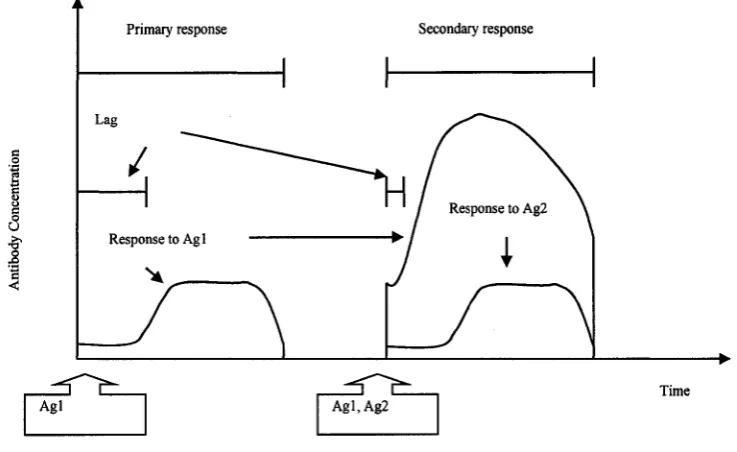
In Figure 3.3 an immune response (memory) with infection of two antigens in two
phases is shown. The immune system first detects the A g l’s invasion, and after a lag
phase, the antibodies against A gl will start increasing in concentration and affinity up to
a certain level, and when the infection is eliminated, its concentration begins to decline.
This first phase is known as the primary response. When another antigen Ag2 is coming,
the same pattern of response will rise again with a kind o f antibody different from the one
that recognizes A gl. The most important property of immune system is that the B-cells
that adapt to a certain type of antigen A gl can present a faster and more efficient
Secondary response Prim ary response
Lag
Response to Ag2
Response to A gl
Time
A g l A g l, Ag2
Figure 3.3: Primary and Secondary Responses
In comparison with the primary response, the secondary response is characterized
by a shorter lag phase, a higher rate of antibody production and longer persistence of
antibody synthesis. Moreover, a dose of antigen substantially lower than that required for
initiating a primary response can cause a secondary response.
7. Affinity Maturation
In a T-cell dependent immune response, only high-affinity B-cells are selected
into the pool o f memory cells. During clone selection, random changes are introduced
into the variable region genes and occasionally one such change will lead to an overall
increase in the affinity of the antibodies. Antibodies present in a secondary response on
an average have a higher affinity than those o f the primary response. The increase in
antibody affinity from the primary to the secondary response shows that the maturation of
the adaptive immune response: 1) sufficient diversity to deal with a universe o f antigens;
2) discrimination o f self from none self; 3) adaptability of the antibodies to the selective
antigens; 4) long lasting immunological memory.
The repertoire o f antigen-activated B-cells is classified into two mechanisms:
Hypermutation and receptor editing. These two mechanisms are discussed in the next
chapter from a viewpoint related to information processing. The repertoire is not only
diversified through a hypermutation process but mechanisms exist such that rare B-cells
with high affinity mutant receptors can be selected to dominate the response. Due to the
random nature o f the somatic mutation process, large proportions o f mutating genes
become non-functional or possibly develop harmful anti-self specificities. These cells
with low affinity or the self-reactive cells must be efficiently eliminated.
8. Summary
The immune system is a remarkable natural defence entity. In this chapter, a
number o f fundamental features and principles o f immune system are presented, giving
an outline o f whole immune system structure and a brief introduction o f its main
components.
Moreover, the working methods of the immune system are explained by
classifying it into two distinct but interacting mechanisms: the innate immunity and
adaptive immunity. While the innate immune system focuses on the ability of immune
system to extract molecular information via MHC molecules to be presented to T-cell, the
adaptive immune system concentrates on the creation o f B -cell antibodies against the
there are many interesting natural processes, such as learning and memory of immune
system, clone selection principle and affinity maturation.
The immune system exhibits capabilities o f learning, memory and adaptation. For
these aforementioned reasons, it is not difficult to imagine the immune system as a
mechanism o f vast potential for applications in a variety o f fields. Based on these
exciting properties and advantages of the immune system, an artificial immune system
that is able to extract valuable information using the properties o f the immune system can
be created for effective and powerful information processing systems. In the following
chapter, a natural defence mechanism to develop a complete framework for the artificial
CHAPTER IV
ARTIFICIAL IMMUNE ALGORITHM
1. Background
In the past few decades, many computational intelligence methods such as neural
network, evolutionary algorithm, annealing algorithm and artificial genetic algorithm
have been well established. Very recently, the immune systems have aroused researcher’s
interest due to its mysterious mechanisms that makes it well suited for certain
applications.
Although research and applications of the immune system is still in its infancy,
the rich properties of the immune system provide researchers with a lot of promise.
Besides, the mechanisms o f immune system show that they can be applied in many fields,
such as computation optimization and information processing.
There are several works in literature that introduce architecture models for
artificial immune system, such as construction model [19], a formal model [20] and a
physical model [21]. However, these works are usually either too restricted to a particular
application or they do not embrace enough immune concepts or components to formulize
a complementary framework o f artificial immune system. In 2001, de Castro attempted to
provide such a general-purpose framework on both theoretical immunology and artificial
immune system in order to build a novel computational tool to solve complex problems.
Some influential computational algorithms o f immune principles, theories, and processes
2. Artificial Immune system
In the previous chapter several mechanisms and main components o f the natural
immune system were introduced. The majority o f immune theories have been almost
entirely conceptual or non-mathematical in nature. The mathematical analysis o f immune
phenomena is extremely important to the science of immunology. This can be achieved
through physical modeling, writing a special purpose computer program or by using a
general simulation package. Mathematical analysis and models are applied to the immune
phenomena through several steps: 1) Through modeling and identification theory, it is
possible to provide a deeper and more quantitative description o f the immune system and
its corresponding experimental results; 2) adopt critical analysis o f hypotheses to
understand the biological mechanisms; 3) assist in the prediction of behaviours and the
design of experiments; 4) stimulate new and more satisfactory approaches to vaccination
policies, treatment o f diseases and control o f graft and transplant rejections; and 5) allow
the recovery o f information from experiment results.
Based on these steps, an experiment can be operated in a controlled environment
for the purpose of gathering observations, data or facts, demonstrating known facts or
theories and testing hypotheses or theories. We can also evaluate the performance of
hypotheses or theories by comparing experimental results with their predictions.
Artificial immune systems are intelligent methodologies inspired by the immune system
towards a real world problem solving.
Artificial immune systems are data manipulation, classification, representation
and reasoning methodologies which follow a biologically plausible paradigm. Therefore,
and organs); 2) incorporate ideas or principles from theoretical and/or experimental
immunology; and 3) aim at problem solving [22].
3. A framework for Engineering AIS
The first step to build a framework for artificial immune system is to devise a set
of models for the components o f natural system. In order to establish the engineering
artificial immune system, some clues are found by glancing at other soft computing
approaches inspired by biology, e.g. Artificial Neural Network (ANN). A set o f artificial
neurons can be arranged together so as to form an artificial neural network. A framework
to design an ANN is composed o f a set o f artificial neurons, a pattern o f interconnection
for these neurons and a learning algorithm. Therefore, a similar framework to design
artificial immune system can be proposed in a similar manner: a representation to create
abstract models o f immune organs, cells and molecules; a set o f functions termed affinity
functions, to qualify the interactions o f these artificial elements and a set of general
purpose algorithms to govern the dynamics of the artificial immune system.
During the building of abstract models o f immune cells, molecules and their
interactions, it is important to bear in mind the assumption that an antibody corresponds
to the portion o f any leukocyte capable o f recognizing a molecule pattern and an antigen
is equivalent to any pattern that can be recognized by this antibody. The strength of
binding between an antigen and an antibody is termed their affinity or degree o f match.
The concept o f shape space is introduced to quantitatively describe the
interactions between molecules o f the immune system and antigens. It is assumed that it
parameters (e.g., the length, width, and the height of any bump or groove in the
combining site, its charge, etc.). Therefore a point in an L-dimensional space, called
shape space S specifies the generalized shape of an antigen binding region of the
molecular receptors on the surface o f immune cells with regard to its antigen binding
properties. Also, it is assumed that a set of L parameters are used to describe an antigenic
determinant, though antigens and antibodies do not necessarily have to be o f the same
length. The mapping from the parameters to their real biological counterparts is not
important from a computational standpoint but will be basically dictated by the
application domain o f the artificial immune system.
Mathematically, the generalized shape of any molecule ‘m ’ in a shape space S can
be represented as an attribute string (set o f coordinates) of length L. Thus, an attribute
string m = < m l,m 2,---,mL > can be regarded as a point in an L-dimensional shape
space, m & S L . This string is usually driven by the problem domain of the artificial
immune system and will be important in the definition o f which measure will be used to
quantify their interactions. Most importantly, the type of attribute will define the type of
shape space to be adopted as follows: 1) Real valued shape space: the attribute strings
are real valued vectors; 2) Integer shape space: the attribute strings are composed of
integer values; 3) Hamming shape space: composed o f attribute strings built out of a
finite alphabet o f length k.
The affinity between an antibody and an antigen involves several processes, such
as short range interactions based on electrostatic charge and hydrogen binding. In order
for an antigen to be recognized, both antigen and antibody must bind complementary
distributions can be considered as properties of antigens and antibodies that are important
to determine their interactions.
Without loss o f generality, an antibody molecule is represented by the set of
coordinates Ab =< Abx,Ab2,---,AbL >and an antigen is Ag =< A gl, A g 2,■■■, AgL > . The
interaction o f antibodies or o f an antibody and an antigen is evaluated via a distance
measure termed as affinity measure between their corresponding attribute strings. The
affinity measure performs a mapping from the interaction between two attribute strings
into a nonnegative real number that corresponds to their affinity or degree of match.
Given an attribute string representation o f antigen and a set o f antibodies, for each
attribute string o f an antibody molecule, one can associate a corresponding affinity with
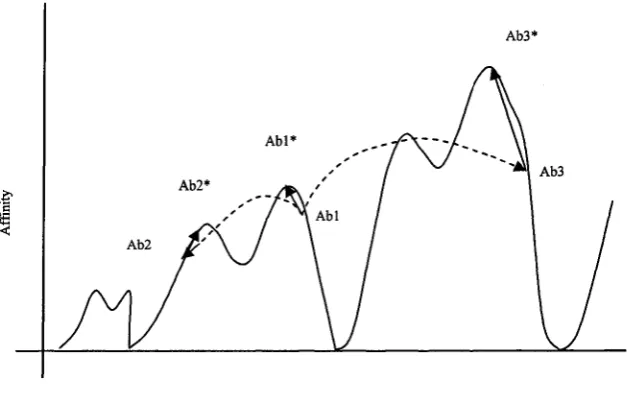
the given antigen. Thus, an affinity landscape can be defined on the shape space, as
illustrated in Figure 4.1.
According to the distance measure used to evaluate the affinity between the
components o f the artificial immune system, the affinity D between an antigen and an
antibody in the shape space is calculated.
D = dis^Abj - Agt ||
The common shape spaces are real valued space, including Euclidean and
Manhattan. An alternative to real valued shape spaces is the Hamming shape space.
Equation 1 depicts the Hamming distance measure used to evaluate the affinity between
<---A ntibody attribute strings
Figure 4.1: Antibodies Affinity Landscape
5. Main immune mechanism principles
The immune system is a complex o f cells, molecules and organs with the primary
role o f limiting damage to the host organism by pathogens (called antigens, Ag), which
elicit an immune response.
In the normal course o f the immune system evolution, the strength and specificity
of the Ag-Ab interaction is measured by the affinity o f their match [23]. The initial
exposure to an Ag that stimulates an adaptive immune response is handled by a small
number o f low-affinity B cells. The effectiveness o f the immune response to secondary
encounters is enhanced considerably by the presence o f memory cells associated with the
first infection, capable o f producing high-affinity A b’s after subsequent encounters. From
this procedure it can be stated that learning in immune system involves raising the