International Journal of Emerging Technology and Advanced Engineering
Website: www.ijetae.com (ISSN 2250-2459,ISO 9001:2008 Certified Journal, Volume 3, Issue 1, January 2013)
607
Approach for Downloading the Hidden Web Content for
Multi-Attribute Query Interface Using Web Log Techniques
Nisha Chhbara
1, Chirag Chhabra
2 1Assistant Professor, MVNIET,Palwal 2Btech Scholar,UIET KURUKSHETRA Abstract—Existing crawlers retrieve content only from thepublicly index able Web, i.e., the set of web pages reachable purely by following hypertext links, ignoring search forms and pages that require authorization or prior registration.
Particularly, they ignore high quality content “hidden” behind search forms, in large searchable electronic databases. In this paper, we provide a framework for addressing the problem of extracting content from this hidden Web. At Stanford, we have built a task-specific hidden Web crawler called the Hidden Web Exposer (HiWE).
Keywords— Crawling, HiddenWeb. I. INTRODUCTION
The tremendous amount of content on the Web is dynamic. This dynamism takes a number of different forms. For instance, web pages can be dynamically generated, i.e., a server-side program creates a page after the request for the page is received from a client. Similarly, pages can be dynamic because they include code that executes on the client machine to retrieve content from remote servers. Based on studies the content on the Web is dynamically generated, and that this number is continuing to increase. As major software vendors come up with new technologies [2, 7, 6] to make such dynamic page generation simpler and more efficient, this trend is likely to continue.
However, little of this dynamic content is being crawled and indexed. Now a days search and categorization services cover only a portion of the Web called the publicly indexable Web [9]. This refers to the set of web pages reachable purely by following hypertext links, ignoring search forms and pages that require authorization or prior registration. In this paper, we address the problem of crawling a subset of the currently uncrawled dynamic Web content. Particularly, we concentrate on extracting content from the portion of the Web that is hidden behind search forms in large searchable databases. The hidden Web is particularly important, as organizations with large amounts of high-quality information are placing their content online. This is typically achieved by building a Web query front-end to the database using standard HTML form elements [12].
As a result, the content from these databases is accessible only through dynamically generated pages, delivered in response to user queries.
Crawling the hidden Web is a very challenging problem for two fundamental reasons. First is the issue of scale; a recent study [4] estimates that the size of the content available through such searchable online databases is about 00 to 500 times larger than the size of the ―static Web.‖ As a result, it does not seem to be prudent to attempt comprehensive coverage of the hidden Web. Second, access to these databases is provided only through restricted search interfaces, intended for use by humans. Hence, ―training‖ a crawler to use this restricted interface to extract relevant content, is a non-trivial problem.
To address these challenges, we propose a task-specific, human-assisted approach to crawling the hidden Web. Specifically, we aim to selectively crawl portions of the hidden Web, extracting content based on the requirements of a particular application, domain, or user profiles. In addition, we provide a framework that allows the human expert to customize and assist the crawler in its activity.
International Journal of Emerging Technology and Advanced Engineering
Website: www.ijetae.com (ISSN 2250-2459,ISO 9001:2008 Certified Journal, Volume 3, Issue 1, January 2013)
608
An index can then be built on these pages. Searches on this index can now reveal both hidden and static content, at least for the targeted application. The repository can also be used as a cache. This use is especially important in military or intelligence applications, where direct Web access may not be desirable or possible. For instance, during a crisis we may want to hide our interest in a particular set of pages. Similarly, copies of the cache could be placed at sites that have intermittent net access, e.g., a submerged submarine. Thus, an analyst on the submarine could still access important ―hidden‖ pages while access is cut off, without a need to submit queries to the original sources.Note that crawling dynamic pages from a database becomes significantly easier if the site hosting the database is cooperative. For instance, a crawler might be used by an organization to gather and index pages and databases on its local intranet. In this paper, we consider the more general case of a crawler visiting sites on the public Internet where such cooperation does not exist. The big advantage is that no special agreements with visited sites are required. This advantage is especially important when a ―competitor‘s‖ or a ―unfriendly country‘s‖ sites are being studied. Of course, the drawback is that that the crawling process is inherently imprecise. That is, an automatic crawler may miss some pages or may fill our some forms incorrectly . But in many cases, it will be better to index or cache a useful subset of hidden pages, rather than having nothing.
2 Classifying Dynamic Web Content
A page P is said to be dynamic if some or all of its content is generated at run-time by a program executing either on the server or on the client.This is in contrast to a static page P0, where the entire content of P0 already exists on the server, ready to be transmitted to the client whenever a request is received. Since our aim is to crawl and index dynamic content, our definition only encompasses dynamism in content, not dynamism in appearance or user interaction. For example, a page with static content, but containing client-side scripts and DHTML tags that dynamically modify the appearance and visibility of objects on the page, does not satisfy our definition. We categorize dynamic Web content along two important dimensions: the type of dynamism, and the mechanism used to implement the dynamism.
II. CATEGORIZATION BASED ON TYPE OF DYNAMISM
There are three common reasons for making web content dynamic: time sensitive information, user customization and user input.this in turn leads to the following three types of dynamism.
A. Temporary dynamism
A page having time-sensitive dynamic content seems to have temporary dynaism. For example, a page displaying stock tickers or a list of the latest world news headlines might fall under this category. By definition, requests for a temporally dynamic page at two different points in time may return different content. Current-day crawlers do crawl temporally dynamic pages. The key issue in crawling such pages is freshness[7], i.e., a measure of how up to date the crawled collection is, when compared with the latest content on the web sites. The strategies presented by Cho et. al. [6, 7], to maximize freshness, are applicable in this context.
B. User-based dynamism
A page which contains content that is custom generated for a particular user (or client) exhibits client-based dynamism. The most common use of user-based dynamism is for personalization. Web sites customize their pages (in terms of look, feel, behavior, and content) to suit a particular user or community of users. This entails generating pages on the fly, using information from client-side cookies or explicit logins, to identify a particular user. Since pages with client-based dynamism have customized content, crawling such pages may not be useful for applications that target a heterogeneous user population (e.g., a crawler used by a generic Web search engine).However, for certain applications, a restricted crawler3 can be equipped with the necessary cookies or login information to allow it to crawl a fixed set of sites.
C. Input dynamism
International Journal of Emerging Technology and Advanced Engineering
Website: www.ijetae.com (ISSN 2250-2459,ISO 9001:2008 Certified Journal, Volume 3, Issue 1, January 2013)
609
These tools provide programs to generate HTML-formatted pages at run-time from the raw content, allowing for clean separation between content and presentation. In this scenario, even though pages are dynamically generated, the content is intrinsically static.III. MECHANISM USED TO IMPLEMENT DYNAMISM
The mechanisms can be divided into the following three categories:
A. Server-side programs
In this , a program executes on the server to generate a complete HTML page which is then transmitted to the client. This is the oldest and most commonly used method for generating web pages on the fly. A variety of specifications are available (e.g., Common Gateway Interface,Java servlets to control the interactions between the web server and the program generating the page. Such server-side programs are most often used to process and generate responses to form submissions (i.e., to implement input dynamism).
B. Embedded code with server-side execution
In this technique, dynamic web pages on the server contain both static HTML text and embedded code snippets. When a request for this page is received, the code snippets execute on the server and generate output that replaces the actual code in the page. Unlike serverside programs which produce a complete HTML page as output, these code snippets generate only portions of the page. Different scripting languages can be used to implement the code snippets [2, 11, 5].
C.
Embedded code with client-side execution [image:3.612.323.587.133.306.2]As in the previous case, web pages contain both HTML text and embedded code . However, the code is now downloaded and executed on the client machine, typically in a controlled environment provided by the browser. Java applets and ActiveX controls are examples of technologies that support this mechanism. Pages that employ server-side programs or embedded code with server-side execution do not pose any special challenges to a crawler, once the page has been received.
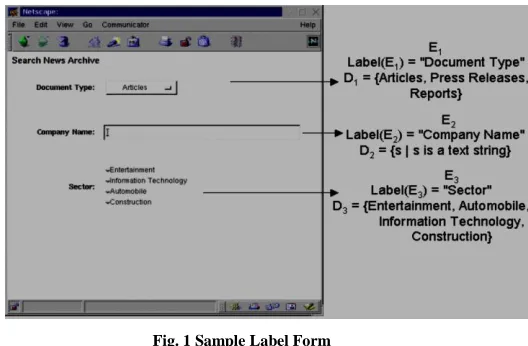
Fig. 1 Sample Label Form
In both cases, the crawler merely receives HTML pages that it can process in the same way that it processes static content. However, pages that use client-side execution to pull in content from the server, require special environments in which to execute the embedded code. Equipping a crawler with the necessary environment greatly complicates it‘s design and implementation. Since pages in the hidden Web are usually generated using the first two techniques, we do not address the third technique any further in this paper. Figure 1 summarizes the classification that we have presented in this section. The vertical axis lists the different generative mechanisms and the horizontal axis, the different types of content. Various portions of the Web have been represented as regions in this 2-dimensional grid.
IV. HIWE:HIDDEN WEB EXPOSE
The basic actions of a hidden Web crawler, such as HiWE, are similar to those of other traditional crawlers [5, 8]. Note that traditional crawlers do not distinguish between:
Pages which are password protected (e.g. online banks)
Pages which are only visible through forms (e.g.
guestbook)
Pages that update so fast that the crawlers never have the time to download them (e.g. online news papers).
Pages that are not linked from anywhere or provided as a seed URL.
International Journal of Emerging Technology and Advanced Engineering
Website: www.ijetae.com (ISSN 2250-2459,ISO 9001:2008 Certified Journal, Volume 3, Issue 1, January 2013)
[image:4.612.60.280.137.282.2]610
Fig. 2 HiWE ArchitectureSpecifically, HiWE performs the following sequence of actions for each form on a page:
A. Form Analysis
Parse and process the form to build an internal representation, based on the model
B. Value assignment and submission
Generate the best (untried) value assignment and submit a completed from using that assignment.
C. Response Analysis
Analyze the response page to check if the submission yielded valid search results or if there were no matches. This feedback could be used to tune the value assignments in step 2.
D. Response Navigation
If the response page contains hypertext links, these are followed immediately (except for links that have already been visited or added to the queue) and recursively, to some pre-specified depth. Note that we could as well have added the links in the response page to the URL queue. However, for ease of implementation, in HiWE, we chose to navigate the response pages immediately, and that too, only upto a depth of 11.
Steps 2, 3, and 4 are executed repeatedly, using different value assignments during each iteration.
V. HIWEARCHITECTURE
The complete architecture of the HiWE crawleris shown in Fig2. It includes six basic functional modules and two internal crawler data structures. The basic crawler data structure is the URL List. It contains all the URLs that the crawler has discovered so far. When starting up the crawler, the URL List is initialized to a seed set of URLs.
The Crawl Manager controls the entire crawling process. It decides which link to visit next, and makes the network connection to retrieve the page from the Web. The Crawl Manager hands the downloaded page over to the Parser module. In turn, the Parser extracts hypertext links from the page and adds them to the URL List structure. This sequence of operations is repeated until some termination condition is satisfied. To process forms and extract hidden content, HiWE employs four additional modules and the LVS Table. The Form Analyzer, Form Processor, and Response Analyzer modules, together implement the iterative sequence of steps. The LVS Manager is responsible for managing additions and accesses to the LVS table. It provides an interface for various application-specific data sources to supply new entries to the table.
VI. DESIGN ISSUES
A. Form Analysis
HiWE‘s representation of a form includes the following information: A list of all the elements (e.g., selection lists, text boxes) in the form, A label for each element., For every element with a finite domain, a list of all the values that constitute that domain_ Submission information (such as the submission method (GET or POST) and the submission URL) to be used when submitting completed forms.
To collect all this information, the Form Analyzer executes the sequence of steps shown in Figure 2. It begins by constructing a logical tree representation of the structure of the HTML page, based on the Document Object Model (DOM) specification [9]. Next, it uses the DOM API to obtain the list of form elements as well as the necessary submission information. We refer the reader to the DOM specification [9] for details on how this can9The Form Processor is responsible for the Response Navigation step.to be done. Then, the Form Analyzer uses the technique described in the remainder of this section to extract labels and domain values. Finally, it normalizes the extracted information and integrates it with the information from the DOM API to produce the internal form representation.
International Journal of Emerging Technology and Advanced Engineering
Website: www.ijetae.com (ISSN 2250-2459,ISO 9001:2008 Certified Journal, Volume 3, Issue 1, January 2013)
611
In this particular example, the layout is such that each label occurs in the first column and the actual form element widget appears in the second column of the table. However, for different forms, the nature and type of the layout markup will be different. In some cases, instead of tables, explicit spaces and line breaks may be used to control the alignment of labels and form widgets. As a result, the structural representation based on the DOM does not directly yield the labels and domain values. To address this problem, we adopted a partial page layout technique. The key to this technique is to realize that the only restriction on the relative locations of the labels, domain values, and form elements, is that when rendered by the browser, the relationships between these various entities must be obvious to the user. Similarly, the word ―Automobile‖ must be visually adjacent to the corresponding radiobutton widget. _ If there are still two candidates remaining, ties are broken in favor of the one rendered in bold or using a larger font size. If the tie is still not resolved, then one of the two candidates is picked at random.Note that to calculate visual adjacency, it is not necessary to completely layout the page. The location of the form with respect to the rest of the page is not relevant. Hence, we first prune the original page and isolate only those elements that directly influence the layout of the form elements and the labels. For instance, the tree-structured representation of two different pages, one in which the FORM is directly embedded in the main body and another in which it is embedded within a table. The pruned tree is constructed by using only the subtree below the FORM element and the nodes on the path from the FORM to the root. In addition, the layout need not be ‗perfect‘; in fact, our implementation uses a simple custom layout engine that discards images, ignores font sizes, uses a default font, ignores styling information such as bold or italics (except to break up ties as mentioned above), and ignores any associated style sheets. Our experiments in Section 6 indicate that visual adjacency is a very robust and effective strategy for extracting labels and domain values. Incidentally, in [8] we study and evaluate other techniques for matching labels to input elements.
B. Form Processing
There are two main issues in the design of the Form Processor module : choosing an algorithm for matching element labels with labels in the LVS table, and deciding whether or not a form must be processed.
1) Matching labels: Once a label is found in a form, we must obtain ―reasonable‖ values to fill-in the corresponding input element, so that we can submit a completed form. For example, if we find a label ―Enter State,‖ we want to search our LVS table for some domain whose name is ‗similar,‘ e.g., ―State.‖ Once we find a good domain in the LVS table, we can use the values associated with it (e.g., ―Arizona‖, ―California‖, etc.) to fill-in the element labeled ―Enter State.‖ To match form labels to labels in the LVS table, we employ an approximate string matching algorithm. There is a large body of work in the design and analysis of such string matching algorithms. Our choice was based on the ability of the algorithm to account for two things: typing errors and word reordering. Typing errors can be captured by the standard string matching notion of edit distance, which measures the minimum number of insertions, deletions, and character replacements required to transform one string to another (e.g., edit-distance(house, hose) = 1). However, word reordering requires a new distance measure so that two labels such as ―Company Type‖ and ―Type of Company‖ (these become ―company type‖ and ―type company‖ after normalization) are identified as being very ‗close‘ to each other. The block edit models proposed in [12], succinctly represent both typing errors and word reordering. These models define the concept of block edit distance; a generalization of the traditional notion of edit distances to handle block/word movements. We used one of a family of algorithms from [21] to implement our label matching system based on the block edit model.
C. Response Analysis
The aim of response analysis is to automatically distinguish between a response page13 that contains search results and one that contains an error message, reporting that no matches were found for the submitted query. The idea is to use this information to tune the crawler‘s value assignment strategy.
Response analysis turns out to be a very challenging problem, for a number of reasons:
The absence of a ‗standard‘ or commonly accepted format for reporting such errors means that each web site is free to use a custom error notification message (e.g., ―No matching results,‖ ―0 results found,‖ etc.).
International Journal of Emerging Technology and Advanced Engineering
Website: www.ijetae.com (ISSN 2250-2459,ISO 9001:2008 Certified Journal, Volume 3, Issue 1, January 2013)
612
Finally, many forms are often associated with
multiple types of error messages, with the web server choosing between them based on some pre-programmed logic.
To tackle these challenges, HiWE‘s response module uses a technique based on identifying the ‗significant portion‘ of the response page (i.e., the portion of the page obtained after discarding headers, footers, side bars, site maps,menus, etc.) To identify the significant portion, we use the heuristic that when the page is laid out, the significant portion will be visually in the middle of the page. Two cases arise:
If the response page is formatted using frames, we use information about the frame sizes to layout the page and identify the center-most frame. Then, we retrieve the center-most frame‘s contents, and treat that content as the significant portion of the response page. _ If the response page does not use frames, we use our custom layout engine to first identify the HTML element E that is visually laid out at the center of the page. Using the significant portion of the response page, HiWE uses two techniques to identify error pages. The first technique searches the significant portion of the page for occurrences of any one of a pre-defined list of error messages (e.g., ―No results‖, ―No matches‖, etc.). The second technique is based on hashing the contents of the significant portion. After each form submission, the response analysis module computes the hash of the significant portion and maintains a list of such hashes for each form. If a particular hash value occurs very often (i.e., more than a specified threshold), we assume that all future response pages which generate the same hash value are error pages. Initial experiments using these techniques indicates that the response analysis module is reasonably successful in distinguishing between pages with search results and pages with error messages.
1) Tuning value assignment: If the response analysis module indicates that an error page was received in response to a particular value assignment, the crawler attempts to isolate the particular form element(s) whose input(s) were incorrect and therefore led to the error.
D. Populating the LVS Table
The mechanisms for populating the LVS table:
1) Explicit Initialization: HiWE can be supplied with labels and associated value sets at startup time. These are loaded into the LVS table during crawler initialization. Explicit initialization is particularly useful to equip the crawler with values for the labels that the crawler is most likely to encounter. For example, when configuring HiWE for the ‗semiconductor news‘, we supplied HiWE with a list of relevant company names and associated that list with labels such as ―Company‖, ―Company Name‖, ―Organization‖, etc.
Built-in categories: It has built-in entries in the
LVS table for certain commonly used categories, such as dates, times, names of months, days of the week, etc., which are likely to be useful across applications.
Wrapped data sources: The LVS Manager can
communicate and receive entries for the LVS tableby querying various data sources through a well-defined interface. This interface includes two kinds of queries, one or both of which can be supported by a give data source:
2) Crawling experience: Form elements with finite domains are a useful source of (label,value) pairs. When processing a form, the crawler can glean such pairs from a finite domain element and add them to the LVS table, so that they may be used when visiting a different form.This is particularly useful if the same label is associated with a finite domain element in one form and with an infinite domain element in another. By using the above technique, the crawler was able to use values from the first set of forms to more effectively fill out the second set of forms.
Set of sites to crawl
Explicit initialization entries for the LVS table
Set of data sources, wrapped if necessary
Label matching threshold (_)
Maximum number of submissions per form
(Smax)
Minimum form size (_)
International Journal of Emerging Technology and Advanced Engineering
Website: www.ijetae.com (ISSN 2250-2459,ISO 9001:2008 Certified Journal, Volume 3, Issue 1, January 2013)
[image:7.612.57.283.150.373.2]613
VII. PROPOSED APPROACH FOR FILLING LVS TABLEFig 4.2 Proposed Architecture for Filling Of LVS Table
A. Search Engine
Search Engine is designed to search for information on the World Wide Web. The information may consist of web pages, images, information and other types of files.
B. Query Processor
Iit is used to process various queries fired by the user at different sites through various search engines.
C. Log merger
It is used to merge the queries at a single place.
D. Query log
It contains user queries and corresponding clicked URLs as well as other information about browsing activities.
E. Log analyzer
It analyzes the data stored in the log database.
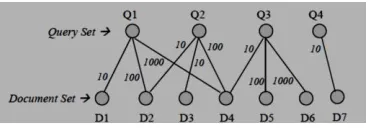
Suppose at a given website user issue some query, it might be that another user issues a similar query. Two queries are considered to be similar if they share or result in the selection of same or similar documents.
Fig 4.3 bipartite graph
10 users have clicked on D1 corresponding to Q1 Whenever a user issue any query the query is matched with the logs maintained for that particular site so as to check whether such queries has been issued earlier or not. If the query has been issued earlier then similarity value of the queries is calculated with those issued earlier, and if similarity value turns out to be above the threshold then these queries are clustered together. After that we make clusters but before making the clusters we have to check the similarity value
)
(
)
(
)
,
(
)
,
(
q
kw
p
kw
q
p
KW
q
p
Sim
keyword
Where kw(p) and kw(q) are the set of keywords in the queries p and q respectively kw(p,q) is the set of common keyword in two queries.If the similarity value turns out to be above the threshold value then the queries are grouped into the same cluster .each cluster is stored in the query cluster database along with associated queries ,query keywords and clicked urls
Next step is to find a set of favored/popular queries from each cluster for every query that belongs to cluster.
After that we will find the popular queries for those clusters. Then we will calculate the we will calculate the weight by checking the no. of IP addresses who have fired that query to the total no. of IP addresses in the that cluster and if the weight is above the threshold then we can say that the query is favored.
Calculate weight
cluster
in that
addresses
IP
of
no
Total
query
the
fired
which
addresses
IP
of
No.
Wt
If (wt > threshold value) then
Return true // means query is favored Else
Return false // query is not favored
[image:7.612.78.263.646.711.2]International Journal of Emerging Technology and Advanced Engineering
Website: www.ijetae.com (ISSN 2250-2459,ISO 9001:2008 Certified Journal, Volume 3, Issue 1, January 2013)
[image:8.612.64.276.136.316.2]614
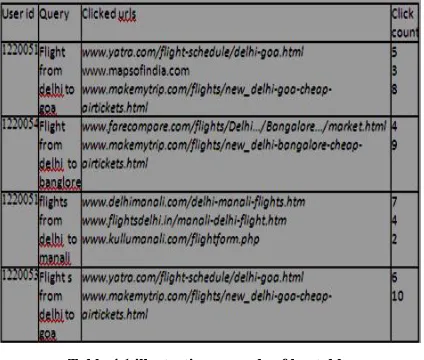
Table 4.1 illustrative example of log tableA user having user id 1220051 fired the query ‗flight from delhi to goa‘ and clicked on following urls www.yatra.com/flight-schedule/delhi-goa.html,
www.mapsofindia.com and
www.makemytrip.com/flights/new_delhi-goa-cheap-airtickets.html having the click counts 5,3,8. The same user have fired the query ‗flight from delhi to manali‘ clicked on
following urls
www.delhimanali.com/delhi-manali-flights.htm, www.flightsdelhi.in/manali-delhi-flight.htm and www.kullumanali.com/flightform.php have clicked counts 7,4,2. Another user having user id 1220054 when fired the query ‗flight from delhi to banglore‘ and clicked on
www.farecompare.com/flights/Delhi.../Bangalore.../market.
html and
www.makemytrip.com/flights/new_delhi-bangalore-cheap-airtickets.html having click counts 4,9 respectively. A different use having user id 1220053 have fired query ‗flights from delhi to goa‘ and clicked on www.yatra.com/flight-schedule/delhi-goa.html,
www.makemytrip.com/flights/new_delhi-goa-cheap-airtickets.html having click counts 6 and 10 respectively. If we calculate the similarity value for user id 1220051 and
1220054
) ytrip.com/ www.makem
/, ompare.com (www.farec
trip.com/) www.makemy
india.com, www.mapsof
.com/, (www.yatra
lights trip.com/f www.makemy
Sim
4
1
Sim
= 0.25
The similarity value for this below to threshold value(0.67) so we will not cluster it.
But if compare query from user id 1220051 and 1220053 and calculate its similarity value
trip.com/) www.makemy
, .com/ (www.yatra trip.com/)
www.makemy
, india.com www.mapsof
, .com/ (www.yatra
lights trip.com/f www.makemy
, com/ www.yatra.
Sim
3
2
Sim
= 0.667
Since this similarity value is above the threshold so the corresponding queries will be clustered .
Our next step will be calculating the weight so that we will found that query is favorable or not.
Formula for calculating the weight is as follows:
cluster in that addresses IP
of no Total
query the fired which addresses IP
of No.
Wt
3
2
Wt
International Journal of Emerging Technology and Advanced Engineering
Website: www.ijetae.com (ISSN 2250-2459,ISO 9001:2008 Certified Journal, Volume 3, Issue 1, January 2013)
615
The calculated value of weight is above the threshold value(0.58) so the query turns out to be favorable and will be used to fill the corresponding search interface.Typically the users need to take the following steps in order to access pages in a hidden web database.
Step1: First the users issue a query though a search interface provided by a website.
Step2: shortly after the user issue a query, the user is presented with a result index page that is website returns a list of links to potentially relevant web pages.
Step3: From the list in the result index page the user identifies the pages that look interesting and follow links.
VIII. CONCLUSION
From all the discussion it is clear that the existing techniques provide the framework that can download the hidden web content from hidden website for textual database through search interface. The mechanism proposed in this will work for multi-attribute queries and site often returns pages that contain values for each of the query attributes. In this we have used web logs for maintaining the details of the queries issued by the users. Any new query is compared with the once maintained in web logs and similarity value is calculated. Once the similarity value reaches the threshold the queries are groups into known clusters after that weight of the fired query is calculated. If the weight is found to be above the threshold value then the query is considered to be a favored query.
The proposed technique proves to be very useful for downloading the hidden web content using structural database.
IX. FUTURE WORK
In this dissertation the hidden website automatically segment the returned pages so that we can identify the sections of pages that present the values corresponding to each attribute. The future work for this includes:
1. In this paper we assumed that the crawler already knows all query interfaces for Hidden-Web sites. But how can the crawler discover the query interfaces?
2.
Some Hidden Web sites may contain an infinite number of Hidden Web pages which do not contribute much significant content. In this case the Hidden-Webcrawler sho
uld be able to detect that the site does not have much more new content and stop downloading pages from the site.REFERENCES
[1 ] Amazon.com web site. http://www.amazon.com.
[2 ] Active Server Pages Technology. http://msdn.microsoft.com/workshop/server/asp/aspfeat.asp. [3 ] BrightPlanet.com.http://www.brightplanet.com.
[4 ] The Deep Web: Surfacing Hidden Value. http://www.completeplanet.com/Tutorials/DeepWeb/.
[5 ] Soumen Chakrabarti, Martin van den Berg, and Byron Dom. Focused crawling: A new approach to topicspecific web resource discovery. In Proceedings of the Eighth International World-Wide Web Conference,1999.
[6 ] Junghoo Cho and Hector Garcia-Molina. The evolution of the web and implications for an incremental crawler. In Proceedings of the Twenty-sixth International Conference on Very Large Databases, 2000. Available at http://www-diglib.stanford.edu/cgi-bin/get/SIDL-WP-1999-0129.
[7 ] Junghoo Cho, Hector Garcia-Molina, and Lawrence Page. Efficient crawling through url ordering. In Proceedings of the Seventh International World-Wide Web Conference, 1998. Available at http://www-diglib.stanford.edu/cgi-bin/WP/get/SIDL-WP-1999-0103.
[8 ] Document Object Model Level 1 specification. http://www.w3.org/TR/REC-DOM-Level-1/.24