Stiffness Modulus Properties Of Hot Mix Asphalt Containing Waste
Engine Oil
Mohd Ezree Abdullah
1,a, Nurul Hidayah Mohd Kamaruddin
2,b, Basil David
Daniel
3,c, Norhidayah Abdul Hassan
4,d, Mohd Rosli Hainin
5,e, Saiful Azhar
Ahmad Tajudin
6,f, Rumaelviner Mapanggil
7,g1,2,3,6,7Faculty of Civil and Environmental Engineering, Universiti Tun Hussein Onn Malaysia
(UTHM), 86400 Parit Raja, Batu Pahat, Johor, Malaysia.
4,5Faculty of Civil Engineering, Universiti Teknologi Malaysia (UTM), 81310 Skudai, Johor,
Malaysia.
a[email protected], b[email protected],c[email protected], d[email protected], e
[email protected],[email protected], [email protected]
Keywords: Stiffness modulus; Waste Engine Oil; Modified mixture; Hot mix asphalt.
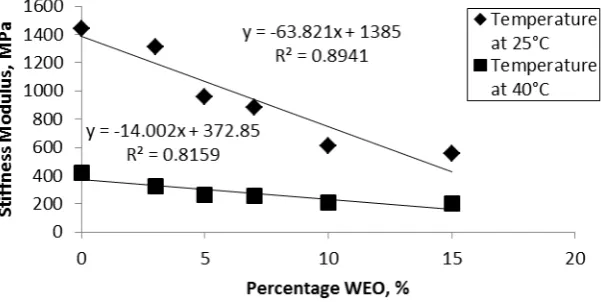
Abstract. This study presents the effect of waste engine oil (WEO) on the mechanical properties of hot mix asphalt mixtures containing waste lubricating WEO. It was added into mixture at 0%, 3%, 5%, 7%, 10% and 15% by weight of binder. The mechanical properties of the mixes were evaluated by conducting indirect tensile stiffness modulus (ITSM) at temperatures of 25°C and 40°C. The results indicated that modified mixes exhibited lower stiffness modulus with the increasing amount of WEO as well as testing temperature. The increasing amount of WEO was found to have a good linear correlation to the decreasing of stiffness modulus. The finding showed that the WEO has the significant role as a softening agent which affected the stiffness modulus even at low percentage.
Introduction
Nowadays, there are many vehicles used all over the world due to the economic growth and modernisation. It includes Malaysia as one of the developing countries. According to the motorcar registration statistics released by the Malaysian Road Transport Department, about 11 million motorcars were registered in Malaysia until 31st December 2013 [1]. After a specific time or mileage usage, the motorcars need to be serviced in order to ensure good conditions and performance. One of the compulsory changing is the engine oil. In a single motorcar oil change, about 4 to 5 litres of WEO can be produced. The improper disposal of this WEO can lead to water and soil pollution [2]. The effect can be seen by eutrophication process. The thin layer of oil appears on the surface of river or lake can block the sunlight, the photosynthesis and also disrupting the oxygen supply to the aquatic life [3-4]. These processes lead to the excessive growth of micro-organism, phytoplankton and algae that use the WEO as a food source. Lake or river quality was deteriorating and also disrupted the intrinsic equilibrium of the aquatic ecosystem.
also was reduced about 28% compared to the control mixtures (without waste engine WEO) at the temperature of 40°C. This is due to the lower viscosity offered by the waste engine WEO deteriorating the mastic bonding. Literature review has shown that limited investigation on the effects of WEO in hot mix asphalt. Hence, the aim of this paper was to investigate the effect of low range percentage of waste engine WEO to mechanical properties of the pavement mixture in terms of stiffness modulus.
Materials and Methods
The bitumen of penetration grade 80/100 supplied by Kemaman Bitumen Company was used as a base binder. The aggregate was obtained from Hanson Quarry Batu Pahat, Johor. Meanwhile, the WEO was collected from a workshop in Batu Pahat, Johor. In this experiment, the amount of used engine WEO were added at 0%, 3%, 5%, 7%, 10%, and 15% of the weight of bitumen. The waste engine WEO and bitumen were mixed using a high shear mixer at 600 RPM for 15 minutes in order to ensure WEO spread uniformly in the bitumen. Then, the modified binder was mixed with aggregate for further testing. The specimens were prepared at 4% air void using Superpave specification at 7% optimum bitumen content (OBC).
Indirect Tensile Stiffness Modulus (ITSM) Test
Stiffness modulus is an important mechanical characteristic of the road base and base-course layers. This test describes a material stiffness that most closely simulates the behavior of material under a moving wheel [14]. Basically, the term stiffness refers to stress divided by corressponding strain [15]. The stiffness can be easily measured by Indirect Tensile Stiffness Modulus Test (ITSM) by using Universal Testing Machine (UTM-5P). The test conducted was in accordance to ASTM D 4123, Standard Test Method for Indirect Tension Test for Stiffness Modulus of Bituminous Mixtures using Universal Testing Machine (UTM) which is a non-destructive test [16]. The test was conducted by applying five pulse loads with a suitable waveform. This repeated load generates movement (strain) along the vertical plane of cylindrical specimen. The load was applied for a period of 0.1 seconds and rest period (load is released) of 0.9 seconds. Therefore, the stiffness modulus, Sm can be determined using the equation below:
(1)
Where;
Sm = indirect tensile stiffness modulus (MPa), P = applied load (N),
v = Poisson’s ratio – 0.35 for temperature 25°C,
D = mean amplitude of horizontal deformation obtained from 5 applied of the load pulse (mm) and t = mean thickness of the test specimen.
Results and Discussions
Indirect Tensile Stiffness Modulus (ITSM) results
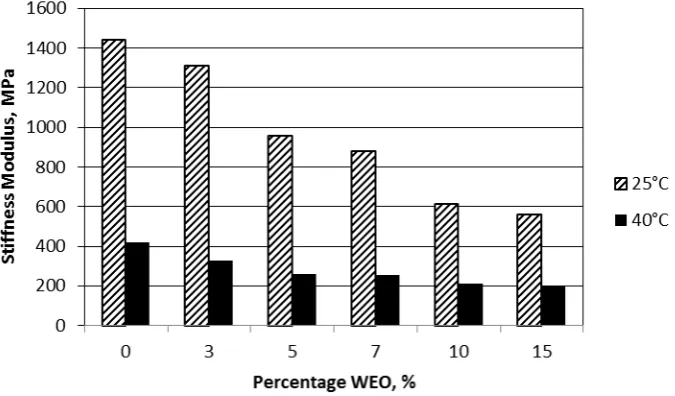
Figure 1 shows the ITSM results for temperature of 25°C and 40ºC. The results showed that the stiffness modulus apparently decreases with the increasing temperature as well as the WEO percentage. The modified mixture showed a decrease of stiffness modulus with mean value of 1310 MPa (3% WEO), 955 MPa (5% WEO), 880 MPa (7%WEO ), 611 MPa (10% WEO) and 559 MPa (15% WEO) as compared to control, 1442 MPa at the temperature of 25°C. Meanwhile, the graph of 40°C temperature showed that there has been a gradual decline of the stiffness modulus with a mean value of 421 MPa (0% WEO), 327 MPa (3% WEO), 261 MPa (5% WEO), 255 MPa (7% WEO), 213 MPa (10% WEO) and 200 MPa (15% WEO). This is due to the softening of the bituminous binder as the temperature and WEO percentage increased. These results are consistent with Borhan et al. [12] and suggested that higher WEO content caused the mixture to be unable to bond strongly with the aggregate. The WEO mainly functioned as softening agent to the asphalt binder which reduced the viscosity and increased the rutting susceptibility [9]. As a result, the strain is increased under applied load, and thus it will lower the stiffness modulus of the modified mixture [18].
Figure 1: Comparison of stiffness modulus of different percentages WEO at 25°C and 40°C
[image:3.595.138.476.387.585.2]Figure 2: Relationship of stiffness modulus and percentage WEO
Conclusions
In conclusion, WEO modification has weakened the performance of the mixture compared to the control mixture (0% WEO). The presence of the WEO has decreased the stiffness modulus of the mixture. The result of this study indicates that WEO has a significant role to soften the mixture and it suggests that the application of the WEO need to be restricted when blending directly with base bitumen. As the use of recycled asphalt pavement (RAP) is extensively explored, the WEO is advisedly used as rejuvenator to revive the aged binder. The presence of RAP which contributed the high stiffness in pavement mixture can be compensated by the addition of WEO.
Acknowledgements
The authors are grateful to the Ministry of Education Malaysia and Universiti Tun Hussein Onn Malaysia for the support in this project.
References
[1] Road Transport Department, “Total Motor Vehicles by Type and State, Malaysia, Until 31st December 2013,” [Online].Retrieved on 17 May 2014 from
http://www.mot.gov.my/my/Statistics/Land/2013 4 - SUKU IV 2013/Jadual 1.2.
[2] M. El-Fadel and R. Khoury, “Strategies for vehicle waste-oil management: a case study,” Resour. Conserv. Recycl., vol. 33, no. 2, pp. 75–91, Sep. 2001.
[3] M. El-Fadel and R. Khoury, “Strategies for vehicle waste-oil management: a case study,” Fuel Energy Abstr., vol. 43, no. 4, p. 296, Jul. 2002.
[4] B. S. Hamad, A. A. Rteil, and M. El-fadel, “Effect of used engine oil on properties of fresh and hardened concrete,” Constr. Build. Mater., vol. 17, pp. 311–318, 2003.
[5] X. Jia, B. Huang, B. F. Bowers, and S. Zhao, “Infrared spectra and rheological properties of asphalt cement containing waste engine oil residues,” Constr. Build. Mater., vol. 50, pp. 683–691, Jan. 2014.
[7] C. D. Dedene, J. Mills-Beale, and Y. Zhanping, “Properties of Recovered Asphalt Binder Blended with Waste Engine Oil: A Preliminary Study,” in 11th International Conference of Chinese Transportation Association, American Society of Civil Engineering, Beijing, China., 2011, pp. 4399–4406.
[8] R. Romera, A. Santamaría, J. J. Peña, M. E. Muñoz, M. Barral, E. García, and V. Jañez, “Rheological aspects of the rejuvenation of aged bitumen,” Rheol. Acta, vol. 45, no. 4, pp. 474–478, Mar. 2006.
[9] M.K. Nurul Hidayah, M. R. Hainin, N. A. Hassan, and M. E. Abdullah, “Rutting Evaluation of Aged Binder Containing Waste Engine Oil,” Adv. Mater. Res., vol. 911, pp. 405–409, 2014.
[10] M. Zaumanis, R. B. Mallick, and R. Frank, “Evaluation of different recycling agents for restoring aged asphalt binder and performance of 100 % recycled asphalt,” Mater. Struct., May 2014.
[11] J. Shen, S. Amirkhanian, and J. A. Miller, “Effects of Rejuvenating Agents on Superpave Mixtures Containing Reclaimed Asphalt Pavement,” J. Mater. Civ. Eng., vol. 19, no. 5, pp. 376–384, May 2007.
[12] M. N. Borhan, F. Suja, A. Ismail, and R. A. Rahmat, “Used Cylinder Oil Modified Cold-Mix Asphalt Concrete,” J. Appl. Sci., vol. 7, no. 22, pp. 3485–3491, 2007.
[13] M.K. Nurul Hidayah, M. R. Hainin, N. A. Hassan, and M. E. Abdullah, “A Short Review of Waste Oil Applicationin Pavement,” in International Conference on Geotechnical and Transportation Engineering and Constrcution and Building Engineering (GEOCON), 2013.
[14] Asphalt Institute, The Asphalt Handbook MS-4, 7th ed. The Asphalt Institute, Lexington, USA, 2007.
[15] E. R. Brown and T. W. K. Prithvi S. Kandhal, Freddy L. Roberts, Y. Richard Kim, Dah-Yinn Lee, Hot Mix Asphalt Materials, Mixture Design and Construction, Third Edit. NAPA Research and Education Foundation, 2009.
[16] D. Read, J. and Whiteoak, The Shell Bitumen Handbook, Fifth edit. Thomas Telford Publisher, 2003.
[17] M. E. Abdullah, “Performance of Warm Mix Asphalt (WMA) mixture using Nanoclay Modified Asphalt Binder,” PhD. Thesis, Universiti Tun Hussein Onn Malaysia (UTHM), 2014.