R E S E A R C H
Open Access
Rateless coding transmission over
multi-state dying erasure channel for SATCOM
Shushi Gu
1, Jian Jiao
1*, Qinyu Zhang
1and Xuemai Gu
2Abstract
Satellite communication (SATCOM) systems have attracted great attention from academic and industrial
communities in recent years, and huge amount of data delivery over satellite downlinks is considered as a promising service in emerging 5G networks, such as multimedia broadcasting. Nevertheless, due to intermittent connections from LEO or MEO satellite to earth station, and high dynamic channel conditions over downlinks, satellites may not be able to transmit the large data files to the ground station on time. In this paper, we propose a new rateless coding transmission for multi-state dying erasure channels (MDEC) with random channel life span and time-varying packet error rates, to improve the transmitting capability over SATCOM downlinks. Firstly, a heuristic approach for suboptimal degree distributions based on AND-OR tree technique is presented to achieve higher intermediate performance and lower symbol error rate of our proposed rateless codes. Furthermore, the appropriate code length of the connective window is derived and analyzed for enhanced average throughput on MDEC that is also optimized by maximum problem solving. Simulations have been conducted to evaluate the effectiveness of our rateless coding transmission for large file delivery on dynamic channel conditions. The results demonstrate that our proposed transmission scheme outperforms existing conventional rateless codes with significantly better intermediate performance and throughput performance over unreliable SATCOM downlinks, under time-varying packet error rates and unpredictable
occurrences of exhausted energy or cosmic ray attacks.
Keywords: Satellite communication, Multi-state dying erasure channel, Rateless codes, Degree distribution, Optimal code length
1 Introduction
Satellite communication (SATCOM) systems have attracted great attention from academic and industrial communities in recent years, which have been widely used for many military and civil services, e.g., weather forecast, environment monitoring, multimedia service, positioning system, and emergency rescue [1–4]. In com-parison to terrestrial communication, SATCOM systems have the advantages of larger bandwidth and wider cover-age, for providing the huge amount of data services in the emerging fifth generation (5G) networks, such as hybrid satellite-terrestrial communication systems [5, 6].
Nevertheless, satellite systems have significantly differ-ent link characteristics than terrestrial links [7]. Firstly,
*Correspondence: [email protected]
1Communication Engineering Research Center, Harbin Institute of
Technology-Shenzhen, The Xili University Town, Nanshan District, Shenzhen 518055, China
Full list of author information is available at the end of the article
since low earth orbit (LEO) or medium earth orbit (MEO) satellites (SA) fly along their own orbits and have very limited contact time with earth stations (ES), there is no sufficient contact time between SA and ES to download all data information [8]. Besides, the satellite downlink channel conditions are indeed time-varying due to atmo-spheric precipitation impacting high-frequency bands, so the time invariance assumption no longer holds [9]. Fur-thermore, the telecommunication systems on satellite may be subjected to serious effects, including the lack of bat-tery energy and the attack of solar winds or cosmic rays, so that the communication links between SAs and ESs would randomly break down unpredictably. The above sit-uations make great difficulties for the large amount of data transmitted back to the ground on the downlink chan-nels. Therefore, it is necessary to give a theoretical channel model to describe the extremely dynamic characteristics on SATCOM channel, as well as to design an efficient
and reliable transmission technique for large satellite data service downloading.
In [10], the authors firstly investigate a special type of channel with a finite and random channel length, termed dying channel. This type of channel may suddenly ter-minate due to communication links subjected to random fatal impacts, e.g., the sensor node may run out of power or be destroyed by fire attacks of military equipments in hostile environment, and the communication systems embedded in biological cells that may disappear unpre-dictably, due to excretion and digestion. It is critical to quantify how fast and reliably the information can be col-lected over this attacked channels with finite channel life span. Dying channels are modeled as the finite-state semi-Markov channels in [11]. It proves that lower Shannon limit which is very close to zero is almost reached on discrete memoryless channel that dies, so that arbitrarily small probability of error is not achievable. The authors optimize the sequences of finite block-length channel cod-ing, to maximize the transmission volume communicated at fixed maximum message error probabilities by dynamic programming. Furthermore, the notion of the channel death is similar to the outage over fading channels. The outage capacity and the outage probability over dying channels are both given and derived in [12]. It also gives the optimization over the frame length and the power allocation over the constituting data blocks to minimize the outage probability. In consequence, the literatures above have motivated us to model the time-varying down-link between SA and ES subjected to unknown random blockages as a special form of dying channel.
Meanwhile, rateless codes, e.g., LT codes [13] and Raptor codes [14], as well-known erasure coding approaches, have attracted considerable interest in the areas of computing and communications. Unlike other error-correcting codes, i.e., RS and LDPC codes, rateless codes do not need a predetermined code-rate and have on-the-fly encoding and decoding property. It means that the encoder could continuously generate encoded symbols, while the decoder could gradually recover the original data files in real time. Rateless codes also have the follow-ing properties. (1) They can totally recover the original message from any subset of the encoded symbols of the length slightly larger than the original message that also can be seen as the near-MDS codes. (2) They allow very efficient encoding and decoding complexities, even as the logarithmic or linear number of the input symbols. In recent years, rateless codes have been widely used in vehicular networks for data dissemination by their high speed broadcasting ability [15]. Besides, based on unequal error protection (UEP) property, rateless codes are also employed for multimedia streaming service in terrestrial networks, and the adaptive recovery of the layered mul-timedia progressively improves the quality of experience
(QoE) of the receivers [16]. Therefore, it can be con-firmed that the flexible adaptation and capacity-achieving make rateless codes natively appropriate for the large data bulk transmission on the satellite downlinks. There have been some studies about rateless codes used in SAT-COM systems for burst error resistance and DVB-S file delivery [17, 18].
For rateless codes over the dying channel, the topic of good intermediate performance of rateless codes would be widely studied. The author of [19] firstly investigated the intermediate performance of LT codes through deriv-ing the asymptotic error probability and provided a tight outer bound on the proportion of recoverable symbols. Building on the basis of [19] , the authors in [20] presented two new methods (degree distribution optimization and encoded symbol sorting) to maximize the intermediate symbol recovery rate of rateless coding. However, in their work, the different degree distributions were needed to match the different numbers of received encoded sym-bols, which may cause the transmitting system more complex. The investigation on rateless codes over dying channel was firstly presented in [21]. The authors opti-mized the degree distribution of LT codes for both partial and full recovery situations, aiming to match the stochas-tic channel life span. But their model failed to consider a constituting procedure of large file transmission over mul-tiple connections or mulmul-tiple channel states over the dying channels. The authors of [22] proposed a new rateless code, named the growth codes, to improve intermediate performance and to maximize video transmission quality over error resilient channels. The transmitter continu-ously adapts the degree of the encoded symbols to guar-antee that each received encoded packet has the highest instantaneous recoverable probability. The online foun-tain codes [23] is another class of rateless codes designed for higher intermediate performance. The lower redun-dancy overhead of online fountain codes is the most important improvement over the growth codes, and the feedback cost is roughly half that of growth codes. But the common drawback of growth codes and online codes is that feedback signal is required to inform the alterations of the decoding states in transmission process, in order to change an optimal encoding strategy at the transmit-ter, which may not be easily employed in some practical SATCOM networks.
by atmospheric precipitation for high-frequency carrier waves, with a semi-Markov chain following time changes. The objective of this work is to improve the through-put of the large bulk files delivering over this multi-state dying erasure channel, through proposing a rateless cod-ing transmission with appropriate degree distributions and code lengths for lower symbol error rate.
Our major contributions are summarized as three aspects: (i) we give the throughput expression of this multi-state dying erasure channel to describe intermittent and time-varying characteristic on SATCOM links, and also indicate the essential methods for rateless transmis-sion designing over this channel model; (ii) we propose the sub-optimal degree distributions by a heuristic approach based on And-OR tree technique to minimize the sym-bol error rate over MDEC; and (iii) we analyze and derive the appropriate code lengths to improve the intermediate performance and throughput by a maximizing problem solving.
The remainder of this paper is organized as follows. Section 2 introduces the multi-state dying erasure channel modeling, presents the rateless transmission, and gives the throughput analysis. Relying on this model and problem statement, Section 3 proposes a certain degree distribu-tion design method and optimizes the code length by solving a maximization problem. The simulation experi-ments and results are presented in Section 4, and Section 5 concludes the paper.
2 System model and performance analysis
2.1 Multi-state dying erasure channel
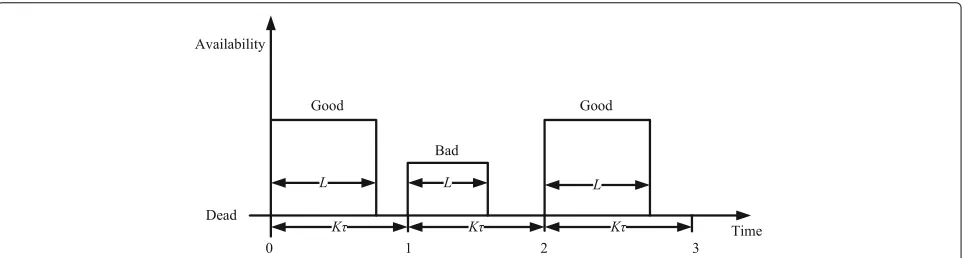
We present a new channel model termed in Fig. 1 for SATCOMs, named multi-state dying erasure channel (MDEC), which targets data packet transmission from SA to ES over the intermittent and time-varying binary erasure channel (BEC). Since LEO or MEO satellites move along their orbits periodically, MDEC channels have N (N = 1, 2, 3, ...) connective windows, which are used to opportunistic convey the data packets from SA to ES. The unit time of each packet isτ, and thus, the connection
time for one window is fixed to Kτ. In one connec-tive window, satellite link would be blockaded randomly, attributed to random events (energy exhausted or radi-ation damage) at unknown times. At this moment, we defined it as channeldead state, the connective window is unavailable for transmitting. The satellite must wait for recharging battery cells or restarting device, so the data transmission will break off unexpectedly until the next connection is established. We define the channel life span of MDEC asL, which follows an exponential distribution with mean1λor a non-negative Gaussian distribution with meanμand varianceσ2, i.e.,L∼E(λ)orL∼ |N(μ,σ2)|. These two random distributions are able to accurately model the channel death caused by device exhaustion or random attacks of cosmic radiation, respectively.
Beside channel dead state, MDEC has another two channel states, defined as good state and bad state. Because the atmospheric environment conditions (weather and solar wind) is changing with time in every window-connection, the erasure probability of MDEC is also time-varying due to different noise temperatures of the receiver. Especially, when the transmitter of the emerging LEO satellite uses Ka-band (26 and 32 GHz), enlarging the capabilities of downlinks, the higher fre-quency produces serious atmospheric fading due to rain scintillation, cloud and gaseous attenuations. Denotepas the erasure probability in one window, which is modeled by a two-state semi-Markov chain, i.e.,p=pGorpB. The states evolve with two transition probabilities, i.e.,λGand
λB. The transition matrixPof the semi-Markov process can be written follows:
P =
P(G|G) P(B|G) P(G|B) P(B|B)
=
1−λG λG
λB 1−λB
(1)
whereλG indicates the probability that the channel tran-sits from bad state to good state, whileλB indicates the probability that the channel transits from good state to bad state.
In summary, MDEC channel in Fig. 1 has three channel states, good, bad, and dead. Good and bad states (avail-able) mean the channel is available for data transmission, but the transmitter cannot know the accurate state is good or bad of every window and just knows the statistical era-sure probabilities of the two states and Markov transition matrix. The occurrence of dead state (unavailable) is also unknown by transmitter, and the duration of channel life span is random. MDEC model exhibits extremely quick dynamics, so SATCOM system cannot provide availabil-ity of reliable communications. Since limited contact time with ESs, satellite may not have sufficient contact time to download all its data to the ground.
2.2 Rateless coding transmission over MDEC
In order to resist the packets discarded and damaged, an appropriate transmission method is desired to improve the data reliability and efficiency over the MDEC with finite and random channel lifespan L and time-varying erasure probability p. It is important to note that auto-matic repeat-request (ARQ) is not suitable for MDEC. Since the connection time is limited, frequent retrans-missions of lost or erroneous packets waste many oppor-tunities of large data volume delivery from SA to ES. In addition, the feedback information is hard to inform channel state information (CSI) to the transmitter due to the dynamic channel conditions and the random channel death, which makes the advantages of ARQ mechanism degrade significantly.
Being able to adapt time-varying channel conditions, rateless codes have attracted a lot of interest as a promis-ing forward error correction (FEC) technique. We use rateless codes to generate original data into encoded pack-ets over MDEC, as illustrated in Fig. 2, in order to guar-antee the reliability and improve the efficiency. Generally speaking, packets after rateless encoded are referred to output symbols, while source packets are regard as input symbols. Rateless codes generate output symbols with a
specific degree distribution(x) = D
d=1
dxd, whereDis
the maximal degree anddis the probability thatdinput symbols are randomly selected to be XORed to generate an output symbol.
Firstly, denote by k as the code length, which is the number of input symbols to be sent in one connective window. Secondly, the number of output symbols actually transmitted by SA is denoted asl. Apparently,lis a ran-dom variable decided by the channel lifespanLand length of window K, i.e.,l = minK,Lτ. Once the channel switches to the dead state unpredictably, the transmitting flow of output symbols would break off at this moment, asl = Lτ. If the channel state sustains available in one connective window, the transmitting flow of output sym-bols can be continuous until the end of connection, as
l = K. Lastly, the number of output symbols successfully received by the ES (lafter erased with probabilityp) in one window is denoted as a random variablen, so the decoding overhead at the decoder is given byγ = nk. If the channel dies or connective window finishes, the receiver will start to decode the output symbols and recover the original data. The decoder may partially or fully recover the orig-inal data in one window, which means that intermediate performance of rateless codes is necessarily considered.
2.3 Throughput performance analysis
As we know, the rateless decoding performance depends largely on the decoding overheadγ as well as the degree distribution . Due to channel erased or death, the receiver may not be able to collect enough output symbols (i.e.,n ≤ k andγ < 1). We definez(γ,)as the inter-mediate performance of our coding scheme, conditioned on the givenγ and, which represents the ratio of the recovered input symbols at the receiver to all the input symbolsk. In MDEC model, the number of output sym-bols successfully received at the ES in every window, i.e., n, is randomly changing, due to the time-varying channel states transitions. Then, we define the average intermedi-ate performancezavgafter infinite number of windows can be expressed as
where Pr(n) is the probability ofn output symbols suc-cessfully received by the receiver in one window, and as
we know that K
n=1
Pr(n) = 1. Furthermore, we can also
express the probability that output symbols erased on MDEC, named as the output symbol error rate SERout. The detailed derivation about the relationship between Pr(n), SERout and channel parameters will be given in Section 3 of this paper.
In Eq. (2),zavg provides a reasonable measurement for the average input symbol recovery ratio over MDEC, con-ditioned upon two crucial parameters about the code length k and the encoding degree distribution . We define the input symbol decoding error rate at the receiver as SER, which can be easily expressed as SER = 1 − zavg(k,). Therefore, largerkmeans less redundancy, and
γ = n
Fig. 2Rateless coding transmission over MDEC. The rateless decoder may fully or partially recover the input symbols, according to the number of successfully received output symbols in one window
one of the objectives of our work is to find the most appro-priatekand(x)under certain channel conditions, in an effort to maximize the intermediate performancezavgand minimize input symbol error rateSERat the receiver.
Traditionally, if we letAidenote the amount of data that SA has actually conveyed to the ES in theith connective window, the average data throughput over N window-connective downlinks is defined as the data amount per unit time and can be computed as follows:
throughput 1 NKτ
N
i=1
Ai. (3)
In our works, for simplicity, we make the assumption that the data transmission between the SA and the ES uses the same packet size and same unit time. That is, the data size and transmission time are interchangeable. The amount of data received by the ES, i.e.,Aiin Eq. (3), can be represented as the total number of input symbols recov-ered. Since each window in the MDEC is i.i.d, the average and normalized throughput of our rateless coding trans-mission on MDEC system is defined as the ratio of the average number of input symbols recovered in one win-dow to the winwin-dow lengthK, basing on (2), which can be expressed as follows:
throughput=kzavg
K =
k
K(1−SER)= k K
K
n=1 z
n
k,
Pr(n).
(4)
As can be easily seen that, ifK is fixed, throughputin Eq. (4) improves by increasingk, which implies more input symbols can be transmitted. But as the above descrip-tion, largerkmakes lower intermediate performancezavg
and higher input symbol error rateSER, so the through-put reduces especially when the lifespanLis shorter or the channel erasure probabilityp is higher. In addition, zavgandSERare both closely decided byin the decod-ing process. Therefore, for our final objective in this work, we need to maximize the throughput in Eq. (4), maxi-mize the intermediate performance zavg in Eq. (2), and minimize the input symbol error rateSERusing the opti-mization method to tradeoff appropriate code lengths k and appropriate degree distributions (x), based on the time-varying and dying channel conditions of MDEC model.
3 Degree distribution design and code length
optimization
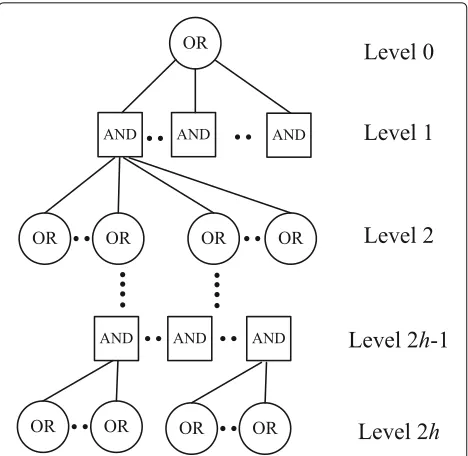
To analyze the potential performance of rateless codes, the AND-OR tree analysis technique [24] has been adopted in many literatures [20, 21, 25, 26]. Since we modified the AND-OR tree structure to analyze rateless coding over MDEC, a brief introduction of conventional AND-OR trees is as follows. An AND-AND-OR tree,Th, is a generated tree of depth 2has shown in Fig. 3. The root of this tree is at depth 0. Its children are at depth 1, and their children are at depth 2, and so on. All nodes at depth 0, 2, 4, ..., 2h-2 are labeled as OR nodes, and all nodes at depth 1, 3, 5, ..., 2h-1 are labeled as AND nodes. An OR node with no chil-dren is assumed to have a value of zero, and an AND node with no children is assumed to have a value of one. It is shown that iterative BP decoding of rateless codes can be mapped to the logical operations in the AND-OR tree. An OR node represents an input symbol in rateless codes, and an AND node stands for an output symbol. More details can be found in [24].
Fig. 3Example of conventional AND-OR trees. The OR nodes indicate input symbols, and the AND nodes indicate output symbols. The probability that the root node is evaluated as 0 afterhiterations indicates the symbol error rate in this rateless decoding process
of the finite-length rateless codes if the codes are sparse enough. Briefly, the asymptotic performance is given based on the standard approximation of the Binomial distribution(1/k,(1)k) by a Poisson input degree dis-tributionδ(x) = e(1)γ (x−1). Then, we defineyh as the asymptotic probability that one input symbol cannot be recovered after h iterations, equal to the input symbol error rateSER, is given by the iterative formula as follow
SER=yh=δ1−β(1−yh−1) (5)
whereβ(x) = ((x1)) andy0 = 1. Then, the input symbol error rate can be also derived based on decoding overhead γ and degree distribution(x)as
SER(γ,)=exp−γ (1−yh−1). (6)
The sequenceyhconverges with respect to the number of decoding iterations h. Consequently, as mentioned in Section 2, the average intermediate performancezavg is the proportion of input symbols recovered in one window, which can be expressed aszavg = 1−SER. We will give theSERperformances of our codes after degree distribu-tion and code-length optimized, compared to those of LT and Raptor codes in the following sections.
3.1 Linearly combined degree distributionLC
Based upon the above discussions, we attempt a sim-ple heuristic approach to design a sub-optimal degree distribution for rateless coding scheme in MDEC. We choose three classical degree distributions similarly to
the method in [19] and combine them to form a new degree distribution to improve the intermediate perfor-mancezwith an assumption of finite code lengthk. That is,(1)(x)=x,(2)(x)=x2, and the weak robust soliton distribution [14]:
(3)(x)=0.008x+0.494x2+0.166x3+0.072x4
+0.083x5+0.056x8+0.037x9+0.056x19
+0.025x64+0.003x66.
(7)
The first two degree distributions are chosen in consid-eration of the dead and bad states of MDEC, while the weak robust soliton distribution accounts for relatively general cases as well as the good state.
It is easy to see from [19] that ln 2 and 34ln 3 are two dividing points forγin the sense of the upper bound of the intermediate performances of the up bound. This obser-vation motivates us to linearly combine (1), (2), and
(3)to form a weighted degree distribution
LC(x)shown below:
LC(x)= 3
j=1
ωj(j)(x), (8)
where ω = [ω1,ω2,ω3] is the weighting vector. The weighting coefficients are taken as the probabilities cor-responding to the different decoding overhead intervals, i.e.,ω1 = Pr{0 ≤γ ≤ln 2},ω2 =Pr
ln 2≤γ ≤ 34ln 3, ω3=Pr
3
4ln 3≤γ
. Similar to Raptor codes, the encod-ing and decodencod-ing complexities with LC is also linear, since the average degree of the output symbols is a con-stant. We will give the simulated results of average degree in the following section. This characteristic is important for rateless codes used in satellite systems with lower com-putation complexity. Using the And-OR tree technique withyLC,0= 1, the asymptotic intermediate performance zLCusingLCcan be readily shown as
zLC(γ,LC)=1−exp
−γ LC(1−yLC,h−1)
. (9)
3.2 Optimization of the code lengthk
Our next step is to optimize the code lengthk with the linear combined degree distributionLC(x), so as to max-imize thethroughputin Eq. (4). The average intermediate performance of the linear combined degree distribution, i.e.,zLC(k,ω), can be expressed as a function ofkandω= [ω1,ω2,ω3] similarly to Eqs. (8) and (9). SinceKis fixed, maximizing throughput in Eq. (4) is equal to maximizing kzLC(k,ω), which can be transformed into the following independent. Because the weighting vectorωis defined as the probability distribution ofγ = nk in different decod-ing overhead intervals. That is, the choice ofkaffects the value of weighting vectorω. As a result,ω1,ω2, andω3can be transformed to functions ofk. Therefore, we attempt to transform the above maximum problem with multiple variables into a single variable optimization problem. We derive the relationship betweenωandkover the MDEC with an exponentially distributed channel life span, while the derivation with a non-negative Gaussian distributed channel life span is similar.
Firstly, in the simplest BEC channel, the probability of n output symbols successfully received at the decoder follows a binomial distribution, i.e.,
Pr1(n)=
where l is the number of output symbols transmitted. Then, assuming the channel state follows the two-state Markov chain with the transition matrix P in Eq. (1), the probability Pr2(n)thatnoutput symbols successfully received over Markov channels should be transformed based on Pr1(n), i.e.,
where the coefficientsqBandqGcan be expressed asqB=
λG
λG+λB andqG=
λB
λG+λB.
Secondly, the probability ofloutput symbols in one win-dow having been transmitted before death of the channel, i.e., Pr(l), can be derived as follows. If we assume that l symbols can be transmitted before the time instant of (l+1)τin one window, Pr(l)can be shown as of the exponential distribution of the channel life span L(t). So, the probability ofnoutput symbols successfully received by the ES, denoted as Pr(n), the same probability Pr(n)in Eq. (2), can be expressed as follows
Besides, similarly as above derivations, the probability ofnoutput symbols erased over MDEC in one connective window, defined as Prout(n), can be shown as
Therefore, the output symbol error rate SERout over MDEC in oneK-length window can be expressed based on Eqs. (13) and (15) as
It can be easily seen that the output symbol error rateSERout is only relevant to the channel conditions of MDEC, including erasure probabilitiespG andpB, tran-sition probabilitiesλG andλB, and channel lifespanL(t). Hence, SERout describes the dynamic switching of the MDEC states.
max
The initial value yLC,0 = 1. The intermediate per-formance zLC = 1 − yLC,h converges roughly with respect to a constant number of decoding iterations h (according to the following simulations, h = 40 is adequate for convergence). Because of the on-the-fly encoding and decoding property, the iteration time delay will not severely impact the throughput performance at the receiver. We can ignore the decoding delay in our analysis.
Furthermore, it is easy to see that the complexity of problem (18) isO(K2)with exhaustive search algorithm used, since the feasible set of the optimum solutionkoptis finite and integer. Due to the computing capability of SA and ES, the complexity ofO(K2)is reasonable for practi-cal SATCOM scenarios. Once the value ofkoptis attained, the linear combined degree distribution LC(x) can be obtained. The optimization results of the code length and degree distribution for various channel conditions will be stored in several databases. As similarly as above, this optimization method of kopt can also be applied in the situation where the channel lifespan follows a Gaussian distributionN(μ,σ2). Although this approach is heuris-tic, the numerical results in Section 4 show that it could achieve a significant performance improvement over the conventional rateless codes.
4 Simulation and discussion
4.1 Symbol error rate and intermediate performance of proposed degree distribution
We will evaluate the symbol error rateSERand the inter-mediate performancezLCof the linear combined degree distributionLC(x)obtained via the heuristic approach.
Firstly, without considering the erasure channel condi-tions, we give the simulation curves about the symbol error rate with respect to the decoding overhead at the receiver, as shown in Fig. 4. The code length is fixed to 2000, and the decoding overheadγ = nk is in the range of 0.7 to 1.3, so it includes full recovery and partial recov-ery situations. We use AND-OR tree analysis to describe the asymptotic decoding performance based on Eqs. (5) and (3), and use BP algorithm with Monte Carlo simula-tion time more than 5000 to describe the practical symbol error rates of the decoder. It can be found that the pro-posed degree distributionLChas much lowerSERthan
0.7 0.8 0.9 1 1.1 1.2 1.3
Symbol error rate
RSD asymptotic WRSD asymptotic ProposedΩLC asymptotic RSD practical WRSD practical ProposedΩLC practical
Fig. 4Symbol error rate of the proposed degree distributionLC(x). Symbol error rateSERof our proposed rateless codes with the linear mixed degree distributionLC(x), compared to other conventional degree distributions. Code lengthk=2000
those of RSD and WRSD in the situation that γ < 1 and the sameSERas that of WRSD in the situation that γ > 1. The reason is that the weighting coefficients of LC are properly designed corresponding to the differ-ent decoding overhead probability intervals. It proof that theSERofLCdoes not have the waterfall region at the point of decoding overhead slightly greater 1 as RSD and WRSD. This adapting property of LC is much suitable for the dynamic channel conditions and random channel lifespans.
15000 1650 1800 1950 2100 2250 2400 2550 2700 2850 Intermediate Performance Upper bound
RSD asymptotic
15000 1650 1800 1950 2100 2250 2400 2550 2700 2850 0.1 Intermediate Performance Upper bound
RSD asymptotic
1,5000 1650 1800 1950 2100 2250 2400 2550 2700 2850 0.1 Intermediate Performance Upper bound
RSD asymptotic
15000 1650 1800 1950 2100 2250 2400 2550 2700 2850 0.1 Intermediate Performance Upper bound
RSD asymptotic
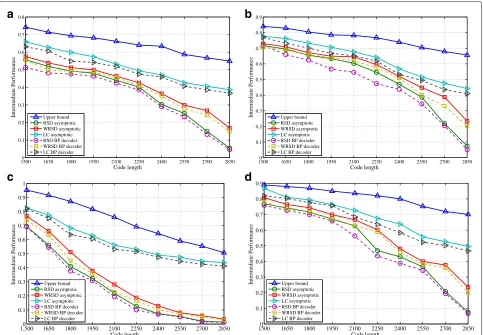
Fig. 5Intermediate performance forLC(x). Intermediate performance forLC(x)compared with RSD and WRSD when the channel lifespan follows exponential distributions and a non-negative Gaussian distributions. The subfigure titles area1/λ=3000;b1/λ=5000;cμ=2000 and σ =400;dμ=3000 andσ=1600
increases, the intermediate performance gains of the three degree distributions all diminish obviously. The reason is that largerkresults in smaller decoding overheadγ at the decoder, due to the fixed window lengthK. Particularly, the intermediate performance ofLC(x) is significantly better than RSD and WRSD, approximately higher 17 to 20%, but still has a gap with the upper bound, attributed to its sub-optimality and the unknown decoding overheads at the decoder for each connective window of satellite downlink.
4.2 Average throughput of proposed transmission scheme
Next, we compare the throughput of the proposed cod-ing scheme with that of the conventional rateless codes. MDEC lifespans with both exponential and non-negative Gaussian distributions are used to model the scenarios of energy exhaustion of the device and random attacks by radiation, respectively. We give three and four cases for the above two channel lifespan distributions with different means and variances.
As shown in Tables 1 and 2, the optimal code lengthkopt and degree distribution LC are attained through solv-ing the maximum problem (18). It shows that with an increasing mean, the optimal code length also increases, which explain the code redundancy decreases thanks to improved channel quality.LCunder 1λ = 3000 has the highest proportion of degree-one nodes (nearly 50%). The channel may randomly die when its length is close to the window length K. As for the case of 1λ = 10000, the channel lifespan is mostly greater than the window length K, indicating that channel death rarely occurs. As a result,LC has only a slight higher proportion of degree-one nodes than that of WRSD to recover as many
Table 1Optimal code lengthkoptand weighting vectorωover the MDEC with an exponentially distributed channel lifespan
Case 1/λ kopt ω=[ω1,ω2,ω3] davg
Table 2Optimal code lengthkoptand weighting vectorωover the MDEC with a non-negative Gaussian distributed channel lifespan
Case μ σ kopt ω=[ω1,ω2,ω3] davg
1 2000 400 2850 0.6241, 0.2584, 0.1176 2.24 2 3000 400 2150 0.0005, 0.0062, 0.9933 9.29 3 3000 1600 2100 0.1905, 0.0515, 0.758 7.37 4 5000 1600 2250 0.0207, 0.0114, 0.9679 9.08
input symbols as possible. Similar results can be acquired for the channel lifespan with a Gaussian distributions. In the case of μ = 2000 and σ = 400, most chan-nel lengths are less than K, so lower degrees nodes (degree-one or degree-two) inLCdominate greater than
90%. The code length in this case is also larger, indicating that the transmitter sends the majority of input symbols unco-ded to resist the severe channel conditions of MDEC. On the contrary, in the cases ofμ=3000,σ =400 andμ=5000, σ = 1600, the optimized results ofLC are similar to those of the weak robust soliton distribution. This implies that a small variance or a large mean of the channel lifes-pan makes the channel condition steady and that LC adaptively evolves into the classical degree distribution with the optimal code lengthkopt. Moreover, we also give the average degree davg of our optimized degree distri-butions in Tables 1 and 2 to show the linear encoding and decoding complexities. The davg can be calculated
by the equation thatdavg = D
d=1
dd of LC in Eq. (8)
Case 1 Case 2 Case 3
0 0.1 0.2 0.3 0.4 0.5 0.6 0.7 0.8
Throughput
Upper bound LT codes Raptor codes Proposed strategy
Case 1 Case 2 Case 3 Case 4
0 0.1 0.2 0.3 0.4 0.5 0.6 0.7 0.8 0.9
Throughput
Upper bound LT codes Raptor codes Proposed strategy
a
b
for different channel condition cases. It demonstrates that our proposed coding transmission is a practical technique for real-time delivery of large bulk data files in SATCOMs.
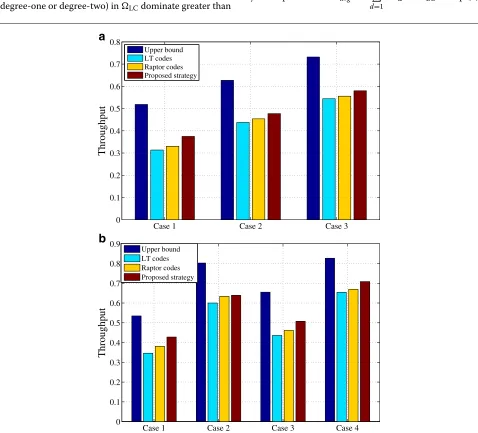
We give a SATCOM scenario that on a point-to-point MDEC between SA and ES with N = 2000 connec-tive windows, and an infinite amount of data files to be transmitted. Figure 6a, b uses the bar charts to illus-trate normalized throughput of the proposed rateless coding transmission under different cases of MDEC con-ditions in Tables 1 and 2, compared with the schemes of conventional LT and Raptor codes. For fair com-parison, the code lengths of the LT and Raptor codes used in our simulations are also optimized by the results of the same maximum problem (10). Simulation results are based on the Eqs. (2) and (4), which demonstrate that our proposed coding transmission achieve better throughput performances compared to LT codes [13] and Raptor codes [14] with the channel randomly ter-minated by unpredictable attacks. When the channel conditions are getting worse, the proposed scheme has more significant outperformance. It is noted that there exists a performance gap between the upper bound and the proposed transmission schemes. Because the throughput of the upper bound is reachable only under a unrealistic assumption that the transmitter can accu-rately estimate the channel life span of every connective window.
5 Conclusions
In this paper, we considered the problem that large data file transmission over the connective-window and dynamic downlinks in SATCOM systems. Due to atmo-spheric precipitation and other emergency situations, such as energy exhausted and cosmic ray attacks, the channel state dramatically changes and unpredictably breaks off. A type of multi-state dying erasure chan-nel model, named MDEC, is presented and charac-terized by a time-varying erasure probabilities and random channel lifespan. Moreover, a rateless cod-ing transmission method with proper degree distri-bution and optimal code length was proposed to improve the average throughput and reduce the sym-bol error rate over MDEC. We firstly used a heuristic approach to design a weighted degree distribution based upon the AND-OR tree analysis technique to increase the intermediate performance. In addition, we have given the optimal code lengths by numerical anal-yses and calculations, to solve a maximize problem of throughput under random channel death prob-ability distributions. We evaluated our transmission schemes by simulation based on different SATCOM channel conditions. The results demonstrated that our proposed rateless coding transmission attained
bet-ter inbet-termediate performance and throughput than LT and Raptor codes with different channel state transitions and random distributions of unpredictable attacks.
Acknowledgements
This work has been supported in part by the National Natural Sciences Foundation of China NSFC) under Grants 61525103, 61701136, 61771158, and 61371102, and Shenzhen Basic Research Program under Grants JCYJ 20160328163327348 and JCYJ 20150930150304185.
Competing interests
The authors declare that they have no competing interests.
Publisher’s Note
Springer Nature remains neutral with regard to jurisdictional claims in published maps and institutional affiliations.
Author details
1Communication Engineering Research Center, Harbin Institute of Technology-Shenzhen, The Xili University Town, Nanshan District, Shenzhen 518055, China.2School of Electronics and Information Engineering, Harbin Institute of Technology, 92 West Dazhi Street, Nan Gang District, Harbin 150001, China.
Received: 4 July 2017 Accepted: 15 October 2017
References
1. C Niephaus, M Kretschmer, G Ghinea, Qos provisioning in converged satellite and terrestrial networks: a survey of the state-of-the-art. IEEE Commun. Surv. Tutorials.18(4), 2415–2441 (2016)
2. K Yu, C Rizos, D Burrage, AG Dempster, K Zhang, M Markgraf, An overview of GNSS remote sensing. EURASIP J. Adv. Signal Process.2014(1), 134 (2014) 3. SK Chronopoulos, C Koliopanos, CT Angelis, inACM International
Conference on Mobile Multimedia Communications (MobiMedia 07). Satellite multibeam signaling for multimedia services, (Nafpaktos, 2007), pp. 1–4 4. SK Chronopoulos, C Koliopanos, A Pappa, CT Angelis,Simulation of a
Feasible Galileo System Operating in L1 and E5 Bands. (Springer, Berlin Heidelberg, 2010), pp. 35–43
5. M Jia, X Gu, Q Guo, W Xiang, N Zhang, Broadband hybrid
satellite-terrestrial communication systems based on cognitive radio toward 5g. IEEE Wireless Commun.23(6), 96–106 (2016)
6. G Araniti, I Bisio, MD Sanctis, A Orsino, J Cosmas, Multimedia content delivery for emerging 5g-satellite networks. IEEE Trans. Broadcast.62(1), 10–23 (2016)
7. M Jia, X Liu, X Gu, Q Guo, Joint cooperative spectrum sensing and channel selection optimization for satellite communication systems based on cognitive radio. Int. J. Satell. Commun. Netw.35(2), 139–150 (2017) 8. X Jia, T Lv, F He, H Huang, Collaborative data downloading by using
inter-satellite links in leo satellite networks. IEEE Trans. Wirel. Commun.
16(3), 1523–1532 (2017)
9. D Zhou, M Sheng, X Wang, C Xu, R Liu, J Li, Mission aware contact plan design in resource-limited small satellite networks. IEEE Trans. Commun.
65(6), 2451–2466 (2017)
10. M Zeng, R Zhang, S Cui, inIEEE Global Telecommunications Conference (GLOBECOM). On the outage capacity of a dying channel, (New Orleans, 2008), pp. 1–5
11. LR Varshney, SK Mitter, VK Goyal, An information-theoretic characterization of channels that die. IEEE Trans. Inf. Theory.58(9), 5711–5724 (2012)
12. M Zeng, R Zhang, S Cui, Outage capacity and optimal transmission for dying channels. IEEE Trans. Commun.61(1), 357–367 (2013)
13. M Luby, inIEEE Symposium on Foundations of Computer Science. LT codes, (Vancouver, 2002), pp. 271–280
14. A Shokrollahi, Raptor codes. IEEE Trans. Inf. Theory.52(6), 2551–2567 (2006) 15. MA Salkuyeh, F Hendessi, TA Gulliver, Data dissemination with rateless
coding in a grid vehicular topology. EURASIP J. Wireless Commun. Netw.
16. Z Chen, L Yin, M Xu, J Lu, Layered multimedia broadcast using rateless codes with progressive recovery over cooperative mimo. EURASIP J. Wireless Commun. Netw.2012(1), 327 (2012)
17. MA Blanco, NV Burkhardt, C Chen, inIEEE Military Communications Conference (MILCOM). Coding strategies for robust link blockage mitigation in satcom, (San Diego, 2013), pp. 611–616
18. P Cataldi, M Gerla, F Zampognaro, inIEEE International Conference on Advances in Satellite and Space Communications (SPACOMM). Rateless codes for file transfer over dvb-s, (Colmar, 2009), pp. 7–12 19. S Sanghavi, inIEEE Information Theory Workshop (ITW). Intermediate
performance of rateless codes, (Tahoe City, 2007), pp. 478–482 20. A Talari, N Rahnavard, On the intermediate symbol recovery rate of
rateless codes. IEEE Trans. Commun.60(5), 1237–1242 (2012) 21. M Zeng, R Calderbank, S Cui, On design of rateless codes over dying
binary erasure channel. IEEE Trans. Commun.60(4), 889–894 (2012) 22. N Thomos, R Pulikkoonattu, P Frossard, Growth codes: intermediate performance analysis and application to video. IEEE Trans. Commun.
61(11), 4710–4721 (2013)
23. Y Cassuto, A Shokrollahi, Online fountain codes with low overhead. IEEE Trans. Inf. Theory.61(6), 3137–3149 (2015)
24. MG Luby, M Mitzenmacher, MA Shokrollahi, inACM Proceedings of the Ninth Annual ACM-SIAM Symposium on Discrete Algorithms. Analysis of random processes via and-or tree evaluation, (San Francisco, 1998), pp. 364–373
25. SF Wang, Analytical multi-soliton solutions of a (2+1)-dimensional breaking soliton equation. Springerplus.5(1), 891 (2016)