Journal of Chemical and Pharmaceutical Research, 2014, 6(3):912-919
Research Article
CODEN(USA) : JCPRC5
ISSN : 0975-7384
Dynamical model based parallel movement centripetal force effects on
horizontal bar swinging technique
Jun LI
College of Physical Education, Hunan University of Technology, Zhuzhou, Hunan, China
_____________________________________________________________________________________________
ABSTRACT
With constantly developing of social scientific theory, present correlation theoretical researches are urgently in need of natural science, modern science and technology melting, in the hope of deeply solving relative problems. This paper targeted sports movement horizontal bar event, taking athletes’ downward swinging as examples, analyze athletes’ status, establish mathematical model, and implement discussion and researching on relative problems. According to body swaying technical features, multi rigid body model, then utilizes dynamics method, corresponding dynamic equation deducing human race swaying. Results show giants turn or grip change motion is more beneficial in 40°-50°or 310°-320°.
Key words: Dynamical model, parallel movement, centripetal force, horizontal bar swinging
_____________________________________________________________________________________________
INTRODUCTION
The origin of horizontal bar can be derived from human race ancestors primitive men went in for trainings in jungle such as each kind of climbing, ascending, swaying, and swinging and so on. At that time, it was just a kind of practical life skill; subsequently it gradually became a kind of physical training way with social progress. In 1896, horizontal ball was listed into Olympic Games competition events. Horizontal bar technical motions main features, except for knee mounting, kipping and hock arms circle as well as other swaying motions, it has also lots of exerting motions and static postures as well as stepping bar flyaway dismounting [1, 2]. During around half century times since entering into first decade in 20th century to the end of 1960s, the main features has eliminated exerting motions and static postures, all is composed of swaying motions that conform to horizontal bar movement features, and it makes progress in dismounting ways, turning, flight with grips releasing and other aspects. Until 1930s, individual technique has been further developed [3-5]. Such as Berlin held 11th Olympic Games in 1936, it appeared “el grip circle”, “swan astride vault”, “flyaway with 2 saltos tucked” and other complicated motions. After that, due to the Second World War, horizontal bar technique affected, the world competition hasn’t restored until 1950s. It is clear that modern times horizontal bar has moved forward three big steps that apparatus is changed from wood bar to iron bar; horizontal bar has been listed into world game events; It has made great progress in technique, appearing turning, flight with grip releasing, giants, double somersault and other relative complicated motions. The above 3 steps have built film foundation for modern horizontal bar movement development [6-8].
______________________________________________________________________________
SWINGING TECHNIQUE DYNAMICS MODEL ESTABLISHMENT Horizontal bar swinging technique biomechanical analysis
When athlete rotates in horizontal bar axis, except for human body internal force friction behavior working, human body gravity torque also works. According to rotation law formula (1).
J
M
=
α
(1)
From which,
M
is gravity torque on horizontal bar,J
is human body rotational inertia to bar axis,α
is corresponding angular accelerated speed. When considering movement changes that generated by gravity torque, only take both gravity torque and rotational inertia into consideration, then it can get correct conclusions.First research on a athlete gravity torque generated angular accelerated speed under two postures. Given an athlete weight 58kg, height 1.73m, body each part proportion can be achieved from the athlete motion pictures. The first posture, athlete shoulder angle , hip angle both are 180゚, that is ideal “ body fully stretching” state. Let athlete body each segment gravity center all in the horizontal bar same horizontal plane. The second posture, athlete body slight bends, both shoulder angle and hip angle are170°; To compare, let athlete gravity center also in the horizontal bar same horizontal plane. Compare athlete gravity torque generated angular accelerated values under the first posture and the second postures. The differences between the two postures are just that shoulder and hip angles are different [9].
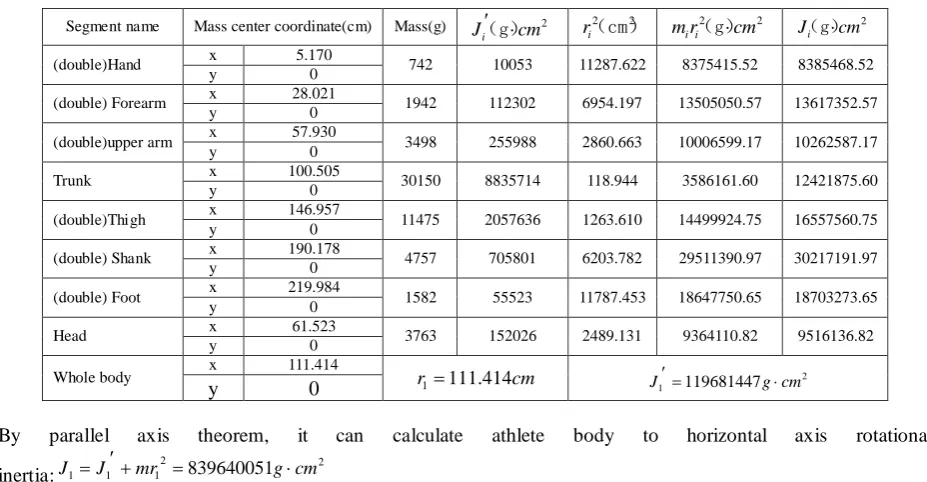
[image:2.595.73.537.380.621.2](1) Posture one: In order to calculate human body rotational inertia and gravity center position, we adopt provided data, below are each posture human body rotational inertia calculation program and corresponding data Table 1:
Table 1: Both shoulder angle and hip angle are 180°data
Segment name Mass center coordinate(cm) Mass(g) 2 i
J(′ ⋅g)cm 2 2 i
r(cm) m ri i(2 g)⋅cm2 2 i J(g)⋅cm
(double)Hand x 5.170 742 10053 11287.622 8375415.52 8385468.52
y 0
(double) Forearm x 28.021 1942 112302 6954.197 13505050.57 13617352.57
y 0
(double)upper arm x 57.930 3498 255988 2860.663 10006599.17 10262587.17
y 0
Trunk x 100.505 30150 8835714 118.944 3586161.60 12421875.60
y 0
(double)Thigh x 146.957 11475 2057636 1263.610 14499924.75 16557560.75
y 0
(double) Shank x 190.178 4757 705801 6203.782 29511390.97 30217191.97
y 0
(double) Foot x 219.984 1582 55523 11787.453 18647750.65 18703273.65
y 0
Head x 61.523 3763 152026 2489.131 9364110.82 9516136.82
y 0
Whole body x 111.414 r1=111.414cm 2
1 119681447g cm
J′= ⋅
y 0
By parallel axis theorem, it can calculate athlete body to horizontal axis rotational
inertia: 2
2 1 1
1 J mr 839640051g cm
J = ′+ = ⋅
Gravity to horizontal bar axis torque:M1=mg⋅r1=6332771760N⋅cm
Gravity torque let human body generated surrounding horizontal bar angular accelerated speed
is:
2 1
1
1 7.542rad/s J
M
= =
α
(2) Posture two: When athlete shoulder angle, hip angle both are 170゚, use the same method solving athlete body
correspond to mass center rotational inertia: J2 =121497735g⋅cm2
Athlete body mass center and horizontal bar axis distance:r2 =110.974cm
Athlete body to horizontal bar axis rotational inertia: 2
2 2 2
2 J mr 835780998g cm
J = ′+ = ⋅
Gravity to horizontal bar torque: M2=mg⋅r2=6307762160N⋅cm
Gravity torque let human body generated surrounding horizontal bar angular accelerated speed is:
2 2
2
2 7.547rad/s
J M = = α
,
1 00066 . 1 542 . 7
547 . 7
1
2 = = >
α α
That is when athlete both shoulder angle and hip angle are 170゚ the gravity torque generated accelerated speed values are larger than that on the condition shoulder angle and hip angle are 180°.
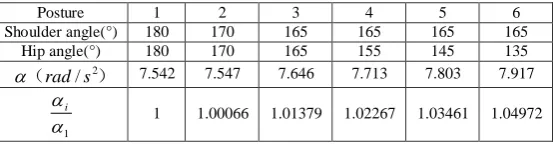
[image:3.595.169.446.350.423.2]Results show, picked posture and stretched posture comparing, gravity torque generated horizontal bar accelerate speed are larger. To further test when horizontal bar downward swinging to bar horizontal plane, body keep certain picked posture and stretched posture, gravity torque generated angular accelerated speed to horizontal bar axis such problem; we make calculations on four cases that athlete shoulder keep 165゚ when horizontal bar downward swinging to horizontal plane, and hip angles are respectively 165゚,155゚, 145゚,135゚, calculation results refer to Table 2.
Table 2: Downward swinging to bar horizontal part each posture comparison
Posture 1 2 3 4 5 6
Shoulder angle(°) 180 170 165 165 165 165 Hip angle(°) 180 170 165 155 145 135
)
( 2
/s rad
α 7.542 7.547 7.646 7.713 7.803 7.917
1
α αi
1 1.00066 1.01379 1.02267 1.03461 1.04972
Results show:
1) When athlete is in horizontal bar downward swinging horizontal plane, picked posture comparing with stretched posture, its gravity torque generated angular accelerated speed to horizontal bar axis is larger;
2) On the condition that shoulder angle is fixed, the smaller hip angle is, its gravity torque generated angular accelerated speed to horizontal bar axis would become bigger.
Giant circle force analysis model
The above model considers angular accelerated speed decisive two factors( that are gravity torque and rotational inertia), when athlete body lies in horizontal bar downward swinging horizontal plane, picked posture comparing with stretched posture, its gravity torque generated angular accelerated speed to horizontal bar axis is larger, which indicates postures have great impact on horizontal bar motion completion quality. By model two, make further analyze each phase pull force changes with giant circle as an example, so that finds out reasonable scheme.
Giant circle can approximate to people make circular movements in vertical plane, connection line from gripping point to mass center is rotational radius(
r
), when athlete lies in handstand position, gravity(mg
) and pull force(F
) both turn downwards, therefore their joint force is athlete centripetal force in handstand position. That is formula (2)r
v
m
mg
F
2
=
+
(2)
From formula (2), it is clear that centripetal force is larger than gravity, tension is in the front, athlete should pull upwards; when centripetal force is smaller than gravity, pull force is negative, athlete should have a downward push force so that can meet circular movement conditions; when centripetal force is the same as gravity, pull force is zero, athlete neither needs to use pull force nor push force, he can still make circular movements.
______________________________________________________________________________
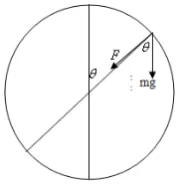
[image:4.595.261.351.134.228.2]speed quadratic. Generally, when athlete makes giant circle motion and arrives at handstand position, speed is relative smaller, so that athlete should act on a downward push force in handstand position; only when making high difficulty dismounting and flight motions, speed is relative larger when giant circle going through handstand position, horizontal bar will provide a downward pull force as Figure 1.
Figure 1: Random time people force schematic diagram
When athlete swings from handstand position to bar underneath vertical position, horizontal bar gives athlete pull force turn upwards, while gravity turn downwards so centripetal force is the gap between the two forces. That is formula (3):
r
v
m
mg
F
2
=
−
(3)
From formula (3), it is clear that pull force is the sum of centripetal force and gravity, due to bar underneath vertical position speed is larger, and pull force is also larger. According to mechanical conservation that giant circle optional position starts from handstand position speed computational formula (4):
2 0 1
2
gr
(
1
cos
)
v
v
=
−
θ
+
(4)
Among them,
v
1 is optional position speed,g
is gravity accelerated speed,r
is rotational radius,θ
isoptional position angle,
cos
θ
is cosine,v
0 is handstand position initial speed.According to giant circle dynamic features, athlete in the whole giant circle process, optional position (angle) force sizes computational formula (5) as following:
θ
cos
2mg
r
v
m
F
=
−
(5)
From which horizontal component force is Fx =Fsinθ, vertical component force is Fy =Fcosθ.
By people handstand moment speeds are respectively
0
m
/
s
,1
m
/
s
, and rotational radius are respectively0
.
8
m
,1
m
calculating each position force and mass ratio(g=9.8). Calculation results are as Table 3.When athlete completing horizontal bar giant circle, his suffered pull force sizes is related to giant circle speed; With speed increasing , pull force would become large; according to calculation data, athlete in handstand position forward and backward 40゚, due to speed is quite small, it needs a upward push force , therefore when athletes swings downward from handstand, it should have a shoulder withstanding motion, it not only can stretch radius increase force arm, enlarge torque ,but also can let athlete continue to make circular movement.
Table 3: Different conditions each position force
θ
F(mg0,0.8)mg F(0,1)
mg F(1,0.8)
mg F(1,1)
0 -1.000 -1.000 -0.872 -0.898 10 -0.954 -0.954 -0.826 -0.852 20 -0.819 -0.819 -0.691 -0.717 30 -0.598 -0.598 -0.470 -0.496 40 -0.298 -0.298 -0.170 -0.196 50 0.072 0.072 0.200 0.174 60 0.500 0.500 0.628 0.602 70 0.974 0.974 1.102 1.076 80 1.479 1.479 1.607 1.581 90 2.000 2.000 2.128 2.102 100 2.521 2.521 2.649 2.623 110 3.026 3.026 3.154 3.128 120 3.500 3.500 3.628 3.602 130 3.928 3.928 4.056 4.030 140 4.298 4.298 4.426 4.400 150 4.598 4.598 4.726 4.700 160 4.819 4.819 4.947 4.921 170 4.954 4.954 5.082 5.056 180 5.000 5.000 5.128 5.102 190 4.954 4.954 5.082 5.056 200 4.819 4.819 4.947 4.921 210 4.598 4.598 4.726 4.700 220 4.298 4.298 4.426 4.400 230 3.928 3.928 4.056 4.030 240 3.500 3.500 3.628 3.602 250 3.026 3.026 3.154 3.128 260 2.521 2.521 2.649 2.623 270 2.000 2.000 2.128 2.102 280 1.479 1.479 1.607 1.581 290 0.974 0.974 1.102 1.076 300 0.500 0.500 0.628 0.602 310 0.072 0.072 0.200 0.174 320 -0.298 -0.298 -0.170 -0.196 330 -0.598 -0.598 -0.470 -0.496 340 -0.819 -0.819 -0.691 -0.717 350 -0.954 -0.954 -0.826 -0.852 360 -1.000 -1.000 -0.872 -0.898
Figure 2: Each position people force changes when handstand initial speed is 0m/s
Figure 3: Each position people force changes when handstand initial speed is 1m/s
______________________________________________________________________________
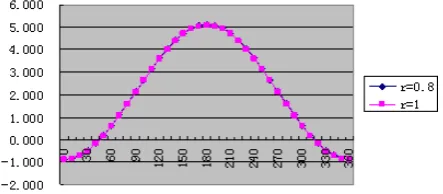
comparison, it is clear that on the condition handstand position has initial speed, rotational radius changing not only will change speed, but also force has changes, radius becomes smaller, then push force gets smaller and pull force gets bigger, therefore when completing short radius circle (such as stalder, endo), it should tightly fold body, trying to enlarge rotational radius, which can enlarge torque and also can save labor.
[image:6.595.171.447.204.306.2]From Figure 4, Figure 5, it is clear that in comparison of athlete has initial speed and hasn’t initial speed in handstand position, athlete with initial speed ,its push force is smaller than that from athlete without initial speed, and pull force is larger. Therefore, when completing pure one-arm giant circle, initial speed through handstand position should try to make smaller, the opportunity with one hand putting should be as later as possible in technique permissible range, so that can decrease one-arm pull force under the bar.
[image:6.595.171.451.342.443.2]Figure 4: Each position force change when rotational radius is 0.8m
Figure 5: Each position force change when rotational radius is 1m
Sports five links multi-rigid-body system model
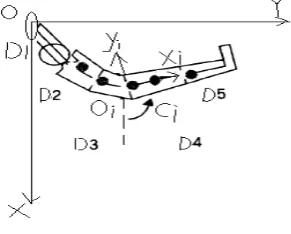
Considering human body horizontal bar swinging sports features, especially in technique concentrated practical movement, avoiding artificial research that let clock pendulum which makes double pendulum during swinging or simplifying handling with horizontal bar. The research focuses on link and uses it classifying trunk part, as Figure 6 shows, human body simplified into 5 links multi-rigid-body system model, from which, D1,D2, D3,D4 and D5 respectively represent arms( including hands), upper trunk( including head, neck, trunk), thigh( including foot), each link is defined according to concrete statuses human body measurement parameters from measuring or body system model.
Figure 6: Model and coordinate system
Coordinate system as well as general coordinates’ selection, as Figure 6 shows, it defines horizontal bar human body swinging motion as planar movement. Establish solidified horizontal bar O point inertia coordinate system OXY and
[image:6.595.230.376.574.691.2]segment link joint,
x
i axis is link joint pointing to segment mass connection line) .Select each segmentcorresponding to X axis positive direction absolute angle
θ
i and define it as general coordinate.Coordinate transform matrix, according to Figure 6, after establishing coordinate system, then
o
ix
iy
i coordinatesystem corresponding to inertia coordinate system
oxy
coordinate transform matrixA
io as following formula (6):
−
=
1
0
0
0
cos
sin
0
sin
cos
i i i i ioA
θ
θ
θ
θ
i=1,2,3,4,5 (6)
Model qualitative analysis: Speed analysis: from general coordinate definition, it is clear that segment angular
speed
ω
iinOXY
can be expressed as formula (7):( )
= θ ω 0 0 i(i=1,2,3,4,5) (7)
Given segment mass center to be
C
i, then segment mass centerC
i speedV
ci in OXY is expressed as formula(8): + =
∑
− = 0 0 0 0 ) ( 1 1 j j T io j j i j T joli A I A r
V
θ
θ
(i,j=1,2,3,4,) (8)
(Among them,
l
i is thei
segment length (that is two link joints distance) ,r
i is thei
segment mass centeri
C
to the
i
−
1
segment link joint distance. )Accelerated speed analysis: make derivation of segment angular speed
ω
i and segment mass speedV
ci, then itget segment angular accelerated speed
ξ
i and segment mass center accelerated speed∂
ci as following formula(9)(10): = = i i i dt d θ ω ξ 0 0 ) ( ) (
(i=1,2,3,4,5) (9)
+ = = ∂
∑
− = 0 0 0 0 ) ( ) ( 1 1 i i T io i j j j T jo cici V A I A r
dt
d
θ
θ
(i,j=1,2,3,4,5) (10)
General active force: in horizontal bar human swinging motions, each active force, and torque as Figure 7 shows.
(From which,
M
i and'
i
M
appear in pairs, is torque acting on each segment.) Regarding system general active force, it has computation formula as following (11):
∑
∑
= = + = • + • = n j j T r j j T r j n j r j j r j jr R V L V R L
F 1 ) ( ) ( 1 ) ( ) ( )
( (
ω
) (( ) ( ) (ω
) ( ))______________________________________________________________________________
Among them, n is number of rigid body, n=1,2,3,4,5;r is freedom degree, r=1,2,3,4,5;
R
j is principal vector actingon segment active force system;
L
j is principal active force system corresponding joint principal moment.Figure 7: Horizontal bar human body swinging motion each principal active force and torque
General inertia force: with regard to rigid body system general inertia force
F
(r), it has following computational formula(12):∑
=
⋅ + ⋅ = n
j
r j j r j j r
L V R F
1
) ( * ) ( * )
(
* (
ω
)(12)
Among them,Rj =−mj∂cj *
,
* j R
is segment inertial force system principal vector;
Establish system dynamics equations (13):
=
=
+
⋅
r r
r r
u
F
F
θ
0
) *( ) (r=1,2,3,4,5 (13)
CONCLUSION
In horizontal bar swinging technique to human dynamics analysis model establishment, optimize and computer numerical simulation. Though giant circle is a basic motion, it is the technical basis to complete each kind of high difficulty motion, by dynamics analysis; it can make further understanding on circle technique and its relative motion. Circle motion is in handstand position forward and backward 40°, most of them should have a downward push force , only speed up circle can be possible to appear upward pull force. Under bar, the vertical position force is larger, calculation values are 5 times than weight. Actually it is nearly 4 times of weight. But when making high difficulty dismounting and flight motions, it should go beyond 5 times of weight. Giant circle turning or grip changing motion is more beneficial in 40°-50°or 310°-320°.In case handstand initial speed is zero, radius changes would not effect on force size, while in case initial speed is not Zero, radius changes and force would also change.
REFERENCES
[1] QIAN Jing-guang; MENG Zhao-li,TANG Xiao. Joournal of Nanjing Institute of Physical Education:Natural Science,2007,6(3),1-5,18.
[2] LI Fa-lin. Joournal of Nanjing Institute of Physical Education:Natural Science, 2012,11(1),78-82. [3] Zhang Zhengmei; Liu Tie; Shen Gaolu. Journal of Shanxi University (Natural Science Edition), 1998, (2). [4] LIU Chang-ting; TONG Zhao-gang. Joournal of Nanjing Institute of Physical Education:Natural Science, 2011, 10(1), 40-43.
[5]XIE Xu-dong. Journal of Shenyang Normal University: Nat Sci Ed, 2007, 25(3),397-400. [6]ZHU Chang-yi. Journal of Chengdu Physical Education Institute, 2000, 26(6),71-74. [7]WEI Juan-li. Journal of Xi'an Institute of Physical Education, 2006, 23(5), 102-105.